http://dx.doi.org/10.7585/kjps.2012.16.4.308 Open Access
308
유통 친환경 과실류와 과채류 중 농약잔류 실태조사 및 안전성 평가
이재윤·노현호·박소현·이광헌1·박효경2·홍수명3·김두호3·경기성*
충북대학교 농업생명환경대학 환경생명화학과, 1(주)동방아그로 기술연구소,
2호서대학교 안전성평가센터, 3국립농업과학원 농산물안전성부
(Received on October 26, 2012. Revised on November 8, 2012. Accepted on November 28, 2012)
Monitoring and Risk Assessment of Pesticide Residues in Commercial Environment Friendly Fruits and Fruiting Vegetables
Jae Yun Lee, Hyun Ho Noh, So Hyun Park, Kwang Hun Lee1, Hyo Kyoung Park2, Su Myeong Hong3, Doo Ho Kim3 and Kee Sung Kyung*
Department of Environmental and Biological Chemistry, College of Agriculture, Life and Environmental Sciences, Chungbuk National University, Cheongju 361-763, Korea
1Dong Bang Agro Corp., Residue Technical Research Institute, Buyeo 323-930, Korea
2Environmental Toxicology Division, Toxicological Research Center, Hoseo University, Asan 336-795, Korea
3Department of Agro-Food Safety, National Academy of Agricultural Science, Rural Development Administration, Suwon 441-707, Korea
Abstract In order to monitor the residual pesticides in environment friendly agricultural commodities, fruits and fruiting vegetables. Twenty-five agricultural commodities were collected twice in May and August 2011 from nine environment friendly agricultural commodities-selling supermarkets and retail stores located in eight major cities in Korea. The number of each agricultural commodity collected, 555 samples in total, was 152 organic agricultural products, 202 pesticide-free agricultural products and 201 low-pesticide agricultural products. Pesticide residues in samples were analyzed by multiresidue method for 245 pesticides using a GC- ECD/NPD and an HPLC-DAD/FLD and the peaks suspected as pesticides were identified with a GC/MSD.
As a result of pesticide residue analysis, three pesticides, bifenthrin, EPN and chlorpyrifos, were detected from four samples including apple, representing a detection rate of 0.72%. The residue levels of the four pesticide-detected samples were less than their maximum residue limits (MRLs) but one pesticide EPN detected from pear exceeded its legible criterion of one twentieth MRL. Estimated daily intakes of the pesticides detected from fruits and fruiting vegetables were less than 0.76% of their maximum permissible intake.
Key words Environment friendly agricultural product, Monitoring, Residual pesticide, Maximum permissible intake
서 론
식량은 과거와 현재를 막론하고 인류 역사상 가장 중요한 에너지원의 하나로 인구가 증가함에 따라 식량의 요구량이 점차 늘어나게 되었고 현재는 식량의 무기화, 식량안보 등
으로 이어지고 있다(NAQS, 2012). 식량의 중요성이 증대되 면서 사용된 농약은 각종 병해충 및 잡초로부터 작물을 보 호하여 작물의 생산성을 향상시킴과 동시에 병해충 및 잡초 의 방제시간을 단축하여 이에 요구되는 노동력 감소 등의 효과를 가져왔다. 이처럼 농약은 현대의 식량안보 위기 속 에서 필수적이고, 지속적인 생산성 향상을 위하여 사용이 불가피한 실정이다(RDA, 2000). 하지만 농약의 잘못된 사 용이나 목적 이외의 다른 용도로 사용하는 등의 문제로 인
*Corresponding author
Tel: +82-43-261-2562, Fax: +82-43-271-5921 E-mail: [email protected]
ORIGINAL ARTICLES / RESIDUE
해 농약의 부정적 측면이 이슈화되고 각종 환경문제와 멜라 민 파동, 유전자조작 등 각종 식품안전성문제가 발생하면서 가급적 화학물질을 멀리 하려는 등의 추세로 인해 농약을 사용하여 재배한 농산물보다 무농약 농산물이나 유기농산물 등의 친환경 농산물이 주목을 받고 있다(Hwang, 2009).
OECD, FAO 및 EU와 같은 국제기구 및 미국이나 일본 등과 같은 선진국에서는 환경을 보전하고 지속가능한 농업 (sustainable agriculture)을 위해 친환경농업을 장려하고 있 으며(CBNU, 2005), Codex에서도 유기식품규격을 설정하여 회원국에 이를 준수하도록 권고하고 있다(Codex, 1999).
EU의 경우 독일을 시작으로 1970년대부터 친환경농업이 시 작되었고, 1980년대 이후 국가의 적극적인 장려정책과 재정 적 지원을 통해 친환경인증 농산물의 재배 면적이 급속도로 증가되었다(Park, 2005). 친환경농업 및 유기농업이 국제적 인 추세로 이어지면서 이와 함께 국내에서도 화학비료나 농 약의 지나친 사용으로 인해 생태계에 미치는 영향을 인식하 고 환경보전 및 식품안전에 대한 국민의 관심에 대응하기 위하여 1993년에 최초로 유기 및 무농약재배 농산물에 대한 품질인증을 실시하였다. 또한 1997년에 환경농업육성법을 제정한 후 2001년에 전면 개정하여 친환경농업육성법을 시 행하고 있다(NAQS, 2012).
친환경농업에 대한 관심이 높아질수록 친환경농산물을 생 산하는 재배농가와 생산량 역시 지속적으로 증가하였다. 친 환경농산물을 생산하는 농가는 2005년에 약 53,000호에서 2011년 160,000호로 3배 이상 증가하였고, 생산량 또한 2005 년 부터 지속적으로 증가하여 2009년에 2,358,000톤으로 전 체 농산물 대비 12.2%를 차지하면서 가장 많은 생산량을 나타내었다가 현재는 1,852,000톤에 이르고 있다. 이는 저 농약농산물 신규인증이 2010년부터 중단되면서 저농약농산 물의 생산량 감소에 따른 것으로 실제 무농약 및 유기농산 물의 생산량은 지속적인 증가 추세에 있다(MIFAFF, 2012).
이처럼 친환경농산물의 생산량이 증가하고 소비가 촉진됨에 따라 관행농산물과 마찬가지로 친환경인증 농산물에 대한 잔류농약 및 중금속등의 안전성 검사가 필요하게 되었으며, 현재 국립농산물품질관리원에서 지속적인 모니터링을 통해 친환경농산물 인증기준에 따라 관리하고 있다(MIFAFF, 2011).
따라서 이 연구는 시중에 유통 중인 친환경 농산물 중 과 채류와 과실류를 수집하여 국립농산물품질관리원에서 수행 중인 245종 농약에 대한 동시다성분 분석방법으로 잔류농 약을 모니터링하고 안전성을 평가하기 위하여 수행하였다.
재료 및 방법
대상 농산물 및 시료 채취
시료는 2011년 5월과 8월 서울을 포함한 전국의 9개 도
시 10개 지점의 대형마트와 친환경인증농산물 전문판매점 에서 채취하였으며, 시료는 시료채취 시기에 판매점에서 판 매중인 모든 과채류와 과실류를 채취하였다. 수집된 시료는 가지를 포함하여 25종이었으며, 이를 Table 1에 나타내었다.
분석대상 농약 및 시약
가스크로마토그래프(gas chromatograph, GC)와 고성능액 체크로마토그래프(high performance liquid chromatograph, HPLC)를 이용하여 다성분동시분석이 가능한 245성분의 농 약을 대상으로 하였다. 잔류농약 분석에 사용한 acetone, acotonitrile, dichloromethane, n-hexane은 SK Chemical사 (한국)의 GR급이었으며, 대상농약의 표준용액조제, 최종정 용용매 및 HPLC의 이동상으로 사용한 acetone, acetonitrile, n-hexane, distilled water는 Burdick & Jackson사(미국)의 chromatography급을 사용하였다. 시료의 정제에 사용된 Florisil SPE cartridge(1,000 mg, 6 mL)와 NH2 SPE cartridge (1,000 mg, 6 mL)는 Phenomenex사(미국)의 제품을 사용하 였다.
혼합표준용액 조제 및 대상농약의 그룹화
혼합표준용액은 GC와 HPLC 분석용으로 나누어 각각 acetone 또는 n-hexane과 acetonitrile 또는 methanol에 표준 품을 녹여 1,000 mg/kg이 되도록 stock solution을 조제하 였다. 분석대상농약은 Noh 등(2010)의 방법에 따라 각각의 이화학적 특성을 고려하여 분석기기 및 검출기를 선택 하고, 시험농약을 개별 분석하여 피크의 머무름시간이 겹치 지 않도록 그룹화하였다.
분석용 시료 조제 및 기기분석
마쇄시료 50 g을 칭량하여 200 mL polyethylene bottle에 넣고 100 mL의 acetonitrile을 첨가하여 균질화한 후 20 g의 NaCl을 넣고 다시 균질화하였으며, 이를 원심분리기를 이용 하여 3,000 rpm에서 3분간 원심분리하였다. 원심분리한 시 료의 상징액 20 mL를 시험관에 취하여 질소 가스로 농축하 였으며, 농축시료를 GC 분석용 시료는 5 mL의 n-hexane:
acetone(80:20, v/v) 혼합용매로 재용해하고, HPLC 분석용 시료는 2 mL의 methanol:dichloromethane(5:95, v/v) 혼합 용매로 재용해 한 후 Lee 등(2012)의 방법과 같이 SPE cartridge(Florisil, NH2, 1,000 mg)로 정제한 후 Table 2, 3, 4의 방법으로 분석하였으며, 분석결과 농약으로 의심되는 peak는 Table 5의 방법으로 GC-MSD를 이용하여 재확인하 였다.
부적합 농산물 판정
잔류농약 분석 결과 농약이 검출된 경우 유기 및 무농약 농산물의 경우 해당 농산물 중 검출농약이 잔류허용기준
(maximum residue limit, MRL)의 1/20을 초과하였을 때 부 적합 농산물로 판정하였으며, 저농약 농산물의 경우 해당 농산물 잔류허용기준의 1/2를 초과했을 때 부적합 농산물로 판정하였다(Environment Friendly Agriculture Promotion Act, 2010). 시료에서 검출된 농약이 해당 농산물에 잔류허 용기준이 설정되어있지 않은 경우 KFDA (2011)의 방법에 따라 잔류허용기준을 적용하였다.
1) 당해 농산물에 대한 Codex 기준
2) 식품공전 별표 4 농산물의 농약 잔류허용기준의 그 농 약 기준 중 당해농산물과 제 1, 3, 1) 식물성 원료의 분 류에서 정한 동일 대분류군(단, 견과종실류, 과실류 및 채소류에 한해서는 소분류를 우선 적용)에 속한 농산물 의 최저기준
3) 식품공전 별표 4 농산물의 농약잔류허용기준의 그 농
약 기준 중 최저기준
안전성 평가
농약이 검출된 농산물을 섭취할 경우를 가정한 안전성은 검출농약의 일일섭취추정량(estimated daily intake, EDI)을 산 출한 후 이를 최대섭취허용량(maximum permissible intake, MPI)과 비교하는 %MPI를 산출하여 평가하였다. 또한 이에 사용된 일일식품섭취량은 보건복지부(2011)의 2010 국민건 강통계 중 다소비식품에 명시된 내용을 사용하였으며, 그 밖에 명시되지 않은 품목은 식품의약품안전청의 1998년부 터 2002년까지 조사한 국민영양조사 결과를 원료로 환산한
“농산물 등 중금속 실태조사” 중 농산물 중 중금속 노출 위 해성 및 기준·규격 평가방법 조사 보고서(식품의약품안 전청, 2005)를 이용하였으며, 국민평균체중은 55 kg(식품의 Table 1. The number of samples collected for the monitoring of pesticide resides in environment friendly fruit and fruiting vegetables from markets in Korea
Agricultural product
Seoul (Songpa)
Seoul
(Nowon) Daejeon Daegu Busan Gwangju Jeonju Cheongju Wonju Chuncheon No. of sample
Eggplant 4 4 3 4 4 4 4 3 3 3 36
Pepper 4 4 4 4 4 4 4 4 4 4 40
Sweet pepper 4 4 3 3 3 3 4 4 2 4 34
Rubi Fructus 2 1 0 0 0 1 1 3 1 1 10
Cucumber 4 4 4 4 4 3 4 4 4 4 39
Squash 4 4 3 4 4 4 4 4 4 4 39
Paprika 3 2 2 3 3 4 2 2 3 2 26
Pear 3 3 2 2 2 2 2 2 1 1 20
Apple 4 4 4 4 4 4 3 4 3 2 36
Plum 3 3 2 2 2 3 3 2 1 2 23
Korean melon 3 3 3 4 3 4 3 3 4 3 33
Water melon 3 4 2 3 3 2 4 2 3 4 30
Tomato 4 4 4 4 4 4 4 4 4 4 40
Cherry tomato 4 2 3 4 3 3 2 2 2 2 27
Kiwi 2 2 2 2 1 1 1 2 1 0 14
Strawberry 0 1 0 0 0 0 1 0 0 0 2
Melon 2 3 2 3 3 3 4 2 2 1 25
Blueberry 0 0 1 1 1 1 2 1 1 0 8
Oval Kunquat 0 0 0 0 0 1 0 0 0 0 1
Peach 2 2 2 2 2 2 3 2 2 3 22
Apricot 0 1 0 0 0 1 0 0 0 0 2
Graph 2 3 2 3 3 3 3 2 2 3 26
Mandarin 2 2 2 2 2 2 2 2 2 2 20
Jujube 0 1 0 0 0 0 0 0 0 0 1
Persimmon 0 1 0 0 0 0 0 0 0 0 1
Total 59 62 50 58 55 59 60 54 49 49 555
Table 2. GC-ECD/NPD conditions for the analysis of pesticide residues in environment friendly fruit and fruiting vegetables
Instrument Gas chromatograph, Agilent 7890 network, Agilent, U.S.A
Detector Electron capture detector (ECD), nitrogen- phosphorus detector (NPD)
Column DB-5 (30 m L.× 0.25 µµ Ι.D., 0.25 µm film thickness
Temperature Oven
Calescence (oC/min)
Temperature
(oC)
Hold time (min)
80 2
10 200 2
2 220 4
10 300 4
Injector: 250oC, Detector: 310oC
Flow rate Carrier (N2): 1 mL/min for ECD and NPD Hydrogen (H2): 3 mL/min for NPD Air: 60 mL/min for NPD
Make-up (N2): 60 mL/min for ECD and 5 mL/min for NPD
Split ratio 60:1 for GC-ECD and splitless for GC-NPD Injection volume 1 µL
Table 3. HPLC-DAD conditions for the analysis of pesticide residues in environment friendly fruit and fruiting vegetables
Instrument 1200 Series High Performance Liquid Chromatograph, Agilent, U.S.A Detector Diode array detector (DAD)
Column CAPCELL PAK C18 (4.6 mm I.D. x 150 mm L., 5 µm)
Wavelength 254 nm (group 1 and2) and 230 nm (group 3) Mobile phase Gradient (A: acetonitrile, B: water)
Time
(min) A (%) B (%) Flow rate (mL/min)
0 15 85 1
10 60 40 1
25 80 20 1
26 85 15 1.5
28 85 15 1
30 90 10 1
35 100 0 1
40 100 0 1
41 15 85 1
45 15 85 1
Injection volume 10 µL
Table 4. HPLC-FLD conditions for the analysis of pesticide residues in environment friendly fruit and fruiting vegetables
Instrument 1200 Series High Performance Liquid Chromatograph, Agilent, U.S.A Post reactor VECTOR PCX, Pickering laboratories Detector Fluorescence detector
(Ex.: 340 nm, Em.: 455 nm)
Column CAPCELL PAK C18(4.6 mm I.D.× 150 mm L., 5 µm)
Reactor Temp 100oC Post reactor
pump
Pump 1: Hydrolysis regent (0.3 mL/min) Pump 2: O-Phthalaldehyde (0.3 mL/min) Mobile
phase Gradient (A: acetonitrile, B: water) Time
(min) A (%)
B (%)
Flow rate (mL/min)
0 20 80 1.0
2 20 80 1.0
25 70 30 1.0
30 20 80 1.0
Injection volume 10 µL
Table 5. GC-MSD conditions for the analysis of pesticide residues in environment friendly fruit and fruiting vegetables
Instrument Gas chromatograph, Agilent 6890 Net- work, Agilent, U.S.A
Detector Mass selective detector (MSD) Column DB-5MS (30 m L.× 0.25 mm I.D.,
0.25 µm film thickness) Temperature Oven
Calescence (oC/min)
Temperature (oC)
Hold time (min)
80 2
10 200 2
2 220 4
10 300 4
Injector: 250oC Source: 230oC Quad: 150oC Interface: 280oC
Flow rate Carrier gas (He) 1 mL/min Solvent delay time 4 min
Split mode Splitless Injection volume 1 µL
약품안전청, 2004)을 사용하였다.
결과 및 고찰
검출농약의 표준검량선
잔류농약 분석결과 검출농약의 시료 중 잔류량을 정량하 기 위해 해당 농약의 표준용액을 농도별로 분석하여 표준검 량선을 작성하였으며, 직선성은 양호하였다.
잔류농약 분석 결과
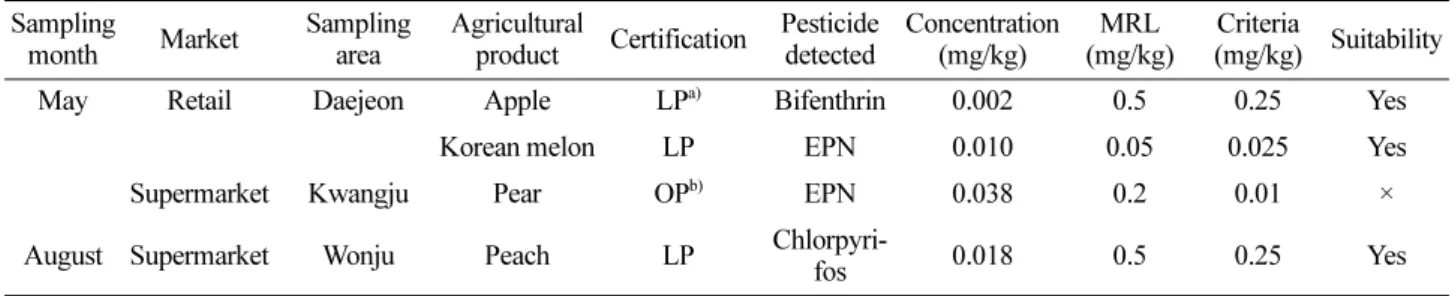
친환경 과채류 및 과실류의 잔류농약 분석결과 Table 6에 제시한 바와 같이 사과 등 4점의 시료에서 bifenthrin, EPN 및 chlorpyrifos가 검출되었으며, 검출농약의 잔류량은 0.002- 0.038 mg/kg의 범위이었다. 지역별로는 대전 2점, 광주와 원
주 각각 1점씩 검출되었으며, 잔류농약 검출률은 0.72%이 었다(Table 7).
잔류농약 분석결과 검출된 bifenthrin, EPN 및 chlorpyrifos 3종의 농약은 모두 살충제로 해당 농산물 또는 기타 농산물 일일섭취추정량
(mg/person/day)= 잔류량(mg/kg) ×일일식품섭취량 (kg/person/day)
Table 6. List of pesticides detected from environment friendly fruits and fruiting vegetables collected from markets Sampling
month Market Sampling area
Agricultural
product Certification Pesticide detected
Concentration (mg/kg)
MRL (mg/kg)
Criteria
(mg/kg) Suitability May Retail Daejeon Apple LPa) Bifenthrin 0.002 0.5 0.25 Yes
Korean melon LP EPN 0.010 0.05 0.025 Yes
Supermarket Kwangju Pear OPb) EPN 0.038 0.2 0.01 ×
August Supermarket Wonju Peach LP Chlorpyri-
fos 0.018 0.5 0.25 Yes
a)Low pesticide agricultural products.
b)Organic agricultural products.
최대섭취허용량
(mg/person/day)= 일일섭취허용량
(mg/kg·bw/day) × 55 kg
%최대섭취허용량 = 일일섭취추정량 × 100 일일최대섭취허용량
Table 7. Detection rates of pesticides by sampling area Sampling
area
No. of sample
No. of sample containing
pesticide
Detection rate (%) Seoul
(Songpa) 59 0 0
Seoul
(Nowon) 62 0 0
Daejeon 50 2 4.00
Daegu 58 0 0
Busan 55 0 0
Kwangju 59 1 1.69
Jeonju 60 0 0
Cheongju 54 0 0
Wonju 49 1 2.04
Chuncheon 49 0 0
Total 555 4 0.72
Table 8. Intake ratios of pesticides detected from environment friendly fruits and fruiting vegetables collected in May and August based on their acceptable daily intakes (ADIs)
%MPId) Pesticide
Agricultural product
Concentration of pesticide detected
(mg/kg)
Food daily intake (g)
ADIa)
(mg/kg·bw/day) mg/person/day %MPId)
Bifenthrin Apple 0.002 21.09 0.01 0.00004218 0.550 0.0077
EPN Korean melon 0.010 11.30 0.0014 0.00011752 0.077 0.1526
EPN Pear 0.038 15.44 0.0014 0.00058672 0.077 0.7620
Chlorpyrifos Peach 0.018 3.78 0.01 0.00006804 0.550 0.0124
a)Acceptable daily intake (mg/kg·bw/day).
b)Estimated daily intake (mg/person/day) = Residual concentration(mg/kg)× daily food intake (g/day).
c)Acceptable daily intake (mg/person/day) = ADI (mg/kg·bw/day)× Body weight (kg).
d)%Maximum permissible intake = (EDI/ADI)× 100.
로 잔류허용기준이 설정되어있었다(KFDA Pesticide Residue Database, 2012). 대전 소매점에서 채취한 저농약 사과 시료 에서 검출된 bifenthrin의 잔류량은 0.002 mg/kg이었으며, 대전 소매점에서 채취한 저농약 참외와 광주의 대형마트에 서 채취한 유기농 배에서 검출된 EPN은 각각 0.010과 0.038 mg/kg이었다. 또한 원주의 대형마트에서 채취한 저 농약 복숭아의 경우 0.018 mg/kg의 chlorpyrifos가 검출되 었다. Moon 등(2011)의 보고에 의하면 친환경농업토양에서 bifenthrin과 chlorpyrifos가 검출되었으며, 그 농도는 각각 0.022, 0.020 mg/kg이었다. 2011 농산물품질관리연보 (NAQS, 2012)에 의하면 관행농산물의 농약 성분별 검출현황에서 EPN은 29720점의 시료 중 147점이 검출되었으며, 이 중 부 적합률은 0.15%로 나타났다.
인증기준 초과 여부 및 검출농약의 안전성평가
농약이 검출된 시료 중 사과에서 검출된 bifenthrin과 참 외에서 검출된 EPN, 복숭아에서 검출된 chlorpyrifos는 모 두 저농약 농산물로 인증기준인 MRL의 1/20 이하로 적합 한 수준이었다. 3점의 시료를 제외한 나머지 EPN이 검출된 유기농 배 시료의 경우 해당농약의 잔류량이 0.038 mg/kg으 로 MRL 0.2 mg/kg의 1/20인 0.01 mg/kg을 초과하므로 부 적합 농산물로 판정되었으며, 전체 시료 중 친환경농산물 인증기준 부적합률은 0.18%이었다. 2009년도 국립농산물품 질관리원의 안전성조사 실적(NAQS, 2010)을 보면 친환경 농산물 13,252건 중 43건이 부적합농산물로 판정되어 0.3%
의 부적합율을 보여 이 연구와 유사한 경향이었다.
농약이 검출된 시료를 섭취하였을 경우를 가정하여 수행 한 안전성평가 결과는 Table 8에 제시한 바와 같이 일일섭 취추정량은 최대섭취허용량의 0.76% 이하로 나타났다.
감사의 글
이 논문은 2011년도 농촌진흥청 연구사업인 ‘유통 친환경 농산물 중 잔류농약 모니터링 및 안전성평가’ 연구(과제번호:
PJ0076822012)의 일부이며, 연구비 지원에 감사드립니다.
Literature Cited
Chungbuk National University (CBNU) (2005) Bio Environmental Friendly Agriculture, pp.1-6.
Codex Alimentarius Commission (1999) Report of the Twenty- Sixth Session of the Codex Committee on Food Labelling, ALINORM 99/12.
Environmentally-friendly Agriculture Promotion Act (2011) Enforcement Regulations. Attachment 3. Certification Criteria.
Hwang, C. J. (2009) A Study on the purchase factors of the environment friendly agricultural products and measures to promote the purchase, Hanseo University, Ph.D. Thesis Lee, J. Y., H. H. Noh, K. H. Lee, S. H. Park and K. S. Kyung
(2012) Monitoring of resticide residues in commercial environmental-friendly stalk and stem vegetables and leafy vegetables and risk assessment, Kor. J. Pest. Sci. 16(1):43~53.
Ministry for Food, Agriculture, Forestry and Fisheries (MIFAFF) (2011) Direction of Environmental-friendly Agricultural Policy, pp.2-10.
Ministry for Food, Agriculture, Forestry and Fisheries (MIFAFF) (2012) Statistics of Food, Agriculture, Forestry and Fisheries, pp.260-265.
Moon, K. M., J. W. Park, Y. G. Lee, Y. W. Choi (2011) Pesticide multiresidues analysis of environmental-friendly agricultural soils by the complex cleanup method of accelerated solvent extraction (ASE) and solid phase extraction (SPE), Journal of Agriculture & Life Science 45(5):73~80.
National Agricultural Products Quality Management Service (NAQS) (2010) 2009 The Annual Report for Quality Management of Agricultural Products, pp.18-23.
National Agricultural Products Quality Management Service (NAQS) (2012) 2011 The Annual Report for Quality Management of Agricultural Products, pp.27-58.
Noh, H. H., Y. S. Park, K. W. Kang, H. K. Park, K. H. Lee, J. Y.
Lee, K. W. Yeop, S. R. Choi and K. S. Kyung (2010) Monitoring of pesticide residues in leafy vegetables collected from wholesale and traditional markets in Cheongju, Kor. J. Pest. Sci. 14(4):381~393.
Park, J. S., (2005) Environmental-friendly Agricultural Promotion Policy, Ministry for Food, Agriculture, Forestry and Fisheries.
Rural Development Administration (RDA) (2000) Safety and Crop Protection of Pesticide. pp.1-11.
Korea Food and Drug Administration (KFDA) (2004) Study to Improve the Tolerance Setting System of Pesticide Residues in Foods.
Korea Food and Drug Administration (KFDA) (2005) Survey on the Heavy Metals in Agricultural Products. pp.1-7.
Korea Food and Drug Administration (KFDA) (2011) MRLs for Pesticides in Foods. pp.2-6.
Korea Food and Drug Administration Pesticide Residue Database (2012) http://fse.foodnara.go.kr/residue/pesticides/
pesticides_info.jsp.
⊙ ··· ⊙
유통 친환경 과실류와 과채류 중 농약잔류 실태조사 및 안전성 평가
이재윤·노현호·박소현·이광헌1·박효경2·홍수명3·김두호3·경기성*
충북대학교 농업생명환경대학 환경생명화학과, 1(주)동방아그로 기술연구소,
2호서대학교 안전성평가센터, 3국립농업과학원 농산물안전성부
요 약 국내 유통 중인 친환경농산물 중 과채류와 과실류의 잔류농약 모니터링을 통해 친환경인증 농산물의 잔류 농약 실태조사 및 안전성을 평가하기 위하여 서울을 포함한 전국 8개 도시 9개 지점의 대형마트와 친환경농산물 전 문판매점에서 25종의 과채류와 과실류를 555점 채취한 후 acetamiprid를 포함한 245종 농약을 대상으로 GC-ECD/
NPD와 HPLC-DAD/FLD를 이용한 다성분동시분석법으로 잔류농약을 분석하였으며, 분석결과 농약으로 추정되는 peak는 GC-MSD를 이용하여 재확인하였다. 잔류농약 분석결과 555점의 시료 중 사과를 포함한 4점의 시료에서 bifenthrin, EPN 및 chlorpyrifos가 검출되었으며, 검출율은 0.72%이었다. 농약이 검출된 4점의 시료 중 잔류량은 모 두 잔류허용기준(maximum residue limit, MRL) 이내였으나 EPN이 검출된 배는 잔류량이 허용수준인 MRL의 1/20 을 초과하였다. 일일최대섭취허용량(maximum permissible intake, MPI) 대비 일일섭취추정량(estimated daily intake, EDI)은 0.76% 미만이었다.
색인어 친환경농산물, 모니터링, 잔류농약, 최대섭취허용량
⊙ ··· ⊙