380 This is an Open-Access article distributed under the terms of the Creative Commons Attribution Non-Commercial License (http://
creativecommons.org/licenses/by-nc/3.0) which permits unrestricted non-commercial use, distribution, and reproduction in any medium, provided the original work is properly cited.
J. Mushrooms 2020 September, 18(4):380-386 http://dx.doi.org/10.14480/JM.2020.18.4.380 Print ISSN 1738-0294, Online ISSN 2288-8853
© The Korean Society of Mushroom Science
Kyung-Je Kim(Principal Research engineer), Young-Woo Koh(Research engineer), Seung-Bin Im(Research engineer), Seong-Woo Jin(Senior Research engineer), Neul-I Ha(Research engineer), Hee-Gyeong Jeong(Research engineer), Sang-Wook Jeong(Research engineer), Kyeong-Won Yun(Professor), Kyoung-Sun Seo(Principal Research engineer)
*Corresponding author E-mail : [email protected] Tel : +82-61-862-8877 Received November 30, 2020 Revised December 14, 2020 Accepted December 21, 2020
농약 허용물질목록 관리제도와 연계한 국내산 표고 잔류농약 실태 조사
김경제1 · 고영우1 · 임승빈1 · 진성우1 · 하늘이1 · 정희경1 · 정상욱1 · 윤경원2 · 서경순1*
1장흥군버섯산업연구원
2순천대학교 한약자원개발학과
Research of pesticide residue of domestic Lentinula edodes related with the positive list system
Kyung-Je Kim1, Young-Woo Koh1, Seung-Bin Im1, Seong-Woo Jin1, Neul-I Ha1, Hee-Gyeong Jeong1, Sang-Wook Jeong1, Kyeong-Won Yun2, and Kyoung-Sun Seo1*
1Jangheung Research Institute for Mushroom Industry, Jangheung 59338, Korea
2Department of Oriental Medicine Resources, Sunchon Nat'l University, Suncheon 57922, Korea
ABSTRACT: The study was conducted for the safety evaluation of 320 pesticide residues in 768 Lentinula edodes fruit body samples and 143 L. edodes media samples, which are distributed nationwide in South Korea. The monitoring method was the second of the multi-residue methods in the Korean Food Code. GC-ECD, GC-NPD, and GC-MSD were used as evaluation equipment for analysis. Single-analysis of the target pesticides was performed for mepiquat chloride. Through the analysis of collected L. edodes samples, pesticide residues were detected in total seven cases, including four L. edodes fruit body samples and three L. edodes media samples. The detected pesticide residues were carbendazim, diflubenzuron, fluopyram, and dinotefuran. In this study, carbendazim was detected in three L. edodes fruit body samples and one L. edodes media sample. The detected amount of carbendazim was 0.056, 0.17, 0.043, and 0.09 mg/kg, respectively. The amount of carbendazim in the collected L. edodes samples was detected below the MRLs (maximum residue level). The detected amounts of fluopyram and dinotefuran were 0.068 mg/kg and 0.06 mg/kg, respectively. Two pesticide residues were detected in the medium in one case.
Mepiquat chloride was not detected in this study. These results suggested that residual pesticides were detected in a small number of collected L. edodes. However, the PLS for unregistered pesticides MRL was 0.01 ppm; therefore, we have to conduct research on preparing safety standards for mushrooms, including L. edodes.
KEYWORDS: Lentinula edodes, Pesticides residue, Maximum residue level, Safety, Positive list system
서 론
농약은 여러 작물의 생산성 증대와 안정적 생산 및 품 질향상에 크게 기여하고 있다. 산업화 및 출산율 감소로 인한 노동력이 매년 감소하는데 반해 농산물 소비량은 크 게 증가하는 추세이며, 소비자들은 고품질의 농산물을 요 구하고 있어 안전하고 효율적인 농약 사용 필요성이 더욱 높아지고 있다(Jung et al., 2004). 국립농산물품질관리원 이 2016년에 수행한 농산물 176품목 11,272건에 대한 잔 류농약 분석결과 512건의 부적합 농산물이 적발되었으며, 부적합율은 4.5% 수준이었다(NAQS, 2016). 농산물 및 식품의 안전성을 확보하고자, 식품의약품안전처는 농약 허용물질목록 관리제도(Positive List System, PLS)를 도
입했으며, 2019년 전면적으로 모든 농산물에 대한 농약 잔류허용기준(Maximum Residue Level, MRL)이 설정되 었다. PLS제도 도입으로 국산 또는 수입식품에 대해 잔류 허용기준이 설정된 농약 이외에는 사용이 금지되었고, 등 록되지 않은 농약류에 대해서는 일률기준인 0.01 mg/kg
미만으로 관리하는 제도로 원료 농산물뿐 아니라 가공식 품에도 동일하게 적용된다(Lee et al., 2019). 소비자들 입 장에서는 더욱 안전한 농식품을 제공받을 수 있는 제도이 지만, 버섯류를 비롯한 농산물 생산자들에게는 반드시 준 수해야 하는 항목이다(Yang et al., 2017).
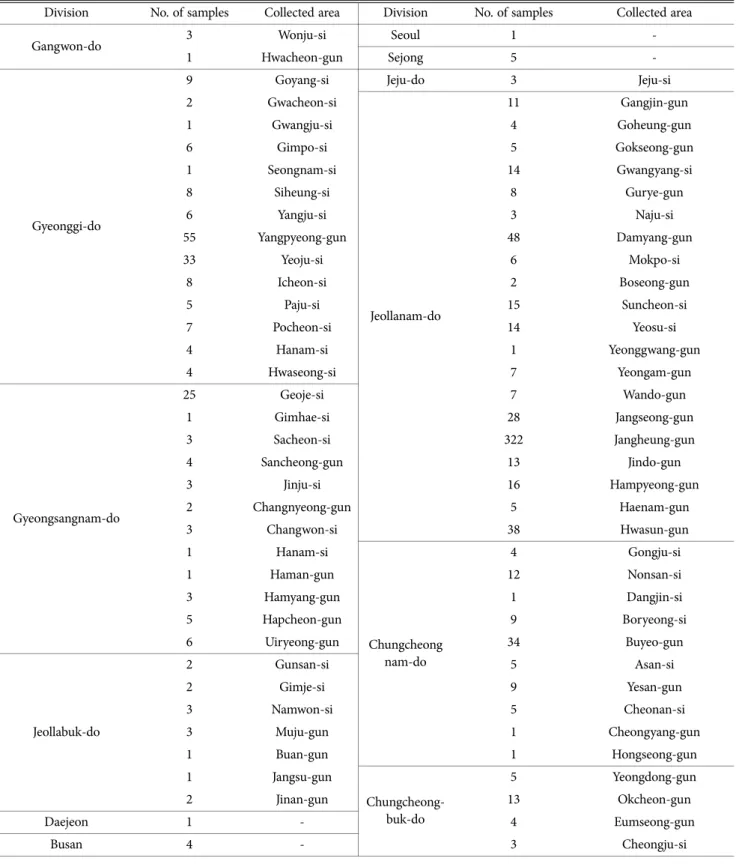
Table 1. List of Lentinula edodes by collected area
Division No. of samples Collected area Division No. of samples Collected area
Gangwon-do 3 Wonju-si Seoul 1 -
1 Hwacheon-gun Sejong 5 -
Gyeonggi-do
9 Goyang-si Jeju-do 3 Jeju-si
2 Gwacheon-si
Jeollanam-do
11 Gangjin-gun
1 Gwangju-si 4 Goheung-gun
6 Gimpo-si 5 Gokseong-gun
1 Seongnam-si 14 Gwangyang-si
8 Siheung-si 8 Gurye-gun
6 Yangju-si 3 Naju-si
55 Yangpyeong-gun 48 Damyang-gun
33 Yeoju-si 6 Mokpo-si
8 Icheon-si 2 Boseong-gun
5 Paju-si 15 Suncheon-si
7 Pocheon-si 14 Yeosu-si
4 Hanam-si 1 Yeonggwang-gun
4 Hwaseong-si 7 Yeongam-gun
Gyeongsangnam-do
25 Geoje-si 7 Wando-gun
1 Gimhae-si 28 Jangseong-gun
3 Sacheon-si 322 Jangheung-gun
4 Sancheong-gun 13 Jindo-gun
3 Jinju-si 16 Hampyeong-gun
2 Changnyeong-gun 5 Haenam-gun
3 Changwon-si 38 Hwasun-gun
1 Hanam-si
Chungcheong nam-do
4 Gongju-si
1 Haman-gun 12 Nonsan-si
3 Hamyang-gun 1 Dangjin-si
5 Hapcheon-gun 9 Boryeong-si
6 Uiryeong-gun 34 Buyeo-gun
Jeollabuk-do
2 Gunsan-si 5 Asan-si
2 Gimje-si 9 Yesan-gun
3 Namwon-si 5 Cheonan-si
3 Muju-gun 1 Cheongyang-gun
1 Buan-gun 1 Hongseong-gun
1 Jangsu-gun
Chungcheong- buk-do
5 Yeongdong-gun
2 Jinan-gun 13 Okcheon-gun
Daejeon 1 - 4 Eumseong-gun
Busan 4 - 3 Cheongju-si
소비자가 식품을 선택하고 섭취할 때 고려하는 사항 중 최우선 순위가 잔류농약이라는 조사 결과(Woo et al., 2010)와 같이 인체에 유해하지 않으며, 품질 좋은 식품의 선호도가 높아짐에 따라 농산물 중 잔류농약의 안전성을 확보하기 위한 분석기술 역시 지속적으로 발전하고 있다.
농산물을 이용한 잔류농약의 분석방법은 일반적으로 시료 의 전처리와 기기분석으로 이루어져있다. 잔류농약 분석 은 1960년대 미국 FDA (Food and Drug Administration) 에서 잔류농약분석법의 기초를 처음 마련하였으며, 현재
까지 수많은 농약 물질의 분석 전처리법과 분석장비가 등 장하고 있다(Ock, 2009). 이에 따라 여러 종류의 농약성 분을 한번에 분석 할 수 있는 다종농약다성분 분석법을 이용한 농산물의 잔류농약에 대한 안전성 평가가 이뤄지 고 있다(Kim et al., 2013; Kim et al., 2015).
표고(Lentinula edodes)는 한국, 대만, 중국, 일본의 동 북아시아 지역에서 수천년 동안 식품 및 의약품으로 사용 되고 있으며, 버섯류 중에서 두 번째로 많이 재배되고 있 다. 표고의 독특한 향기와 감칠맛은 버섯내에 핵산계 조
Table 2. List of the pesticides(321 pesticides)
Classification Pesticides
Insecticide (139)
Abamectin, Acephate, Acetamiprid, Acrinathrin, Aldicarb, Aldirin, Azinphos-methyl, Bendiocarb, Benzoxi- mate, BHC(α,β,δ), Bifenthrin, Bromopropylate, Buprofezin, Cadusafos, Carbaryl, Carbofuran, Carbopheno- thion, Chlorantraniliprole, Chlorfenapyr, Chlorfenvinphos, Chlorfluazuron, Chlorobenzilate, Chlorpyrifos, Chlorpyrifos-methyl, Chromafenozide, Clofentezine, Clothianidin, Cyfluthrin, Cyhalothrin, Cypermethrin, DDT, Deltamethrin, Demeton-S-Methyl, Diazinon, Dichlorvos(DVP), Dicofol, Dieldrin, Diflubenzuron, Dimethoate, Dimethylvinphos, Dinotefuran, Disulfoton, Endosulfan, Endrin, EPN, Ethiofencarb, Ethion, Ethoprophos(Ethoprop), Etofenprox, Etoxazole, Etrimfos, Fenamiphos, Fenazaquin, Fenitrothion, Fenobu- carb, Fenothiocarb, Fenoxycarb, Fenpropathrin, Fenpyroximate, Fenthion(MP), Fenvalerate, Fipronil, Flonic- amid, Fluacrypyrim, Flubendiamide, Flucythrinate, Flufenoxuron, Fonofos, Fosthiazate, Furathiocarb, Halfenprox, Hexaflumuron, Hexythiazox, Imicyafos, Imidacloprid, Indoxacarb, Isazofos, Isofenphos, Isopro- carb, Lindane(γ-BHC), Lufenuron, Malathion, Mandipropamid, Mecarbam, Methidathion, Methiocarb, Methomyl, Methoxyfenozide, Metolcarb, Mevinphos, Milbemectin, Monocrotophos, Novaluron, Omethoate, Oxamyl, Parathion, Parathion-methyl, Permethrin, Phenothrin, Phenthoate, Phorate, Phosalone, Phosphami- don, Phoxim, Piperonyl butoxide, Pirimicarb, Pirimiphos-ethyl, Pirimiphos-methyl, Profenofos, Promecarb, Propoxur, Prothiofos, Pyraclofos, Pyridaben, Pyridalyl, Pyridaphenthion, Pyrifluquinazon, Pyrimidifen, Pyriproxyfen, Quinalphos, Silafluofen, Spinetoram, Spirodiclofen, Spiromesifen, Spirotetramat, Sulfoxaflor, Tebufenozide, Tebufenpyrad, Tebupirimfos, Teflubenzuron, Tefluthrin, Terbufos, Tetradifon, Thiacloprid, Thiamethoxam, Thiodicarb, Triazophos,Triflumuron, Vamidothion
Herbicide (88)
Alachlor, Anilofos, Azimsulfuron, Benfuresate, Bensulfuron-methyl, Benzobicyclon, Bifenox, Bromacil, Bro- mobutide, Butachlor, Butafenacil, Cafenstrole, Carfentrazone-ethyl, Chlorpropham, Chlorsulfuron, Clethodim, Clomazone, Cyclosulfamuron, Cyhalofop-butyl, Daimuron, Diclofop-methyl, Dimepiperate, Dimethametryn, Dimethenamid, Diphenamid, Dithiopyr, Diuron, Esprocarb, Ethalfluralin, Ethoxysulfuron, Fenclorim, Fenoxaprop-ethyl, Fentrazamide, Flucetosulfuron, Flufenacet, Flumioxazin, Halosulfuron-methyl, Haloxyfop, Heptachlor, Hexazinone, Imazosulfuron, Indanofan, Linuron, Mefenacet, Metamifop, Metazosul- furon, Methabenzthiazuron, Metobromuron, Metolachlor, Metribuzin, Molinate, Napropamide, Nicosulfu- ron, Oxadiazon, Oxaziclomefone, Oxyfluorfen, Pendimethalin, Penoxsulam, Pentoxazone, Piperophos, Pretilachlor, Prometryn, Propachlor, Propanil, Propaquizafop, Propazine, Propisochlor, Propyzamide, Pyra- zolate, Pyribenzoxim, Pyributicarb, Pyriftalid, Pyriminobac-methyl, Pyrimisulfan, Quinoclamine, Quizalo- fop-ethyl, Saflufenacil, Sethoxydim, Simazine, Simetryn, Terbuthylazin, Terbutryn, Thenylchlor, Thiazopyr, Thifensulfuron-methyl, Thiobencarb, Tri-alate, Trifluralin
Fungicide (87)
Ametoctradin, Amisulbrom, Azaconazole, Azoxystrobin, Benthiavalicarb-isopropyl, Bitertanol, Boscalid, Car- bendazim, Carboxin, Carpropamide, Chlordane, Cyazofamid, Cyflufenamid, Cymoxanil, Cyproconazole, Cyprodinil, Dicloran, Diethofencarb, Difenoconazole, Dimethomorph, Diniconazole, Diphenylamine, Edifen- phos, Epoxiconazole, Ethaboxam, Etridiazole, Famoxadone, Fenarimol, Fenbuconazole, Fenhexamid, Fenox- anil, Ferimzone, Fludioxonil, Fluopicolide, Fluopyram, Fluquinconazole, Flusilazole, Flutolanil, Fluxapyroxad, Fthalide, Hexaconazole, Imazalil, Imibenconazole, Iprobenfos, Iprodione, Iprovalicarb, Isoprothiolane, Isopyr- azam, Kresoxim-methyl, Mepanipyrim, Mepronil, Metalaxyl, Metconazole, Metrafenone, Myclobutanil, Nuarimol, Ofurace, Oxadixy, Penconazole, Pencycuron, Penthiopyrad, Picoxystrobin, Probenazole, Prochloraz, Procymidone, Propamocarb, Propiconazole, Pyraclostrobin, Pyrazophos, Pyrimethanil, Pyro- quilon, Quintozene, Simeconazole, Tebuconazole, Tetraconazole, Thiabendazole, Thifluzamide, Tiadinil, Tol- clofos-methyl, Triadimefon, Triadimenol, Tricyclazole, Trifloxystrobin, Triflumizole, Uniconazole,
Vinclozolin, Zoxamide
Plant growth regulator (7) Forchlorfenuron, Giberelic acid, Inabenfide, Mepiquat chloride, Paclobutrazol, Quinmerac, Thidiazuron
미료인 구아닐산과 정미성분인 글루탐산, 아스파르트산을 다량 함유하고 있기 때문이며(Cho et al., 2010), 지방, 단 백질을 비롯해 비타민 B군과 철분, 칼슘, 칼륨, 인 등의 무기질을 다량 함유하고 있다(Song et al., 2001). 표고의 약리 효과는 성인병 예방과 인터페론 생성을 촉진하는 단 백 다당체가 종양에 대한 생체 고유의 방어력을 높여줌으 로 간접적으로 종양세포의 증식을 저해하거나, 암세포나 병원성균을 직접 사멸시키는 중요한 역할을 담당하는 대 식세포의 수를 증가시키는 작용을 하는 것으로 보고되고 있다(Takehara, 1979). 또한 혈관 속의 콜레스테롤 함량을 낮추어 주는 에리타데닌(eritadenin), 항암, 면역조절, 항당 뇨 등 약리적인 효능이 과학적으로 밝혀져있다(Park et al., 2011; Fang et al., 2006; Tanaka et al., 2011; Sharma et al., 2013).
버섯류 농약잔류허용기준 및 허용물질 관리제도는 버섯 에 대한 식품안전성을 확보하고, 소비자 신뢰도를 제고하 기 위해 국내외에서 유통되는 버섯 유해성분을 분석하여, 합리적인 안전기준을 설정하고자 체계를 정립하고 있다.
하지만 버섯의 경우 PLS제도 설립 초기 단계로 보여 지 며, 그에 대한 연구가 미비하여 이에 관한 현장적용 연구 필요성이 대두되고 있는 상황이다. 따라서 본 연구에서는 우리나라 주요 버섯중 하나인 표고를 대상으로 연구를 진 행하였고, 연구수행을 위하여 원목 건표고 생산량의 대부 분을 차지하고 있는 장흥군을 비롯한 전국 각지의 표고를 수집하고 잔류농약 모니터링을 실시하였으며, 가장 빈번 히 검출되는 위해성이 있는 농약들의 함량을 평가하였다.
재료 및 방법
실험재료
실험에 사용된 시료는 2018년 1월부터 2019년 11월까 지 재배된 표고를 대상으로, 표고 재배 농가와 재래시장,
대형마트, 온라인 쇼핑몰 등에서 원목표고 768점, 표고배 지 143점을 수집하였다. 분석대상 표고는 Table 1과 같다.
분석대상 농약 및 시약
분석에 사용한 표준품은 다성분동시분석이 가능한 320 종 농약과 단성분 분석법으로 분석이 가능한 mepiquat chloride가 대상이며 Dr. Ehrenstorfer (Germany)와 Wako (Japan) 제품을 사용하였고, 시료 추출 및 정제를 위해 사용 한 acetonitile, dechloromethan, acetone, hexane은 Merck (USA) 제품을 구입하였다. 각각의 농약표준품은 actone, acetonitrile으로 1,000 mg/L의 용액을 gas chromatograph 분 석용 혼합표준용액을 조제하여 4oC에 냉장보관 하여 사용하 였다.
전처리방법
전처리는 식품공전 잔류농약 분석법 실무 해설서 7.1.2.2 다종농약다성분 분석법(Multi lass pesticide multiresidue methods) 제2법에 따라 acetonitrile을 추출 용매로 사용하였다(Ministry of Food and Drug Safety, 2017). 시험에 수집된 시료를 분쇄기를 이용하여 균질화 한 후 시료 10 g을 칭량하여 증류수 40 mL을 넣고 2시간 동안 습윤화 시켜 분석시료로 사용하였으며, 칭량된 각 시료에 acetonitrile 100 mL을 넣어 3분간 고속 마쇄 추출 하여 여과하였다. 여과액에 NaCl 15 g을 첨가한 후 강하 게 진탕하였으며, 진탕한 시료는 4,500 rpm에서 5분간 원 심분리를 하였다. 이 후 정치하여 actonitirle층과 water층 을 분리 후, 상층액 10 mL을 취하여 40oC에서 1차 감압 농축 하였다. Gas chromatography 분석을 위해서는 시료 농축물을 20% 아세톤 함유 헥산 4 mL로 용해하고 미리 헥산 5 mL와 20% 아세톤 함유헥산 5 mL로 활성화시킨 SPE-florisil (500 mg/6 mL)은 Phenomenex (Torrance, CA, USA)제품에 용출시켜 받고 20% 아세톤 함유 헥산 5 mL를 Table 3. Operating conditions of gas chromatography and GC-MS
Parameters Analytical Conditions
Detector GC-ECD GC-NPD GC-MSD
Inlet split (1:2), 270oC 1.0 uL injection
splitless, 250oC 1.0 uL injection
splitless, 250oC 1.0 uL injection
Column DB-5 (30 m × 0.25 mm, 0.25 μm) DB-5 (30 m × 0.25 mm, 0.25 μm) DB-5MS (30 m × 0.25 mm, 0.25 μm)
Flow rate N2 (1.0 mL/min) N2 (1.0 mL/min) He (1.5 mL/min)
Oven Temp.
Rate (oC/min)
Temp.
(oC)
Hold (min)
Rate (oC/min)
Temp.
(oC)
Hold (min)
Rate (oC/min)
Temp.
(oC)
Hold (min)
160 1 130 1 70 1.5
8 180 1 20 180 1
4.7 240 4
4 210 3 10 265 1
13 280 20
10 300 8 5 300 4.5
Detector Temp. 300oC 300oC 300oC
용출하여 시험관에 모아 40oC 이하 수욕상에서 2차 감압 농축하고 아세톤 2 mL로 녹이고 막여과지(PTFE 0.45 μm)로 여과하여 시험용액으로 사용하였다.
기기 분석 조건
잔류농약 321종에 대한 분석기기로는 GC-ECD (Agilent 7890B, USA), GC-NPD (Agilent 7890B, USA), GC-MSD(Agilent 5977B, USA)를 사용하여 정성 및 정 량분석 하였으며 Table 2의 조건으로 분석하였다. GC는 ECD로 유기염소계 잔류농약, NPD로 유기인계 잔류농약 을 분석하였고, column은 모두 DB-5 (30 m × 0.25 mm, 0.25 μm, Agilent)를 사용하였다. 잔류농약이 검출된 시료는 GC- MSD로 확인하였고, column은 DB-5MS (30 m × 0.25
mm, 0.25 μm, Restek, Bellefonte, PA, USA)를 사용하였다.
결과 및 고찰
수집지역별 잔류농약 검출 현황
전국 12개 지역에서 수집된 표고 768건, 표고배지 143 건의 시료를 대상으로 다종다성분 320종 및 단성분 mepiquat chloride에 대해 분석한 결과, 표고 4건, 표고배 지 3건으로 총 7건에서 잔류농약이 검출되었으며, 검출된 성분은 carbendazim(4건), diflubenzuron(1건), fluopyram (1건), dinotefuran(1건) 이었다(Table 4-7). 이 중 MRL을 초과하여 검출된 농약은 diflubenzuron 1건이었다.
mepiquat chloride는 식물생장 조절제로 사용되며 버섯 재 Table 4. Detected pesticides of Lentinula edodes fruit body by collected areas
Collected area No.
of samples
No. of samples without detectable pesticides
% samples without detectable pesticides
No. of samples with pesticides below MRL1)
% samples with pesticides below MRL
Gangwon-do 4 4 100 0 0.0
Gyeonggi-do 106 104 98 2 2
Gyeongsangnam-do 46 46 100 0 0
Daejeon 1 1 100 0 0
Busan 2 2 100 0 0
Seoul 1 1 100 0 0
Sejong 3 3 100 0 0
Jeollanam-do 504 503 99.8 1 0.2
Jeollabuk-do 13 12 92 1 8
Jeju-do 2 2 100 0 0
Chungcheong nam-do 86 86 100 0 0
1)MRL : Maximum residue level.
Table 5. Detected pesticides of Lentinula edodes media by collected areas Collected area No. of
samples
No. of samples without detectable pesticides
% samples without detectable pesticides
No. of samples with pes- ticides below MRL1)
% samples with pesti- cides below MRL
Gangwon-do - - - - -
Gyeonggi-do 43 40 93 3 7
Gyeongsangnam-do 11 11 100 0 0
Daejeon - - - - -
Busan 2 2 100 0 0
Seoul - - - - -
Sejong 2 2 100 0 0
Jeollanam-do 63 63 100 0 0
Jeollabuk-do 1 1 100 0 0
Jeju-do 1 1 100 0 0
Chungcheong nam-do 20 20 100 0 0
1)MRL : Maximum residue level.
배용 배지에서 검출되는 사례가 발생하여 단성분 분석을 실시하였으나 본 연구에서는 검출되지 않았다.
Carbendazim
Carbendazim은 곡류 및 과실 재배에 광범위하게 사용 되는 벤지미다졸계 침투성 살균제로서 국내뿐만 아니라 수입 과일에서 운송 중 수확 후 살균제로도 사용되고 있 는데, 미국의 경우 이들 벤지미다졸계 농약이 간독성, 기 형 독성, 발암성 등에 대한 논란이 계속되고 있다. 벤지미 다졸계 농약의 독성 기전은 세포 수준에서 microtubule과 결합하여 진핵세포 내 물질 전달이나 spindle 형성을 억제 하므로 세포분열의 기능을 저해하는 것으로 알려져 있다 (Hwang et al., 2017). 본 연구에서는 표고 3건, 배지 1건 으로 총 4건의 시료에서 carbendazim이 검출되었으나 각 각의 검출량은 0.056 mg/kg, 0.17 mg/kg, 0.043 mg/kg, 0.09 mg/kg으로 MRL인 0.7 mg/kg에 비해 소량으로 나 타났다(Table 6, 7).
Diflubenzuron
Diflubenzuron은 IGRs (Insect growth regulator: 곤충생 장조절물질)계 살충제로서 버섯파리의 방제약제로 주로 사용된다. Benzoylphenyl urea 계통의 화합물은 곤충의 키틴 형성을 억제하거나 탈피과정을 방해하여 유충을 치 사시키고 기존의 유기인계, 카바메이트계의 살충제 저항 성인 해충에도 방제효과가 있다(Park, 1998). 이들 곤충생 장조절물질은 파리류 해충의 성충에 자가 불임을 유발시 키며 알껍질이나 유충 피부를 구성하는 키틴 합성을 저해 하므로 세대에 걸친 방제 효과를 기대할 수 있다(Park et al., 1999). 본 연구에서 분석한 시료 중에서는 1건이 검출 되었으며 검출량은 0.4192 mg/kg으로 MRL인 0.3 mg/kg 을 초과하였다(Table 6). 이는 표고 재배 시 푸른곰팡이를
방제하기 위해 초기에 처리하는 살균제와 달리 모든 생육 단계에 걸쳐 발생하는 버섯파리에 대해 처리된 살충제가 잔류한 것으로 생각된다.
Fluopyram, Dinotefuran
Fluopyram은 채소류에 많이 발생되는 흰가루병, 잿빛곰 팡이병균에 대한 살균효과가 2002년 보고되면서 2012년에 국내에 살균제로 등록되어 사용중인 succinate dehydrogenase 저해제로서 다양한 식물기생성 선충에 대한 살선충 효과 가 추가로 확인되었다. 국내에서도 오이, 수박, 참외 등의 뿌리혹 선충을 대상으로 등록되어 사용되어 오고 있다 (Park et al., 2019). Dinotefuran은 후라니코티닐계의 침 투이행성 살충제로 과수나 채소에 발생하는 총채벌레류, 진딧물류 등의 방제에 주로 사용하는 약제이다. 접촉독과 섭식독을 통하여 살충효과를 나타내며, 유기인계, 카바메 이트계, 합성피레스로이드계 등에 저항성이 생긴 해충에 도 살충효과가 있는 것으로 알려져 있다.
본 연구에서 fluopyram은 0.068 mg/kg, dinotefuran은 0.06 mg/kg으로 모두 배지에서 각각 1건씩 검출되었다 (Table 7). 검출된 잔류농약들은 현재 버섯류 및 표고의 잔류허용물질목록에는 등록되어 있지 않으며 fluopyram 의 경우 엽채류 0.04 mg/kg에서 호프 50 mg/kg까지 66 종, dinotefuran의 경우 엽채류 0.05 mg/kg에서 들깻잎 30 mg/kg까지 97종의 작물에 걸쳐 다양한 기준이 적용되 고 있으나(Kim et al., 2020), 식품으로 섭취하는 농산물 의 확보 차원에서 기준이 설정되지 않은 농약이 0.01 mg/
kg 이상 잔류하는 품목의 유통 및 판매를 금지하는 positive list, 불검출을 원칙으로 하는 zero tolerance등을 도입하여 농산물의 안전성을 확보하고 있다(Chung et al., 2014).
따라서 국내산 표고 및 배지에서 검출된 잔류농약은 허 Table 6. The amount of detected pesticides of collected Lentinula edodes fruit body
Collected area Detected pesticides Amount(mg/kg) MRL(mg/kg)1) Registration
Gyeonggi-do Carbendazim 0.056 0.7T O
Carbendazim 0.17 0.7T O
Jeollanam-do Diflubenzuron 0.4192 0.3T O
Jeollabuk-do Carbendazim 0.043 0.7T O
1)MRL : Maximum residue level.
Table 7. The amount of detected pesticides of collected Lentinula edodes media
Area Detected pesticide Amount(mg/kg) MRL(mg/kg)1) Registration
Gyeonggi-do
Carbendazim 0.09 0.7T O
Fluopyram 0.068 0.04-50/vegetables and fruits ×
Dinotefuran 0.06 0.05-30/vegetables and fruits ×
1)MRL : Maximum residue level.
용치가 정해져 있지 않은 상태이므로, 이에 따른 기준 마 련이 필요하다. 이에 재배 농가에서 표고에 적용 가능한 약제를 선별하여 사용할 수 있도록 꾸준한 지도와 교육을 수행하고, 현장에 알맞은 기준을 제시함으로서 표고의 안 전한 생산과 소비를 위해 지속적인 관리가 이루어져야 할 것으로 보인다.
적 요
전국 12개 지역에서 수집된 표고 768건, 표고배지 143 건의 시료를 대상으로 다종다성분 320종 및 단성분 mepiquat chloride에 대해 분석한 결과, 표고 4건, 표고배지 3건으로 총 7건에서 잔류농약이 검출되었으며, 검출된 성분 은 carbendazim, diflubenzuron, fluopyram, dinotefuran 이었 다. 본 연구에서는 표고 3건, 배지 1건으로 총 4건의 시료에 서 carbendazim이 검출되었으나 각각의 검출량은 0.056 mg/kg, 0.17 mg/kg, 0.043 mg/kg, 0.09 mg/kg으로 MRL 인 0.7 mg/kg에 비해 소량으로 나타났다. Fluopyram은 0.068 mg/kg, dinotefuran은 0.06 mg/kg으로 모두 배지에 서 각각 1건씩 검출되었다. 식물생장조절제로 사용되는 mepiquat chloride는 본 연구에서는 검출되지 않았다. 전 체 수집표고 중 소수의 시료에서 잔류농약이 검출되었나, 등록되지 않은 농약은 PLS에 의하면 0.01 ppm이 최대허 용치로 구분되어 있어, 후속 연구를 통하여 표고를 비롯 한 버섯류의 안전성의 기준 작성에 필수적인 자료를 확보 하고자 한다.
감사의 글
본 연구는 농림축산식품부 농축산물안전생산·유통관리 기술개발사업 "국내외 유기성 버섯 배지재료의 유해성분 분석 및 안전기준 설정(318019-03)" 수행결과의 일부로 이에 감사드립니다.
REFERENCES
Cho KA, Lee YJ, Sim CH, Kim KJ, Chun SS. 2010. Quality characteristics of sponge cake prepared with Lentinus edodes powder. Kor J Food Nutr 23: 218-225.
Chung SJ, Kim HY, Kim JH, Yeom MS, Cho JH, Lee SY. 2014.
Monitoring of pesticide residues and risk assessment in some fruits on the market in Incheon, Korea. Korean J Environ Agric 33: 111-120.
Fang N, Li Q, Yu S, Zhang J, He L, Martin J.J. Ronis, Thomas MB. 2006. Inhibition of growth and induction of apoptosis in human cancer cell lines by an ethyl acetate fraction from shiitake mushrooms. J Alterna Complement Med 12: 125-132.
Hwang LH, Lee SD, Kim JG, Kim JY, Park SH, Kim MS. 2017.
Determination of carbendazim in commercial agricultural products by LC-MS/MS. J Food Hyg Saf 32: 141-146.
Jung YH, Kim JU, Kim JH, Lee YD, Im CH, Heo JH. 2004.
Definition of pesticides, recent pesticide science. Sigma Press, Seoul, Korea.
Kim HY, Lee SY, Kim CG, Choi EJ, Lee EJ, Jo NG, Lee JM, Kim YH. 2013. A survey on the pesticide residues and risk assessment for agricultural products on the markets in Incheon area from 2010 to 2012. Korean J Environ Agric 32:
61-69.
Kim JH, Oh JY, Shin JH. 2020. Pesticide and heavy metal residue monitoring in 13 types of agroforestry products in 2019. J Food Hyg Saf 35: 341-353
Kim JY, Jung YM, Oh HS, Kang ST. 2015. Monitoring and risk assessment of pesticide residues in commercial environment- friendly agricultural products distributed using LC-MS/MS in Seoul metropolitan area. Korean J Food Sci Technol 47: 306- 320.
Lee SY, Paik MK, Kim NS, Park ES, Son EH. 2019. A survey on pesticide use by farmers for positive list system settlement.
Korean J Pestic Sci 23: 358-370.
MFDS. 2017. Ministry of Food and Drug Safety Notification. No.
2017-57.
National Agricultural Products Quality Management Service (NAQS). 2017. 2016 Annual Report for Quality Management of Agricultural Products. p. 19.
Ock HS. 2009. Developmental trend of analytical methods for pesticide residues. Korea J Pestic Sci 13: 336-348.
Park JK. 1998. Effects of several insect growth regulators on the development of housefly, Musca domestica L., larvae. Korea J Pestic Sci 2: 137-146.
Park JK, Kim DH. 1999. Effects of some insect growth regulators on adult and egg viability of the house fly, Musca domestica L. applied via larval medium. Korea J Pestic Sci 3: 78-83.
Park SH, Kim NR, Kim SM. 2019. Efficacy of nematicides against root lesion nematode (Pratylenchus spp.) and their effect on the yield in radish. Korea J Pestic Sci 23: 96-101.
Park YA, Lee KT, Bak WC, Kim MK, Ka KH, Koo CD. 2011.
Eritadenin contents analysis on various strains of Lentinula edodes using LC-MS/MS. Kor J Mycol 39: 239-242.
Sharma VP, Kumar S, Kumar R. Singh R, Verma D. 2013.
Cultural requirements, enzyme activity profile, molecular identity and yield potential of some potential strains of shiitake (Lentinula edodes). Mushroom Res 22: 105-110.
Song JY, Yoon KJ, Yoon HK, Koo SJ. 2001. Effects of β-glucan from Lentinus edodes and Horeum vulgare on blood glucose and lipid composition in alloxan-induced diabetic mice. Kor J Food Sci Technol 33: 802-807.
Tanaka K, Ishikawa S, Matsui Y, Tamesada M, Harashima N, Harada M. 2011. Oral ingestion of Lentinula edodes mycelia extract inhibits B16 melanoma growth via mitigation of regulatory T cell–mediated immunosuppression. Cancer Sci 102: 516-521.
Takehara M. 1979. Antiviral activity of virus-like particles from Lentinus edodes (Shiitake). Arch Virol 59: 269-274.
Woo HD, Lee JK, Han GD. 2010. Consumer awareness survey on safety management of pesticide residue. J Food Sci Ind 43: 24- 40.
Yang YS, Gang GL, Lee SM, Kim SG, Lee MG, Choi EA, Seo KW, Kim ES, Kim JH. 2017. Survey on pesticide residues and risk assessment of agricultural products from wholesale market in Gwangju (2014-2016). Korean J Pestic Sci 21: 341-354.