Kurnia ANDRIYANI, Taufiq MARWA, Nazeli ADNAN, Muizzuddin MUIZZUDDIN /
Journal of Asian Finance, Economics and Business Vol 7 No 11 (2020) 629–636 629 629
Print ISSN: 2288-4637 / Online ISSN 2288-4645 doi:10.13106/jafeb.2020.vol7.no11.629
The Determinants of Foreign Exchange Reserves: Evidence from Indonesia
Kurnia ANDRIYANI
1, Taufiq MARWA
2, Nazeli ADNAN
3, Muizzuddin MUIZZUDDIN
4Received: August 01, 2020 Revised: October 05, 2020 Accepted: October 15, 2020
Abstract
This study aims to identify and analyze the factors that affect foreign exchange reserves in Indonesia. We consider the variables of external debt, exchange rate, inflation, and exports as explanatory factors referring to previous studies. We apply the Autoregressive Distributed Lag approach to time-series data retrieved from the Central Bank of Indonesia (BI), the Central Bureau of Statistics (BPS), and International Monetary Funds (IMF) from January 2016 to December 2018. Our results show that foreign debt, exchange rates, inflation, and exports significantly affect the simultaneous fluctuation of foreign exchange reserves in Indonesia. Partially, foreign debt has a significant and positive effect on foreign exchange reserves. The exchange rate has a significant and negative effect on foreign exchange reserves in Indonesia. However, our findings explain that inflation does not significantly affect foreign exchange reserves in Indonesia, and exports have a significant and positive effect on foreign exchange reserves. This study is expected to be useful to policymakers in managing foreign exchange reserves, so the economy of Indonesia can grow sustainably. One of the exciting things in this study lies in the model that uses the Autoregressive Distributed Log, which can explain long-term relationships through adjusted coefficient and cointegration tests.
Keywords: Foreign Exchange Reserves, Foreign Debt, Exchange Rate, Inflation, Export JEL Classification Code: E52, F31, H63, P24
tool to finance imbalances in the balance of payments or the context of monetary stability by intervening in the foreign exchange market and for other purposes.
Meanwhile, in the balance of payments, foreign exchange reserves are usually used to finance imports and pay foreign liabilities. On the flip side, it functions to maintain monetary stability by maintaining the exchange rate of the currency.
Furthermore, the global financial crisis underlined the critical role of foreign exchange reserves as a buffer stock to prevent external shocks (Tran & Le, 2020) and the material basis for bridging the national balance of payments deficit (Chen et al., 2007).
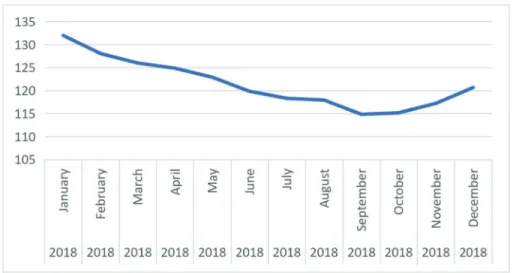
According to Yuliana and Pratomo (2016), to manage foreign exchange reserves, the Indonesian government has a precautionary motive. This precautionary motive emerged during the period when export promotion policies were implemented and strengthened in the period following the Asian financial crisis (AFC) and after the global financial crisis (GFC), which could impact foreign exchange conditions in Indonesia. Foreign exchange reserves in Indonesia have fluctuated, as shown in Figure 1. In January 2018, reserves amounted to US$131,980 billion, and then there was a decrease in February to the US$128,059 billion until September 2018, US$114,847 billion. In October 2018, there was an increase in the US$115,163 billion.
1. Introduction
Foreign exchange reserves are an essential aspect of the economy in each country. The growth and size of reserves serve as signals for global financial markets regarding the credibility of a country’s monetary policy and creditworthiness. Based on the concept of international reserves and foreign currency liquidity (IRFCL) issued by the IMF (2013), foreign exchange reserves are all foreign assets controlled by the monetary authority and can be used at any time. It is further explained that these reserves are a
1
First Author. Economics Department, Faculty of Economics, Universitas Sriwijaya, Indonesia. Email: [email protected]
2
Corresponding Author. Professor, Department of Economics, Faculty of Economics, Universitas Sriwijaya, Indonesia [Postal Address: Jln Inderalaya-Prabumulih, Rektorat Kampus Universitas Sriwijaya, KM 32, Inderalaya, Ogal Ilir, Sumatera Selatan, 30662, Indonesia] Email: [email protected]
3
Lecturer, Department of Economics, Faculty of Economics, Universitas Sriwijaya, Indonesia. Email: [email protected]
4
Lecturer, Department of Management, Faculty of Economics, Universitas Sriwijaya, Indonesia. Email: [email protected]
© Copyright: The Author(s)
This is an Open Access article distributed under the terms of the Creative Commons Attribution Non-Commercial License (https://creativecommons.org/licenses/by-nc/4.0/) which permits unrestricted non-commercial use, distribution, and reproduction in any medium, provided the original work is properly cited.