Received September 3, 2010; Revised November 1, 2010 ; Accepted November 13, 2010
Corresponding author: Kho, Kang Hee
Tel: +82 (61) 659-3192 e-mail: [email protected] 1225-3480/24361
*Present address: Fisheries Science Institute, Chonnam National University, Yeosu 550-749, Korea
피조개,
Scapharca broughtonii
(Schrenck) 정자의 동결보존라성주
*, 한경호, 최명락
1, 고강희
전남대학교 해양기술학부, 1전남대학교 생명화학공학부
Cryopreservation of Scapharca broughtonii (Schrenck) Sperm
Sung-Ju Rha
*, Kyeong-Ho Han, Myeong-Rak Choi
1and Kang-Hee Kho
Division of Marine Technology, Chonnam National University, Yeosu 550-749, Korea1Division of Biotechnology and Chemical Engineering, Chonnam National University, Yeosu 550-749, Korea
ABSTRACT
This study was conducted to investigate protocol standardization for spermatozoa cryopreservation of the
Scapharca broughtonii (Schrenck). Among the freezing rates, freezing at a height of 2 cm above liquid nitrogensurface for 5 minute gave higher activity and survival rate. Among the various diluents, Ringer's solution was the best for S. broughtonii sperm cryopreservation. The suitability of cryoprotectants dimethylsulfoxide (DMSO), dimethylacetamide (DMA), glycerol and methanol were tested against three freezing rates. DMSO gave significantly higher activity and survival rates than others.
Key words: Scapharca broughtonii (Schrenck), Spermatozoa, Cryopreservation
서 론
정자 동결보존은 이종 교잡, 선발육종, 다배체 및 종보존 등 많은 이점을 가지고 있으며 (Dong et al., 2005), 수산생물에 있어 개체 성숙의 시기제한 및 성비의 불균형, 대규모 산란장 의 필요를 극복할 수 있다. 특히, 양식대상의 종묘생산에서 어 미의 산란시기와 성비의 차이에 따른 문제, 웅성선숙 또는 어 획된 자연산 어미를 이용할 경우 정액의 확보나 수정과정에 효 과적으로 이용할 수 있는 장점이 있으며 (Lim et al., 1997) 산란시기에 집단으로 성성숙하는 종에 있어서는 매우 유용하 게 이용될 수 있다. 수산생물의 정자 동결보존은 이미 50여년 전 시작되었고 (Billard and Zhang, 2001), 담수어류 및 양 식산업종과 멸종위기 종 등에 대한 연구가 보고되었으나 육상 생물에 비하여 아직까지 미진하다 (Chao et al., 1975; Hara et al., 1982; McNiven et al., 1993; DeGraaf and Berlinsky, 2004; Billard et al., 2004; Lim et al., 2005).
최근 기후변화와 생태계변화에 따른 생물종의 보호 및 산업 적 응용을 위해 정자 동결보존은 많은 발전을 이루었으며, 주 로 육상생물과 인간을 대상으로 주로 연구가 진행되어왔으나 근래에는 해양생물의 보호와 수산산업에도 적용시키기 위한 연구가 수행되고 있다 (Muchlisin et al., 2004; Lanes et al., 2008; Vuthiphandchai et al., 2009; He and Woods, 2003; Butts et al., 2009). 특히, 담수 및 해양양식생물과 관 상어에 대한 연구는 더욱 활발히 진행되고 있으나 (Yao Z. et al., 2000; Zilli et al., 2003; Ding et al., 2009) 해양무척 추동물에 대한 연구는 매우 미비하다. 풍부한 자원량과 유전적 다양성을 가진 해양무척추동물에 대한 정자 냉동보존에 관한 연구는 진주조개, Pinctada fucata martensii (Kawamoto et al., 2007), 참굴, Crassostrea gigas (Usuki et al.
1997; Adams et al., 2004), Sicyonia ingentis (Anchordoguy et al., 1988), 지중해담치, Mytilus galloprovincialis (Di Matteo et al., 2009) 등 제한적으로 연구되어지고 있다.
해양무척추동물 중 피조개, Scapharca broughtonii (Schrenck) 는 우리나라 동해안 남부, 서남해안 연안의 니질 또는 사니질에 서식하고 있으며, 우수한 품질로 주요 수출 품 목이었으나, 자연채묘의 부진과 환경변화로 인해 1980년대 말 부터 생산량이 급감하고 있다 (Kim et al., 2006; Chun et
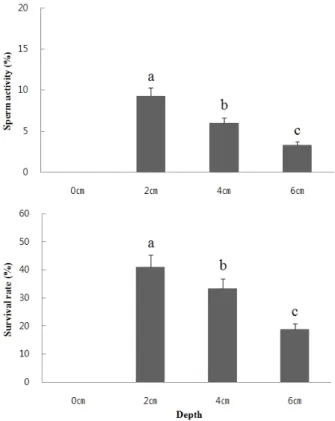
Fig. 1. Effect of feezing depths on the sperm activity and survival rate in cryopreservation of Scapharca broughtonii (Schrenck) sperm (p < 0.05).
al., 1991; Park et al., 2001; Kim et al., 2007). 특히, 연 안어장의 노화와 오염, 종패채묘의 부진, 간척, 매립 및 기후변 화로 큰 어려움을 겪고 있다. 따라서 본 연구에서는 산업적으 로 유용한 피조개 정자의 동결보존 가능성을 검토하여 해양무 척추동물의 보존과 종묘생산 과정에 이용 가능한 기초자료를 제공하고자 한다.
재료 및 방법
실험에 사용한 피조개, Scapharca broughtonii (Schrenck) 는 진해만에서 채집하여 실험실로 운반하여 48시 간 동안 여과해수에 수용하여 안정시켰으며, 각장 약 10 cm 내외의 성숙한 개체를 이용하였다. 피조개 정액 채취를 위해 패각을 분리한 후 생식소를 절개하였으며, 채취한 정액은 시험 관에 넣어 밀봉한 후 얼음을 채운 용기에 보관하였다. 채취한 정액 중 인공해수 (artificial sea water, ASW: 423.00 mM NaCl, 9.00 mM KCl, 9.27 mM CaCl2, 22.94 mM MgC12, 2.11 mM NaHCO3, 10 mM Hepes-pH 7.8) 에서 희석직후의 운동성이 높은 정액만을 실험에 사용하였다.
1. 동결높이에 따른 예비동결의 보존효과
동결높이에 따른 동결보존 효과를 확인하기 위하여 Ringer,s solution과 10% dimethylsulfoxide (DMSO) 를 각각 희석액과 동해방지제로 사용하였으며, 피조개 정액에 첨 가한 후 straw에 충전하였고, 충전된 straw는 액체질소 표면 으로부터 0, 2, 4, 6 cm 높이에서 각각 5분간 예비동결 후 액 체질소에 침지하였다. 침지시켜 동결한 피조개 정자는 24시간 경과한 후 해동하여 정자의 운동성과 생존율을 조사하여 동결 높이에 따른 효과를 조사하였다.
2. 희석액과 동해방지제
희석액에 따른 피조개 정자의 동결보존 효과를 조사하기 위 해 희석액으로 150 mM NaCl (10 mM Hepes-pH 7.8), 300 mM glucose (10 mM Hepes-pH 7.8), Ringer’s solution (230 mM NaCl, 8 mM KCl, 2 mM CaC12, 3.7 mM MgC12, 0.2 mM NaHCOs, 10 mM Hepes-pH 7.8) 를 사용하였으며 대조구로 원정액을 ASW에 희석하여 실험하 였다. 이때 동해방지제로는 DMSO를 동일하게 사용하였으며, DMSO의 농도는 15%로 하였고, 평형시간은 1분 이내로 하 였다.
또한, 동해방지제의 종류와 농도별 실험에서는 상기 실험결 과에 따라 최적 희석액을 이용하여 피조개 정자를 희석한 후 동해방지제로 glycerol, DMSO, DMA (dimethylacet -amide) 를 각각 5, 10, 15%의 농도가 되도록 희석액과 혼합 하였고, methanol은 5, 6, 7%의 농도가 되도록 혼합하여 실
험하였다. 평형시간은 1분 이내였으며, 해동한 정자의 운동성 과 생존율은 액체질소에 침지시켜 동결한 후 24시간 경과하여 조사하였다. 모든 동결보존 실험에서 정자의 동결은 희석정액 이 주입된 0.5 ml 용량의 straw를 동결높이에 따른 실험결과 를 토대로 5분간 1차 냉동한 다음,즉시 액체질소 (-196℃) 에 넣어 급속 동결하였다.
3. 정자운동성 및 생존율 측정
피조개 정자가 슬라이드 글라스에 달라붙는 것을 방지하기 위하여 1% 소 혈청액을 이용하여 슬라이드 글라스를 코팅한 후 정자의 운동성을 조사하였다. 동결보존의 각 실험별 정액의 처리조건에 따른 운동성을 평가하기 위해 각각의 실험에서 보 존한 희석정액을 인공해수와 1코팅5의 비율로 섞은 다음 광학 현미경으로 운동성을 측정하였으며, 5회 측정하여 평균을 구 하였다. 냉동보존한 정자의 생존여부는 정자를 5% eosin-l0%
nigrosin (Blom, 1950; Fribourgh, 1966) 에 염색하여 정 자의 염색정도에 따라 판별하였으며,광학현미경 (X 1,000) 상에서 5회 측정하여 전체 정자수에 대한 살아있는 정자수의 비율로 생존율을 구하였다. 실험결과는 일원분산분석 (One-way ANOA) 으로 검정하였다.
Fig. 2. Effects of various diluents on the sperm activity and survival rate in cryopreservation of Scapharca broughtonii (Schrenck) sperm (p < 0.05).
Fig. 3. Effect of cryoprotectants on the sperm activity and survival rate in cryopreservation of Scapharca broughtonii (Schrenck) sperm (P < 0.05).
결 과
1. 동결높이 따른 보존효과Ringer,s solution과 10% DMSO를 각각 희석제와 동해 방지제로 하여 액체질소 표면으로부터 0, 2, 4, 6 cm 높이에 서 5분간 각각 피조개 정액을 예비동결 후 액체질소에 침지시 켜 동결한 후 24시간 경과하여 피조개 정자의 동결보존효과를 확인한 결과 Fig. 1과 같다. 예비동결하지 않고 직접 동결한 실험구에서는 사멸한 것으로 나타났으며, 피조개 정자는 2 cm 의 높이에서 생존율과 정자의 운동성이 각각 평균 41.11%, 9.33%로 유의적으로 (p < 0.05) 높게 나타났고, 액체질소로 부터 높이가 증가할수록 보존효과가 감소하였다.
2. 희석액과 동해방지제
150 mM NaCl, 300 mM glucose, Ringer's solution를 희석액으로 동결보존한 피조개 정자의 생존율과 운동성을 조 사한 결과는 Fig. 2와 같다. 해동직후의 정자의 운동성은 Ringer's solution에서 28.33 ± 1.53%로 가장 높았으며, 150 mM NaCl에서 8.67 ± 2.08%로 가장 낮았다. 정자의 생존율 또한 Ringer's solution에서 50.33 ± 0.58%로 가장 높았고, 300 mM glucose에서 35.67 ± 1.15%로 가장 낮았 으며, 150 mM NaCl와 300 mM glucose 두 실험구에서 정 자의 운동성은 ASW와 비교하여 낮은 결과를 나타냈으나 생
존율에서는 높게 나타났다 (p < 0.05).
또한, 희석액별 실험에서 가장 높은 결과를 나타낸 Ringer's solution을 기본 희석액으로 glycerol, metanol, DMSO (dimethylsulfoxide), DMA (dimethylacetamide) 을 사용하여 각각 농도별 동해방지제의 효과를 실험한 결과 Fig. 2와 같다. DMSO 10% 실험구에서 28.71 ± 0.55%의 생존율과 11.50 ± 1.51%의 운동성을 보여 다른 실험구에 비 해 높은 결과를 보였으며 (p < 0.05), DMSO 5%와 15% 실 험구와도 큰 차이를 나타냈고, DMSO 10%와 15% 실험구는 정자 운동성에서 유의적 차이를 나타내지 않았으나 (p >
0.05), 생존율에서는 각각 12.27 ± 0.26%, 19.14 ± 0.77%
로 차이를 보였다. Methanol과 DMA 실험구에서는 각각 6%, 10% 농도에서 높은 생존율을 보였으나 11.78 ± 0.49, 17.34 ± 0.11%로 DMSO 10% 실험구와는 차이를 나타냈으 며 (p < 0.05), glyerol을 사용한 실험구에서는 5, 10, 15%
농도에서 모두 1%미만의 정자 운동성을 보여 가장 낮은 실험 결과를 보였으나, 생존율은 각각 3.43 ± 0.44%, 9.29 ± 0.52%, 15.08 ± 0.35%였다.
고 찰
피조개 S. broughtonii (Schrenck) 는 우리나라에 대표적 인 해양무척추동물로 과거부터 현재까지 식용되고 있으나 현 재는 생산량이 감소하여 이를 보호하기 위한 적극적인 대처가 필요하며, 정자 동결보존이 보다 효과적으로 이용될 수 있을 것이다. 정자 동결보존에는 희석액, 삼투압, 동해방지제, 평형 시간 및 해동온도 등이 주요한 요인으로 작용되며, 이 중 적정 희석액은 정자 동결보존을 위한 첫 과정으로 종에 따라 차이가 나타나 많은 종류의 희석액이 이용되고 있다 (Chang et al., 1997). 희석액으로 갖추어야 할 중요한 요인은 정자의 운동을 억제하여 에너지 소비를 줄이는데 있다 (Ohta and Izawa, 1996). 본 연구에서 피조개 정자는 Ringer's solution를 희석 액으로 사용한 실험구에서 높은 생존율과 운동성을 보였는데 동일선 상에서 비교하기는 어려우나 해양무척추동물인 말똥성 게, Hemicentrotus pulcherrimus에서는 ASW와 1.2M glucose가 적합한 희석액으로 보고하여 (Kho et al., 2003) 차이를 나타냈다. 또한, 어류인 가자미류에 관한 연구에서는 Stein's solution 이 가장 좋은 효과를 나타내었으며 (Chang et al., 2002), Hipplglossus hippoglossus에서는 Mounib's solution과 MFRS가 적합하다고 밝혔다 (Bolla et al., 1987). 따라서 종마다 적합한 희석액의 종류와 농도가 다르며, 정자의 활성을 효율적으로 억제하고 보존할 수 있는 다양한 희 석액의 탐색이 필요하다고 생각된다. 또한, 피조개 정자를 액 체질소 표면으로부터 높이를 달리하여 온도차를 이용한 동결 속도를 조절한 예비동결 후 침지하는 실험에서 표면에서 2 cm높이의 실험구에서 가장 높은 생존율과 운동성을 보였다.
Mazur and Cole (1985) 는 다양한 발단단계의 정자세포를 동결보존 할 때 가장 중요한 것은 동결속도라고 보고하였으며, 적절한 동결속도를 결정하기 위하여 액체질소 (Oettle, 1982;
Cristiansen, 1984) 의 표면으로부터 정자의 높이를 달리하 였다. 특히, 정 등 (2001) 은 동결속도에 따라 동결보호제의 삼투압, 투과성 및 유리 수분의 형성이 각기 달리 적용된다고 하였고 육상동물인 Shih-Tzu의 정자 동결 시 액체질소 표면 에서 6, 10, 17 및 20 cm 높이에서 예비동결하였는데, 이는 생물마다 특성이 다르므로 적정 동결속도의 구명이 정자 동결 보존에 큰 영향을 미친다고 사료된다.
정자의 운동성과 생존율을 근거로 동해방지제의 효과를 서 로 비교해보면, 피조개 정자의 동해방지제로는 DMSO 10%
에서 가장 좋은 결과를 보였다. 동해방지제는 분자량이 작아 세포내로 침투되는 투과성 동해방지제와 세포내로 침투되지 않는 비투과성 동해방지제로 구분되며, 투과성 또는 비투과성 동해방지제의 첨가방법 및 첨가수준은 각각 차이가 있다 (이와 김, 1999). 또한, 동해방지제는 중성물질이어야 하며, 친수성
이 강해야 하고, 세포막에 대한 투과성이 높아야 하며, 세포에 대한 독성이 적어야 한다 (Kuwano and Saga, 2000). 현재 동해방지제로서 DMSO, glycerol, ethylene glycol, proline, sucrose, sorbital, dextran 그리고 polyvinylpyrolidone 등 여러 가지 물질들이 사용되어지고 있다. 피조개 정자의 동해방지제로 DMSO 10%가 가장 좋은 결과를 나타내었는데 반해 Harvey (1983) 은 온수성 담수어 류의 정자를 동결보존할 때 DMSO가 동해방지제로서 부적합 하다고 밝힌 것과 비교하면 동해방지제의 종류에 따라 생물특 이적인 경향을 가진다고 사료된다. 모든 생물에서 공통적으로 사용될 수 있는 동해방지제는 아직 밝혀진 바 없으며, 동해방 지제가 세포 동결시 세포를 보호하는 자세한 기구에 관해서도 아직 잘 알려지지 않고 있다 (Kho, 2007). 본 연구에서는 피 조개 정자의 냉동보존을 위해 동결높이를 이용한 동결속도 조 절과 희석액, 동해방지제에 따른 운동성과 생존율을 조사하여 해양무척추동물 보존을 위한 기초 자료를 마련하였으나 정자 의 냉동보존에 있어 해동기구, 정자운동성 메카니즘, 정자의 구조, 이온의 역할 및 정액채취 조건과 환경조건 등 다양한 부 분에서 세밀한 연구가 앞으로 더욱 필요할 것이다.
요 약
피조개, Scapharca broughtonii (Schrenck) 정자의 동결 보존 위해 동결높이에 따른 예비동결 (0, 2, 4, 6 cm), 희석 제 (150 mM NaCl, 300 mM glucose, Ringer’s solution) 와 동해방지제(glycerol, dimethylsulfoxide (DMSO), dimethylacetamide (DMA), methaol) 에 따른 효과를 정 자의 운동성과 생존율로 비교하였다. 피조개 정자 동결보존에 있어 예비동결은 액체질소표면으로부터 2 cm가 가장 효과적 이었으며, 희석제로는 Ringer's solution이 동해방지제로는 DMSO 10% 농도가 가장 적합하였다.
사 사
이 논문은 2008년도 정부 (교과부) 의 재원으로 한국연구재 단의 지원을 받아 수행된 연구임 (2008-1566).
REFERENCES
Adams S.L., Smith J.F., Roberts R.D., Janke A.R., Kaspar H.F., Tervit H.R., Pugh P.A., Webb S.C. and King N.G. (2004) Cryopreservation of sperm of the Pacific oyster (Crassostrea gigas): development of a practical method for commercial spat production.
Aquaculture, 242: 271-282.
Anchordoguy T., Crowe J.H., Griffin F.J., Clark W.H. Jr.
(1988) Cryopreservation of sperm from the marine shrimp Sicyonia ingentis. Cryobiology, 25(3): 238-43.
Billard, R., J. Cosson, S.B. Noveiri and M. Pourkazemi
(2004) Cryopreservation and short-term storage of sturgeon sperm, a riview. Aquaculture, 236: 1-9.
Billard R. and Zhang T. (2001) Techniques of genetic resource banking in fish. In: P.F. Walson and W.V.
Holt, Editors, Cryobanking the Genetic Resource:
Wildlife Conservation for the Future. pp. 143–170, Taylor & Francis, New York
Blom E. (1950) A one-minute live-dead sperm stain by means ofeosin-nigrosin. Fertility and sterility, 1:
176-177.
Bolla S., Holmefjord I. and Refstie T. (1987) Cryogenic preservation of Atlantic halibut sperm. Aquaculture.
65: 371-374.
Butts A.E., E.A. Trippel and M.K. Litvak (2009) The effect of sperm to egg ratio and gamete contact time on fertilization success in Atlantic cod Gadus morhua L. Aquaculture, 286: 89–94.
Chang Y.J., Y.J. Chang and H.K. Lim (1997) Cryopreservation of Tiger puffer (Takifugu rubripes) sperm. Development and Reproduction, 1(1): 29-36.
[in Korean]
Chang Y.J., Y.J. Chang, H.K. Lim, J.K. Lee and Y.J.
Park (2002) Coldstorage of milt from four species of flatfish. Journal of Fisheries Science and Technology, 5: 64-74. [in Korean]
Chao N.H., H.P. Chen and I.C. Liao (1975) Study on cryogenic preservation of grey mullet sperm.
Aquaculture, 5: 389-406.
Chun Y.Y., Na G.H. and Choi E.J. (1991) Mass morta1ity of arkshell, Anadara broughtonii SCHRENCK seed1ing with marine ecological characteristics. Bulletin Korea Fisheris Society, 24:
70-78. [in Korean]
Christiansen I.J. (1984) Part 1. Andrology of the normal male. In Reprodudtion in the Dog and Cat. pp 80-109. Bailliere Tindal, London.
DeGraaf J.D. and D.L. Berlinsky (2004) Cryogenic and refrigerated storage of Atlantic cod (Gadus morhua) and haddock (Melanogrammus aeglefinus) spermatozoa.
Aquaculture, 234: 527-540.
Di Matteo O., Langellotti A.L., Masullo P., Sansone G.
(2009) Cryopreservation of the Mediterranean mussel (Mytilus galloprovincialis) spermatozoa.
Cryobiology, 58(2): 145-50.
Ding S., Ge J., Hao C., Zhang M., Yan W., Xu Z., Pan J., Chen S., Tian Y. and Huang Y. (2009) Long-term cryopreservation of sperm from Mandarin fish Siniperca chuatsi. Animal Reproduction Science, 113(1-4): 229-235.
Dong Q., Huang C., Eudeline B. and Tiersch T.R.
(2005) Tierscha. Systematic factor optimization for cryopreservation of shipped sperm samples of diploid Pacific Oysters, Crassostrea gigas. Cryobiology, 51(2): 176-97.
Fribourgh, J.H. (1966) The app1ication of a differentia1 staining method to 10w-temperature studies on goldfish spermatozoa. Progressive Fish-Culturist, 28:
227-231.
Hara S., J.T. Canto and J.M.E. Almendras (1982) A comparative study of various extenders for milkfish, Chanos chanos (Forsskal), sperm preservation.
Aquaculture, 28: 339-346.
Harvey B. (1983) Cryopreservation of Sarotherodon mossambicus spermatozoa. Aquaculture, 32: 313-320.
He S. and L.C. Woods III (2003) Effects of glycine and alanine on short-term storage and cryopreservation of striped bass (Morone saxatilis) spermatozoa.
Cryobiology, 46: 17–25.
Kawamoto T., Narita T., Isowa K., Aoki H., Hayashi M., Komaru A., Ohta H. (2007) Effects of cryopreservation methods on post-thaw motility of spermatozoa from the Japanese pearl oyster, Pinctada fucata martensii. Cryobiology, 54(1): 19-26.
Kho K.H., Kang K.H. and Kim J.M. (2003) Effect of diluents on the cold storage of sperm in sea urchin, Hemicentrotus pulcherrimus. Development and Reproduction, 7(1): 9-13. [in Korean]
Kho K.H. (2007) Milt property and sperm motility of panther puffer, Takifugu pardalis. Korean Journal of Ichthyology, 19(2): 168-172. [in Korean]
Kim B.H., Min K.S., Lee S.J., Park K.Y., An C.M., and Min B.H. (2006) Effect of Temperature on Induced Sexual Maturation of the arkshell, Scapharca broughtonii (Schrenck) broodstock. The Korean Journal of Malacology, 22(2): 175-182. [in Korean]
Kim J.B., Lee S.Y., Jung C.G., Jung C.S. and So S.G.
(2007) The effects of the spat planting time and environmental factors in the arkshell, Scapharca broughtonii Schrenck culture. Journal of Aquaculture, 20(1): 31-40. [in Korean]
Kuwano K. and N. Saga (2000) Cryopreservation of marine algae: Cryopreservation of marine algae:
Applications in biotechnology. In: Figerman, M. and R. Nagabhusshanam. ed. Recent advances in marine biotechnology. Volume 4: Aquaculture. Part A, Seaweeds and invertebrates. pp. 23-40. Science Pubulishers Inc., New Hampshire.
Lanes C.F.C., Okamoto M., Cavalcanti P.V., Collares T., Campos V.F., Deschamps J.C., Robaldo R.B., Marins L.F. and Sampaio L.A. (2008) Cryopreservation of Brazilian fl ounder (Paralichthys orbignyanus) sperm. Aquaculture. 275: 361-65
Lim H.K., Kho K.H. and Chang Y.J. (1997) Effect of diluents on the short-term storage of sperm in Black seabream, Acanthopagrus schlegeli. Journal of the Korean Fisheries Society, 30(2): 211-215.
Lim H.K., C.M. An, M.H. Son, M.W. Park and Y.J. Park (2005) Effect of diluents for cold storage of olive flounder (Paralichthys olivaceus) sperm. Journal of the Korean Fisheries Society, 38: 232-238.
Mazur P. and Cole K.W. (1985) Influence of cell concentration on the contribution of unfrozen fraction and salt concentration to the survival of slowly frozen human erythrocytes. Cryobiology, 22:
509-536.
McNiven M.A., R.K. Gallant and G.F. Richardson (1993)
Fresh storage of rainbow trout (Oncorhynchus mykiss) semen using a non-aqueous medium.
Aquaculture, 109: 71-82.
Muchlisin Z.A., R. Hashim and A.S.C. Chong (2004) Preliminary study on the cryopreservation of tropical bagrid catfish (Mystus nemurus) spermatozoa; the effect of extender and cryoprotectant on the motility after short-term storage, Theriogenology, 62: 25-34.
Ohta H. and T. Izawa (1996) Diluent for cool storage of Japanese eel (Anguilla japonica) spermatozoa.
Aquaculure, 142: 107-118.
Oettle E.E. (1982) Preliminary report: a pregnancy from frozen centrifuged dog semen. Journal of the South African Veterinary Association, 53: 269-270.
Park M.S., Kang C.K. and Lee P.Y. (2001) Reproductive cycle and biochemical composition of the ark shell Scapharca broughtonii (Schrenck) in a southern coastal bay of Korea. Journal of shellfish research, 20: 51-59.
Usuki H., M. Hamaguchi and H. Ishioka (1997) Long-term cryopreservation of Pacific oyster,
Crassostrea gigas, sperm. Bulletin of Nansei National Fisheries Research Institute, 30: 115–123 [in Japanese with English abstracts]
Vuthiphandchai V., Thadsri I. and Nimrat S. (2009) Chilled storage of walking catfish (Clarias macrocephalus) semen. Aquaculture, 296(1-2): 58-64.
Yao Z., L.W. Crim, G.F. Richardson and C.J. Emerson (2000) Motility, fertility and ultrastructural changes of ocean pout (Macrozoarces americanus L.) sperm after cryopreservation. Aquaculture, 181(3-4):
361-375.
Zilli L., R. Schiavone, V. Zonno, C. Storelli and S.
Vilella (2003) Evaluation of DNA damage in Dicentrarchus labrax sperm following cryopreservation. Cryobiology, 47(3): 227-235.
이장희, 김인철 (1999) 돼지정자의 동결융해 후 활력 및 생존성 에 대한 보존액, 동해보호제, 예비동결 및 동결처리시간의 영향. 한국동물번식학회지, 23: 165-174.
정정란, 유재규, 양성열, 여현진, 박종식 (2001) 개 정자의 보존 방법에 따른 첨체 및 생존성의 변화 II. 동결보존에 따른 효 과. 한국수정란이식학회지, 16(2): 133-138.