—75—
INTRODUCTION
Cryopreservation is a process where biological sam- ples, such as cells or tissues, are preserved by cooling to sub-zero temperatures. It is an effective method for long- term storage of sperm and used in breeding strategies of numerous animal species (Gañán et al., 2009; Anzar et al., 2010; Hu et al., 2010). Preservation of spermatozoa at low temperatures was initially reported by Polge et al.
(1949), where in a brief article they stated that the addi- tion of 20% glycerol to the freezing process achieved high survival rates for human and fowl sperm after thaw- ing. Cryopreservation offers benefits in aquaculture and experimental studies related to protecting stocks from ex- tinction due to sudden disease outbreaks, natural disas- ters, or anthropogenic factors by making top-quality gamete and larvae available year-round, and providing greater ease in conducting selective breeding for disease resistance, preserving desirable characteristics and esta- blishing gene banks (Chang et al., 1997; Chang, 1998;
Bart, 2000; Chao and Liao, 2001). Cryopreservation techniques of fish sperm is well established in many spe-
cies, including puffer, sea bass, mandarin fish, cod, zebra- fish and carp (Mounib, 1978; Gwo et al., 1993; Babiak et al., 1995; Fauvel et al., 1998; Linhart et al., 2000;
Ding et al., 2009; Jinga et al., 2009), but only in a limit- ed number of shellfish such as several commercially important species, abalone, mud crab, Mytilus gallopro- vincialis, oyster, marine shrimp (Jeyalectumie and Sub- ramonian, 1989; Tsai and Chao, 1994; McFadzen, 1995;
Adams et al., 2004; Kawamoto et al., 2007; Vuthiphand- chai et al., 2007; Matteo et al., 2009).
Bar-tailed is one of the most important commercial species in the Korean fisheries industry (Yoon, 2008).
However, there remains a paucity of data on standardized procedure for cryopreservation of sperm. The present study attempted to identify an optimized method of sperm cryopreservation with various cryoprotectants at different freezing rates and thawing rates. Sperm motility and sur- vival rates were assessed post-thawing in order to decide on the best procedure.
MATERIALS AND METHODS
Bar-tailed flatheads were captured from shallow areas near Yeosu city, Jeonnam province, Korea in July 2008
Practical Procedure of Sperm Cryopreservation of the Bar-tailed Flathead Platycephalus indicus
By Do Hyung Kim, Il Keun Kong
1, Sung Ju Rha
2, Ji Won Yun
2, Kyeong Ho Han and Kang Hee Kho*
Department of Aquatic Biology, College of Fisheries and Ocean Sciences, Chonnam National University, Yeosu 550-749, Korea
1Department of Animal Science, College of Agriculture and Life Science, Gyeongsang National University, Jinju 660-701, Korea
2Fisheries Science Institute, Chonnam National University, Yeosu 550-749, Korea
ABSTRACT This study was conducted to investigate protocol standardization for cryopreservation spermatozoa of the bar-tailed flathead Platycephalus indicus. The suitability of the cryoprotectants, dimethyl sulphoxide (DMSO), glycerol and methanol were tested against three freezing rates and three thawing temperatures. DMSO and glycerol gave significantly higher motile index and survival rates than methanol. Among the freezing rates, freezing at a height of 2 cm above LN2surface for 10 min--1gave higher motile index and survival rates. In terms of best thawing temperature, 20��C obtained the highest motility.
Key words : Platycephalus indicus, bar-tailed flathead, spermatozoa, cryopreservation, cryoprotectants
*Corresponding author: Kang Hee Kho Tel: 82-61-659-3192, Fax: 82-61-659-3169, E-mail: [email protected]
Accepted : March 25, 2011
http://www.fishkorea.or.kr
and transported to the laboratory. Semen was collected by abdominal stripping and stored in polyethylene tubes on crushed ice until use.
1. Motility estimation
Percentage of sperm exhibiting rapid, vigorous and forward movement was evaluated under a microscope by diluting sperm samples in Artificial SeaWater (ASW;
423.00 mM NaCl, 9.00 mM KCl, 9.27 mM CaCl2, 22.94 mM MgCl2, 2.114 mM NaHCO3, 10 mM HEPES-pH 7.8) at a ratio of 1 : 1000 (Table 1). Samples with high moti- lity were kept on crushed ice until use for the experi- ments outlined below.
2. Cryopreservation of sperm
DMSO (dimethyl sulfoxide), glycerol or Methanol was added to 36% ASW to formulate the extenders at concen- trations between 5 and 15% of total volume. Sperm was diluted 1 : 3 with the extenders. The diluted sperm was inserted into 0.5 mL plastic straws and frozen at differ- ent freezing temperatures according to the method of Bo- uysson and Chupin (1982). The straws were then placed in a polystyrene box at 2 mm, 4 mm and 6 mm above liquid nitrogen. The straws were thawed in a 30�Cwater bath for 2 min. Survival rate was also estimated by the eosin-nigrosin staining technique.
To determine the optimum thawing temperature, frozen tubes were thawed in a water bath at different tempera- tures of 10�C, 20�C or 30�C.
RESULTS AND DISCUSSION
On contact with ASW, sperm became immediately activated and reached maximum motility. Vigorous for- ward movement was constant for about 10 sec, after which sperm lost total motility.
1. Cryoprotectant trial
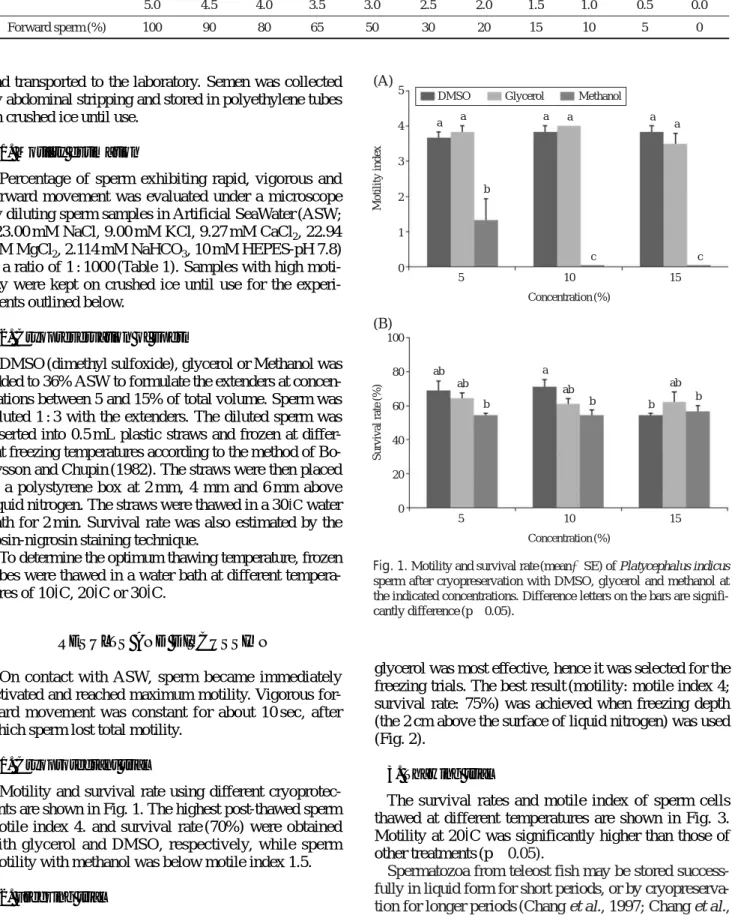
Motility and survival rate using different cryoprotec- tants are shown in Fig. 1. The highest post-thawed sperm motile index 4. and survival rate (70%) were obtained with glycerol and DMSO, respectively, while sperm motility with methanol was below motile index 1.5.
2. Freezing trial
Results of cryoprotectants trial indicated that 10%
glycerol was most effective, hence it was selected for the freezing trials. The best result (motility: motile index 4;
survival rate: 75%) was achieved when freezing depth (the 2 cm above the surface of liquid nitrogen) was used (Fig. 2).
3. Thawing trial
The survival rates and motile index of sperm cells thawed at different temperatures are shown in Fig. 3.
Motility at 20�C was significantly higher than those of other treatments (p⁄0.05).
Spermatozoa from teleost fish may be stored success- fully in liquid form for short periods, or by cryopreserva- tion for longer periods (Chang et al., 1997; Chang et al., 1999; Daly et al., 2008; Yasui et al., 2009; Cabrita et al.,
Table 1. Motile index in relation to percentage of sperm with rapid, vigorous and forward movement Motility index
5.0 4.5 4.0 3.5 3.0 2.5 2.0 1.5 1.0 0.5 0.0
Forward sperm (%) 100 90 80 65 50 30 20 15 10 5 0
Fig. 1. Motility and survival rate (mean±SE) of Platycephalus indicus sperm after cryopreservation with DMSO, glycerol and methanol at the indicated concentrations. Difference letters on the bars are signifi- cantly difference (p⁄0.05).
Motility indexSurvival rate(%)
5
4
3
2
1
0
100
80
60
40
20
0
5 10 15
Concentration (%)
5 10 15
Concentration (%)
(A)
(B)
a
ab
ab ab
ab
b b b b
a
a a a
DMSO Glycerol Methanol
c c
a a
b
2010). Overall, spermatozoa storage in marine species has received considerably less attention than freshwater species. This study provides detailed information on cryopreservation of semen in the bar-tailed flathead.
The application of sperm cryopreservation in aquatic animals is a possible tool in conservation and manage- ment of endangered species. Initiation of sperm motility is triggered primarily by environmental signals. Motility of spermatozoa usually occurs immediately after release into the environment, where chemical conditions are dif- ferent to seminal plasma (Kho et al., 2001; Wojtczak et al., 2003; Lahnsteiner, 2007).
Immobilizing solutions, such as 1% NaCl, 0.3 M glu- cose, diluted seawater, and other solutions whose com- position are similar with seminal plasma, are often used as diluents in short-term preservation and cryopreserva- tion of fish sperm (Blaxter, 1953; Chang et al. 1999;
Fabbrocini et al., 2000; Yao et al., 2000). Motility of bar-tailed flathead sperm was short-lived and only con- stant for about 10 sec after activation with ASW. An immobilization solution is necessary prior to cryopreser- vation so as to avoid excessive expenditure of energy by sperm through movement (Gwo, 1994). In this study, results of motility estimation showed that 36% diluted ASW was enough to inhibit sperm movement and ensure restoration of motility after re-activation.
Generally, Freezing and thawing of sperm caused struc- tural damage to spermatozoan organelles. Post-thaw sper- matozoa appeared to have undergone considerable da- mage to cellular structures such as plasma membrane, nucleus, mitochondria, and flagellum, due to stress caused by heat shock, ice crystals, and excessive dehydration during freezing (Gwo and Arnold, 1992; Watson, 1995).
This damage appears to correspond well to reduced sper- matozoan motility and fertility (Gwo and Arnold, 1992), which are used as evaluation parameters of sperm cryo- preservation. In fact, many authors have linked the per- centage of motile sperm and quality of movement to fertilization success rate (Lahnsteiner et al., 1996a, b, c).
In the present study, results of sperm motilities and sur- vival rates were little less than those of fresh sperm, while the best post-thawing motility and survival rate was obtained by using 5% and 10% DMSO and glycerol, respectively, and freezing at 2 cm above liquid nitrogen.
In addition, comparisons of motility between treatments showed that thawing at 20�C obtained the best results.
REFERENCES
Adams, S.L., J.F. Smith, R.D. Roberts, A.R. Janke, H.F.
Kaspar, H.R. Tervit, P.A. Pugh, S.C. Webb and N.G.
Fig. 2. Motility and survival rate (mean±SE) of Platycephalus indicus sperm after cryopreservation at three depths. Difference letters on the bars are significantly difference (p⁄0.05).
Fig. 3. Effects of thawing temperature on motility and survival rate (mean±SE) of Platycephalus indicus sperm. Difference letters on the bars are significantly difference (p⁄0.05).
Motility indexSurvival rate(%)
5
4
3
2
1
0
100
80
60
40
20
0
2 4 6
Depth (cm)
2 4 6
Depth (cm)
(A)
(B)
a
a
c a
b
b
Motility indexSurvival rate(%)
100
80
60
40
20
0 5
4
3
2
1
0 10 20 30
Temperature (�C)
10 20 30
Temperature (�C) b
b a
(A)
(B)
King. 2004. Cryopreservation of sperm of the Pacific oyster (Carassostrea gigas): development of a practi- cal method for commercial spat production, Aquacul- ture, 242: 271-282.
Anzar, M., Z. Rasul, T.A. Ahmed and N. Ahmad. 2010. Res- ponse of buffalo spermatozoa to low temperatures during cryopreservation. Reprod. Fertil. Dev., 22:
871-880.
Babiak, I., J. Glogowsky, E. Brzuska, J. Szumiec and J. Ada- mek. 1995. Cryopreservation of sperm of common carp, Cyprinus carpio. Aquac. Res., 28: 567-571.
Bart, A.N. 2000. New Approaches in Cryopreservation of Fish Embryos. In: Tiersch, T.R. and P.M. Mazik (eds.), Cryopreservation in Aquatic Species. World Aquaculture Society, Baton Rouge, Louisiana, pp.
179-187.
Blaxter, J.H.S. 1953. Sperm storage and cross fertilization of spring and autumn spawning herring. Nature, 172:
1189-1190.
Bouysson, B. and D. Chupin. 1982. Two step freezing of cattle blastocysts with dimethylsulfoxide (DMSO) or glycerol. Theriogenology, 17: 159-166.
Cabrita, E., S. Engrola, L.E.C. Conceição, P. Pousão-Ferreira and M.T. Dinis. 2010. Successful cryopreservation of sperm from sex-reversed dusky grouper, Epinephe- lus marginatus. Aquaculture, 287: 152-157.
Chang, Y.J. 1997. Present and future studies on the cryopre- servation of fish gametes. Suisanzoshoku, 45: 557- 564.
Chang, Y.J., Y.H. Choi, H.K. Lim and K.H. Kho. 1999. Cold storage and cryopreservation of grey mullet (Mugil cephalus) sperm. J. Aquaculture, 12: 57-62. (in Ko- rean)
Chang, Y.J., Y.J. Chang and H.K. Lim. 1997. Short-term preservation of sperm in the tiger puffer, Takifugu rubripes. J. Aquaculture, 10: 273-279. (in Korean) Chang, Y.J., Y.J. Chang and H.K. Lim. 1998. Physico-che-
mical properties of milt and fine structure of cryo- preserved spermatozoa in tiger puffer (Takifugu rub- ripes). J. Korean Fish. Soc., 31: 353-358.
Chao, N.H. and I.C. Liao. 2001. Cryopreservation of finfish and shellfish gametes and embryos. Aquaculture, 197:
161-189.
Daly, J., D. Galloway, W. Bravington, M. Holland and B.
Ingram. 2008. Cryopreservation of sperm from Mur- ray cod, Maccullochella peelii peelii. Aquaculture, 285: 117-122.
Ding S., J. Ge, C. Hao, M. Zhang, W. Yan, Z. Xu, J. Pan, S.
Chen, Y. Tian and Y. Huang. 2009. Long-term cryo- preservation of sperm from Mandarin fish Siniperca chuatsi. Anim. Reprod. Sci., 113: 229-235.
Fabbrocini, A., S.L. Lavadera, S. Rispoli and G. Sansone.
2000. Cryopreservation of seabream (Sparus aurata) spermatozoa. Cryobiology, 40: 46-53.
Fauvel, C., M. Suquet, C. Dreanno, V. Zonno and B. Menu.
1998. Cryopreservation of sea bass (Dicentrachus labrax) spermatozoa in experimental and production conditions. Aquat. Living Resour., 11: 387-394.
Gañán, N., M. Gomendio and E.R. Roldan. 2009. Effect of storage of domestic cat (Felis catus) epididymides at 5 degrees C on sperm quality and cryopreservation.
Theriogenology, 72: 1268-1277.
Gwo, J.C. 1994. Cryopreservation of yellowfin seabream (Acanthopagrus latus) spermatozoa (teleost, perci- formes, sparides). Theriogenology, 41: 989-1004.
Gwo, J.C. and C.R. Arnold. 1992. Cryopreservation of atlan- tic croaker spermatozoa: Evalution of morphological changes. J. Exp. Zool., 264: 444-453.
Gwo, J.C., H. Kurokura and R. Hirano. 1993. Cryopreserva- tion of spermatozoa from rainbow trout, common carp and marine puffer. Nippon Suisan Gakk., 59: 777-782.
Hu, J.H., W.Q. Tian, X.L. Zhao, L.S. Zan, H. Wang, Q.W.
Li and Y.P. Xin. 2010. The cryoprotective effects of ascorbic acid supplementation on bovine semen quali- ty. Anim. Reprod. Sci., 121: 72-77.
Jeyalectumie, C. and T. Subramoniam. 1989. Cryopreserva- tion of spermatophores and seminal plasma of the edible crab, Scylla serrata. Biol. Bull., 177: 247-253.
Jinga, R., C. Huanga, C. Baia, R. Tanguaya and Q. Donga.
2009. Optimization of activation, collection, dilution, and storage methods for zebrafish sperm. Aquaculture, 290: 165-171.
Kawamoto, T., T. Narita, K. Isowa, H. Aoki, M. Hayashi, A.
Komaru and H. Ohta. 2007. Effects of cryopreservat- ion methods on post-thaw motility of spermatozoa from the Japanese pearl oyster, Pinctada fucata mar- tensii. Cryobiology, 54: 19-26.
Kho, K.H., S. Tanimoto, K. Inaba, Y. Oka and M. Morisawa.
2001. Transmembrane cell signaling for the initiation of trout sperm motility: Roles of ion channels and membrane hyperpolarization for cyclic AMP synthe- sis. Zool. Sci., 18: 919-928.
Lahnsteiner, F. 2007. Characterization of seminal plasma pro- teins stabilizing the sperm viability in rainbow trout (Oncorhynchus mykiss). Anim. Reprod. Sci., 97: 151- 164.
Lahnsteiner, F., B. Berger, T. Wiesmann and R. Patzner.
1996a. Changes in morphology, physiology, metabo- lism, and fertilization capacity of rainbow trout semen following cryopreservation. Prog. Fish. Cult. 58: 149- 159.
Lahnsteiner, F., R. Patzner and T. Wiesmann. 1996b. Semen cryopreservation of salmonid fish: Influence of hand- ling parameters on the post-thawing fertilization rate.
Aquac. Res., 27: 659-671.
Lahnsteiner, F., B. Berger, T. Wiesmann and R. Patzner.
1996c. The influence of various cryoprotectants on semen quality of the rainbow trout (O. mykiss) before and after cryopreservation. J. Appl. Ichthyol., 112:
99-106.
Linhart, O., M. Rodina and J. Cosson. 2000. Cryopreservat- ion of sperm in common carp Cyprinus carpio: sperm motility and hatching success of embryos. Cryobiolo- gy, 41: 241-250.
Matteo, O.D., A.L. Langellotti, P. Masullo and G. Sansone.
2009. Cryopreservation of the Mediterranean mussel (Mytilus galloprovincialis) spermatozoa. Cryobiolo- gy, 58: 145-150.
McFadzen, I.R.B. 1995. Cryopreservation of the sperm of the pacific oyster, Crassostrea gigas. In: Day, J.G. and M.R. Mclellan, (ed.), Methods in Molecular Biology, Vol. 38 Humann Press, Totowa, NJ, pp. 145-149.
Mounib, M.S. 1978. Cryogenic preservation of fish and mam- malian spermatozoa. J. Reprod. Fertil. 53: 13-18.
Polge, C., A.U. Smith and A.S. Parks. 1949. Revival of sper- matozoa after vitrification and dehydration at low temperatures. Nature, 164: 666.
Tsai, H.P. and N.H. Chao. 1994. Cryopreservation of small abalone (Haliotis diversicolor) sperm-technique and its significance. J. Fis. Soc. Taiwan, 21: 347-360.
Vuthiphandchai, V., S. Nimrat, S. Kotcharat and A.N. Bart.
2007. Development of a cryopreservation protocol for long-term storage of black tiger shrimp (Penaeus mo- nodon) spermatophores. Theriogenology, 68: 1192- 1199.
Yao, Z., L.W. Crim, G.F. Richardson and C.J. Emerson.
2000. Motility, fertility and ultrastructural changes of ocean pout (Macrozoarces americanus L.) sperm after cryopreservation. Aquaculture, 181: 361-375.
Yasui, G.S., L. Arias-Rodriguez, T. Fujimoto and K. Arai.
2009. A sperm cryopreservation protocol for the loach Misgurnus anguillicaudatus and its applicability for other related species. Anim. Reprod. Sci., 116: 335- 345.
Yoon, J.W. 2008. Reproductive ecology and early develop- ment of Platycephalus indicus, in Korea. PhD thesis, Chonnam National University, 102pp. (in Korean) Watson, P.E. 1995. Recent developments and concepts in the
cryopreservation of spermatozoa and the assessment of their post-thawing function. Reprod. Fertil. Dev., 7: 871-891.
Wojtczak, M., J. Glogowski, M. Kodras, D. Kucharczyk and A. Ciereszko. 2003. Characterization of protease in- hibitors of seminal plasma of cyprinids. Aquat. Living Resour., 6: 461-465.
양태, Platycephalus indicus의 정자의 냉동보존
김도형∙공일근1∙라성주2∙윤지원2∙한경호∙고강희
전남대학교 수산해양대학 양식생물학과, 1경상대학교 농업생명과학대학 축산학과,
2전남대학교 수산과학연구소
요 약 :양태, Platycephalus indicus 정자의 동결보존을 위해 적정 동해방지제와 동결높이에 따른 예비동결(0, 2, 4, 6 cm), 그리고 해동온도에 따른 정자의 운동성과 생존율로 비교하였다. 적정 동해방지제로 dimethylsulphoxide (DMSO), glycerol, methanol에 대해 실험하였으며, DMSO와 glycerol에서 methanol에 비하여 높은 생존율과 운 동성을 나타내었다. 또한, 동결보존에 있어 예비동결은 액체질소표면으로부터 2 cm 높이에서 높은 생준율과 운동 성을 보였고, 해동온도로는 20�C가 가장 적합하였다.
찾아보기 낱말 :Platycephalus indicus, 양태, 정자, 동결보존