Veterinary Science
*Corresponding author
Tel: +82-55-751-5512; Fax: +82-55-756-7171 E-mail: [email protected]
Enhanced tyrosine hydroxylase expression in PC12 cells co-cultured with feline mesenchymal stem cells
Guang-Zhen Jin
1, Xi-Jun Yin
4, Xian-Feng Yu
4, Su-Jin Cho
1, Hyo-Sang Lee
4, Hyo-Jong Lee
3, Il-Keun Kong
1,2,*
1Division of Applied Life Science, 2Institute of Agriculture and Life Science, 3College of Veterinary Medicine, Gyeongsang National University, Jinju 660-701, Korea
4Department of Animal Science & Technology, Sunchon National University, Suncheon 540-742, Korea
Mesenchymal stem cells (MSCs) secrete a variety of neu- roregulatory molecules, such as nerve growth factor, brain-derived neurotrophic factor, and glial cell-derived neurotrophic factor, which upregulate tyrosine hydrox- ylase (TH) gene expression in PC12 cells. Enhancing TH gene expression is a critical step for treatment of Parkinson's disease (PD). The objective of this study was to assess the effects of co-culturing PC12 cells with MSCs from feline bone marrow on TH protein expression. We divided the study into three groups: an MSC group, a PC12 cell group, and the combined MSC + PC12 cell group (the co-culture group). All cells were cultured in DMEM-HG medium supplemented with 10% fetal bovine serum for three days. Thereafter, the cells were examined using western blot analysis and immunocytochemistry. In western blots, the co-culture group demonstrated a stron- ger signal at 60 kDa than the PC12 cell group (p < 0.001).
TH was not expressed in the MSC group, either in western blot or immunocytochemistry. Thus, the MSCs of feline bone marrow can up-regulate TH expression in PC12 cells. This implies a new role for MSCs in the neuro- degenerative disease process.
Key words: co-culture, feline bone marrow, mesenchymal stem cell, rat PC12 cell, tyrosine hydroxylase
Introduction
Parkinson's disease (PD) is characterized by a loss of dop- amine in the striatum resulting from the progressive degen- eration of dopaminergic neurons within the substantia ni- gra [20]. Tyrosine hydroxylase (TH) is the rate-limiting en- zyme in the synthesis of catecholamine, and is widely used as a marker of dopaminergic cells [23]. Tang et al. [32]
have shown that dopaminergic differentiation of stria- tum-derived precursor cells following transplantation re- quires TH induction. Furthermore, Lu et al. [16] observed significant functional recovery in rats model of PD receiv- ing TH-engineered mesenchymal stem cells transplanted into the striatum. Moreover, Peschanski et al. [25] have demonstrated bilateral motor improvement in two patients with PD after grafting of fetal mesencephalic tissue.
Therefore, enhancing TH gene expression or protein pro- duction is a critical step for treatment of PD.
The PC12 cell line is a neural crest-derived adrenal chro- maffin cell line obtained from a rat pheochromocytoma.
PC12 cells serve as a useful model system for studying the molecular mechanisms responsible for sympathetic neuro- nal differentiation induced by nerve growth factor (NGF) because they can synthesize and store the catecholamine neurotransmitters dopamine and norepinephrine [8].
Mesenchymal stem cells (MSCs) derived from bone mar- row can differentiate into osteoblasts, chondrocytes, adi- pocytes [26], and neural cells [15,24]. In addition, MSCs express neuroregulatory molecules, such as NGF, brain- derived neurotrophic factors (BDNF), and glial cell-de- rived neurotrophic factors (GDNF) [5,6,14,17,18]. NGF can upregulate TH gene expression in PC12 cells [7,13].
Others have reported that induction of TH gene expression can be achieved by co-treatment fetal cerebral cortex with dopamine and BDNF [37,38]. Therefore, novel methods of inducing TH expression via treatment with growth factors, either directly or through cell co-cultures, has significant potential.
Co-cultures of two different cell types provide insight in- to mechanisms of cell-cell interactions. Direct-contact co-cultures can promote more mature differentiation of neural stem cells [30], which also involves the ex- tracellular matrix or soluble factors secreted by supporting cells [1,30,31]. Moreover, direct contact cultures better mimic intracerebral grafting in terms of the cell-cell interactions.
cells were isolated from the collected samples by the Ficoll 400 (Sigma, USA) density gradient method. The cells were then rinsed twice with PBS, and grown in Dulbeco's Modified Eagle high glucose medium (DMEM, 4.5 g/l glu- cose; Gibco-BRL, USA) with 10% fetal bovine serum (FBS; Gibco-BRL, USA) and penicillin/streptomycin (50 IU/ml / 50 µg/ml; Sigma, USA). After 5 days, the resulting monolayer of cells, hereafter named bone marrow-derived MSCs, was trypsinized and aliquots were frozen and stored or cultivated further.
Co-culture of PC12 cells and MSCs
MSCs were from passage 4. The study was divided into three experimental groups: a MSC group, a PC12 cell group, and the combined MSC + PC12 cell group. The cells were seeded at 1.5 × 10⁵ cells of each cell type (3 × 10⁵ total in the combined group) onto 60 mm dishes and grown in DMEM supplemented with 10% FBS and penicillin/
streptomycin (50 IU/ml / 50 µg/ml). Cells were incubated at 37 °C in a humidified atmosphere of 5% CO2 for 3 days.
Flow cytometric determination of cell-surface anti- gen profile
Ten microliters of CD9 (Serotec, USA), CD18, CD44, and CD45-like (VMRD, USA) cat-specific antibodies were added to the bottom of tubes, followed by 100 µl of 6
× 106 cells/ml single cell suspensions of cultured MSCs in the 4th passage. The mixture was incubated for 30 min at 4°C in the dark and washed. Five microliters fluo- rescent-tagged secondary antibodies were then added to the resuspended cells for 30 min at 4°C in the dark. Positive cells were then detected on flow cytometers.
Immunocytochemistry of MSCs and TH expression in PC12 cells
To identify MSCs from feline derived bone marrow, the primary chicken anti-vimentin antibody (1 : 5,000, poly- clonal; Chemicon, USA) was employed; the secondary an- tibody was a FITC-conjugated antibody against chicken
secondary antibodies were used at the same concentrations as the primary antibodies. The slides were examined with an microscope (Olympus, Japan) equipped with fluo- rescent illumination.
Western blots of TH protein
Western blot analysis was performed to determine wheth- er the presence of MSCs affected TH protein expression in PC12 cells. The cells were lysed using a SDS-sample buffer. After ultracentrifugation (12,000 rpm/4°C/10 min), the supernatant was collected. Fifteen μg of protein was separated by SDS-PAGE and transferred to a PVDF mem- brane (Bio-Rad, USA). Immunoreactions were performed with antibodies against TH (1 : 500, polyclonal; Chemicon, USA) and GAPDH (1 : 300, monoclonal; Chemicon, USA). The membrane was washed and incubated with horseradish peroxidase conjugated anti-rabbit IgG (1 : 1,000; Santa Cruz Biotechnology, USA) or anti-mouse IgG (1 : 5,000; Chemicon, USA). Antigen protein was vi- sualized using chemiluminescence with an ECL-detecting reagent (Amersham Pharmacia Biotech, USA) according to the protocol of the manufacturer.
Statistical analysis
Experiments were repeated three times. The band from the western blot was scanned and analyzed by densi- tometry using the Sigma Gel System (SPSS, USA).
Density values are expressed as the mean ± SD. Statistical analysis was performed using one-way ANOVA analysis followed by a posthoc LSD test. The acceptance level for statistical significance was p<0.05.
Results
Establishment of primary culture
The feline bone marrow-derived mononuclear fraction was isolated and then cultured. Attached cells were ob- served at 10-14 days after the initial plating. These cells comprised a morphologically heterogeneous population of
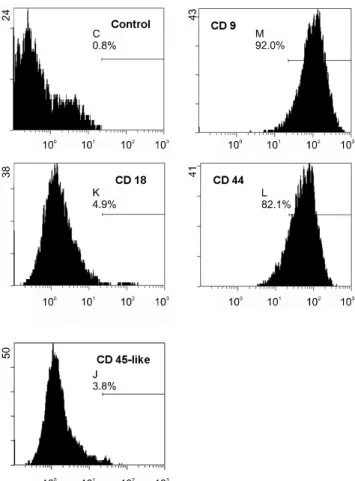
Fig. 2. Flow cytometric determination of cell-surface antigen profiles for feline MSC. Feline bone marrow MSCs were stained with feline specific antibodies to a variety of cell-surface antigens. The percentage of cells positive for each antibody is listed in the corresponding histogram. An isotype control is used to identify background fluorescence. MSC from 3 separate cats were tested with similar results. Representative results from 1 cat are shown.
Fig. 1. Identification of isolated bone marrow-derived MSCs.
(A) Phase contrast image of heterogeneous MSCs after passage 1. (B) Phase contrast image of fibroblast-like, homogeneous MSCs after passage 4. (C) Immunostaining of vimentin antigen, a marker expressed by BMCs. Scale bar = 200 µm, A and B; 50 µm, C.
cells that included spindle-shaped cells, large flat cells, and small round cells (Fig. 1A).
Morphology and characterization of MSCs culture
Upon a fourth passage of adherent cells, a homogeneous population of fibroblast-like cells progressively arose from the feline bone marrow-derived mononuclear cells (Fig.1B). Identification of mesenchymal stem cells was per- formed with a primary anti-vimentin antibody (Fig. 1C).
Cell-surface antigen profile
The feline MSC-surface antigen profile was ascertained by staining with feline-specific monoclonal antibodies fol- lowed by flow cytometry (Fig. 2). Feline MSCs were strongly positive for CD9 and CD44, but negative for CD18 and CD45. They demonstrated typical character- istics of mesenchymal cells, including the capacity to transform into osteocytes and adipocytes.
Morphology in co-culture of PC12 cells and MSCs
In the MSCs alone, the cells showed an elongated fibro- blast shape (Fig. 3A). In the PC12 cells alone, the cells showed modest growth and tended to grow in small clus- ters (Fig. 3B). In the co-cultured group, both cells appeared robust. Although the PC12 cells did not change morphol- ogy significantly, the MSCs possessed long, thin, complex processes (Fig. 3C).Western blot analysis of TH expression in PC12 and MSC co-cultures
Representative immunoblot bands for TH proteins are
shown in Fig. 4. TH protein demonstrated a stronger signal at 60 kDa in the co-culture group than the PC12 cell group (p<0.001). In contrast, TH wasn't expressed in the MSC alone group.
Immunocytochemistry of TH expression in PC12 and MSC co-cultures
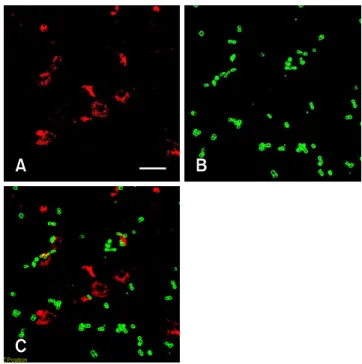
MSCs (red) did not show immunostaining of TH protein (green) (Figs. 5A-C), indicating that the MSCs had not dif- ferentiated into TH positive cells under our experimental conditions.
Discussion
Here, we show that MSCs derived from feline bone mar- row can enhance TH protein expression in PC12 cells.
There are several possibilities for what mediates this
Fig. 3. Phase contrast image of PC12 cells and MSCs. (A) MSCs cultured alone for 3 days. The cells exhibited an elongated spin- dle shape resembling fibroblasts. (B) PC12 cells cultured alone for 3 days. The cells tended to grow in small clusters. (C) PC12 cells were co-cultured with MSCs for 3 days. The PC12 cells were not significantly changed, but the MSCs possessed a longer, more complex processes (white arrowheads). Scale bar = 200 µm.
Fig. 4. Representative Western blot analysis of TH proteins. (A) Immunoblots of TH and GAPDH protein expression. M, molecular marker, Lane 1, MSC group; Lane 2, PC12 group; Lane 3, MSC + PC12 group. (B) Ratio of TH to GAPDH density values in A. TH expression was significantly increased in the MSC + PC12 group. **p<0.001 vs. PC12 group.
Fig. 5. Fluorescence micrographs of co-cultures of PC12 cells (green) and MSCs (red) for three days. (A) MSCs prelabeled with Dil-Ac-LDL (red). (B) PC12 cells stained with a rabbit anti-TH antibody (green). (C) Merged image of A and B. MSCs were not TH positive. Scale bar = 100 µm.
cell differentiation was also not affected by increased cell density [30].
Fourth, direct cell-cell contact may help enhance TH expression. Direct contact between bone marrow stromal cells and the host brain tissue is important for differ- entiation [1]. Direct chromaffin cell contact may stimulate differentiation of neuronal progenitor cells [30]. The direct interaction of MSCs with neurons promoted long-last sur- vival [31].
In summary, co-culture of MSCs with PC12 cells in- creases TH expression in the cultures. In vivo, MSCs from bone marrow markedly increase the proliferation of hippo- campal-derived neural stem cells via secretion of cytokines [22]. Furthermore, MSCs transplantation into rats follow- ing traumatic brain injury improved functional recovery [15]. However, only a small number of transplanted cells expressed neuronal antigens in that study, making func- tional improvement in recipients unlikely. Therefore, the secretion of neurotrophic factors or direct cell-cell contact by MSCs may be more important than the resulting neural differentiation in transplant experiments. Our results imply a new role for MSCs in treating neurodegenerative dis- eases such as PD.
Acknowledgments
This work was supported by funds from KOSEF (Grant # M10525010001-05N2501-00110) and Post BK21 for G.Z.
Jin and S.J. Cho. We deeply thank Dr. Tae-Hoon Lee (Department of Stomatology, Chonnam National Univer- sity, Korea) for the kind donation of PC12 cells.
References
1. Abouelfetouh A, Kondoh T, Ehara K, Kohmura E.
Morphological differentiation of bone marrow stromal cells into neuron-like cells after co-culture with hippocampal slice.
Brain Res 2004, 1029, 114-119.
2. Acheson AL, Thoenen H. Cell contact-mediated regulation of tyrosine hydroxylase synthesis in cultured bovine adrenal chromaffin cells. J Cell Biol 1983, 97, 925-928.
3. Arts MP, Cools AR. 6-hydroxydopamine lesion in the A8 cell group of cats produces a short-lasting decreased accuracy in goal-directed forepaw-movements. Behav Brain Res 1999, 103, 13-21.
4. Badoyannis HC, Sharma SC, Sabban EL. The differential effects of cell density and NGF on the expression of tyrosine hydroxylase and dopamine beta-hydroxylase in PC12 cells.
Brain Res Mol Brain Res 1991, 11, 79-87.
5. Crigler L, Robey RC, Asawachaicharn A, Gaupp D, Phinney DG. Human mesenchymal stem cell subpopu- lations express a variety of neuro-regulatory molecules and promote neuronal cell survival and neuritogenesis. Exp Neurol 2006, 198, 54-64.
6. Garcia R, Aguiar J, Alberti E, de la Cuetara K, Pavon N.
Bone marrow stromal cells produce nerve growth factor and
glial cell line-derived neurotrophic factors. Biochem Biophys Res Commun 2004, 316, 753-754.
7. Gizang-Ginsberg E, Ziff EB. Nerve growth factor regulates tyrosine hydroxylase gene transcription through a nucleopro- tein complex that contains c-Fos. Genes Dev 1990, 4, 477- 491.
8. Greene LA, Tischler AS. Establishment of a noradrenergic clonal line of rat adrenal pheochromocytoma cells which re- spond to nerve growth factor. Proc Natl Acad Sci USA 1976, 73, 2424-2428.
9. Guarita-Souza LC, Carvalho KA, Rebelatto C, Senega- glia A, Hansen P, Furuta M, Miyague N, Francisco JC, Olandoski M, Faria-Neto JR, Oliveira SA, Brofman PR.
Cell transplantation: differential effects of myoblasts and mesenchymal stem cells. Int J Cardiol 2006, 111, 423-429.
10. Kramer BC, Woodbury D, Black IB. Adult rat bone mar- row stromal cells express genes associated with dopamine neurons. Biochem Biophys Res Commun 2006, 343, 1045- 1052.
11. Krieglstein K, Henheik P, Farkas L, Jaszai J, Galter D, Krohn K, Unsicker K. Glial cell line-derived neurotrophic factor requires transforming growth factor-beta for exerting its full neurotrophic potential on peripheral and CNS neurons. J Neurosci 1998, 18, 9822-9834.
12. Li Y, Chen J, Wang L, Zhang L, Lu M, Chopp M.
Intracerebral transplantation of bone marrow stromal cells in a 1-methyl-4-phenyl-1,2,3,6-tetrahydropyridine mouse mod- el of Parkinson's disease. Neurosci Lett 2001, 316, 67-70.
13. Li XM, Qi J, Juorio AV, Boulton AA. Reciprocal regulation of the content of aromatic L-amino acid decarboxylase and tyrosine hydroxylase mRNA by NGF in PC12 cells. J Neurosci Res 1997, 47, 449-454.
14. Liu LH, Sun Z, Sun QY, Huang YJ, Man QH, Guo M, Zhao CH, Ai HS. Study on biological characteristics of cul- tured rhesus mesenchymal stem cells. Zhongguo Shi Yan Xue Ye Xue Za Zhi 2005, 13, 417-421.
15. Lu J, Moochhala S, Moore XL, Ng KC, Tan MH, Lee LK, He B, Wong MC, Ling EA. Adult bone marrow cells differ- entiate into neural phenotypes and improve functional recov- ery in rats following traumatic brain injury. Neurosci Lett 2006, 398, 12-17.
16. Lu L, Zhao C, Liu Y, Sun X, Duan C, Ji M, Zhao H, Xu Q, Yang H. Therapeutic benefit of TH-engineered mesen- chymal stem cells for Parkinson's disease. Brain Res Brain Res Protoc 2005, 15, 46-51.
17. Mahmood A, Lu D, Chopp M. Intravenous administration of marrow stromal cells (MSCs) increases the expression of growth factors in rat brain after traumatic brain injury. J Neurotrauma 2004, 21, 33-39.
18. Majumdar MK, Thiede MA, Mosca JD, Moorman M, Gerson SL. Phenotypic and functional comparison of cul- tures of marrow-derived mesenchymal stem cells (MSCs) and stromal cells. J Cell Physiol 1998, 176, 57-66.
19. Malik R. Genetic diseases of cats. J Feline Med Surg 2001, 3, 109-113.
20. Marsden CD. Parkinson's disease. Lancet 1990, 335, 948- 952.
21. Martin DR, Cox NR, Hathcock TL, Niemeyer GP, Baker HJ. Isolation and characterization of multipotential mesen-
in two patients with Parkinson's disease following intra- striatal transplantation of foetal ventral mesencephalon.
Brain 1994, 117, 487-499.
26. Pittenger MF, Mackay AM, Beck SC, Jaiswal RK, Douglas R, Mosca JD, Moorman MA, Simonetti DW, Craig S, Marshak DR. Multilineage potential of adult hu- man mesenchymal stem cells. Science 1999, 284, 143-147.
27. Rohn JL, Gwynn SR, Lauring AS, Linenberger ML, Overbaugh J. Viral genetic variation, AIDS, and the multi- step nature of carcinogenesis: the feline leukemia virus model. Leukemia 1996, 10, 1867-1869.
28. Saadat S, Stehle AD, Lamouroux A, Mallet J, Thoenen H.
Influence of cell-cell contact on levels of tyrosine hydrox- ylase in cultured bovine adrenal chromaffin cells. J Biol Chem 1987, 262, 13007-13014.
29. Saadat S, Thoenen H. Regulation of tyrosine hydroxylase mRNA levels in rat pheochromocytoma PC12 cells by
Montero-Menei CN, Schiller PC. Neurotrophin-directed differentiation of human adult marrow stromal cells to dop- aminergic-like neurons. Bone 2007, 40, 360-373.
35. Unsicker K, Krieglstein K. Growth factors in chromaffin cells. Prog Neurobiol 1996, 48, 307-324.
36. Wade TV, Rothblat DS, Schneider JS. Changes in striatal dopamine D3 receptor regulation during expression of and re- covery from MPTP-induced parkinsonism. Brain Res 2001, 905, 111-119.
37. Zhou J, Bradford HF, Stern GM. The stimulatory effect of brain-derived neurotrophic factor on dopaminergic pheno- type expression of embryonic rat cortical neurons in vitro.
Brain Res Dev Brain Res 1994, 81, 318-324.
38. Zhou J, Pliego-Rivero B, Bradford HF, Stern GM, Jauniaux ER. Induction of tyrosine hydroxylase gene ex- pression in human foetal cerebral cortex. Neurosci Lett 1998, 252, 215-217.