383
http://dx.doi.org/10.4196/kjpp.2015.19.4.383 eISSN 2093-3827
ABBREVIATIONS: DFNB6, nonsyndromic deafness, autosomal recessive type 6; TEA, tetraethylammonium; 4-AP, 4-aminopyridine.
Received April 30, 2015, Revised May 28, 2015, Accepted June 8, 2015
Corresponding to: Seung Cheol Ahn, Department of Physiology, College of Medicine, Dankook University, 119 Dandae-ro, Anseo- dong, Cheonan 330-714, Korea. (Tel) 82-41-550-3852, (Fax) 82-1-565- 6167, (E-mail) [email protected]
This is an Open Access article distributed under the terms of the
Creative Commons Attribution Non-Commercial License (http://
creativecommons.org/licenses/by-nc/4.0) which permits unrestricted non-commercial
use, distribution, and reproduction in any medium, provided the original work
is properly cited.
Copyright ⓒ Korean J Physiol Pharmacol
Characteristics of K + Outward Currents in the Cochlear Outer Hair Cells of Circling Mice within the First Postnatal Week
Ji Woong Ahn, Shin Wook Kang, and Seung Cheol Ahn
Department of Physiology, College of Medicine, Dankook University, Cheonan 330-714, Korea
K
+ outward currents in the outer hair cells (OHCs) of circling mice (homozygous (cir/cir) mice), an animal model for human deafness (DFNB6 type), were investigated using a whole cell patch clamp technique. Littermate heterozygous (+/cir) mice of the same age (postnatal day (P) 0 − P6) were used as controls. Similar slow rising K
+ currents were observed in both genotypes, but their biophysical and pharmacological properties were quite different. The values of V
half for activation were significantly different in the heterozygous (+/cir) and homozygous (cir/cir) mice (- 8.1±2.2 mV, heterozygous (+/cir) mice (n=7) and - 17.2±4.2 mV, homozygous (cir/cir) mice (n=5)). The inactivation curve was expressed by a single first order Boltzmann equation in the homozygous (cir/cir) mice, while it was expressed by a sum of two first order Boltzmann equations in the heterozygous (+/cir) mice. The K
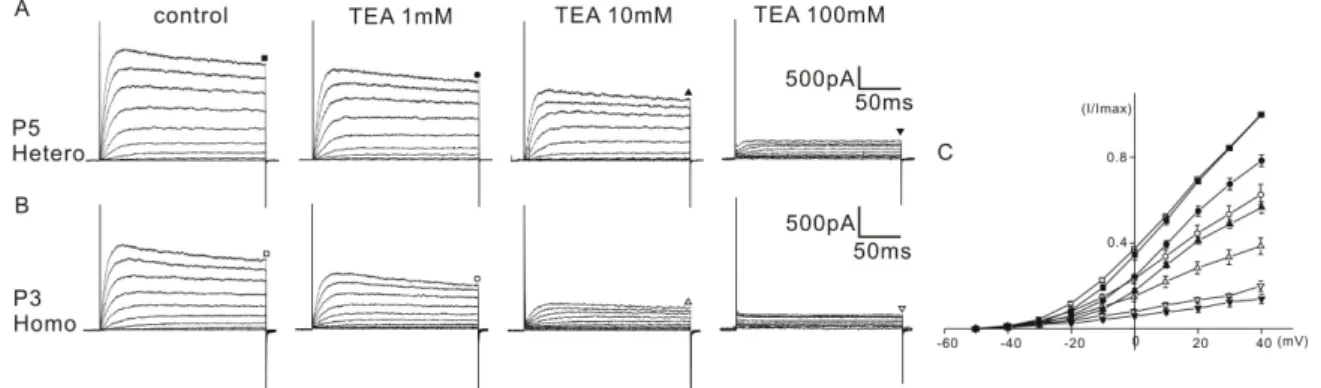
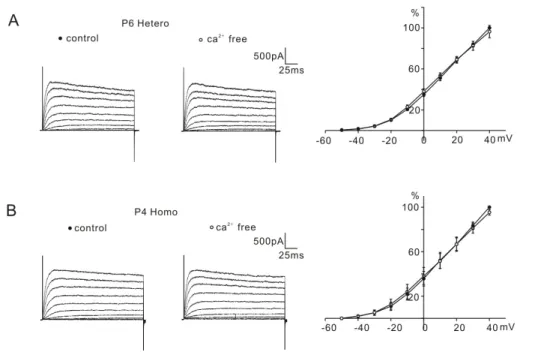
+ current of homozygous (cir/cir) mice was more sensitive to TEA in the 1 to 10 mM range, while the 4-AP sensitivities were not different between the two genotypes. Removal of external Ca
2+ did not affect the K
+ currents in either genotype, indicating that the higher sensitivity of K
+ current to TEA in the homozygous (cir/cir) mice was not due to an early expression of Ca
2+ activated K
+ channels. Our results suggest that the K
+ outward current of developing homozygous (cir/cir) mice OHCs is different in both biophysical and pharmacological aspects than that of heterozygous (+/cir) mice.
Key Words: Circling mice, Deafness, DFNB6, K
+ current, Outer hair cell
INTRODUCTION
Previous findings have shown that the expression of K
+
channels is developmentally regulated in murine cochlear hair cells. From embryonic day 14.5 to P 30, delayed rec- tifier K
+ current (I
K,emb
, I
K,neo
) [1], inward rectifier K
+ cur- rent (I
K1
) [2], K
+ current activated at negative potentials (I
K,n
) [3], delayed rectifier K
+ current (I
K,s
), and Ca
2+ acti- vated K
+ current (I
K,f
) [4] are sequentially expressed in mur- ine cochlear hair cells. The timely expression of K
+ channels is important for the functional maturation of cochlear hair cells [1,3,4], which raises a possibility that early stage K
+
channel expression might be different in the cochlear hair cells of genetically abnormal animals, such as mouse mod- els for human deafness.
The circling mouse is a mouse model for human deafness (DFNB6 type) [5,6]. The most notable pathologic findings
of the circling mice are their completely degenerated organ of Corti, which can occur as early as P21, as well as mark- edly reduced cellularity of the spiral ganglion neurons [6].
A scanning electron microscope study demonstrated that the stereocilliary defects of OHCs were observable as early as P10 and were more severe in the OHCs than in the inner hair cells (IHCs) at P18 in circling mice [6].
It has been reported that progressive hearing loss is par- alleled by a selective degeneration of OHCs in KCNQ4 K
+
channel knockout mice (Kcnq4
-/- mice) [7], which raises a possibility that the alteration of K
+ channel expression might affect the degeneration of OHCs in circling mice.
However, the types of K
+ channels expressed prior to degen- eration in the OHCs of circling mice have not been reported.
The aim of this study was to investigate the expression and characteristics of the K
+ channels in circling mice OHCs during the first postnatal week.
METHODS Animal and cochlear preparation
Female heterozygous (+/cir) mice were mated with male
homozygous (cir/cir) mice (circling mice), and their off-
spring were used for this study. The circling mice strain
has been maintained for more than 10 generations by