
Metabolomics approach to serum biomarker forloperamide-induced constipation in SD rats
9
0
0
전체 글
(2) 36. Ji-Eun Kim et al.. movements of colonic mass and suppresses the gastrocolic reflex to improve diarrhea syndromes [4]. Although loperamide causes side effects related to its impact on bowel motility including abdominal pain, distention, bloating, nausea, vomiting, and constipation, it is generally well tolerated at recommended nonprescription doses [2]. Owing to these side effects, loperamide has been used to induce constipation in a variety of studies to determine the cause of constipation and identify novel compounds with therapeutic effects [5-7]. When used to treat animals, it can stimulate the extension of stool evacuation time and delay intestinal luminal transit through inhibition of water secretion [8] and smooth movement in the intestinal wall [9,10]. Although the dose and time for loperamide treatment have been found to vary among studies, constipation was successfully induced by treatment with 1.5-3 mg/kg body weight of loperamide for 3-7 days [5-7,11,12]. However, screening of metabolomics biomarkers that can anticipate the constipation induced by loperamide treatment has not been conducted to date. Generally, metabolomics analyze metabolomes changed in response to stressors or xenobiotics and then identify biomarkers [13,14]. This methodology has also been widely applied in preclinical studies investigating the toxicity, safety and efficacy of chemical compounds [15-17]. As part of the search for sensitive and reliable biomarkers of loperamide-induced constipation, this study was designed to comparatively compare serum biomarkers obtained from loperamide-treated SD rats with No-treated rats using the metabolomics-based proton (NMR) platform. The results indicated that the metabolomics profile of serum collected from loperamidetreated SD rats may provide useful information to develop novel sensitive and reliable biomarkers.. Materials and Methods Care and use of animals. The animal protocol used in this study was reviewed and approved by the Pusan National UniversityInstitutional Animal Care and Use Committee (PNUIACUC; Approval Number PNU-2012-0010). Adult SD rats were purchased from SamTacho (Osan, Korea) and handled at the Pusan National University-Laboratory Animal Resources Center accredited by Association for Assessment and Accreditation of Laboratory Animal Care (AAALAC) International (Accredited Unit NumberLab Anim Res | March, 2014 | Vol. 30, No. 1. 001525) in accordance with the United States of America (USA) National Institutes of Health (NIH) guidelines and the Korea Food and Drug Administration (Accredited Unit Number-00231) in accordance with the Laboratory Animals Act. All rats were provided with standard irradiated chow diet (Purina Mills, Seoungnam, Korea) ad libitum and maintained in a specific pathogenfree state under a strict light cycle (lights on at 06:00 h and off at 18:00 h) at a temperature of 22±2°C and a relative humidity of 50±10%. Induction of constipation. Constipation was induced in SD rats by subcutaneous injection of loperamide (1.5 mg/kg weight) in 0.9% sodium chloride twice a day (9:00 AM, 6:00 PM) for 3 days, whereas the non-constipation group was injected with 0.9% sodium chloride alone [5]. For the animal experiment, 8-week-old SD rats (n=6-10) were assigned to either a non-constipation group (loperamide-treated group, n=3-5) or a constipation group (No-treated group, n=3-5). At 72 h after loperamide treatment, all animals were sacrificed using CO2 gas until assay. Measurement of stool parameters and urinary volume. All SD rats were bred in metabolic cages during the experimental period to avoid contamination of samples. The stools and urine excreted from each SD rat were collected at 10:00 am. Stool weight was weighed three times per sample using an electric balance, whereas the water content was determined as the difference between the wet and dry weights of the stool as previously described [5,6]. Changes in the urine volume were measured three times per sample using a cylinder. Histological analysis. Transverse colons collected from SD rats were fixed with 10% formalin for 48 h, embedded in paraffin wax, and then sectioned into 4 µm thick slices that were stained with hematoxylin and eosin (H&E, SigmaAldrich, MO, USA). Morphological features of these sections were observed under light microscopy, after which the length of the villus layer, thickness of crypt and muscle layer, diameter of crypt, and number of crypts were measured using Leica Application Suite (Leica Microsystems, Switzerland). Serum biochemical analysis. For serum biochemical analysis, blood was collected.
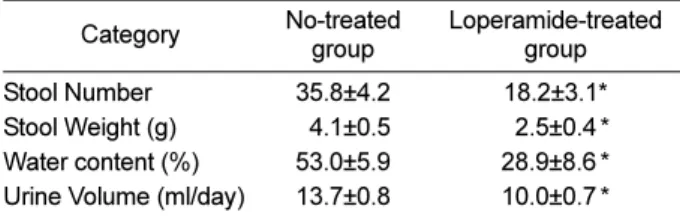
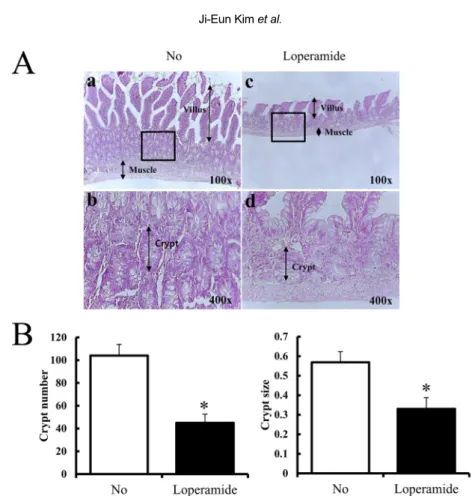
(3) 37. Metabolics approach for constipation biomarker. from abdominal veins of rats that were fasted for 8 hr and incubated for 30 min at room temperature. Serum was then obtained by centrifugation of blood. The serum alkaline phosphatase (ALP), alanine aminotransferase (ALT), AST, LDH, blood urea nitrogen (BUN), and Cr levels were subsequently assayed using an automatic serum analyzer (HITACHI 747, Tokyo, Japan). All assays were measured using fresh serum and conducted in duplicate.. Table 1. Alteration of stool and urine secretion in loperamideinduced constipated SD rats Category. No-treated group. Loperamide-treated group. Stool Number Stool Weight (g) Water content (%) Urine Volume (ml/day). 35.8±4.2 04.1±0.5 53.0±5.9 13.7±0.8. 18.2±3.1* 02.5±0.4 * 28.9±8.6 * 10.0±0.7 *. Data represent the mean±SD from three replicates. *P<0.05 compared to the No-treated group.. Metabolomics analysis. Statistical analysis. Appropriate serum samples (300 µL) obtained from animals were placed in micro centrifuge tubes containing 300 µL D2O solutions with 4 mM TSP as a qualitative standard for the chemical shift scale. After vortexing, serum samples were analyzed by NMR spectrometry within 48 h. All spectra were determined using a Varian Unity Inova 600 MHz spectrometer operating at a temperature of 26oC supported by Pusan National University (Busan, Korea). The one-dimensional NMR spectra were acquired with the following acquisition parameters: spectral width 24,038.5 Hz, 7.55 min acquisition time, and 128 nt. Additional conditions of a relaxation delay time of 1 s and saturation power of 4 were set to suppress a massive water peak. NMR spectra were reduced to data using the program Chenomx NMR Suite (ver 4.6, Chenomx Inc., Edmonton, Alberta, Canada). The spectral region of δ 0.0-10.0, excluding the water peak (δ 4.5-5.0), was segmented into regions of 0.04 ppm, which provided 250 integrated regions in each NMR spectrum. This binning process endowed each segment with integral values, giving an intensity distribution of the whole spectrum with 250 variables prior to pattern recognition analysis. All data were converted from the NMR suite Professional software format into Microsoft Excel format (*.xls). One-dimensional NMR spectra data were imported into the SIMCA-P (version 12.0, Umetrics Inc., Kinnelon, NJ, USA) for multivariate statistical analysis to examine the intrinsic variation in the data set. These data were scaled using centered scaling prior to principal component analysis (PCA) and partial least square-discriminant analysis (PLS-DA). With the scaling process, the average value of each variable is calculated and then subtracted from the data. Score plots of PCA and PLSDA were used to interpret the intrinsic variation of the data. Variable importance plots (VIP) were also utilized to select putative metabolites related to loperamide.. One-way ANOVA (SPSS for Windows, Release 10.10, Standard Version; SPSS, Chicago, IL, USA) was used to identify significant differences between No- and loperamide-treated SD rats. All values are reported as the mean±SD. A P value of <0.05 was considered significant.. Results Induction of constipation. Constipation is generally determined based on altered excretion from laboratory animals. To investigate whether loperamide treatment could induce constipation, alterations in excretion parameters including stool weight and urine volume were measured in No- and loperamide-treated SD rats. Excretion volumes of stool and urine were significantly reduced after administration of loperamide compared to the No-treated group. Indeed, the weight of stool in the loperamide-treated group was approximately twice that of the No-treated group. Furthermore, the water content of stool in the loperamide-treated group was roughly 45-55% lower than that in the No-treated group (Table 1). Therefore, these results suggest that loperamide treatment could successfully induce constipation in SD rats through inhibition of stool and urine excretion. Histological alteration of the transverse colon. To investigate the effects of loperamide treatment on the histological structure of the transverse colon, the villus length, crypt layer thickness, and muscle thickness were measured in transverse colons of SD rats following H&E staining. The average length of the villus layer was significantly shorter in the loperamide-treated group than the No-treated group. The loperamide-treated group also showed greatly reduced crypt layer thickness and muscle thickness relative to those in the No-treated group. Furthermore, the number of crypts per restrict area as Lab Anim Res | March, 2014 | Vol. 30, No. 1.
(4) 38. Ji-Eun Kim et al.. Figure 1. Effects of loperamide treatment on histological parameters in the transverse colon of SD rats. (A) H&E-stained sections of transverse colons collected from No-treated rats (a and b) andloperamide-treated rats (c and d) were observed at two different magnifications using a light microscope. (B) The crypt number per specific area and diameter per crypt was measured with Leica Application Suite. Five to six rats per group were assayed in triplicate by H&E. Data represent the mean±SD from three replicates. *P<0.05 compared to the No-treated group.. well as diameter of the crypt was decreased after loperamide treatment (Figure 1). These results indicated that loperamide treatment may induce constipation-like phenotypes including short villus length, decreased crypt layer and muscle layer, and a small number of crypts in the transverse colon of SD rats. Effects of loperamide on serum biochemical components. To investigate whether loperamide treatment could affect the serum biochemical components, alteration of several components related to liver and kidney metabolism was investigated in blood serum using serum biochemical analysis. Liver toxicity analysis revealed no differences in the concentrations of two liver toxicity indicators, ALT and LDH, between the No-treated group and loperamide-treated group. However, the concentration of ALP and AST was slightly increased in the loperamidetreated group than that of the No-treated group (Table 2). In the case of kidney toxicity analysis, similar patterns to. Lab Anim Res | March, 2014 | Vol. 30, No. 1. Table 2. Serum biochemical analysis of loperamide-induced constipated SD rats. BUN Cr ALP ALT AST LDH. No-treated group (mg/dL). Loperamide-treated group (mg/dL). 23.6±1.81 00.7±0.07 346.8±41.93 25.4±2.60 54.6±5.68 150.6±12.12. 24.2±2.210 00.4±0.12* 0775.2±186.94* 29.8±4.860 67.8±4.65* 154.6±14.380. Data represent the mean±SD of three replicates. *P<0.05 compared to the No-treated group.. those observed upon liver toxicity analysis were found for the BUN and Cr concentrations. The concentration of BUN in serum did not differ significantly among rats, but that of Cr was lower in the loperamide-treated group than the No-treated group (Table 2). Therefore, these results suggest that loperamide treatment may induce some toxicity in the liver and kidneys of SD rats..
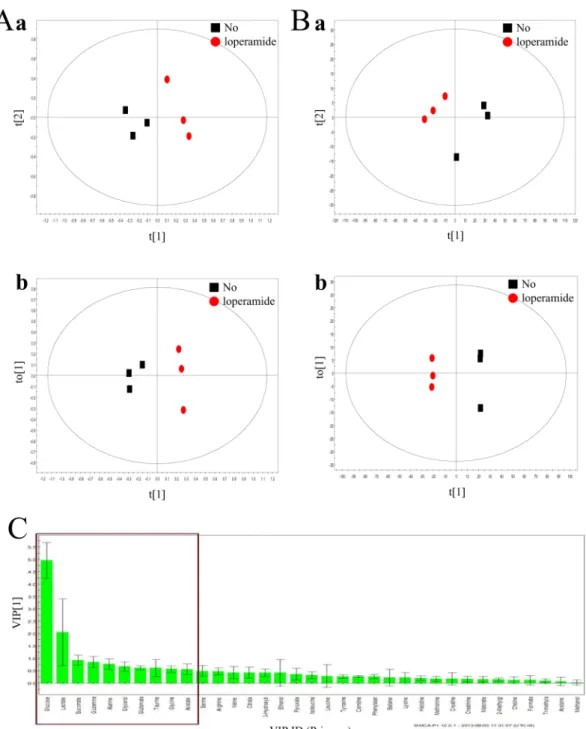
(5) Metabolics approach for constipation biomarker. 39. Figure 2. Metabolomics pattern recognition using PCA (a) and OPLS-DA (b). (A) Global profiling of loperamide treatment in the serum samples. (B) Targeted profiling of loperamide treatment in the serum samples. (C) The VIP showed the major metabolites contributing to cluster separation.. Effects of loperamide treatment on endogenous metabolites in serum. Upon NMR analysis of serum, pattern recognition using PCA and OPLS-DA of the NMR spectra in global profiling revealed clustering between the No-treated and loperamide treated groups (Figure 2A). Chenomx NMR Suite (ver. 4.6, Chenomx Inc., Edmonton, Alberta, Canada) was used for targeted NMR spectral analysis. A total of. 35 metabolites were determined, and PCA and OPLSDA score plots differed between the No-treatment and loperamide treatment groups (Figure 2B). Based on these results, endogenous metabolites were selected to investigate the effects of loperamide treatment using VIP. The threshold for meaningful contributions to identify significantly influential metabolites was established as VIP >0.5 (Figure 2C). Among 35 endogenous Lab Anim Res | March, 2014 | Vol. 30, No. 1.
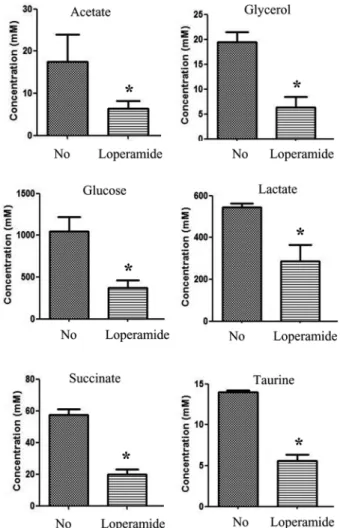
(6) 40. Ji-Eun Kim et al.. Figure 3. Concentration of four amino acids after loperamide administration in SD rats. Data represent the mean±SD from three replicates. *P<0.05 compared to the No-treated group.. metabolites, ten metabolites were selected as putative candidates: acetate, alanine, glucose, glutamate, glutamine, glycerol, glycine, lactate, succinate, taurine (Figure 3 and 4). These metabolites were categorized into two major groups, an amino acid group containing alanine, glutamine, glutamate and glycine, and a metabolite group containing acetate, glucose, glycerol, lactate, succinate and taurine. In the serum sample of loperamidetreated rats, the concentrations of the ten metabolites were significantly decreased relative to those of Notreated rats. The highest decrease of the concentration was observed in glycine, followed succinate, taurine, glycerol and glutamine. Most metabolites in the loperamide-treated rats were roughly 2-3 times lower than those in the No-treated group (Figure 3 and 4). Therefore, these results suggested that loperamide treatment could cause a decrease of endogenous metabolites relative to the controls.. Discussion Constipation is a chronic gastrointestinal disorder characterized by symptoms such as infrequent bowel movements, difficulty during defecation, and sensation of incomplete bowel evacuation that affects almost 25% of the western population [18-21]. Generally, chronic constipation is categorized into three groups by assessment Lab Anim Res | March, 2014 | Vol. 30, No. 1. Figure 4. Concentration of six endogenous metabolites after loperamide administration in SD rats. Data represent the mean±SD from three replicates. *P<0.05 compared to the Notreated group.. of colonic transit and anorectal function, normal transit or irritable bowel syndrome, pelvic floor dysfunction (functional defecatory disorders) and slow transit constipation [22]. Among patients with chronic constipation, the most prevalent form is normal transit (59%), followed by functional defecatory disorders (25%), slow transit (13%) and a combination of defecatory disorders and slow transit (3%) [23]. This disorder is often caused by insufficient dietary fiber intake, inadequate fluid intake, decreased physical activity, side effects of medication, hypothyroidism, and obstruction by colorectal cancer [24]. Constipation can also be induced as side effects of the administration of drugs applied to treat clinical diseases [6,7]. In this study, we selected loperamide to induce constipation and observed the human-like symptoms of constipation in SD rats injected with 4 mg/kg of loperamide without.
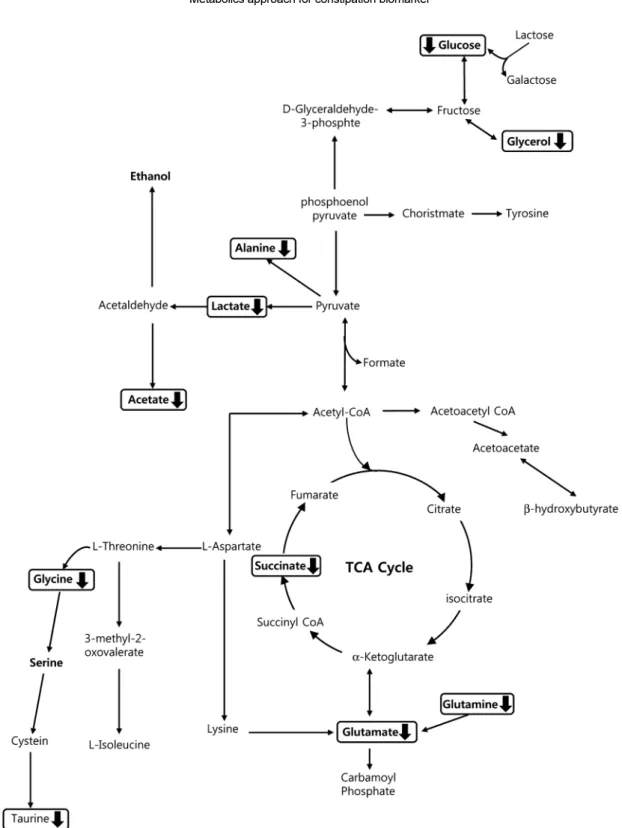
(7) Metabolics approach for constipation biomarker. 41. Figure 5. Pathway related to endogenous metabolites that were changed after loperamide treatment. Bold arrows indicate the alteration of metabolites, while the box shows the altered metabolites.. any specific problems. However, the rat model of pharmacological constipation induced by loperamide treatment can only reflect slow transit constipation, which is characterized by less daily fecal excretion, lower water content, lower numbers of fecal pellets and. thinner fecal mucus [11,25,26]. Therefore, metabolomics profiles obtained from the loperamide-induced constipation cannot be applied to all forms of chronic constipation detected in human patients. In loperamide-induced rats, a significant reduction of Lab Anim Res | March, 2014 | Vol. 30, No. 1.
(8) 42. Ji-Eun Kim et al.. fecal excretion and histological structure is considered one of the key markers of constipation in most studies. Administration of loperamide dramatically induced a decrease of stool-related factors such as pellet number, weight, and water content [5,6,11,27]. Furthermore, the average thickness of the distal colon layer and mucus layer is thinner in loperamide-treated rats than in control rats [6,25]. In the present study, a similar effect on stoolrelated factors and histological structure was observed in loperamide-treated rats (Figure 1 and 2). Only a few studies have investigated the metabolomics profiles associated with constipation. Rodriguez et al. [28] examined the metabolic profile before and after a meal challenge in a cohort of children with constipation and determined its relationship with postprandial colon motility patterns to identify metabolic targets for treatment of constipation. Of 187 metabolites, 16 amino acid and 22 lipid metabolites had changed significantly in the postprandial group. Some of the metabolites including methylhistamine, histamine and Gamma-Amino Butyric Acid (GABA) were decreased in the same group at 60 min after the meal. A significant correlation between normal and abnormal postprandial motility pattern was observed in specific metabolites including glycerol, carnosine, alanine, asparagine, cytosine, choline, phosphocholine, thyroxine and triiodothyronine [28]. In this study, most metabolites were significantly decreased in SD rats treated with loperamide relative to the Notreated group. These findings are very different from those of previous results in which the level of most metabolites was increased in the postprandial group with constipation. However, glycerol showed a similar pattern in both studies. The level of glycerol decreased in a timedependent manner from 14 to 56% in a study of children with constipation, while their level decreased by 3 times in loperamide-induced constipation rats. Therefore, this concomitant feature demonstrates the possibility that glycerol is tightly correlated with the phenotypes of constipation in mammals (Figure 5). And also TCA cycle is expected to be down-regulated when succinate concentration is decreased in constipation-induced rats (Figure 5). Overall, this is the first study to examine the metabolic changes in SD rats treated with loperamide and to correlate changes in specific metabolites with loperamideinduced constipation. In addition, the results presented herein provide evidence that glycerol may be considered a biomarker for prediction of constipation induced by Lab Anim Res | March, 2014 | Vol. 30, No. 1. loperamide treatment.. Acknowledgments We thank Jin Hyang Hwang for directing the Animal Facility and Care at the Laboratory Animal Resources Center. This work was supported for two years by a Pusan National University Research Grant.. References 1. Stokbroekx RA, Vandenberk J, Van Heertum AH, Van Laar GM, Van der Aa MJ, Van Bever WF, Janssen PA. Synthetic antidiarrheal agents. 2,2-Diphenyl-4-(4'-aryl-4'-hydroxypiperidino) butyramides. J Med Chem 1973; 16(7): 782-786. 2. Hanauer SB. The role of loperamide in gastrointestinal disorders. Rev Gastroenterol Disord 2008; 8(1): 15-20. 3. Vandenbossche J, Huisman M, Xu Y, Sanderson-Bongiovanni D, Soons P. Loperamide and P-glycoprotein inhibition: assessment of the clinical relevance. J Pharm Pharmacol 2010; 62(4): 401-412. 4. Katzung BG. Basic and Clinical Pharmacology, 9th ed, McGrawHill Companies Inc., New York, 2004; pp 321-370. 5. Wintola OA, Sunmonu TO, Afolayan AJ. The effect of Aloe ferox Mill. in the treatment of loperamide-induced constipation in Wistar rats. BMC Gastroenterol 2010; 10: 95. 6. Lee HY, Kim JH, Jeung HW, Lee CU, Kim DS, Li B, Lee GH, Sung MS, Ha KC, Back HI, Kim SY, Park SH, Oh MR, Kim MG, Jeon JY, Im YJ, Hwang MH, So BO, Shin SJ, Yoo WH, Kim HR, Chae HJ, Chae SW. Effects of Ficus carica paste on loperamideinduced constipation in rats. Food Chem Toxicol 2012; 50(3-4): 895-902. 7. Méité S, Bahi C, Yéo D, Datté JY, Djaman JA, N'guessan DJ. Laxative activities of Mareya micrantha (Benth.) Müll. Arg. (Euphorbiaceae) leaf aqueous extract in rats. BMC Complement Altern Med 2010; 10: 7. 8. Hughes S, Higgs NB, Turnberg LA. Loperamide has antisecretory activity in the human jejunum in vivo. Gut 1984; 25(9): 931-935. 9. Sohji Y, Kawashima K, Shimizu M. Pharmacological studies of loperamide, an anti-diarrheal agent. II. Effects on peristalsis of the small intestine and colon in guinea pigs (author’s transl). Nihon Yakurigaku Zasshi 1978; 74(1): 155-163. 10. Yamada K, Onoda Y. Comparison of the effects of T-1815, yohimbine and naloxone on mouse colonic propulsion. J Smooth Muscle Res 1993; 29(2): 47-53. 11. Yang ZH, Yu HJ, Pan A, Du JY, Ruan YC, Ko WH, Chan HC, Zhou WL. Cellular mechanisms underlying the laxative effect of flavonol naringenin on rat constipation model. PLoS One 2008; 3(10): 3348. 12. Bustos D, Ogawa K, Pons S, Soriano E, Bandi JC, Bustos Fernández L. Effect of loperamide and bisacodyl on intestinal transit time, fecal weight and short chain fatty acid excretion in the rat. Acta Gastroenterol Latinoam 1991; 21(1): 3-9. 13. Robertson DG, Watkins PB, Reily MD. Metabolomics in toxicology: preclinical and clinical applications. Toxicol Sci 2011; 120 Suppl 1: S146-170. 14. Kim KB, Chung MW, Um SY, Oh JS, Kim SH, Na MA, Oh HY, Cho WS, Choi KH. Metabolomics and biomarker discovery: NMR spectral data of urine and hepatotoxicity by carbon tetrachloride, acetaminophen, and d-galactosamine in rats. Metabolomics 2008; 4: 377-392. 15. Kim KB, Um SY, Chung MW, Jung SC, Oh JS, Kim SH, Na HS, Lee BM, Choi KH. Toxicometabolomics approach to urinary biomarkers for mercuric chloride (HgCl2)-induced nephrotoxicity using proton nuclear magnetic resonance (1H NMR) in rats..
(9) Metabolics approach for constipation biomarker. Toxicol Appl Pharmacol 2010; 249(2): 114-126. 16. Kim KB, Yang JY, Kwack SJ, Kim HS, Ryu DH, Kim YJ, Bae JY, Lim DS, Choi SM, Kwon MJ, Bang DY, Lim SK, Kim YW, Hwang GS, Lee BM. Potential metabolomic biomarkers for evaluation of adriamycin efficacy using a urinary (1) H-NMR spectroscopy. J Appl Toxicol 2012; 33(11): 1251-1259. 17. Mendrick DL, Schnackenberg L. Genomic and metabolomic advances in the identification of disease and adverse event biomarkers. Biomark Med 2009; 3(5): 605-615. 18. Higgins PD, Johanson JF. Epidemiology of constipation in North America: a systematic review. Am J Gastroenterol 2004; 99(4): 750-759. 19. Walia R, Mahajan L, Steffen R. Recent advances in chronic constipation. Curr Opin Pediatr 2009; 21(5): 661-666. 20. McCallum IJ, Ong S, Mercer-Jones M. Chronic constipation in adults. BMJ 2009; 338: 831. 21. Emmanuel AV, Tack J, Quigley EM, Talley NJ. Pharmacological management of constipation. Neurogastroenterol Motil 2009; 21: 41-54. 22. Bharucha AE. Constipation. Best Pract Res Clin Gastroenterol 2007; 21(4): 709-731.. 43. 23. Nyam DC, Pemberton JH, Ilstrup DM, Rath DM. Long-term results of surgery for chronic constipation. Dis Colon Rectum 1997; 40(3): 273-279. 24. Leung FW. Etiologic factors of chronic constipation: review of the scientific evidence. Dig Dis Sci 2007; 52(2): 313-316. 25. Shimotoyodome A, Meguro S, Hase T, Tokimitsu I, Sakata T. Decreased colonic mucus in rats with loperamide-induced constipation. Comp Biochem Physiol A Mol Integr Physiol 2000; 126(2): 203-212. 26. Hou XY, Wang WL, Yong LI. DNA fingerprinting of intestinal flora in rats with slow transit constipation. J China Med Univ 2013; 42: 348-354. 27. Kakino M, Izuta H, Ito T, Tsuruma K, Araki Y, Shimazawa M, Oyama M, Iinuma M, Hara H. Agarwood induced laxative effects via acetylcholine receptors on loperamide-induced constipation in mice. Biosci Biotechnol Biochem 2010; 74(8): 1550-1555. 28. Rodriguez L, Roberts LD, LaRosa J, Heinz N, Gerszten R, Nurko S, Goldstein AM. Relationship between postprandial metabolomics and colon motility in children with constipation. Neurogastroenterol Motil 2013; 25(5): 420-426.. Lab Anim Res | March, 2014 | Vol. 30, No. 1.
(10)
수치
+2
관련 문서
The Relationships between Elementary School Students' Expectancy-Value Beliefs, Self-Efficacy, and Intention for Class Participation in Expressive Activity..
Changes in ridge dimensions (mean±SD)... Histologic and
Therefore, cTnT is a recommended biomarker for use in the detection of myocardial infarction (MI) and in acute coronary syndromes.[8] Indeed, several authors
That is, the aim of this research is to investigate the military strategy in North Korea on Jeong Eun Kim era from Military Science point of view by analyzing the change
Sang-Keun Woo, Yong Jin Lee, WonHo Lee, Min Hwan Kim, Ji Ae Park, In Ok Ko, Jin Su Kim, Jong Guk Kim, Young Hoon Ji, Joo Hyun Kang, Gi Jeong Cheon, Chang Woon Choi, Sang Moo
Contents of total cholesterol in the epididymal adipose tissue of STZ-induced diabetic rats containing barley leaf powder for 4 weeks ··· 147 Fig.. The change of growth rate
Mortality and clinical signs in SD rats about single oral administration after 3 weeks with callus extract ..... Hematological values in SD rats administered orally
Effect of mulberry leaf powder containing the lactic acid bacteria on body weight gain, food intake and food efficiency ratio in a constipation model
