ORIGINAL ARTICLE
Received: October 27, 2016, Revised: November 30, 2016, Accepted: December 7, 2016 Corresponding author: Sang-Moon Han, 566 Nonhyun-ro, Gangnam-gu, Seoul 06135, Korea
Department of Surgery, CHA Gangnam Medical Center, CHA University School of Medicine Tel: 82-2-3468-3369, Fax: 82-2-3468-3507, E-mail: [email protected]
CC This is an open access article distributed under the terms of the Creative Commons Attribution Non-Commercial License (http://creativecommons.org/licenses/by-nc/4.0) which permits unrestricted non-commercial use, distribution, and reproduction in any medium, provided the original work is properly cited.
Copyright © 2016, The Korean Society for Metabolic and Bariatric Surgery
Feasibility and Safety of Conversion Sleeve Gastrectomy after Failed Primary Adjustable Gastric Banding or Sleeve Gastrectomy
Department of Surgery, CHA Gangnam Medical Center, CHA University School of Medicine, Seoul, Korea
Jong Seob Park, Sang-Moon Han
Purpose: Adjustable gastric banding (AGB) and sleeve gastrectomy (SG) are restrictive bariatric surgeries that are popular in Korea. However, patients often require further conversion surgeries because weight loss failure and surgical complications tend to occur. The aim of this study was to evaluate the feasibility and safety of conversion sleeve gastrectomy (CSG) after failed primary AGB (PAGB) or primary SG (PSG). Materials and Methods: From February 2010 to April 2016, 21 consecutive patients who underwent CSG after failed PAGB or PSG were enrolled in this study. This study was a retrospective analysis of our prospectively collected database. Demographic, intra and post-operative data were collected and analyzed. Results: Twenty-one patients were enrolled in this study. This comprised 20 women and 1 man, with an average BMI of 31.8±7.8 kg/m2. Eighteen patients underwent PAGB and 3 underwent PSG. The mean operative time was 243.6±76.8 minutes, and the estimated blood loss was 190.9±233.2 ml. The mean hospital stay was 4.7±1.7 days. The mean follow-up after CSG was 9.3±1.0 months. Two cases developed immediate postoperative complications: one was a stricture (Clavien-Dindo surgical complication grade II) and the other, a pleural effusion (Grade I). Conclusion: CSG is a feasible and safe treatment option after failed PAGB or PSG. Further prospective studies are required to establish the strategy for conversion operations after failed primary restrictive bariatric surgery.
Key Words: Bariatric surgery, Conversion sleeve gastrectomy, Feasibility, Safety
INTRODUCTION
The number of bariatric operations in Korea has in- creased year on year, from 139 in 2003 to 1686 in 2013 [1].
Adjustable gastric banding (AGB, 67.2%) is the most popular operation, followed by sleeve gastrectomy (SG, 14.2%) and Roux-en-Y gastric bypass (RYGB, 12.7%) [1]. AGB is rela- tively simple to perform, reversible, and safe [2]. However, the AGB can cause numerous complications, including
slippage, erosion, migration, and esophageal dilatation due to gastric outlet obstruction or stenosis [3-5]. In addition, approximately 14.3-50% of these patients require revision or conversion surgeries [5-7]. However, there is no con- sensus as to the best choice of revision surgery [8-12]. The safety and efficacy of this are still being explored. This study aimed to evaluate the safety and feasibility of conversion SG (CSG) after failed primary adjustable gastric banding (PAGB) and primary sleeve gastrectomy (PSG).
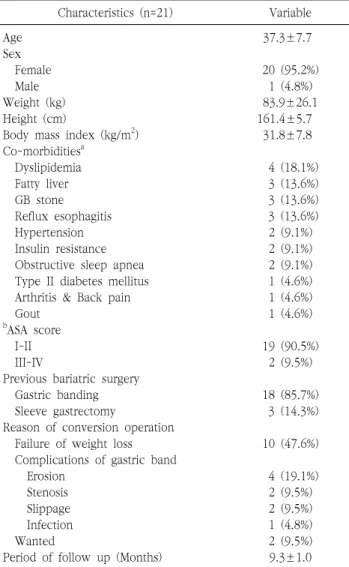
Table 1. Patients’ general characteristics
Characteristics (n=21) Variable
Age 37.3±7.7
Sex
Female 20 (95.2%)
Male 1 (4.8%)
Weight (kg) 83.9±26.1
Height (cm) 161.4±5.7
Body mass index (kg/m2) 31.8±7.8
Co-morbiditiesa
Dyslipidemia 4 (18.1%)
Fatty liver 3 (13.6%)
GB stone 3 (13.6%)
Reflux esophagitis 3 (13.6%)
Hypertension 2 (9.1%)
Insulin resistance 2 (9.1%)
Obstructive sleep apnea 2 (9.1%) Type II diabetes mellitus 1 (4.6%) Arthritis & Back pain 1 (4.6%)
Gout 1 (4.6%)
bASA score
I-II 19 (90.5%)
III-IV 2 (9.5%)
Previous bariatric surgery
Gastric banding 18 (85.7%)
Sleeve gastrectomy 3 (14.3%)
Reason of conversion operation
Failure of weight loss 10 (47.6%) Complications of gastric band
Erosion 4 (19.1%)
Stenosis 2 (9.5%)
Slippage 2 (9.5%)
Infection 1 (4.8%)
Wanted 2 (9.5%)
Period of follow up (Months) 9.3±1.0
aIncluded in duplication.
b
MATERIALS AND METHODS
From February 2010 to April 2016, 21 consecutive pa- tients who underwent CSG after failed PAGB or PSG at a minimally invasive obesity surgery center were enrolled in this study. The indications for CSG included failure of weight loss, gastric band complications (stenosis, erosion, slippage, infection), and patient choice.
This study was a retrospective analysis of our pros- pectively collected database. The following demographic data were collected and analyzed: age, sex, body mass index (BMI), American Society of Anesthesiologists (ASA) physical status classification system score, the type of primary bariatric surgery, reason for conversion, past medical history, duration of follow-up, operative time, estimated blood loss, simultaneous operation, mean duration of hospital stay, and surgical complications. This study was approved by the institutional review board of CHA Gangnam Medical Center, CHA University.
The surgical procedure for CSG has been described previously [13]. The 36-French bougie and a continuous seromuscular suture at the resection margin were used. A point on the greater curvature of the stomach appro- ximately 4 cm proximal to the pylorus was used as the distal resection point [14].
Data were analyzed by descriptive statistical methods with the Statistical Package for the Social Sciences for Windows, version 18.0 (SPSS Inc., Chicago, IL). They were then presented as either means±standard deviations or percentages.
RESULTS
1. Demographics
Twenty-one patients comprising 20 women and 1 man were enrolled in this study. The average BMI was 31.8±7.8 kg/m2, and the mean age was 37.3±7.7 (range, 23-58) years. The ASA score in most of the 19 patients was grade I-II. Eighteen patients underwent PAGB and 3 patients underwent PSG prior to CSG. Regarding the indications for conversion, 10 patients underwent CSG due to failure of weight loss; 9 patients due to complications of gastric
erosions, 2 slippages, and 1 infection; and 2 due to patient choice. Eleven patients had 1 or more co-morbidity; one of these patients had 5, including hypertension, insulin resistance, fatty liver, obstructive sleep apnea, and gout.
The mean postoperative follow-up period was 9.3±1.0 months (Table 1).
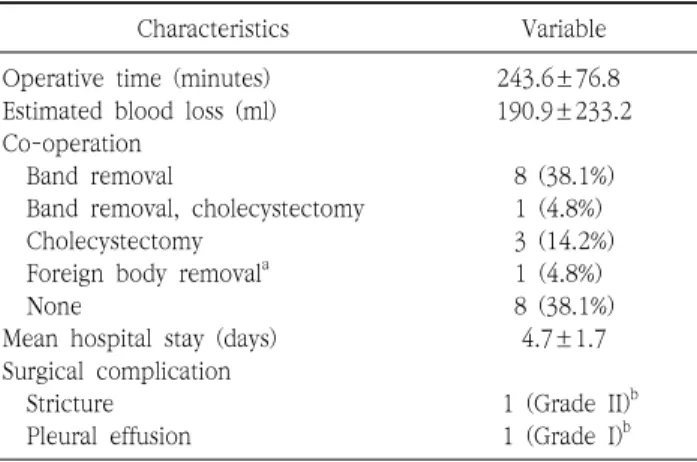
2. Intraoperative data and postoperative outcomes All 21 cases were completed laparoscopically. There were no open conversions or intraoperative complications.
The mean operative time was 243.6±76.8 minutes, and the estimated blood loss was 190.9±233.2 ml. Among the 18 patients who underwent CSG after PAGB, one-step SG
Table 2. Intraoperative and postoperative features
Characteristics Variable
Operative time (minutes) 243.6±76.8
Estimated blood loss (ml) 190.9±233.2 Co-operation
Band removal 8 (38.1%)
Band removal, cholecystectomy 1 (4.8%)
Cholecystectomy 3 (14.2%)
Foreign body removala 1 (4.8%)
None 8 (38.1%)
Mean hospital stay (days) 4.7±1.7
Surgical complication
Stricture 1 (Grade II)b
Pleural effusion 1 (Grade I)b
aForeign body (part of band material) removal.
bAccording to Clavien-Dindo surgical complication classification.
Fig. 1. The part of the gastric band material.
Fig. 2. Small phytobezoar was found in the remnant stomach.
with gastric band removal was performed in 9 patients, and two-step SG with gastric band removal was performed in the remaining 9. Five of these patients underwent gastric band removal at a different institution (Table 2). In one of the patients with previous band erosion, a foreign body was incidentally noted during CSG. This was found to be part of the gastric band material (Fig. 1).
3. Postoperative features
The mean hospital stay was 4.7±1.7 days. There were 2 immediate postoperative complications: 1 was a stricture (Clavien-Dindo surgical complication grade II) and 1 was a pleural effusion (Grade I) [15]. The patient with the gastric stricture was re-admitted thrice after CSG. Each admission lasted 3-4 days, during which she received conservative management. A gastrograffin upper gastrointestinal series
did not demonstrate any disturbance of dye flow; however, a small phytobezoar was found in the remnant stomach during gastroscopy (Fig. 2). The patient remained symp- tom-free at her 3-year follow-up visit. The patient with the postoperative pleural effusion was managed conserva- tively and discharged 4 days postoperatively; no drainage was required (Table 2). No patients developed anastomotic leakage after CSG, and the mortality rate was zero.
DISCUSSION
AGB is a restrictive bariatric operation that is reversible, safe, and relatively simple to perform. However, only 30%
of patients with gastric bands rated their life as “good” 10 and 14 years after surgery [16]. Indeed, several long-term studies on AGB have reported that revision or conversion operations are frequently required to manage the ensuing complications [5-7,17]. Various types of conversion ope- rations for failed primary bariatric surgery have emerged;
examples include SG, RYGB, and AGB [8,9,11,12]. Con- version operations to RYGB (CRYGB) have been reported to be feasible and well tolerated after failed AGB [12]. Other reports demonstrated that both CSG and CRYGB were feasible options and resulted in further substantial weight loss [8]. Another study revealed that CSG might be a valid option for managing PSG complications such as primary or
secondary dilatation [11]. However, there is still insuffi- cient evidence to help establish robust guidelines for conversion operations after failed primary bariatric surgery.
Although SG and RYGB are comparable in terms of perioperative complications and long-term outcomes [18-20], SG has more advantages than RYGB. SG is a purely restrictive operation, causes less malabsorption than RYGB, maintains pylorus function, preserves the natural anatomy of the intestinal tract, and results in a lower risk of ulce- ration. SG also reduces ghrelin secretion in the stomach, which is associated with greater appetite suppression and greater weight loss [21,22]. In addition, the study by Hong et al., which was also conducted in our institution, sugge- sted that SG might be an effective weight loss option for patients with lower BMI [14]. The average BMI in this present study was 31.8±7.8 kg/m2.
SG and RYGB are comparable in terms of perioperative complication rates and the need for conversion operations.
However, they differ in weight loss outcomes. One study reported that CRYGB was superior to CSG in terms of percentage of excess weight loss (% EWL) (55 vs. 28%, P=0.001) [19]. Another report demonstrated that both CSG and CRYGB were safe procedures with similar %EWL (47.4 vs. 45.6%, P=0.77) over a 20.7-month follow-up period. And, as CRYGB might cause long-term nutritional complications, the author has suggested that CSG may be a better option in patients with low BMI [23].
The risk of postoperative complications is higher in patients who had revision surgery, and is even higher after multiple revisions [24]. The leak rate is reportedly higher after revision of AGB into SG – this procedure involves stapling over scarred tissue, a longer stapler line, and dis- section at the left crus, which can jeopardize the blood supply at the gastroesophageal junction [24-27]. However, several studies have demonstrated SG’s feasibility as a revision procedure [28-30]. The overall post-CSG leakage rate was 13.7%, but patients who underwent the two-stage operation did not develop leakage [29]. Another study that analyzed patients with one-stage operations reported only one complication, which was a contained leak that re- solved after antibiotic treatment [30]. None of the patients in our study developed a stapler line leakage. The only
managed conservatively. This patient had also undergone a two-stage revision operation, which was considered to have a lower complication rate as compared to a one-stage operation [29].
Although we have only analyzed a relatively small amo- unt of cases, we believe that CSG would be a safe and feasible procedure for failed primary bariatric surgery. Our study will also provide evidence to help establish the surgical strategy for revision operations after failed primary bariatric surgery.
The main limitations of this study were that it was a case series conducted at a single institution, and utilized a retrospective study design that might result in bias. In addition, there were no comparative groups such as CRYGB or CAGB, because the institutional policy for revision surgery was to perform SG for patients with low BMI.
In conclusion, CSG is a feasible and safe treatment option for failed ABG or SG. Prospective studies are required to establish an evidence-based strategy for conversion ope- rations after the failure of primary bariatric surgeries.
CONFLICT OF INTEREST
No potential conflict of interest relevant to this article was reported.
REFERENCES
1. Lee HJ, Ahn HS, Choi YB, et al. Nationwide survey on bariatric and metabolic surgery in Korea: 2003-2013 results. Obes Surg 2016;26:691-5.
2. Favretti F, Segato G, Ashton D, et al. Laparoscopic adjustable gas- tric banding in 1,791 consecutive obese patients: 12-year results.
Obes Surg 2007;17:168-75.
3. Gagner M, Gumbs AA. Gastric banding: conversion to sleeve, by- pass, or DS. Surg Endosc 2007;21:1931-5.
4. Piazza L, Di Stefano C, Ferrara F, Bellia A, Vacante M, Biondi A.
Revision of failed primary adjustable gastric banding to mini-gas- tric bypass: results in 48 consecutive patients. Updates Surg 2015;67:433-7.
5. DeMaria EJ, Sugerman HJ, Meador JG, et al. High failure rate after laparoscopic adjustable silicone gastric banding for treatment of morbid obesity. Ann Surg 2001;233:809-18.
6. Vijgen GH, Schouten R, Pelzers L, Greve JW, van Helden SH, Bouvy ND. Revision of laparoscopic adjustable gastric banding: success or failure? Obes Surg 2012;22:287-92.
7. Robert M, Poncet G, Boulez J, Mion F, Espalieu P. Laparoscopic
gastric bypass for failure of adjustable gastric banding: a review of 85 cases. Obes Surg 2011;21:1513-9.
8. Moon RC, Teixeira AF, Jawad MA. Conversion of failed laparo- scopic adjustable gastric banding: sleeve gastrectomy or Roux-en-Y gastric bypass? Surg Obes Relat Dis 2013;9:901-7.
9. Aminian A, Corcelles R, Daigle CR, Chand B, Brethauer SA, Schauer PR. Critical appraisal of salvage banding for weight loss failure after gastric bypass. Surg Obes Relat Dis 2015;11:607-11.
10. Hong JS, Han SM. Re-sleeve gastrectomy for failure of weight loss after primary sleeve gastrectomy; 3 cases. J Metabolic Synd 2015;4:182.
11. Noel P, Nedelcu M, Nocca D, et al. Revised sleeve gastrectomy:
another option for weight loss failure after sleeve gastrectomy.
Surg Endosc 2014;28:1096-102.
12. Fournier P, Gero D, Dayer-Jankechova A, et al. Laparoscopic Roux-en-Y gastric bypass for failed gastric banding: outcomes in 642 patients. Surg Obes Relat Dis 2016;12:231-9.
13. HAN SM, Kim WW, Oh JH. Results of laparoscopic sleeve gas- trectomy (LSG) at 1 year in morbidly obese Korean patients. Obes Surg 2005;15:1469-75.
14. Hong JS, Kim WW, Han SM. Five-year results of laparoscopic sleeve gastrectomy in Korean patients with lower body mass in- dex (30-35 kg/m2). Obes Surg 2015;25:824-9.
15. Dindo D, Demartines N, Clavien PA. Classification of surgical complications: a new proposal with evaluation in a cohort of 6336 patients and results of a survey. Ann Surg 2004;240:205-13.
16. Aarts EO, Dogan K, Koehestanie P, Aufenacker TJ, Janssen IM, Berends FJ. Long-term results after laparoscopic adjustable gas- tric banding: a mean fourteen year follow-up study. Surg Obes Relat Dis 2014;10:633-40.
17. O’Brien PE, MacDonald L, Anderson M, Brennan L, Brown WA.
Long-term outcomes after bariatric surgery: fifteen-year fol- low-up of adjustable gastric banding and a systematic review of the bariatric surgical literature. Ann Surg 2013;257:87-94.
18. Dogan K, Gadiot RP, Aarts EO, et al. Effectiveness and safety of sleeve gastrectomy, gastric bypass, and adjustable gastric banding in morbidly obese patients: a multicenter, retrospective, matched cohort study. Obes Surg 2015;25:1110-8.
19. Marin-Perez P, Betancourt A, Lamota M, Lo Menzo E, Szomstein S, Rosenthal R. Outcomes after laparoscopic conversion of failed adjustable gastric banding to sleeve gastrectomy or Roux-en-Y
gastric bypass. Br J Surg 2014;101:254-60.
20. Zellmer JD, Mathiason MA, Kallies KJ, Kothari SN. Is laparoscopic sleeve gastrectomy a lower risk bariatric procedure compared with laparoscopic Roux-en-Y gastric bypass? A meta-analysis.
Am J Surg 2014;208:903-10.
21. Karamanakos SN, Vagenas K, Kalfarentzos F, Alexandrides TK.
Weight loss, appetite suppression, and changes in fasting and postprandial ghrelin and peptide-YY levels after Roux-en-Y gas- tric bypass and sleeve gastrectomy: a prospective, double blind study. Ann Surg 2008;247:401-7.
22. Carlin AM, Zeni TM, English WJ, et al. The comparative effective- ness of sleeve gastrectomy, gastric bypass, and adjustable gastric banding procedures for the treatment of morbid obesity. Ann Surg 2013;257:791-7.
23. Khoursheed M, Al-Bader I, Mouzannar A, et al. Sleeve gas- trectomy or gastric bypass as revisional bariatric procedures: ret- rospective evaluation of outcomes. Surg Endosc 2013;27:4277-83.
24. Hallowell PT, Stellato TA, Yao DA, Robinson A, Schuster MM, Graf KN. Should bariatric revisional surgery be avoided secondary to increased morbidity and mortality? Am J Surg 2009;197:391-6.
25. Spivak H, Beltran OR, Slavchev P, Wilson EB. Laparoscopic re- vision from LAP-BAND to gastric bypass. Surg Endosc 2007;
21:1388-92.
26. Iannelli A, Schneck AS, Ragot E, et al. Laparoscopic sleeve gas- trectomy as revisional procedure for failed gastric banding and vertical banded gastroplasty. Obes Surg 2009;19:1216-20.
27. van Wageningen B, Berends FJ, Van Ramshorst B, Janssen IF.
Revision of failed laparoscopic adjustable gastric banding to Roux-en-Y gastric bypass. Obes Surg 2006;16:137-41.
28. Acholonu E, McBean E, Court I, Bellorin O, Szomstein S, Rosenthal RJ. Safety and short-term outcomes of laparoscopic sleeve gas- trectomy as a revisional approach for failed laparoscopic adjust- able gastric banding in the treatment of morbid obesity. Obes Surg 2009;19:1612-6.
29. Berende CA, de Zoete JP, Smulders JF, Nienhuijs SW. Laparosco- pic sleeve gastrectomy feasible for bariatric revision surgery.
Obes Surg 2012;22:330-4.
30. Jacobs M, Gomez E, Romero R, Jorge I, Fogel R, Celaya C. Failed restrictive surgery: is sleeve gastrectomy a good revisional proce- dure? Obes Surg 2011;21:157-60.