울혈성 심부전 환자에서 N-Terminal Probrain-type Natriuretic Peptide의 진단적 유용성
충남대학교병원 진단검사의학과
손 계 성
Diagnostic Usefulness of N-Terminal Probrain-type Natriuretic Peptide to Detect Congestive Heart Failure Patients
Gye-Sung Son
Department of Laboratory Medicine, Chungnam University Hospital, Daejeon 301-172, Korea
Even though the echocardiograph has been recognized as the method of choice among various diagnostic tools to detect congestive heart failure (CHF), there were some limitations in relation to the consumption of time, labor and process. We analyzed results of N-terminal probrain-type natriuretic peptide (NT-proBNP) and various parameters of the echocardiographic findings to clarify the diagnostic usefulness of NT-proBNP in detecting patients with CHF. We analyzed the sera from total of 242 cases from in-patients and out-patients, which were requested from the cardiovascular section of department of Internal Medicine at Chungnam National University Hospital from March 2003 to May 2004. The procedures were performed in order as shown below; sampling, NT-proBNP analysis, data acquisition and data analysis. All data including personal information and echocardiographic findings ware acquired by medical record review.
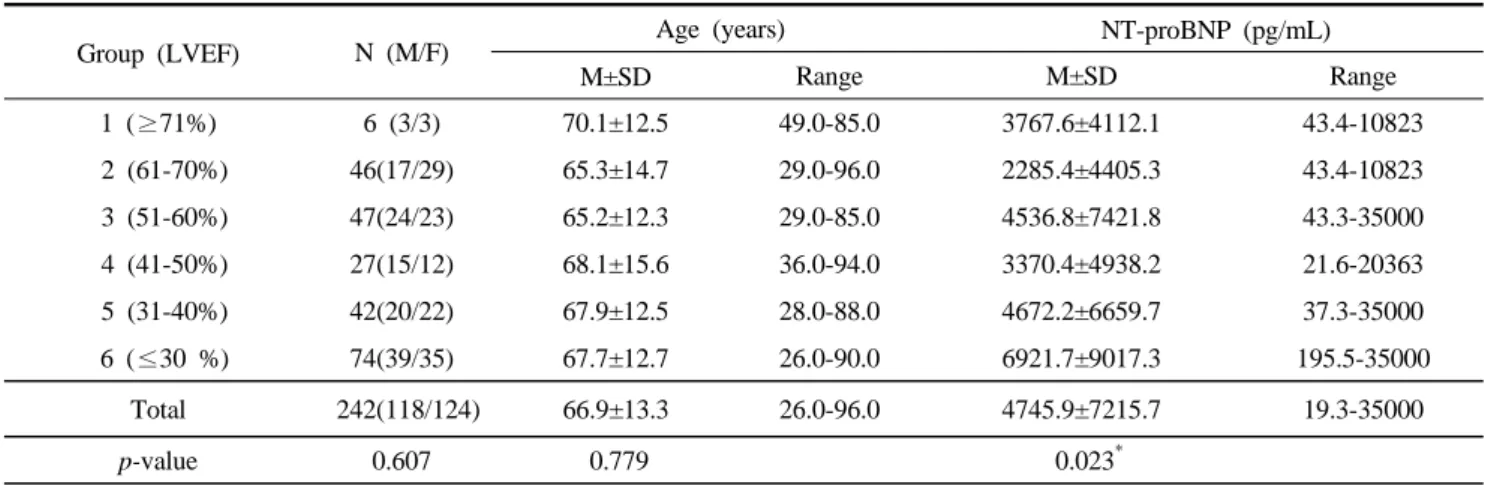
When classifying the study population into six groups according to the degree of left ventricular ejection fraction (LVEF), the serum level of NT-proBNP was higher in the group with 51-60% of LVEF (P=0.023).
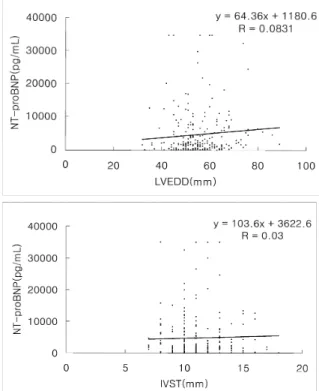
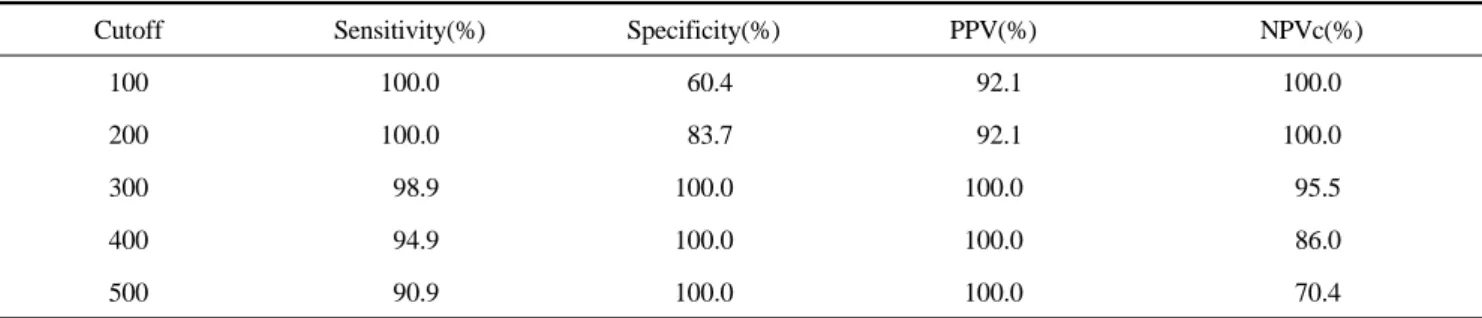
There were low correlation between the serum level of NT-proBNP and various parameters of the echocardiographic findings with LVESD (r=0.1513), LVEDD (r=0.0831), LVEF (r=0.2035), IVST (r=0.03) and LVPWT (r=0.0728), respectively. When comparing NT-proBNP with atrial and/or ventricular enlargement, the patient group with both left atrial and left ventricular enlargement (p=0.186) or only left atrial (p=0.105) or only left ventricular enlargement (p=0.256) showed higher level of NT-proBNP without statistical significance than patient group with no enlargement. Searching the optimal cutoff of the serum level of NT-proBNP, the sensitivity (98.9%) and the specificity (100%) was highest at the cutoff of 300 pg/mL than any other cutoffs. These findings suggested that the analysis of NT-proBNP in serum might detect the patients with CHF earlier than with the echocardiograph, especially in patients with asymptomatic or mild symptomatic CHF. In conclusion, NT-proBNP test was proved to be clinically useful to diagnose CHF patients.
Key Words : NT-proBNP, CHF, LVESD, LVEDD, IVST, LVPWT, LVEF 대한임상검사학회지 : 37권 제2호, 88-95, 2005
1)
교신저자 : 손계성, (우)130-182 대전시 중구 문화동 164-1, 충남대학교병원 진단검사의학과
Tel : 011-9802-7747 E-mail : [email protected]
Ⅰ. 서 론
울혈성 심부전증은 서구사회의 주된 사망원인 중 하나 이다. 심부전의 발생빈도는 우리나라에서는 거의 보고된 바 없으며 미국의 경우 연간 50만 명이 발생하고 연간 4 만 명이 사망하는 것으로 보고되고 있어 조기 진단과 적 절한 치료가 매우 중요하다(Levin 등, 1998).
울혈성 심부전증은 심근 조직으로의 불충분한 산소공 급으로 인한 좌심실의 이완성 또는 수축성 장애이다. 또 한 다양하고 모호한 증상을 나타내는 경우가 많아 심전 도, 흉부 방사선 촬영 및 심초음파검사를 통해 진단한다.
현재 울혈성 심부전의 진단은 주로 심초음파도 (echocardiography)에 의존하고 있으며 심초음파도에서 측정 가능한 여러 변수 중 좌심실 구혈률(left ventricular ejection fraction, LVEF)을 대표적인 기준으로 하고 있다 (Remme 등, 2001).
심초음파도는 심부전증 진단에 있어 심장의 구조적 장 애, 중증도 평가 및 예후 평가에 유용한 지표이다. 그러나 심부전증이 경한 경우 심초음파도상의 수축능은 정상임 에도 불구하고 호홉 곤란 등의 증상을 호소하는 심근 이 완기능 장애에 의한 조기 심부전증은 진단하기 어려운 것이 현실이다(Davies 등, 2000).
또한 시간과 노력이 수반되고 숙련된 검사자가 필요한 고가의 검사로 대중적인 선별검사로 사용하기 어려운 한 계점을 갖고 있다. 이에 심초음파 검사를 대체할 생화학 적 지표들이 개발되어 왔다.
대표적으로 울혈성 심부전을 반영하는 생체물질로는 나트륨이뇨 펩타이드(natriuretic peptide)가 있다.
Natriuretic peptide는 신체 내 생성위치에 따라 나눠지는 데 N-terminal proBNP(NT-proBNP), atrial natriuretic peptide(ANP), N-terminal proANP(NT-proANP), brain- type natriuretic peptide(BNP) 등이 있다.
이 중에서 ANP는 혈중 반감기가 짧고 채혈시의 자세 나 채혈 전의 약물투여에 의해 많은 영향을 받으며 실온 에서 2-3시간 동안만 안정하여 정확한 혈중 농도 측정이 어려운 단점이 있다. 이에 비해 NT-proANP, BNP, NT-proBNP는 반감기가 상대적으로 길고 분석 전 변수에 크게 영향을 받지 않으며 실온에서 장시간 안정하여 측정 이 용이하다. 특히 NT-proBNP는 생화학적 활성분자인 ANP, BNP보다 분자가 크고 비교적 고농도로 혈중에 존 재하여 면역분석법을 이용한 측정에서 보다 우수한 분석
이에 본 연구는 혈중 NT-proBNP 농도와 심초음파도의 여러 변수와의 상관성을 비교, 분석함으로써 울혈성 심부 전에서의 NT-proBNP의 임상적 유용성을 평가하고자 시 행하였다.
II. 재료 및 방법
1. 연구대상
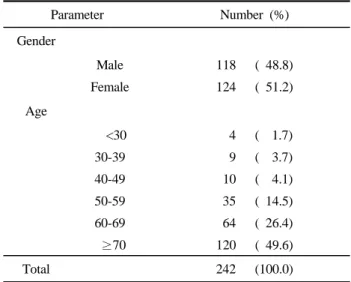
연구대상은 2003년 9월 19일부터 2004년 5월 29일까 지 충남대학교병원 순환기내과에 내원한 외래 및 입원 환자 중 울혈성 심부전질환으로 진단된 환자들을 대상으 로 하였다. 대상인원수는 총 242명으로 남자 118명, 여자 124명이었으며 평균연령은 66.9세(26-96)이었다(Table 1).
각 환자에 대한 임상자료와 심초음파 및 생화학적 검사결 과는 의무기록을 조사하여 얻었다.
2. 방법
1) 검체채취
대상군의 검체는 SST(serum separated tube)에 정맥혈 을 채혈한 후 3,000 rpm에서 10분간 원심분리를 시행한 후 혈청을 분리하였다. 혈중 NT-proBNP 검사는 채혈 후 6시간 이내에 시행하였으며 그렇지 못한 경우 검사할 때 까지 -70℃에 냉동 보관하였다.
Table 1. Demographic data of the study population
Parameter Number (%)
Gender
Male 118 ( 48.8)
Female 124 ( 51.2)
Age
<30 4 ( 1.7)
30-39 9 ( 3.7)
40-49 10 ( 4.1)
50-59 35 ( 14.5)
60-69 64 ( 26.4)
≥70 120 ( 49.6)
Total 242 (100.0)
Table 2. The serum levels of NT-proBNP in the study population according to LVEF
Group (LVEF) N (M/F) Age (years) NT-proBNP (pg/mL)
M±SD Range M±SD Range
1 (≥71%) 6 (3/3) 70.1±12.5 49.0-85.0 3767.6±4112.1 43.4-10823
2 (61-70%) 46(17/29) 65.3±14.7 29.0-96.0 2285.4±4405.3 43.4-10823
3 (51-60%) 47(24/23) 65.2±12.3 29.0-85.0 4536.8±7421.8 43.3-35000
4 (41-50%) 27(15/12) 68.1±15.6 36.0-94.0 3370.4±4938.2 21.6-20363
5 (31-40%) 42(20/22) 67.9±12.5 28.0-88.0 4672.2±6659.7 37.3-35000
6 (≤30 %) 74(39/35) 67.7±12.7 26.0-90.0 6921.7±9017.3 195.5-35000
Total 242(118/124) 66.9±13.3 26.0-96.0 4745.9±7215.7 19.3-35000
p-value 0.607 0.779 0.023*
LVEF, left ventricular ejection fraction; M±SD, Mean±sandard dviation; NT-proBNP, N-terminal pro brain-type natriuretic peptide;
* p<0.05 2) 검사방법
혈중 NT-proBNP는 proBNP Elecsys kit(Roche Diagnostics, Indianapolis, USA)와 Elecsys 1010(Roche Diagnostics, Indianapolis, USA)를 이용하여 전기화학발광 면역분석법으로 측정하였다.
검사방법의 반응원리에서 1차 배양은 검체 20 μL, biotin 처리된 polyclonal NT-proBNP에 특이적인 항체와 ruthenium이 표지된 polyclonal NT-proBNP 항체를 함께 배양한다. 2차 배양은 streptavidin이 코팅된 microparticle 을 첨가한 후에 biotin과 streptavidin의 상호작용을 통해 solid phase에 결합하여 sandwish 화합물을 형성한다. 반 응화합물은 measuring cell에 흡수된 후 microparticles은 measuring cell 안의 전극 표면에 달라 붙는다. 달라 붙지 않은 검체 및 시약 일부는 procell에 의해 제거된다. 전극 에 전압을 걸어 주면 화학 발광반응이 일어나고 이를 photomultiplier가 측정한다. 2-point calibration을 통한 교 정곡선과 시약의 바코드에 의해 제공되는 master cuve (5-point calibration)에 의해 결과 값을 산출한다. 이 방법 을 이용한 혈중 NT-proBNP의 측정범위는 5-35,000 pg/mL이었다.
심초음파도 검사는 도플러를 사용하여 좌심실 구혈률, 수축말기 좌심실 내경(left ventricular end systolic dimension, LVESD), 이완말기 좌심실내경(left ventricular end diastolic dimension, LVEDD), 이완말기 심실중격 두 께(intervtricular septal thickness,en IVST)와 좌심실 후벽 두께(left ventricular posterior wall thickness, LVPWT)를 측정하였다.
구혈률이 감소함에 따라 혈중 NT-proBNP 농도가 증가
한다는 보고(Richards 등, 1998; Talwar 등, 1999; Rossi 등, 2000)에 따라 대상군을 좌심실 구혈률에 따라 1군 (LVEF >71%), 2군 (LVEF 61-70%), 3군(LVEF 51-60%), 4군(LVEF 41-50%), 5군(LVEF 31-40%), 6군 (LVEF
<30%)으로 구분하였다(Table 2).
3) 통계 및 분석
통계적 분석은 각 연구 대상자들에 대해 얻은 자료를 SPSS version 10.0을 이용하였고, 좌심실 구혈률에 따른 NT-proBNP 농도의 차이는 분산분석을, 혈중 NT-proBNP 농도와 각 심초음파 검사지표와는 상관분석을 하였다.
p-value가 0.05 미만인 경우를 통계적으로 유의성이 있는 것으로 간주하였다.
Ⅲ. 결 과
1. 혈중 NT-proBNP 농도와 좌심실 구혈률의 분석
좌심실 구혈률에 따라 각 군의 나이 및 성별의 분포와 혈중 NT-proBNP 농도를 비교하였다. 연구대상자는 242 명으로 좌심실 구혈률에 따라 대상군을 6군으로 나누었 을 때 구혈률 30% 이하가 74명으로 가장 많았고 구혈률 71% 이상일 때 연구대상자수가 가장 적었다.
좌심실 구혈률에 따라 나이 및 성별의 분포와 혈중 NT-proBNP 농도의 차이를 분산분석한 결과 각 군에 따 라 나이 및 성별은 통계적으로 유의한 차이는 없었고, 혈 중 NT-proBNP 농도는 각 군 간에 통계적으로 유의한 차
이가 있었다(p<0.05)(Table 2).
2. 혈중 NT-proBNP 농도와 심초음파 소견과의 상관 관계
혈중 NT-proBNP 농도와 심초음파도와의 상관계수는 좌심실 구혈률, 수축말기 좌심실 내경은 각각 0.2035, 0.1513으로 낮은 상관관계를 보였고 이완말기 좌심실 내 경, 이완말기 심실중격 두께, 좌심실 후벽 두께는 각각 0.0831, 0.03, 0.0728을 나타냈다(Fig. 1).
3. 좌심방ㆍ좌심실 비대에 따른 혈중 NT-proBNP 농 도 분석
비대가 없는 군, 좌심방 비대만 있는 군, 좌심실 비대
만 있는 군, 좌심방과 좌심실 비대를 동반한 군으로 나누 어 각각 비교한 결과, 좌심방과 좌심실 비대를 동반한 144명에서의 평균 혈중 NT-proBNP 농도는 5437.6 pg/mL로 심장비대가 없는 19명의 3978.7 pg/mL와 유의 한 차이가 없었고, 좌심방 비대 또는 좌심실 비대만을 가 진 대상에 비하여도 통계적으로 유의한 차이는 없었다 (Table 3).
4. 혈중 NT-proBNP 검사의 민감도 및 특이도
울혈성 심부전 환자의 혈중 NT-ProBNP 농도에 대한 민감도와 특이도를 분석한 결과 300 pg/mL에서 민감도 와 특이도가 각각 98.9%, 100%이었고 양성 예측도와 음 성 예측도는 각각 100%, 95.5%로 가장 높았다. 500 pg/mL인 경우에서의 민감도와 특이도는 각각 90.9%,
Fig 1. Correlations between NT-proBNP level in serum and
Table 3. Comparison between various chamber enlargement and NT-proBNP level in serum
N M±SD Range p-value*
No LAE or LVE 19 3978.7±8999.3 27.4-35000
LAE 36 4761.6±6801.6 44.6-17270 0.105†
LVE 43 2755.3±4849.2 19.3-22006 0.256‡
LAE & LVE 144 5437.6±7587.6 21.6-35000 0.186§
Total 242 4745.9±7215.7 19.3-35000
LAE, left atrial enlargement; LVE, left ventricular enlargement; M±SD, 'See Table 2'
*One-way ANOVA test; †No LAE or LVE vs LAE; ‡No LAE or LVE vs LVE; § No LAE or LVE vs both LAE & LVE
Table 4. Comparison of the analysis impact according to various cutoffs of NT-proBNP levels (pg/mL) in serum
Cutoff Sensitivity(%) Specificity(%) PPV(%) NPVc(%)
100 100.0 60.4 92.1 100.0
200 100.0 83.7 92.1 100.0
300 98.9 100.0 100.0 95.5
400 94.9 100.0 100.0 86.0
500 90.9 100.0 100.0 70.4
PPV, positive predictive value; NPV, negative predictive value
100%이었고 양성 예측도와 음성 예측도는 각각 100%, 70.4%이었다(Table 4).
Ⅳ. 고 찰
나트륨이뇨 펩타이드(natriuretic peptide)는 심혈관계의 평형성을 유지하려는 성향을 가지고 분비되는 생체활성 물질로 1981년 처음 ANP(atrial natriuretic peptide)가 쥐 의 심방에서 발견된 이후, 1991년 돼지의 뇌에서 BNP(brain-type natriuretic peptide)가 추출되었으며 주된 분비는 심실에서 담당한다는 것이 밝혀지게 되었다.
NT-proBNP는 76개의 아미노산 펩타이드로 구성되어 있으며, 총 108개의 아미노산 펩타이드로 구성된 BNP의 전구 물질인 proBNP에서 분할되어 생긴다. Brain-type natriuretic peptide(BNP)는 심방에서 분비되는 atrial-type natriuretic peptide(ANP)과는 달리 심실에서 분비되며, 특 히 좌심실 기능이 저하된 환자에서 분비가 증가된다 (Wilkins 등, 1997).
울혈성 심부전은 높은 유병률과 사망률에도 불구하고 환자의 반수에서 심부전과 동반된 임상증상을 보이지 않
으며 증상이 나타나는 경우에도 환자가 호소하는 증상과 진찰 소견이 애매하여 정확한 진단이 어려웠다(Cowie 등, 1999).
울혈성 심부전증의 조기진단 방법으로는 심초음파도가 있으나 이는 고가의 장비와 숙련된 검사자가 필요하여 실제적으로 선별검사로 사용되기에는 어려운 한계점을 갖고 있다. 이에 혈중 나트륨이뇨 펩타이드 농도를 측정 하여 울혈성 심부전의 조기진단에 이용하려는 시도가 지 속적으로 있었으며 최근 현장검사(point-of-care test, POCT) 장비를 이용한 혈중 BNP 농도의 측정방법이 미 국 식약청으로부터 공인을 받아 임상에 적용하는 단계에 이르고 있다.
BNP에 대한 연구는 1978년 동물의 뇌에서 처음 발견 되어 그 분자구조 및 기능에 대한 연구가 일찍부터 시작 되어 왔지만, 그 측정방법이 용이하지 않아 연구가 활발 히 이루어지지 못하다가 측정 가능한 kit가 개발되면서 근 래 많은 연구논문들이 발표되고 있다. BNP gene은 염색 체 1번의 단원(1P36.2)에 위치하며 심실에서 생산될 때 108개의 아미노산으로 구성된 전구체인 proBNP의 형태 로 분비되는데 이는 심방과 심실의 심근세포의 분비에 포 함되어 생산된다(Cowie 등, 2002).
심실기능이 저하된 환자의 경우에는 BNP의 증가에 비 해 NT-proBNP의 절대적인 증가와 상대적인 증가가 모두 현저하여 이를 진단하는 데 있어 NT-proBNP가 BNP에 비해 우월한 것으로 알려져 있으며 근래에 와서 NT-proBNP에 대해 재현성이 좋고 짧은 시간에 저비용으 로 측정이 가능한 면역 혈청학적 검사법이 개발되어 심 실기능 저하여부 및 심부전 진단과 치료 예후 판정에 NT-proBNP를 이용하고 있다(Sahn 등, 1978; Cowie 등, 2002; Palladini 등, 2003).
Schulz 등(2001)은 연령이 증가함에 따라 혈중 NT-proBNP 농도가 증가하고 남․여 간의 차이가 없다고 보고한 반면, BNP가 estrogen에 의해 여자가 남자보다 높 다는 상반된 연구(Clerico 등, 2002)도 있어 추후 참고범 위의 설정에 관한 연구가 이루어져야 할 것으로 사료된 다.
본 연구에서 혈중 NT-proBNP 농도와 좌심실 구혈률 의 상관분석을 시행한 결과 연령에서는 통계적으로 유의 하였으나(p<0.05), 성별은 통계적으로 유의하지 않았다.
본 연구에서는 구혈률이 감소함에 따라 혈중 NT-proBNP 농도가 증가한다는 보고(Richards 등, 1998;
Talwar 등, 1999; Rossi 등, 2000)와 비슷한 결과를 나타 내지는 않았지만 혈중 NT-proBNP 농도는 각 군 간에 통 계적으로 유의한 차이가 있었다(p<0.05).
혈중 NT-proBNP 농도는 심초음파도 검사지표인 좌심 실 구혈률(r=0.2035), 수축말기 좌심실 내경(r=0.1513)과 는 상관성이 낮았지만 통계적으로 유의하였고 다른 심초 음파도 검사지표와는 상관성을 보이지 않았다.
좌심방과 좌심실 비대를 동반한 144명에서의 평균 혈 중 NT-proBNP 농도는5437.6 pg/mL로 심장비대가 없는 19명에서의 3978.7 pg/mL와는 통계학적으로 유의한 차이 가 없었고, 좌심실 비대 또는 좌심방 비대만을 가진 대상 에서도 유의한 차이가 없었다. 이는 순환기 내과의 울혈 성 심부전 환자만을 대상으로 연구를 하여 혈중 NT-proBNP 농도가 증가한 것으로 임상적으로 의미가 있 는 것으로 사료되었다.
본 연구에서는 울혈성 심부전 환자를 대상으로 혈중 NT-proBNP의 적절한 cutoff 값을 정하고자 분석한 결과 300 pg/mL에서 민감도 98.9%, 특이도 100%, 양성예측도 100%, 음성예측도 95.5%로 분석되어 300 pg/mL가 가장 신뢰할 수 있는 cutoff 수치로 생각되었으며, 울혈성 심부 전 환자만을 대상으로 하지 않았던 이전의 결과 80-100
본 연구는 대조군이 없는 환자군만을 대상으로 이루어 져 치료방침 설정에 도움이 될 수 있는 지표인지를 확인 하는 연구가 진행되어야 할 것으로 생각되며 또한 우심 실 부전이 있는 경우 혈중 NT-proBNP 농도가 유의한 수 준의 차이가 있는지에 대한 추가적인 연구가 필요할 것 으로 생각된다.
이상의 결과를 종합하여 볼 때 혈중 NT-proBNP 농도 가 울혈성 심부전을 조기 진단할 때 심초음파의 역할을 상당부분 대체할 수 있는 유용한 검사로 사료되었다.
Ⅴ. 결 론
2003년 9월 19일부터 2004년 5월 29일까지 충남대학 교병원 순환기 내과에서 울혈성 심부전으로 진단된 환자 242명을 대상으로 혈중 NT-proBNP 농도와 심초음파도 검사지표와 비교․분석한 결과 다음과 같은 결론을 얻었 다.
1. 좌심실 구혈률에 따라 대상군을 6군으로 나누어 분 석한 결과 좌심실 구혈률이 증가하여도 혈중 NT-proBNP 농도는 증가된 소견을 보였다.
2. 울혈성 심부전 환자 242명을 대상으로 혈중 NT- proBNP 농도와 심초음파 지표와의 상관성을 분석한 결과 좌심실 구혈률, 수축말기 좌심실 내경과 통계적 으로 유의한 상관관계가 있었다(p<0.05).
3. 비대를 동반하지 않은 울혈성 심부전 환자 19명에서 혈중 NT-proBNP 농도는 3978.7 pg/mL로 증가하였 고, 좌심방 비대와 좌심실 비대가 동반된 환자, 좌심 방 또는 좌심실 비대가 단독으로 존재하는 환자에서 도 증가하였고 통계적으로 유의한 차이가 없었다.
본 연구 결과 좌심실 구혈률이 증가된 환자 및 비대를 동반하지 않은 울혈성 심부전 환자에서 혈중 NT-pro BNP 농도가 증가하였으며 이는 울혈성 심부전 환자를 조기 진단할 수 있는 생화학적 지표로서 임상적으로 우 수한 검사로 사료되었다.
참 고 문 헌
F. Plasma human brain natriuretic peptide in chronic renal failure. Clin Nephrol 44:61-64, 1995.
2. Clerico A, Lervasi G, Del Chicca MG, Emdin M, Naffei S, Nannipieri M, et al. Circulating levels of cardiac natriuretic peptides (ANP and BNP) measured by highly sensitive and specific immunoradiometric assays in normal subjects and in patients with different degrees of heart failure. J Endocrinol Invest 21:170-179, 1998.
3. Cowie MR, Mosterd A, Wood DA, Decker JW, Poole-Wilson PA, Sutton GC, et al. The epidemiology of heart failure. Eur Heart J 18:208-225, 1997.
4. Davis M, Espiner E, Richards G, et al. Utility of B-type natriuretic peptide in assessment of acute dyspnea. Lancet 343:440-444, 1994.
5. Davidson NC, Coutie WJ, Struthers AD. N-terminal proatrial natriuretic peptide and brain natriuretic peptide are stable for up to 6 hours in whole blood in vitro. Circulation 91:1276-1277, 1995.
6. Davidson NC, Nass AA, Hanson JK, Kennedy NS, Coutie WJ, Struthers AD. Comparison of atrial natriuretic peptide, B-type natriuretic peptide, and N-terminal proatrial natriuretic peptide as indicators of left ventricular systolic dysfunction. Am J Cardiol 77;828-831, 1996.
7. Dao Q, Krishnaswamy P, Kazanegra R, Harrison A, Amirnovin R, Lenert L, et al. Urgent-care setting. J Am Coll Cardiol 37:379-385, 2001.
8. Davies MK, Gibbs CR, Lib YM. ABC of heart failure; investigation. BMI 320:297-300, 2000.
9. Hammerer-Lercher A, Neubauer E, Muller S, Pachinger O, Puschendorf B, Mair J. Head-to-head comparison of N-terminal pro-brain natriuretic peptide, brain natriuretic peptide, and N-terminal pro-atrial natriuretic peptide in diagnosing left ventricular dysfunction. Clin Chim Acta 310:193-197, 2001.
10. Harrison A, Morrison LK, Krishnaswamy P. B-type natriuretic peptide (BNP) predicts future cardiac events in patients presenting to the emergency department with dyspnea. Ann of Emerg Med.
39:131-138, 2002.
11. Lemos JA, McGuire DK, Drazner MH. B-type natriuretic peptide in cardiovascular disease. Lancet 362:316-322, 2003.
12. Levin ER, Gardener DG, Samson WK. Mechanism of disease; Natriuretic peptide. N Eng J Med 339:321-328, 1998.
13. Logeart D, Saudubray C, Beyne P, Thabut G, Ennezat PV, Chavelas C, Zanker C, Bouvier E, Solal AC.
Comparative value of doppler echocardiography and B-type natriuretic peptide assay in the etiologic diagnosis of acute dyspnea. J AM Coll Cardiol 40:1794-1800, 2002.
14. Mair J, Hammerer-Lercher A, Puschendorf B. The impact of cardiac natriuretic peptide determination on the diagnosis and management of heart failure. Clin Chem Lab Med 39:571-588, 2001.
15. McDonagh TA, Robb SD, Murdoch DR, Morton JJ, Ford I, Morrison CE, et al. Biochemical detection of left-ventricular systolic dysfunction. Lancet 351:1121- 1128, 1998.
16. Murdoch DR, Byme J, Morton JJ, Dargie HJ. Brain natriuretic peptide is stable in whole blood and can be measured using a simple rapid assay: implications for clinical practice. Heart 78:594-597, 1977.
17. Palladini G, Campana C, Klersy C, Balduni A, Vadacca G, Perfetti V, et al. Serum N-terminal pro-brain natriuretic peptide is a sensitive marker of myocardial dysfunction in AL amyloidosis.
Circulation 107:2440-2445, 2003.
18. Remes J, Miettinen H, Reunanen A, Pyorala K.
Validity of clinical diagnosis of heart failure in primary health care. Eur Heart J 12:315-321, 1991.
19. Remme WJ and Swedberg K. Guidelines for the diagnosis and management of chronic heart failure.
Eur Heart J 22:1527-1560, 2001.
20. Richards AM, Nicholls MG, Yandle TG, Frampton C, Epiner EA, Turner JG, et al. Plasma N-terminal pro-brain natriuretic peptide and adrenomedullin: new neurohormonal predictors of left ventricular function and prognosis after myocardial infarction. Circulation 97:1921-1929, 1998.
21. Rossi A, Enriquez-Sarano M, Burnett JC Jr, Lerman
A, Abel MD, Seward JB. Natriuretic peptide levels in atrial fibrillation: a prospective hormonal and doppler-echocardiographic study. J Am Coll Cardiol 35:1256-1262, 2000.
22. Sahn DJ, Demaria S, Kisslo J, Weyman A.
Recommendations regarding quantitation in M-mode echocardiography: result of a survey of echocardio- graphic measurements. Circulation 58:1072-1083, 1978.
23. Schulz H, Langvik TA, Lund SE, Smith J, Ahmad N, Hall C. Radioimmunoassay for N-terminal probrain natriuretic peptide in human plasma. Scand J Clin Sab Invest 61:33-42, 2001.
24. Sharp N and Doughty R. Epidemiology of heart failure and left ventricular dysfunction. Lancet 352 (S1):S13-17, 1998.
25. Stevenson LW and Perloff JK. The limited reliability of physical sign for estimating hemodynamics in chronic heart failure. JAMA 261:884-888, 1989.
26. Talwar S, Squire IB, Davies JE, Barnett DB, Ng LL.
Plasma N-Terminal pro-brain natriuretic peptide and the ECG in the assessment of left-ventricular systolic dysfunction in a high risk population. Eur Heart J 20:1736-1744, 1999.
27. Tsutamoto T, Wada A, Maeda K, Hisanaga T, Maeda Y, Fukai D, et al. Attenuation of compensation of endogenous cardiac natriuretic peptide system in chronic heart failure: prognostic role of plasma brain natriuretic peptide concentration in patients with chronic symptomatic left ventricular dysfunction.
Circulation 96:509-516, 1997.
28. Wang T, Larson M, Sevy D, Lepis EP, Benjamin EJ, Wilson PW, Sutherland P, Omland T, Vasan RS.
Impact of age and sex on plasma natriuretic peptide level in healthy adult. Am J Cardiol 90:254-258, 2002.
29. Wilkins MR, Redondo J, Brown LA. The natriuretic peptide family. Lancet 349:1307-1310, 1997.