THE SPIRITUAL NATURE OF GINSENG IN THE FAR EAST
Ginseng, a medicinal herb, has long been used in the Far East, particularly in Korea and China as a respected herbal medicine in maintaining physical vitality. The genus name Panax (Pan=all +axos=medicine) means ‘cure all’in Greek.
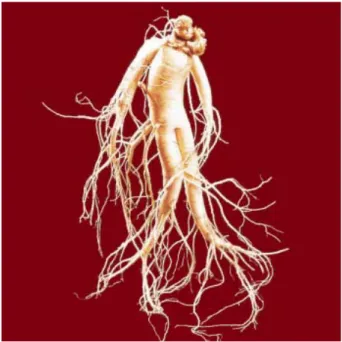
The herbal root is so named as ginseng, because it is shaped like a man (Fig. 1), and is believed to embody his three es- sences (i.e. body, mind and spirit) and is known as the lord or king of herbs (1). Ginseng had been used mainly as a tonic to invigorate weak bodies, but only rarely as a curative medi- cine, although, according to the Bancao Gangmu (Encyclo- pedia of Herbs) written by Li Shizhen in China, 1596 A.D.
(2), it was included as an ingredient for curing 23 diseases.
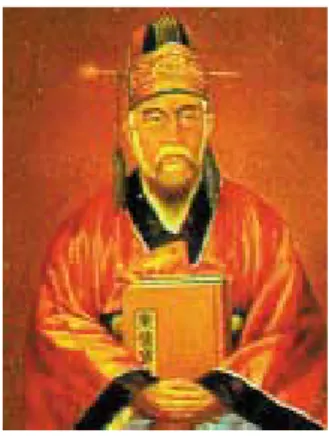
It is also included in 653 (16.6%) of the total 3,944 prescrip- tions in Dongeui Bogam (Korean Clinical Pharmacopoeia), written by the Korean herbalist, Huh Joon, in 1610 A.D.
(3) (Fig. 2).
THE HISTORY OF GINSENG
The origin of ginseng dates back to prehistory. In China, Shennong (Divine Peasant) also known as Emperor Yan, the Yellow Emperor, or one of the “Three Emperors”(the Emper- or who is said to have started herbal medicine about 5,500 yr ago) is reported to have tasted hundreds of plants to dis- cover many medicinal herbs (4). The original work was lost long ago, however, studies performed by Shennong were handed down verbally over many generations and were com-
piled into a commentary book “Shennong Bencao Jing (Shen- nong’s Herbal)”by Tao Hongjing during the Liang Dynasty, 502-557 A.D. (5).
Three hundred and sixty-five kinds of herb are listed and they are divided into three classes according to the degree of toxicity. The superior ones are non-toxic and serve to reinforce vital energy, and can be taken regularly. Examples include Radix Ginseng. Ginseng was also mentioned in Jijuzhang (Interpretation of Creatures) written by Shi You of China, as
Taik-Koo Yun
Laboratory of Experimental Pathology, Korea Cancer Center Hospital, Seoul, Korea
Address for correspondence Taik-Koo Yun, M.D.
Laboratory of Experimental Pathology, Korea Cancer Center Hospital, 215-4 Gongneung-dong, Nowon-ku, Seoul 139-706 Korea
Tel : +82.2-335-1020, Fax : +82.2-335-1020 E-mail : [email protected]
S3 J Korean Med Sci 2001; 16(Suppl): S3-5
ISSN 1011-8934
Copyright � The Korean Academy of Medical Sciences
Brief Introduction of Panax ginseng C.A. Meyer
For many many thousand years, mankind has been using various plants as nutri- ent, beverage, cosmetics, dye and medicine to maintain health and to improve quality of life. In Aisa, particularly, Panax ginseng C.A. Meyer is considered to be the most precious plant among herbs, and ginseng has been in the spotlight worldwide. Even in the Western world, where there are greatly advanced research facilities and highly qualified man-power available, and are regarded to be capa- ble of conquering any hard-to-cure ailments, many peoples has recently been reported to use herbal medicine, particularly ginseng. In the present compilation of papers, many scientists contributed papers pertaining to“Chemopreventive effects of ginseng”. In order to facilitate the readers understand easier and bet- ter, I catalogued this collection as follows: The spiritual nature of ginseng in the Far East, the history of ginseng, nomenclature and geographical distribution of ginseng, and type of ginseng products.
Key Words : Ginseng; Chemoprevention; Panax ginseng C.A. Meyer
Fig. 1. Fresh Panax ginseng C.A Meyer shaped like a person.
S4 T.-K. Yun
early as between 48 and 33 B.C. (6). Ginseng prescriptions are found in Shanghan Lun (Treatise on Fevers) between 196 and 200 A.D. (7). There are many mythical story. A leg- endary story relates that a young man whose mother was suf- fering from incurable disease found a miraculous remedy in the deep mountain in the dream: The mountain spirit pre- sented a ginseng plant to him when he met fantastic old man in a ecstasy.
Among many forces influencing the present health care environment is a rapid increase of the use of complementary and alternative medical therapies. In the U.S.A., it has been reported that 40% of the public use alternative therapies (8), and herbal medicine is among the most prevalent comple- mentary/alternative therapies (CATs). In 1998, total U.S.A.
sales for herbal remedies approached dollars 4 billion, sug- gesting an annual growth rate of approximately 25% (9).
This is also confirmed by a recent assessment of the U.S.A.
herbal market. The annual sale of ginseng was$98 million U.S. dollars with a growth rate of 26% (10).
NOMENCLATURE AND GEOGRAPHICAL DISTRIBUTION OF GINSENG
The ginseng plant is a deciduous perennial belonging to the Family Araliaceae. Thirteen species of ginseng include:
Panax ginseng C.A. Meyer (in 1833, once known as Panax schinseng Nees after a German botanist, Nees van Esenbeck and later renamed by the Russian scientist Carl Anton Meyer in 1843), which is cultivated in Korea, Japan, China, Russia and Germany; Panax quinquefolius L. (American ginseng;
once known as Aralia canadensis), found in Southern Canada and the United States of America, from Maine to Minneso- ta, south to Florida, and west to Oklahoma; Panax japonicus C.A. Meyer (Japanese ginseng), grown in Japan; Panax noto- ginseng (Burk.) F.H. Chen (Sanchi ginseng) grows in China’s Yunnan province; Panax trifolius L. (Dwarf ginseng), found from Nova Scotia to Wisconsin and further south; Panax major Ting; Panax omeiensis J. Wen; Panax pseudoginseng Wallich, grown in Nepal and the eastern Himalayas; Panax sinensis J. Wen; Panax stipuleanatus H.T. Tsai & K.M. Feng;
Panax wangianus Sun; Panax zingiberensis C.Y. Wu & K.M.
Feng (11) and Panax vietnamensis Ha et Grushv (12) (Table 1). Siberian ginseng does not belong to the genus Panax, but to the genus Eleutherococcus senticosus (maxim.) containing no ginsenosides (13, 14). Asian ginseng is not a generic name.
When one uses the name Asian ginseng, it includes all gin- sengs originated from Asian countires, i.e., Panax ginseng C.A. Meyer, Panax japonicus, Panax notoginseng (Sanchi gin- seng) and Panax sinensis J. Wien.
Cultivation of Panax ginseng C.A. Meyer in Korea started around 11 B.C. by transplantation of wild ginseng. In 1122 A.D., during the era of King In Jong of the Koryo Dynasty, ginseng cultivation was also attempted through the propa- gation of transplanted ginseng from seeds (15).
Panax quinquefolius (American ginseng): in 1709 the French Jesuit missionary Father Jartoux recognized ginseng roots in China and wrote a letter to Father Lafitau in St Louise, Canada (near Montreal) accurately describing its appearance.
Father Lafitau read the letter in 1714, and one day he stum- bled across ginseng growing at the site of a new house (16).
The quantity of wild ginseng was not sufficient to meet the demand, so experiments on cultivation were undertaken in 1878 at the Botanical Gardens in Jamaica without success.
American ginseng cultivation, however, was achieved in Fabius, New York by George Stanton, a retired tinsmith turned to farmer. His story appeared in a New York news- paper in 1897, stressing the importance of shade for the successful cultivation of ginseng, a technique practiced in Korea for centuries (17).
Germany is one of the countries which has imported Kore- an ginseng for a long time. In 1982, Heinrich Wischmann who had been farming since 1960 in an old farm inaugurated in 1438 at Winsrode, happened to read an article on Korean ginseng in the newspaper “Die Welt”, and in 1983 he ac- quired the seed of Panax ginseng C.A. Meyer from Hong Kong through a Chinese. At the beginning, he planted the seed only in an area of 50 square meters and harvested the first crop in 1992 & nice then, he established a distribution company called “FloraFarm”.
1. Panax ginseng C. A. Meyer (Korean ginseng) 2. Panax japonicus C. A. Meyer (Japanese ginseng) 3. Panax major Ting
4. Panax notoginseng (Burkill) F. H. Chen (Sanchi ginseng) 5. Panax omeiensis J. Wen
6. Panax pseudoginseng Wallich
7. Panax quinquefolius L. (American ginseng) 8. Panax sinensis J. Wen
9. Panax stipuleanatus H. T. Tsai & K.M. Feng 10. Panax trifolius L. (Dwarf ginseng) 11. Panax wangianus Sun
12. Panx zingiberensis C.Y. Wu & K.M. Feng
13. Panax vietnamensis Ha et Grushv. (Vietnamese ginseng) Table 1. Species of Ginseng
Fig. 2. Portrait of Huh Joon, an ancient Korean Herbalist.
Introduction of Panax ginseng S5
TYPES OF GINSENG PRODUCTS
The conventional sun-drying of ginseng was switched to the steaming method to meet the great demand for ginseng which was stimulated by active trade with China during the reign of King Ae, the 14th King of Balhae. Xu-Jing of the Sung Dynasty, an attendant to a special envoy of the Chinese Emperor to Korea, wrote in “Kaoli T’suching”of the impression of his visit to the (Korean) Kingdom of Koryo in 1123, during the reign of King In Jong. He described in his book that there were two kinds of ginseng products in Koryo, sun-dried and steamed ginseng; red ginseng (18).
Panax ginseng C.A. Meyer cultivated in Korea (Korean ginseng) is harvested after 4 to 6 yr of cultivation, and it is classified into three types depending on how it is processed:
(a) fresh ginseng (less than 4 yr old; can be consumed in it’s fresh state); (b) white ginseng (4-6 yr old; dried after peel- ing); and (c) red ginseng (harvested when 6 yr old, and then steamed and dried). Each type of ginseng is further subcate- gorized as ginseng products; fresh sliced, juice, extract (tinc- ture or boiled extract), powder, tea, tablet, capsule, etc. Two years old fresh ginseng is also used as an ingredient in the Korean chicken-ginseng soup known as “Samketang”.
REFERENCE
1. Hu SY. The genus Pananx (ginseng) in Chinese medicine. Econ Bot 1976; 30: 11-28.
2. Li Shizhen. Encyclopedia of Herbs. 1596; 52 vol., China.
3. Huh Joon. Dongeui Bogam (Korean Clinical Pharmacopoeia). 1610;
25 vol, Korea.
4. Zheng BC. Shennong’s herbal - One of the world’s earliest pharma- copoeia. J Tradit Chin Med 1985; 5: 236.
5. Wang J. The earliest officially published pharmacopoeia in the world.
J Tradit Chin Med 1987; 7: 155-6.
6. Shi You. Jijuzhang (Interpretation of Creatures). 48 and 33 B.C.
China.
7. Chang Chung-Jing. Shanghan Lun (Treatise on Fevers). 196 and 200 A.D., China.
8. Astin JA. Why patients use alternative medicine. Results of a national study. JAMA 1998; 279: 1548-53.
9. Brevoort P. The booming US botanical market - a new overview.
Herbalgram 1998; 44: 33-46.
10. Muller JL, Clauson KA. Pharmaceutical considerations of common herbal medicine. Am J Manage Care 1997; 3: 1753-70.
11. Wen J, Zimmer EA. Phylogeny and biogeography of Panax L. (the Ginseng genus, Araliaceae): Inferences from ITS sequenes of nucle- ar ribosomal DNA. Mol Phylogenet Evol 1996; 6: 167-77.
12. Nguyen MD, Nguyen TN, Kasai R, Ito A, Yamasaki K, Tanaka, O.
Saponins from Vietnamese ginseng, Panax vietnamensis Ha et Grushv. collected in Central Vietnam. 1. Chem Pharm Bull 1993;
41: 2010-4.
13. Brekhman II. Eleutherococcus senticosus-a new medicinal herb of the Araliaceae family. In: Pharmacology of Oriental Plants. Proc.
2nd Int. Pharmacol. Meet.: Vol. 7, Oxford: Pergamon Press 1965;
97-101.
14. Cui J, Garle M, Eneroth P, Bjorkhem I. What do commercial ginseng preparations contain? Lancet 1994; 344: 134.
15. Korea Ginseng & Tobacco Research Institute. An Introduction to Korean Ginseng: The Elixir of Life. 3rd ed. 1986; 134 Daejeon, Korea.
16. Goldstein B. Ginseng: Its history, dispersion, and folk tradition. Am J Chin Med 1975; 3: 223-34.
17. Harding AR. Ginseng and other medicinal plants. Columbus, Ohio:
A.R. Harding Publishing Co., 1913; 43.
18. Xu, Jing. Impressions of his visit to the Kingdom of Koryo. Kaoli T'suching 1123 A.D. During the King In Jong, Vol 23.