HMCM-41 촉매에서 2,3-Dihydrobenzofuran 유도체의 합성
김형진†·서 곤·김정년·최경호 전남대학교응용화학공학부
500-757 광주시북구용봉동 300 (2005년 8월 19일접수, 2005년 10월 27일채택)
Synthesis of 2,3-Dihydrobenzofuran Derivatives over HMCM-41 Catalysts Hyung Jin Kim
†, Gon Seo, Jung-Nyun Kim and Kyung Ho Choi
School of Applied Chemical Engineering, Chonnam National University, 300, Yongbong-dong, Puk-gu, Gwangju 500-757, Korea (Received 19 August 2005; accepted 27 October 2005)
요 약
HMCM-41 중간세공물질(mesoporous material) 촉매를사용하여 aryl methallyl ether로부터의약품과농약의주요 중간체인 2,3-dihydrobenzofuran 유도체를합성하였다. 산점농도가촉매활성에미치는영향을비교하기위하여 Si/Al
몰비가 40과 50으로다른촉매를제조하였으며, aryl methallyl ether에다양한치환기를도입하여벤젠고리의전자밀 도가전환율과수율에미치는효과를조사하였다. 산점이많아질수록전환율은높아졌으나, 2,3-dihydorbenzofuran 유 도체의수율과직접연관짓기는어려웠다. 전자공여기의치환으로벤젠고리의전자밀도가높아지면 claisen 자리 옮김반응이빨라져서 2,3-dihydrobenzofuran 유도체가많이생성되었다. 반면, 전자흡인기가치환되어벤젠고리의전 자밀도가낮아지면산촉매에의해 aryl methallyl ether 분해반응이촉진되어 2,3-dihydrobenzofuran 유도체대신 phenol
유도체가생성되었다.
Abstract – 2,3-Dihydrobenzofuran derivatives, important intermediates of medicines and agricultural chemicals, were prepared from aryl methallyl ethers over MCM-41 mesoporous material catalysts. Two mesoporous materials with Si/Al mole ratios of 40 and 50 were prepared to investigate the effect of acid site concentration on their catalytic activities.
Aryl methallyl ethers with various substituents on their benzene rings were used to investigate the effect of electron den- sity on benzene ring on the conversion of the ethers and the yield of 2,3-dihydorbenzofuran derivatives. The catalyst with a high acid site concentration showed high conversions, but it is difficult to correlate the yield of the derivatives with the acid site concentration. The increase in the electron density of the benzene ring by introducing electron-donat- ing groups accelerated Claisen rearrangement reaction, resulting in the enhanced yield of the derivatives. On the other hand, the decrease in the electron density by introducing electron-attracting groups accelerated the cracking reaction of aryl methallyl ether by acid catalysts, producing phenol derivatives rather than 2,3-dihydrobenzofuran derivatives.
Key words: HMCM-41, Dihydrobenzofuran, Cyclization Reaction, Acid Catalyst
1. 서 론
고체산은액체산에비해산세기범위가넓고열적으로안정하여 높은온도에서도사용할수있으므로, 정유나석유화학산업에서촉 매로많이사용한다. 최근에는생성물과분리하기쉽고세공구조를 이용하여선택성을높일수있다는점을고려하여정밀화학물질을
제조하는유기반응에도고체산을촉매로활용한다[1,2]. 특히계면
활성제를 구조 유도물질로 사용하여 합성한 중간세공 물질
(mesoporous material)은중간세공(mesopore)의직경이 20~100 Å으
로커서, 큰유기분자의물질이동에제약이없으므로유기반응의 산촉매로적절하다. 산세기와산점농도의조절도가능하여유기 반응의선택성제어에도효과적이다. 크고균일한중간세공에귀금 속, 전이금속, 아민등촉매활성물질을담지할수있어지지체로 도유용하다[3].
중간세공물질을유기반응에산촉매로사용한연구가많다. 방 향족화합물의알킬화반응[4], α-pinene oxide의이성화반응[5], 선 택적 diels-alder 반응[6], ene 고리화반응[7], 알코올의탈수반응[8]
등에촉매로적용되었다. 중간세공물질은산성이너무강하지도약 하지도않아서아세틸화반응, 알코올축합반응, michael 첨가반응, Beckmann 자리옮김반응, 글리코시드화반응등중간세기산점에 서촉진되는여러유기반응에촉매로서적용이검토되고있다[9].
†To whom correspondence should be addressed.
E-mail: [email protected]
2,3-Dihydrobenzofuran 유도체는의약, 농약, 천연물화학분야의 중요한중간체이지만[10], 대량으로제조할수있는쉬운방법이아 직개발되지않았다. 실험실에서는강산[11]이나 ZnCl2[12], AlCl3 [13], MgCl2[14], Mo(CO)6[15]등루이스산을촉매로사용하여 claisen
자리옮김반응과고리화반응을거쳐 2,3-dihydrobenzofuran 유도 체를합성한다. 위에나열한균일계산촉매를사용하면생성물의 수율은높으나, 반응절차와조건이까다롭고여러단계를거쳐야 생성물과촉매를분리할수있다. 더욱이황산이나염화물촉매는 부식성이강하여특수반응기를사용하여야하고환경오염을유발 하는폐수를다량발생하므로, 환경친화적이면서도유도체의수율 이높은촉매의개발에관심이많다.
Aryl methallyl ether(1)을 2,3-dihydrobenzofuran 유도체(2)로전 환하는반응에고체산을촉매로사용하면, 반응후생성물을분리 하기쉽고사용하기편리하며폐수가발생하지않아환경친화적이 다. 산성인 HY 제올라이트를촉매로사용하면 2,3-dihydro-benzofuran
유도체(2)의수율이상당히높다[16]. 그러나세공이작고산세기 가강하여부반응의진행이불가피하다.
이연구에서는제올라이트보다세공은크나산세기가약한중간 세공물질을촉매로사용하여고체산촉매의산성도와세공구조가
aryl methallyl ether(1) 전환반응의전환율과선택성에미치는영향 을검토하였다. 이와함께벤젠고리치환기의전자적성질을 2,3- dihydrobenzofuran 유도체의수율및선택성과연관지어고찰함으 로써벤젠고리의전자밀도가 aryl methallyl ether(1) 전환반응의 경로에미치는영향을고찰하였다.
2. 실 험
2-1. 시약및기구
2,3-Dihydrobenzofuran 유도체합성에사용한시약은 Aldrich사에 서구입하였다. 1,2-Dichloroethane(99%)에 CaCl2를가하여수분을
일차제거하고, CaH2를넣어질소기류하에서환류가열한후증류
하여사용하였다. Chlorobenzene(99.5+%)은 Linde 4A 분자체로물 을제거한후사용하였다. 용리액으로사용한용매는일급시약을 구입하여더욱정제하지않고그대로사용하였다.
Thin layer chromatograph(TLC) 분리판으로는 Merck사에서구입 한 silica gel plate(Kiesel gel 60F 254)를 사용하였으며, column chromatograph의분리관에는 silica gel(Merck 60, 230~400 mesh)을 충전하였다.
합성한물질의녹는점은 Mel-Temp II capillary melting point 측 정장치로측정하였다. 적외선흡수스펙트럼은 Shimadzu IR-435
적외선흡수분광기로, 1H-NMR 스펙트럼은시료를 CDCl3용매에 녹여 AMX-R300 핵자기공명분광기로그렸다. Chemical shift는
TMS를 내부 표준물질(0.00 ppm)로 넣어 결정하였다. 다중도
(multiplicity)는다음처럼단순화하여표기하였다(s=singlet, d=doublet, t=triplet, q=quartet, dq=doublet-quartet, m=multiplet).
2-2. Aryl methallyl ether(1)의 합성
Aryl methallyl ether는 Aldrich사에서 구입한페놀유도체와 3- chloro-2-methyl propene를문헌[13]에설명된방법에따라합성하 였다(Scheme 1).페놀유도체를 K2CO3로처리하여만든페놀레이 트유도체와 3-chloro-2-methyl propene과 KI의반응생성물인요오 드화물중간체를반응시켜 aryl methallyl ether를만들었다. 페놀유 도체의치환기를바꾸어 Scheme 1에보인다양한 aryl methallyl ether 유도체를제조하였다.
Methallyl 3,4,5-trimethylphenyl ether(1a). 3,4,5-Trimethyl-phenol (0.5g, 3.67mmol), K2CO3(0.61g, 4.40 mmol), KI(0.008g, 0.05 mmol)을
acetone 5 mL와 DMF 1 mL 혼합용매에녹였다. 이어 3-chloro-2- methylpropene(0.47 g, 5.14 mmol)을가하여환류가열하면서, TLC
로반응의진행정도를확인하였다. 반응이끝난후, 반응혼합물에
냉각수(5 mL)를가하여반응하지않은반응물과생성된 KCl을제
거하였다. 유기물층을 디에틸에테르(10 mL)로 추출하여 10%
NaOH 수용액, 물, NaCl 수용액으로차례로세척한후무수 MgSO4
로 건조하였다. 유기물층을농축한후칼럼크로마토그래피(n- hexane : EtOAc=12 : 1)로정제하여 aryl methallyl ether를얻었다
(수율: 91%): b.p. 61-62oC/0.05 mmHg; 1H NMR(CDCl3) δ: 1.82 (s, 3H), 2.10(s, 3H), 2.25(s, 6H), 4.38(s, 2H), 4.96(s, 1H), 5.08(s, 1H), 6.60(s, 2H); IR(KBr) 3008, 1599, 1501, 1443, 1306, 1197, 1139.
Methallyl 2,3,5-trimethyl ether(1b). 2,3,5-Trimethylphenol(1 g, 7.34 mmol), K2CO3(1.21 g, 8.81 mmol), KI(0.01 g, 0.10 mmol), 3- chloro-2-methylpropene(0.93 g, 10.28 mmol)을위에설명한방법으 로반응시켜 methallyl 2,3,5-trimethyl ether를제조하였다(수율: 91%):
1H NMR(CDCl3) δ: 1.85(s, 3H), 2.14(s, 3H), 2.24(s, 3H), 2.28(s, 3H), 4.39(s, 2H), 4.97(s, 1H), 5.12(s, 1H), 6.52(s, 1H), 6.61(s, 1H).
3,4-Dimethylphenyl methallyl ether(1c). 3,4-Dimethylphenol(2 g, 16.37 mmol), K2CO3(2.26 g, 16.37 mmol), KI(0.03 g, 0.19 mmol), 3-chloro-2-methylpropene(1.75 g, 19.64 mmol)을위에설명한방법 으로반응시켜 3,4-dimethylphenyl methallyl ether를제조하였다(수 율: 77%): 1H NMR(CDCl3) δ: 1.81(s, 3H), 2.17(s, 3H), 2.21(s, 3H), 4.38(s, 2H), 4.96(s, 1H), 5.07(s, 1H), 6.63(dd, J=8.2 Hz, 1H), 6.72 (d, 1H), 6.99(d, J=8.2 Hz, 1H).
2,5-Dimethylphenyl methallyl ether(1d). 2,5-Dimethylphenol(2 g, 16.37 mmol), K2CO3(2.26 g, 16.37 mmol), KI(0.03 g, 0.19 mmol), 3-chloro-2-methylpropene(1.75 g, 19.64 mmol)을위에설명한방법
Scheme 1. Preparation of aryl methallyl ethers.
으로반응시켜 2,5-dimethylphenyl methallyl ether를제조하였다(수 율: 91%): 1H NMR(CDCl3) δ: 1.81(s, 3H), 2.22(s, 3H), 2.31(s, 3H), 4.41(s, 2H), 4.98(s, 1H), 5.12(s, 1H), 6.63(s, 1H), 6.66(d, J=7.2 Hz, 1H), 7.01(d, J=7.2 Hz, 1H).
2-Chloro-4,5-dimethylphenyl methallyl ether(1e). 2-Chloro-4, 5-dimethylphenol(2 g, 12.77 mmol), K2CO3(1.765 g, 15.32 mmol), KI(0.02 g, 0.15 mmol), 3-chloro-2-methylpropene(1.38 g, 15.32 mmol)
을위에설명한방법으로 반응시켜 2-chloro-4,5-dimethylphenyl methallyl ether를제조하였다(수율: 88%): 1H NMR(CDCl3) δ: 1.82 (s, 3H), 2.12(s, 3H), 2.17(s, 3H), 4.42(s, 2H), 4.97(s, 1H), 5.12(s, 1H), 6.67(s, 1H), 7.07(s, 1H); IR(KBr) 2943, 1649, 1598, 1486, 1438, 1379, 1280, 1193, 1149, 1039.
Methallyl 4-methylphenyl ether(1f). 4-Methylphenol(3g, 27.74 mmol), K2CO3(4.6 g, 33.29 mmol), KI(0.06 g, 0.38 mmol), 3-chloro- 2-methylpropene(3.52 g, 38.84 mmol)을위에설명한방법으로반 응시켜 methallyl 4-methylphenyl ether를제조하였다(수율: 92%):
1H NMR(CDCl3) δ: 1.80(s, 3H), 2.16(s, 3H), 4.27(s, 2H), 4.95(s, 1H), 5.07(s, 1H), 6.79-6.85(m, 2H), 7.02-7.08(m, 2H).
Methallyl 4-methoxyphenyl ether(1g). 4-methoxyphenol(2 g, 16.11 mmol), K2CO3(2.23 g, 16.11 mmol), KI(0.04 g, 0.22 mmol), 3- chloro-2-methylpropene(2.04 g, 22.56 mmol)을위에설명한방법으 로반응시켜 methallyl 4-methoxyphenyl ether를제조하였다(수율: 62%): 1H NMR(CDCl3) δ: 1.82(s, 3H), 3.76(s, 3H), 4.38(s, 2H), 4.97 (s, 1H), 5.07(s, 1H), 6.80-6.88(m, 4H).
2-Chlorophenyl methallyl ether(1h). 2-Chlorophenol(2 g, 15.56 mmol), K2CO3(2.15 g, 15.56 mmol), KI(0.04 g, 0.21 mmol), 3-chloro- 2-methylpropene(1.97 g, 21.78 mmol)을위에설명한방법으로반 응시켜 2-chlorophenyl methallyl ether를제조하였다(수율: 90%): 1H NMR(CDCl3) δ: 1.85(s, 3H), 4.51(s, 2H), 5.01(s, 1H), 5.15 (s, 1H), 6.89-6.93(m, 1H), 7.16-7.26(m, 1H), 7.35-7.38(m, 1H); IR (KBr) 2891, 1650, 1579, 1471, 1444, 1369, 1265, 1236, 1055, 1034.
2-3. HMCM-41 중간세공 물질의합성
HMCM-41 중간세공물질은 hexadecyltrimethylammonium bromide
(Aldrich)를구조유도물질로사용하여문헌에설명되어있는방법
에 따라합성하였다[17].계면활성제의미셸이형성된용액에
NaAlO2(Junsei, Al2O3, 35.5%, Na2O 29.5%, H2O 35%)를가하여 혼합한후, 콜로이달실리카(Du Pont, Ludox HS-40, silica 40%)를 가하여합성모액을준비하였다.
Si/Al 몰비가다른두종류중간세공물질을합성하기위하여
NaAlO2첨가량을조절하였다. 48시간동안 100oC 건조기에넣어반 응시킨후냉각하였다. 구조안정성을향상시키기위하여합성혼합 물에초산용액을가하여 pH를 10.2로조절하였다. 48시간동안 100oC
에서합성한후합성혼합물의 pH를한번더조절하였다. 48시간더 결정화시킨후냉각하여상온에서세척하고여과하였다. 100oC에서 건조한후공기중에서 550oC 까지 12시간에걸쳐승온하고 12시간 소성하여계면활성제를제거하였다. NH4NO3(동양화학, 98%)로이
온교환한후다시소성하여 H형 MCM-41 중간세공물질을제조하
였다. 유도플라즈마분광기(Jobin Yvon JY 38 Plus)로분석한 Si/Al
몰비는 40과 50이었다. Si/Al 몰비를괄호안에써넣어합성한중간 세공물질을 HMCM-41(40)과 HMCM-41(50)으로표기하였다.
2-4. HMCM-41 촉매에서 2,3-dihydrobenzofuran 유도체의 합성 반응
HMCM-41 중간세공물질을 550oC에서 6시간동안가열하여활 성화한후촉매로사용하였다. 둥근바닥플라스크에 HMCM-41 중 간세공물질과 aryl methallyl ether를각각 200 mg 정도넣고, 질소 를흘리면서주사기로 chlorobenzene(15 mL)을넣었다. 130oC에서 환류가열하면서, TLC로반응의진행정도를확인하였다. 반응이끝 난후반응혼합물을여과하여촉매를제거하였다. 거른촉매를메 탄올(20 mL×3)로씻어생성물을모았다. 여과액과촉매를씻은메 탄올용액을모아농축하고, 칼럼크로마토그래피(n-hexane : EtOAc
= 20:1)로정제하였다. 생성물의1H-NMR 스펙트럼을그려문헌[13, 18]에보고된자료와비교하여구조를확인하였다. 분리한생성물의 무게를 측정하여 aryl methallyl ether의 전환율 및 2,3-dihydro- benzofuran 유도체의수율을결정하였다.
2,3-Dihydro-2,2,4,5,6-pentamethylbenzofuran(2a). HMCM-41 (170 mg) 촉매에 methallyl 3,4,5-trimethyl ether(170 mg, 0.895 mmol)과 chlorobenzene(15 mL)을넣고위에설명한방법으로반응 시켜무색기름 2a를얻었다: 1H NMR(CDCl3) δ: 1.46(s, 6H), 2.09 (s,3H), 2.14(s, 3H), 2.23(s, 3H), 2.93(s, 2H), 6.44(s, 1H); IR (KBr) 1591, 1469, 1433, 1259, 1060, 1034, 875, 835, 780.
2,3-Dihydro-2,2,4,6,7-pentamethylbenzofuran(2b). HMCM-41 (208 mg) 촉매에 methallyl 2,3,5-trimethyl ether(203 mg, 1.07 mmol)
과 chlorobenzene(15 mL)을넣고위에설명한방법으로반응시켜 흰색결정고체 2b를얻었다: 1H NMR(CDCl3) δ: 1.46(s, 6H), 2.07(s, 3H), 2.14(s, 3H), 2.20(s, 3H), 2.90(s, 2H), 6.49(s, 1H); IR (KBr) 1056, 1453, 1401, 1276, 1144, 1080, 833.
2,3-Dihydro-2,2,4,5-tetramethylbenzofuran(2c-I)과 2,3-dihydro- 2,2,5,6-tetramethyl benzofuran (2c-II). HMCM-41(205 mg) 촉매에
3,4-dimethylphenyl methallyl ether(204mg, 1.16mmol)과 chlorobenzene (15 mL)을넣고위에설명한방법으로반응시켜무색기름 2c-I,II의 혼합물을 얻었다: 1H NMR(CDCl3) δ: 1.45(d, 6H), 2.12-2.19(m, 6H), 2.11(s, 2H), 6.47-6.90(dt, 3H). 2,3-Dihydro-2,2,4,5-tetramethyl- benzofuran과 2,3-dihydro-2,2,5,6-tetramethylbenzofuran은 1H NMR
상에 1:1로나타났다.
2,3-Dihydro-2,2,4,7-tetramethylbenzofuran(2d). HMCM-41(210 mg) 촉매에 2,5-dimethylphenyl methallyl ether(208 mg, 1.18 mmol)
과 chlorobenzene(15 mL)을넣고위에설명한방법으로반응시켜 무색 기름 2d를얻었다: 1H NMR(CDCl3) δ: 1.48(s, 6H), 2.15(s, 6H), 2.92(s, 2H), 6.55(d, J=7.5 Hz, 1H), 6.84(d, J=7.5 Hz, 1H); IR (KBr) 1587, 1433, 1407, 1255, 1137, 1065, 871, 785.
7-Chloro-2,3-dihydro-2,2,4,5-tetramethylbenzofuran(2e). HMCM- 41(200 mg) 촉매에 2-chloro-4,5-dimethylphenyl methallyl ether(202 mg, 1.04 mmol)과 chlorobenzene(15 mL)을넣고위에설명한방법 으로반응시켜무색기름 2e를얻었다: 1H NMR(CDCl3) δ: 1.51(s, 6H), 2.12(s, 3H), 2.20(s, 3H), 2.99(s, 2H), 6.91(s, 1H).
2,3-Dihydro-2,2,5-trimethylbenzofuran(2f). HMCM-41(200 mg)
촉매에 methallyl 4-methylphenyl ether(205 mg, 1.27 mmol)과
chlorobenzene(15 mL)을넣고위에설명한방법으로반응시켜무색 기름 2f를 얻었다: 1H NMR(CDCl3) δ: 1.45(s, 6H), 2.26(s, 3H), 3.00(s, 2H), 6.60-6.94(m, 3H); IR (KBr) 1607, 1474, 1437, 1243, 870, 802.
2,3-Dihydro-2,2-dimethyl-5-methoxybenzofuran(2g). HMCM-41 (208 mg) 촉매에 methallyl 4-methoxylphenyl ether(210 mg, 1.18 mmol)과 chlorobenzene(15 mL)을넣고위에설명한방법으로반응 시켜무색기름 2g를얻었다: 1H NMR(CDCl3) δ: 1.46(s, 6H), 2.98(s, 2H), 3.75(s, 3H), 6.64-6.74(m, 3H).
7-Chloro-2,3-dihydro-2,2-dimethylbenzofuran(2h). HMCM-41 (195 mg) 촉매에 2-chlorophenyl methallyl ether(198 mg, 1.09 mmol)
과 chlorobenzene(15 mL)을넣고위에설명한방법으로반응시켜 무색기름 2h를 얻었다: 1H NMR(CDCl3) δ: 1.53(s, 6H), 3.07(s, 2H), 6.72-7.12(m, 3H); IR (KBr) 1577, 1468, 1436, 1239, 1190, 745.
3. 결과 및 고찰
3-1. HMCM-41 촉매에서 2,3-Dihydrobenzofuran 유도체의합성
2,3-Dihydrobenzofuran 유도체는상당히크기때문에제올라이트 세공내에서는물질전달제한으로인해반응이느려질수있다. 산 성도가비슷하다면세공지름이 10 Å 정도인 HY 제올라이트[16]
보다중간세공의지름이 35 Å 정도인 HMCM-41 중간세공물질이
aryl methallyl ether에서 2,3-dihydrobenzofuran 유도체를합성하는 반응에촉매로더유리할수있다. 산점수가다른 HMCM-41(40)
과 HMCM-41(50) 촉매에서 Scheme 2에보인 2,3-dihydrobenzofuran
유도체의합성반응을조사하였다.
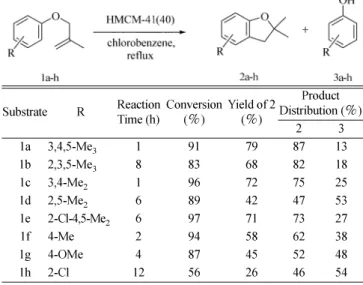
HMCM-41(40) 촉매를사용하여 aryl methally ether에서치환기 가다른 2,3-dihydrobenzofuran 유도체를합성하는반응의결과를
Table 1에정리하였다. TLC에서출발물질의신호가모두사라지는 시간을반응소요시간으로잡았다. 1h를제외한 1a-g 반응물의전 환율은 80%이상으로높았다. 그러나 2,3-dihydrobenzofuran 유도 체(2a-h)의수율은 HY 제올라이트에서얻은수율에비해[16]에비 해약간낮았다. HMCM-41(40) 중간세공물질은 HY 제올라이트에 비해세공이커서물질전달은유리하나, 산점수가적고산세기가 약해서촉매로서활성은낮았다.
산성도의영향을검증하기위해 HMCM-41(40) 촉매보다산점개
수가적은 HMCM-41(50) 촉매에서 aryl methallyl ether 유도체에서
2,3-dihydrobenzofuran 유도체의합성반응을조사하였다. Table 2에
정리한전환율은 Table 1결과에비해전반적으로조금낮았으나그
리큰차이는없었다. HMCM-41(40) 촉매에서전환율이높았던 aryl methallyl ether 유도체에대해서는 HMCM-41(50) 촉매에서도전환 율이그런대로높았다. 그러나 HMCM-41(40) 촉매에서 1b와 1h 유
도체의전환반응의전환율이낮았고, HMCM-41(50) 촉매에서도
이반응의전환율은낮았다. HMCM-41(40) 촉매에비해 HMCM- 41(50) 촉매의산점개수가적다. HMCM-41(40) 촉매에서도산점
이충분하지않아전환율이낮았던 aryl methallyl ether 유도체의생
성반응은 HMCM-41(50) 촉매에서는산점이더적어서반응의진
Scheme 2. Preparation of 2,3-dihydro-2,2-dimethylbenzofuran derivatives over HMCM-41(40) and HMCM-41(50) catalysts.
Table 1. The conversion of aryl methallyl ether derivatives over HMCM-41(40) catalyst in the preparation of 2,3-dihydro- benzofuran derivatives at 130 oC.
Substrate R Reaction
Time (h) Conversion
(%) Yield of 2 (%)
Product Distribution (%)
2 3
1a 3,4,5-Me3 1 91 79 87 13
1b 2,3,5-Me3 8 83 68 82 18
1c 3,4-Me2 1 96 72 75 25
1d 2,5-Me2 6 89 42 47 53
1e 2-Cl-4,5-Me2 6 97 71 73 27
1f 4-Me 2 94 58 62 38
1g 4-OMe 4 87 45 52 48
1h 2-Cl 12 56 26 46 54
Table 2. The conversion of aryl methallyl ether derivatives over HMCM-41(50) catalyst in the preparation of 2,3-dihydro- benzofuran derivatives at 130 oC.
Substrate R Reaction
Time (h) Conversion (%) Yield of 2
(%)
Product Distribution (%)
2 3
1a 3,4,5-Me3 2 92 82 89 11
1b 2,3,5-Me3 6 54 30 56 44
1c 3,4-Me2 3 94 74 79 21
1d 2,5-Me2 4 72 35 49 51
1e 2-Cl-4,5-Me2 6 74 50 68 32
1f 4-Me 4 84 44 52 48
1g 4-OMe 12 85 43 51 49
1h 2-Cl 24 17 12 71 29
행이더느려지므로전환율이더낮다고설명할수있다.
2,3-Dihydrobenzofuran의 수율은 HMCM-41(40) 촉매에 비해
HMCM-41(50) 촉매에서상당히낮아졌다. 2a와 2c의수율은두촉 매에서비슷하게높고, 2g의수율은어느촉매에서나낮은점을제 하면, HMCM-41(50) 촉매에서전반적으로수율이낮았다. 2b의선 택성이 HMCM-41(50) 촉매에서특이하게낮고 2h 선택성이특이 하게높은점을제하면두촉매에서선택성이비슷하다. 이런결과 를종합하여볼때 HMCM-41(50) 촉매에서 2,3-dihydrobenzofuran
의수율저하는산점감소에따른전환율저하가주요원인이다. 선 택성이달라지지않았으므로 HMCM-41(50) 촉매에서전환율이낮 은점은수율이낮은데기인한다.
3-2. 벤젠고리의치환기가반응경로에미치는영향
HMCM-41 고체산촉매에서 aryl methallyl ether이 2,3-dihydro- benzofuran이나페놀유도체로전환되는반응은 Scheme 3과 4에나 타낸대로서로다른반응경로를거쳐경쟁적으로진행된다고추 정한다.
Aryl methallyl ether에서 2,3-dihydrobenzofuran이생성되려면먼 저 Claisen 자리옮김반응이진행되어야한다. 전자공여기가벤젠 고리의적절한위치에치환되어있는유도체에서는벤젠고리의전
자밀도가높아져서 Claisen 자리옮김반응이촉진되므로 enol
form(5)이쉽게형성된다. 화합물 5는산점에의해활성화되어중간 체 6으로변환된다음, 하이드록실기의친핵성고리화반응에의해
2,3-dihydrobenzofuran(2) 유도체로전환된다.
이와반대로페놀유도체가생성되려면벤젠고리의전자밀도가 낮아 Claisen 자리옮김반응은느리게진행되고, 대신고체산에서 제공하는양성자에의해구조식 8처럼반응물이활성화되어야한다.
전자흡인기가벤젠고리에치환되어있거나전자공여기인메틸기가
벤젠고리의 C-2 위치에치환되어있으면 Claisen 자리옮김반응 은느리다. 반면, 산촉매반응이진행되어 8의상태를거쳐 C-O 결 합이분해되면서페놀유도체(3)가생성된다.
벤젠고리치환기의전자공여또는전자흡인의성격에따라 aryl methallyl ether의 Claisen 자리옮김반응의진행정도가달라진다.
전자공여기인메틸기가 C-3이나 C-4 위치에치환되어있으면전환 율이높고, 2,3-dihydrobenzofuran 유도체의수율도높다. 반면메틸
기가 C-2 위치에치환되거나전자흡입기가치환되어있으면전환율
이낮고 2,3-dihydrobenzofuran 유도체의수율이낮다. 이러한현상 은산점이적은 HMCM-41(50) 촉매에서더뚜렷하다. 치환기의전 자공여성격이강해서벤젠고리의전자밀도가높아지면산촉매 와상호작용으로 6이많이생성되므로 7상태를거치는고리화반응 이많이진행되어 2,3-dihydrobenzofuran(2) 유도체의수율이높다.
반면치환기의전자흡인성격이강하면 Claisen 자리옮김반응은
억제되고, 산촉매의양성자가전자밀도가상대적으로높은산소 원자를공격하므로 8상태를거쳐에테르결합이분해되어페놀유 도체(3)가많이생성된다.
Scheme 3과 Scheme 4 경로모두산촉매에의해촉진되지만, 2,3-dihydrobenzofuran(2) 유도체의생성에대한기여정도는크게 다르다. 벤젠고리의전자밀도차이에의한 Claisen 자리옮김반 응의진행정도가 2,3-dihydrobenzofuran 유도체생성반응의속도 를결정하는주요인자이기때문이다. 물질전달의제한이없는촉 매에서산세기와산종류가두경쟁반응의속도에미치는영향을 조사할수있으면, 2,3-dihydrobenzofuran 유도체합성반응에서산 촉매의기능을더명확하게설명할수있으리라기대한다.
4. 결 론
HMCM-41 중간세공물질을촉매로사용하여 Claisen 자리옮김 반응과고리화반응을거쳐 aryl methallyl ether에서 2,3-dihydro- 2,2-dimethylbenzofuran의유도체를한반응기안에서합성할수있 었다. 촉매의산점이많아지면 2,3-dihydrobenzofuran 유도체의수 율이높아졌으나, 선택성은벤젠고리의전자밀도에의해결정되 었다. 벤젠고리에전자공여기가치환되어전자밀도가높아지면고 리화반응이촉진되어 2,3-dihydrobenzofuran 유도체의수율이높아 졌다. 반면, 벤젠고리에전자흡입기가치환되거나 C-2 위치에메틸 기가치환되면유도체의수율이낮아졌으며, aryl methallyl ether의 분해반응으로페놀유도체가많이생성되었다.
감 사
이논문은 2003년도한국학술진흥재단의지원에연구되었습니다
(KRF-2003-042-C00069).
참고문헌
1. (a) Breck, D. W., Zeolite Molecular Sieves, Wiley, New York(1974).
(b) Dyer, A. An Introduction to Zeolite Molecular Sieves, Wiley, Chichester(1988).
2. (a) Hölderich, W., Hesse, M. and Näumann, F., “Zeolites: Cata- lysts for Organic Syntheses,”Angew. Chem. Int. Ed. Engl., 27(2), Scheme 3. Suggested mechanism for the formation of 2,3-dihy
drobenzofurans.
Scheme 4. Suggested mechanism for the formation of phenol deriva tives.
226-246(1988).
3. (a) Kim, Y., Kim, C. and Yi, J., “Comparison of Mesoporous Aluminas Synthesized Using Stearic Acid and Its Salts,”Korean J. Chem. Eng., 22(2), 321-327(2005). (c) Jung, K-H., Chung, K- H., Kim, M-Y., Kim., J.-H. and Seo, G. “IR Study of the Second- ary Reaction of Ethylene Oxide over Silver Catalyst Supported on Mesoporous Materia,” Korean J. Chem. Eng., 16(3), 396- 400(1999). (c) Seo, G., Kim, T. J., Lim, S., Ko, C. H. and Ryoo, R., “The Reduction of Dissolved Oxygen by Hydrazine over Platinum Catalyst Supported on Dispordered Mesoporous Mate- rials,”Korean J. Chem. Eng., 15(6), 611-614(1998). (d) Han, S- H., Yang, J.-S. and Choung, S.-J., “Studies on the Selective Cat- alytic Reduction of NO by Propylene over MCM-41 Supported Pt Catalyst,”Korean Chem. Eng. Res., 38(5), 578-584(2000). (e) Jentys, A., Pham, N. H., Vinek, H., Englisch, M. and Lercher, J.
A., “Synthesis and Characterization of Mesoporic Materials Containing Highly Dispersed Cobalt,”Micropor. Mater., 6(1), 13- 17(1996).
4. (a) Armengol, E., Cano, M. L., Corma, A., Garcia, H. and Navarro, M. T. “Mesoporous Aluminosilicate MCM-41 as a Convenient Acid Catalyst for Friedel-Crafts Alkylation of a Bulky Aromatic Compound with Cinnamyl Alcohol,”J. Chem. Soc., Chem. Comm., (5), 519-520(1995). (b) Subrahmanyam, Ch., Viswanathan, B. and Varadarajan, T. K., “Alkylation of Naphthalene with Alcohols over Acidic Mesoporous Solids,”J. Mol. Catal. A: Chemical, 226(2), 155-163(2005). (c) Selvam, P. and Dapurkar, S. E., “Tertiary Butylation of Phenol over Mesoporous MeMCM-48 and MeMCM- 41(Me=Ga, Fe, Al or B) Solid Acid Catalysts,”Catal. Today, 96(3), 135-141(2004).
5. Ravindra, D. B., Nie, Y. T., Jaenicke, S. and Chuah, G. K.,
“Isomerisation of α-Pinene Oxide over B2O3/SiO2 and Al-MSU Catalysts,”Catal. Today, 96(3), 147-153(2004).
6. (a) Kugita, T., Jana, S. K., Owada, T., Hashimoto, N., Onaka, M.
and Namba, S., “Mesoporous Al-Containing MCM-41 Molecu- lar Sieves: Highly Active Catalysts for Diels-Alder Reaction of Cyclopentadiene with α,β-Unsaturated Aldehydes,”Appl. Catal., A:
General, 245(2), 353-362(2003). (b) Onaka, M. and Yamasaki, R., “Catalysis by Solid Acid: Selective Diels-Alder Reactions are Promoted by Mesoporous Aluminosilicate with Zinc Ions and Nanometer Honeycomb Openings ,”Chem. Lett., 6(3), 259-260(1998).
7. Mikami, K., Ohmura, H. and Yamanaka, M., “(2,5)-Ene Cycliza- tion Catalyzed by Mesoporous Solid Acids: Isotope Labeling Study and Ab Initio Calculation for Continuum from Concerted to Stepwise Ene Mechanism,”J. Org. Chem., 68(3), 1081-1088(2003).
8. Yadav, G. D. and Murkute, A. D., “Novel Efficient Mesoporous Solid Acid Catalyst UDCAT-4: Dehydration of 2-Propanol and Alkylation of Mesitylene,”Langmuir, 20(26), 11607-11619(2004).
9. (a) Ryoo, R., “Mesoporous Molecular Sieves,”Chem World, 38 (11), 26-29(1998). (b) Park, S. E., “Application of Mesoporous Molecular Sieves,”ibid, 38(11), 30-39(1998).
10. (a) Donnelly, D. M. X. and Meegan, M. J., Comprehensive Het- erocyclic Chemistry; Katritzky, A. R., Rees, C. W., Eds.; Perga-
mon Press: Oxford, 4, 705-709(1984). (b) Keay, B. A., Comprehensive Heterocyclic Chemistry, Katritzky, A. R., Rees, C. W., Scriven, E. F., Eds., Elsevier Science Ltd., New York, 2, 413-436(1996).
11. (a) Shulgin, A. T. and Baker, A. W., “Solvent Effects on the Claisen Rearrangement of β-Methylallyl Phenyl Ether,”J. Org. Chem., 28(9), 2468-2469(1963). (b) Harwood, L. M., “An Investigation into the Regioselectivity of the Acid Catalysed Claisen Rear- rangement of Methyl 4- and 5-Allyloxy-2-Hydroxybenzoate Deriv- atives, ” J. Chem. Soc. Chem. Commun., (9), 530-532(1983). (c) Widmer, U., Hansen, H. J. and Schmid, H., “Charge Induced Rearrangement of Allylaryl Ethers with Trifluoroacetic Acid,”Helv.
Chim. Acta, 56(7), 2644-2648 (1973). (d) Nichols, D. E., Hoffman, A. J., Oberlender, R. A. and Riggs, R. M., “Synthesis and Evalu- ation of 2,3-Dihydrobenzofuran Analogs of the Hallucinogen 1- (2,5-Dimethoxy-4-methylphenyl)-2-aminopropane: Drug Discrimi- nation Studies in Rats,”J. Med. Chem.,29(2),302-304(1986).
12. Feoktistov, V. M., Bunina-Krivorukova, L. I. and Bal’yan, Kh, V., “Condensation of Aromatic Compounds with Allylic Halides.
XXIII. Preparation of p-Cresol β,γ,γ-D3-Allyl Ether and Its Rearrangement in the Presence of Lewis Acids,”Zh. Org. Khim., 14(4), 807-811(1978).
13. (a) Kim, K. M., Kim, H. R. and Ryu, E. K., “One-pot Syntheses of 2,3-Dihydro-2,2-dimethylbenzofuran Derivatives,”Heterocycles, 36(3), 497-505(1993). (b) Kang, S. K., Kim, S. S., Choi, J.-K.
and Yum, E. K., “A Facile Synthesis of 7-Nitro-2,3-dihy- drobenzo[b]furans,”Bull. Korean Chem. Soc., 18(10), 1128-1130 (1997).
14. Kataoka, K., Shiota, T., Takeyasu, T., Minoshima, T., Watanabe, K., Tanaka, H., Mochizuki, T., Taneda, K., Ota, M., Tanabe, H.
and Yamaguchi, H., “Potent Inhibitors of Acyl-CoA: Cholesterol Acyltransferase. 2. Structure-activity Relationships of Novel N- (2,2-dimethyl-2,3-dihydrobenzofuran-7-yl)amides,”J. Med. Chem., 39(6), 1262-1270(1996).
15. (a) Bernard, A. M., Cocco, M. T., Onnis, V. and Piras, P. P.,
“Mo(CO)6 Catalyzed One-pot Conversion of Allyl Aryl Ethers to Dihydrobenzofurans,”Synthesis, (1), 41-43(1997). (b) Bernard, A. M., Cocco, M. T., Onnis, V. and Piras, P. P., “Facile Synthesis of 2,2-Dimethylchromans by Mo(CO)6-catalyzed Reaction of Aryl Prenyl Ethers,”Synthesis, (3), 256-258(1998).
16. Kim, H. J., Seo, G., Kim, J. N. and Choi, K. H., “HY Zeolite Cat- alyzed One-pot Synthesis of 2,3-Dimethylbenzofurans from Aryl Methallyl Ethers,”Bull. Korean Chem. Soc., 25, 1726-1728(2004).
17. Hartmann, M., Poppl, A. and Kevan, L., “Formation and Stabil- ity of Ni(I) Ions in MCM-41 Mesoporous Molecular Sieves,”J.
Phys. Chem., 99(49), 17494-17496(1995).
18. Ryu, E. K., Kim, K. M., Kim, H. R., Song, J. H., Kim, J. N. and Kim, J. S., “Preparation of Herbicidal Benzofuranylcyclohexane- 1,3-dione Derivatives,”PCT Int. Appl., WO 9403443(1994). (b).
Ariamala, G. and Balasubramanian, K. K., “Photochemical Behav- iour of 3,4-Epoxyprecocene-I and Related Epoxychromans,” Tet- rahedron, 45(12), 3769-3774(1989).