www.kafm.or.kr 57 서 론
최근 고령화 사회에 따라 요양병원의 수가 빠르게 증가하고 있다.
치매환자의 보호자가 요양병원을 포함한 보호기관에 환자의 입원 을 원하는 가장 직접적인 원인으로 작용하는 것은 환자의 이상행동 증상에 대해 보호자가 느끼는 강도이다. 그리고 이러한 치매의 원인 질환으로 가장 높은 비율을 차지하는 것은 알츠하이머병이다. 알츠 하이머병의 주된 증상은 인지장애이지만 보호자에게 고통을 주거
나1) 병원에 입원하게 되는 주된 이유는 행동심리적 증상(behavioral and psychological symptoms of dementia)인 경우가 많다.2)
치매환자들은 인지기능의 장애와 함께 망상, 환각, 비협조적 행동, 공격성, 우울, 낙담, 불안, 무관심, 충동조절능력이상, 비정상적 반복 행동, 수면장애 등의 행동심리적 증상을 흔히 보인다. 치매에서의 이 러한 행동심리적 증상은 환자의 진단, 예후, 관리에서도 중요하다.3) 진단적인 측면에서 행동심리적 증상은 인지기능의 저하보다 먼저 나 타날 수 있고,4) 특정 행동심리적 증상은 질환의 예후와도 관련이 있
Original Article
알츠하이머병에서 우울증과 이상행동증상과의 상관관계
범인규, 조지연, 강인웅, 손효림*
광주보훈병원 가정의학과
The Relationship between Depression and Behavioral Symptoms in Patient with Alzheimer’s Disease
In Gyu Beom, Ji Yeon Jo, In Ung Kang, Hyo Rim Son*
Department of Family Medicine, Kwangju Veterans Hospital, Gwangju, Korea
Background: There has been a recent increase in the number of long-term care hospitals as society ages. The burden of caring for dementia patients and managing their abnormal behavior is the most important factor which make caregivers desire access to special centers, including long-term care hospitals. Alzheimer’s disease is the most common cause of dementia. We investigated the relationship between clinical depression and behavioral symptoms in patients with Alzheimer’s dementia.
Methods: The patients with Alzheimer’s dementia and their caregivers who visited the dementia-psychiatry clinic at Kwangju Veterans Hospital between February 2012 and April 2014 were involved in this study. Among 319 patients with Alzheimer’s dementia, we selected patients who scored similarly on clinical dementia rating score and Korean mini-mental status examination score and classified them into either a depression group (N=35; male, 25; female, 10) who showed clinically significant symptoms of depression or a not-depression group (N=31; male, 19; female, 12) who did not show any clinical symptoms. The clinical symptoms of depression were evaluated with geriatiric depres sion scale, and the relationship between depression and abnormal behaviors was analyzed by chi-square test and Mann-Whitney test.
Results: The depression group showed a significantly higher proportion (45.7%) of sleep-related behavior disorders than not-depression group (22.6%) (P<0.05). The average of the rank in the depression group was 37.08, which was higher than those of the not-depression group (29.45) without the statistical significance (P>0.05).
Conclusion: There was no relationship between depression and abnormal behavior in patients with Alzheimer’s disease.
Keywords: Alzheimer’s Disease; Behavioral Symptoms; Depression http://dx.doi.org/10.21215/kjfp.2016.6.1.57 pISSN 2233-9019 · eISSN 2233-9116 Korean J Fam Pract. 2016;6(1):57-60
KJFP
Korean Journal of Family PracticeReceived February 25, 2015 Accepted October 13, 2015 Corresponding author Hyo Rim Son
Tel: +82-62-602-6267, Fax: +82-62-602-6982 E-mail: [email protected]
Copyright © 2016 The Korean Academy of Family Medicine
This is an open-access article distributed under the terms of the Creative Commons At- tribution Non-Commercial License (http://creativecommons.org/licenses/by-nc/4.0) which permits unrestricted noncommercial use, distribution, and reproduction in any medium, provided the original work is properly cited.
In Gyu Beom, et al. The Relationship between Depression and Behavioral Symptoms in Patient with Alzheimer’s Disease
www.kafm.or.kr
58
Korean Journal of Family Practice
KJFP
Korean J Fam Pract. 2016;6(1):67-70 는데 알츠하이머병에서 망상 또는 환각은 빠른 인지기능의 저하와
관련이 있는 것으로 알려져 있다.5-7) 또한 이러한 증상은 환자를 돌보 는 보호자들에게 정신적, 육체적 부담을 가중시키고, 병원이나 보호 기관에서의 입원기간을 늘리는 원인이 되기도 한다.8)
이러한 행동심리적 증상의 평가를 위해 최근에는 neuropsychiatric inventory (NPI)3)가 주로 사용되고 있다. NPI는 치매환자들에게서 보 이는 행동심리적 증상을 12가지의 영역에서 평가하고, 그 변화를 추 적하기 위한 검사도구로써 사용되고 있는데,9) 국내에서도 표준화된 한국어판 NPI (Korean NPI, K-NPI)가 개발되어 여러 치매질환에 적 용하여 타당성과 신뢰성을 인정받았다.10)
본 연구에서는 K-NPI 12개 항목 중 이상행동 증상 유무를 이용하 여 알츠하이머병에서 임상적으로 의미 있는 우울증이 동반된 환자 에서 알츠하이머병에서 보이는 이상행동들과의 연관성을 알아보고 자 하였다.
방 법
1. 연구대상
2012년 2월부터 2014년 4월까지 광주보훈병원 치매정신클리닉에 내원한 알츠하이머병 환자와 보호자들을 대상으로 연구를 시행하 였다. 319명의 알츠하이머병 환자 중 clinical dementia rating (CDR) 점 수(1–2점), Korean mini-mental status examination (K-MMSE) 점수(19–
25점)가 비슷한 환자를 선별하여 이 중 임상적으로 의미 있는 우울 증을 가진 35명(남: 25, 여: 10)과 그렇지 않은 31명(남: 19, 여: 12)을 연 구대상으로 하였다.
2. 방법
전반적인 인지기능의 측정은 K-MMSE를 이용하였고 치매의 심한 정도는 CDR 척도를 이용하였다. 자세한 인지기능의 상태는 Seoul Neuropsychological Screening Battery를 사용하였다. Geriatiric depres- sion scale (GDS) 8점 이상을 임상적으로 의미 있는 우울증이 있는 것 으로 정의하였다.
행동심리적 증상은 크게 이상행동(behavioral symptoms)과 정신
증상(psychological symptoms)으로 나눌 수 있는데, 이상행동은 공격 성, 배회, 초조, 좌불안석, 부적절한 성적행동, 보호자 쫓아다니기, 소 리지르기, 악담, 불면증, 과식증 등이 있고 정신증상으로는 불안, 우 울증상, 환각, 망상 등이 있다.
K-NPI는 보호자를 대상으로 하여 환자에게서 나타난 12가지의 행동 변화에 관하여 질문하였다. 보호자에게 먼저 각 항목에 해당하 는 선별 질문을 하여 특정 이상행동이 있다고 한 경우 다시 선택하도 록 하였고, 해당되는 이상행동이 없다고 답하는 경우는 다음 항목으 로 이동하도록 하였다. 이상행동과 우울증과의 연구를 위해 7개의 정신증상항목인 망상, 환각, 우울감/발성장애, 불안, 행복감, 무관심, 과민성/불안정성을 제외하고 5개의 이상행동증상인 초조/공격성, 탈억제, 일탈적인 행동, 수면 중 행동, 섭식장애만을 수집하였다. 연 구대상인 우울증과 7개의 정신증상항목 중 우울감이 중복되므로 이 연구에서는 이상행동만을 수집하였다.
3. 조사자료의 통계처리
두 환자군 사이의 성별, K-MMSE 점수, 연령, 교육 정도, CDR 점수 는 t-test를 이용하여 분석하였고 임상적 우울증과 이상행동증상의 상관관계는 교차분석(chi-square test)과 Mann-Whitney검정을 실시 하여 차이를 살펴보았다. 통계자료의 유의수준은 P-value 0.05 미만 인 경우를 유의하다고 간주하였고, IBM SPSS Windows ver. 21.0 (IBM Co., Armonk, NY, USA) 프로그램을 이용하여 분석하였다.
결 과
1. 우울증과 Sex, Age, Education, Korean MiniMental Status Examination 점수, Clinical Dementia Rating 점수의 관계
평균차이 검증인 t-test를 실시하였고 우울증이 없는 집단과 우울증 이 있는 집단 사이에서 sex, age, education은 P<0.05 수준에서 유의하지 않음을 알 수 있다. K-MMSE 점수와 CDR 점수도 유의한 차이를 보이 지 않았기 때문에 연구대상으로 선정한 두 집단은 일반적 특성과 인지 기능, 그리고 치매의 정도에서 동질한 집단임을 알 수 있다(Table 1).
Table 1. Characteristics of Alzheimer’s disease patients with depressive symptoms and, Alzheimer’s disease patients without depression
Variable Depression (-) Depression (+) t P-value
Sex (male/female) 19/12 25/10 0.706 0.271
Age (y) 72.35±7.48 71.63±5.69 0.447 0.657
Education 7.45±5.01 6.57±5.07 0.708 0.482
Korea mini-mental status examination 22.29±1.94 21.63±2.28 1.264 0.211
Clinical dementia rating 1.00±.32 1.17±.44 -1.807 0.075
Values are presented as mean±standard deviation. Analyzed by t-test.
www.kafm.or.kr 범인규 외. 알츠하이머병에서 우울증상과 이상행동증상과의 상관관계
Korean J Fam Pract. 2016;6(1):67-70 59
Korean Journal of Family Practice
KJFP
2. 우울증상과 이상행동증상 간의 상관관계
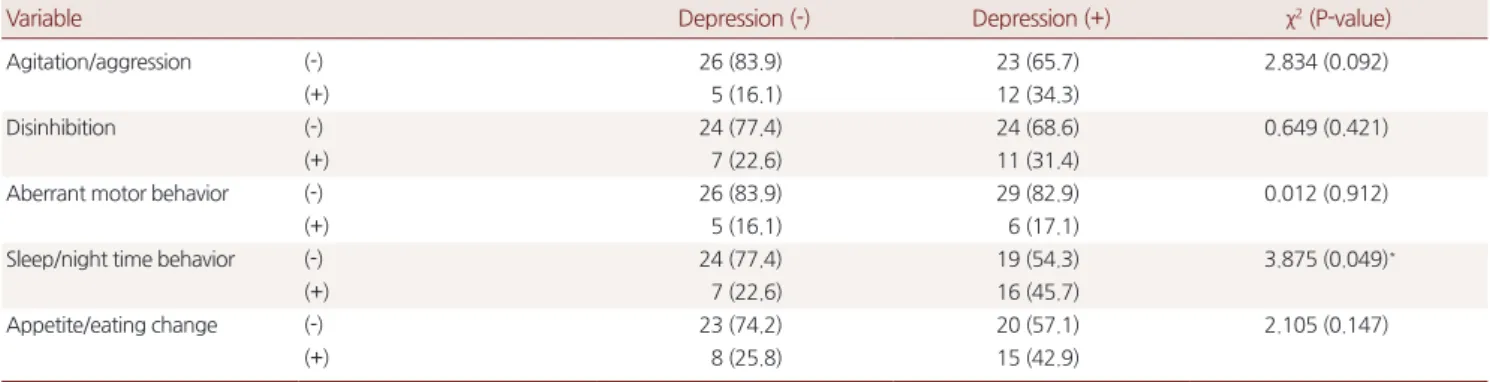
범주형 자료에서 비모수기법인 경우 교차분석(chi-square test)을 실시하였고 수면 중 행동을 보인 환자군에서 우울증이 없는 집단이 22.6%, 우울증이 있는 집단이 45.7%로 나타나 우울증이 있는 집단에 서 높게 나타났으며, P<0.05 수준에서 유의한 차이를 보였다. 과민성/
불안정성을 보인 환자군에서 우울증이 없는 집단은 16.1%, 우울증이 있는 집단은 34.3%로 나타나 우울증 있는 집단이 상대적으로 높게 나타났으나 P<0.05 수준에서 유의한 차이를 보이지 않았다. 탈억제, 일탈적인 행동, 섭식장애의 경우에도 통계적으로 유의한 차이를 보 이지 않았다(Table 2).
3. 우울증상과 이상행동증상 간의 상관관계
비모수통계에서 독립적인 두 집단의 차이 검증을 위하여 Mann- Whitney 검정을 실시하였으며, 수면 중 행동에서 우울증이 있는 집 단의 평균순위가 37.08로 우울증이 없는 집단의 29.45보다 높게 나타
났으나, P<0.05 수준에서 유의한 차이를 보이지 않았다. 초조/공격성, 탈억제, 일탈적인 행동의 경우에도 P<0.05 수준에서 유의한 차이를 보이지 않았다. 결론적으로 알츠하이머 환자의 우울증과 이상행동 증상 간의 연관성을 찾기는 어려웠다(Table 3).
고 찰
Aharon-Peretz 등11)은 MMSE와 이상행동과의 상관관계를 분석한 후 알츠하이머병 환자에서는 치매의 정도와 이상행동의 정도는 관 련성이 없다고 보고하였다. 이는 알츠하이머병 환자에게서 치매의 정도는 측두엽과 두정엽의 기능저하와 관련이 있지만 이상행동의 정 도는 전두엽의 기능저하와 관련성이 있기 때문인 것으로 생각된다.
치매환자에서 이상행동은 치매의 진단, 치료, 예후에 있어 중요한 부분을 차지하며, K-NPI는 이러한 증상의 평가, 추적, 약물 치료의 효과 판정 등에서 매우 유용하게 쓰이고 있는 도구이다.12) 본 연구에 Table 2. The relationship between depression and behavioral symptoms in patient with Alzheimer’s disease
Variable Depression (-) Depression (+) χ2 (P-value)
Agitation/aggression (-) 26 (83.9) 23 (65.7) 2.834 (0.092)
(+) 5 (16.1) 12 (34.3)
Disinhibition (-) 24 (77.4) 24 (68.6) 0.649 (0.421)
(+) 7 (22.6) 11 (31.4)
Aberrant motor behavior (-) 26 (83.9) 29 (82.9) 0.012 (0.912)
(+) 5 (16.1) 6 (17.1)
Sleep/night time behavior (-) 24 (77.4) 19 (54.3) 3.875 (0.049)*
(+) 7 (22.6) 16 (45.7)
Appetite/eating change (-) 23 (74.2) 20 (57.1) 2.105 (0.147)
(+) 8 (25.8) 15 (42.9)
Values are presented as number (%). Analyzed by chi-sqaure test.
*P<0.05.
Table 3. The relationship between depression and behavioral symptoms in patient with Alzheimer’s disease
Variable No. Average rank Rank sum z P-value
Agitation/aggression Depression (-) 31 30.32258 940 1.67 0.095
Depression (+) 35 36.31429 1,271
Total 66
Disinhibition Depression (-) 31 31.95161 990.5 0.799 0.424
Depression (+) 35 34.87143 1,220.5
Total 66
Aberrant motor behavior Depression (-) 31 33.32258 1,033 0.109 0.913
Depression (+) 35 33.65714 1,178
Total 66
Sleep/night time behavior Depression (-) 31 29.45161 913 1.96 0.050
Depression (+) 35 37.08571 1,298
Total 66
Appetite/eating change Depression (-) 31 30.51613 946 1.44 0.150
Depression (+) 35 36.14286 1,265
Total 66
Analyzed by Mann-Whitney test.
In Gyu Beom, et al. The Relationship between Depression and Behavioral Symptoms in Patient with Alzheimer’s Disease
www.kafm.or.kr
60 Korean J Fam Pract. 2016;6(1):57-60
Korean Journal of Family Practice
KJFP
서 K-NPI의 12항목 중 7개의 정신증상 항목을 제외한 5개의 이상행 동증상인 초조/공격성, 탈억제, 일탈적인 행동, 수면 중 행동, 섭식장 애가 우울증과 관련하여 보이는 연관성을 찾기는 어려웠다.
이 연구는 치매환자에서 높은 유병률을 보이는 우울증과 이상행 동 간의 연관성을 찾아보기 위한 연구로 요양병원이 급증하는 최근 에 중요한 연구자료이지만, 제한점으로는 첫째, 대상 환자의 숫자가 적다는 점이다. 앞으로 CDR 점수와 MMSE 점수가 비슷한 환자 중 임상적으로 의미 있는 우울증을 가진 알츠하이머병 환자와 그렇지 않은 환자의 숫자를 늘려 분석하는 것이 필요할 것으로 생각된다. 둘 째, 임상적인 우울증의 기준척도를 GDS 8점 이상으로 정하고 시행 된 연구이다. GDS는 1–15점까지 평가할 수 있는 검사로 8–15점까지 다양한 임상적인 우울증을 8점 이상이라는 기준으로 우울증을 동 반한 알츠하이머 환자에서 환자의 우울의 강도를 정확하게 반영하 기는 어려웠다는 점이다.
요 약
연구배경: 최근 고령화 사회에 따라 요양병원의 수가 빠르게 증가하 고 있다. 치매환자의 보호자가 요양병원을 포함한 보호기관에 환자 의 입원을 원하는 가장 직접적인 원인으로 작용하는 것은 환자의 이 상행동증상에 대해 보호자가 느끼는 강도이다. 그리고 이러한 치매 의 원인질환으로 가장 높은 비율을 차지하는 것은 알츠하이머병이 다. 알츠하이머 치매환자들에서 보이는 임상적인 우울증과 이상행 동들과의 연관성을 알아보고자 하였다.
방법: 2012년 2월부터 2014년 4월까지 광주보훈병원 치매정신클리닉 에 내원한 알츠하이머병 환자와 보호자들을 대상으로 연구를 시행 하였다. 319명의 알츠하이머병 환자 중 clinical dementia rating 점수, Korean mini-mental status examination 점수가 비슷한 환자를 선별하 여 이 중 임상적으로 의미 있는 우울증상을 가진 35명(남: 25, 여: 10) 과 그렇지 않은 31명(남: 19, 여: 12)을 연구대상으로 하였다. 임상적 우 울증상은 geriatric depression scale로 평가하였고 우울증과 이상행동 증상의 상관관계는 교차분석(chi-square test)과 Mann-Whitney검정 을 실시하여 차이를 살펴보았다.
결과: 이상행동증상 중 수면 중 행동을 보인 환자군은 우울증이 없
는 집단의 22.6%보다 우울증이 있는 집단에서 45.7%로 높게 나타났 으며, 유의수준 P<0.05 수준에서 유의한 차이를 보였다. 우울증이 있 는 집단의 평균순위는 37.08로 우울증이 없는 집단의 29.45보다 높게 나타났으나, P<0.05 수준에서 유의한 차이를 보이지 않았다.
결론: 알츠하이머 환자의 우울증과 이상행동증상 간의 연관성을 찾 기는 어려웠다.
중심단어: 알츠하이머병; 행동증상; 우울증
REFERENCES
1. Everitt DE, Fields DR, Soumerai SS, Avorn J. Resident behavior and staff dis- tress in the nursing home. J Am Geriatr Soc 1991;39:792-8.
2. Lee SJ. MR angiography in patients with transient ischemic attack. J Korean Neurol Assoc 1999;17:14-9.
3. Cummings JL, Mega M, Gray K, Rosenberg-Thompson S, Carusi DA, Gorn- bein J. The neuropsychiatric inventory: comprehensive assessment of psy- chopathology in dementia. Neurology 1994;44:2308-14.
4. Rubin EH, Kinscherf DA. Psychopathology of very mild dementia of the Al- zheimer type. Am J Psychiatry 1989;146:1017-21.
5. Drevets WC, Rubin EH. Psychotic symptoms and the longitudinal course of senile dementia of the Alzheimer type. Biol Psychiatry 1989;25:39-48.
6. Mortimer JA, Ebbitt B, Jun SP, Finch MD. Predictors of cognitive and func- tional progression in patients with probable Alzheimer’s disease. Neurology 1992;42:1689-96.
7. Wilson RS, Gilley DW, Bennett DA, Beckett LA, Evans DA. Hallucinations, delusions, and cognitive decline in Alzheimer’s disease. J Neurol Neurosurg Psychiatry 2000;69:172-7.
8. Kim JM, Shin IS, Jeong SJ, Gormley N, Yoon JS. Predictors of institutionaliza- tion in patients with dementia in Korea. Int J Geriatr Psychiatry 2002;17:
101-6.
9. Choi SH, Na DL, Kwon HM, Yoon SJ, Jeong JH, Ha CK. The Korean version of the neuropsychiatric inventory: a scoring tool for neuropsychiatric distur- bance in dementia patients. J Korean Med Sci 2000;15:609-15.
10. Stern Y, Mayeux R, Sano M, Hauser WA, Bush T. Predictors of disease course in patients with probable Alzheimer’s disease. Neurology 1987;37:1649-53.
11. Aharon-Peretz J, Kliot D, Tomer R. Behavioral differences between white matter lacunar dementia and Alzheimer’s disease: a comparison on the neu- ropsychiatric inventory. Dement Geriatr Cogn Disord 2000;11:294-8.
12. Cummings JL. The Neuropsychiatric Inventory: assessing psychopathology in dementia patients. Neurology 1997;48(5 Suppl 6):S10-6.