16
서 론
노인에서는 수면의 질이 좋을수록 노인의 신체 건강과 인 지 능력에 긍정적인 영향을 미치는 것으로 알려져 있다
(Driscoll 등 2008). 그러나 노인의 수면장애는 유병률이 50%
정도로 흔하며(Foley 등 1995) 노인의 수면의 질은 나이가 들면서 점차 나빠진다(Hoch 등 1994). 수면장애를 겪고 있 는 노인은 피로감 뿐만 아니라 기억력 및 인지 저하, 집중력
지역사회 노인에서의 수면의 질과 인지기능의 관련성에 대한 연구
A Study on the Relationship between Sleep Quality and Cognitive Function in Community Elderly
오윤균1
·
김봉조1,2·
박철수1,2·
이철순2,3·
차보석1,2·
이소진1,2 이동윤2,3·
서지영3·
최재원1·
이영지3·
이재헌1·
이윤정1Youn-Kyoun Oh,
1Bong-Jo Kim,
1,2Chul-Soo Park,
1,2Cheol-Soon Lee,
2,3Bo-Seok Cha,
1,2So-Jin Lee,
1,2Dong-Yun Lee,
2,3Ji-Yeong Seo,
3Young-Ji Lee,
3Jae-Won Choi,
1Jae-Hon Lee,
1Youn-Jung Lee
1▒
ABSTRACT
Objectives: Sleep disturbance in the elderly is associated with cognitive decline. Sleep quality is known to deteriorate with age, and prospective studies seldom have examined the relationship between sleep quality and cognitive function. This study investigates the relationship between early sleep quality and cognitive function based on six-year follow-up data of communi- ty individuals older than 60 years.
Methods: The participants included 622 community elderly people older than 60 years from Jinju-Si. The final analysis com- prised 322 elderly people. Pittsburgh sleep quality index (PSQI) and the Korean version of Consortium to Establish a Registry for Alzheimer’s Disease (CERAD-K) were used to assess early sleep quality and cognitive function after six years. Multiple lin- ear regression analysis was performed to investigate the association between early sleep quality and cognitive function in the elderly.
Results: Early sleep quality (PSQI) was significantly associated with the results of the digit span test, clock drawing test (clox 1), and word recall test after six years. Sleep quality (PSQI) decreased significantly after six years, and lower quality of sleep (PSQI) score was associated with higher digit span test score (β = -0.167, p = 0.026) and higher clock drawing test score (β
= -0.157, p = 0.031). Lower quality of sleep (PSQI) score was associated with higher word recall test (β = -0.140, p = 0.039).
Conclusion: The digit span test, word recall test, and clock drawing task (CLOX 1) shown to be significantly associated to sleep quality can be performed fast and easily in clinical practice. It is important to assess early cognitive function in the el- derly with poor sleep quality, and further studies could suggest that these tests may be useful screening tests for early de- mentia in elderly with poor sleep quality. Sleep Medicine and Psychophysiology 2020;27(1):16-23
Key words: Aged·Clock drawing task 1·Cognition·Digit span test·Quality of sleep·Word list recall test.
Sleep Medicine and Psychophysiology ...
수면·정신생리 27(1): 16-23, 2020
...
Received: April 21, 2020 / Revised: June 22, 2020 / Accepted: June 22, 2020
본 연구는 한국보건산업진흥원과 보건복지부의 지원에 의하여 이루어진 것임(B-0912-089-010).
1경상대학교병원 정신건강의학과 Department of Psychiatry, Gyeongsang National University Hospital, Jinju, Korea
2경상대학교 의학전문대학원 정신건강의학교실 Department of Psychiatry, Gyeongsang National University College of Medicine, Jinju, Korea
3창원경상대학교병원 정신건강의학과 Department of Psychiatry, Gyeongsang National University Changwon Hospital, Changwon, Korea Corresponding author: Bong-Jo Kim, Department of Psychiatry, Gyeongsang National University College of Medicine, 79 Gangnam-ro, Jinju 52727, Korea
Tel: 055) 750-8086, Fax: 055) 759-0003, E-mail: [email protected]
원 저
https://doi.org/10.14401/KASMED.2020.27.1.16
17
감소, 일상생활의 수행능력 감소 등 부정적 증상을 호소한다(Kamel과 Gammack 2006). 이처럼 노인의 수면문제는 사 회적, 신체적, 심리적 측면의 문제를 야기시킬 수 있다. 따 라서 노인의 수면문제를 빠른 시기에 발견 및 관리를 하는 것은 수면으로 인해 추후 발생 할 수 있는 문제에 대비할 수 있어 이를 임상적으로 다루는 것은 중요하다고 할 수 있다.
지역사회 노인을 대상으로 수면양상을 파악하고 수면의 영 향과 인지기능 사이의 관련성을 조사한 국내외 연구가 있었 다. 수면 무호흡증(sleep apnea)이 있는 노인에게서 수면 중 호흡의 방해, 산소포화도의 저하 및 잦은 수면분절로인해 노 인의 인지기능이 감소된다는 연구 결과가 있으며(Aloia 등 2003 ; Cohen-Zion 등 2004) 수면 무호흡증의 위험도가 노 인의 실행기능의 감소에 유의미한 영향을 주었다는 보고가 있다(Lee 등 2007). 그 외에도 과다 주간 졸음(excessive daytime sleepiness)이 노인의 인지기능 중 실행기능(exec- utive function)의 저하와 유의한 관련성이 있음을 보고한 바 있다(Lee 등 2007). 수면의 질과 인지기능의 연관성을 알 아본 연구에서는 노인 남성에서 수면의 질이 나빠질수록 인 지장애의 위험성이 커진다는 연구결과가 있었으며(Potvin 등 2012) 수면의 질이 좋지 않은 노인에게서 작업기억(working memory), 주의력 전환(attentional set shifting), 추상적 문제 해결 능력(abstract problem-solving capabilities), 언어적 지 연회상(delayed recall)의 저하가 관찰된 바 있었다(Nebes 등 2009). 특히 일상 업무를 수행하는 데 중요하게 작용하 는 사고(thinking)와 행동의 통제 및 규제를 담당하는 집행 기능(executive function)이 낮은 수면의 질과 관련이 있다 고 밝혀진 바 있다(Waters과 Bucks 2011). 그러나 선행연구 의 대부분은 단면연구로 진행이 되었으며 시간의 흐름에 따른 수면의 질과 인지기능 사이의 관련성을 알아본 전향 적 연구는 지금까지 거의 없었다. 이런 이유로 수면의 질이 인지기능과 어떠한 관련성이 있는지를 조사한 전향적 연구 가 필요하다. 또한 다른 연구에서는 낮은 수면의 질과 인지 기능 사이의 유의한 관련성이 없다는 연구결과가 있어 (Saint Martin 등 2012) 수면의 질과 인지기능 사이의 일관 된 관련성을 도출하기에 제한점이 있었다. 그러므로 본 연 구에서는 60세 이상의 지역사회 노인을 대상으로 수면의 질 과 인지기능에 대하여 초점을 맞추어 연구해 보고자 하였 다. 이를 통해 수면의 질과 인지기능 사이의 관련성을 더욱 명확히 하고 더불어 6년 동안의 인지기능 평가 및 수면의 질을 추적조사한 자료를 바탕으로 수면의 질과 인지기능과 의 관련성에 대하여 알아보고자 하였다. 또한 초기 수면의 질과 유의한 관계가 있는 인지기능 검사 항목을 찾아보고자 하였다.
연구 대상 및 방법
1. 연구 대상
본 연구에서는 경남 진주시에 거주하는 60세 이상의 노인 을 대상으로 2011년 부터 2017년 까지 한국인의 인지노화와 치매에 대한 전향적인 연구(Korean Longitudinal Study on Cognitive Aging and Dementia, KLOSCAD)의 설문조사를 실시하였다. KLOSCAD는 지역사회 코호트 기반 전향적 연 구분석으로 한국보건산업진흥원과 보건복지부의 지원으로 전국 14개 대학병원, 2개의 노인전문병원의 치매 전문가들 이 참가하여 매 2년마다 60세 이상의 노인 인지기능 평가 및 치매 진단을 실시하는 연구로 분당 서울대학교병원 생명윤리 심의위원회에서 승인을 받았다. 본 연구는 6년 동안 총 4차례 진행된 KLOSCAD 연구결과 중에서 1차 KLOSCAD (2011 년)와 4차 KLOSCAD (2017년)의 연구결과를 비교 분석하 였다. 대상자 모집은 진주시 보건소와 연계하여 이루어졌으 며 연구자가 방문하여 대면 조사로 시행했다. 경남 진주 지역 의 60세 이상의 노인에게 연구에 대한 취지와 방법에 대한 설 명을 하였고 서면동의를 받은 후 충분한 교육을 받은 평가자 가 KLOSCAD 지침에 따라 임상평가 및 신경심리검사가 분 석되었다. 기존에 치매가 있거나 연구기간 중 새롭게 치매를 진단을 받은 경우는 연구에서 제외되었다. 1차 KLOSCAD 평 가를 완료한 노인은 622명이었으며 4차 KLOSCAD 평가를 완료한 노인은 332명으로 최종 추적률은 51%이었다. 설문 이 진행되는 6년 동안 새롭게 치매를 진단받은 10명의 노인 자료는 최종 분석에서 제외하였으며 결과적으로 322명이 연구를 위한 분석에 포함되었다.
2. 연구 절차
모든 대상자에게 연구를 위한 평가로 임상 평가와 신경 심리검사를 시행했다. 임상평가는 자가 설문지 작성으로 이 루어졌고 사전에 충분한 교육을 받은 연구자가 직접 평가했 다. 자가 설문지는 대상자가 직접 읽고 결과를 작성할 수 있 도록 하였으며 글을 읽을 수 없는 경우에는 평가자가 대상 자에게 문항을 읽어주는 방식으로 진행했다. 그 이외에도 피 츠버그 수면질 척도(Pittsburgh sleep quality index, PSQI) 와 노인성 우울척도(geriatric depression scale, GDS) 등을 평가했다. 평가자의 질문을 통해 대상자의 사회 인구학적 조 사(연령, 성별, 교육 수준 등)와 현존 질환(고혈압, 당뇨 등) 에 대한 평가가 이루어졌으며 신체 검사(혈압, 키, 몸무게, 신체질량 지수[Body-mass index, BDI])도 시행하였다. 평 가가 병원에서 이루어진 경우는 평가자가 직접 몸무게와 키 를 측정하여 기록하였으나, 가정방문으로 평가가 이루어진
18
경우는 대상자가 알고 있는 수치를 기록하였다. 신경심리평 가는 14개 항목으로 구성되어 있으며 평가자가 대상자에게 시행하여 결과를 기록하였다.
1) 인지기능 평가 도구
대상군의 인지기능 평가를 위해 한국판 신경심리 평가집 (Korean version of Consortium to Establish a Registry for Alzheimer’s Disease, CERAD-K)을 사용하였다. CERAD- K는 1994년 영문판 CERAD 평가집을 보완 수정하여 타당도 및 신뢰도 연구, 정상규준 연구를 통해 개발된 도구로 임상상 황에서 유용한 인지기능 평가 도구로 사용되고 있다(Welsh 등 1994). CERAD-K는기억력을 포함하여, 언어능력, 시공 간 파악 능력, 주의 집중력, 판단력 및 추상적인 사고력을 평가하는 인지기능 검사들로 이루어져 있다. CERAD-K 검 사에 소요되는 시간은 30~40분 정도로 비교적 짧고 다른 검 사에 비해 상대적으로 용이하여 노인의 인지기능 평가에 흔 하게 사용되는 검사이다(Ku 등 2011). CERAD-K는 중증인 지 감퇴평가 척도(severe cognitive impairment rating scale), 간이 정신상태 검사(MMSE-DS), 언어유창성 검사(verbal fluency), 보스톤 이름대기 검사(boston naming test), 단어 목록 기억(word list memory), 구성행동 검사(constructional praxis), 단어목록회상 검사(word list recall), 단어목록재인 검사(word list recognition), 구성회상 검사(constructional recall), 구성 재인검사(constructional recognition), 길 만들 기 검사 A 및 B (trail making test A and B, 숫자 외우기 검 사(digit span test), 전두엽 기능 평가(frontal assessment battery), 시계 그리기 검사(clock drawing task) 등 총 14개 의 세부항목들로 구성되어 있다. 본 연구에서는 2011년부터 2017년까지 6년 동안 수면의 질의 변화와 CERAD-K의 세 부항목 인지기능 검사 중 연관성이 있는 검사를 알아보고자 하였다.
2) 수면 관련 요인
연구에 참여한 노인들의 수면의 질을 평가하기 위해 Buysse (1989)등이 개발한 Pittsburgh Sleep Quality Index (PSQI) 를 사용하였다(Buysse 등 1989). PSQI는 총 19문항으로 구 성되어 있으며 수면의 질(Subjective Sleep quality), 수면 효율(Sleep efficiency), 수면 장애(Sleep disturbance), 수면 잠복기(Sleep latency), 수면시간(Sleep duration), 수면제 사용(Use of sleeping medication) 등의 총 7가지 하위항목 들로 이루어져 있다. 각 세부 항목은 0~3점의 점수로 표현 가능하며 7가지 세부항목의 점수를 합하면 0~21점의 총 수 면지수가 결정된다. PSQI 총 점수가 높을수록 수면의 질이
좋지 않은 것을 의미하며 일반적으로 총 점수가 5점을 초과하 는 경우 수면의 질이 좋지 않다고 판단할 수 있다(Buysse 등 1989).
3. 통계분석방법
본 연구의 분석은 1차 KLOSCAD 연구(2011년)에 참여하 였던 622명 중 4차 KLOSCAD 연구(2017년)에 참여한 332 명 이 최종연구에 참여하였고 연구기간동안 새롭게 치매를 진단받은 환자 10명을 제외한 322명을 최종분석 대상으로 삼 았다. 최종분석에 포함된 대상자들의 사회인구학적 변인들 은 빈도분석방법을 이용하여 산출하였으며 기술통계를 사 용하여 대상자들의 인지기능 평가에 대하여 평균값과 신뢰 구간 및 표준편차를 구하였다. 6년 동안의 결과값 변화를 분 석하기 위해 대응표본 T검정을 시행하였으며, 1차 조사에서 의 수면의 질(PSQI)을 독립변수로 하고 4차 조사에서의 인 지 검사 영역을 종속변수로 설정하였다. 기존의 연구에서 인 지기능에 영향을 미치는 것으로 알려진(Beeri 등 2006 ; Okereke 등 2008 ; Guarnieri 등 2012 ; Steenland 등 2012 ; Miller과 Spencer 2014) 나이, 성별, 교육 연한, 신체질량지 수, 현존 질환(고혈압, 당뇨 등), 노인 우울증(GDS) 및 야간 수면시간을 교란 변수로 설정을 하였다. 다중선형회귀 분석 을 시행 하였으며 변수선택방법은 입력 방식을 사용하였다.
통계적으로 유의미한 수준은 양측검정을 사용하여 p < 0.05 로 설정하였다. 본 연구의 통계 분석은 SPSS (ver 25.0 ; IBM Corp,. Armonk, NY, USA)를 사용하였다.
결 과
1. 인구 통계학적 특성 결과
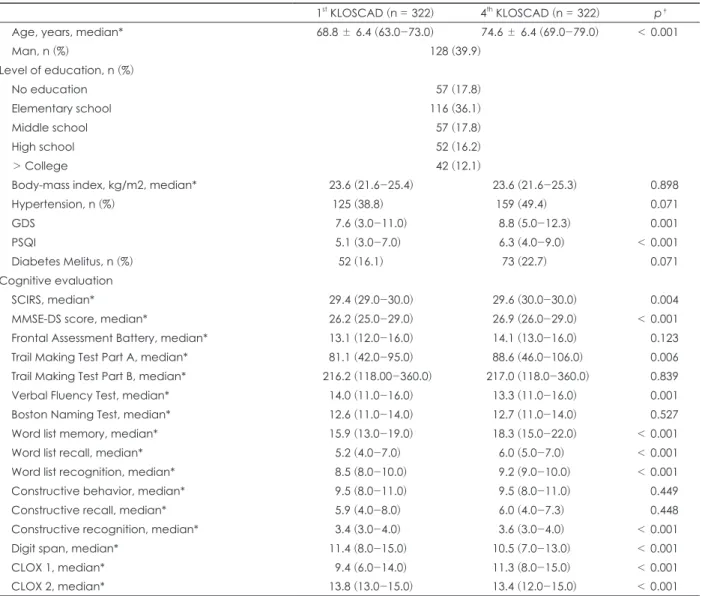
본 연구는 2011년 1차 설문 조사에 622명이 설문에 참여 하였고 그 중 332명이 2017년 4차 설문 조사에 참여하여 최 종 추적률은 53.4%였다. 6년간의 추적연구에서 10명의 노 인이 치매 진단을 받았으며 최종 분석에 사용된 노인 322명 을 대상으로 연구를 진행하였다. 노인들의 평균 연령은 1차 설문 조사에서 68.8 ± 6.4세(최소 : 60세, 최대 : 90세)였으 며, 4차 설문 조사에서는 74.6 ± 6.4세(최소 : 65세, 최대 : 96세)이었다. 성별 분포는 여성이 194명(60.1%)으로 남성보 다 더 많았다. 교육 연한은 6년인 대상자가 116명(36.1%)로 가장 많은 수를 차지 하였다. 공존질환으로 고혈압, 당뇨를 가진 대상자는 1차 설문조사에서 각각 125명(38.8%), 52명 (16.1%)였으며 4차 설문조사에서 고혈압, 당뇨를 가진 대상 자는 각각 159명(49.4%), 73명(22.7%)이었다. 이외 신체질량 지수(BMI), 수면의 질 척도(PSQI), 노인 우울증 척도(GDS)
19
와 같은 인구학적 변수들의 특징을 제시했다(Table 1).2. 시간에 따른 인지기능의 결과 측정
노인들의 인지기능의 추이를 조사하기 위해서 1차 분석 과 4차 분석의 결과에 대해 대응 표본 T검정을 수행하였다.
1차 설문조사 당시 숫자 외우기 검사(digit span test)의 평균 은 11.4 ± 4.5점, 4차 분석에서 10.5 ± 4.3점으로 6년을 거친 이후에 숫자 외우기 검사 값이 유의하게 감소했다(t = 5.140, p < 0.001). 단어 목록 회상 검사(word list recall)에서는 1차 조사에서 5.2 ± 2.0점, 4차 조사에서 6.0 ± 2.0점으로 인지기 능 검사 결과값이 유의하게 증가했다(t = -8.017, p < 0.001).
또한 clock drawing task (CLOX1) 검사에서는 1차 조사에 서 9.4 ± 4.4점, 4차 조사에서 11.3 ± 4.6점으로 시간의 경 과에 따른 인지기능 검사 결과값이 유의하게 증가했다(t =
-7.161, p <0.001).
3. 수면의 질 척도(PSQI)와 인지기능 평가 결과 사이의 다중 회귀선형분석
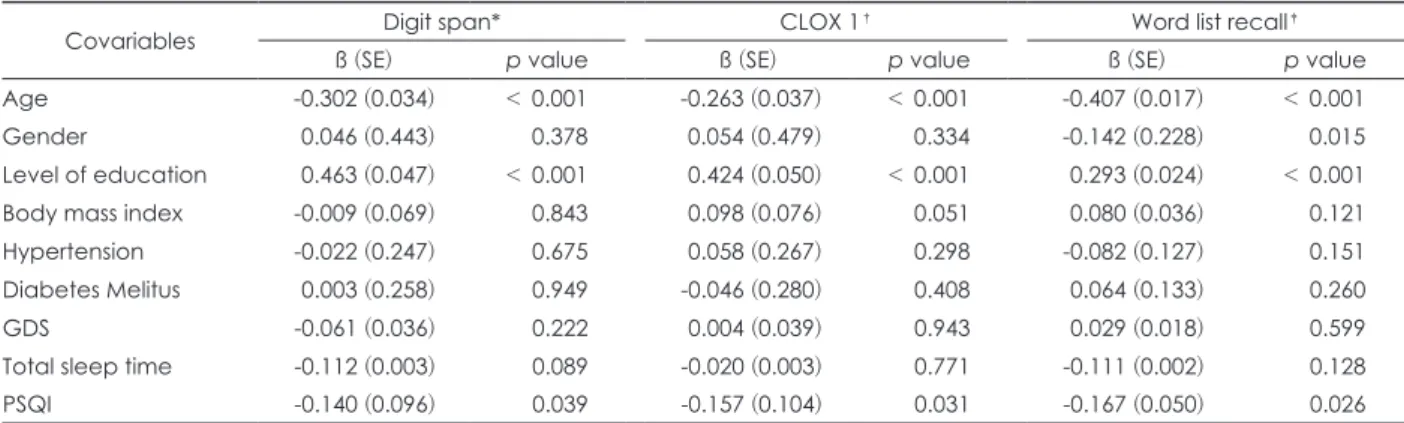
초기에 측정한 노인의 수면의 질(PSQI)가 6년 뒤 숫자 외우기 검사, 시계그리기 검사, 단어 목록 회상 검사 결과값 에 예측 인자로 작용하는지 3개의 다중회귀선형분석을 시행 한 결과를(Table 2)에 제시했다. 기존에 인지기능 저하에 영 향을 미친다고 알려진 성별, 나이, 교육 연한, 신체질량지수 (BMI), 노인우울증상(GDS), 야간 수면시간, 고혈압/당뇨의 여부를(Kee 등 1997 ; Lindsay 등 2002 ; Wu 등 2003 ; An 등 2009 ; Lee와 Lee 2015). 각각 공변량으로 입력하여 각각 분 석을 시행하였다. 6년 동안 노인에게서 측정한 초기 수면의 질(PSQI)이 인지기능에 어떤 영향을 끼치는지에 대한 분석한
Table 1. Sociodemographics and clinical characteristics of the study population
1st KLOSCAD (n = 322) 4th KLOSCAD (n = 322) p†
Age, years, median* 68.8 ± 6.4 (63.0-73.0) 74.6 ± 6.4 (69.0-79.0) < 0.001
Man, n (%) 128 (39.9)
Level of education, n (%)
No education 57 (17.8)
Elementary school 116 (36.1)
Middle school 57 (17.8)
High school 52 (16.2)
>College 42 (12.1)
Body-mass index, kg/m2, median* 23.6 (21.6-25.4) 23.6 (21.6-25.3) 0.898
Hypertension, n (%) 125 (38.8) 159 (49.4) 0.071
GDS 7.6 (3.0-11.0) 8.8 (5.0-12.3) 0.001
PSQI 5.1 (3.0-7.0) 6.3 (4.0-9.0) < 0.001
Diabetes Melitus, n (%) 52 (16.1) 73 (22.7) 0.071
Cognitive evaluation
SCIRS, median* 29.4 (29.0-30.0) 29.6 (30.0-30.0) 0.004
MMSE-DS score, median* 26.2 (25.0-29.0) 26.9 (26.0-29.0) < 0.001
Frontal Assessment Battery, median* 13.1 (12.0-16.0) 14.1 (13.0-16.0) 0.123
Trail Making Test Part A, median* 81.1 (42.0-95.0) 88.6 (46.0-106.0) 0.006
Trail Making Test Part B, median* 216.2 (118.00-360.0) 217.0 (118.0-360.0) 0.839
Verbal Fluency Test, median* 14.0 (11.0-16.0) 13.3 (11.0-16.0) 0.001
Boston Naming Test, median* 12.6 (11.0-14.0) 12.7 (11.0-14.0) 0.527
Word list memory, median* 15.9 (13.0-19.0) 18.3 (15.0-22.0) < 0.001
Word list recall, median* 5.2 (4.0-7.0) 6.0 (5.0-7.0) < 0.001
Word list recognition, median* 8.5 (8.0-10.0) 9.2 (9.0-10.0) < 0.001
Constructive behavior, median* 9.5 (8.0-11.0) 9.5 (8.0-11.0) 0.449
Constructive recall, median* 5.9 (4.0-8.0) 6.0 (4.0-7.3) 0.448
Constructive recognition, median* 3.4 (3.0-4.0) 3.6 (3.0-4.0) < 0.001
Digit span, median* 11.4 (8.0-15.0) 10.5 (7.0-13.0) < 0.001
CLOX 1, median* 9.4 (6.0-14.0) 11.3 (8.0-15.0) < 0.001
CLOX 2, median* 13.8 (13.0-15.0) 13.4 (12.0-15.0) < 0.001
* : 25th-75th Percentile, † : paired sample t-test. SCIRS : Severe Cognitive Impairment Rating Scale, MMSE-DS : Mini Mental Status Ex- amination for Dementia Screening, KLOSCAD : Korean Longitudinal Study on Cognitive Aging and Dementia, CLOX : Clock Drawing Task GDS : Geriatric Depression Scale, PSQI : Pittsburg Sleep Quality Index
20
결과 숫자 외우기 검사는 수면의 질이 좋을수록(β = -0.167, p = 0.026) 숫자 외우기 검사 점수가 증가했다(Table 2). 시계 그리기 검사는 수면의 질이 좋을수록(β = -0.157, p = 0.031) 시계 그리기 점수가 증가했다(Table 2). 마지막으로 단어 목 록 회상 검사는 수면의 질이 좋을수록(β = -0.140, p = 0.039) 단어 목록 회상 검사 점수가 증가했다(Table 2).
고 찰
본 연구를 통해 60세 이상의 노인들의 수면의 질(PSQI)이 6년 이후의 숫자외우기 검사(digit span test), 단어목록 회상 검사(word list recall), 시계 그리기 검사(CLOX 1)와 유의 한 관계가 있다는 것을 알 수 있었다. 인지기능에 영향을 미칠 수 있다고 이미 알려진 인자들을 통제하여도 수면의 질 (PSQI)은 숫자외우기 검사(digit span test), 단어목록 회상 검사(word list recall), 시계 그리기 검사(CLOX 1)에 유의 한 예측인자로 작용했다.
기존의 연구에서 수면의 질(PSQI)과 인지기능과의 관련 성을 보고한 바 있다. 수면의 질(PSQI)과 MMSE와의 관련 성을 본 연구에서는 수면의 질(PSQI)이 낮을수록 MMSE 점수가 낮아졌다는 보고가 있다(Nakakubo 등 2017). 또한 PSQI를 측정한 수면의 질과 Stroop test의 관련성을 본 연구 에서는 수면의 질 차이와 Stroop test의 점수 차이에 대한 유 의한 관련성이 없었으며(Siengsukon 등 2018) PSQI를 측정 한 수면의 질과 길만들기 검사(trail-making test)의 관련성을 본 연구에서는 수면의 질이 나쁠수록 길만들기 검사(trail- making test)의 시간이 증가하였다(Benitez과 Gunstad 2012 ; Blackwell 등 2014). 이제까지 수면의 질(PSQI)과 숫자외우 기 검사(digit span test), 단어목록 회상 검사(word list recall), 시계 그리기 검사(CLOX 1)사이의 관계를 다룬연구는 아직
은 없었다. 본 연구는 6년 동안 추적관찰한 연구에서 60세 이 상 노인의 수면의 질(PSQI)이 좋을수록 숫자외우기 검사(digit span test), 단어목록 회상 검사(word list recall), 시계 그리 기 검사(CLOX 1) 점수가 유의하게 더 높았음을 확인하였다.
노인에서는 정상노화로 인해수면분절의 증가, 입면 후 각 성(wake after sleep onset, WASO) 서파수면 감소가 발생 한다(Anderson과 Horne 2003 ; Crowley 2011 ; Ferini- Strambi 등 2013). 또한 노인의 일주기 리듬(circadian rhythm) 변화가 발생하는데 초저녁에 일찍 잠을 자게 되고 이른 아침 에 잠에서 깨어나며 중간에 잠이 깨면 다시 잠들기 어렵게 된다. 이렇게 해서 노인에서의 총 수면시간 및 수면의 질이 감소하게 된다(Cooke과 Ancoli-Israel 2006). 이번 연구에서 도 노인의 수면의 질이 6년이 지난 뒤 유의하게 나빠진다는 것을 확인할 수 있었다.
노인에서 낮은 수면의 질은 작업기억(working memory), 주의 전환(attentional shifting), 추상적 문제해결의 능력 (abstract problem solving capabilities)을 저하시켜 결국에는 인지기능에 영향을 미친다는 연구가 있다(Nebes 등 2009).
노인의 수면장애는 결국 기억력/집중력의 저하로 인한 인 지기능의 변화를 유발시킬 수 있으며(Kamel과 Gammack 2006) 일상생활에 현저한 지장을 주게 된다(Cooke과 An- coli-Israel 2006 ; Vaz Fragoso과 Gill 2007). 기존의 다른 연구에서도 노인에서의 수면의 질이 인지기능 저하와 밀접 한 관련이 있음을 보고한 것도 본 연구의 결과와 일치한다 (Blackwell 등 2011 ; Potvin 등 2012). 이미 알려진 인지기 능 저하와 관련된 여러 변수들을 통제하여도 낮은 수면의 질이 노인의 인지기능의 감소에 유의미한 예측 인자가 되었 다(Beeri 등 2006 ; Okereke 등 2008 ; Guarnieri 등 2012 ; Steenland 등 2012 ; Miller과 Spencer 2014).
숫자외우기 검사(digit span test)는 주의집중/작업기억
Table 2. Relationship cognitive function using multiple linear regression models
Covariables Digit span* CLOX 1† Word list recall‡
ß (SE) p value ß (SE) p value ß (SE) p value
Age -0.302 (0.034) < 0.001 -0.263 (0.037) < 0.001 -0.407 (0.017) < 0.001
Gender 0.046 (0.443) 0.378 0.054 (0.479) 0.334 -0.142 (0.228) 0.015
Level of education 0.463 (0.047) < 0.001 0.424 (0.050) < 0.001 0.293 (0.024) < 0.001
Body mass index -0.009 (0.069) 0.843 0.098 (0.076) 0.051 0.080 (0.036) 0.121
Hypertension -0.022 (0.247) 0.675 0.058 (0.267) 0.298 -0.082 (0.127) 0.151
Diabetes Melitus 0.003 (0.258) 0.949 -0.046 (0.280) 0.408 0.064 (0.133) 0.260
GDS -0.061 (0.036) 0.222 0.004 (0.039) 0.943 0.029 (0.018) 0.599
Total sleep time -0.112 (0.003) 0.089 -0.020 (0.003) 0.771 -0.111 (0.002) 0.128
PSQI -0.140 (0.096) 0.039 -0.157 (0.104) 0.031 -0.167 (0.050) 0.026
* : Digit span : R2 = 0.46, adjusted R2 = 0.44, N = 322, F = 24.91, p < 0.001. † : CLOX 1 : R2 = 0.38, adjusted R2 = 0.36, N = 322, F = 18.20, p < 0.001. ‡ : Word list recall : R2 = 0.34, adjusted R2 = 0.32 , N = 322, F = 15.24, p < 0.001. GDS : Geriatric Depressdion Scale, PSQI : Pittsburg Sleep Quality Index, CLOX : Clock Drawing Task, SE : Standard Deviation
21
기능을 평가한다(Lee 등 2008 ; Choi과 Choi 2014). 작업기억 능력은 언어이해의 핵심적인 역할을 함으로써 기억의 저장기능과 처리기능을 반영한다. 저장기능은 청각적으로 입력된 단어, 구, 문장을 기억하는 능력과 관련이 있어(Just 와 Carpenter 1987) 노인의 인지기능 평가에 유용하게 사용 될 수 있는 척도이다. 이전에 시행한 단면연구에서 낮은 수 면의 질이 숫자외우기 검사(Digit span test)와 연관이 있음 을 보고한바 있다(Seidel 등 2015). 이는 본 연구와 일치되 는 결과로 수면의 질이 낮은 것이 숫자외우기 검사가 낮은 것을 예측할 수 있었다.
단어목록 회상 검사(word list recall)는 언어적 지연 기억 (delayed recall)과 삽화적 기억(episodic memory)을 평가 하는 검사로(Choi 등 2015), CERAD-K의 세부검사 중 정 상과 초기 치매를 구별하는 변별력이 가장 큰 지연회상 능 력을 평가할 수 있을 뿐만 아니라(Karrasch 등 2005) 언어기 억능력(verbal memory), 학습(learning), 부호화(encoding), 저장(storage), 인출(retrieval) 기능을 평가할 수 있다(우종 인 등 2003). 본 연구에서는 수면의 질(PSQI)이 낮을수록 단 어목록 회상 검사(word list recall) 점수가 낮아졌다. 이전에 시행한 단면 연구에서는(n = 160) 낮은 수면의 질과 단어목 록 회상 검사(Word list recall)와 유의미한 관련성이 없음을 보고했다(Kang 등 2017). 이러한 차이는 본 연구의 대상군 이 기존 연구에 비해 두배 가량 더 많았고 전향적 연구였다 는 것에서 기인했을 수 있다.
시계그리기 검사(CLOX 1)는 비교적 단시간 내에 간편하 게 환자에게 적용할 수 있는 인지기능 검사 도구로(Sunder- land 등 1989) 시공간 기능(visuo-spatial function)및 실행 기 능(executive function)을 평가한다(Cahn 등 1996 ; Shul- man 2000 ; Salmon과 Lange 2001). 시계 그리기 검사(CLOX 1)는 교육수준, 문화적 차이와의 관련성이 크지 않아 인지 기능을 평가하는데 있어 예민한 지표가 될 수 있으며(Shul- man 등 1986) 노인에서 비교적 손쉽게 인지기능을 평가 할 수 있다. 본 연구에서는 수면의 질이 좋을수록 시계 그리기 검사 (CLOX 1) 점수가 높은것과 관련성이 있는 것을 확인했다.
많은 연구에서 수면장애는 시공간 기능(visuo-spatial func- tion)및 실행 기능(executive function)과 일차적인 관련성이 있다고 보고하고 있으며(Goldman 등 2013 ; Kluger 등 2017 ; Li 등 2018)노인에서의 낮은 수면의 질은 결국 시공간 기능 (visuo-spatial function)및 실행 기능(executive function)에 영향을 끼쳐 인지기능에 부정적 영향을 주게 된다(Waters과 Bucks 2011 ; Specketer 등 2019). 이전에 시계 그리기 검사 (CLOX 1)와 인지기능의 관련성을 살핀 연구는 거의 없었으 며 본 연구는 수면의 질(PSQI)과 인지기능의 관련성에 또
다른 단서를 제공할 수 있을 것이다.
이 연구의 강점으로 노인의 인지기능을 평가하기 위해 다 양한 검사가 시행 되었다는 것을 들 수 있다. 수면의 질과 인 지기능과의 관련성을 다룬 기존의 연구에서는 주로 집행기 능 및 기억력을 평가하는 5~6가지의 인지기능 평가로만 이 루어진 경우가 많았다(Kuo 등 2005 ; Talfournier 등 2013).
본 연구에서는 기존의 연구들과는 달리 기억력, 전두엽 기 능, 시공간 기능, 언어기능 및 집행기능 등과 같이 14가지의 구조화된 검사를 통해 다양한 영역을 평가하였다.
둘째, 수면의 질(PSQI)과 인지기능의 관련성을 6년간의 시간 동안 전향적으로 분석하였다는 것이다. 기존 선행 연 구는 수면의 질과 인지기능과의 관련성을 단면연구로 진행 을 하였지만(Seidel 등 2015) 본 연구는 종단연구를 통한 장 기간의 추적관찰을 진행하였다는 점에서 기존 연구 결과의 타당성을 더욱 보충해 줄 수 있을 것으로 생각된다.
셋째, 본 연구는 비슷한 디자인의 다른 연구에 비해 대상 자 수가 컸다. 수면의 질과 인지기능의 연관성을 살펴본 기 존의 선행연구보다(Kang 등 2017) 이번 연구에 참여한 대상 자 수는 2배 정도 더 많아 통계적 관련의 타당성을 더욱 높 일 수 있을 것이다.
넷째, 시계 그리기 검사(CLOX 1)와 수면의 질(PSQI)의 관계를 규명한 연구는 현재까지는 시행된 바 없으며 본 연구 에서 그 관계를 최초로 입증했다고 생각된다. 이러한 이유로 수면의 질(PSQI)이 낮은 노인에서 시계 그리기 검사(CLOX 1)를 반복적으로 시행하여 기억력 저하를 선별하는 도구로 활용할 수 있을 것이다.
이 연구의 제한점으로는 60세 이상의 노인 대상자의 1차 조사에서 고혈압과 당뇨 여부는 고려했지만 유병기간, 약제 복용여부에 대해서는 고려되지 않았다는 것을 들 수 있다.
고혈압과 당뇨의 조절이 잘 안될 경우 노인의 인지기능 저 하를 유발 할 수 있다는 연구결과가 있으나(Kuo 등 2005) 본 연구에서는 고혈압과 당뇨의 진단 여부만을 교란변수로 사용했다. 후속 연구에서는 고혈압과 당뇨가 조절된 상태에 서 수면의 질이 인지기능에 어떠한 영향을 미치는지에 대한 연구가 이루어져야 할 것이다. 또 다른 제한점은 연구 시행 도중 탈락된 대상이 많았다는 것이다. 1차 조사에서 632명, 4차 조사에서 332명으로 연구기간 중 새롭게 치매를 진단받 은 10명을 제외하면 최종 추적률은 51%에 불과하였다. 따 라서 이번 연구 결과를 모든 노인들에게 적용시켜 일반화 하기에는 제한점이 될 수 있으며 선택편향(selection bias)의 문제가 발생할 수 있다.
22
요 약
목 적:나이가 들수록 수면의 질은 나빠진다고 알려져 있으며 수면의 질과 인지기능 사이의 관계를 조사한 전향 적 연구는 현재까지 거의 없었다. 본 연구에서는 60세 이상 의 지역사회 노인을 대상으로 6년 동안 추적 조사한 자료를 바탕으로 초기 수면의 질과 인지기능 사이의 관련성을 알 아보고자 하였다.
방 법:본 연구에서는 60세 이상의 지역사회 노인 622명 을 대상으로 하였고 최종 분석에는 322명의 노인이 포함되 었다. 다음과 같은 임상척도가 사용되었다. 피츠버그 수면 질 척도(Pittsburgh sleep quality index, PSQI)와 한국판 신 경심리 평가집(Korean version of Consortium to Establish a Registry for Alzheimer’s Disease, CERAD-K). 초기 수 면의 질과 6년 이후의 인지기능의 관련성을 평가하기 위해 다중 선형 회귀분석을 시행하였다.
결 과:초기 수면의 질(PSQI)은 6년 이후의 숫자 외우기 검사(digit span test), 시계그리기 검사(CLOX 1), 단어 목 록 회상 검사(word recall test)의 결과와 유의한 관련성이 있었다. 수면의 질이 좋을수록(β = -0.167, p = 0.026) 숫자 외우기 검사 점수가 증가했으며 수면의 질이 좋을수록(β = -0.157, p = 0.031) 시계 그리기 점수(CLOX 1)가 증가했다.
또한 수면의 질이 좋을수록(β = -0.140, p = 0.039) 단어 목 록 회상 검사 점수(word recall test)가 증가했다.
결 론:본 연구에서 수면의 질과 유의한 관련성이 있는 나온 숫자외우기 검사(digit span test), 단어목록 회상 검사 (word list recall), 시계 그리기 검사 (CLOX 1)는 임상에서 비교적 단시간 내에 간편하게 수행 할 수 있는 검사이다. 수 면의 질이 낮은 노인을 대상으로 이른 시기에 인지기능을 평가하는 것은 중요하며 추후 위의 3가지 검사가 수면의 질 이 낮은 노인에게 조기 치매 진단의 유용한 선별검사가 될 수 있음을 밝히는 연구가 더 진행되어야 할 것이다.
중심 단어:노인·단어목록 회상 검사·인지기능·수면의
질·숫자외우기 검사·시계 그리기 검사.
R
EFERENCES우종인, 김기웅, 김성윤, 김주한, 우성일, 윤종철 등. 치매 진단평가
를 위한 한국판 CERAD 평가집. 서울대학교출판부;2003
Aloia MS, Ilniczky N, Di Dio P, Perlis ML, Greenblatt DW, Giles DE. Neuropsychological changes and treatment compliance in older adults with sleep apnea. J Psychosom Res 2003;54:71-76.
An KJ, Kim TH, Kim SJ, Jhoo JH, Lee JH. Relationship of neuro- cognitive function with the sleep-wake rhythm in mild cogni- tive impairment patients. J Korean Neuropsychiatr Assoc 2009;
48:447-453.
Anderson C, Horne JA. Prefrontal cortex: links between low frequen- cy delta EEG in sleep and neuropsychological performance in healthy, older people. Psychophysiology 2003;40:349-357.
Beeri MS, Schmeidler J, Sano M, Wang J, Lally R, Grossman H, et al.
Age, gender, and education norms on the CERAD neuropsycho- logical battery in the oldest old. Neurology 2006;67:1006-1010.
Benitez A, Gunstad J. Poor sleep quality diminishes cognitive func- tioning independent of depression and anxiety in healthy young adults. Clin Neuropsychol 2012;26:214-223.
Blackwell T, Yaffe K, Ancoli-Israel S, Redline S, Ensrud KE, Ste- fanick ML, et al. Association of sleep characteristics and cogni- tion in older community-dwelling men: the MrOS sleep study.
Sleep 2011;34:1347-1356.
Blackwell T, Yaffe K, Laffan A, Ancoli-Israel S, Redline S, Ensrud KE, et al. Associations of objectively and subjectively measured sleep quality with subsequent cognitive decline in older commu- nity-dwelling men: the MrOS sleep study. Sleep 2014;37:655- Buysse DJ, Reynolds CF, 3rd, Monk TH, Berman SR, Kupfer DJ. 663.
The Pittsburgh Sleep Quality Index: a new instrument for psy- chiatric practice and research. Psychiatry Res 1989;28:193-213.
Cahn DA, Salmon DP, Monsch AU, Butters N, Wiederholt WC, Co- rey-Bloom J, et al. Screening for dementia of the alzheimer type in the community: the utility of the Clock Drawing Test. Arch Clin Neuropsychol 1996;11:529-539.
Choi H, Choi H. Verbal working memory and verbal memory’s rela- tionship to discourse comprehension in healthy elderly. Com- mun Sci Disord 2014;19:513-522.
Choi L, Joo SH, Lee CU, Paik IH. Association between global corti- cal atrophy, medial temporal atrophy, white matter hyperinten- sities and cognitive functions in Korean Alzheimer’s disease patients. Korean J Biol Psychiatry 2015;22:140.
Cohen-Zion M, Stepnowsky C, Johnson S, Marler M, Dimsdale JE, Ancoli-Israel S. Cognitive changes and sleep disordered breath- ing in elderly: differences in race. J Psychosom Res 2004;56:
549-553.
Cooke JR, Ancoli-Israel S. Sleep and its disorders in older adults.
Psychiatr Clin North Am 2006;29:1077-1093.
Crowley K. Sleep and sleep disorders in older adults. Neuropsychol Rev 2011;21:41-53.
Driscoll HC, Serody L, Patrick S, Maurer J, Bensasi S, Houck PR, et al. Sleeping well, aging well: a descriptive and cross-sectional study of sleep in “successful agers” 75 and older. Am J Geriatr Psychiatry 2008;16:74-82.
Ferini-Strambi L, Galbiati A, Marelli S. Sleep microstructure and memory function. Front Neurol 2013;4:159.
Foley DJ, Monjan AA, Brown SL, Simonsick EM, Wallace RB, Blaz- er DG. Sleep complaints among elderly persons: an epidemio- logic study of three communities. Sleep 1995;18:425-432.
Goldman JG, Ghode RA, Ouyang B, Bernard B, Goetz CG, Stebbins GT. Dissociations among daytime sleepiness, nighttime sleep, and cognitive status in Parkinson’s disease. Parkinsonism Relat Disord 2013;19:806-811.
Guarnieri B, Adorni F, Musicco M, Appollonio I, Bonanni E, Caf- farra P, et al. Prevalence of sleep disturbances in mild cognitive impairment and dementing disorders: a multicenter Italian clini- cal cross-sectional study on 431 patients. Dement Geriatr Cogn Disord 2012;33:50-58.
Hoch CC, Dew MA, Reynolds CF, 3rd, Monk TH, Buysse DJ, Houck PR, et al. A longitudinal study of laboratory- and diary-based sleep measures in healthy “old old” and “young old” volunteers.
Sleep 1994;17:489-496.
Just MA, Carpenter PA. The psychology of reading and language
23
comprehension, Allyn & Bacon;1987.
Kamel NS, Gammack JK. Insomnia in the elderly: cause, approach, and treatment. Am J Med 2006;119: 463-469.
Kamel NS, Gammack JK. Insomnia in the elderly: cause, approach, and treatment. Am J Med 2006;119:463-469.
Kang SH, Yoon IY, Lee SD, Kim T, Lee CS, Han JW, et al. Subjec- tive memory complaints in an elderly population with poor sleep quality. Aging Ment Health 2017;21:532-536.
Karrasch M, Sinerva E, Gronholm P, Rinne J, Laine M. CERAD test performances in amnestic mild cognitive impairment and Alzheimer’s disease. Acta Neurol Scand 2005;111:172-179.
Kee BS, Yoon JH, Kim SK. A preliminary study on the risk factors between vascular dementia and Alzheimer’s dementia. J Korean Geriatr Psychiatry 1997;1:96.
Kluger BM, Pedersen KF, Tysnes OB, Ongre SO, Oygarden B, Her- lofson K. Is fatigue associated with cognitive dysfunction in early Parkinson’s disease? Parkinsonism Relat Disord 2017;37:
87-91.
Ku BD, Kim SG, Lee JY, Park KH, Shin JH, Kim KK, et al. Clini- cal practice guideline for dementia by Clinical Research Cen- ter for Dementia of South Korea. J Korean Med Assoc 2011;54:
861-875.
Kuo HK, Jones RN, Milberg WP, Tennstedt S, Talbot L, Morris JN, et al. Effect of blood pressure and diabetes mellitus on cogni- tive and physical functions in older adults: a longitudinal anal- ysis of the advanced cognitive training for independent and vi- tal elderly cohort. J Am Geriatr Soc 2005;53:1154-1161.
Kuo HK, Jones RN, Milberg WP, Tennstedt S, Talbot L, Morris JN, et al. Effect of blood pressure and diabetes mellitus on cogni- tive and physical functions in older adults: a longitudinal analy- sis of the advanced cognitive training for independent and vital elderly cohort. J Am Geriatr Soc 2005;53:1154-1161.
Lee JH, Kim SJ, Lee DY, Chou IH, Kim KW, Youn JC, et al. Rela- tionship of sleep factors with neurocognitive function in normal elderly subjects and mild cognitive impairment (MCI) patients.
J Korean Neuropsychiatr Assoc 2007;46:41-49.
Lee JS, Lee SY. Effect on cognitive function in elderly people. The KJ-HSM 2015;9:201-210.
Lee JY, Dong Woo L, Cho SJ, Na DL, Hong Jin J, Kim SK, et al.
Brief screening for mild cognitive impairment in elderly outpa- tient clinic: validation of the Korean version of the montreal cog- nitive assessment. J Geriatr Psychiatry Neurol 2008;21:104-110.
Li G, Tang H, Chen J, Qi X, Chen S, Ma J. Executive and visuospa- tial dysfunction in patients with primary restless legs syndrome/
willis-ekbom disease: study of a chinese population. J Clin Sleep Med 2018;14:785-790.
Lindsay J, Laurin D, Verreault R, Hébert R, Helliwell B, Hill GB, et al. Risk factors for Alzheimer’s disease: a prospective anal- ysis from the Canadian Study of Health and Aging. Am J Epi- demiol 2002;156:445-453.
Lee JH, Kim SJ, Lee DY, Chou IH, Kim KW, Youn JC, et al. Rela- tionship of sleep factors with neurocognitive function in normal elderly subjects and mild cognitive impairment (MCI) patients.
J Korean Neuropsychiatr Assoc 2007;46:41-49.Miller AA, Spencer SJ. Obesity and neuroinflammation: a pathway to cognitive impairment. Brain Behav Immun 2014;42:10-21.
Nakakubo S, Makizako H, Doi T, Tsutsumimoto K, Lee S, Lee S, et al. Impact of poor sleep quality and physical inactivity on cog- nitive function in community-dwelling older adults. Geriatr Gerontol Int 2017;17:1823-1828.
Nebes RD, Buysse DJ, Halligan EM, Houck PR, Monk TH. Self-re- ported sleep quality predicts poor cognitive performance in
healthy older adults. J Gerontol B Psychol Sci Soc Sci 2009;64:
180-187.
Okereke OI, Kang JH, Cook NR, Gaziano JM, Manson JE, Buring JE, et al. Type 2 diabetes mellitus and cognitive decline in two large cohorts of community-dwelling older adults. J Am Geri- atr Soc 2008;56:1028-1036.
Potvin O, Lorrain D, Forget H, Dube M, Grenier S, Preville M, et al.
Sleep quality and 1-year incident cognitive impairment in com- munity-dwelling older adults. Sleep 2012;35:491-499.
Potvin O, Lorrain D, Forget H, Dubé M, Grenier S, Préville M, et al.
Sleep quality and 1-year incident cognitive impairment in com- munity-dwelling older adults. Sleep 2012;35:491-499.
Saint Martin M, Sforza E, Barthélémy JC, Thomas-Anterion C, Roche F. Does subjective sleep affect cognitive function in healthy el- derly subjects? The Proof cohort. Sleep Med 2012;13:1146-1152.
Salmon DP, Lange KL. Cognitive screening and neuropsychologi- cal assessment in early Alzheimer’s disease. Clin Geriatr Med 2001;17:229-254.
Seidel S, Dal-Bianco P, Pablik E, Muller N, Schadenhofer C, Lamm C, et al. Depressive symptoms are the main predictor for subjec- tive sleep quality in patients with mild cognitive impairment--a controlled study. PLoS One 2015;10:e0128139.
Shulman KI. Clock-drawing: is it the ideal cognitive screening test?
Int J Geriatr Psychiatry 2000;15:548-561.
Shulman KI, Shedletsky R, Silver IL. The challenge of time: clock- drawing and cognitive function in the elderly. Int J Geristr Psy- chiatry 1986;1:135-140.
Siengsukon CF, Aldughmi M, Kahya M, Lynch S, Bruce J, Glusman M, et al. Individuals with mild MS with poor sleep quality have impaired visuospatial memory and lower perceived functional abilities. Disabil Health J 2018;11:116-121.
Specketer K, Zabetian CP, Edwards KL, Tian L, Quinn JF, Peterson- Hiller AL, et al. Visuospatial functioning is associated with sleep disturbance and hallucinations in nondemented patients with Parkinson’s disease. J Clin Exp Neuropsychol 2019;41:803-813.
Steenland K, Karnes C, Seals R, Carnevale C, Hermida A, Levey A.
Late-life depression as a risk factor for mild cognitive impair- ment or Alzheimer’s disease in 30 US Alzheimer’s disease cen- ters. J Alzheimers Dis 2012;31:265-275.
Sunderland T, Hill JL, Mellow AM, Lawlor BA, Gundersheimer J, Newhouse PA, et al. Clock drawing in Alzheimer’s disease. A novel measure of dementia severity. J Am Geriatr Soc 1989;37:
725-729.
Talfournier J, Bitu J, Paquet C, Gobron C, Guillausseau PJ, Hugon J, et al. Relationship between blood pressure, cognitive func- tion and education level in elderly patients with diabetes: a pre- liminary study. Diabetes Metab 2013;39:418-423.
Vaz Fragoso CA, Gill TM. Sleep complaints in community-living older persons: a multifactorial geriatric syndrome. J Am Geriatr Soc 2007;55:1853-1866.
Waters F, Bucks RS. Neuropsychological effects of sleep loss: impli- cation for neuropsychologists. J Int Neuropsychol Soc 2011;17:
571-586.
Welsh KA, Butters N, Mohs RC, Beekly D, Edland S, Fillenbaum G, et al. The Consortium to Establish a Registry for Alzheimer's Disease (CERAD). Part V. A normative study of the neuropsy- chological battery. Neurology 1994;44:609-614.
Wu JH, Haan MN, Liang J, Ghosh D, Gonzalez HM, Herman WH.
Impact of diabetes on cognitive function among older Latinos:
a population-based cohort study. J Clin Epidemiol 2003;56:
686-693.