INTRODUCTION
Alzheimer’s disease (AD) is the most common cause of de- mentia, and the prevalence of AD in a population usually in- creases with age. After the age of 65, the risk of developing AD doubles every 5 years, so that by the age of 85, some re- searchers suggest that about half of the individuals will have this disease. Several estimates have predicted that there could be more 125 million patients with AD in the world by 2050.1
Therefore, many studies have tried to discover a therapeutic ap- proach for AD.2 Currently, the only approved therapeutics for AD are acetylcholinesterase inhibitors and the N-methyl-D-as- partate receptor antagonist which provide transient symptom- atic improvement or minimal benefit in terms of modifying the overall course of the disease.3-5
Stem cell therapy (SCT) may be one of the promising treat- ment options that may improve the patient’s outcome in AD.
SCT may have beneficial effects, such as replacing the neu- rons,6,7 protecting them,8 preventing inflammation,9 and pro- moting angiogenesis.10 Based on these expectations, there are many ongoing controlled trials of SCT for a lot of diseases, es- pecially neurodegenerative diseases. However, preclinical and
Analysis of the Expectation of Stem Cell Therapy in Patients with Alzheimer’s Disease
Seokgil Han, Hojin Choi, Young Seo Kim, Kyu-Yong Lee, Young Joo Lee, Seong-Ho Koh
Department of Neurology, Hanyang University College of Medicine, Seoul, Korea
Background and Purpose Alzheimer’s disease (AD) is the most common form of dementia which typically manifests as loss of memory and cognitive functions. Currently, available treatments for AD provide only symptomatic improvement and the benefit is minimal. Stem cell therapy (SCT) has been considered a promising treatment option for AD. We investigated the caregiver’s perception about implementation of SCT in their AD patients, and determined the factors related to SCT.
Methods A total of 100 caregivers, who cared for their AD patients, were interviewed at two hospitals. Structured open and closed ques- tions about SCT for AD were asked by trained interviewers using the conventional in-person method. In addition, 60 dementia-related phy- sicians were randomly interviewed via an e-mail questionnaire.
Results Of the 100 subjects, 61 caregivers replied that they wanted their AD patients to receive SCT. Approximately 50% of the caregivers expected high improvement in cognitive function, behavioral and psychological symptoms, and activities of daily living, and physical im- provements among their AD patients. However, physicians had much lower expectations of improvements in the above parameters. Multi- variate analysis revealed that female gender [odds ratio (OR): 3.747, 95% confidence interval (CI): 1.425–9.851] and familiarity with stem cells (OR: 3.873, 95% CI: 1.290–11.622) were independently associated with caregivers’ desire that their AD patients should undergo SCT.
The major source of information on SCT was television (76.7%), and the most reliable source of information on SCT was physicians (83.6%).
Conclusions In this study, many caregivers of AD patients fantasized and overestimated the need for SCT in comparison with physicians’
expectation. Therefore, it is necessary for physicians to develop strategies for educating caregivers about the appropriate risks and benefits of SCT.
Key Words Alzheimer’s disease, caregiver, stem cell therapy.
Received: November 3, 2016 Revised: November 22, 2016 Accepted: November 22, 2016
Correspondence: Seong-Ho Koh, MD, PhD, Department of Neurology, Hanyang University College of Medicine, Guri Hospital, 153 Gyeongchun-ro, Guri 11923, Korea
Tel: +82-31-560-2267, Fax: +82-31-560-2267, E-mail: [email protected]
cc This is an Open Access article distributed under the terms of the Cre- ative Commons Attribution Non-Commercial License (http://creative- commons.org/licenses/by-nc/3.0) which permits unrestricted non-com- mercial use, distribution, and reproduction in any medium, provided the ori- ginal work is properly cited.
DND
ORIGINAL ARTICLE
Seokgil Han et al.
The Expectation of Stem Cell Therapy in AD
clinical evidence to support its efficacy in AD is still not avail- able. For many neurodegenerative disorders such as Parkin- son’s disease, stem cell-based therapies aim to replace specific structures or neurotransmitters. Unfortunately in AD, because there are a lot of related neuronal systems and neurotransmit- ters, cell replacement strategies are considered a challenging ap- proach. Since there is currently no proven SCT for AD, reckless trials of SCT may be accompanied by physical and financial risks. For example, there have been reports of brain tumors and death after SCT.7,8 Despite several serious risks, many caregivers who are not satisfied with the current treatments for their AD patients are willing to try SCT.9
The importance of appropriate governance of advanced sci- ence has been discussed,10 but inappropriate SCTs are still be- ing used in many countries, and the number of patients re- ceiving SCT is greatly increasing.11 Therefore, caregivers need to have a better understanding of SCT to avoid inappropriate treatments for their AD patients. This baseline understand- ing may be essential for establishing correct treatment strate- gies. Several surveys have been performed to assess the pub- lics’ understanding of stem cell research.12,13 However, to the best of our knowledge, there are no studies evaluating caregiv- ers’ knowledge about SCT, except for our previous report in stroke patients.14 We aimed to investigate the baseline knowl- edge of caregivers on SCT, to confirm the factors related to caregivers who would like their AD patients to receive SCT, and to compare the results with those of our previous report in stroke patients.14
METHODS
This study was designed as a prospective, multicenter, con- secutive study conducted at 2 hospitals in Seoul and Guri, Ko- rea. We used a similar protocol to compare the similarities and differences in the results between this study and the previous study16 which we had performed in chronic ischemic stroke patients. Caregivers of patients who had been diagnosed with AD by neurologists or psychiatrists at least 3 months previous- ly were included. Patients with AD met the National Institute of Neurological and Communicative Disorders and Stroke and the AD and Related Disorders Association criteria for probable AD. Exclusion criterion was diagnosis of disease with another type of dementia.
Caregivers who were not able to communicate were ex- cluded. There were no public campaigns or educational efforts before or during this study. This study was approved by the Institutional Review Board of Hanyang University Guri hos- pital. The study was performed from January 2013 to June 2013 and recruitment was stopped when the total number of
patients reached 100. All consecutive caregivers of patients with AD in the outpatient departments of the 2 hospitals were reviewed to confirm their eligibility. After obtaining current neurological scales, such as Korean version of Mini-Mental State Examination (K-MMSE)15 and Clinical Dementia Rat- ing (CDR),16 physicians, who had been formally trained in the use of standardized definitions and data collection techniques, conducted in-person interviews with all eligible caregivers.
The caregivers were interviewed within 5 minutes after pro- viding verbal informed consent. Caregivers who did not con- sent to participate in the study were excluded. The interviews were conducted in Korean and there was no attempt to prompt the respondents. The survey instrument contained 4 sections. In the first section, the questions were about demographic charac- teristics, including age, sex, education level, housing status, and the presence of risk factors (smoking, alcohol, hypertension, diabetes mellitus, hyperlipidemia, heart disease, head trauma history, stroke history and family history). In the second sec- tion, information about AD, such as onset, disease duration and clinical symptoms was obtained. In the third section, caregivers were asked closed questions about whether they wanted their AD patients to receive SCT in spite of its un- known side effects. We also asked questions about knowl- edge, attitudes, and expectations of SCT, and regarding what was thought to be a reasonable price. Finally, in the fourth sec- tion, caregivers were asked, using closed-ended multiple- choice questions, to name all sources from which they had ob- tained SCT-related information. Those who wanted their AD patients to receive SCT were asked, using closed-ended single choice questions, to name their most reliable source of infor- mation. In addition to the caregiver survey, we also performed a physician survey among those who may encounter patients with AD, to determine if the lack of knowledge on the part of the patients was due to lack of communication with their phy- sicians. We sent 250 e-mails to randomly sampled neurolo- gists and psychiatrists and analyzed the first 60 completed questionnaire forms. The survey instruments included the following factors: age, sex, specialization, knowledge, perspec- tive, expectation, reasonable price and whether they would recommend SCTs.
Statistical analysis
Baseline characteristics of caregivers of AD patients were recorded as means (standard deviation) and numbers (per- centages). The patients were divided into 2 groups according to whether their caregivers wanted them to receive SCT or not. We compared the explanatory variables by the chi-square test, the Student’s t-test, or the Mann-Whitney U test, wher- ever appropriate. Using a multivariable logistic regression
DND
analysis, we investigated the independent effects of demo- graphics, the presence of risk factors, and outcome scale scores for the patients whose caregivers wanted them to undergo SCT.
Interactions between variables were also assessed. Explanato- ry variables identified by the univariate analysis at p<0.2 were used in the model. All significance tests were 2-tailed, and differences were considered statistically significant at p<0.05.
Data were analyzed with SPSS version 18.0 for Windows (SPSS Inc., Chicago, IL, USA).
RESULTS
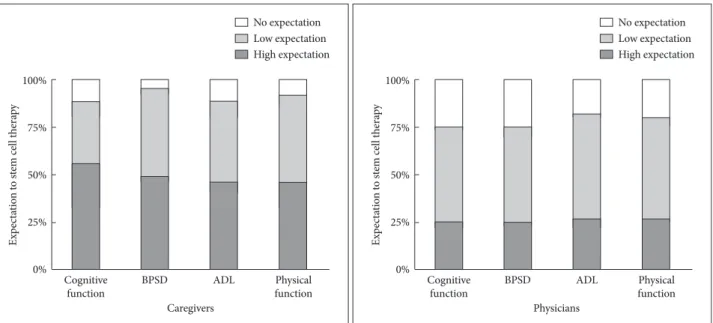
Of the 100 patients registered in the present study who were cared by caregivers, 60 patients (60%) were female and 40 pa- tients (40%) were male. The mean age was 76.7 years and the age range was 63–93 years. The demographic characteristics of the AD patients are shown in Table 1. The mean score of the K-MMSE was 17.9 and the number of patients assessed as CDR 1 and 2 was 75 and 25, respectively. Among the caregiv- ers, 43 caregivers (43%) replied that they had heard about stem cells, and 17 caregivers (17%) stated that they knew about the ongoing worldwide clinical trials of SCT for AD patients. Sixty-one caregivers (61%) replied that they wanted their AD patients to receive SCT in spite of the unknown side effects. Of the 61 caregivers who replied that they would like their AD patients to receive SCT, the largest proportion of caregivers (52.5%) replied that less than $1000 was a rea- sonable price, followed by $1000–$5000 (34.4%). Only 9 caregivers would have liked their AD patients to receive SCT at a cost of $5000–$10000, and 5 caregivers replied that they would like their AD patients to receive SCT even at a cost ex- ceeding $10000 (Table 2). When caregivers answered the questions about what they expected from SCT for their AD patients, improvement in cognitive function, behavioral and psychological symptoms, activities of daily living and physical improvements were highly expected by 34 (55.7%), 30 (49.2%), 28 (45.9%), and 28 (45.9%) responders, respectively (Fig. 1).
The clinical characteristics of the patients in the 2 subgroups are also shown in Table 1. Sex of the patients (female gender), disease duration, hyperlipidemia and familiarity with stem cells were significantly associated with a desire for undergoing SCT in univariate analysis. In multivariable logistic regression analysis, female gender [odds ratio (OR): 3.747, 95% confi- dence interval (CI): 1.425–9.851, p=0.007] and familiarity with stem cells (OR: 3.873, 95% CI: 1.290–11.622, p=0.016) were independent factors associated with caregivers’ desire that their AD patients should undergo SCT (Table 3). The most common sources of information are listed in Table 4. Televi- sion (76.7%) was the most frequently cited source of informa-
Table 1. Clinical characteristics of AD patients whose caregivers wanted them to undergo stem cell therapy versus clinical charac- teristics of AD patients whose caregivers did not want them to un- dergo stem cell therapy
Want stem cell therapy
Yes No p
Demographics
Age (years) 76.4 77.1 0.572*
Gender (female) 57.5 26.7 0.002
Education (years) 4.4 5.6 0.235
Disease duration
Months 30.4 45.5 0.041†
Risk factors (%)
HTN 50.8 59 0.425
DM 42.6 38.5 0.68
Hyperlipidemia 42.6 17.9 0.01
Head trauma 14.8 17.9 0.671
Family history 14.8 25.6 0.176
K-MMSE
Scores 18.5 17.1 0.238†
CDR, scores (%)
1 75.4 74.4 0.906
2 24.6 25.6
Familiarity with stem cells (%) 54.1 25.6 0.005 Knowledge of stem cells
clinical trials for dementia (%) 18 15.4 0.731 Pearson’s w2 test was used.
*Student’s t-test, †Mann–Whitney U test were used.
‘‘Familiarity with stem cells’’ indicates the patients who answered that they had heard about stem cells. ‘‘Knowledge of stem cells clinical tri- als for dementia’’ indicates the patients who answered that they knew about stem cell clinical trials for stroke.
CDR: Clinical Dementia Rating, DM: diabetes mellitus, HTN: hyper- tension, K-MMSE: the Korean Mini-Mental State Examination.
Table 2. Caregivers’ and physicians’ views about stem cell thera- py for AD patients
Caregivers Physicians p (n=100) (n=60)
Familiarity with stem cells (%) 43 100 <0.001 Knowledge of stem cells
clinical trials for dementia (%) 17 55 <0.001 Want stem cell treatment (%) 61
Would recommend stem cell treatment
48.3
Reasonable price, $ (%)* <0.001
1000< 52 13.3
1000–5000 34 18.3
5000–10000 9 51.7
>10000 5 16.7
Pearson’s w2 test was used.
*Answers concerning a reasonable price were obtained from caregiv- ers and physicians.
Seokgil Han et al.
The Expectation of Stem Cell Therapy in AD
tion, followed by the internet (11.6%) and physician (7.0%).
However, doctors were considered the most reliable source of information (83.6%), followed by television (11.5%) and the internet (4.7%). After sending 250 e-mails, 78 (31.2%) physicians responded to the survey and the first 60 question- naires were analyzed. Among them, 43 physicians (71.7%) were male and the mean age was 38.6 years with a range from 27 to 53 years. The respondents included 40 neurologists and 20 psychiatrists. All of the physicians had heard of stem cells, and 55 (91.7%) knew about the clinical trials being per- formed around the world. To compare with the caregivers’
survey, in which 61% indicated that they wanted their AD patients to receive SCT in spite of the unknown side effects,
only 29 physicians (48.3%) responded that they would rec- ommend SCT and the reasonable price was much higher than that expected by the patients. The largest proportion of physicians (51.7%) answered that $5000–$10000 was a rea- sonable price, followed by $1000–$5000 (18.3%), and more than $10000 (16.7%) (Table 2). Expectations of SCT in physi- cians were also different from those in caregivers. The majori- ty of physicians had low expectations of improvements in cognitive function (50%), behavioral and psychological symptoms (50%), and activities of daily living (55%), and physical improvements (53.3%), respectively (Fig. 1).
DISCUSSION
In the previous study, we evaluated the attitudes or expecta- tions of SCT in chronic ischemic stroke patients.16 Therefore, we could analyze the results of this study with reference to those of the previous study and could find some similarity or difference between the two studies.
First, 61% of caregivers of AD patients replied that they wanted their AD patients to receive SCT, and this proportion is Fig. 1. Expectations concerning stem cell therapy among caregivers and physicians. Almost half of the respondents thought that it would be highly effective. However, physicians had relatively low expectations from the use of stem cell therapies. ADL: activities of daily living, BPSD:
behavioral and psychological symptoms of dementia.
100%
75%
50%
25%
0%
Expectation to stem cell therapy
Cognitive
function BPSD Physicians
ADL Physical
function No expectation Low expectation High expectation 100%
75%
50%
25%
0%
Expectation to stem cell therapy
Cognitive
function BPSD Caregivers
ADL Physical
function No expectation Low expectation High expectation
Table 3. Multivariable logistic regression analysis: factors associated with stem cell therapy
Caregivers who wanted stem cell therapy for AD patients
Crude OR (95% CI) Adjusted OR (95% CI) p*
Gender, female 3.721 (1.592–8.694) 3.747 (1.425–9.851) 0.007
Familiarity with stem cells 3.418 (1.421–8.221) 3.873 (1.290–11.622) 0.016
Candidate variables were those from the univariate analysis with p<0.2.
*p for multivariable model.
AD: Alzheimer’s disease, CI: confidence interval, OR: odds ratio.
Table 4. Sources of information about stem cell therapies Source of information
(n=43)
Most reliable source (n=43)
Television 33 (76.7%) 5 (11.5%)
Internet 5 (11.6%) 2 (4.7%)
Physician 3 (7.0%) 36 (83.6%)
Friends/colleagues 2 (4.7%) 0 (0%)
DND
higher than that of patients with stroke (61% vs. 47%). They also had unrealistic expectations that SCT would improve cognitive function, behavioral and psychological symptoms, and activities of daily living and cause physical improvements in AD patients. Considering that unsafe SCTs are increasing rapidly and are widely attracting the patients,11 caregivers do not have detailed information and patients can easily be ex- posed to unsafe SCTs. In the previous study, we reported that male gender and long disease duration in chronic stroke pa- tients were independently associated with a desire for under- going SCT, and these findings reflect patients’ desire to regain social activity and recover from disability, because males may participate more in social activities than females, and patients with long disease duration may have more pronounced dis- abilities. However, in this study, female gender and familiarity with stem cells were independently associated with caregivers’
desire that their AD patients should undergo SCTs. Therefore, we had to find other explanations for the results.
Most AD patients are in their seventies and are generally older than stroke patients. Therefore, caregivers of AD patients expect less social activities than those of stroke patients. Oth- erwise, most caregivers of AD patients consider more about family bonding and good activities of daily living. In this study, we noted that caregivers of female AD patients are more likely to want their patients to receive SCT because they might be contribute more to family life rather than social activities.
Manifestations and symptoms of AD progress continuously and result in mental deterioration. It is a possible explanation that some caregivers may lose hope and are not ready for treat- ment of their AD patients as time passes. Therefore, it is a pos- sible explanation that disease duration can have an inverse correlation with anticipation of receiving SCT.
Second, our study showed that caregivers expected too much from SCT. Although SCT for AD lagged far behind that for many other neurodegenerative disorders because of the widespread nature of AD pathology17 and current evidence for SCT in AD is less than that for SCT in stroke.17-20 Almost 50%
of our subjects expected high improvement in cognitive func- tion, behavioral and psychological symptoms, and activities of daily living, and physical improvements. These findings suggest that caregivers do not have accurate knowledge of SCT in spite of their familiarity with stem cells from adver- tisements on television and internet. In contrast to caregivers’
expectations, more than half of the physicians had low expec- tations of any improvements with SCT in AD. This disagree- ment in opinion may be due to deficient communication be- tween caregivers and physicians during their visit to the clinics. Recently, a doctor’s responsibility to inform the pa- tients about the benefits and risks of SCT has been empha-
sized.21,22 In addition, our study also showed that television was the most frequently reported source of information on SCT and caregivers thought that physicians were the most re- liable source of information on SCT. Therefore, we suggest that dementia specialists and physicians should make a great- er effort to provide their patients and caregivers with detailed knowledge via television and internet media.
The final finding of interest concerns caregivers’ thoughts about the cost of SCT. The actual cost has been reported to vary between US $5000 and $3950024 and more than half of the physicians in our survey also indicated that the cost of SCT can be in the range of $5000–$10000. However, the majority (52%) of the caregivers thought that the reasonable price of SCT would be below $1000. The difference between caregivers’
ideas regarding the cost of SCT and the real price was similar to that in our previous study, and it may suggest that patients had not been directly exposed to commercial advertisements and they only had baseless hopes about SCTs.
There are some limitations to this study. The number of en- rolled caregivers of patients might be too small to represent all caregivers. We were willing to evaluate patients’ and care- givers’ information in detail. Therefore, the sample size was re- stricted to 100, but in terms of the results, it might be too small. However, since we evaluated the same subjects who had chronic ischemic stroke in our previous study, we could com- pare the data between chronic ischemic stroke and AD. There- fore, we believe that our results provide valuable information about caregivers’ understanding and expectation of SCT. An extension of the survey to other diseases and comparative studies would be of interest and they should be undertaken.
Second, we could not investigate the patients’ economic status and caregivers’ educational status, which might be associated with the results. We included economic status and educational status in our survey list, but majority of caregivers were not willing to provide this information. Since insufficient data on economic status and educational status could lead to confusing results, we decided not to use this information in the present re- sults. Third, we focused on mild to moderate AD patients be- cause it would be difficult for severe AD patients and their care- givers to visit the hospital. Due to this reason, severe AD patients could have been ignored. We think that caregivers of severe AD patients might show similar results, but it should be inves- tigated in further evaluation. Finally, we could not evaluate the difference between neurologists and psychiatrists or other phy- sicians because initially, we did not consider the differences be- tween these groups. Future study that compares the difference between neurologists and other physicians will be interesting.
Taken together, this study indicates that many caregivers fantasize about their AD patients receiving SCT and AD pa-
Seokgil Han et al.
The Expectation of Stem Cell Therapy in AD
tients could be exposed to a substantial risk of inappropriate SCT if they do not receive proper information. This tendency was greater in AD compared with chronic ischemic stroke.
Accurate strategies to educate patients and caregivers about the risks and benefits of SCT are needed to reduce the number of unproven stem cell therapies.
Conflicts of Interest
The authors have no financial conflicts of interest.
Acknowledgements
This work was supported by a grant from the Korea Research Foundation (2015R1A2A2A04004865).
REFERENCES
1. Wimo A, Winblad B, Jönsson L. The worldwide societal costs of de- mentia: estimates for 2009. Alzheimers Dement 2010;6:98-103.
2. Mangialasche F, Solomon A, Winblad B, Mecocci P, Kivipelto M. Al- zheimer’s disease: clinical trials and drug development. Lancet Neurol 2010;9:702-716.
3. Hansen RA, Gartlehner G, Webb AP, Morgan LC, Moore CG, Jonas DE. Efficacy and safety of donepezil, galantamine, and rivastigmine for the treatment of Alzheimer’s disease: a systematic review and me- ta-analysis. Clin Interv Aging 2008;3:211-225.
4. Roberson ED, Mucke L. 100 years and counting: prospects for de- feating Alzheimer’s disease. Science 2006;314:781-784.
5. Maggini M, Vanacore N, Raschetti R. Cholinesterase inhibitors: drugs looking for a disease? PLoS Med 2006;3:e140.
6. Lindvall O, Hyun I. Medical innovation versus stem cell tourism.
Science 2009;324:1664-1665.
7. Amariglio N, Hirshberg A, Scheithauer BW, Cohen Y, Loewenthal R, Trakhtenbrot L, et al. Donor-derived brain tumor following neural stem cell transplantation in an ataxia telangiectasia patient. PLoS Med 2009;6:e1000029.
8. Pontes-Neto OM, Silva GS, Feitosa MR, de Figueiredo NL, Fiorot JA Jr, Rocha TN, et al. Stroke awareness in Brazil: alarming results in a
community-based study. Stroke 2008;39:292-296.
9. Enserink M. Biomedicine. Selling the stem cell dream. Science 2006;
313:160-163.
10. Gaskell G, Einsiedel E, Hallman W, Priest SH, Jackson J, Olsthoorn J.
Communication. Social values and the governance of science. Science 2005;310:1908-1909.
11. Ryan KA, Sanders AN, Wang DD, Levine AD. Tracking the rise of stem cell tourism. Regen Med 2010;5:27-33.
12. Shineha R, Kawakami M, Kawakami K, Nagata M, Tada T, Kato K.
Familiarity and prudence of the Japanese public with research into in- duced pluripotent stem cells, and their desire for its proper regulation.
Stem Cell Rev 2010;6:1-7.
13. Einsiedel E, Premji S, Geransar R, Orton NC, Thavaratnam T, Bennett LK. Diversity in public views toward stem cell sources and policies.
Stem Cell Rev 2009;5:102-107.
14. Kim YS, Chung DI, Choi H, Baek W, Kim HY, Heo SH, et al. Fanta- sies about stem cell therapy in chronic ischemic stroke patients. Stem Cells Dev 2013;22:31-36.
15. Kang Y, Na DL, Hahn S. A validity study on the Korean Mini-Mental State Examination (K-MMSE) in dementia patients. J Korean Neurol Assoc 1997;15:300-308.
16. Morris JC. The Clinical Dementia Rating (CDR): current version and scoring rules. Neurology 1993;43:2412-2414.
17. Chen WW, Blurton-Jones M. Concise review: can stem cells be used to treat or model Alzheimer’s disease? Stem Cells 2012;30:2612-2618.
18. Dantuma E, Merchant S, Sugaya K. Stem cells for the treatment of neurodegenerative diseases. Stem Cell Res Ther 2010;1:37.
19. Lee JS, Hong JM, Moon GJ, Lee PH, Ahn YH, Bang OY. A long-term follow-up study of intravenous autologous mesenchymal stem cell transplantation in patients with ischemic stroke. Stem Cells 2010;28:
1099-1106.
20. Honmou O, Houkin K, Matsunaga T, Niitsu Y, Ishiai S, Onodera R, et al. Intravenous administration of auto serum-expanded autologous mesenchymal stem cells in stroke. Brain 2011;134(Pt 6):1790-1807.
21. Zarzeczny A, Caulfield T. Stem cell tourism and doctors’ duties to mi- nors--a view from Canada. Am J Bioeth 2010;10:3-15.
22. Regenberg AC, Hutchinson LA, Schanker B, Mathews DJ. Medicine on the fringe: stem cell-based interventions in advance of evidence.
Stem Cells 2009;27:2312-2319.