Missing Data Analysis in Drug-Naïve Alzheimer’s Disease with Behavioral and Psychological Symptoms
Yong Tae Kwak,1 YoungSoon Yang,2 and Sang-Gue Park3
1Department of Neurology, Hyoja Geriatric Hospital, Yongin; 2Department of Neurology, Seoul Veterans Hospital, Seoul;
3Department of Applied Statistics, Chung-Ang University, Seoul, Korea.
Received: September 5, 2012 Revised: October 5, 2012 Accepted: October 17, 2012
Corresponding author: Dr. Yong Tae Kwak, Department of Neurology,
Hyoja Geriatric Hospital, 1-30 Jungbu-daero 874beon-gil, Giheung-gu, Yongin 446-512, Korea.
Tel: 82-31-288-0602, Fax: 82-31-288-0539 E-mail: [email protected]
∙ The authors have no financial conflicts of interest.
© Copyright:
Yonsei University College of Medicine 2013 This is an Open Access article distributed under the terms of the Creative Commons Attribution Non- Commercial License (http://creativecommons.org/
licenses/by-nc/3.0) which permits unrestricted non- commercial use, distribution, and reproduction in any medium, provided the original work is properly cited.
Purpose: To clarify the effects of missing values due to behavioral and psycholog- ical symptoms in dementia (BPSD) in Alzheimer’s disease (AD) patients on the neuropsychological tests, this study describes the pattern of missing values due to BPSD, and its influence on tests. Materials and Methods: Drug-naïve probable AD patients (n=127) with BPSD and without BPSD (n=32) were assessed with Seoul Neuropsychological Screening Battery including measures of memory, in- telligence, and executive functioning. Moreover, patients were rated on Korean Neuropsychiatry Inventory (K-NPI). Results: The more severe the K-NPI score, the less neuropsychological tests were assessable, leading to many missing values.
Patients with BPSD were more severely demented than those without BPSD. K- NPI scores were significantly correlated with the number of missing values. The effect of BPSD was largest for tests measuring frontal functions. The replacement of the missing values due to BPSD by the lowest observed score also showed the largest effect on tests of frontal function. Conclusion: The global cognitive and behavior scales are related with missing values. Among K-NPI sub-domains, delu- sion, depressing, apathy, and aberrant motor behavior are significantly correlated for missing values. Data imputation of missing values due to BPSD provides a more differentiated picture of cognitive deficits in AD with BPSD.
Key Words: BPSD, missing values, drug-naïve, Alzheimer’s disease, K-NPI
INTRODUCTION
Alzheimer’s disease (AD) is a progressive neurodegenerative disorder character- ized by declining memory and cognitive function. In addition to these cognitive symptoms, most patients suffer from neuropsychiatric symptoms called ‘behavior- al and psychological symptoms of dementia (BPSD)’. Recently, BPSD have been increasingly recognized as an important part of the symptom of AD. They occur in 80-90% of patients with AD,1,2 affecting the quality of life of both patient and care- giver, resulting in change of patient’s lifestyle and management.3
AD patients with BPSD tend to lack of concentration while taking cognitive tests, and may show low performance on these tests. Furthermore, AD patients with BPSD frequently refuse to take these tests. Consequently, all or some part of
onset of memory disturbances that exceeded episodic forget- fulness. After complete description of the study was given to subjects, and caregivers, written informed consent was ob- tained from the patients or caregivers. This study was ap- proved by the Local Ethics Committee.
Neuropsychological examinations
All study subjects underwent the Seoul Neuropsychological Screening Battery,5 a neuropsychological battery that in- cludes standardized and validated tests of various cognitive domains. The test assesses attention, language, praxis, cal- culation, visuoconstructive function, verbal and visual memory, and frontal/executive functions and provides nu- meric scores in most test items. Among them, digit span (forward and backward), the Korean version of the Boston Naming Test, calculation, ideomotor praxis, the Rey-Oster- rieth Complex Figure Test (RCFT) (copying, immediate and 20-min delayed recall and recognition), the Seoul Ver- bal Learning Test (SVLT) (three learning-immediate recall trials of a 12 item list, a 20-min delayed recall trial for the 12 items), contrasting program test/go-no-go test, a test of se- mantic fluency and letter-phonemic fluency (the Controlled Oral Word Association Test, or COWAT), Stroop test (Col- or Word Stroop Test or CWST; correct number of responses for word reading and naming the color of the font for 112 items during a two-min period) were adopted for this study.
All participants underwent neuropsychological tests using the same protocol. When tests could not be completed for any reasons, we repeated the missed test in another day by the same examiner. Nevertheless, if we were confronted with missing values, then we distinguished between miss- ing values due to behavioral disturbances and missing val- ues due to other reasons (e.g. communication problem, medical illness etc.). Only missing values due to behavioral problems were the subjects of this study.
Behavioral rating scale
The Korean version of the NPI (K-NPI),6 which is a retro- spective informant-based rating scale for the behavioral and psychological symptoms in patients with dementia, was used for the evaluation of neuropsychiatric symptoms. This scale addresses 12 specific behavioral and psychological symptoms; delusions, hallucinations, agitation-aggression, depression, anxiety, euphoria, apathy, disinhibition, irritabili- ty, aberrant motor behavior, sleep disturbances, and eating abnormalities. The K-NPI gives a composite score for each domain that is the product of frequency by severity of sub- neuropsychological tests may be left behind as missing val-
ues in specific neuropsychological tests. Due to these prob- lems, it is difficult to complete all neuropsychological test battery in AD patients with BPSD.
Generally, if missing values occur in considerable por- tions of a study, increasing the sample population may be an appropriate statistical option. However, if increasing the sample population is difficult due to rare occurrence of such cases, missing values may reduce the precision of calculated statistics because there is less information than originally planned. Furthermore, if the missing mechanism is not at random, the result can be misleading. Another concern is that the assumptions behind many statistical procedures are based on complete cases, therefore missing values can com- plicate the theory required.
We studied herein the number of missing values of neu- ropsychological tests occurring in AD patients with BPSD, sub-domains of BPSD related with missing values and their influence on the profile of neuropsychological test results.
Finally, after the imputation of these missing values, we compared observed and adjusted data for AD with BPSD and without BPSD.
MATERIALS AND METHODS
Patients
An initial 1212 patients with dementia were screened from March 2003 to January 2012 at the Hyoja Geriatric Hospital.
From this initial screening, 159 patients with probable AD (these patients were newly diagnosed and never medicated before visiting the hospital) were recruited to be the subjects of this study. Among them, 127 patients were suffering from BPSD and others had no BPSD. All patients included in this study met National Institute of Neurological and Communi- cative Disorders and Stroke-Alzheimer’s Disease and Relat- ed Disorders Association criteria for probable AD.4 The pa- tients were drug-naïve, except for episodic hypnotics that were taken for sleep disturbances. Patients who were taking psychotropic drugs, including antipsychotics, antidepres- sants, anticonvulsants, benzodiazepines, and cholinesterase inhibitors, and not educated were excluded from this study.
The diagnostic evaluation included complete medical his- tory, physical and neurological evaluation, comprehensive neuropsychological test, routine laboratory test, and brain magnetic resonance imaging or computed tomography scans.
The age at the onset of dementia was defined as the time of
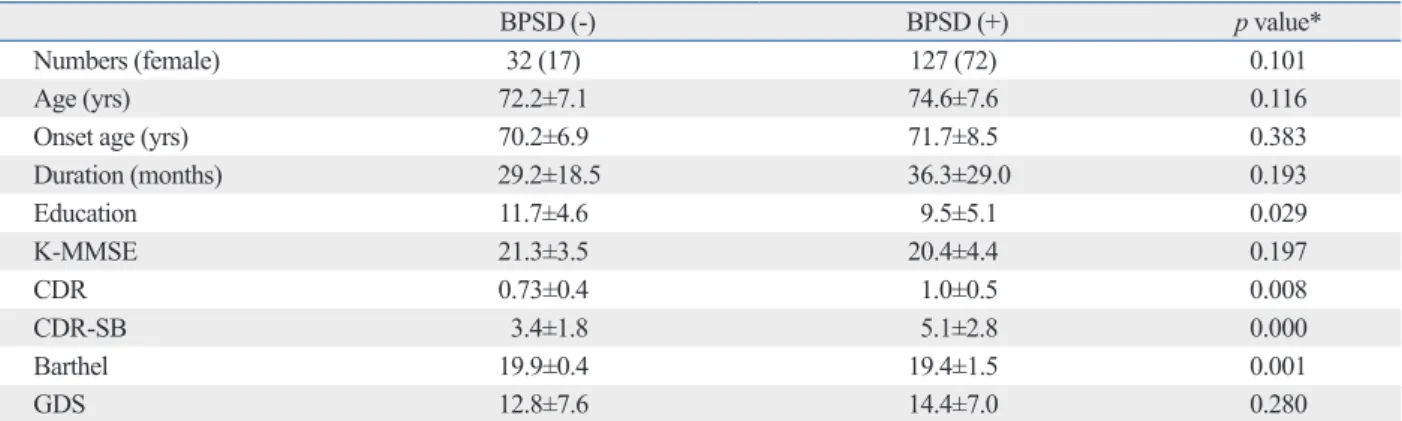
BPSD. The AD with BPSD showed significantly higher scores for CDR, and CDR-SB, and lower Barthel index than AD without BPSD. The education level of AD with BPSD was significantly lower than that of AD without BPSD (Ta- ble 1). Age, onset age, and duration were not significantly different between AD with BPSD and without BPSD.
Demographic factors influencing total missing values Using multiple regression analysis, we searched for the de- mographic factors that influenced the number of total miss- ing values in study groups. The K-MMSE score was only statistically related to the number of total missing values (Table 2).
Number of missing values in study subjects
Some patients were unable to perform certain neuropsycho- scores. The total K-NPI score was calculated by adding the
12 composite scores. The test-retest reliability and internal consistency of the K-NPI was assessed in a previous study.6
In order to assess global dementia severity, the Korean version of the Mini-Mental State Examination (K-MMSE),7 Clinical Dementia Rating Scale (CDR),8 and the Clinical Dementia Rating Scale-Sum of Boxes (CDR-SB) were used. A Barthel index9 for the activities of daily living evalu- ation, and a Geriatric Depression Scale (GDS)10 for depres- sion were also assessed.
Statistical analysis
First, the baseline characteristics of the AD patients with and without BPSD were assessed by using Student’s two-tailed t- tests and chi-square tests. Second, missing values in each neuropsychological test were assessed. Third, we computed Pearson’s correlation coefficients between the K-NPI sub-do- mains and the number of missing values in individual neuro- psychological tests for significance using the two tailed tests.
For all test scores, means were calculated. Next, while we replaced each missing value in AD without BPSD by series mean, in AD with BPSD, we replaced each missing value by the worst score found on that particular test. After this adjustment, we calculated means of the adjusted scores.
A significance level of 0.05 (two-tailed) was set for all analyses, which were performed by using the SPSS version 18.0 (SPSS Inc., Chicago, IL, USA) for Windows.
RESULTS
Characteristics of the patients
The study included 127 AD with BPSD and 32 AD without
Table 1. Demographic Data for Drug-Naïve AD Patients with BPSD (Mean±Standard Deviation)
BPSD (-) BPSD (+) p value*
Numbers (female) 32 (17) 127 (72) 0.101
Age (yrs) 72.2±7.1 74.6±7.6 0.116
Onset age (yrs) 70.2±6.9 71.7±8.5 0.383
Duration (months) 29.2±18.5 36.3±29.0 0.193
Education 11.7±4.6 9.5±5.1 0.029
K-MMSE 21.3±3.5 20.4±4.4 0.197
CDR 0.73±0.4 1.0±0.5 0.008
CDR-SB 3.4±1.8 5.1±2.8 0.000
Barthel 19.9±0.4 19.4±1.5 0.001
GDS 12.8±7.6 14.4±7.0 0.280
BPSD, behavioral and psychological symptoms in dementia; K-MMSE, Korean Mini-Mental State Examination; CDR, Clinical Dementia Rating Scale; CDR- SB, Clinical Dementia Rating Scale-Sum of Boxes; GDS, Geriatric Depression Scale; AD, Alzheimer’s disease.
*Independent t-test, chi-square test was done.
Table 2. List of Total Missing Value Related Demographic Variables with Corresponding Weights(B) and Probability Levels in Patients of Alzheimer’s Disease
B p value*
Age -0.253 0.649
Onset age 0.301 0.590
Duration 0.042 0.410
Sex 0.085 0.890
Education -0.029 0.667
K-MMSE -0.312 0.002
CDR -0.760 0.461
CDR-SB 0.110 0.560
Barthel -0.111 0.450
GDS 0.032 0.429
CDR, Clinical Dementia Rating Scale; CDR-SB, Clinical Dementia Rating Scale-Sum of Boxes; GDS, Geriatric Depression Scale.
The number of total missing values significantly related with K-MMSE (Korean Mini-Mental State Examination).
R=0.528, *Multiple regression analysis was done.
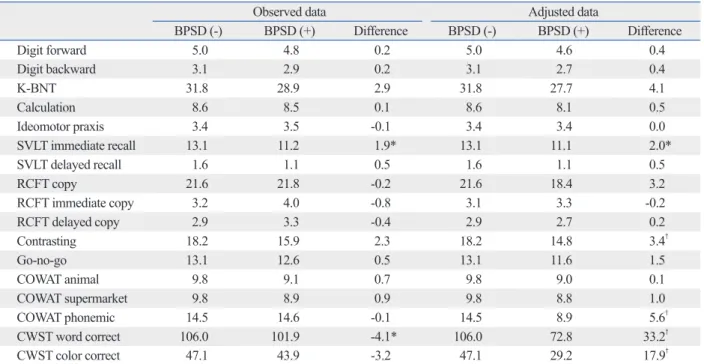
test between AD patients with and without BPSD in ob- served and adjusted data. In observed data, AD patients with BPSD showed significantly lower scores in SVLT immedi- ate recall and the CWST word test. After data adjustment, AD patients with BPSD showed additionally significantly lower scores in COWAT phonemic, contrasting program and the CWST color test. In the CWST word test, statistical significance was increased more.
DISCUSSION
This study aimed to assess the prevalence of missing val- ues, relation between BPSD and missing values of the neu- ropsychological test, and value of missing values analysis in AD patients with BPSD.
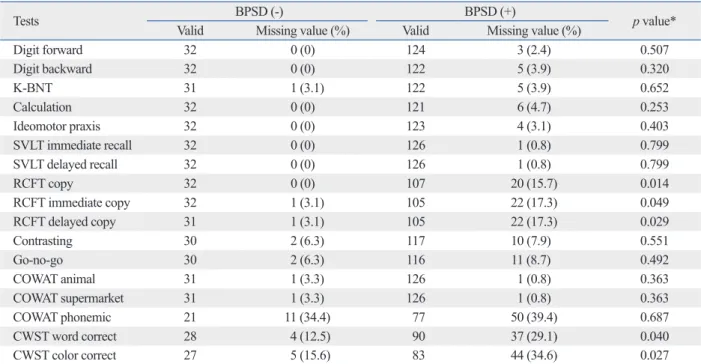
Most neuropsychological tests assessing various cognitive domains require some degree of attention and cooperation of patients. If examinees have behavior problems or have severe specific cognitive impairment, there is a high proba- bility of specific neuropsychological tests being left unfin- ished. For example, agitation, inability to correct, loss of in- sight into performance, perseverative behavior, stereotypy behavior, and stimulus boundedness were strongly related with missing data analysis in patients with frontotemporal logical tests and the number of missing values due to BPSD
is shown in Table 3. Except COWAT animal and supermar- ket, most missing values occurred more often in AD patients with BPSD than in AD patients without BPSD. Among neu- ropsychological tests, RCFT copy, RCFT immediate recall, RCFT delayed recall, CWST word and CWST color were more significantly unable to be completed by AD patients with BPSD (Table 3).
Correlation of K-NPI sub-domains with missing values numbers of neuropsychological tests, CDR, disease duration and age in AD with BPSD
Our patients were often unable to perform certain neuro- psychological tests. To clarify the relationship between K- NPI sub-domains and missing value numbers of specific neuropsychological tests, correlation among these parame- ters was tested, and the results are shown in Table 3. Delu- sions, depression, apathy, aberrant motor behavior, and total K-NPI scores were significantly correlated with the number of total missing values (Table 4).
Differences of neuropsychological tests between AD with BPSD and without BPSD in observed and adjusted data
Table 5 shows the differences of each neuropsychological
Table 3. Number of Valid Test, Missing Value due to Behavior Disturbances (in AD With BPSD) and Other Reasons (in AD Without BPSD)
Tests BPSD (-) BPSD (+)
p value*
Valid Missing value (%) Valid Missing value (%)
Digit forward 32 0 (0) 124 3 (2.4) 0.507
Digit backward 32 0 (0) 122 5 (3.9) 0.320
K-BNT 31 1 (3.1) 122 5 (3.9) 0.652
Calculation 32 0 (0) 121 6 (4.7) 0.253
Ideomotor praxis 32 0 (0) 123 4 (3.1) 0.403
SVLT immediate recall 32 0 (0) 126 1 (0.8) 0.799
SVLT delayed recall 32 0 (0) 126 1 (0.8) 0.799
RCFT copy 32 0 (0) 107 20 (15.7) 0.014
RCFT immediate copy 32 1 (3.1) 105 22 (17.3) 0.049
RCFT delayed copy 31 1 (3.1) 105 22 (17.3) 0.029
Contrasting 30 2 (6.3) 117 10 (7.9) 0.551
Go-no-go 30 2 (6.3) 116 11 (8.7) 0.492
COWAT animal 31 1 (3.3) 126 1 (0.8) 0.363
COWAT supermarket 31 1 (3.3) 126 1 (0.8) 0.363
COWAT phonemic 21 11 (34.4) 77 50 (39.4) 0.687
CWST word correct 28 4 (12.5) 90 37 (29.1) 0.040
CWST color correct 27 5 (15.6) 83 44 (34.6) 0.027
BPSD, behavioral and psychological symptoms in dementia; K-BNT, Korean version of the Boston Naming Test; RCFT, Rey-Osterrieth Complex Figure Test;
SVLT, Seoul Verbal Learning Test; COWAT, Controlled Oral Word Association Test; CWST, Color Word Stroop Test; AD, Alzheimer’s disease.
*Independent t-test test was done.
for the close relationship between delusions with missing data is not clear. One possible explanation is that delusion is closely related with agitation and aberrant motor behav- ior,12,13 and these physical symptoms apparently lead to problems in assessing these time-consuming tests. More- over, patients with delusions frequently have persecutory delusion,14,15 and as a results some patients with this delu- dementia.11
In contrast to this frontotemporal dementia study, our study showed that delusions, depression, apathy, and aber- rant motor behaviors were closely related with missing val- ues of test. Among them, delusions and aberrant motor be- haviors were more significantly correlated with missing values than other K-NPI sub-domains (Table 4). The reason
Table 4. Correlation of K-NPI Sub-Domains with Number of Missing Values, Clinical Dementia Rating Scales, Disease Dura- tion and Age
Number of total
missing values K-MMSE CDR Duration Age
Delusions 0.359† -0.379† 0.374† 0.087 0.128
Hallucinations 0.100 -0.097 0.181* 0.042 -0.040
Aggression 0.156 -0.373† 0.436† 0.086 0.032
Depression 0.201* -0.212* 0.181* 0.128 0.083
Anxiety 0.133 -0.144 0.148 0.023 -0.036
Euphoria 0.058 -0.008 0.015 -0.034 -0.027
Apathy 0.148* -0.271† 0.251† 0.226* -0.046
Disinhibition -0.027 0.014† 0.120 0.152 0.039
Irritability 0.043 -0.105† 0.254† 0.126 -0.081
Motor behavior 0.259† -0.402† 0.462† -0.093 -0.097
Nighttime behavior 0.125 0.553† 0.127 0.124 0.127
Eating change -0.005 0.487† 0.082 -0.084 -0.030
Total K-NPI score 0.195† -0.518 0.360† 0.108 -0.023
K-NPI, Korean Neuropsychiatric Inventory; K-MMSE, Korean Mini-Mental State Examination; CDR, Clinical Dementia Rating Scale.
*p-value <0.05.
†p-value <0.01.
Table 5. Observed and Adjusted Means Difference between AD Patients With BPSD and Without BPSD
Observed data Adjusted data
BPSD (-) BPSD (+) Difference BPSD (-) BPSD (+) Difference
Digit forward 5.0 4.8 0.2 5.0 4.6 0.4
Digit backward 3.1 2.9 0.2 3.1 2.7 0.4
K-BNT 31.8 28.9 2.9 31.8 27.7 4.1
Calculation 8.6 8.5 0.1 8.6 8.1 0.5
Ideomotor praxis 3.4 3.5 -0.1 3.4 3.4 0.0
SVLT immediate recall 13.1 11.2 1.9* 13.1 11.1 2.0*
SVLT delayed recall 1.6 1.1 0.5 1.6 1.1 0.5
RCFT copy 21.6 21.8 -0.2 21.6 18.4 3.2
RCFT immediate copy 3.2 4.0 -0.8 3.1 3.3 -0.2
RCFT delayed copy 2.9 3.3 -0.4 2.9 2.7 0.2
Contrasting 18.2 15.9 2.3 18.2 14.8 3.4†
Go-no-go 13.1 12.6 0.5 13.1 11.6 1.5
COWAT animal 9.8 9.1 0.7 9.8 9.0 0.1
COWAT supermarket 9.8 8.9 0.9 9.8 8.8 1.0
COWAT phonemic 14.5 14.6 -0.1 14.5 8.9 5.6†
CWST word correct 106.0 101.9 -4.1* 106.0 72.8 33.2†
CWST color correct 47.1 43.9 -3.2 47.1 29.2 17.9†
BPSD, behavioral and psychological symptoms in dementia; K-BNT, Korean version of the Boston Naming Test; RCFT, Rey-Osterrieth Complex Figure Test;
SVLT, Seoul Verbal Learning Test; COWAT, Controlled Oral Word Association Test; CWST, Color Word Stroop Test; AD, Alzheimer’s disease.
*p-value <0.05.
†p-value <0.01.
on the mini mental state examination were explored. This study concluded that non-response did not occur randomly, and scoring non-response as error was more likely to reflect the severity of dementia. In randomized controlled clinical trial study, they showed that drop out (i.e. missing values) does not occur randomly, therefore the data can influence the overall results.20 Due to these missing values, the neuro- psychological tests are biased toward the null effect. This might have obscured the characteristic cognitive deficit of the AD patients with BPSD.
Nevertheless, replacing all missing values irrespective of its cause is not valid and feasible for all patient groups and has to be done with caution. Missing values may be caused by other reasons, such as sensory impairments, aphasia, or external factors caused by the examiner. In these cases, the failure to complete a specific neuropsychological test does not necessarily indicate a specific cognitive deficit, but is more likely to reflect other non-cognitive factors.
In the present study, BPSD was found to be significantly correlated with missing values, therefore, we replaced only the missing values in AD patients with BPSD by the lowest observed scores. Missing values due to other reasons were excluded from this study. In our present study, therefore, re- placing missing values due to BPSD by the lowest scores is justified.
However, this study had several limitations. First, sample size was relatively small compared to the number of factors.
Second, this study included mostly milder dementia pa- tients. Since the BPSD was more prevalent in moderate to severe stage of dementia than mild stage of dementia,21 these methods were expected to be more applicable to mod- erate to severe stage of dementia groups. Third, even though we excluded the missing values due to other problems caused by examiner and other researcher, the possibility of false positive and negative cases could not completely be ruled out. Fourth, though K-MMSE score, which is only statistically influencing factor for the total missing data number, was not different between AD patients with and without BPSD, the patients with BPSD showed more signif- icant global cognitive dysfunctions. Therefore, there was possibility that these between-group differences might have originated from these severity differences. Finally, our study was a hospital-based study, therefore it may not rep- resent a real community.
In conclusion, our results showed that missing values in the context of BPSD did not occur at random and provided useful information. Using data imputation, a more differen- sion may resist diagnostic evaluations.
The BPSD showed the largest effect on tests measuring the frontal functions (contrasting programs, CWST word, CWST color and COWAT phonemic). Missing values in these tests (sensitive markers for impairment of frontal func- tion) may blur the differences of cognitive sub-domain func- tions in AD with BPSD. In contrast, however, tests such as the SVLT immediate and delay recall (sensitive markers for temporal function) showed nearly no differences in missing values between AD with BPSD and without BPSD.
The missing values were differently replaced in each group.
According to missing value analysis, missing values in AD without BPSD were replaced by the mean scores. Howev- er, because the missing values of AD with BPSD were cor- related with K-NPI scores, these were replaced by the low- est observed values in AD with BPSD. The effect of the data imputation was largest for tests measuring frontal function.
As a consequence, the difference between test results of frontal function becomes clear, and more differentiated pat- tern of cognitive deficits is found in AD with BPSD.
In our study, the total missing data number was signifi- cantly related with K-MMSE scores, while global cognitive scale (CDR) was not (Table 2). These discrepancies may result from study population characteristics. Most of our study subjects were in the mild stage dementia. Therefore, CDR staging, which is only five grade scale, may not re- flect the differences.
The relationship of neurocognitive functions in AD pa- tients with BPSD versus those without BPSD has been the subject of considerable debate. While some studies have noted difficulties in differentiating AD with and without BPSD on neuropsychological variables and have questioned the specificity of deficient sub-cognitive domains in AD pa- tients with BPSD compared with AD patients without BPSD,16 other studies have shown a relationship with more cognitive impairment and frontal lobe dysfunctions.17,18
Considering the fact that considerable portion of certain neuropsychological tests were left unfinished in our study, there is a possibility that missing values may have influ- enced our overall results, even though our study subjects were mainly mildly demented patients. Perhaps, the miss- ing values analysis might provide a clue for this finding. In this study, most patients without BPSD showed no difficul- ties in completing the neuropsychological test, therefore most neuropsychological tests were assessable, thus provid- ing the investigator with more complete data set.
In a previous study,19 the missing values (or non-response)
140:566-72.
9. Mahoney FI, Barthel DW. Functional evaluation: the barthel in- dex. Md State Med J 1965;14:61-5.
10. Jung IK, Kwak DI, Shin DK, Lee MS, Lee HS, Kim JY. A reli- ability and validity study of geriatric depression scale. J Korean Neuropsychiatr Assoc 1997;36:103-12.
11. Smeding HM, de Koning I. Frontotemporal dementia and neuro- psychology: the value of missing values. J Neurol Neurosurg Psy- chiatry 2000;68:726-30.
12. Aarsland D, Cummings JL, Yenner G, Miller B. Relationship of aggressive behavior to other neuropsychiatric symptoms in pa- tients with Alzheimer’s disease. Am J Psychiatry 1996;153:243-7.
13. Frisoni GB, Rozzini L, Gozzetti A, Binetti G, Zanetti O, Bianchet- ti A, et al. Behavioral syndromes in Alzheimer’s disease: descrip- tion and correlates. Dement Geriatr Cogn Disord 1999;10:130-8.
14. Ikeda M, Shigenobu K, Fukuhara R, Hokoishi K, Nebu A, Maki N, et al. Delusions of Japanese patients with Alzheimer’s disease.
Int J Geriatr Psychiatry 2003;18:527-32.
15. Kwak YT, Yang Y, Kwak SG, Koo MS. Delusions of Korean pa- tients with Alzheimer’s disease: study of drug-naïve patients.
Geriatr Gerontol Int 2013;13:307-13.
16. Spalletta G, Baldinetti F, Buccione I, Fadda L, Perri R, Scalmana S, et al. Cognition and behaviour are independent and heterogeneous dimensions in Alzheimer’s disease. J Neurol 2004;251:688-95.
17. Jeste DV, Wragg RE, Salmon DP, Harris MJ, Thal LJ. Cognitive deficits of patients with Alzheimer’s disease with and without de- lusions. Am J Psychiatry 1992;149:184-9.
18. Paulsen JS, Ready RE, Stout JC, Salmon DP, Thal LJ, Grant I, et al. Neurobehaviors and psychotic symptoms in Alzheimer’s dis- ease. J Int Neuropsychol Soc 2000;6:815-20.
19. Fillenbaum GG, George LK, Blazer DG. Scoring nonresponse on the Mini-Mental State Examination. Psychol Med 1988;18:1021-5.
20. Di Bari M, Pahor M, Franse LV, Shorr RI, Wan JY, Ferrucci L, et al. Dementia and disability outcomes in large hypertension trials:
lessons learned from the systolic hypertension in the elderly pro- gram (SHEP) trial. Am J Epidemiol 2001;153:72-8.
21. Spalletta G, Musicco M, Padovani A, Rozzini L, Perri R, Fadda L, et al. Neuropsychiatric symptoms and syndromes in a large cohort of newly diagnosed, untreated patients with Alzheimer disease.
Am J Geriatr Psychiatry 2010;18:1026-35.
tiated picture of cognitive deficits in AD with BPSD is sug- gested without the need to exclude those patients who dis- played behavioral disturbances. Consequently, more realistic and reliable statistical analysis should be carried out and further research on the clinical picture of AD with BPSD and its relation to other BPSD would provide the answer.
REFERENCES
1. Aalten P, de Vugt ME, Lousberg R, Korten E, Jaspers N, Senden B, et al. Behavioral problems in dementia: a factor analysis of the neuropsychiatric inventory. Dement Geriatr Cogn Disord 2003;15:
99-105.
2. Steinberg M, Tschanz JT, Corcoran C, Steffens DC, Norton MC, Lyketsos CG, et al. The persistence of neuropsychiatric symptoms in dementia: the Cache County Study. Int J Geriatr Psychiatry 2004;19:19-26.
3. Matsui T, Nakaaki S, Murata Y, Sato J, Shinagawa Y, Tatsumi H, et al. Determinants of the quality of life in Alzheimer’s disease pa- tients as assessed by the Japanese version of the Quality of Life- Alzheimer’s disease scale. Dement Geriatr Cogn Disord 2006;21:
182-91.
4. McKhann G, Drachman D, Folstein M, Katzman R, Price D, Stadlan EM. Clinical diagnosis of Alzheimer’s disease: report of the NINCDS-ADRDA Work Group under the auspices of Depart- ment of Health and Human Services Task Force on Alzheimer’s Disease. Neurology 1984;34:939-44.
5. Kang Y, Na DL. Seoul neuropsychological screening battery.
Incheon: Human Brain Research & Consulting Co; 2003.
6. Choi SH, Na DL, Kwon HM, Yoon SJ, Jeong JH, Ha CK. The Korean version of the neuropsychiatric inventory: a scoring tool for neuropsychiatric disturbance in dementia patients. J Korean Med Sci 2000;15:609-15.
7. Kang Y, Na DL, Hahn S. A validity study on the Korean Mini- Mental State Examination (K-MMSE) in dementia patients. J Ko- rean Neurol Assoc 1997;15:300-8.
8. Hughes CP, Berg L, Danziger WL, Coben LA, Martin RL. A new clinical scale for the staging of dementia. Br J Psychiatry 1982;