273
목 적: 대퇴 삽입물의 정렬을 향상시켜 시멘트 mantle의 두께를 확보하기 위하여 centralizer가 이용되고 있으나, 시멘트 mantle이 부적절하게 형성되는 경우들이 있다. 저자들은 인공 고관절 전치환술에서 시멘트 mantle 두께에 영향을 주는 요소들을 알아보고자 본 연구를 시행하였다
대상 및 방법: 3세대 시멘트 기법을 사용하여 인공 고관절 전치환술을 시행받은 환자 80명을 대상으로 하였으며, 4가지 다 른 형태의 대퇴인공 삽입물(각 형태당 20명씩)을 사용하였다: Centralign (Zimmer, Warsaw, IN), Precision (Howmedica, Rutherford, NJ), Omnifit (Osteonics, Allendale, NJ), Elite Plus (Depuy, Warsaw, IN). 대퇴 삽입물의 크기, 첨부의 직경, centralizer의 형태 및 크기, 방사선 사진에서의 시멘트 mantle의 상태를 분석하였다.
결 과: Barrack 분류에 따라 환자들을 C1 이상(≥C1; A, B 및 C1, 69예)과 C2 (11예)의 두 군으로 나누었을 때, 두 군 간에 나이, 성별, 원인 질환, 사용한 스템의 크기, Dorr ratio, plug까지 시멘트의 길이는 차이가 없었다. 환자들 중 18예에서는 원위부 centralizer의 직경과 스템 첨부 직경의 차이가 2 mm 미만이었고, 62예에서는 2 mm 이상이었다. 직경 차이가 2 mm 이상인 환자들에 비해 2 mm 미만인 환자들에서 C2가 더 흔하게 관찰되었다 (22.2% vs. 11.3%). 그러나 직경 차이가 2 mm 이상인 경우에서도 centralizer의 모양에 상관없이 모든 종류의 centralizer에서 C2가 발생하였다.
결 론: 적절한 두께의 cement mantle을 형성하기 위해서는 원위부 centralizer의 직경을 스템 첨부의 직경보다 최소한 2 mm 이상 큰 크기로 선택하여야 한다. 또한, 본 연구에서 비교된 centralizer들은 사용에 주의를 기울여야 하며, 성공적인 cement mantle 형성을 위해서는 개선된 형태의 centralizer가 요구된다.
색인 단어: 고관절 전치환술, 시멘트 층 두께, 중립화기구
Purpose: This study was performed to find out the influencing factors on cement mantle thickness in cemented total hip arthroplasty.
Materials and Methods: Eighty patients were randomly enrolled who received total hip arthroplasty with the third generation cementing technique. Four types of femoral prosthesis (20 patients in each type) were used: Centralign (Zimmer, Warsaw, IN), Precision (Howmedica, Rutherford, NJ), Omnifit (Osteonics, Allendale, NJ), and Elite Plus (Depuy, Warsaw, IN). Size of femoral prosthesis, diameter of stem tip, shape and size of centralizer, and the condition of cement mantle on the radiograph were analyzed.
Results: Between the two groups of same or above C1 (≥C1; A, B, and C1, n=69) and C2 (n=11) by Bar- rack classification, there was no difference in age, sex, underlying disease, size of applied stem, Dorr ratio, and the distance between stem tip and plug. The difference of distal diameter between centralizer and stem was less than 2 mm in 18 patients, and same or above 2 mm in 62 patients. C2 was more fre- quently observed in patients with the diameter difference <2 mm than in patients with the diameter dif- ference ≥2 mm (22.2% vs. 11.3%). However, C2 developed in all types of femoral stems, irrespective of
Department of Orthopaedic Surgery, Hallym University College of Medicine, Seoul, Korea
Jun-Dong Chang, M.D., Sang-Soo Lee, M.D., Je-Hyun Yoo, M.D., Dong-Hyun Suh, M.D., Chang-Young Kim, M.D., and Byoung-Hyuk Jun, M.D.
Roles of Distal Centralizer in Cemented Total Hip Arthroplasty
273
시멘트형 인공 고관절 전치환술에서의 원위 중립화 기구의 역할
장준동ㆍ이상수ㆍ유제현ㆍ서동현ㆍ김창영ㆍ전병혁
한림대학교 의과대학 정형외과학교실
273 273 통신저자 : 유 제 현
서울시 영등포구 영등포동 94-200 한림의대 한강성심병원 정형외과학교실 TEL: 02-2639-5300∙FAX: 02-2631-9337 E-mail: [email protected]
Address reprint requests to Je-Hyun Yoo, M.D.
Department of Orthopaedic Surgery, Hangang Sacred Heart Hospital, Hallym University, College of Medicine, 94-200 Youngdungpo-dong, Youngdungpo-gu, Seoul 150-719, Korea
Tel: +82.2-2639-5300, Fax: +82.2-2631-9337 E-mail: [email protected]
Since the first report of clinical experience on cemented total hip arthroplasty by Charnley5), use of bone cement for the femoral stem fixation has been fully extended. Never- theless, aseptic loosening became an important issue as the most common cause of long term failure of cemented total hip arthroplasty. To overcome this problem, cementing tech- nique has been improved to decrease stress to the cement, and to increase material strength toward the goal for improv- ing fatigue strength.
One of the most important factors in the cement techniques is to achieve a cement mantle of optimal thickness proxi- mally and distally without implant-bone impingement. For this, an exact fixation of the stem in the femoral canal is required. At present, the cementing technique advanced to the third generation, which include the attaching method of centralizer to the distal and proximal portion of the stem.
In spite of the use of centralizers, however, suboptimal and thin distal cement mantle formation and malposition of the prosthesis are occasionally found. This study was performed to investigate the influencing factors of distal centralizer on the thickness of cement mantle in cemented total hip arthroplasty.
MATERIALS AND METHODS
Eighty patients who received total hip replacement arthro- plasty with third generation cementing technique in a sin- gle institution were enrolled in this study. They consisted of 42 males and 38 females, and their age ranged from 37 years to 91 years. The follow-up period was from 1.2 years to 6.8 years (mean, 4.7 years). The final diagnoses of patients were: osteonecrosis of femoral head (n=27), osteoarthritis (n=14), femoral neck fracture (n=33), intertrochanteric frac- ture (n=3), and developmental dysplasia of hip (n=2).
They were evenly distributed to four groups (20 patients in each) according to the four different types of femoral stems:
Centralign (Zimmer, Warsaw, IN), Precision (Howmedica, Rutherford, NJ), Omnifit (Osteonics, Allendale, NJ), and Elite Plus (Depuy, Warsaw, IN) (Table 1). The feature and shape of centralizers used in this study were triangular shaped streamline centralizer for Elite plus, tetra-fine shaped poly- methylmethacrylate (PMMA) centralizer for Precision and Omnifit, and aerodynamically-shaped centralizer at proxi- mal and distal positions for Centralign.
Size of femoral stem, height, tip diameter, shape and size of centralizer, and Dorr ratio were measured. After two weeks of operation, cement mantle status was evaluated on the radiograph by Barrack’s classification. Varus and valgus angles of femoral stem, thickness of cement mantle at each Gruen zone, width of femoral canal at stem tip were also measured (Fig. 1).
Dorr ratio was a ratio of the canal diameter at the level of lesser trochanter to that at a point 10 cm distal. The status of cement mantles was graded as A, B, C1, C2, and D accord- ing to the following criteria described by Barrack: grade A, if the cementing technique resulted in a complete filling of the medullary canal around stem, so that a distinction bet- ween cortical bone and cement was not evident; grade B, if the distribution of cement was nearly complete, but it was possible to distinguish cortical bone from cement in some areas; grade C1, if an extensive radiolucent line (along more
274 장준동ㆍ이상수ㆍ유제현 외3인
their shapes, even the diameter difference was ≥2 mm.
Conclusion: The diameter of distal centralizing device should be at least 2 mm larger than that of stem tip for an optimal cement mantle thickness. In addition, centralizers investigated in this study should be care- fully used, and more improved shape of centralizer is required for the successful cement mantle formation.
Key Words: Total hip arthroplasty, Cement mantle thickness, Centralizer
Total (n=80) Centralign
(n=20) Elite Plus
(n=20) Precision
(n=20) Omnifit
(n=20)
Sex (M:F) 11:9 9:11 10:10 12:8 42:38
Site (L:R:B) 8:8:2 11:7:1 13:7:0 13:7:0 45:29:3 Age (years) 37-91 49-84 48-91 39-86 37-91
(64.0) (66.0) (69.0) (58.0) (64.0) Weight (kg) 32-85 32-70 42-80 39-85 32-85 (56.0) (55.5) (57.8) (61.0) (55.7) All values of age and weight presented as the range and the mean.
n, number of cases; M, male; F, female; L, left; R, right; B, both.
Table 1.Distribution of the cases according to the types of femoral stem
than 50% of the cement-bone interface) or voids in the cement was present; grade C2, if either a thin (<1 mm) mantle of cement at any site or a defect in the mantle of cement, with the metal in direct contact with cortical bone, was present;
grade D, if gross deficiencies in the mantle of cement, such as no cement distal to the tip of stem, major defects in the mantle of cement, or multiple large voids were seen.
Achievement of a proximal cement mantle is likely affect- ed by implant design and proximal femoral anteversion.
Therefore, in the present study, the thickness of distal cement mantle at Gruen zone 3 and 5 was evaluated from antero- posterior and lateral views of femur. A thin cement mantle was defined as <0.9 mm on the radiographs. Because the radiographs used in some previous reports were enlarged 1.1-fold, the corrected values <0.9 mm obtained from the
radiographs were defined as thin cement mantle with respect to the actual measurements.
For the statistical analysis, statistical analysis system (SAS) software (version 6.12, SAS Institute Inc., Cary, NC) was used. Student’s t-test was used for the differences of means, and chi-square test was used for the evaluation of differences between dichotomous variables. P<0.05 was considered to be statistically significant.
RESULTS
The thickness of cement mantle in Omnifit, Precision, Elite plus, and Centralign were: 2.14±0.20 mm, 3.00± 0.99 mm, 2.97±1.07 mm, and 3.36±1.11 mm for antero- posterior view, and 2.33±0.34 mm, 3.13±0.51 mm, 4.03
±1.04 mm, 3.53±0.41 mm, for lateral view, respectively.
The average width of the medullary canal was 16.7±2.73 mm on anteroposterior view, and 19.7±3.38 mm on later- al view, indicating that the canal shape was oval (p<0.05).
According to the Barrack’s classification, 69 patients were
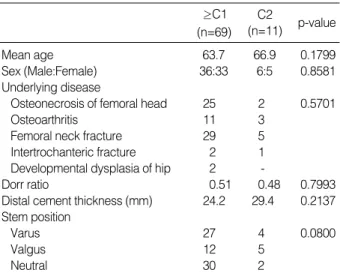
≥C1 (A, B, or C1), and 11 patients C2. The incidence of C2 in each femoral stem was 25% in Omnifit, and 10% in the other three types (Precision, Elite Plus, and Centralign) (Fig. 2). Between the two tetra-pin shaped stems, the inci- dence of C2 was significantly higher in Omnifit than in Precision (25% vs. 10%). There was no statistical difference between the two groups of ≥C1 and C2 in age, sex, under- lying disease, size of stem, Dorr ratio, stem position, and the length of distal cement mantle between stem tip and
Fig. 1.Relationship between size of the distal centralizer and size of the femoral stem tip: (C-A)/2. (A) size of the femoral stem tip, (B) size of the femoral medullary canal, (C) size of the distal central- izer.
A B
C
Fig. 2.Thin cement mantles were observed in the hips on the antero- posterior radiograph. Four differ- ent types of femoral stems were compared: (A) Omnifit (Osteon- ics, Allendale, NJ), (B) Precision (Howmedica, Rutherford, NJ), (C) Elite Plus (Depuy, Warsaw, IN), and (D) Centralign (Zimmer, War- saw, IN).
A B C D
276 장준동ㆍ이상수ㆍ유제현 외3인
plug (Table 2).
The difference of distal diameter between centralizer and stem was less than 2 mm (<2 mm) in 18 patients, and same or above 2 mm (≥2 mm) in 62 patients (Table 3). C2 was more frequently observed in patients with the diameter dif- ference <2 mm than in patients with the diameter difference
≥2 mm (22.2% vs. 11.3%). When the diameter difference was <2 mm, C2 was observed only in tetra-pin shaped stems, three cases in Omnifit and one case in Precision. However, C2 developed in all types of femoral stems, irrespective of their shapes, when the diameter difference was ≥2 mm.
During the mean follow-up period of 4.7 years, the loosen- ing of femoral stem was observed in two cases.
DISCUSSION
The loosening of femoral component and the resorption of femoral bone are known to be the most important issues in the prognosis of cemented total hip arthroplasty, and their occurrence requires a revisional surgery. The status and thick- ness of cement mantle and intramedullary positioning of femoral component would be the most important factors, which affect the loosening of femoral stem. After Barrack et al.2)and Ebramzadah et al.6)reported the association between cement mantle thickness and loosening, Barrack and Mul- roy2)classified the level of cement mantle formation as A, B, C1, C2, and D. They reported the poor result of cement-
ed total hip arthroplasty for C2 and D. Accordingly, com- plete cement mantle formation with a reasonable thickness not to produce defective portion is strictly required for the successful cemented total hip arthroplasty2).
Although there was a large progression in the clinical re- sults of cemented total hip arthroplasty thanks to the advanc- ed cementing technique, many failure cases have been also reported. The reasons for earlier failure of cemented femoral stem are poor cementing technique, application of smaller broach, increased stem offset, reduction of stem length, rough surface treatment, and round-sectioned stem1). In the long term follow-up result of cemented femoral stem, cement mantle thickness has been known as the most important influencing factor. Particularly, the thin cement mantle at distal portion is regarded to have some substantial connec- tion to the failure rate of total hip arthroplasty8).
It is difficult to recommend the best thickness of cement mantle, but it should be at least more than 2 mm at distal and 3-6 mm at proximal portions12). The increased strain in the cement mantle at stem tip would be a possible initi- ation point of the crack, which is very dangerous especially in case of less than 2 mm of mantle thickness. Ramairaka et al.13)has recently reported that micromotion of femoral stem is minimal, when mantle thickness is in 3-4 mm, and increased again at the thickness more than 3-4 mm. Thick-
p-value C2
(n=11)
≥C1 (n=69)
Mean age 63.7 66.9 0.1799
Sex (Male:Female) 36:33 6:5 0.8581
Underlying disease
Osteonecrosis of femoral head 25 2 0.5701
Osteoarthritis 11 3
Femoral neck fracture 29 5
Intertrochanteric fracture 2 1 Developmental dysplasia of hip 2 -
Dorr ratio 0.51 0.48 0.7993
Distal cement thickness (mm) 24.2 29.4 0.2137 Stem position
Varus 27 4 0.0800
Valgus 12 5
Neutral 30 2
Table 2.Comparison of clinical and radiologic data between
≥C1 and C2
≥C1 C2
Diameter difference <2 mm (n=18) 14 (77.8%) 4 (22.2%)*
Omnifit (n=12, %) 9 (75.0%) 3 (25.0%) Precision (n=4, %) 3 (75.0%) 1 (25.0%) Elite Plus (n=2, %) 2 (100.0%) 0 (
Centralign (n=0, %) 0 ( 0 (
Diameter difference ≥2 mm (n=62) 55 (88.7%) 7 (11.3%) Omnifit (n=8, %) 6 (75.0%) 2 (25.0%) Precision (n=16, %) 15 (93.8%) 1 (6.2%) Elite Plus (n=18, %) 16 (88.9%) 2 (11.1%) Centralign (n=20, %) 18 (90.0%) 2 (10.0%)
*The incidence of C2 was significantly higher in patients with the diameter difference was <2 mm, compared with the patients with the diameter difference ≥2 mm (22.2% vs. 11.3%). Statistical anal- ysis with chi-square test revealed significance of the relationship between the diameter difference and the incidence of C2 ( <0.005,
2=24.949).
Table 3.Distribution of ≥C1 and C2 with relation to the dia- meter difference between centralizer and stem tip and the types of femoral stem
ness of 3-4 mm may be suitable, especially in proximal medi- al portion, in which stress delivery is very important.
Attention should be paid for the interpretation of some cases, in whom cement mantle on the plain radiograph may be measured thicker than the actual size14). Historically, varus positioning of the femoral component has been implicated to be contributory to mechanical loosening due to increased bending moment and decreased axial loading on the stem11). This axiom has been supported by cemented and cement- less femoral stem with an exception of a tapered femoral
stem8,10). Therefore, neutral or valgus positioning of the stem
is recommended. However, higher failure rates even at exces- sive valgus positioning have been also reported, which need the most caution during the fixation of femoral stem3).
Application of centralizer in total hip replacement arthro- plasty achieved an improvement in the implantation posi- tion of femoral stem7), and plays an important role in cement mantle formation4,8). The feature and shape of centralizers used in this study were triangular shaped streamline cen- tralizer for Elite plus, tetra-fine shaped PMMA centralizer for Precision and Omnifit, and aerodynamically-shaped cen- tralizer at proximal and distal positions for Centralign.
Kawate et al.9)analyzed the cases that showed improper cement mantle thickness using triangular shaped centraliz- er in total hip replacement arthroplasty. They reported that as stem tip was apt to incline to one side of the oval medullary space despite using centralizer, thin cement mantle could be formed. They were also interested in the meaning of thick- ness at the wings of centralizer at distal position, but could not reach a conclusion.
In this study, there were four cases (22.2%) of C2 out of 18 cases that had the diameter difference <2 mm between centralizer on distal position and stem tip, while there were seven cases (11.3%) of C2 out of 62 cases that had the diam- eter difference ≥2 mm. This result shows that the diame- ter difference between centralizer and stem tip is very impor- tant in getting a proper thickness of cement mantle. With regard to the sectional shapes of centralizer, the incidence of C2 was significantly higher in Omnifit than in Precision between the two tetra-pin shaped stems (25% vs. 10%).
Considering the shape of femoral medullary canal, which is not circular but oval, some types of centralizers, particular- ly tetra-pin shaped or triangular stems, should be carefully used. When the diameter difference between centralizer on distal position and stem tip was <2 mm, C2 was observed only in tetra-pin shaped stems, three cases in Omnifit and one case in Precision. However, it is noteworthy that C2 developed in all types of femoral stems, irrespective of their shapes, when the diameter difference was ≥2 mm. This finding reflects that careful use of centralizer with an ade- quate orientation for mounting it to stem tip is a prerequisite for proper cement mantle thickness, at least for the four types of centralizers compared in this study. This also imply that more improved shape of centralizer is required for the suc- cessful cement mantle formation.
We have investigated the influencing factors of distal centralizer on the thickness of cement mantle in cemented total hip arthroplasty in this study. However, the cement mantle thickness is likely to be influenced by various fac- tors such as size and design of centralizer as well as length and design of femoral stem. Therefore various confounding variables may be present in this study about the cases with various design of femoral stem and centralizer. Thus, to clari- fy the influencing factors of distal centralizer on the thick- ness of cement mantle in cemented total hip arthroplasty, the authors suggest that more profound studies with uni- fying designed femoral stem and centralizer are necessary.
CONCLUSION
The size and shape of centralizer seems to be important factors that affect cement mantle thickness. The diameter of distal centralizing device should be at least 2 mm larger than that of stem tip for the proper cement mantle thick- ness. Four types of centralizers compared in this study should be carefully used, and the shape of them should be improved for the successful cement mantle formation.
REFERENCES
1. Barrack RL: Early failure of modern cemented stems. J Arthro- plasty, 15: 1036-1050, 2000.
2. Barrack RL, Mulroy RD Jr and Harris WH: Improved cement- ing techniques and femoral component loosening in young patients with hip arthroplasty: A 12-year radiographic review. J Bone Joint Surg, 74-B: 385-389, 1992.
3. Beckenbaugh RD and Ilstrup DM: Total hip arthroplasty. J Bone Joint Surg, 60-A: 306-313, 1978.
4. Berger RA, Seel MJ, Wood K, et al: Effect of a centralizing device on cement mantle deficiencies and initial prosthetic align- ment in total hip arthroplasty. J Arthroplasty, 12: 434-443, 1997.
5. Charnley J: Arthroplasty of the hip. A new operation. Lancet, 1:
1129-1132, 1961.
6. Ebramzadeh E, Sarmiento A, Mckellop HA, Llinas A and Gogan W:The cement mantle in total hip arthroplasty. Analysis of long-term radiographic results. J Bone Joint Surg, 76-A: 77-87, 1994.
7. Egund N, Lidgren L and Onnerfalt R: Improved positioning of the femoral stem with a centralizing device. Acta Orthop Scand, 61: 236-239, 1990.
8. Hanson PB and Walker RH: Total hip arthroplasty cemented femoral component distal stem centralizer. J Arthroplasty, 10: 683-
688, 1995.
9. Kawate K, Ohmura T, Nakajima H and Takakura Y: Distal cement mantle thickness with a triangular distal centralizer insert- ed into stem tip in cemented total hip arthroplasty. J Arthroplasty, 16: 998-1003, 2001.
10. Khalily C and Lester DK: Results of a tapered cementless femoral stem implanted in varus. J Arthroplasty, 17: 463-466, 2002.
11. McBeath AA, Schopler SA and Narechania RG: Circumfer- ential and axial strain in the proximal femur: effect of prosthesis type and position. Clin Orthop, 150: 301-305, 1980.
12. Noble PC, Collier MB, Maltry JA, Kamaric E and Tullos HS:Pressurization and centralization enhance the quality and reproducibility of cement mantles. Clin Orthop, 355: 77-89, 1998.
13. Ramaniraka NA, Rakotomanana LR and Leyvraz PF: The fixation of the cemented femoral component. Effects of stem stiff- ness, cement thickness and roughness of the cement-bone surface. J Bone Joint Surg, 82-B: 297-303, 2000.
14. Valdivia GG, Dunbar MJ, Parker DA, et al: The John Charn- ley Award: Three-dimensional analysis of the cement mantle in total hip arthroplasty. Clin Orthop, 393: 38-51, 2001.
278 장준동ㆍ이상수ㆍ유제현 외3인