• 검색 결과가 없습니다.

Predictors of Mortality after Surgery for Empyema Thoracis in Chronic Kidney Disease Patients

N/A
N/A
Protected

Academic year: 2021

Share "Predictors of Mortality after Surgery for Empyema Thoracis in Chronic Kidney Disease Patients"

Copied!
8
0
0

로드 중.... (전체 텍스트 보기)

전체 글

(1)

KJTCVS

The Korean Journal of Thoracic and Cardiovascular Surgery

Clinical Research Predictors of Mortality after Surgery for Empyema Thoracis in Chronic Kidney Disease Patients

Mohan Venkatesh Pulle, D.N.B. 1 , Harsh Vardhan Puri, D.N.B. 1 , Belal Bin Asaf, M.S. 1 , Sukhram Bishnoi, D.N.B. 1 , Manish Malik, D.N.B. 2 , Arvind Kumar, M.S., F.A.C.S. 1

1
Centre for Chest Surgery and

2

Department of Nephrology, Sir Ganga Ram Hospital, New Delhi, India

ARTICLE INFO

Received August 24, 2020 Revised September 28, 2020 Accepted October 13, 2020 Corresponding author Arvind Kumar

Tel 91-9810765405 Fax 91-1142252328

E-mail [email protected] ORCID

https://orcid.org/0000-0001-6143-7984

Background: Surgical treatment of empyema thoracis in patients with chronic kidney disease is challenging, and few studies in the literature have evaluated this issue. In this study, we aim to report the surgical outcomes of empyema and to analyze factors predict- ing perioperative mortality in patients with chronic kidney disease.

Methods: This retrospective study included data from 34 patients with chronic kidney disease (estimated glomerular filtration rate <60 mL/min/1.73 m

2

for 3 or more months) who underwent surgery for empyema between 2012 and 2020. An analysis of demo- graphic characteristics and perioperative variables, including complications, was carried out. Postoperative mortality was the primary outcome measure.

Results: Patients’ age ranged from 20 to 74 years with a 29-to-5 male-female ratio. The majority (n=19, 55.9%) of patients were in end-stage renal disease (ESRD) requiring main- tenance hemodialysis. The mean operative time was 304 minutes and the mean intraop- erative blood loss was 562 mL. Postoperative morbidity was observed in 70.5% of patients (n=24). In the subgroup analysis, higher values for operative time, blood loss, intensive care unit stay, and complications were found in ESRD patients. The mortality rate was 38.2% (n=13). In the univariate and multivariate analyses, poor performance status (East- ern Cooperative Oncology Group >2) (p=0.03), ESRD (p=0.02), and late referral (>8 weeks) (p<0.001) significantly affected mortality.

Conclusion: ESRD, late referral, and poor functional status were poor prognostic factors predicting postoperative mortality. The decision of surgery should be cautiously assessed given the very high risk of perioperative morbidity and mortality in these patients.

Keywords: Chronic kidney failure, Empyema thoracis, Surgery, Mortality, Patient out- come assessment

Copyright © The Korean Society for Thoracic and Cardiovascular Surgery. 2020. All right reserved.

This is an Open Access article distributed under the terms of the Creative Commons Attribution Non-Commercial License (http://creativecommons.org/licenses/

Introduction

Chronic kidney disease (CKD) is defined as the presence of kidney damage or decreased kidney function for 3 or more months, irrespective of the cause [1]. Patients with CKD are more susceptible to the development of pleural effusion [2,3]. Causes of pleural effusion include bacterial infections, tuberculosis, volume overload, uremic pleuritis, and malignancy. Inappropriately treated pleural effusion, if infected, develops into empyema. The underlying mecha- nisms for a higher risk of infection include multiple at- tempts at aspiration, altered immunity, poor nutritional status, multiple other comorbid conditions, and suscepti-

bility to nosocomial and dialysis catheter-related infections [4]. In this group of patients, empyema poses a significant risk of morbidity and mortality [5].

Surgery is the treatment of choice for chronic empyema.

However, surgical intervention in this group of patients is a therapeutic challenge for several reasons. Patients with CKD are more susceptible to various metabolic and hemo- dynamic changes in the perioperative period such as elec- trolyte disturbances (hyperkalemia), unexpected hemody- namic alterations, and propensity for postoperative bleeding [6,7]. Studies reporting surgical experiences for empyema in patients with CKD are sparse in the literature.

Herein, we present the outcomes of surgery for empyema

https://doi.org/10.5090/kjtcs.20.111 pISSN: 2233-601X eISSN: 2093-6516

Korean J Thorac Cardiovasc Surg. 2020;53(6):392-399

(2)

Mohan Venkatesh Pulle, et al. Predictors of Mortality in CKD Empyema KJTCVS

in CKD patients and analyze various factors influencing mortality.

Methods

Study design and patients

This is a retrospective analysis of prospectively main- tained data from 34 CKD patients who underwent decorti- cation for empyema thoracis between March 2012 to Feb- ruary 2020 at a thoracic surgery center in New Delhi, India. This study was approved by the Institutional Review Board of Sir Ganga Ram Hospital (IRB approval no., Ethic/

SGRH/204). Informed consent was obtained from all indi- vidual participants included in the study.

Preoperative evaluation

Demographic details, duration of kidney disease, dura- tion of hemodialysis (if applicable), radiological reports, and previous interventions were recorded. Computed to- mography of the chest was performed in all patients to as- sess the disease state. Trapped lung, multi-loculated collec- tion, and incompletely drained infected pleural collection even after tube thoracostomy were considered to be indica- tions for surgical intervention.

All patients had a detailed preoperative cardiac and ne- phrology workup. Adequate nutritional preparation and physiotherapy counseling were done. Electrolyte abnor- malities were corrected in accordance with the attending nephrologist’s opinion. For post-renal transplant patients, immunosuppressive medications were stopped or their dosages modified in accordance with the advice of the transplant physician. All patients with end-stage renal dis- ease (ESRD) underwent hemodialysis 1 day prior or on the day of surgery. Patients were infused with 20% human al- bumin and/or various blood components to address low albumin levels, low hemoglobin, low platelet count, or ele- vated prothrombin time/international normalized ratio.

All possible nephrotoxic medications were avoided during the hospital stay.

Surgical details

All surgical procedures were performed with the patient under general anesthesia in the lateral decubitus position, with single lung-ventilation achieved with a double-lumen endotracheal tube. The procedures performed included video-assisted thoracoscopic surgery (VATS) or open de-

bridement or decortication. All pus locations were broken and debridement of the cavity was done. Pressure packing of all oozing surfaces should be done to minimize blood loss. This was followed by complete visceral and parietal decortication. Lung expansion was checked, and any sites of major air leak were assessed and corrected. Hemostasis was ensured with a combination of pressure packing, elec- trocautery, and argon plasma coagulation. Two chest drains were placed and connected to a Thopaz digital neg- ative-suction device (Medela, Baar, Switzerland) with a negative pressure of 20 cmH

2

O. According to protocol, all patients were transferred to the intensive care unit (ICU) in an intubated state and monitored for urine output, chest tube drainage, blood pressure fluctuations, and other vital signs. Blood gas analysis was carried out every 6 hours.

Once the patient was hemodynamically stable, the decision of extubation was made. For patients who were on mainte- nance hemodialysis before the surgery, hemodialysis (with- out heparin) was done on the first postoperative day and then the patient was extubated. Patients were transferred to a high-dependency unit for further observation and then transferred to the ward once stabilized.

Postoperative care and follow-up

Supervised chest physiotherapy was continued after sur- gery to maintain good lung expansion. Special attention was paid to adequate nutritional intake and patients unable to consume enough nutrients orally were administered an appropriate diet through a nasogastric tube. Antibiotics were modified based on intraoperative cultures. Chest drains were removed when there was no air leak, and when the drainage was non-purulent/hemorrhagic and was less than 100 mL in 24 hours. Patients were discharged from the hospital either after drain removal or with drains if they had prolonged drainage or air leak. Duration of the postoperative air leak, duration of the chest tube, hospital stay, wound infection, recurrence of disease, and mortality during the hospital stay were monitored and recorded. Af- ter discharge, patients were monitored for the status of lung expansion and any other complications. Follow-up was done at the outpatient clinic, first 1 week after discharge, and every month thereafter for 6 months. All patients had a chest X-ray every month until 6 months to assess the sta- tus of lung expansion and any recurrence of the collection.

Statistical analysis

Continuous variables are presented as mean±standard

(3)

https://doi.org/10.5090/kjtcs.20.111

KJTCVS

deviation or median with interquartile range. Categorical variables are expressed as frequencies and percentages.

Normally distributed continuous variables were compared between the groups using the Student t-test. Nominal cate- gorical data between the groups were compared using the chi-square test or Fisher exact test as appropriate. Non-nor- mally distributed continuous variables were compared us- ing the Mann-Whitney U-test. Multivariate analysis was done using a step-wise binary logistic regression model.

For all statistical tests, a p-value of less than 0.05 was taken to indicate a significant difference. Statistical testing was conducted with IBM SPSS ver. 23.0 (IBM Corp., Armonk, NY, USA).

Definitions used

“CKD III” is defined as the estimated glomerular filtra- tion rate (EGFR) of 30–59 mL/min/1.73 m

2

with no re- quirement of hemodialysis [8]. “CKD IV” is defined as the EGFR of 15–29 mL/min/1.73 m

2

with no requirement of hemodialysis [8]. “ESRD” is defined as EGFR of <15 mL/min/

1.73 m

2

with the requirement of dialysis to maintain body homeostasis [8]. “Maintenance hemodialysis” is defined as patient undergoing regular hemodialysis for more than 3 months. “Perioperative mortality” is defined as death due to any cause within 90 days of surgical intervention.

Results

Demographic characteristics and surgical procedures

There were 29 men (85.2%) and 5 women (14.8%), with a mean age of 56.6 years (range, 20–74 years). Hypertension (79.4%) was the most common associated comorbidity, fol- lowed by diabetes (44.1%). Seventy-six percent of patients were referred more than 4 weeks after the onset of disease.

All of the patients had undergone preoperative aspiration at least once before being referred to us. All patients had a chronic disease. In our study group, 58.9% of patients de- veloped para-pneumonic empyema, and 41.1% of patients developed para-pneumonic effusion/empyema with the further complication of infected clotted hemothorax due to multiple aspirations. The majority (n=19, 55.9%) of patients had ESRD and were on hemodialysis, followed by those with CKD III and IV (n=9, 26.5%) and renal allograft re- cipients (n=6, 17.6%) (Table 1).

Perioperative surgical outcomes

Perioperative variables are described in Table 2. In our initial cases, we opted for the VATS decortication method.

The procedure was started by VATS in 9 patients and was completed by this approach in 7 patients. Two patients re- quired conversion to the open method because of uncon- trolled diffuse oozing/bleeding faced intraoperatively.

However, after these initial 9 cases, we switched to postero- lateral thoracotomy as our routine surgical approach be- cause of the high morbidity and mortality we experienced with the VATS approach. Overall, the mean operative time was 304±68 minutes, and mean intraoperative blood loss Table 1. Demographic and clinical characteristics of the patients

Characteristic Value

Sex

Male 29 (85.2)

Female 5 (14.8)

Mean age (yr) 56.6 (20–74)

Co-morbidities

Hypertension 27 (79.4)

Diabetes mellitus 15 (44.1)

Coronary artery disease 7 (20.6)

Pulmonary emphysema 4 (11.8)

Hypothyroidism 3 (8.8)

Hepatitis B positive 2 (5.8)

Hepatitis C positive 2 (5.8)

Symptomatology

Dyspnea on exertion 34 (100)

Fever 28 (82.3)

Chest pain 19 (55.9)

Cough with expectoration 18 (52.9)

Time of referral (wk)

<4 8 (23.5)

4–8 8 (23.5)

>8 18 (53)

Spectrum

PPE 20 (58.9)

PPE complicated with infected clotted hemothorax 14 (41.1) Side of disease

Right side 22 (64.7)

Left side 12 (35.3)

Preoperative interventions

Aspiration 34 (100)

Intercostal drain placement 19 (55.9)

Type of renal dysfunction

End-stage renal disease (CKD-V) on maintenance hemodialysis

19 (55.9) CKD III, IV not on hemodialysis 9 (26.5) Renal allograft recipient status 6 (17.6) Values are presented as number (%) or mean (range).

PPE, para-pneumonic empyema; CKD, chronic kidney disease.

(4)

Mohan Venkatesh Pulle, et al. Predictors of Mortality in CKD Empyema KJTCVS

was 562±86 mL. In comparisons of individual groups, op- erative time, intraoperative blood loss, mean ICU stay, and the duration of the intercostal drain (ICD) showed higher values in ESRD patients than in the CKD III, CKD IV, and post–renal allograft recipient groups.

Complications

Postoperative complications occurred in 24 patients (70.5%). Prolonged air leak was the most common compli- cation (47%), followed by wound infection, recollection, bleeding, and cardiac arrhythmias. In cases with prolonged air leak, the ICD was kept connected to underwater-seal drainage for a maximum of 4 weeks. After this, the ICD was disconnected from the underwater seal bottle and kept on open drainage for 24 hours. If there was no lung col- lapse shown on a chest X-ray examination, the chest tube was removed despite active air leak. Wound infection was managed with thorough debridement and vacuum-assisted closure. Re-collection occurred in 5 patients (14.7%), of whom 3 patients were managed with reinsertion of ICD and prolonged antibiotics, whereas 2 patients finally re- quired window thoracostomy. Four patients (11.7%) devel- oped atrial fibrillation, which was managed with Injectable amiodarone therapy. Postoperative bleeding occurred in 4 patients (11.7%), all of whom required repeated surgery and evacuation of the hematoma. In the individual group anal- ysis, ESRD patients had significantly higher operative

times, intraoperative blood loss, ICU stay, and ICD dura- tion. ESRD patients also had higher rates of total complica- tions, including postoperative air leak, recollections, and bleeding, than the other 2 groups (Table 2).

Out of the 34 patients in the study population, 23 had positive culture results, while the other 11 were cul- ture-negative. The causative micro-organisms in those 23 patients were Pseudomonas aeruginosa in 10, Klebsiella pneumoniae in 7, Enterococcus faecium in 5, and Staphy- lococcus epidermidis in 1. However, culture positivity did not significantly affect mortality.

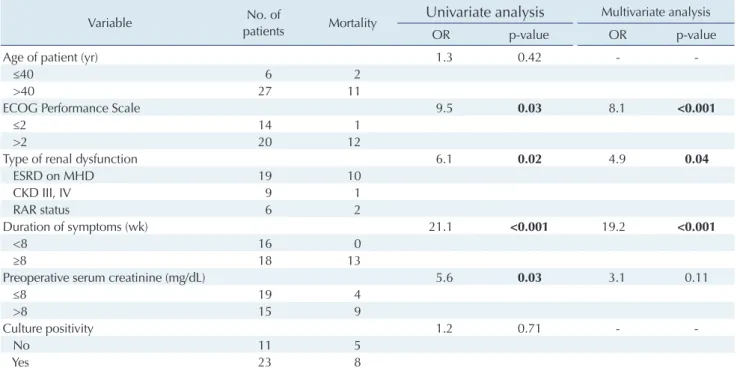
Details of mortality and factors influencing mortality

In total, 13 deaths occurred in the study group, corre- sponding to a mortality rate of 38.2%. Mortality was sig- nificantly higher in the ESRD group than in the other 2 groups (n=10, p=0.02). In the univariate analysis, poor per- formance status (Eastern Cooperative Oncology Group >2) (p=0.03), ESRD (p=0.02), late referral (>8 weeks) (p<0.001), and preoperative serum creatinine >8 mg/dL (p=0.03) were significantly associated with mortality. In the multivariate analysis, all of the above factors except serum creatinine levels were also found to be poor prognostic factors pre- dicting mortality. Septic shock was the major cause of mortality, followed by bleeding (Table 3). Nearly 46% of all deaths happened in the first 9 cases in the first 2 years of Table 2. Comparison of perioperative variables in the 3 groups of patients

Characteristic ESRD (n=19) CKD (n=9) Post-RAR (n=6) p-value

Operative time (min) 324±58 289±51 285±51 <0.001

Blood loss (mL) 601±59 506±68 528±55 <0.001

Method of surgery

Open 11 9 5

VATS 9 0 0

Conversions from VATS 2 0 0

Mean intensive care unit stay (day) 12.3±7.4 5.8±4.3 6.4±5.4 <0.001

Pus/peel culture positivity 14 5 4 0.63

Intercostal drain duration (day) 14.8±10.9 9.5±7.9 8.8±8.1 <0.001

Complications (overall) 16 (47) 4 (11.7) 4 (11.7) 0.40

Bleeding 3 0 1

Re-collection 5 0 0

Wound infection 5 1 3

Prolonged air leak (>7 day) 9 4 3

Cardiac arrythmias 2 1 1

Hospital stay (day) 19.4±18.3 13.1±10.4 16.6±11.7 0.07

<90-day mortality 10 1 2 0.10

Values are presented as mean±standard deviation, number, or number (%).

ESRD, end-stage renal disease; CKD, chronic kidney disease; RAR, renal allograft recipient.

(5)

https://doi.org/10.5090/kjtcs.20.111

KJTCVS

our experience (March 2012 to February 2014). Thereafter, based on an analysis of the causes of death, we modified our surgical protocols, and in the last 6 years (March 2014 to March 2020), the mortality rate decreased to nearly 28%

(Table 4).

Discussion

Surgical management of empyema in CKD patients pos- es a significant challenge to the surgeon as well as the pa- tient because of the high rate of perioperative morbidity and mortality [9]. Patients with CKD and ESRD are more

susceptible to various infections including empyema tho- racis due to their immunosuppressed status [10-13]. Pa- tients with CKD and ESRD are also affected by complex hematological abnormalities such as anemia, thrombocy- topenia, and altered leukocyte function [14]. The decre- ment in the number of platelets, abnormal platelet-vessel wall interactions, and platelet dysfunction predispose CKD patients to bleeding diathesis [15]. This may be the reason why 41% of our patients presented with clotted hemotho- rax secondary to multiple failed attempts of pleural aspira- tion.

In ideal situations, the decision of surgical intervention Table 3. Analysis of factors affecting mortality

Variable No. of

patients Mortality Univariate analysis Multivariate analysis

OR p-value OR p-value

Age of patient (yr) 1.3 0.42 - -

≤40 6 2

>40 27 11

ECOG Performance Scale 9.5 0.03 8.1 <0.001

≤2 14 1

>2 20 12

Type of renal dysfunction 6.1 0.02 4.9 0.04

ESRD on MHD 19 10

CKD III, IV 9 1

RAR status 6 2

Duration of symptoms (wk) 21.1 <0.001 19.2 <0.001

<8 16 0

≥8 18 13

Preoperative serum creatinine (mg/dL) 5.6 0.03 3.1 0.11

≤8 19 4

>8 15 9

Culture positivity 1.2 0.71 - -

No 11 5

Yes 23 8

Bold font indicates the values which were statistically significant (p<0.05).

OR, odds ratio; ECOG, Eastern Cooperative Oncology Group; ESRD, end-stage renal disease; MHD, maintenance hemodialysis; CKD, chronic kidney disease; RAR, renal allograft recipient.

Table 4. Evaluation of surgical experience over time

Variable March 2012 to

February 2014

March 2014 to February 2016

March 2016 to February 2018

March 2018 to

February 2020 p-value

No. of cases 9 7 11 7

Open 0 7 11 7

VATS 9 0 0 0

Mortality 6 (66.7) 2 (28.5) 3 (27.2) 2 (28.5) 0.24

Cause for mortality

Sepsis 4 2 3 1

Bleeding 2 - - 1

Values are presented as number or number (%).

VATS, video-assisted thoracoscopic surgery.

(6)

Mohan Venkatesh Pulle, et al. Predictors of Mortality in CKD Empyema KJTCVS

should be taken within a few days after initial intercostal drainage. However, empyema patients most often undergo a staged procedure, which includes prolonged antibiotics, multiple rounds of aspiration, and intercostal drainage [16].

Often, this staged approach leads to unwarranted delays in the definitive treatment process and causes prolongation of the infective process. This predisposes the patients to more postoperative morbidity and mortality because of deterio- rated nutritional status, as well as further worsening of he- moglobin levels and serum albumin levels causing deterio- ration in patients’ performance status. All these factors are often present together in most patients [17]. In our study population, more than 75% of patients were referred more than 1 month after diagnosis for surgical intervention. Late referral (>8 weeks) and poor performance status were strong predictive factors for postoperative mortality (p<

0.0001).

The outcome of surgery also depends on the stage of CKD. ESRD patients on chronic dialysis usually have a wide range of metabolic and hemodynamic changes and weaker immunity [18]. Therefore, patients on hemodialysis are at a high risk of postoperative issues such as a tendency for bleeding, poor wound healing, higher infection rates, electrolyte disturbances, and hemodynamic instabil- ity [19]. The presence of associated comorbid conditions also poses increased difficulties and makes empyema man- agement even more complicated. In our study, we similarly observed that ESRD patients on regular dialysis had higher rates of postoperative complications and prolonged hospi- tal stay, as well as significantly higher mortality than CKD III and IV patients. Of the 6 patients who were renal al- lograft recipients, 2 patients died. Both of these patients had graft rejection for which they were undergoing mainte- nance hemodialysis. Chronic immunosuppression in renal allograft recipients due to immunosuppressive medications often predisposes these patients to postoperative infections.

Meticulous intraoperative management is essential to prevent further kidney damage [20]. There should be a rapid return to the previous dialysis schedule to optimize the physiological status of patients already on maintenance hemodialysis. All CKD patients with empyema thoracis were kept electively intubated with slightly higher positive end-expiratory pressure the first postoperative day, follow- ing our standard protocol. We believe that the possibility of immediate postoperative bleeding/oozing decreases due to tamponade by the completely expanded lungs. VATS is usually the preferred modality in CKD patients, as its min- imal invasiveness reduces the inflammatory and cytokine response after surgery [21-23]. In our initial cases, the

VATS method was used for decortication. However, con- tinuous diffuse oozing from the chest wall after parietal pleurectomy was found to be very difficult to control with the VATS approach. The surgical duration of VATS decor- tication was also longer than that of open decortication.

For these reasons, we made the conscious decision to per- form open decortication in all patients with CKD, despite our extensive experience in managing stage III empyema through the VATS approach [16]. A few reports have high- lighted the usability of VATS in such patients, albeit with higher reoperation rates (34.8%) [24]. We had an overall 38.2% mortality rate in our study group. Around 46% of the instances of mortality occurred in the first 2 years, where we struggled to formulate and standardize the sur- gical protocols for this difficult group of patients. We were subsequently able to reduce the mortality rate to 28%, which is similar to that reported in a previous surgical se- ries [24]. This reduction was made possible by careful pa- tient selection and standardization of the operative ap- proach, intraoperative anesthetic management, and postoperative protocols. In the first 2 years of our experi- ence, all patients who were operated were ESRD patients who were referred late, in a very moribund state with an altered coagulation profile. We initially managed all such patients with VATS approach. This approach usually led to longer operative times and higher blood loss, thus causing more intraoperative hemodynamic alterations, which in- creased the risk of mortality.

The major change in our approach after this experience

was to perform surgery by thoracotomy, following the

principle of “quick going in–quick coming out,” with better

control over hemostasis. Several extra measures taken to

achieve reduced intraoperative blood loss, including pres-

sure packing of oozing surfaces with sponges, routine use

of an argon plasma coagulator to coagulate the oozing ar-

eas, and an intravenous injection of 1 g of tranexamic acid

before starting parietal pleurectomy. In addition, only a

few experienced anesthesiologists handled anesthesia in

these patients, with strict maintenance of the mean blood

pressure above 70–80 mm Hg intraoperatively. The proto-

cols in the postoperative phase included resumption of he-

modialysis as soon as possible, avoiding excess fluid re-

placement, early resumption of oral fluids and diet, early

ambulation with aggressive chest physiotherapy, and rou-

tine application of a digital negative-suction device to the

chest tubes. Adequate postoperative analgesia was achieved

with injectable paracetamol and the dosage of pain relief

measures was titrated according to the requirements of

each patient.

(7)

https://doi.org/10.5090/kjtcs.20.111

KJTCVS

Limitations

The retrospective nature of this study is one of its major limitations. The second most significant limitation is the heterogeneity of the cohort that was studied. The patients ranged from non-dialysis-dependent patients to previous allograft recipients on immunosuppression. Third, the pol- icy of surgical management was modified over time (VATS to open) and was not standardized throughout the proce- dure. Another potential limitation of this study is the lack of a control group (i.e., patients managed by non-surgical methods). This is likely to have caused several biases, in- cluding selection, detection, and performance bias. Finally, the power of this study was also limited by the analysis of a very small cohort of patients, which may also call into question the credibility of multivariate analysis used to as- sess factors affecting mortality. Further randomized stud- ies with a greater number of patients and standardized treatment protocols are required further to assess these findings.

Conclusion

Surgical management of empyema thoracis in patients with CKD is a therapeutic challenge. Proper identification and addressing of modifiable risk factors in the preopera- tive period, meticulous intraoperative techniques, and vig- ilant postoperative management are mandatory, as these patients are prone to a very high risk of perioperative mor- bidity and mortality. ESRD, late referral, and poor perfor- mance status were poor prognostic factors predicting post- operative mortality. Therefore, based on these risk factors, the decision to perform surgery should be carefully weighed.

Conflict of interest

No potential conflict of interest relevant to this article was reported.

ORCID

Mohan Venkatesh Pulle: https://orcid.org/0000-0002-6868-1477 Harsh Vardhan Puri: https://orcid.org/0000-0002-5269-7976 Belal Bin Asaf: https://orcid.org/0000-0002-1860-4887 Sukhram Bishnoi: https://orcid.org/0000-0001-7343-7148 Manish Malik: https://orcid.org/0000-0002-5432-417X Arvind Kumar: https://orcid.org/0000-0001-6143-7984

References

1. Chapter 1: definition and classification of CKD. Kidney Int Suppl (2011) 2013;3:19-62.

2. Leibovici L, Shraga I, Drucker M, Konigsberger H, Samra Z, Pitlik SD. The benefit of appropriate empirical antibiotic treatment in pa- tients with bloodstream infection. J Intern Med 1998;244:379-86.

3. Maher JF. Uremic pleuritis. Am J Kidney Dis 1987;10:19-22.

4. Wang IK, Chang YC, Liang CC, et al. Bacteremia in hemodialysis and peritoneal dialysis patients. Intern Med 2012;51:1015-21.

5. Bryant RE, Salmon CJ. Pleural empyema . Clin Infect Dis 1996;22:747-62.

6. Akiba T, Marushima H, Hiramatsu M, et al. Video-assisted thoraco- scopic surgery for non-small cell lung cancer in patients on hemodi- alysis. Ann Thorac Cardiovasc Surg 2010;16:40-4.

7. Toh Y, Yano K, Takesue F, et al. Abdominal surgery for patients on maintenance hemodialysis. Surg Today 1998;28:268-72.

8. National Kidney Foundation. K/DOQI clinical practice guidelines for chronic kidney disease: evaluation, classification, and stratifica- tion. Am J Kidney Dis 2002;39(2 Suppl 1):S1-266.

9. Shen TC, Chen CH, Wang IK, et al. Risk of empyema in patients with end-stage renal disease: a nationwide propensity-matched co- hort study. QJM 2017;110:425-30.

10. Soni R, Horowitz B, Unruh M. Immunization in end-stage renal dis- ease: opportunity to improve outcomes. Semin Dial 2013;26:416-26.

11. Raska K Jr, Raskova J, Shea SM, et al. T cell subsets and cellular immunity in end-stage renal disease. Am J Med 1983;75:734-40.

12. Peraldi MN, Berrou J, Metivier F, Toubert A. Natural killer cell dys- function in uremia: the role of oxidative stress and the effects of dial- ysis. Blood Purif 2013;35 Suppl 2:14-9.

13. Ray S, Mukherjee S, Ganguly J, Abhishek K, Mitras S, Kundu S. A cross-sectional prospective study of pleural effusion among cases of chronic kidney disease. Indian J Chest Dis Allied Sci 2013;55:209- 13.

14. Iyawe IO, Adejumo OA. Hematological profile of predialysis chron- ic kidney disease patients in a tertiary hospital in Southern Nigeria. J Med Trop 2018;20:36-41.

15. Boccardo P, Remuzzi G, Galbusera M. Platelet dysfunction in renal failure. Semin Thromb Hemost 2004;30:579-89.

16. Kumar A, Asaf BB, Lingaraju VC, Yendamuri S, Pulle MV, Sood J.

Thoracoscopic decortication of stage III tuberculous empyema is ef- fective and safe in selected cases. Ann Thorac Surg 2017;104:1688- 94.

17. Cham CW, Haq SM, Rahamim J. Empyema thoracis: a problem with late referral? Thorax 1993;48:925-7.

18. Yasuda K, Tahara K, Kume M, Tsutsui S, Higashi H, Kitano S. Risk

factors for morbidity and mortality following abdominal surgery in

patients on maintenance hemodialysis. Hepatogastroenterology

2007;54:2282-4.

(8)

Mohan Venkatesh Pulle, et al. Predictors of Mortality in CKD Empyema KJTCVS

19. Tsuchida M, Yamato Y, Aoki T, et al. Complications associated with pulmonary resection in lung cancer patients on dialysis. Ann Thorac Surg 2001;71:435-8.

20. Bihorac A. Acute kidney injury in the surgical patient: recognition and attribution. Nephron 2015;131:118-22.

21. Novitsky YW, Litwin DE, Callery MP. The net immunologic advan- tage of laparoscopic surgery. Surg Endosc 2004;18:1411-9.

22. Ng CS, Whelan RL, Lacy AM, Yim AP. Is minimal access surgery

for cancer associated with immunologic benefits? World J Surg 2005;29:975-81.

23. Chen KC, Chen JS, Kuo SW, et al. Descending necrotizing mediasti- nitis: a 10-year surgical experience in a single institution. J Thorac Cardiovasc Surg 2008;136:191-8.

24. Liao HC, Chuang JH, Hsu HH, Chen KC, Chen JS. Video-assisted

thoracoscopic surgery for thoracic empyema in patients on mainte-

nance hemodialysis. Surg Endosc 2020;34:1641-7.

수치

Table 4. Evaluation of surgical experience over time

참조

관련 문서

Surgical Outcome of Spine Surgery in Patients Undergoing Hemodialysis Due to Chronic Kidney Disease Journal of Korean Society of Spine Surgery.. www.krspine.org 157 었고(p=0.001),

estimated glomerular filtration rate &lt;30 mL/min/1.73 m 2 ), diabetes mellitus, biliary tract disease (defined as a stone in the bile duct, air in the biliary tree, bile

hemodiafiltration; DIC: Disseminated intravascular coagulation; DNI: Delta neutrophil index; DNR: Do-not-resuscitate; eGFR: Estimated glomerular filtration rate; HRs: Hazard

BMI, body mass index; CAD, coronary artery disease; CKD, chronic kidney disease; CRP, C-reactive protein; eGFR, estimated glomerular filtration rate; HDL, high density

Damage control orthopedics management as vital procedure in elderly patients with fem- oral neck fractures complicated with chronic renal failure: a retrospective cohort study.

The aim of this study was to investigate survival rate, complications and associated risk factors after hip fracture surgery in patients with chronic kidney disease (CKD) by

We report the baseline cardiovascular characteristics of 2,238 participants by using the data of the KoreaN Cohort Study for Outcomes in Patients With Chronic Kidney

Correlation analyses for urine protein and urinary neutrophil gelatinase-associated lipocalin (NGAL) levels and glomeru- lar filtration rate (GFR) in chronic kidney disease