Survivorship and Complications after Hip Fracture Surgery in Patients with Chronic Kidney Disease
The aim of this study was to investigate survival rate, complications and associated risk factors after hip fracture surgery in patients with chronic kidney disease (CKD) by comparing to non-CKD patients. A total of 119 patients (130 hips, 63 hips CKD group, 67 hips non-CKD) who underwent hip fracture surgery were included. We assessed variables including age, gender, CKD, comorbidities, operation delay and operation time as risk factors for survival and complications after hip fracture surgery. The survival rate was 55.8% at 1-year, 45.8% at 3-year, and 31.4% at 5-year in CKD group, whereas 82.1%, 60.7%, and 36.8%, respectively in non-CKD. Age (more than 85) (hazard ratio [HR], 3.238; 95% confidence interval [CI], 1.736–6.042; P < 0.001), stages 4, 5 of CKD (HR, 2.004; 95% CI, 1.170–3.433; P = 0.001), cerebrovascular disease (HR, 2.213; 95% CI, 1.196–4.095; P = 0.001), and malignancy (HR, 3.086; 95% CI, 1.553–6.129; P = 0.001) were significant risk factors. Complications occurred in 17 hips of CKD group and 8 hips of non-CKD. Stage 4–5 of CKD (odds ratio [OR], 3.401; 95% CI, 1.354–8.540; P = 0.001), malignancy (OR, 3.184; 95% CI, 0.984–10.301; P = 0.050) were significant risk factor.
When performing hip fracture surgery in patients with CKD, surgeons should consider age, severity of CKD, and presence of other comorbid disease, such as cerebrovascular disease and malignancy, as patients with these risk factors will need more intensive preoperative and postoperative care.
Keywords: Hip Fracture Surgery; Chronic Kidney Disease; Survival Rate; Complication You-Sung Suh, Sung Hun Won,
Hyung-Suk Choi, Jae Chul Lee, Dong-il Chun, Jae-Hwi Nho,
Hwan-Woong Lee, and Jin Hyeung Kim Department of Orthopaedic Surgery,
Soonchunhyang University Seoul Hospital, Seoul, Korea
Received: 26 April 2017 Accepted: 17 September 2017 Address for Correspondence:
Sung Hun Won, MD, PhD
Department of Orthopaedic Surgery, Soonchunhyang University Seoul Hospital, 59 Daesagwan-ro, Yongsan-gu, Seoul 04401, Korea
E-mail: [email protected]
Funding: This work was supported by the Soonchunhyang University Research Fund.
https://doi.org/10.3346/jkms.2017.32.12.2035 • J Korean Med Sci 2017; 32: 2035-2041
INTRODUCTION
Recently, due to the increase in the aging population, quality of life and survival after fractures in elderly patients have become important topics of social interest. Hip fractures in elderly pa- tients have been reported to result in a 1-year mortality of 15%–
40% (1-3), due to medical and orthopedic complications and aggravation of their comorbidity. In particular, patients with chronic kidney disease (CKD) have a very high 1-year mortality of 50%–64% after hip fractures (4-7). Moreover, after a hip frac- ture, patients with CKD are more likely than non-CKD patients to experience postoperative complications such as hematoma, persistent wound drainage, infection, failure of internal fixation, and non-union (4,5,7).
A few studies have reported the complications and radiologi- cal outcomes after total hip arthroplasty or bipolar hemiarthro- plasty in patients with CKD; however, these studies only exam- ined a small number of subjects, or lacked a control group (4-6).
Hence, the present study aimed to investigate survival rate, complications, and associated risk factors after hip fracture sur- gery in patients with CKD, as well as to perform a comparative analysis with hip fracture patients without CKD.
MATERIALS AND METHODS Participants
Subjects were recruited from patients who underwent surgical treatment for hip fracture (femoral neck or intertrochanteric) after being admitted to our hospital between March 2004 and January 2013. Of those, 65 patients (70 hips) who had been di- agnosed with CKD with a glomerular filtration rate (GFR) of less than 60 mL/min/1.73 m2 for at least 3 months before sur- gery, (8) and 66 hip fracture patients without CKD (72 hips) were selected as the subjects for this study.
In the CKD group, exclusions included 1 patient with an ac- companying fracture in another region, 1 patient with a patho- logic fracture caused by malignant metastasis, and 5 patients for whom survival was not recorded in the medical records and could not be confirmed through contact with the individual or their family. Five patients were excluded from the control group because survival could not be confirmed. Finally, 58 (63 hips) patients in the CKD group and 61 (67 hips) patients in the non- CKD were included in the present study.
Surgery and rehabilitation methods
Patients on hemodialysis underwent 3 times a week before sur- ORIGINAL ARTICLE
Musculoskeletal Disorders
2017-03-16 https://crossmark-cdn.crossref.org/widget/v2.0/logos/CROSSMARK_Color_square.svg
gery, and they continued dialysis at the same frequency after surgery. Surgery was performed on a day following dialysis. All operations were performed by the same surgeon, and anesthet- ic was administered via either the spinal or the epidural route in the lateral decubitus position with the assistance of the de- partment of anesthesiology.
The internal fixation surgery was as follows. After anesthesia, the patient was moved to a fracture table, and suitable fracture reduction was performed under a C-arm image intensifier, be- fore performing internal fixation with a cannulated screw, dy- namic hip screw (TDM, Gwangju, Korea) or a proximal femur nail (Synthes, Zuchwil, Switzerland), depending on the shape of the fracture. For arthroplasty surgery, the modified postero- lateral approach was used with the patient in the lateral decubi- tus position, and the posterior capsule and external rotators were reattached in all cases. For cementless femoral implants, a C2 femoral stem (Lima Lto, Udine, Italy) or COREN® femoral stem (Corentec, Seoul, Korea) was used, and for cemented im- plants, a Logica mirror stem (Lima Lto) was used.
After surgery, creatinine (Cr) levels were monitored in all pa- tients, prophylactic antibiotics were administered for one week with assistance from the department of nephrology, and the drainage catheter was removed from all patients on the third postoperative day. All patients wore pressure stockings and un- derwent intermittent pneumatic compression of the lower limbs after surgery to prevent deep vein thrombosis. After having the drainage catheter removed on the third postoperative day, pa- tients trained in parallel bar walking with the assistance of the hospital’s physiotherapy department, before being allowed to practice partial weight walking with the aid of an assisted walk- er. Once bone union had been confirmed radiological, the pa- tients were allowed to perform full body weight walking in pa- tients who underwent osteosynthesis surgery. Patients who un- derwent hip arthroplasty were also trained sufficiently in paral- lel bar walking after the removal of the drainage catheter, and were allowed to perform full body weight walking as soon as possible.
Research methods Patients’ demographic data
Medical records were used to determine sex, date of CKD diag- nosis and cause, other comorbidities, dialysis period of patients undergoing dialysis, and preoperative bone density. Surgery-re- lated data were also analyzed, including the elapsed time from injury to surgery, duration of surgery, preoperative blood urea nitrogen (BUN)/Cr levels, GFR, blood loss and transfused blood volumes during and after surgery, and hospitalization time.
Assessment of survival and complications, and analysis of risk factors When survival could not be confirmed from the medical records, survival was investigated by phone interview with the patient or
the patients’ family members, and in cases where the patient had died, the date of death was recorded. Post-operative com- plications were divided into orthopedic and medical complica- tions. Orthopedic complications included hematoma, prolonged discharge, deep vein thrombosis, infection, dislocation, peri- prosthetic fracture, and heterotopic ossification. Medical com- plications included clear aggravation of an underlying disease, or a separate, newly developed decline in cardiopulmonary func- tion or multiple organ failure.
As known risk factors affecting survival and complications after hip fractures, age, sex, CKD, preoperative underlying dis- ease, time from injury to surgery, and surgery time were ana- lyzed statistically.
For the analysis of risk factors for survival, age was divided into two groups of ≤ 84 years, and ≥ 85 years old. In addition to testing the presence of CKD, the patient and control groups were also graded into one of 5 stages using GFR levels, and each stage of CKD was assessed for risk. (8) An analysis was also per- formed comparing patients with severe CKD (stages 4, 5) against other patients (stages 1–3). In terms of preoperative underlying diseases, diabetes, hypertension, cardiac disease (ischemic heart diseases, congestive heart failure, and cardiomyopathy), cancer (breast cancer, stomach cancer, colon cancer, rectal cancer, and bladder cancer), cerebrovascular disease, lung disease (asthma, chronic obstructive pulmonary disease), liver disease (liver cir- rhosis), dementia, and thyroid disease (hypothyroidism, hyper- thyroidism) were investigated, and risk was analyzed for each of these diseases. Time from injury to surgery was analyzed by dividing the group into those who received surgery within 2 days, and those who received surgery after 3 days or more (1,3,9). Sur- gery time was analyzed by dividing the subjects into those whose surgery took longer than average and those whose surgery took less time than average, where the mean surgery time was calcu- lated across the patient and control groups together. The risks of survival and complications were compared between these two groups.
In the analysis of factors affecting complications, the occur- rence of complications was investigated irrespective of their num- ber or whether they were orthopedic or medical complications.
In other words, subjects were analyzed as a complications group and a no-complications group.
Statistical methods
SPSS 21.0 (SPSS Inc., Chicago, IL, USA) was used for statistical processing. Continuous variables were compared using the Student’s t-test, while discrete variables were compared using the χ2 test and Fisher’s exact test. A logistic regression analysis was used to investigate factors that influence the incidence of complications, and survival was analyzed comparatively, using the Kaplan-Meier survival analysis and log rank survival. We deal with following situations as a censored data for survival
analysis; First, follow-up loss cases, Second, death cases due to another reason. Factors that influence survival were analyzed using the Cox proportional hazard model. Power calculation was performed by using R v3.1.2 (‘powerSurvEpi’ packages; R Foundation, Vienna, Austria).
Ethics statement
This retrospective study was approved by the Institutional Re- view Board of Soonchunhyang University Hospital Seoul (SCHUH 2016-12-014). Informed consent was waived by the board.
RESULTS
Demographic results
The mean age for the both groups were 76.6 (CKD) and 75.3 (non-
CKD) years, and the mean follow-up period was 10.3 (CKD) and 8.2 months (non-CKD), respectively. Other demographic results were shown in Table 1.
The stage of CKD as determined by GFR is shown Table 2. The most common causes of CKD were diabetes (50%) and hyper- tension (43.8%), while other causes included nephrectomy in 1 patient, ischemic heart disease in 2 patients, and hydronephro- sis due to renal stone in 1 patient. Within the CKD group, 20 pa- tients (34.5%) were receiving hemodialysis, and the mean dialy- sis duration was 10.2 ± 8.2 years.
Risk factors for survival and complications
There were 36 deaths among patients with CKD and 24 deaths among the non-CKD. The postoperative 1-year survival rates were 55.8% and 82.1%, while the 3-year/5-year survival rates Table 1. Demographics of patients
Explanatory variables CKD group
(n = 63) Non-CKD group
(n = 67) P value
Age, yr 76.6 ± 8.6 75.3 ± 10.6 0.532
Gender (female) 36 (57.1) 52 (77.6) 0.001
Fracture type 0.473
Femur neck 35 (55.6) 33 (49.3)
Femur intertrochanter 28 (44.4) 34 (50.7)
Site (left) 37 (58.7) 34 (50.7) 0.363
Operation method 0.172
CHS 12 (19) 8 (11.9)
PFN 3 (4.8) 9 (13.4)
Cannulated screw 2 (3.2) 5 (7.5)
Bipolar 46 (73) 45 (67.2)
Hb/Hct 10.2/30.4 ± 1.6/4.5 11.5/34.4 ± 1.7/5.2 < 0.001
BUN/Cr 28.6/2.8 ± 13.7/1.9 15.9/0.8 ± 4.7/0.2 < 0.001
GFR 24.1 ± 16.6 82.5 ± 11.7 < 0.001
BMD
Lumbar −3.00 ± 1.3 −3.19 ± 1.4 0.532
Femur −3.65 ± 1.5 −3.43 ± 0.9 0.392
Follow up, mon 10.3 ± 14.7 8.2 ± 13.1 0.493
Hospital stay, day 38.6 ± 41.5 28.9 ± 33.3 0.232
Co-morbidity
Diabetes mellitus 32 (50.8) 24 (35.8) 0.086
Hypertension 57 (90.5) 34 (50.7) < 0.001
Heart disease 23 (36.5) 7 (10.4) < 0.001
Malignancy 14 (22.2) 2 (3.0) 0.001
CVA 13 (20.6) 6 (9.0) 0.064
Pulmonary disease 5 (7.9) 3 (4.5) 0.484
Hepatic disease 6 (9.5) 1 (1.5) 0.062
Dementia 2 (3.2) 10 (14.9) 0.033
Thyroid disease 6 (9.5) 2 (3.0) 0.153
Operation day, day 4.5 ± 3.9 2.8 ± 1.5 0.001
Operation time, min 64.3 ± 38.3 65.0 ± 26.3 0.921
Bleeding at operation, mL 381.6 ± 183.8 354.0 ± 128.1 0.441
Bleeding at postop, mL 322.1 ± 279.5 293.7 ± 286.0 0.652
Transfusion at operation, mL 324.3 ± 375.2 192.0 ± 315.5 0.074
Transfusion at postop, mL 475.7 ± 497.4 152.0 ± 301.1 0.001
Data are shown as mean ± standard deviation or number (%). Statistical analysis was done by χ2 or Fisher's exact test for categorical, independent t-test for continuous vari- ables.
CKD = chronic kidney disease, CHS = compression hip screw, PFN = proximal femur nail, Hb = hemoglobin, Hct = hematocrit, BUN = blood urea nitrogen, Cr = creatinine, GFR = glomerular filtration rate, BMD = bone mineral density, CVA = cerebrovascular accident, Postop = post-operation period.
were 45.8%/60.7% and 31.4%/36.8% in the CKD and non-CKD groups, respectively. The survival rate was significantly lower in the CKD group (Fig. 1).
In the univariate analysis to identify mortality-related factors, the ≥ 85-year-old patient had significantly higher risk than the
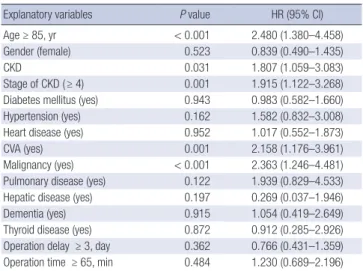
< 85-year-old (hazard ratio [HR], 2.48; 95% confidence interval [CI], 1.380–4.458; P < 0.001). The risk of death was higher in the patient with CKD than in the non-CKD, and this difference was statistically significant (HR, 1.807; 95% CI, 1.059–3.083; P = 0.031).
In the analysis according to CKD stage, patients in the ≥ stage 4 group showed significantly higher risk than those in the ≤ stage 3 group (HR, 1.915; 95% CI, 1.122–3.268; P = 0.001). Among un- derlying diseases, cerebrovascular disease (HR, 2.158; 95% CI, 1.176–3.961; P = 0.001) and cancer (HR, 2.363; 95% CI, 1.246–
4.481; P < 0.001) were found to be significant mortality-related factors (Table 3).
In the multivariate analysis, patients ≥ 85 years old (HR, 3.238;
95% CI, 1.736–6.042; P < 0.001), ≥ stage 4 (HR, 2.004; 95% CI, 1.170–3.433; P = 0.001), the presence of cerebrovascular disease (HR, 2.213; 95% CI, 1.196–4.095; P = 0.001), and the presence of cancer (HR, 3.086; 95% CI, 1.553–6.129; P < 0.001) were found to be important risk factors for mortality (Table 4).
A total of 17 cases (27%) in the CKD group and 8 cases (11.9%) in the control group experienced complications, with a signifi- cantly higher frequency in the CKD group (odds ratio [OR], 2.726;
95% CI, 1.081–6.870; P = 0.032). Of these, there were 6 cases of orthopedic complications in the CKD group and 1 in the non- CKD, which was a statistically significant difference (OR, 6.947;
95% CI, 0.812–59.432; P = 0.050). There were 11 cases of medi- cal complications in the CKD group, and 7 cases in the non-CKD, which was not a statistically significant difference (P = 0.243) (Table 5).
The 6 cases of orthopedic complications in the CKD group included 4 cases of prosthesis dislocation, 1 case of infection, and 1 case of heterotopic ossification; in the non-CKD, there was one case of loss of fracture reduction using a cannulated Fig. 1. Kaplan-Meier curves for survival ≥ stage 4 CKD group and ≤ stage 3 CKD (log-
rank test P = 0.001).
CKD = chronic kidney disease.
Survival probability
Month
0 20 40 60 80 100 120 1.0
0.8
0.6
0.4
0.2
0
Stage of CKD ≤ 3 ≥ 4
P = 0.001 Table 2. Stages of CKD (8)
Stages Description GFR, mL/min/1.73 m2 No. (%)
1 Kidney damage with normal or ↑GFR ≥ 90 18 (13.9)
2 Kidney damage with mild ↓GFR 60–89 49 (37.7)
3 Moderate ↓GFR 30–59 24 (18.4)
4 Severe ↓GFR 15–29 13 (10.0)
5 Kidney failure < 15 (or dialysis) 26 (20.0)
CKD is defined as either kidney damage or GFR < 60 mL/min/1.73 m2 for ≥ 3 months.
CKD = chronic kidney disease, GFR = glomerular filtration rate.
Table 4. Multivariate Cox proportional hazards regression models for survival
Explanatory variables P value HR (95% CI)
Age ≥ 85, yr < 0.001 3.238 (1.736–6.042)
Stage of CKD ( ≥ 4) 0.001 2.004 (1.170–3.433)
CVA 0.001 2.213 (1.196–4.095)
Malignancy < 0.001 3.086 (1.553–6.129)
Statistics were analyzed by backward stepwise method in Cox proportional hazards regression analysis.
HR = hazard ratio, CI = confidence interval, CKD = chronic kidney disease, CVA = cerebrovascular accident.
Table 5. Complications of CKD and non-CKD group Explanatory
variables CKD Non-CKD P value OR (95% CI)
Orthopaedic 6 (9.5) 1 (1.5) 0.050 6.947 (0.812–59.432) Medical 11 (17.5) 7 (10.4) 0.243 1.813 (0.655–5.017)
Total 17 (27) 8 (11.9) 0.032 2.726 (1.081–6.870)
Statistical analysis was done by χ2 or Fisher’s exact test.
CKD = chronic kidney disease, OR = odds ratio, CI = confidence interval.
Table 3. Univariate Cox proportional hazards regression models for survival
Explanatory variables P value HR (95% CI)
Age ≥ 85, yr < 0.001 2.480 (1.380–4.458)
Gender (female) 0.523 0.839 (0.490–1.435)
CKD 0.031 1.807 (1.059–3.083)
Stage of CKD ( ≥ 4) 0.001 1.915 (1.122–3.268)
Diabetes mellitus (yes) 0.943 0.983 (0.582–1.660)
Hypertension (yes) 0.162 1.582 (0.832–3.008)
Heart disease (yes) 0.952 1.017 (0.552–1.873)
CVA (yes) 0.001 2.158 (1.176–3.961)
Malignancy (yes) < 0.001 2.363 (1.246–4.481)
Pulmonary disease (yes) 0.122 1.939 (0.829–4.533)
Hepatic disease (yes) 0.197 0.269 (0.037–1.946)
Dementia (yes) 0.915 1.054 (0.419–2.649)
Thyroid disease (yes) 0.872 0.912 (0.285–2.926)
Operation delay ≥ 3, day 0.362 0.766 (0.431–1.359) Operation time ≥ 65, min 0.484 1.230 (0.689–2.196) Statistics were analyzed by Cox proportional hazards regression analysis.
HR = hazard ratio, CI = confidence interval, CKD = chronic kidney disease, CVA = cerebrovascular accident.
Table 6. Univariate binary logistic regression models for complications
Explanatory variables No. P value OR (95% CI)
Age, yr
< 85 106 - Ref.
≥ 85 24 < 0.001 2.480 (1.380–4.458)
Gender
Male 42 - Ref.
Female 88 0.662 0.815 (0.326–2.034)
CKD
No 67 - Ref.
Yes 63 0.032 2.726 (1.081–6.870)
Stage of CKD
≤ 3 104 - Ref.
≥ 4 26 0.001 3.292 (1.337–8.105)
Diabetes mellitus
No 74 - Ref.
Yes 56 0.585 1.280 (0.533–3.070)
Hypertension
No 39 - Ref.
Yes 91 0.476 1.451 (0.531–3.969)
Heart disease
No 100 - Ref.
Yes 30 0.523 1.386 (0.516–3.724)
CVA
No 111 - Ref.
Yes 19 0.424 1.625 (0.525–5.031)
Malignancy
No 114 - Ref.
Yes 16 0.050 3.000 (0.973–9.246)
Pulmonary disease
No 122 - Ref.
Yes 8 0.672 1.435 (0.272–7.571)
Hepatic disease
No 123 - Ref.
Yes 7 0.523 1.739 (0.317–9.532)
Dementia
No 118 - Ref.
Yes 12 0.815 0.826 (0.169–4.031)
Thyroid disease
No 122 - Ref.
Yes 8 0.624 0.583 (0.068–4.969)
Operation delay, day
≤ 2 43 - Ref.
≥ 3 87 0.735 0.851 (0.342–2.122)
Operation time, min
≤ 65 95 - Ref.
≥ 65 35 0.528 1.359 (0.527–3.506)
Statistics were analyzed by binary logistic regression analysis.
OR = odds ratio, CI = confidence interval, CKD = chronic kidney disease, CVA = cere- brovascular accident.
Table 7. Multivariate binary logistic regression models for complications
Explanatory variables P value OR (95% CI)
Stage of CKD ( ≥ 4) 0.001 3.401 (1.354–8.540)
Malignancy (Yes) 0.050 3.184 (0.984–10.301)
Statistics were analyzed by backward stepwise method in binary logistic regression analysis.
OR = odds ratio, CI = confidence interval, CKD = chronic kidney disease.
screw. All 4 cases of dislocation occurred due to falls. Two cases were treated by manual reduction followed by use of an abduc- tion brace; in 1 case where manual reduction was not possible, open reduction was performed, which was followed by use of an abduction brace. In 1 case, the patient experienced 3 dislo- cations and manual reduction was performed under general anesthesia, but the patient’s condition subsequently deteriorat-
ed resulting in death 2 months after surgery. In the 1 case of in- fection, the patient had undergone bipolar hemiarthroplasty for an intertrochanteric fracture, and was discharged without complications. Two months after surgery, the patient developed an abscess near the operated area, and was admitted again for debridement, removal of the prosthesis, and vancomycin-load- ed prosthesis with antibiotic-loaded acrylic cement (PROSTA- LAC) insertion. Klebsiella pneumoniae was identified in blood and tissue cultures took during surgery, and the patient was in- travenous meropenem injection with assistance from the de- partment of infectious disease. During monitoring, the patient’s condition deteriorated, resulting in death due to respiratory ar- rest 2 months after revision surgery. In the 1 case of heterotopic ossification, the patient had undergone bipolar hemiarthro- plasty for an intertrochanteric fracture. Complications mani- fested 5 weeks after surgery, and heterotopic ossification was classified as Brooker grade III at the final follow-up (10), but with no apparent symptoms and no restrictions in the range of joint motion. The 1 case of orthopedic complications in the non-CKD was a Garden type 4 femur neck fracture. The patient underwent internal fixation using a cannulated screw, but re- duction of the fracture was lost 4 weeks after surgery. Conver- sion to bipolar hemiarthroplasty had to be performed. After the second surgery, no further complications were observed dur- ing follow-up.
In terms of medical complications, 11 cases (17.5%) occurred in the CKD group, including 7 cases of pneumonia, 1 case of upper gastrointestinal bleeding, 1 case of liver abscess, 1 case of urinary tract infection, and 1 case of cerebral infarction. A total of 7 cases (10.4%) occurred in the non-CKD, including 4 cases of pneumonia, 1 case of deep vein thrombosis, 1 case of gastri- tis, and 1 case of acute kidney injury.
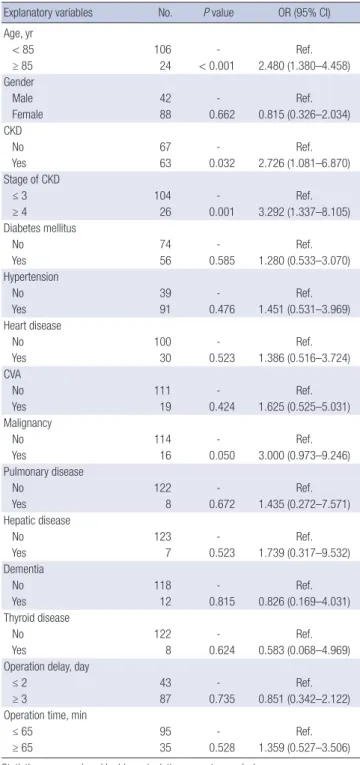
In the univariate analysis to identify factors associated with complications, the complication rate was significantly higher in the ≥ 85-year-old patient compared to the < 85-year-old (OR, 2.480; 95% CI, 1.380–4.485; P < 0.001), and higher in the CKD group (OR, 2.726; 95% CI, 1.081–6.870; P = 0.032) compared to non-CKD. When the patients were divided by CKD stage, the complication rate was significantly higher in the group with se- vere ≥ stage 4 CKD compared to patients with ≤ stage 3 CKD (OR, 3.292; 95% CI, 1.337–8.105; P = 0.001). In addition, among underlying diseases, patients with cancer showed a higher rate of complications than patients without cancer (OR, 3.000; 95%
CI, 0.973–9.246; P = 0.050) (Table 6).
In the multivariate analysis ≥ stage 4 (OR, 3.401; 95% CI, 1.354–
8.540; P = 0.001), cancer (OR, 3.184; 95% CI, 0.984–10.301; P = 0.050) was found to be an important risk factor for the develop- ment of complications (Table 7).
DISCUSSION
The present study aimed to investigate survival rate, complica- tions and associated risk factors after hip fracture surgery in pa- tients with CKD by comparing to non-CKD patients. The 1-, 3-, and 5-year survival rates in the CKD group were significantly lower than that in the non-CKD. Important risk factors affecting survival included age ≥ 85 years, severe CKD (≥ stage 4), and cerebrovascular comorbidities or malignancy. Compared to the non-CKD group, the CKD patients showed a significantly higher rate of complications, and ≥ stage 4 CKD and malignan- cy were found to be important risk factors for incidence of com- plications.
Based on a number of previous studies, 1-year mortality after hip joint surgery is reported to be 10.7%–36% (1-3). In particu- lar, 1-year mortality is reported to be very high in patients with CKD, at 50%–64% (4-7). In the present study, the 1-year mortal- ity after hip joint surgery in patients with CKD was 32.4%, which was relatively lower than that reported in other studies, but was still high compared to the healthy patient group (13.7%). Gen- erally, a patient’s condition before surgery is known to have a large effect on mortality after hip fracture surgery (1,3,11). Roche et al. (11) performed a large-scale prospective study in 2,448 patients and reported that underlying diseases prior to surgery that affect postoperative 1-year mortality include lung disease (HR, 1.4), renal disease (HR, 1.6), diabetes (HR, 1.3), and cancer (HR, 1.6), with risk reported to be high for renal disease and can- cer. The present study also found that the stage of CKD (stages 4 or 5), cancer, and cerebrovascular disease were important fac- tors in mortality after hip fracture surgery. Several researchers have also reported that age is an important factor influencing mortality after hip fracture surgery (1,3,11). In particular, Suh et al. (3) reported that mortality was significantly higher in patients
≥ 85 years old compared to that in patients < 85 (P = 0.006), and Roche et al. (11) found 2-fold higher risk of mortality in patients aged 80–89 years compared to patients aged 60–69 years, as well as 2.8-fold higher risk in patients aged ≥ 90 years old. Similarly, the present study found that the risk of mortality in patients ≥ 85 years old was 3.2-fold higher than that in patients < 85 years old. Hence, when performing hip fracture surgery in elderly pa- tients, especially in patients aged ≥ 85 years, the patient’s con- dition should be monitored closely peri-operative period, espe- cially in patients with underlying diseases, such as CKD, cere- brovascular disease, or malignancy.
In the present study, the complication rate in the CKD group
was 27%, which was significantly higher than the rate of 11.9%
in the non-CKD. This is similar to findings of several previous studies that reported complication rates of 16.7%–27.5% (5,12).
In particular, patients in severe ≥ stage 4 showed a 3.4-fold high- er risk of complications. There were 6 cases (9%) of orthopedic complications in the CKD group, which was higher than that in the non-CKD (1%), and in particular, dislocations were the most common complication (4 cases). All 4 dislocations occurred because of falls, and these patients had comorbidities such as lung cancer in 1 case, a chronic obstructive pulmonary disease in 1 case, cerebral infarction in 2 cases, and hypothyroidism in 1 case. This indicated that these underlying diseases might have affected the patients’ rehabilitation, restricting proper gait and increasing the chance of falls, thereby increasing the risk of dis- location. Hence, elderly CKD patients with such comorbidities should be closely monitored after arthroplasty so that they are not exposed to the risk of falls. Numerous studies have reported infection rates in patients with CKD after hip surgery (6,7,13,14), with various factors known to be associated with infection, such as malnutrition, coagulopathy, and secondary impairment of immune mechanisms due to long-term hemodialysis (15,16).
In the present study, there was 1 case of deep infection, and the patient underwent debridement, prosthesis removal, and sur- gery using an antibiotic-loaded cement spacer (PROSTALAC), but the patient’s condition deteriorated 3 weeks after surgery resulting in mortality due to respiratory arrest. In addition, pa- tients with CKD have been reported to show unsatisfactory clin- ical outcomes compared with non-CKD due to a higher rate of systemic complications, such as systemic immune compromise, poor bone quality due to renal osteodystrophy, deterioration of underlying disease, and the risk of multiple organ failure due to metabolic imbalance caused by impaired renal function during surgery (5,7,13). The present study also found a higher rate of medical complications in the CKD group (17.5%) compared to the healthy patient group (10.4%), though this was not statisti- cally significant. Therefore, close peri-operative monitoring and collaboration with medical department might be necessary.
Limitations of the present study include the possibility of in- accurate data from medical records due to the retrospective study design, and the fact that selection bias could not be ex- cluded in the non-CKD group selection process even though we used the multivariate analysis with age, cerebrovascular ac- cident (CVA), and malignancy. In addition, 57% of low power was estimated, so further prospective studies with larger sam- ple size will be needed to demonstrate the effect size of our study finding.
Strengths of the present study were that our study included a relatively large patient group (58 patients, 63 hips), and survival and complications were investigated through comparison with a non-CKD hip fracture patients. Moreover, it is a significant outcome that long-term 3-year and 5-year survival rates were
investigated in addition to the 1-year survival rate. Our study presented that severe stages of CKD (stages 4, 5) were signifi- cant risk factors for survival and complication after hip fracture surgery. Previous studies rarely used stage of CKD on hip frac- ture surgery for patients with CKD. The authors think our re- sults raise awareness about management of hip fracture surgery especially underlying severe CKD.
In the present study, 1-, 3-, and 5-year survival rate after hip fracture surgery was 55.8%, 45.8%, and 31.4% in patients with CKD, which was lower than the 1-, 3-, and 5-year survival rates of 82.1%, 60.7%, and 36.8%, respectively, in the non-CKD pati- ents. Especially, severe CKD group (≥ stage 4) was lower than mild CKD group. In particular, severe CKD (≥ stage 4), age ≥ 85 years, and underlying cerebrovascular disease or malignancy were found to be important mortality-related factors, while se- vere CKD (≥ stage 4), and malignancy were demonstrated to be an important risk factor in the development of postoperative complications. Therefore, when performing hip fracture sur- gery in patients with severe CKD, a thorough preoperative risk assessment needs to be conducted, and more intensive post- operative care taking into account age and underlying diseases, such as cerebrovascular disease and malignancy.
DISCLOSURE
The authors have no potential conflicts of interest to disclose.
AUTHOR CONTRIBUTION
Formal analysis: Won SH, Lee HW, Kim JH. Investigation: Won SH, Choi HS, Lee HW. Writing - original draft: Won SH, Chun DI, Lee JC. Writing - review & editing: Suh YS, Won SH, Nho JH.
ORCID
You-Sung Suh https://orcid.org/0000-0002-4906-9709 Sung Hun Won https://orcid.org/0000-0002-5471-7432 Hyung-Suk Choi https://orcid.org/0000-0003-2342-6437 Jae Chul Lee https://orcid.org/0000-0002-8272-6723 Dong-il Chun https://orcid.org/0000-0001-7255-8984 Jae-Hwi Nho https://orcid.org/0000-0003-1053-456X Hwan-Woong Lee https://orcid.org/0000-0002-2916-782X Jin Hyeung Kim https://orcid.org/0000-0002-9738-3057
REFERENCES
1. Kenzora JE, McCarthy RE, Lowell JD, Sledge CB. Hip fracture mortality.
Relation to age, treatment, preoperative illness, time of surgery, and com- plications. Clin Orthop Relat Res 1984: 45-56.
2. Zuckerman JD, Skovron ML, Koval KJ, Aharonoff G, Frankel VH. Postop- erative complications and mortality associated with operative delay in older patients who have a fracture of the hip. J Bone Joint Surg Am 1995;
77: 1551-6.
3. Suh YS, Kim YB, Choi HS, Yoon HK, Seo GW, Lee BI. Postoperative mor- tality and the associated factors in elderly patients with hip fracture. J Ko- rean Orthop Assoc 2012; 47: 445-51.
4. Tierney GS, Goulet JA, Greenfield ML, Port FK. Mortality after fracture of the hip in patients who have end-stage renal disease. J Bone Joint Surg Am 1994; 76: 709-12.
5. Karaeminogullari O, Demirors H, Sahin O, Ozalay M, Ozdemir N, Tando- gan RN. Analysis of outcomes for surgically treated hip fractures in pa- tients undergoing chronic hemodialysis. J Bone Joint Surg Am 2007; 89:
324-31.
6. Sunday JM, Guille JT, Torg JS. Complications of joint arthroplasty in pa- tients with end-stage renal disease on hemodialysis. Clin Orthop Relat Res 2002: 350-5.
7. Sakalkale DP, Hozack WJ, Rothman RH. Total hip arthroplasty in patients on long-term renal dialysis. J Arthroplasty 1999; 14: 571-5.
8. National Kidney Foundation. K/DOQI clinical practice guidelines for chro- nic kidney disease: evaluation, classification, and stratification. Am J Kid- ney Dis 2002; 39: S1-266.
9. Shiga T, Wajima Z, Ohe Y. Is operative delay associated with increased mortality of hip fracture patients? Systematic review, meta-analysis, and meta-regression. Can J Anaesth 2008; 55: 146-54.
10. Brooker AF, Bowerman JW, Robinson RA, Riley LH Jr. Ectopic ossification following total hip replacement. Incidence and a method of classification.
J Bone Joint Surg Am 1973; 55: 1629-32.
11. Roche JJ, Wenn RT, Sahota O, Moran CG. Effect of comorbidities and post- operative complications on mortality after hip fracture in elderly people:
prospective observational cohort study. BMJ 2005; 331: 1374.
12. Nho JH, Choi HS, Park KH, Park JS, Suh YS. Analysis about complications of hip arthroplasty in patients with chronic renal failure on hemodialysis.
J Korean Orthop Assoc 2011; 46: 222-30.
13. Abbott KC, Bucci JR, Agodoa LY. Total hip arthroplasty in chronic dialysis patients in the United States. J Nephrol 2003; 16: 34-9.
14. García-Ramiro S, Cofán F, Esteban PL, Riba J, Gallart X, Oppenheimer F, Campistol JM, Suso S. Total hip arthroplasty in hemodialysis and renal transplant patients. Hip Int 2008; 18: 51-7.
15. Lieberman JR, Fuchs MD, Haas SB, Garvin KL, Goldstock L, Gupta R, Pel- licci PM, Salvati EA. Hip arthroplasty in patients with chronic renal fail- ure. J Arthroplasty 1995; 10: 191-5.
16. Naito M, Ogata K, Shiota E, Nakamoto M, Goya T. Hip arthroplasty in hae- modialysis patients. J Bone Joint Surg Br 1994; 76: 428-31.