ISSN 2288-0356(Online) http://dx.doi.org/10.14518/crals.2013.31.4.005 Original Article
Residue Patterns of Fungicides, Flusilazole and Myclobutanil in Apples
Jeong-In Hwang, Jang-Eok Kim*
School of Applied Biosciences, Kyungpook National University, Daegu 702-701, Republic of Korea
살균제 Flusilazole 및 Myclobutanil의 사과 중 잔류양상
황정인․김장억*
경북대학교 농업생명과학대학 응용생명과학부
Abstract
The dissipation patters of the triazole fungicides flusilazole and myclobutanil in apples were investigated to establish the biological half-lives and pre-harvest residue limits (PHRLs). The residual amounts of the fungicides sprayed with single or triple doses were below the maximum residue limits (MRL) for apples established by Ministry of Food and Drug Safety. The dissipation constants of the fungicides in the apples were 0.0513 for flusilazole and 0.0244 for myclobutanil meaning their biological half-lives were calculated as 6.2-6.7 days for flusilazole and 13.3-24.8 days for myclobutanil. The PHRLs calculated using the dissipation constants indicated that the residual amounts of flusilazole and myclobutanil in the apples at the harvesting date would be below the MRLs if their residual amounts were 0.43 and 0.59 mg/kg, respectively, at 7 days prior to harvesting the apples.
Keywords:Apple, Biological half-life, Dissipation constant, Flusilazole, Myclobutanil, Residue
서 론1)
사과는 국내에서 생산되는 과일 중에서 가장 많은 양을 갖고 있는데 2012년 사과생산량은 395천 톤으로 전년대비 4.0% 늘었으며 기후변화에 따라 생산지가 다소 북상하고 있지만 경북, 충북, 경남지역이 전체생산량의 87.4%를 차 지하고 있다(Ministry for Food, Agriculture, Forestry and Fisheries 2012). 사과 재배 시에 발생하는 병해충을 방제하 기 위하여 살균제와 살충제를 사용하게 되는데 발생되는 병해충의 종류가 많고 또한 저항성 병해충의 발생 등으로 인하여 다양한 화학구조의 농약이 개발되어 살포되고 있 다. 살포된 농약은 정도의 차이는 있지만 일부는 최종 수확 물에도 잔류하게 된다. 사과의 생산과 소비가 늘어남에 따라 생산자 및 소비자는 각기 다른 관점에서 농약잔류를 바라보게 되는데 생산자는 방제의 관점에서 소비자는 안 전성의 관점이다.
이러한 문제점들을 해결하기 위하여 정부는 농약의 수확 전 살포일수 및 횟수인 농약의 안전사용기준을 설정하고 (Kim et al. 2008; Lee et al. 2009a; 2009b; Park et al. 2009;
Hwang et al. 2011) 또한 사과 중 농약의 최대잔류허용기준
치를 설정하여 약효적인 측면은 농촌진흥청에서 안전성 문제는 식품의약품안전처에서 관리하고 있다.
사과를 재배하는 생산자가 재배 기간 중에 살포한 농약이 최종 수확물에 얼마나 잔류되어 있는지를 알게 된다면 수확일을 결정하고 출하시기를 결정하는데 크게 도움 받 을 수 있을 것이다(Kim et al. 2003; Yu et al. 2011; Kim et al. 2012). 따라서 정부는 출하일의 농약 잔류허용기준은 식품의약품안전처에서 고시한 식품위생법 제7조제1항에 따른 식품의 기준 및 규격에서 정한 농산물의 농약 잔류허 용기준을 적용하도록 하고 있다. 즉 농산물 분류에 따른 품목 및 성분별 출하 전 10일부터 출하일까지 농약 잔류허 용기준을 설정하여 식품의약품안전처 고시 제2013-92호 (2013년 4월 5일, 개정)로 2013년 8월까지 총 774개 농약에 대하여 잔류허용기준이 설정되어 있다.
우리나라에서 사과 재배시 사용이 허가된 농약의 품목수 는 2012년 기준으로 802개 품목으로서 살균제 392, 살충제 380, 제초제 19, 생장조정제 8, 기타 3품목으로 되어 있다 (Korea Crop Protection Association 2012). 이중 사과에 직접 살포하는 살균제와 살충제에 대하여서는 출하일 농약 잔
Received: November 29 2013 / Revised: December 12 2013 / Accepted: December 31 2013
*Corresponding Author: Jang-Eok Kim, Tel. 82-53-950-5720, Fax. 82-53-953-7233, Email. [email protected]
류허용기준이 현재까지 44개 농약에 대하여 설정(Ministry of Food and Drug Safety 2013)되어 있어 계속적으로 확대되 어야 할 것이다.
사과 재배 시에 살포된 농약은 사과의 표면에 부착되어 있거나 사과 표면의 왁스 층으로 침투하여 잔류하게 되는 데 잔류되는 양상은 약제의 이화학적 특성, 사과의 표면 성상 그리고 기상환경에 따라 다양한 것으로 알려져 있다 (Clavijo et al. 1996; Kirkwood 1999; Wang and Liu 2007; Ricco et al. 2006). 따라서 수확전 포장상태에서 사과에 잔류되어 있는 농약의 잔류량을 정확히 알 수 있다면 출하시점에서 의 안전성이나 안전한 출하일을 결정하는데 크게 도움이 될 것이다. 잔류량을 예측하기 위한 모델로서는 Kim et al. (2012)이 보고한 바와 같이 first order kinetic과 다른 여러 kinetic 모델을 사용하여 잔류량과 시간과의 관계를 도식화 하여 높은 결정계수를 갖는 최적의 모델을 찾아 가장 합리 적인 방법으로 생물학적 반감기를 산출하고자 한다.2) 본 연구의 대상 약제로는 사과 재배 시에 많이 사용되고 있는 살균제 중 ergosterol의 생합성을 저해하는(EBI, ergosterol biosynthesis inhibitor) triazole계 살균제중 flusilazole과 myclobutanil이다. 현재 flusilazole은 사과의 붉은별무늬병, 검은별무늬병, 겹무늬썩음병의 방제에 품목이 등록되어 있고 myclobutanil은 붉은별무늬병, 흰가루병, 검은별무늬 병, 겹무늬썩음병 등의 방제에 등록되어 있다(Korea Crop Protection Association 2012). 따라서 본 연구는 flusilazole과 myclobutanil의 사과 중 출하일 잔류허용기준을 설정하기 위한 기초자료를 얻고자 하였다.
Table 1. Physico-chemical properties of flusilazole and myclobutanil
Flusilazole Myclobutanil
Structure
Chemical name bis(4-fluorophenyl)(methyl)(1H-1,2,4-triazol-1-ylmethyl) silane; 1-[[bis(4-fluorophenyl)(methyl)silyl]methyl]- 1H-1,2,4-triazole
2-p-chlorophenyl-2-(1H-1,2,4-triazol-1-ylmethyl) hexanenitrile; 2-(4-chlorophenyl)-2-(1H-1,2,4-triazol-1- ylmethyl) hexanenitrile
Solubility
In water 45 (pH 7.8), 54 (pH 7.2), 900 (pH 1.1) mg/L (20℃).
Readily soluble (>2 kg/L) in many organic solvents.
In water 124 (pH 3), 132 (pH 7), 115 (pH 9-11) (all in mg/L, 20℃).
In acetone, ethyl acetate, methanol, 1,2-dichloroethane
>250, xylene 270, n-heptane 1.02 (all in g/L, 20℃).
Stability Stable for more than 2 years under normal storage conditions. Stable to light, and to temperatures up to 310℃.
Stable in water (pH 4-9) at 25℃. Stable to photolysis.
재료 및 방법 농약 및 시약
Flusilazole(98.0%) 및 Myclobutanil(99.0%) 표준품은 Dr.
Ehrenstorfer GmbH(Germany)로부터 구입하였고 시험 농약 의 물리화학적 특성은 Table 1과 같다. 포장시험에 사용된 농약은 flusilazole 1.5% 액상수화제[싱그롱, (주)동부한농]
및 myclobutanil 6% 수화제[시스텐, (주)경농]이었다. 두 농 약의 사과 중 잔류분석에 사용된 acetone, methylene chloride, 및 n-hexane은 Burdick & Jackson Inc.(Muskegon, MI)에서, florisil(F9127, 60-100 mesh)은 Sigma-Aldrich Chemical Co.(St.
Louis, MO)로부터 구입하였다. Sodium chloride(EP급)와 sodium sulfate(GR급)는 Junsei Chemical Co.(Tokyo, Japan) 제품을 사용하였다.
시험구 배치 및 약제살포
시험포장은 대구광역시 산격동에 위치한 경북대학교 부 속농장 과수원을 임차하여 사용하였으며, 시험에 사용된 사과는 노지무대로 재배된 후지품종이었다. 시험구획은 한 시험구 당 길이 8 m, 폭 2.5 m의 면적이 되도록 3반복 배치하였으며, 각 시험구 사이에는 1 m 간격의 완충대를 설치하였다. 시험농약의 살포는 농약사용지침서의 안전 사용기준(Korea Crop Protection Association 2012)에 따라 flusilazole은 1,000배, myclobutanil은 1,500배로 희석한 후 동력식 분무기를 이용하여 시험구 전체에 균일하게 살포 하였다. 각 농약은 최종 살포일이 2012년 10월 9일이 되도 록 하여 일주일 간격으로 기준량(1회) 및 3배량(3회) 살포 하였다.
시료채취 및 잔류농약 분석
최종 약제살포 2시간 후를 0일차로 하여 0, 1, 2, 4, 6, 8, 10, 12, 및 14일차에 시료를 채취(15개/구)하고 즉시 실험실 로 운반 후 처리구별로 균질화하여 분석 전까지 -20℃ 냉동 고에 보관하였다.3)
사과 중 flusilazole 및 myclobutanil의 잔류분석은 다음과 같이 실시되었다. 사과시료 25 g에 100 mL acetone을 가하 고 homogenizer로 12,000 rpm에서 3분간 마쇄·추출하였다.
추출액을 감압·여과하여 1 L 분액여두에 옮기고 증류수와 포화식염수를 일정량 첨가한 뒤 50 mL dichloromethane로 2회 분배하였다. 이 용매층을 sodium sulfate 층에 탈수시키 고 감압·농축한 후n-hexane으로 활성화시킨 florisil이 충진 된 glass column(16 mm I.D., 40 cm length)에 정제하였다.
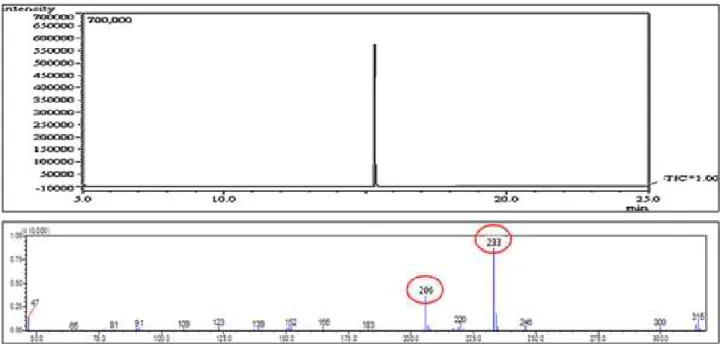
Flusilazole의 정제는 column 상부에 10 mLn-hexane에 재용 해한 시료를 가하고 30 mLn-hexane/acetone(80/20, v/v)로 흘려버린 후, 다시 70 mLn-hexane/acetone(60/40, v/v)로 용 출시켰다. 이 용출액을 감압·농축한 뒤 일정량의 acetone에 재용해하여 DB-5MS[30 m (L.) x 0.25 mm (I.D.) × 0.25 μm (film thickness)]을 장착한 GC-MS(Shimadzu GC 2010 with GC-MS QP2010 Plus, Japan)로 분석하였다. GC-MS의 이온 화 방식은 electron impact(EI) mode이었으며 flusilazole의 selective ion monitoring(SIM) 분석을 위한 target ion은 206 및 233 m/z로 설정되었다. Myclobutanil의 정제는 동일한 column 상부에 10 mLn-hexane에 재용해한 시료를 가하고 60 mLn-hexane/acetone(80/20, v/v)로 흘려버린 후, 다시 60 mLn-hexane/acetone(60/40, v/v)로 용출시켰다. 이 용출액을 감압·농축한 뒤 일정량의 acetone에 재용해하여 DB-5[30 m (L.) × 0.25 mm (I.D.) × 0.25 μm (film thickness)] column을 장착한 GC-ECD(Shimadzu GC 2010, Japan)로 분석하였다.
사과시료 중 각 농약의 잔류량은 0.1~10.0 mg/kg의 표준희 석용액으로 작성된 검량선의 직선회귀식을 이용하여 산 출하였다.
감소상수 및 생물학적 반감기 산출
사과 중 flusilazole 및 myclobutanil의 감소상수(dissipation constant, k)는 first order kinetics에 따라 아래의 식에 의해 계산하였다.
위 식에서 C는 농약의 일자별 잔류량(mg/kg), t는 경과일자 (day),k는 감소상수를 나타내며, Ct는t시간에 농약의 잔류 량(mg/kg), C0는 초기시간에 농약의 잔류량(mg/kg)을 나타 내는 식으로 정리하였다.
실제 시험을 통해 분석된 각 농약의 일자별 잔류량 그래프 로부터 지수감소식(exponential dissipation equation)을 유도 함으로써 위 식의k 값을 산출하였으며, 일자별 잔류량 그래프는 SigmaPlot 10.0 ver. 프로그램을 이용하여 얻었다.
위의 first order kinetics 식을 이용하여 반감기 중 농약의 잔류량을 산출하는 식을 유도하였으며, 이 식을 정리함으 로써 생물학적 반감기(biological half-life, T)를 산출하는 식을 얻었다.
앞서 산출한 각 농약별k값을 대입하여 사과 중 각 농약의 반감기를 산출하였다.
출하 전 농약 잔류허용기준 설정
사과의 출하 전 농약 잔류허용기준(Pre-Harvest Residue Limit, PHRL)은 다음 식에 따라 계산하였다.
이 식에서Md는 출하 전 농약잔류허용기준(mg/kg),Mh는 출하일의 농약잔류허용기준(mg/kg),k는 감소상수,d는 출 하 전 일자(day)를 의미한다. 사과(인과류) 중 출하일의 잔류허용기준(Maximum Residue Limit, MRL)은 flusilazole 의 경우 0.30 mg/kg, myclobutanil의 경우 0.50 mg/kg이었으 며(Ministry of Food and Drug Safety 2013), 포장시험을 통해 얻어진 각 농약의 감소상수를 대입하여 사과의 출하전 일자별 농약의 잔류허용기준치를 산출하였다.
결과 및 고찰
사과의 증체율 및 재배시 기상조건
작물체 중 농약의 잔류는 작물체의 형태, 재배방법 및 생장 속도 등에 의해 영향을 받을 수 있으며 특히 농약이 살포되 어 부착되는 작물체의 표면상태나 증체율 등은 농약의 작물 잔류성에 큰 영향을 미치는 요인들이다(Lee et al.
2004; Na et al. 2013). 따라서 시험기간 중 사과의 무게변화 를 측정하여 증체율을 조사하였으며 그 결과는 Figure 1과 같다. 일자별로 측정된 사과의 개수는 30개였으며, Tukey- test를 이용한 통계분석 시에는 시간의 경과에 따라 사과의 무게가 유의한 차이를 보이며 서서히 증가하는 것으로 나타났다. 하지만 사과는 대부분의 박과류나 엽채류에 비 하여 상대적으로 무게의 변화가 적은 작물군에 속하며 (Kim et al. 2002; Lee et al. 2005; Lee et al. 2009b; Kim et
al. 2012), 본 연구의 시험기간 중 사과무게의 증체율 역시 미미한 수준인 것으로 판단되어 사과의 증체율 변화는 두 농약의 잔류양상에 큰 영향을 미치지 않을 것으로 사료 된다. 시험기간 중 포장의 평균온도 및 습도는 각각 15.6±1.5℃와 53.6±8.2%이었다.4)
Figure 1. Box-Whisker plots showing weight changes of harvested apples during experimental period.
The line in the boxes represents the median; the boxes are between the 25thand the 75th percentile; the whisker extends to the 95thpercentile of the measured weights; the closed cycles indicate the highest weight. The mean apple weights with different italic words are significantly different (p< 0.05, Tukey-test).
회수율 시험
Flusilazole 및 myclobutanil의 검량선 및 사과 중 회수율은 Table 2 및 3과 같다. 두 농약의 검량선은 상관계수(R2)
Table 2. Linear equations and coefficients of correlation (R2) obtained from calibration curves of flusilazole and myclobutanil
Pesticide Slope Intercept R2 Flusilazole 75,266 10,022 0.9997 Myclobutanil 82,748 7,435 0.9995
Table 3. Recoveries and limit of quantitation for flusilazole and myclobutanil in apples Pesticide Fortification level
(mg/kg)
Recovery (%) MDAb)
(ng) LODc) (mg/kg)
1 2 3 Meana)± SD
Flusilazole 0.2 83.8 96.1 96.5 92.1 ± 7.3
0.1 0.01
1.0 101.4 99.3 100.8 100.5 ± 1.1 Myclobutanil 0.2 100.4 104.1 98.2 100.9 ± 3.0 1.0 79.8 83.9 82.3 82.0 ± 2.1
a)Mean of triplication; b)MDA,Minimum detectable amount; c)LOD, Limit of Detection
값이 0.9995~0.9997로 상당히 양호한 직선성을 나타내었으 며, 회수율 역시 79.8~104.1%로 나타나 잔류농약분석 기준 인 70~120% 이내의 회수율을 만족하였다. 또한 기기분석 시 최소검출량(Minimum Detectable Amount, MDA)은 두 농 약 모두 0.1 ng으로 나타났고 검출한계(Limit of Detection, LOD)는 0.01 mg/kg로 산출되어 사과 중 두 농약의 고감도 잔류분석이 가능하였다.
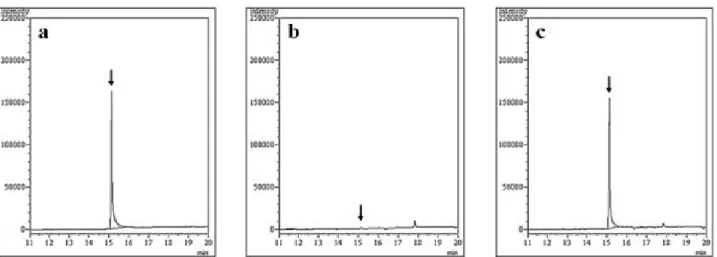
Flusilazole 농약의 분석에는 감도 및 선택성이 높은 GC-MS 기기를 사용하였고 이로부터 분석된 표준품의 total ion chromatogram(TIC) 및 electron impact(EI) mass spectrum은 Figure 2와 같다. 또한 사과 중 두 농약의 회수율시험 결과 크로마토그램은 Figure 3 및 4에 나타내었으며, 두 농약의 머무름 시간에 간섭피크는 존재하지 않았다.
사과 재배기간 중 농약잔류량 변화
사과의 재배기간 중 flusilazole 및 myclobutanil의 잔류양상 은 농약의 종류와 살포량에 따라 Figure 5와 같이 상이하게 나타났다. Flusilazole의 경우, 기준량 살포된 처리구에서는 최종살포 2시간 후에 최대 0.05 mg/kg까지 잔류하였으나, 시간이 경과함에 따라 14일 후에는 0.01 mg/kg까지 잔류량 이 감소하였다. 반면에 3배량 살포된 처리구에서는 시험기 간 내에 0.02~0.10 mg/kg의 잔류량을 보이며 기준량 처리구 보다 약 두 배 가량 높은 잔류량을 나타내었다. 하지만 두 처리구 모두에서 flusilazole의 잔류량이 사과 중 잔류허 용기준치인 0.30 mg/kg 이하로 나타나 안전한 수준이었다.
Yu et al. (2011)은 환경조건이 다른 세 개 지역에서 사과 중 flusilazole의 잔류량을 조사하기 위해 기준량과 1.5배량 의 농약을 살포한 결과, 0.117~0.372 mg/kg의 최대 잔류량 을 확인하였다. 이와 비교하여 본 시험에서 측정된 flusilazole의 사과 중 잔류량은 전체 시험기간 동안 0.10 mg/kg 이하의 낮은 잔류량을 나타내었다. Myclobutanil의 사과 중 잔류양상은 기준량과 3배량 처리구에서 각각 0.07~0.11 mg/kg 및 0.11~0.23 mg/kg으로 나타나 3배량의 잔류량이 기준량보다 약 1.5배 이상 높았다. 하지만 myclobutanil의 사과 중 잔류량도 두 처리구 모두에서 잔류 허용기준치인 0.50 mg/kg 이하로 나타나 안전한 수준이었다.
Figure 2. Total ion chromatogram (TIC) and electron impact (EI) mass spectrum of flusilazole analyzed using GC-MS.
5)
Figure 3. Chromatograms of flusilazole recovery in apples analyzed using GC-MS.
(a; 10 ng of flusilazole, b; control, c; recovery at 1.0 mg/kg).
사과 중 두 농약의 잔류량은 시간의 경과에 따라 지속적으 로 감소하여 fulsilazole은 약 80%까지, myclobutanil은 52%
까지 소실되었다. 이러한 결과를 바탕으로 first order kinetics에 근거한 각 농약의 사과 중 생물학적 반감기를 산출하였다. Flusilazole의 생물학적 반감기는 기준량과 3 배량 처리 시 각각 6.7 및 6.2일로 산출되었으며, myclobutanil의 경우 13.3 및 24.8일로 산출되어 동일한 triazole계 농약임에 도 불구하고 화학구조에 의한 차이로 myclobutanil에서 더 긴 반감기를 나타내었다. 이와 관련하여 다른 문헌에서는 flusilazole의 반감기를 사과에서 4.2~7.7일, 감귤에서
6.3~8.4일, 오이에서 2~3일로 보고한 바 있으며(Li and Leng 2004; Yu et al. 2011; Wang et al. 2013), myclobutanil의 반감기 를 양파에서 3.4일, 담뱃잎에서 14.9~6.8일, 여지(lychee)에 서 2.2~3.4일, 밀에서 3.5~4.5일로 보고한 바 있다(Liu et al. 2009; Cui et al. 2011; Liu et al. 2012; Wang et al. 2012).
본 연구에서 산출된 사과 중 flusilazole의 반감기는 다른 문헌들과 비슷한 경향을 나타내었으나, myclobutanil는 비교 적 더 긴 반감기를 가지는 것으로 확인되었다. 이러한 반감 기의 차이는 사과재배 기간 중 환경적인 요인과 작물 간의 특성차이 때문일 것으로 생각된다.
Figure 4. Chromatograms of myclobutanil recovery in apples analyzed using GC-MS.
(a; 10 ng of myclobutanil, b; control, c; recovery at 1.0 mg/kg).
6)
Figure 5. Dissipation patterns of flusilazole (a) and myclobutanil (b) in apples sprayed with single or triple doses on apples.
Error bars represent standard deviations of triplicate experiments. The mean residual amounts of pesticides with different italic words are significantly different (p<
0.05, Duncan’s test).
감소상수 및 출하 전 잔류허용기준 산출
First order kinetic에 의한 감소지수식을 이용하여 사과 중 flusilazole 및 myclobutanil의 감소상수가 산출되었다. 기준 량 처리구에서 감소상수는 flusilazole 및 myclobutanil에 대 해 각각 0.0513 및 0.0244로 나타났으며, 산출된 감소상수들 은 사과의 출하 전 농약 잔류허용기준(MRL)을 설정하기 위한 입력데이터로 사용되었다. 출하 전 잔류허용기준 (PHRL)은 출하 시점에서의 농약 잔류량이 MRL을 초과하 지 않도록 출하 전 일정한 시점의 잔류량을 설정한 기준이 다(Kim et al. 2013). 본 시험의 결과에서는 시험기간 동안 두 농약의 잔류량이 모두 MRL 이하로 나타났지만, 작물 재배기간 중 살포된 농약의 잔류량은 농약의 물리화학적 성질이나 제제의 형태, 함량, 살포방법 또는 작물의 재배조
건 등에 의해 달라질 수 있기 때문에 다양한 조건에서 산출된 감소상수를 이용하여 출하 전 농약의 잔류량을 예측하는 것이 필요하다(Hwang et al. 2012).
현재 식품의약품안전처에서 고시하고 있는 사과(인과류) 중 flusilazole 및 myclobutanil의 MRL 값인 0.30 및 0.50 mg/kg 을 대입하여(Ministry of Food and Drug Safety 2013) 사과 중 두 농약의 PHRL을 산출한 결과는 Table 4와 같았다.
안전사용기준을 준수한 농약살포를 가정하여 출하 10일 전까지 PHRL을 산출한 결과, 출하 일주일 전 사과 중 잔류 량이 flusilazole은 0.43 mg/kg 이하, myclobutanil은 0.59 mg/kg 이하이면 수확 시 잔류농도가 MRL 이하로 잔류할 것으로 예측되었다.
Table 4. Calculation of Pre-Harvest Residue Limits (PHRLs) for pesticides in apple
Pesticide
Pre-Harvest Residue Limit (mg/kg)
Dissipation constant
10 9 8 7 6 5 4 3 2 1 Harvesting
day
Flusilazole 0.50 0.48 0.45 0.43 0.41 0.39 0.37 0.35 0.33 0.32 0.30 0.0513 Myclobutanil 0.64 0.62 0.61 0.59 0.58 0.56 0.55 0.54 0.53 0.51 0.50 0.0244
요 약
사과 중 triazole계 살균제 flusilazole 및 myclobutanil의 생물 학적 반감기와 출하전 잔류허용기준을 산출하기 위해 안 전사용기준에 근거한 기준량과 3배량의 약제를 살포하고 그 잔류량을 조사하였다. 시험기간 중 두 농약의 잔류량은 각각의 MRL 이하로 나타났으며, 사과 중 생물학적 반감기 는 flusilazole의 경우 기준량 처리구에서 6.7일, 3배량 처리 구에서 6.2일로 나타났다. 반면에 myclobutanil의 반감기는 기준량 처리구에서 13.3일, 3배량 처리구에서 24.8일로 나 타나 flusilazole보다 더 긴 반감기를 가지는 것으로 조사되 었다. First order kinetics에 근거한 감소지수식을 이용하여 산출된 각 농약의 감소상수는 flusilazole에 대하여 0.0513, myclobutanil에 대하여 0.0244이었으며, 산출된 감소상수들 을 이용하여 출하 전 잔류허용기준(PHRL)을 계산한 결과, 안전사용기준을 준수한 농약살포를 가정하였을 때 flusilazole은 수확 일주일 전 0.43 mg/kg, myclobutanil은 같은 시기 0.59 mg/kg 이하로 잔류하면 수확 시 잔류농도가 MRL 이하로 잔류할 것으로 예측된다.
감사의 글
이 연구는 2012년 국립농산물품질관리원의 ‘생산단계 농 산물의 잔류농약 허용기준 설정연구’의 연구비 및 2013학 년도 경북대학교 학술 연구비 지원에 의하여 연구되었음.
인용문헌
Clavijo MP, Medina MP, Asensio JS, Bernal JG (1996) Decay study of pesticide residues in apple samples.J Chromatogr A740:146-150.
Cui SH, Wang KY, Yang J, Qian JL, Liu JF, Zhang LD (2011) Residue dynamics of myclobutanil in onion.Agrochemicals 50:283-288.7)
Hwang JI, Jeon YH, Kim HY, Kim JH, Ahn JW, Kim KS, Yu YM, Kim JE (2011) Residue of Fungicide Boscalid in Ginseng Treated by Different Spraying Methods. Kor J Pesticide Sci 15:366-373.
Hwang KW, Kim TW, Yoo JH, Park BS, Moon JK (2012) Dissipation pattern of amisulbrom in cucumber under greenhouse condition for establishing pre-harvest residue limit. Kor J Pesticide Sci 16:288-293.
Kim JE, Kim TH, Kim YH, Lee JH, Kim JS, Paek SK, Choi SY, Youn YN, Yu YM (2008) Residue of tolclofos-methyl, azoxystrobin and difenoconazole in ginseng sprayed by safe use guideline. Kor J Medicinal Crop Sci 16:390-396.
Kim JH, Hwang JI, Jeon YH, Kim HY, Ahn JW, Kim JE (2012) Dissipation patterns of triazole fungicides estimated from kinetic models in apple.J Appl Biol Chem55:235-239.
Kim KJ, Kim DS, Heo SJ, Ham HJ, Hur JH (2013) Establishment or pre-harvest residue limit(PHRL) of emamectin benzoate during cultivation of amaranth.Kor J Pesticide Sci17:77-83.
Kim YS, Park JH, Park JW, Lee YD, Lee KS, Kim JE (2002) Persistence and dislodgeable residues of Chlorpyrifos and Procymidone in lettuce leaves under greenhouse condition.
Kor J Environ Agric 21:149-155.
Kim YS, Park JH, Park JW, Lee YD, Lee KS, Kim JE (2003) Residue Levels of Chlorpyrifos and Chlorothalonil in Apples at Harvest. Kor J Environ Agric 22(2):130-136.
Kirkwood RC (1999) Recent developments in our understanding of the plant cuticle as a barrier to the foliar uptake of pesticides. Pestic Sci 55:69-77.
Korea Crop Protection Association (2012) Agrochemicals use guide book. Korea Crop Protection Association, Korea, pp.
96-404.
Lee HD, Ihm YB, Kwon HY, Kim JB, Kyung KS, Park SS, Oh BY, Im GJ, Kim JE (2005) Characteristics of pesticide residue in/on cucurbitaceous fruit vegetables applied with foliar spraying under greenhouse. Kor J Pesticide Sci 9:359-364.
Lee HD, Kyung KS, Kwon HY, Ihm YB, Kim JB, Park SS, Kim JE (2004) Residue characteristics of hexaconazole and chlorothalonil in several fruits. Kor J Pesticide Sci 8:107-111.
Lee JH, Kim YH, Jeon YH, Shin KS, Kim HY, Kim TH, Kim JE (2009a) Residue amounts of Cypermethrin and Diethofencarb in ginseng sprayed by safe use guideline.
Kor J Environ Agric 28:412-418.
Lee JH, Jeon YH, Shin KS, Kim HY, Park EJ, Kim TH, Kim JE (2009b) Biological half-lives of fungicides in Korean melon under greenhouse condition. Kor J Environ Agric
28:419-426.
Liu X, Dong F, Wang X, Zheng Y (2009) The dissipation rates of Myclobutanil and residue analysis in wheat and soil using gas chromatography-ion trap mass spectrometry. Intern J Environ Anal Chem89:957-967.
Liu Y, Sun H, Liu F, Wang S (2012) Dissipation and residue of Myclobutanil in lychee. Bull Environ Contam Toxicol 88:902-905.
Li W, Leng YF (2004) Residue dynamics of Flusilazole in cucumber and soil. Chin J Pesti Sci 6:87-89.
Ministry for Food, Agriculture, Forestry and Fisheries (2012) Food agriculture, forestry and fisheries statistical yearbook.
Ministry for Food, Agriculture, Forestry and Fisheries, Korea.8)
Ministry of Food and Drug Safety (2012) MRLs for pesticides in foods. Ministry of Food and Drug Safety, Korea.
Na ES, Lee YJ, Kim KJ, Kim SS, Kim JE (2013) Establishment of pre-harvest residue limits of Clothianidin and Thiacloprid in ginseng. Kor J Pesticide Sci 17:155-161.
Park EJ, Lee JH, Kim TH, Kim JE (2009) Residual patterns of Strobilurin fungicides in Korean melon under plastic film house condition. Kor J Environ Agric 28:281-288.
Ricco R, Trevisan M, Capri E (2006) Effect of surface waxes on the persistence of Chlorpyrifos-methyl in apples, strawberries and grape fruits. Food Additives and Contaminants 23:683-692.
Wang CJ, Liu ZQ (2007) Foliar uptake of pesticides–present status and future challenge. Pestic Biochem and Physiol 87:1-8.
Wang C, QiuL, Zhao H, Wang K, Zhang H (2013) Dissipation dynamics and residue distribution of Flusilazole in mandarin.
Environ Monit Access1 85:9169-9176.
Wang X, LiY, Xu G, Sun H, Xu JL, Zheng X, W F (2012) Dissipation and residues of Myclobutanil in tobacco and soil under field conditions. Bull Environ Contam Toxicol 88:759-763.
Yu S, Qin D,Wu Q, GX, Han L, Jiang S (2011) Residue and dissipation dynamics of Flusilazole in apple and soil.Bull Environ Contam Toxicol 86:319-322.