ISSN 2234-3806 • eISSN 2234-3814
https://doi.org/10.3343/alm.2021.41.5.455
Risk Factors for Extended-Spectrum- β-Lactamase- Producing Escherichia coli in Community-Onset Bloodstream Infection: Impact on Long-Term Care Hospitals in Korea
Yae Jee Baek , M.D.1*, Young Ah Kim , M.D.2*, Dokyun Kim , M.D.3, Jong Hee Shin , M.D.4, Young Uh , M.D.5, Kyeong Seob Shin , M.D.6, Jeong Hwan Shin , M.D.7, Seok Hoon Jeong , M.D.3, Geun Woo Lee , M.P.H.8, Eun Ji Lee , M.S8, Dong-Sook Kim , Ph.D.8, Yoon Soo Park , M.D., Ph.D.1
1Department of Internal Medicine, Yonsei University College of Medicine, Seoul, Korea; 2Department of Laboratory Medicine, National Health Insurance Service, Ilsan Hospital, Goyang, Korea; 3Department of Laboratory Medicine and Research Institute of Bacterial Resistance, Yonsei University College of Medicine, Seoul, Korea; 4Department of Laboratory Medicine, Chonnam National University Medical School, Gwangju, Korea; 5Department of Laboratory Medicine, Yonsei University Wonju College of Medicine, Wonju, Korea; 6Department of Laboratory Medicine, Chungbuk National University College of Medicine, Cheongju, Korea; 7Department of Laboratory Medicine and Paik Institute for Clinical Research, Inje University College of Medicine, Busan, Korea;
8Department of Research, Health Insurance Review & Assessment Service, Wonju, Korea
Background: The prevalence of extended-spectrum β-lactamase-producing Escherichia coli (ESBL-EC) in the community has increased worldwide due to multifactorial reasons.
ESBL-EC bloodstream infection (BSI) complicates the decision for proper antimicrobial administration. In this multicenter study, we investigated the prevalence, risk factors, and molecular background of community-onset (CO) ESBL-EC BSI.
Methods: We included data for all episodes of ESBL-EC BSI of community origin from May 2016 to April 2017 obtained from the Korean national antimicrobial resistance sur- veillance system, which comprises six sentinel hospitals. Data, including previous history of admission and use of antimicrobials and medical devices before BSI, were collected, along with microbiological analysis results.
Results: Among 1,189 patients with CO BSI caused by E. coli, 316 (27%) were identified as ESBL producers. History of admission, especially to a long-term care hospital (LTCH), and previous use of β-lactams/β-lactamase inhibitors, carbapenem, lincosamide, amino- glycoside, and extended-spectrum cephalosporin were independent risk factors for CO ESBL-EC BSI; admission to an LTCH showed the highest odds ratio (3.8, 95% confidence interval 2.3–6.1). The most common genotype was CTX-M-15 (N=131, 41%), followed by CTX-M-14 (N=86, 27%). ST131 was the most common sequence type among ESBL- EC groups (57%).
Conclusions: In Korea, 27% of CO E. coli BSI were caused by ESBL producers. From per- spectives of empirical treatment and infection control, history of admission to an LTCH and antimicrobial use should be noted.
Key Words: Community-onset infection, Extended-spectrum β-lactamase-producing Esch- erichia coli, Bloodstream infection, Prevalence, Risk factors, Molecular background
Received: August 10, 2020
Revision received: November 2, 2020 Accepted: March 20, 2021
Corresponding author:
Yoon Soo Park, M.D., Ph.D.
Department of Internal Medicine, Yonsei University College of Medicine, 50-1 Yonsei-ro, Seodaemun-gu, Seoul 03722, Korea
Tel: +82-2-2228-0051 Fax: +82-2-2227-6558 E-mail: [email protected]
* These authors contributed equally to this study.
© Korean Society for Laboratory Medicine This is an Open Access article distributed under the terms of the Creative Commons Attribution Non-Commercial License (https://creativecom- mons.org/licenses/by-nc/4.0) which permits unrestricted non-commercial use, distribution, and reproduction in any medium, provided the original work is properly cited.
2017-03-16 https://crossmark-cdn.crossref.org/widget/v2.0/logos/CROSSMARK_Color_square.svg
INTRODUCTION
Extended-spectrum β-lactamase (ESBL)-producing Escherichia coli (ESBL-EC) has emerged as a major antimicrobial-resistant pathogen in the community worldwide [1]. Since ESBLs are typ- ically plasmid-mediated, acquisition of plasmids containing these genes could confer resistance to antimicrobials [2]. SHV and TEM types were the first ESBLs identified in the late 1980s;
however, the noble CTX-M type ESBL has dominated since the 1990s [3]. Currently, ESBL-EC spread is mainly caused by the CTX-M-type ESBL-producing sequence type (ST) 131, which could pose a challenge for the management of community-on- set (CO) infection [4]. The rapid dissemination of ESBL-EC is likely caused by several factors, such as misuse or overuse of antimicrobials in both humans and animals, international travel, and direct transmission within households and the community [5]. The elucidation of CO BSIs risk factors caused by antimi- crobial-resistant bacteria is particularly important and can help develop specific strategies to prevent these infections and the spread of resistant bacteria. From a clinical perspective, this might help identify patients for whom empirical treatment should include coverage against antimicrobial-resistant infection [6]. As the epidemiological characteristics of ESBL-EC can show significant local variations, multicenter studies are important to obtain comprehensive knowledge of risk factors for infections caused by it. However, there are few large-scale studies of CO bloodstream infection (BSI) caused by ESBL-EC in Korea.
The incidence of CO ESBL-EC BSI was estimated to be 7.3% in Spain (2004–2006) [6], 6.9% in South Korea (2006–2009) [7], 6.1% in the United States (2013) [8], and 55.5% in China (2013–
2014) [9]. However, the ESBL-EC incidence has increased among community-acquired urinary tract infections [10].
We investigated the prevalence, risk factors, and molecular background of CO ESBL-EC BSI in Korea using data from the Korean antimicrobial surveillance system Kor-GLASS. Kor- GLASS is compatible with the Global Antimicrobial Resistance Surveillance System (GLASS) with respect to the standardization of antimicrobial resistance surveillance, in line with the previous Korean Antimicrobial Resistance Monitoring System [11]. The Kor-GLASS was established in May 2016, and the first 1-year assessment up to April 2017 was published in 2018 [12].
MATERIALS AND METHODS
Study designBacterial isolates and clinical data were collected for all epi-
sodes of CO ESBL-EC BSI (CO-BSI) from May 2016 to April 2017 in six sentinel hospitals located throughout Korea, with a total of 5,194 beds (715 to 1,050 beds per hospital). During the study period, 1,510 patients were diagnosed as having E. coli BSI. Among them, 1,211 patients were identified as having a CO-BSI, which represented 80% of total E. coli BSI cases. We excluded 22 patients owing to lack of clinical information, leav- ing 1,189 patients with CO-BSI for analysis. Data for clinical characteristics, including age, sex, intensive care unit (ICU) ad- mission, underlying illness and its severity (Charlson morbidity index and sequential organ failure assessment [SOFA] score), from the electronic medical records of the sentinel hospitals were investigated [14, 15]. History of admission, antimicrobial use, and use of medical devices before BSI were acquired from the National Health Insurance claims database (HIRA claims data, http://nhiss.nhis.or.kr). Only the first bacterial isolate from each patient was collected for microbiological analysis, and sub- sequent isolates were excluded. All isolates collected at the sen- tinel hospitals were transferred to the Research Institute of Bac- terial Resistance, Yonsei University College of Medicine, for mi- crobiological assessments.
Phenotypic confirmatory analysis and multilocus sequence typing (MLST) were conducted for each E. coli isolate at the analysis center. The study was approved by all local Institutional Review Boards of the six sentinel hospitals included in the study (National Health Insurance Service Ilsan Hospital, Yonsei Uni- versity College of Medicine, Yonsei University Wonju College of Medicine, Chonnam National University School of Medicine, Inje University College of Medicine, and Chungbuk National University College of Medicine). The requirement for written in- formed consent was waived.
Definitions
CO-BSI includes healthcare-associated and community-ac- quired infection but excludes hospital-acquired infection [13].
Cases for which the specimen was taken either from an outpa- tient or from a patient hospitalized for <two days were included.
If a patient was transferred from another hospital, the date of transfer was counted from the admission date at the previous hospital. History of admission was included when a patient was admitted to any hospital, excluding a nursing home, within three months before BSI. History of antimicrobial use was defined as any use of antimicrobials within three months before BSI.
Microbiological analysis
EC identification was performed with matrix-assisted laser de-
sorption/ionization time-of-flight (MALDI-TOF) mass spectrome- try (Bruker Biotyper, Bruker Daltonics GmbH, Bremen, Ger- many) at the analysis center. Susceptibility was analyzed by the disk diffusion method on Mueller-Hinton agar (Difco Laborato- ries, Detroit, MI, USA), according to the CLSI guidelines [14].
Genes encoding ESBLs (CTX-M-1, CTX-M-9, CTX-M-2, CTX- M25, TEM, and SHV) were analyzed by PCR [15] and sequenc- ing [16]. Briefly, bacterial DNA was extracted by the boiling lysis method, and the PCR was performed under the following ampli- fication conditions: 94°C for 5 minutes, followed by 35 cycles at 94°C for 30 seconds, then 59°C for 30 seconds (blaTEM), 61°C for 30 seconds (blaSHV), or 56°C for 20 seconds (blaCTX-M), and subsequently 72°C for 30 seconds, followed by a final extension at 72°C for 4 minutes using C1000TM Thermal Cycler (Bio-rad, Hercules, USA). PCR amplicons were purified using a QIAquick PCR purification kit (Qiagen, Hilden, Germany) and sequenced using an Applied Biosystems 3730xl DNA analyzer (Applied Biosystems, Foster City, CA) to identify the variant types of each family. MLST was performed on ESBL-EC isolates using seven conserved housekeeping genes (adk, fumC, gyrB, icd, mdh, purA, and recA) to identify the STs [17], with reference to the EC MLST database (http://mlst.warwick.ac.uk/mlst/dbs/Ecoli).
Statistical analysis
Fisher’s exact test was used for univariate comparisons of cate- gorical data. Variables that were not normally distributed, such as age, Charlson comorbidity index, and SOFA score, were ana- lyzed by Mann–Whitney U test. Variables with P <0.05 from the univariate analysis were included in the multivariate logistic re- gression model using the Backward Stepwise (Wald) method.
We used two multivariate models because of collinearity be- tween variables: history of admission to any hospital and to a long-term care hospital (LTCH). All P values were two-tailed and a P-value <0.05 was considered to indicate statistical signifi- cane. All statistical analyses were performed using IBM SPSS Statistics for Windows software version 23.0 (IBM Corp., Ar- monk, NY, USA).
RESULTS
The median age of the patients was 75 years [interquartile range (IQR) 63–81 years], and 39% patients (465/1,189) were males.
The most prevalent underlying disease was diabetes mellitus (16%, 194/1,189). The median number of antimicrobials used within three months in patients with CO-BSI was 1 (IQR 0–3), and 61% of patients used one or more antimicrobials. The most
frequently used antimicrobial was extended-spectrum cephalo- sporin (29%, 342/1,189), followed by fluoroquinolone (24%) and β-lactams and β-lactamase inhibitors (19%).
Among E. coli causing CO-BSI episodes, 316 were identified as ESBL producers, resulting in an ESBL-EC prevalence of 27%
(95% confidence interval, [CI] 24–29%). The clinical character- istics of patients with CO-BSI caused by ESBL-EC and non-ESBL- EC isolates are given in Table 1. Of the patients with ESBL-EC, 62% (196/316) had a history of admission to any type of hospi- tal, whereas 40% (346/873) of the non-ESBL-EC patients had a history of hospital admission. Admission to LTCH within three months of BSI was more common in the ESBL-EC group than in the non-ESBL-EC group (13% vs. 4%). There was no statistically significant difference in comorbidities, including diabetes, Charl- son comorbidity index, and SOFA score, between the groups.
Univariate logistic regression showed that risk factors of ESBL- EC BSI over those for non-ESBL-EC BSI included a history of ICU admission, history of admission to any hospital and to an LTCH, use of antimicrobials (β-lactams/β-lactamase inhibitors, fluoroquinolone, trimethoprim/sulfamethoxazole, lincosamide, glycopeptide, aminoglycoside, carbapenem, and cephalosporin, regardless of generation), and history of specific intervention (urinary catheterization, nasogastric tubes, and major surgery).
Multivariate analysis of risk factors associated with CO ESBL- EC-BSI is described in Table 2. In the first model, we included a history of admission to any hospital as a variable, whereas the second model included history of admission to an LTCH instead of any hospital, because of recent concerns about antimicrobial resistance in LTCHs in Korea [21]. In the first model, indepen- dent risk factors were history of admission to any hospital (odds ratio [OR] 1.6, 95% CI 1.1–2.2) and previous use of carbape- nem (OR 2.7, 95% CI 1.7–4.3), lincosamide (OR 2.6, 95% CI 1.3–5.3), aminoglycoside (OR 1.8, 95% CI 1.1–2.7), and ex- tended-spectrum cephalosporin (OR 1.5, 95% CI 1.1–2.2). In addition to these variables, the second model identified the his- tory of admission to an LTCH (OR 3.8, 95% CI 2.3–6.1) and previous use of β-lactams/β-lactamase inhibitors (OR 1.4, 95%
CI 1.0–2.0) as significant independent risk factors.
All 316 isolates from patients with confirmed ESBL-EC BSI produced at least one CTX-M enzyme, including 168 (53%) iso- lates of the CTX-M-1 group and 160 (51%) isolates of the CTX- M-9 group; 12 isolates produced both CTX-M-1 and CTX-M-9 enzymes. The most common genotype was CTX-M-15 (41%, N =131 of ESBL-EC), followed by CTX-M-14 (27%, N =86), CTX-M-27 (N=42), CTX-M-55 (N=28), CTX-M-17 (N=8), and CTX-M-24 (N =6). One isolate produced both CTX-M-15 and
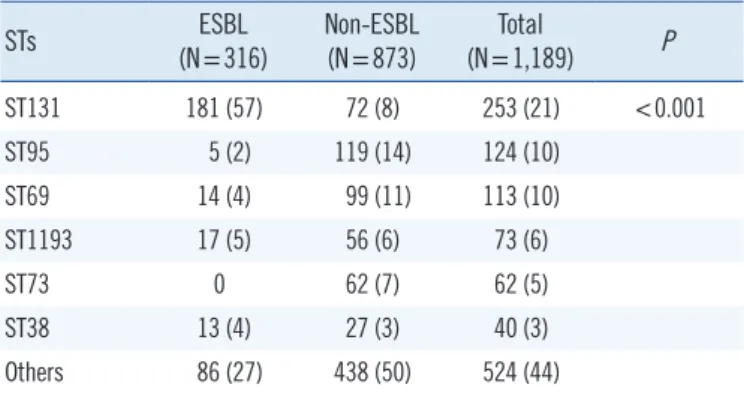
TEM-30. MLST showed that the 316 ESBL-EC isolates belonged to 65 different STs, suggesting substantial genetic diversity among isolates. ST131 was more common in ESBL-EC (57%) than in non-ESBL-EC (8%) isolates (Table 3).
DISCUSSION
Previous studies indicated that risk factors for CO ESBL-EC in- fections were related to contact with healthcare facilities (such as recent admission to a hospital, residence in an LTCH), recent Table 1. Univariate analysis of risk factors associated with community-onset E. coli bloodstream infection
Variables ESBL (N=316) Non-ESBL (N=873) OR (95% CI) P
Age (yr), median (IQR) 75 (63–81) 74 (63–81) 0.595
Male 121 (38) 344 (39) 1.0 (0.8–1.2) 0.737
ICU admission 30 (10) 35 (4) 2.5 (1.5–4.2) <0.001
History of hospital admission 196 (62) 346 (40) 2.5 (1.9–3.2) <0.001
History of LTCH admission 41 (13) 37 (4) 3.4 (2.1–5.4) <0.001
Underlying disease
End-stage renal disease 16 (5) 52 (6) 0.8 (0.5–1.5) 0.672
Cerebrovascular disease 7 (2) 15 (2) 1.3 (0.5–3.2) 0.626
Liver cirrhosis 9 (3) 29 (3) 0.9 (0.4–1.8) 0.852
Chronic pulmonary disease 5 (2) 9 (1) 1.5 (0.5–4.6) 0.542
Diabetes mellitus 62 (20) 132 (15) 1.4 (1.0–1.9) 0.075
Cardiovascular disease 9 (3) 25 (3) 1.0 (0.5–2.2) 1.000
Malignancy 40 (13) 120 (14) 0.9 (0.6–1.3) 0.701
Charlson comorbidity index (median, IQR) 4 (3–5) 4 (3–5) 0.905
SOFA score (median, IQR) 3 (1–5) 3 (1–5) 0.109
Antimicrobial use within previous three months
Penicillin 19 (6) 50 (6) 1.1 (0.6–1.8) 0.888
β-lactam/β-lactamase inhibitor 90 (29) 135 (16) 2.2 (1.6–3.0) <0.001
Fluoroquinolone 107 (34) 174 (20) 2.1 (1.5–2.7) <0.001
Trimethoprim/sulfamethoxazole 10 (3) 10 (1) 2.8 (1.2–6.8) 0.022
Macrolide 22 (7) 39 (5) 1.6 (0.9–2.7) 0.101
Lincosamide 18 (6) 19 (2) 2.7 (1.4–5.2) 0.004
Glycopeptide 16 (5) 21 (2) 2.2 (1.1–4.2) 0.024
Aminoglycoside 40 (13) 57 (7) 2.1 (1.4–3.2) 0.001
Carbapenem 61 (19) 46 (5) 4.3 (2.9–6.5) <0.001
First-generation cephalosporin 41 (13) 62 (7) 2.0 (1.3–3.0) 0.002
Second-generation cephalosporin 70 (22) 132 (15) 1.6 (1.2–2.2) 0.003
Extended-spectrum cephalosporin 137 (43) 205 (24) 2.5 (1.9–3.3) <0.001
History of intervention within three months
Urinary catheterization 58 (18) 80 (9) 2.2 (1.5–3.2) <0.001
Center catheter 18 (6) 32 (4) 1.6 (0.9–2.9) 0.140
Intubation/tracheostomy 3 (1) 6 (1) 1.4 (0.3–5.6) 0.707
Nasogastric tube 20 (6) 26 (3) 2.2 (1.2–4.0) 0.011
Major surgery 13 (4) 16 (2) 2.3 (1.1–4.8) 0.032
Data are summarized as N (%), unless otherwise indicated.
Bold formatting indicates statistical significance.
Abbreviations: CO, community-onset; ESBL, extended-spectrum β-lactamase; EC, Escherichia coli; CI, confidence interval; OR, odds ratio, ICU, intensive care unit; IQR, interquartile range; LTCH, long-term care hospital; SOFA, sequential organ failure assessment.
use of medical devices (such as a urinary catheter), recent use of antimicrobial agents, and comorbidities [6, 18, 19]. In this study, previous admission to a hospital, especially to an LTCH, and use of carbapenem, lincosamide, aminoglycoside, and ex- tended-spectrum cephalosporin antimicrobials within the previ- ous three months emerged as risk factors for ESBL-EC BSI, whereas medical procedures, such as urinary catheterization and use of nasogastric tubes, did not. Our results will assist in adjusting local recommendations for the appropriate empirical antimicrobial therapy of this unique population, in the sense that patients with these ESBL-EC infection risk factors would be considered for empirical therapy using antimicrobials with activ- ity against ESBL producers.
The burden of infection and antimicrobial resistance in LTCHs is a significant threat to public health [20, 21]. The primary lo- cation of antimicrobial resistant bacteria is tertiary-care hospi- tals, but the frequent referral and transfer between acute-care hospitals and LCTHs in Korea has led to the spread of antimi- crobial resistant bacteria to LTCHs [22, 23], which are particu- larly vulnerable due to lack of effective infection control strate- gies [24]. In this study, history of LTCH admission was strongly associated with CO ESBL-EC BSI (OR 3.8, 95% CI 2.3–6.1).
Because the influx of ESBL-EC from LTCHs can cause out-
breaks in acute-care hospitals, appropriate barrier precautions and active surveillance cultures should be employed during pa- tient transfer, according to cost-effectiveness evaluation find- ings. In addition, further study on the current status of antimi- crobial resistance in Korean LTCHs is urgently needed.
This multicenter study of six sentinel hospitals located across Korea showed that an alarmingly high proportion (27%) of CO EC-BSIs are caused by ESBL producers. Korea has experienced a significant increase in the proportion of ESBL producers among CO-BSI causing E. coli, with a 4.1% increase in 2002–
2005 [25] and 9.5% increase in 2006–2009 [7]. Continuous increase of antimicrobials use would increase the prevalence of resistant isolates; however, this correlation is not always obvious due to the complexity of resistance ecology [26]. Among the an- timicrobials, previous use of carbapenem was most significantly associated with CO ESBL-EC BSI in both multivariate models (P <0.001). This suggests that increased use of carbapenem would increase ESBL producers. To prevent antimicrobial resis- tance in the community, it is important to focus on antimicrobial stewardship and, in particular, on the proper use of carbape- nem. Reducing the use of other antimicrobials, such as lincos- amide, aminoglycoside, and extended-spectrum cephalosporin, will also contribute to preventing the spread of ESBL producers in Korea.
All ESBL-EC isolates had CTX-M-type genotypes, including CTX-M-15 (N =131), CTX-M-14 (N =86), CTX-M-27 (N =42), and CTX-M-55 (N=28). CTX-M-15 was the most common type among ESBL-EC from clinical blood isolates at Korean hospitals [27, 28]. CTX-M-55 can be rapidly disseminated and transmit- ted in clinical practices in China [29] and is the most frequently detected ESBL-EC type of animal-origin in Korea [30, 31]. This reflects temporal trends in blaCTX-M epidemiology, showing that Table 2. Multivariate analysis of risk factors associated with com-
munity-onset E. coli bloodstream infection
Model OR (95% CI) P
Model with history of admission to any hospital
History of admission* 1.6 (1.1–2.2) 0.006
Previous use of antimicrobials
Carbapenem 2.7 (1.7–4.3) <0.001
Lincosamide 2.6 (1.3–5.3) 0.006
Aminoglycoside 1.8 (1.1–2.7) 0.014
Extended-spectrum cephalosporin 1.5 (1.1–2.2) 0.031 Model with history of admission to LTCH
History of admission to LTCH* 3.8 (2.3–6.1) <0.001 Previous use of antimicrobials
β-lactam/β-lactamase inhibitor 1.4 (1.0–2.0) 0.039
Carbapenem 2.9 (1.8–4.5) <0.001
Lincosamide 2.6 (1.3–5.1) 0.008
Aminoglycoside 1.8 (1.1–2.8) 0.015
Extended-spectrum cephalosporin 1.7 (1.3–2.4) <0.001 1st generation cephalosporin 1.5 (0.96–2.4) 0.075 Bold formatting indicates statistical significance.
*These two variables were not analyzed simultaneously because of collinearity.
Abbreviations: LTCH, long-term care hospital; OR, odds ratio.
Table 3. Sequence type of community-onset E. coli bloodstream in- fection
STs ESBL
(N=316) Non-ESBL
(N=873) Total
(N=1,189) P
ST131 181 (57) 72 (8) 253 (21) <0.001
ST95 5 (2) 119 (14) 124 (10)
ST69 14 (4) 99 (11) 113 (10)
ST1193 17 (5) 56 (6) 73 (6)
ST73 0 62 (7) 62 (5)
ST38 13 (4) 27 (3) 40 (3)
Others 86 (27) 438 (50) 524 (44)
Data are summarized as N (%) of patients.
Abbreviations: ST, sequence type; ESBL, extended-spectrum β-lactamase.
blaCTX-M-15 and blaCTX-M-14 have displaced other genotypes in many parts of the world [32]. One isolate in our study had both CTX-M-15 and TEM-30.
The MLST results showed clonal diversity among EC isolates, but ST131 was the most common ESBL-EC type; hence, ST131 is another risk factor of ESBL-EC. We previously reported that ST131 clones may be associated with the spread of community- associated BSI exhibiting high antimicrobial resistance and highly virulent H30Rx traits [27]. In a multicenter study from Korea, the prevalence of ST131 isolates was 21% (57/268) [33].
ST131 can harbor CTX-M-14 and CTX-M-15 [27, 31] and was associated with hospital settings but now plays a major role in global dissemination as a pandemic clone, causing predomi- nantly CO antimicrobial-resistant infection [34]. The reasons for the successful dissemination and expansion of the ST131 clones remain unclear, but possible contributors include LTCH [35], mismatched antibiotic selection [36], and the expansion of fluoroquinolone resistance-associated subclones [37]. ESBL- EC spread in communities has led to the increased use of car- bapenems, which creates selection pressure for carbapenem resistance. In this superbug era, carbapenem-resistant Entero- bacteriaceae ST131 warrants close attention with respect to its epidemiological success and high prevalence in community set- tings. Among the 116 carbapenemase-producing strains col- lected from 16 countries during 2008–2013, 41 (35%) were carbapenemase-producing ST131 E. coli isolates [38].
Many of these risk factors have already been identified in stud- ies from other countries. However, similar studies are needed in other regions, because risk factors might show substantial geo- graphic differences across the world, according to antimicrobial- prescribing practices, rates of colonization in the population, and population density. The strength of this study is that we an- alyzed CO-associated E. coli isolated in Kor-GLASS, based on the principles of representativeness, specialization, harmoniza- tion, and localization. The clinical isolates and information from six sentinel hospitals represent four of nine provinces and two of seven metropolitan cities in Korea [12]. We also used HIRA claim data, which include almost all antimicrobials and medical procedures under the National Health Insurance, assuring ac- curacy in data collection. In conclusion, the prevalence of ESBL-EC is increasing in communities, and 27% of CO EC-BSIs are caused by ESBL producers in Korea. Documented risk fac- tors of CO ESBL-EC BSIs should be considered for empirical treatment, infection control measures, and antimicrobial stew- ardship.
ACKNOWLEDGEMENTS
We thank all Kor-GLASS participants for their contribution to the program; we especially thank Hyukmin Lee, MD, Ph.D. of Yon- sei University (Seoul, Korea) for advice regarding the molecular epidemiology of E. coli.
AUTHOR CONTRIBUTIONS
Baek YJ and Kim YA analyzed the data and wrote the manu- script. Kim YA, Kim D, Shin JH, Uh Y, Shin KS, Shin JH, and Jeong SH collected isolates and data. Lee GW, Lee EJ, and Kim DS collected data. Kim D and Jeong SH conducted the microbi- ological analyses. Park YS contributed to the study conception and manuscript revision. All authors have read and approved the final manuscript.
CONFLICTS OF INTEREST
The authors declare no competing interests.
RESEARCH FUNDING
The study was supported by the research programs funded by the Korea Centers for Disease Control & Prevention (2017E280- 401#, PI: YSP; 2017E4400100#, PI: SHJ).
ORCID
Yae Jee Baek https://orcid.org/0000-0003-0994-4940 Young Ah Kim https://orcid.org/0000-0002-9624-0126 Dokyun Kim https://orcid.org/0000-0002-0348-5440 Jong Hee Shin https://orcid.org/0000-0001-9593-476X Young Uh https://orcid.org/0000-0002-2879-7870 Kyeong Seob Shin https://orcid.org/0000-0002-1680-1510 Jeong Hwan Shin https://orcid.org/0000-0003-3960-6969 Seok Hoon Jeong https://orcid.org/0000-0001-9290-897X Geun Woo Lee https://orcid.org/0000-0002-1459-1652 Eun Ji Lee https://orcid.org/0000-0002-6026-6148 Dong-Sook Kim https://orcid.org/0000-0003-2372-1807 Yoon Soo Park https://orcid.org/0000-0003-4640-9525
REFERENCES
1. Rodriguez-Baño J and Paterson DL. A change in the epidemiology of infections due to extended-spectrum beta-lactamase-producing organ-
isms. Clin Infect Dis 2006;42:935-7.
2. Paterson DL. Resistance in gram-negative bacteria: Enterobacteriaceae.
Am J Infect Control 2006;34:S20-8.
3. Pitout JD, Nordmann P, Laupland KB, Poirel L. Emergence of Entero- bacteriaceae producing extended-spectrum β-lactamases (ESBLs) in the community. J Antimicrob Chemother 2005;56:52-9.
4. Johnson JR, Johnston B, Clabots C, Kuskowski MA, Castanheira M.
Escherichia coli sequence type ST131 as the major cause of serious multidrug-resistant E. coli infections in the United States. Clin Infect Dis 2010;51:286-94.
5. Doi Y, Iovleva A, Bonomo RA. The ecology of extended-spectrum beta- lactamases (ESBLs) in the developed world. J Travel Med 2017;24:S44- 51.
6. Rodríguez-Baño J, Picón E, Gijón P, Hernández JR, Ruíz M, Peña C, et al.
Community-onset bacteremia due to extended-spectrum β-lactamase- producing Escherichia coli: risk factors and prognosis. Clin Infect Dis 2010;50:40-8.
7. Kang CI, Song JH, Chung DR, Peck KR, Ko KS, Yeom JS, et al. Risk factors and treatment outcomes of community-onset bacteraemia caused by extended-spectrum beta-lactamase-producing Escherichia coli. Int J Antimicrob Agents 2010;36:284-7.
8. Zahar JR, Lesprit P, Ruckly S, Eden A, Hikombo H, Bernard L, et al.
Predominance of healthcare-associated cases among episodes of com- munity-onset bacteraemia due to extended-spectrum β-lactamase- producing Enterobacteriaceae. Int J Antimicrob Agents 2017;49:67-73.
9. Quan J, Zhao D, Liu L, Chen Y, Zhou J, Jiang Y, et al. High prevalence of ESBL-producing Escherichia coli and Klebsiella pneumoniae in com- munity-onset bloodstream infections in China. J Antimicrob Chemother 2017;72:273-80.
10. Kim YJ, Lee J-M, Cho J, Lee J. Change in the annual antibiotic suscep- tibility of Escherichia coli in community-onset urinary tract infection be- tween 2008 and 2017 in a tertiary care hospital in Korea. J Korean Med Sci 2019;34:e228.
11. Kim D, Ahn JY, Lee CH, Jang SJ, Lee H, Yong D, et al. Increasing resis- tance to extended-spectrum cephalosporins, fluoroquinolone, and car- bapenem in gram-negative bacilli and the emergence of carbapenem non-susceptibility in Klebsiella pneumoniae: analysis of Korean Antimi- crobial Resistance Monitoring System (KARMS) data from 2013 to 2015. Ann Lab Med 2017;37:231-9.
12. Lee H, Yoon EJ, Kim D, Jeong SH, Shin JH, Shin JH, et al. Establish- ment of the South Korean national antimicrobial resistance surveillance system, Kor-GLASS, in 2016. Euro Surveill 2018;23:1700734.
13. Friedman ND, Kaye KS, Stout JE, McGarry SA, Trivette SL, Briggs JP, et al. Health care–associated bloodstream infections in adults: a reason to change the accepted definition of community-acquired infections. Ann Intern Med 2002;137:791-7.
14. CLSI. Performance standards for antimicrobial susceptibility testing.
26th ed. CLSI M100-S26. Wayne, PA: Clinical and Laboratory Stan- dards Institute. 2016.
15. Urban C, Mariano N, Bradford PA, Tuckman M, Segal-Maurer S, Weh- beh W, et al. Identification of CTX-M β-lactamases in Escherichia coli from hospitalized patients and residents of long-term care facilities. Di- agn Microbiol Infect Dis 2010;66:402-6.
16. Yoon EJ, Choi MH, Park YS, Lee HS, Kim D, Lee H, et al. Impact of host-pathogen-treatment tripartite components on early mortality of pa- tients with Escherichia coli bloodstream infection: prospective observa- tional study. EBioMedicine 2018;35:76-86.
17. Wirth T, Falush D, Lan R, Colles F, Mensa P, Wieler LH, et al. Sex and virulence in Escherichia coli: an evolutionary perspective. Mol Microbiol 2006;60:1136-51.
18. Isendahl J, Giske CG, Tegmark Wisell K, Ternhag A, Nauclér P. Risk factors for community-onset bloodstream infection with extended-spec- trum beta-lactamase-producing Enterobacteriaceae: national popula- tion-based case-control study. Clin Microbiol Infect 2019;25:1408-14.
19. Ben-Ami R, Rodríguez-Baño J, Arslan H, Pitout JD, Quentin C, Calbo ES, et al. A multinational survey of risk factors for infection with extend- ed-spectrum beta-lactamase-producing enterobacteriaceae in nonhos- pitalized patients. Clin Infect Dis 2009;49:682-90.
20. Almog M, Yanovskay A, Edelstein H, Schwartz N, Colodner R, Chazan B.
Increasing antimicrobial resistance in long-term care facility patients with bacteremia: a 5 year’s surveillance. J Am Med Dir Assoc 2018;19:1024- 6.e1.
21. Yoo JS, Byeon J, Yang J, Yoo JI, Chung GT, Lee YS. High prevalence of extended-spectrum beta-lactamases and plasmid-mediated AmpC be- ta-lactamases in Enterobacteriaceae isolated from long-term care facili- ties in Korea. Diagn Microbiol Infect Dis 2010;67:261-5.
22. Choi JP, Cho EH, Lee SJ, Lee ST, Koo MS, Song YG. Influx of multidrug resistant, Gram-negative bacteria (MDRGNB) in a public hospital among elderly patients from long-term care facilities: a single-center pi- lot study. Arch Gerontol Geriatr 2012;54:e19-22.
23. Choi MJ, Noh JY, Cheong HJ, Kim WJ, Kim MJ, Jang YS, et al. Spread of ceftriaxone non-susceptible pneumococci in South Korea: long-term care facilities as a potential reservoir. PLoS One 2019;14:e0210520.
24. Kariya N, Sakon N, Komano J, Tomono K, Iso H. Current prevention and control of health care-associated infections in long-term care facili- ties for the elderly in Japan. J Infect Chemother 2018;24:347-52.
25. Kang CI, Cheong HS, Chung DR, Peck KR, Song JH, Oh MD, et al.
Clinical features and outcome of community-onset bloodstream infec- tions caused by extended-spectrum beta-lactamase-producing Esche- richia coli. Eur J Clin Microbiol Infect Dis 2008;27:85-8.
26. Turnidge J and Christiansen K. Antimicrobial use and resistance–prov- ing the obvious. Lancet 2005;365:548-9.
27. Kim H, Kim YA, Park YS, Choi MH, Lee GI, Lee K. Risk factors and mo- lecular features of sequence type (ST) 131 extended-spectrum beta- lactamase-producing Escherichia coli in community-onset bacteremia.
Sci Rep 2017;7:14640.
28. Kim YA, Kim JJ, Kim H, Lee K. Community-onset extended-spectrum- beta-lactamase-producing Escherichia coli sequence type 131 at two Korean community hospitals: the spread of multidrug-resistant E. coli to the community via healthcare facilities. Int J Infect Dis 2017;54:39-42.
29. Hu X, Gou J, Guo X, Cao Z, Li Y, Jiao H, et al. Genetic contexts related to the diffusion of plasmid-mediated CTX-M-55 extended-spectrum be- ta-lactamase isolated from Enterobacteriaceae in China. Ann Clin Mi- crobiol Antimicrob 2018;17:12.
30. Kim YA, Kim H, Choi MH, Seo YH, Lee H, Lee K. Whole-genome analy- sis of blaCTX-M-55-carrying Escherichia coli among pigs, farm environ- ment, and farm workers. Ann Lab Med 2020;40:180-3.
31. Kim YA, Kim H, Seo YH, Park GE, Lee H, Lee K. Prevalence and mo- lecular epidemiology of extended-spectrum-β-lactamase (ESBL)-pro- ducing Escherichia coli from multiple sectors of the swine industry in Korea: A Korean nationwide monitoring program for a One Health ap- proach to combat antimicrobial resistance. Ann Lab Med 2021;41:285- 92.
32. Bevan ER, Jones AM, Hawkey PM. Global epidemiology of CTX-M beta- lactamases: temporal and geographical shifts in genotype. J Antimicrob Chemother 2017;72:2145-55.
33. Kim SY, Park YJ, Johnson JR, Yu JK, Kim YK, Kim YS. Prevalence and characteristics of Escherichia coli sequence type 131 and its H30 and H30Rx subclones: a multicenter study from Korea. Diagn Microbiol In- fect Dis 2016;84:97-101.
34. Lee E, Lee Y. Prevalence of Escherichia coli carrying pks islands in bac- teremia patients. Ann Lab Med 2018;38: 271-3.
35. Burgess MJ, Johnson JR, Porter SB, Johnston B, Clabots C, Lahr BD, et al. Long-term care facilities are reservoirs for antimicrobial-resistant sequence type 131 Escherichia coli. Open Forum Infect Dis 2015;2:
ofv011.
36. Tchesnokova V, Riddell K, Scholes D, Johnson JR, Sokurenko EV. The Uropathogenic Escherichia coli subclone sequence type 131-H 30 is responsible for most antibiotic prescription errors at an urgent care clin-
ic. Clin Infect Dis 2019;68:781-7.
37. Johnson JR, Thuras P, Johnston BD, Weissman SJ, Limaye AP, Riddell K, et al. The pandemic H 30 subclone of Escherichia coli sequence type 131 is associated with persistent infections and adverse outcomes independent from its multidrug resistance and associations with com- promised hosts. Clin Infect Dis 2016;62:1529-36.
38. Peirano G, Bradford PA, Kazmierczak KM, Badal RE, Hackel M, Hoban DJ, et al. Global incidence of carbapenemase-producing Escherichia coli ST131. Emerg Infect Dis 2014;20:1928-31.