INTRODUCTION
The incidence of new-onset postoperative atrial fibrillation (POAF) ranges from 25 to 40% after coronary artery bypass graft (CABG) surgery and up to 62% after a combined CABG
and valve procedure.1-3 POAF has been shown to be associat- ed with an increased risk of postoperative stroke and an in- creased length of hospital stay.4 As the demographic profile of patients undergoing CABG shifts toward adults of older age, the incidence of POAF will increase, because the frequency of this complication sharply increases with age.5 Although POAF has been commonly regarded as a benign, transient, and self- limited complication after cardiac surgery, it has been found to be associated with perioperative myocardial infarction, re- nal failure, cognitive dysfunction, infective complications, higher readmission rate, and increasing medical costs.5-8 It has been demonstrated that long-term mortality is increased in patients with an episode of POAF because of an increased risk of cardiovascular death.7,9 Recently, we found that POAF is in- dependently associated with long-term (>1 year) newly devel- oped atrial fibrillation (LTAF) and mortality.10 However, the Received: November 9, 2016 Revised: August 19, 2017
Accepted: August 22, 2017
Corresponding author: Dr. Boyoung Joung, Division of Cardiology, Department of Internal Medicine, Severance Hospital, Yonsei University College of Medicine, 50-1 Yonsei-ro, Seodaemun-gu, Seoul 03722, Korea.
Tel: 82-2-2228-8460, Fax: 82-2-393-2041, E-mail: [email protected]
•The authors have no financial conflicts of interest.
© Copyright: Yonsei University College of Medicine 2017
This is an Open Access article distributed under the terms of the Creative Com- mons Attribution Non-Commercial License (http://creativecommons.org/licenses/
by-nc/4.0) which permits unrestricted non-commercial use, distribution, and repro- duction in any medium, provided the original work is properly cited.
Gender Difference in the Long-Term Clinical
Implications of New-Onset Atrial Fibrillation after Coronary Artery Bypass Grafting
Seung-Hyun Lee
1,2, Hancheol Lee
3, Jin-Kyu Park
1, Jae-Sun Uhm
1, Jong-Youn Kim
1, Hui-Nam Pak
1, Moon-Hyoung Lee
1, Ho-Geun Yoon
2, and Boyoung Joung
11Division of Cardiology, Department of Internal Medicine, Severance Hospital, Yonsei University College of Medicine, Seoul;
2Department of Biochemistry and Molecular Biology, Brain Korea 21 PLUS Project for Medical Science, Yonsei University College of Medicine, Seoul;
3Division of Cardiology, National Health Insurance Service Ilsan Hospital, Goyang, Korea.
Purpose: New-onset postoperative atrial fibrillation (POAF) is associated with poor short- and long-term outcomes after isolated coronary artery bypass graft (CABG) surgery. This study evaluated gender differences in the long-term clinical implications of POAF.
Materials and Methods: After propensity score matching, a gender-based comparison of long-term (>1 year) newly developed atrial fibrillation (LTAF) and mortality between 1664 (480 females) consecutive patients with (POAF) and without POAF (no- POAF) who had undergone CABG was performed.
Results: During a follow-up of 49±28 months, cumulative survival free of LTAF was lower in the POAF group than in the no-POAF group for both males (92.1% vs. 98.2%, p<0.001) and females (84.1% vs. 98.0%, p<0.001). However, female patients with POAF more frequently developed LTAF than male POAF patients (13.9 % vs. 6.9%, p=0.049). In multivariate analysis, POAF was a signifi- cant predictor of LTAF among males [hazard ratio (HR) 4.91; 95% confidence interval (CI) 1.22−19.79, p=0.031] and females (HR 16.50; 95% CI 4.79−56.78; p<0.001). POAF was a predictor of long-term mortality among females (adjusted HR 3.96; 95% CI 1.13−13.87, p=0.033), but not among males.
Conclusion: Although POAF was related to LTAF in both genders, cumulative survival free of LTAF was poorer among females than among males. Additionally, a significant correlation with long-term mortality after CABG was observed among female pa- tients with POAF.
Key Words: Atrial fibrillation, coronary artery bypass graft, postoperative complications, survival, gender
pISSN: 0513-5796 · eISSN: 1976-2437 Yonsei Med J 2017 Nov;58(6):1119-1127
https://doi.org/10.3349/ymj.2017.58.6.1119
gender differences in the long-term prognosis and the effect of POAF has not been fully elucidated. Therefore, we aimed to investigate gender differences in the long-term prognosis and the effect of POAF.
MATERIALS AND METHODS
Patients
The study protocol was approved by the Institutional Review Board of Severance Cardiovascular Hospital, Seoul, Korea and complied with the Declaration of Helsinki. We used Interna- tional Statistical Classification of Disease and Related Health Problems, 10th revision, codes to identify 1810 consecutive adult patients who underwent an isolated CABG at the Sever- ance Cardiovascular Hospital, Yonsei University Health Sys- tem, between January 2005 and December 2011. Patients with a history of atrial fibrillation (AF) (n=94) or emergency surgery (n=38) and those who had insufficient medical records (n=8) were excluded. Additionally, patients who died within 10 days after surgery (n=6) were excluded. Finally, we enrolled 1664 patients who were divided into two groups based on their gen- der (females, n=480 and males, n=1184) (Fig. 1).
We obtained detailed information regarding patient demo- graphics, preoperative risk factors, operative details, postop- erative hospital courses, and morbidity and mortality outcomes from the hospital database and through telephone calls. Renal dysfunction was defined as a serum creatinine level of >1.5 mg/dL for at least 3 months and/or the presence of kidney
damage (persistent microalbuminuria, proteinuria, or hema- turia after the exclusion of urological causes or structural ab- normalities detected on kidney imaging tests). Renal failure was defined as a serum creatinine elevation of >three times the baseline or a serum creatinine level of >2.0 mg/dL. Obesity was defined as a body mass index ≥30 kg/m2. Significant coro- nary artery disease was defined as visualized luminal narrow- ing of each vessel of >50%. Hypercholesterolemia was defined as patients having abnormal preoperative lipid profiles ac- cording to the American Heart Association Guidelines or be- ing previously diagnosed and treated by physicians. Before the surgery, the volume of the left atrium (LA) was measured us- ing echocardiography, through the biplane Simpson’s method;
the LA volume index was calculated as the LA volume/body surface area (mL/m2). Diastolic dysfunction was defined as an E to e’ ratio of >15 on echocardiography.
Management and follow-up
POAF was defined as newly developed AF documented using electrocardiography (ECG) or continuous monitoring during the first 10 days after surgery. To restore sinus rhythm in most patients within 24 h after the onset of POAF, electrolyte re- placement, antiarrhythmic drugs (AADs), or electrical cardio- version was applied. Patients with AF who were discharged to their home were maintained on warfarin (in the absence of any contraindications) and usually referred for cardioversion after 3−6 weeks. In the absence of any evidence of AF recur- rence, AADs were stopped, and this decision was left to the discretion of the treating physician. All patients were followed up with a clinical examination and ECG at 2 weeks, 1 month, 3 months, and every 6 months thereafter. In case of symptom recurrence between follow-up visits, patients were evaluated with a clinical examination, ECG, and Holter monitoring.
Outcomes, including mortality, stroke, renal failure, and AF, were evaluated in the follow-up period. Recurrent AF was de- fined as any recurrent AF documented in the patients’ medical and ECG records. In this study, AF that occurred within 1 year after surgery was not included under LTAF (Supplementary Ta- ble 1, only online). Additionally, mortality was defined as death from any cause that occurred at any time after hospital discharge. There were no missing data on preoperative patient characteristics in this study. Long-term follow-up (>1 year) was achieved in 92.3% (1536/1664) of the patients.
Statistical analysis
All continuous data are expressed as a mean±standard devia- tion (SD), and categorical data are reported as an absolute num- ber or percentage. Student’s unpaired t-test or Welch’s t-test was adopted based on variance tests for the distribution. Fish- er’s exact test or Pearson’s chi-squared test with Yates’ conti- nuity correction (expected frequency >5) was used to compare groups of categorical variables. All calculated p-values were two-sided, and p-values of <0.05 were considered statistically CABG (n=1810)
• History of AF (n=94)
• Emergency operations (n=38)
• No medical data (n=8)
• Death <10 days after the CABG (n=6)
Fig. 1. Flow diagram and follow-up for new-onset POAF, LTAF, and mor- tality. CABG, coronary artery bypass graft; AF, atrial fibrillation; POAF, postoperative atrial fibrillation; LTAF, long-term (>1 year) newly devel- oped atrial fibrillation.
1:1 Propensity score matching
Male (n=393)
(n=102)POAF
LTAF (n=7) Death (n=14)
(n=79)POAF
LTAF (n=11) Death (n=9) No POAF
(n=291) LTAF (n=5) Death (n=15)
No POAF (n=314) LTAF (n=6) Death (n=10) Female (n=393) Enrolled patients (n=1664)
(Male:Female=1184:480)
significant. Statistical analyzes were performed using R Statis- tical Software, version 3.0.1 (Foundation for Statistical Comput- ing, Vienna, Austria).
The clinical characteristic variables were compared be- tween males and females before matching, which showed sig- nificant differences. To reduce the effect of selection bias and heterogeneity of the gender subgroup in this retrospective co- hort study, estimated propensity scores were used to match the patients according to gender, using R Statistical Software with the MatchIt package.11 Propensity scores were computed for each of the patients using a logistic regression model compris- ing all 20 variables of baseline characteristics that could have been confounders of AF, such as age, stroke, chronic obstruc- tive pulmonary disease (COPD), renal dysfunction, diabetes, hypercholesterolemia, hypertension, congestive heart failure, peripheral artery occlusive disease, history of percutaneous coronary intervention, recent myocardial infarction, three- vessel disease, left main disease, left ventricular ejection frac- tion, E/e’ ratio, LA volume index, and preoperative medica- tions. A nearest-neighbor matching algorithm was used to match participants, with matches occurring if the difference in the logits of the propensity scores was >0.2 times the SD of the scores. The propensity score model was well calibrated (Hosmer-Lemeshow goodness-of-fit test, p=0.3562), with good discrimination (Harrell’s c index=0.76). Based on the propensi-
ty scores, 393 male patients were matched to 393 female pa- tients (Fig. 1).
A Kaplan-Meier estimate of survival was obtained to investi- gate the differences in mortality and survival free from AF be- tween the male and female groups. Cox proportional hazard models were used to test the significance of POAF in survival free from LTAF and long-term mortality. We selected the most appropriate model according to the Akaike Information Crite- ria and principal of parsimony. The assessment of model ade- quacy was confirmed using scaled Schoenfeld residuals for each variable interaction with time (log). The hazard ratios (HRs), 95% confidence intervals (CIs), and p-values were also reported. In this study, the estimated AF incidence differences between the study groups might have been biased because pa- tients who died during the follow-up might not have survived long enough to develop AF. Therefore, we calculated the HR of competing risk regression using death as a competing event.
RESULTS
Gender differences in pre- and postoperative characteristics, including POAF
Among 1664 enrolled patients, 480 (28.8%) were female, and
>90% of the patients had undergone off-pump surgery in this Table 1. Preoperative Characteristics and Operation Data Stratified by Gender
Variable
Overall series Propensity score-matched pairs Male
(n=1184)
Female
(n=480) p value Male
(n=393)
Female
(n=393) p value
Age (yr, mean±SD) 63±9 66±7 <0.001 66±8 66±7 0.731
Stroke, n (%) 28 (2.4) 7 (1.5) 0.328 9 (2.3) 7 (1.8) 0.801
Chronic obstructive pulmonary disease, n (%) 30 (2.5) 8 (1.7) 0.373 7 (1.8) 8 (2.0) 1.000
Renal dysfunction, n (%) 122 (10.3) 26 (5.4) 0.002 27 (6.9) 21 (5.3) 0.456
Diabetes mellitus, n (%) 461 (38.9) 231 (48.1) 0.001 173 (44.0) 182 (46.3) 0.566
Hypercholesterolemia, n (%) 686 (57.9) 252 (52.5) 0.049 202 (51.4) 214 (54.5) 0.432
Hypertension, n (%) 774 (65.4) 363 (75.6) <0.001 285 (72.5) 290 (73.8) 0.747
Congestive heart failure, n (%) 68 (5.7) 33 (6.9) 0.446 31 (7.9) 25 (6.4) 0.488
Peripheral vascular disease, n (%) 92 (7.8) 21 (4.4) 0.017 17 (4.3) 18 (4.6) 1.000
Recent myocardial infarction, n (%) 168 (14.2) 58 (12.1) 0.291 55 (14.0) 42 (10.7) 0.193
Three-vessel disease, n (%) 792 (66.9) 320 (66.7) 0.975 271 (69.0) 261 (66.4) 0.492
Left main disease, n (%) 271 (22.9) 87 (18.1) 0.038 69 (17.6) 70 (17.8) 1.000
LV ejection fraction (%) 55.0±14.2 59.6±14.0 <0.001 58.4±14.0 59.1±14.0 0.490
E/e’ 13.0±5.5 16.2±7.1 <0.001 14.9±6.5 14.7±5.3 0.624
LA volume index (mL/m2) 26.9±9.4 29.7±9.9 <0.001 30.0±10.5 28.4±9.2 0.382
Medication, n (%)
Statin 460 (38.9) 194 (40.4) 0.591 155 (39.4) 159 (40.5) 0.827
Beta-blocker 583 (49.2) 256 (53.3) 0.145 196 (49.9) 198 (50.4) 0.943
ACEI+ARB 400 (33.8) 184 (38.3) 0.088 143 (36.4) 142 (36.1) 1.000
Calcium antagonist 433 (36.6) 192 (40.0) 0.210 152 (38.7) 155 (39.4) 0.884
POAF 306 (25.8) 107 (22.3) 0.145 102 (26.0) 79 (20.1) 0.062
ACEI, angiotensin converting enzyme inhibitors; ARB, angiotensin II receptor blocker; LA, left atrial; LV, left ventricular; POAF, postoperative atrial fibrillation; SD, standard deviation.
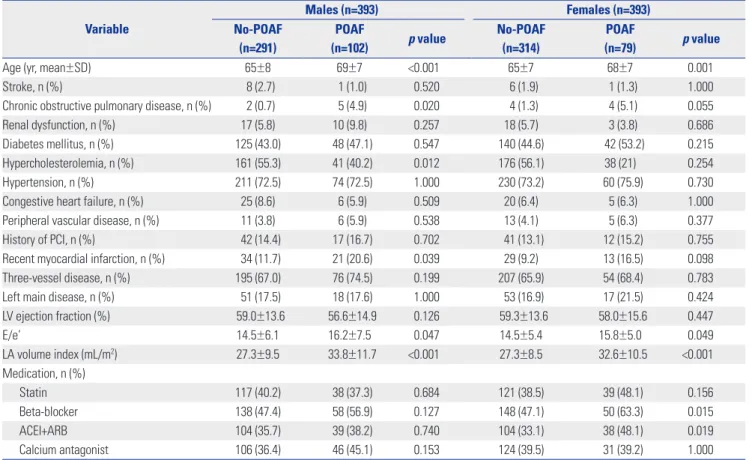
study. The preoperative characteristics and operative data of the male and female groups are presented in Table 1. Com- pared with the male patients, the female patients were older (63±9 years vs. 66±7 years, p<0.001) and more frequently had diabetes (38.9% vs. 48.1%, p=0.001), hypertension (65.4% vs.
75.6%, p<0.001), a higher E/e’ ratio (13.0±5.5 vs. 16.2±7.1, p<
0.001), and a larger LA volume index (26.9±9.4 mL/m2 vs.
29.7±9.9 mL/m2, p<0.001). However, renal dysfunction (10.3%
vs. 5.4%, p=0.002), peripheral vascular disease (7.8% vs. 4.4%, p=0.017), and hypercholesterolemia (57.9% vs. 52.5%, p=0.049) were more common among the male patients. Except for POAF, no gender differences were found in the postoperative data of both overall and propensity score-matched pairs (Supplemen- tary Table 1, only online). The incidence of POAF exhibited no statistical differences between males and females among the overall patients. However, after propensity score matching, the male group exhibited a trend of higher POAF incidence (26.0%
vs. 20.1%, p=0.062), compared with the female group.
Gender differences in the preoperative characteristics stratified by POAF
Table 2 shows the preoperative characteristics and operative data after a propensity score matching stratified by POAF.
Among both genders, the POAF group was older and more fre- quently had a higher E/e’ ratio and a larger LA volume index
(all p<0.050).
Gender differences in the perioperative data stratified by POAF
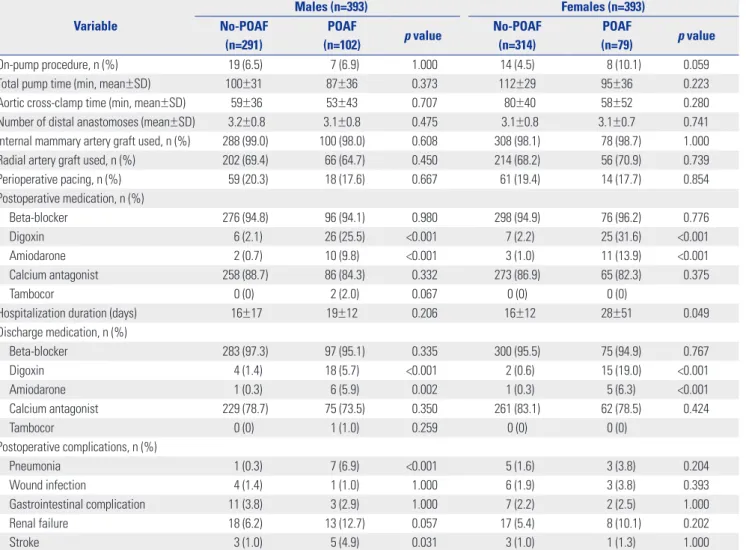
In the female patients, POAF was related to increased hospi- talization duration (16±12 days vs. 28±51 days, p=0.049). Among the male patients, postoperative complications, including pneu- monia (0.3% vs. 6.9%, p<0.001) and stroke (1.0% vs. 4.9%, p=
0.031), were more frequently observed in the POAF group than in the no-POAF group (Table 3). Among both genders, digoxin and amiodarone were more commonly used in the POAF group than in the no-POAF group (all p<0.050).
Gender differences in the incidence and risk factors for LTAF
During follow-up of 49±28 months, the POAF group exhibited higher overall AF (2.2% vs. 21.1%, p<0.001) and LTAF (1.8% vs.
9.2%, p<0.001) rates than the no-POAF group in all patients.
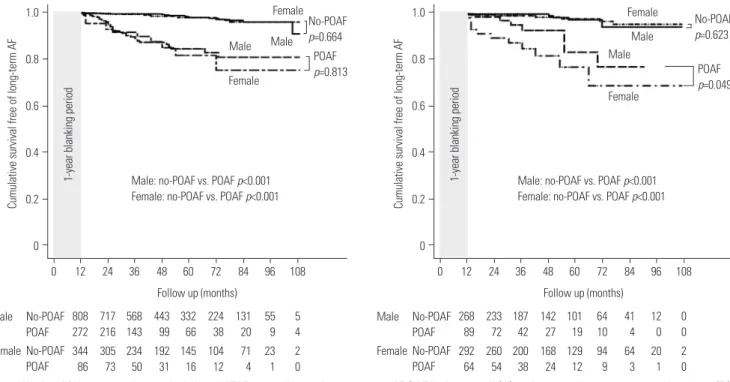
After propensity score matching, the POAF group had a high- er incidence of overall AF and LTAF than the no-POAF group among both genders (all p<0.001). Fig. 2 shows the Kaplan- Meier survival curves for LTAF, according to the presence of POAF in the overall (Fig. 2A) and propensity score-matched patients (Fig. 2B). Regarding the propensity score-matched pairs, the POAF group had a lower cumulative survival free of Table 2. Preoperative Characteristics after Propensity Score Matching Stratified by POAF
Variable
Males (n=393) Females (n=393)
No-POAF (n=291)
POAF
(n=102) p value No-POAF
(n=314)
POAF
(n=79) p value
Age (yr, mean±SD) 65±8 69±7 <0.001 65±7 68±7 0.001
Stroke, n (%) 8 (2.7) 1 (1.0) 0.520 6 (1.9) 1 (1.3) 1.000
Chronic obstructive pulmonary disease, n (%) 2 (0.7) 5 (4.9) 0.020 4 (1.3) 4 (5.1) 0.055
Renal dysfunction, n (%) 17 (5.8) 10 (9.8) 0.257 18 (5.7) 3 (3.8) 0.686
Diabetes mellitus, n (%) 125 (43.0) 48 (47.1) 0.547 140 (44.6) 42 (53.2) 0.215
Hypercholesterolemia, n (%) 161 (55.3) 41 (40.2) 0.012 176 (56.1) 38 (21) 0.254
Hypertension, n (%) 211 (72.5) 74 (72.5) 1.000 230 (73.2) 60 (75.9) 0.730
Congestive heart failure, n (%) 25 (8.6) 6 (5.9) 0.509 20 (6.4) 5 (6.3) 1.000
Peripheral vascular disease, n (%) 11 (3.8) 6 (5.9) 0.538 13 (4.1) 5 (6.3) 0.377
History of PCI, n (%) 42 (14.4) 17 (16.7) 0.702 41 (13.1) 12 (15.2) 0.755
Recent myocardial infarction, n (%) 34 (11.7) 21 (20.6) 0.039 29 (9.2) 13 (16.5) 0.098
Three-vessel disease, n (%) 195 (67.0) 76 (74.5) 0.199 207 (65.9) 54 (68.4) 0.783
Left main disease, n (%) 51 (17.5) 18 (17.6) 1.000 53 (16.9) 17 (21.5) 0.424
LV ejection fraction (%) 59.0±13.6 56.6±14.9 0.126 59.3±13.6 58.0±15.6 0.447
E/e’ 14.5±6.1 16.2±7.5 0.047 14.5±5.4 15.8±5.0 0.049
LA volume index (mL/m2) 27.3±9.5 33.8±11.7 <0.001 27.3±8.5 32.6±10.5 <0.001
Medication, n (%)
Statin 117 (40.2) 38 (37.3) 0.684 121 (38.5) 39 (48.1) 0.156
Beta-blocker 138 (47.4) 58 (56.9) 0.127 148 (47.1) 50 (63.3) 0.015
ACEI+ARB 104 (35.7) 39 (38.2) 0.740 104 (33.1) 38 (48.1) 0.019
Calcium antagonist 106 (36.4) 46 (45.1) 0.153 124 (39.5) 31 (39.2) 1.000
ACEI, angiotensin converting enzyme inhibitors; ARB, angiotensin II receptor blocker; LA, left atrial; LV, left ventricular; PCI, percutaneous coronary intervention;
POAF, postoperative atrial fibrillation; SD, standard deviation.
LTAF than the no-POAF group among male (92.1% vs. 98.2%, p<0.001) and female (84.1% vs. 98.0%, p<0.001) genders. Fur- thermore, female patients with POAF more frequently had LTAF than did male patients with POAF, according to Kaplan- Meier survival analysis (6.9% vs. 13.9 %, p=0.049) (Fig. 2B).
Table 4 presents the multivariate adjusted HRs of LTAF as- sociated with POAF. In the competing risk model, patients with POAF had a higher risk of LTAF among both male (ad- justed HR 4.91; 95% CI 1.22−19.79; p=0.031) and female (ad- justed HR 16.50; 95% CI 4.79−56.78; p<0.001) genders. Addi- tionally, LTAF was associated with COPD in both male (adjusted HR 17.68; 95% CI 1.39−224.58; p=0.032) and female patients (adjusted HR 12.71; 95% CI 1.81−89.06; p=0.011). Furthermore, congestive heart failure (adjusted HR 16.08; 95% CI 3.17−
81.56; p<0.001) and renal dysfunction (adjusted HR 14.16; 95%
CI 3.62−55.36; p<0.001) were significant predictors of LTAF among females, and postoperative beta-blocker usage (ad- justed HR 0.05; 95% CI 0.01−0.20; p<0.001) was a significant predictor of LTAF among males.
Gender differences in the incidence and risk factors for long-term (>1 year) mortality
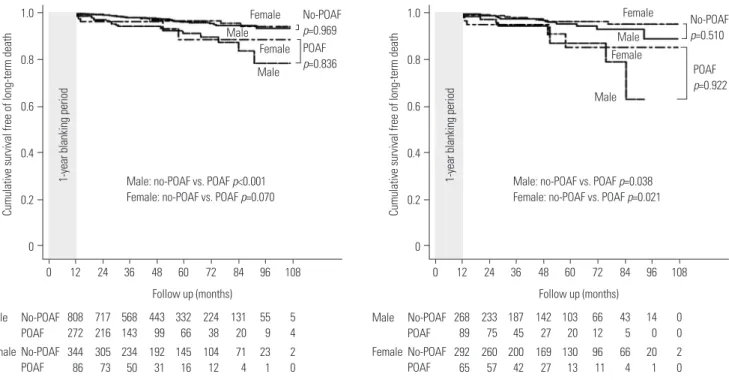
During follow-up, the POAF group had a higher overall mor- tality (3.5% vs. 10.7%, p<0.001) than the no-POAF group in all the patients. Fig. 3 shows the Kaplan-Meier survival curves for long-term mortality, according to the presence of POAF in the overall (Fig. 3A) and propensity score-matched (Fig. 3B) pa- tients. After propensity score matching, the POAF group had a lower cumulative survival free of long-term mortality than the no-POAF group among both genders (all p<0.05). Unlike pa- tients with LTAF, there were no significant differences in long- term mortality between male and female patients with POAF (13.7% vs. 11.4%, p=0.922), according to the Kaplan-Meier sur- vival analysis.
Table 4 presents the multivariate adjusted HRs for long-term mortality associated with POAF. In the Cox proportional haz- ards model, POAF was a risk factor for long-term mortality among females (adjusted HR 3.96; 95% CI 1.13−13.87; p=
0.033) but not among males. Diabetes was a significant risk factor for long-term mortality among both male (adjusted HR 3.04; 95% CI 1.05−8.79; p=0.043) and female (adjusted HR 4.14;
Table 3. Operative Data after Propensity Score Matching Stratified by POAF Variable
Males (n=393) Females (n=393)
No-POAF (n=291)
POAF
(n=102) p value No-POAF
(n=314)
POAF
(n=79) p value
On-pump procedure, n (%) 19 (6.5) 7 (6.9) 1.000 14 (4.5) 8 (10.1) 0.059
Total pump time (min, mean±SD) 100±31 87±36 0.373 112±29 95±36 0.223
Aortic cross-clamp time (min, mean±SD) 59±36 53±43 0.707 80±40 58±52 0.280
Number of distal anastomoses (mean±SD) 3.2±0.8 3.1±0.8 0.475 3.1±0.8 3.1±0.7 0.741
Internal mammary artery graft used, n (%) 288 (99.0) 100 (98.0) 0.608 308 (98.1) 78 (98.7) 1.000
Radial artery graft used, n (%) 202 (69.4) 66 (64.7) 0.450 214 (68.2) 56 (70.9) 0.739
Perioperative pacing, n (%) 59 (20.3) 18 (17.6) 0.667 61 (19.4) 14 (17.7) 0.854
Postoperative medication, n (%)
Beta-blocker 276 (94.8) 96 (94.1) 0.980 298 (94.9) 76 (96.2) 0.776
Digoxin 6 (2.1) 26 (25.5) <0.001 7 (2.2) 25 (31.6) <0.001
Amiodarone 2 (0.7) 10 (9.8) <0.001 3 (1.0) 11 (13.9) <0.001
Calcium antagonist 258 (88.7) 86 (84.3) 0.332 273 (86.9) 65 (82.3) 0.375
Tambocor 0 (0) 2 (2.0) 0.067 0 (0) 0 (0)
Hospitalization duration (days) 16±17 19±12 0.206 16±12 28±51 0.049
Discharge medication, n (%)
Beta-blocker 283 (97.3) 97 (95.1) 0.335 300 (95.5) 75 (94.9) 0.767
Digoxin 4 (1.4) 18 (5.7) <0.001 2 (0.6) 15 (19.0) <0.001
Amiodarone 1 (0.3) 6 (5.9) 0.002 1 (0.3) 5 (6.3) <0.001
Calcium antagonist 229 (78.7) 75 (73.5) 0.350 261 (83.1) 62 (78.5) 0.424
Tambocor 0 (0) 1 (1.0) 0.259 0 (0) 0 (0)
Postoperative complications, n (%)
Pneumonia 1 (0.3) 7 (6.9) <0.001 5 (1.6) 3 (3.8) 0.204
Wound infection 4 (1.4) 1 (1.0) 1.000 6 (1.9) 3 (3.8) 0.393
Gastrointestinal complication 11 (3.8) 3 (2.9) 1.000 7 (2.2) 2 (2.5) 1.000
Renal failure 18 (6.2) 13 (12.7) 0.057 17 (5.4) 8 (10.1) 0.202
Stroke 3 (1.0) 5 (4.9) 0.031 3 (1.0) 1 (1.3) 1.000
POAF, postoperative atrial fibrillation; SD, standard deviation.
95% CI 1.00−17.12; p=0.049) patients.
DISCUSSION
Major findings
The main finding of this study was that, although POAF was related to LTAF among both genders, cumulative survival free of LTAF was poorer in female patients than in male patients.
Second, females with LTAF were related to multiple risk factors, including POAF, congestive heart failure, renal dysfunction,
and COPD. Third, POAF was a determinant of long-term mor- tality in female patients, but not in male patients. These differ- ences suggest a need for more strict surveillance for AF among female patients.
Gender differences in POAF
In both genders, POAF was a common risk factor, along with older age and COPD, and these patients more often presented with comorbidities, including a reduced left ventricular func- tion and increased LA volume index. Although the incidence of POAF according to gender is controversial, several studies Table 4. Effect of Gender on LTAF or Mortality According to Significant Risk Factors in a Multivariate Regression Model
Risk factors Male Female
Adjusted HR (95% CI) p value Adjusted HR (95% CI) p value LTAF*
POAF 4.91 (1.22–19.79) 0.031 16.50 (4.79–56.78) <0.001
Congestive heart failure 1.97 (0.25–15.50) 0.516 16.08 (3.17–81.56) <0.001
Renal dysfunction 0.67 (0.02–16.05) 0.813 14.16 (3.62–55.36) <0.001
Chronic obstructive pulmonary disease 17.68 (1.39–224.58) 0.032 12.71 (1.81–89.06) 0.011
Postoperative beta-blocker usage 0.05 (0.01–0.20) <0.001 3.66 (0.07–192.20) 0.524
Long-term mortality†
POAF 2.26 (0.80–6.33) 0.117 3.96 (1.13–13.87) 0.033
Diabetes mellitus 3.04 (1.05–8.79) 0.043 4.14 (1.00–17.12) 0.049
POAF, postoperative atrial fibrillation; LTAF, long-term (>1 year) newly developed atrial fibrillation; HR, hazard ratio; CI, confidence interval.
*Adjusted for age, POAF, ejection fraction, left atrial volume index, on-pump surgery, chronic obstructive pulmonary disease, congestive heart failure, renal dys- function, recent myocardial infarction, postoperative beta-blocker usage, and the propensity score, †Adjusted for age, POAF, ejection fraction, left atrial volume index, chronic obstructive pulmonary disease, hypercholesterolemia, diabetes mellitus, recent myocardial infarction, renal dysfunction, and the propensity score.
1.0 0.8
0.6
0.4 0.2
0
Cumulative survival free of long-term AF
0 12 24 36 48 60 72 84 96 108
Follow up (months) Male: no-POAF vs. POAF p<0.001 Female: no-POAF vs. POAF p<0.001
No-POAF p=0.664
POAF p=0.813 Male Male
Female
Female
808 272
717 216
568 143
443 99
332 66
131 20 224 38
55 9
5 4 Male No-POAF
POAF 344 86
305 73
234 50
192 31
145 16
71 4 104 12
23 1
2 0 No-POAF
POAF Female
1-year blanking period
1.0 0.8
0.6
0.4 0.2
0
Cumulative survival free of long-term AF
0 12 24 36 48 60 72 84 96 108
Follow up (months) Male: no-POAF vs. POAF p<0.001 Female: no-POAF vs. POAF p<0.001
No-POAF p=0.623
POAF p=0.049 Male
Male Female
Female
268 89
233 72
187 42
142 27
101 19
41 4 64 10
12 0
0 0 Male No-POAF
POAF 292 64
260 54
200 38
168 24
129 12
64 3 94 9
20 1
2 0 No-POAF
POAF Female
1-year blanking period
Fig. 2. Kaplan-Meier curves for survival free of LTAF according to the presence of POAF in the overall (A) and propensity score-matched patients (B).
The left and right panels show the survival curves in the male and female patients according to POAF, respectively. The POAF group had a lower cu- mulative survival free of LTAF than the no-POAF group among both the overall and propensity score-matched patients (all p<0.001). The female POAF group had a lower cumulative survival free of LTAF than the male POAF group among the propensity score-matched patients (p=0.049). LTAF, long- term (>1 year) newly developed atrial fibrillation; POAF, postoperative atrial fibrillation; AF, atrial fibrillation.
have reported that male patients more frequently have POAF after CABG.8,12 After propensity score matching, our results were also consistent with those of recent studies. However, women with AF generally had a lower quality of life and fre- quently had more comorbidities than did men.13 Moreover, the significantly longer length of hospital stays among the female patients with POAF in our study could be similarly explained.
Gender differences in the Role of POAF for LTAF
Previously, new-onset POAF was commonly considered as being relatively easy to treat,14-16 and it rarely recurred after dis- charge from the hospital.15 Other studies have reported that POAF is self-limiting, with a total prevalence of AF of 1−4% at 1 year.15,17,18 On the contrary, recent studies have reported that patients with POAF are at an increased risk of developing over- all AF19,20 and LTAF.10 However, the effects of gender differenc- es in POAF on long-term follow-up are not fully elucidated. In this study, female patients had a poorer cumulative survival free of LTAF than did male patients.POAF was a significant predictor of LTAF in both genders in our multivariate competing risk-adjusted model. However, the other covariates significantly differed according to gender.
Postoperative beta-blocker use and COPD were significant predictors of LTAF in males, whereas congestive heart failure, COPD, and renal dysfunction were predictors in females. These results indicate that, for reducing LTAF, gender-specific risk assessment should be considered during pre- and periopera- tive periods.
Gender differences in POAF as a risk factor for long-term mortality
In general, AF is a well-established risk factor for mortality, stroke, and heart failure.21 Previous studies have reported that worse preoperative risk profiles in patients with POAF account- ed for higher observed early and late mortality.14,20,22,23 In the present study, interestingly, the multivariate regression analy- sis showed that POAF was a significant predictor of long-term mortality in females but not in males. Therefore, POAF in fe- males should be treated as a severe complication with close fol- low-up. There are some points to be considered regarding these results. First, the contributing factors for POAF might differ according to gender. Second, other confounding factors that were not addressed in this study, such as diet, exercise, and fam- ily history, might also have affected the results. Among patients of both genders, diabetes was recognized as a risk factor for long-term mortality after CABG. This finding is consistent with previous studies.24,25
Limitations of the study
First, we performed a risk adjustment in the overall patients by using the propensity score matching method. Therefore, a smaller number of patients were included in the analyses, and a decreased statistical power was inevitable. However, pro- pensity score matching has been shown to provide unbiased and more reliable results.26 Second, the prevalence of AF and other long-term complications at follow-up might have been underestimated because of the retrospective study design.
Third, the older age of patients in this study could lead to a 1.0
0.8
0.6 0.4
0.2
0
Cumulative survival free of long-term death
0 12 24 36 48 60 72 84 96 108
Follow up (months) Male: no-POAF vs. POAF p<0.001 Female: no-POAF vs. POAF p=0.070
No-POAF p=0.969 POAF p=0.836 Male
Male Female Female
808 272
717 216
568 143
443 99
332 66
131 20 224 38
55 9
5 4 Male No-POAF
POAF 344 86
305 73
234 50
192 31
145 16
71 4 104 12
23 1
2 0 No-POAF
POAF Female
1-year blanking period
1.0
0.8
0.6 0.4
0.2
0
Cumulative survival free of long-term death
0 12 24 36 48 60 72 84 96 108
Follow up (months) Male: no-POAF vs. POAF p=0.038 Female: no-POAF vs. POAF p=0.021
No-POAF p=0.510
POAF p=0.922 Male
Female Female
Male
268 89
233 75
187 45
142 27
103 20
43 5 66 12
14 0
0 0 Male No-POAF
POAF 292 65
260 57
200 42
169 27
130 13
66 4 96 11
20 1
2 0 No-POAF
POAF Female
1-year blanking period
Fig. 3. Kaplan-Meier curves for survival free of long-term mortality according to the presence of POAF in the overall (A) and propensity score- matched patients (B). The left and right panels show the survival curves in the male and female patients according to POAF, respectively. The POAF group had a lower cumulative survival free of long-term mortality than the no-POAF group among both the overall and propensity score-matched pa- tients (all p<0.050). POAF, postoperative atrial fibrillation.
bias, because old age affects the incidence of AF and absolute mortality.27 Fourth, despite the convincing findings, it is neces- sary to interpret the results with caution, because POAF and other cardiovascular risk factors may not be completely inde- pendent. Indeed, further large prospective cohort studies are necessary to determine the role of gender in long-term clini- cal implications. Although our results could hardly be gener- alized to all patients, it may reveal a relationship between POAF and long-term prognosis according to gender in off-pump CABG patients of older age.
Conclusions
After isolated CABG, POAF was a significant predictor of LTAF regardless of gender, and cumulative survival free of LTAF was poorer in female than in male patients. Furthermore, male and female patients had different risk predictors of LTAF. POAF was related to long-term mortality in only female patients. These gender differences in the clinical implications of POAF should be considered in careful postoperative surveillance aimed at reducing AF and its complications.
ACKNOWLEDGEMENTS
This research was supported by Basic Science Research Pro- gram through the National Research Foundation of Korea (NRF) funded by the Ministry of Science and ICT (NRF- 2017R1A2B3003303) and grants from the Korean Healthcare technology R&D project funded by the Ministry of Health &
Welfare (HI16C0058, HI15C1200).
REFERENCES
1. Maisel WH, Rawn JD, Stevenson WG. Atrial fibrillation after car- diac surgery. Ann Intern Med 2001;135:1061-73.
2. Ommen SR, Odell JA, Stanton MS. Atrial arrhythmias after car- diothoracic surgery. N Engl J Med 1997;336:1429-34.
3. Shantsila E, Watson T, Lip GY. Atrial fibrillation post-cardiac sur- gery: changing perspectives. Curr Med Res Opin 2006;22:1437-41.
4. Lahtinen J, Biancari F, Salmela E, Mosorin M, Satta J, Rainio P, et al.
Postoperative atrial fibrillation is a major cause of stroke after on- pump coronary artery bypass surgery. Ann Thorac Surg 2004;77:
1241-4.
5. Mathew JP, Parks R, Savino JS, Friedman AS, Koch C, Mangano DT, et al. Atrial fibrillation following coronary artery bypass graft surgery: predictors, outcomes, and resource utilization. Multi- Center Study of Perioperative Ischemia Research Group. JAMA 1996;276:300-6.
6. Almassi GH, Schowalter T, Nicolosi AC, Aggarwal A, Moritz TE, Henderson WG, et al. Atrial fibrillation after cardiac surgery: a ma- jor morbid event? Ann Surg 1997;226:501-11.
7. Albahrani MJ, Swaminathan M, Phillips-Bute B, Smith PK, New- man MF, Mathew JP, et al. Postcardiac surgery complications: as- sociation of acute renal dysfunction and atrial fibrillation. Anesth Analg 2003;96:637-43.
8. Aranki SF, Shaw DP, Adams DH, Rizzo RJ, Couper GS, VanderVliet M, et al. Predictors of atrial fibrillation after coronary artery sur- gery. Current trends and impact on hospital resources. Circula-
tion 1996;94:390-7.
9. Ahlsson A, Bodin L, Fengsrud E, Englund A. Patients with post- operative atrial fibrillation have a doubled cardiovascular mortal- ity. Scand Cardiovasc J 2009;43:330-6.
10. Lee SH, Kang DR, Uhm JS, Shim J, Sung JH, Kim JY, et al. New-on- set atrial fibrillation predicts long-term newly developed atrial fi- brillation after coronary artery bypass graft. Am Heart J 2014;167:
593-600.e1
11. Ho DE, Imai K, King G, Stuart EA. MatchIt: Nonparametric pre- processing for parametric causal inference. J Statistical Software 2011;42:1-28.
12. Zaman AG, Archbold RA, Helft G, Paul EA, Curzen NP, Mills PG.
Atrial fibrillation after coronary artery bypass surgery: a model for preoperative risk stratification. Circulation 2000;101:1403-8.
13. Dagres N, Nieuwlaat R, Vardas PE, Andresen D, Lévy S, Cobbe S, et al. Gender-related differences in presentation, treatment, and outcome of patients with atrial fibrillation in Europe: a report from the Euro Heart Survey on Atrial Fibrillation. J Am Coll Cardi- ol 2007;49:572-7.
14. Villareal RP, Hariharan R, Liu BC, Kar B, Lee VV, Elayda M, et al.
Postoperative atrial fibrillation and mortality after coronary artery bypass surgery. J Am Coll Cardiol 2004;43:742-8.
15. Landymore RW, Howell F. Recurrent atrial arrhythmias following treatment for postoperative atrial fibrillation after coronary by- pass operations. Eur J Cardiothorac Surg 1991;5:436-9.
16. Rubin DA, Nieminski KE, Reed GE, Herman MV. Predictors, pre- vention, and long-term prognosis of atrial fibrillation after coro- nary artery bypass graft operations. J Thorac Cardiovasc Surg 1987;94:331-5.
17. Kowey PR, Stebbins D, Igidbashian L, Goldman SM, Sutter FP, Ri- als SJ, et al. Clinical outcome of patients who develop PAF after CABG surgery. Pacing Clin Electrophysiol 2001;24:191-3.
18. Cioffi G, Cemin C, Russo TE, Pellegrini A, Terrasi F, Ferrario G.
Post-discharge recurrences of new-onset atrial fibrillation follow- ing cardiac surgery: impact of low-dose amiodarone and beta- blocker prophylaxis. Ital Heart J 2000;1:691-7.
19. Antonelli D, Peres D, Freedberg NA, Feldman A, Rosenfeld T. In- cidence of postdischarge symptomatic paroxysmal atrial fibrilla- tion in patients who underwent coronary artery bypass graft: long- term follow-up. Pacing Clin Electrophysiol 2004;27:365-7.
20. Ahlsson A, Fengsrud E, Bodin L, Englund A. Postoperative atrial fibrillation in patients undergoing aortocoronary bypass surgery carries an eightfold risk of future atrial fibrillation and a doubled cardiovascular mortality. Eur J Cardiothorac Surg 2010;37:1353-9.
21. Stewart S, Hart CL, Hole DJ, McMurray JJ. A population-based study of the long-term risks associated with atrial fibrillation: 20- year follow-up of the Renfrew/Paisley study. Am J Med 2002;113:
359-64.
22. Filardo G, Hamilton C, Hebeler RF Jr, Hamman B, Grayburn P.
New-onset postoperative atrial fibrillation after isolated coronary artery bypass graft surgery and long-term survival. Circ Cardiovasc Qual Outcomes 2009;2:164-9.
23. Mariscalco G, Engström KG. Atrial fibrillation after cardiac sur- gery: risk factors and their temporal relationship in prophylactic drug strategy decision. Int J Cardiol 2008;129:354-62.
24. Carson JL, Scholz PM, Chen AY, Peterson ED, Gold J, Schneider SH. Diabetes mellitus increases short-term mortality and morbidi- ty in patients undergoing coronary artery bypass graft surgery. J Am Coll Cardiol 2002;40:418-23.
25. Rajakaruna C, Rogers CA, Suranimala C, Angelini GD, Ascione R.
The effect of diabetes mellitus on patients undergoing coronary surgery: a risk-adjusted analysis. J Thorac Cardiovasc Surg 2006;
132:802-10.
26. Pirracchio R, Resche-Rigon M, Chevret S. Evaluation of the pro- pensity score methods for estimating marginal odds ratios in case of small sample size. BMC Med Res Methodol 2012;12:70.
27. Feinberg WM, Blackshear JL, Laupacis A, Kronmal R, Hart RG.
Prevalence, age distribution, and gender of patients with atrial fi- brillation. Analysis and implications. Arch Intern Med 1995;155:
469-73.