• 검색 결과가 없습니다.

Sternal Healing after Coronary Artery Bypass Grafting Using Bilateral Internal Thoracic Arteries: Assessment by Computed Tomography Scan

N/A
N/A
Protected

Academic year: 2021

Share "Sternal Healing after Coronary Artery Bypass Grafting Using Bilateral Internal Thoracic Arteries: Assessment by Computed Tomography Scan"

Copied!
7
0
0

로드 중.... (전체 텍스트 보기)

전체 글

(1)

ISSN: 2233-601X (Print) ISSN: 2093-6516 (Online)

1

Department of Thoracic and Cardiovascular Surgery, Seoul National University Bundang Hospital,

2

Department of Thoracic and Cardiovascular Surgery, Seoul National University Hospital, Seoul National University College of Medicine,

3

Department of Thoracic and Cardiovascular Surgery, Sejong General Hospital

Received: June 24, 2014, Revised: September 24, 2014, Accepted: October 2, 2014, Published online: February 5, 2015

Corresponding author: Kay-Hyun Park, Department of Thoracic and Cardiovascular Surgery, Seoul National University Bundang Hospital, Seoul National University College of Medicine, 82 Gumi-ro 173 beon-gil, Bundang-gu, Seongnam 463-707, Korea

(Tel) 82-31-787-7141 (Fax) 82-31-787-7140 (E-mail) [email protected]

C

The Korean Society for Thoracic and Cardiovascular Surgery. 2015. All right reserved.

CC
This is an open access article distributed under the terms of the Creative Commons Attribution Non-Commercial License (http://creative- commons.org/licenses/by-nc/3.0) which permits unrestricted non-commercial use, distribution, and reproduction in any medium, provided the original work is properly cited.

Sternal Healing after Coronary Artery Bypass Grafting Using Bilateral Internal Thoracic Arteries:

Assessment by Computed Tomography Scan

Yoon Cheol Shin, M.D.

1

, Sue Hyun Kim, M.D.

2

, Dong Jung Kim, M.D.

1

, Dong Jin Kim, M.D.

3

, Jun Sung Kim, M.D.

1

, Cheong Lim, M.D., Ph.D.

1

, Kay-Hyun Park, M.D., Ph.D.

1

Background: This study aimed to investigate sternal healing over time and the incidence of poor sternal healing in patients undergoing coronary artery bypass graft (CABG) surgery using bilateral internal thoracic arteries. Methods:

This study enrolled 197 patients who underwent isolated CABG using skeletonized bilateral internal thoracic arteries (sBITA) from 2006 through 2009. Postoperative computed tomography (CT) angiography was performed on all pa- tients at monthly intervals for three to six months after surgery. In 108 patients, an additional CT study was per- formed 24 to 48 months after surgery. The axial CT images were used to score sternal fusion at the manubrium, the upper sternum, and the lower sternum. These scores were added to evaluate overall healing: a score of 0 to 1 reflected poor healing, a score of 2 to 4 was defined as fair healing, and a score of 5 to 6 indicated complete healing. Medical records were also retrospectively reviewed to identify perioperative variables associated with poor early sternal healing. Results: Three to six months after surgery, the average total score of sternal healing was 2.07±1.52 and 68 patients (34.5%) showed poor healing. Poor healing was most frequently found in the manu- brium, which was scored as zero in 72.6% of patients. In multivariate analysis, the factors associated with poor early healing were shorter post-surgery time, older age, diabetes mellitus, and postoperative renal dysfunction. In later CT images, the average sternal healing score improved to 5.88±0.38 and complete healing was observed in 98.2% of patients. Conclusion: Complete sternal healing takes more than three months after a median sternotomy for CABG using sBITA. Healing is most delayed in the manubrium.

Key words: 1. Coronary artery bypass 2. Wound healing 3. Mammary arteries 4. Computed tomography

INTRODUCTION

Many reports have investigated sternal wound complica- tions and dehiscence depending on the techniques and devices

employed during sternal closure, but sternal healing is usually

evaluated by assessing symptoms and through physical ex-

aminations [1,2]. Recently, Raman et al. [3] evaluated sternal

healing using axial images of chest computed tomography

http://dx.doi.org/10.5090/kjtcs.2015.48.1.33

(2)

(CT) to determine whether sternal reconstruction using rigid fixation with plates results in improved bone healing, and Vestergaard et al. [4] used chest CT to compare sternal heal- ing after the application of either bone wax or Ostene.

In coronary artery bypass grafting (CABG), it has been demonstrated that bilateral internal thoracic artery (BITA) grafting improves survival and reduces the need for additional revascularization, but concerns have been raised about sternal wound infections after BITA grafting [5]. The increased risk of sternal infection after BITA grafting can be minimized by harvesting the internal thoracic arteries in a skeletonized man- ner with meticulous attention to preserving sternal blood flow, especially in diabetic patients undergoing CABG [6,7].

Skeletonized BITA (sBITA) grafting also results in reduced postoperative pain and dysesthesia and in increased sternal perfusion at follow-up [8]. However, few reports have eval- uated sternal healing after CABG using sBITA, which was the focus of our study. Seoul National University Bundang Hospital, we usually have used sBITA for multivessel anasto- moses in CABG since 2005, and coronary CT has been regu- larly performed to evaluate graft patency after CABG. The coronary CT imaging performed in Seoul National University Bundang Hospital included the whole sternum, leading us to hypothesize that coronary CT could allow us to evaluate ster- nal healing after CABG using sBITA. We reviewed coronary CT records for indications of sternal healing. Our study aimed to investigate the progress of sternal healing over time and the incidence of poor sternal healing in patients under- going CABG using sBITA.

METHODS

From January 2006 to December 2009, CABG was per- formed on 526 patients at Seoul National University Bundang Hospital, of whom 340 underwent CABG using sBITA. We included patients who underwent isolated CABG using sBITA and were examined with coronary CT three to six months af- ter the operation. We excluded patients who underwent com- bined valve surgery, left ventricular remodeling, or aortic sur- gery, as well as patients who did not undergo coronary CT three to six months after the operation. A total of 197 pa- tients were analyzed, of whom 98 (49.7%) had diabetes mel-

litus and eight (4.1%) had chronic renal failure. The mean age of the patients was 64.4 years. Off-pump CABG was performed in 143 patients. We used sBITA and closed the sternum with transsternal wiring, using eight to 10 stainless steel wires (thickness number 5.0; Ethicon, Johnson and Johnson Medical GmbH, Norderstedt, Germany) in all patients. Bone wax was used for hemostasis.

The hospital institutional review board approved this study (B-1310/222-105) and individual patient consent was waived.

We reviewed the coronary CTs of each of the 197 patients to evaluate early postoperative sternal healing. The coronary CTs of 108 patients who were reexamined 24 to 48 months after the operation were analyzed to evaluate longer-term sternal healing. The coronary CT angiography was performed with a 64-slice MDCT scanner (Brilliance 64; Philips Medical Systems, Best, the Netherlands). Scanning was performed with 64×0.625 mm section collimation, 420 ms rotation time, 120 kV tube voltage, 800 mA tube current, and electrocardio- gram-gated dose modulation. A bolus of 80 mL iomeprol (Iomeron 400; Bracco Diagnostics, Milan, Italy) was intra- venously injected (4 mL/sec) followed by a 50 mL saline chaser.

Sternal healing was evaluated by an experienced radiologist. The window width was adjusted to 2,000 Hounsfield units, and the window level to 250 Hounsfield units. Sternal healing was scored in the axial CT images at the levels of the manubrium, upper sternum, and lower ster- num using the following system: 0=definite visible sternal gap, 1=incomplete reunion or visible bone formation, 2=com- plete reunion. A definite visible sternal gap refers to cases in which there was a visible separation of both the anterior and posterior plates of the sternum in the CT image. Incomplete fusion was defined as fusion of one plate and separation of the other. Visible bone formation refers to cases in which bone formation was present without definite bone remodeling.

Complete fusion was defined as the presence of definite bone remodeling in both the anterior and posterior plates (Fig. 1).

The scores assigned to the three levels were summed, and overall sternal healing was categorized as poor (total score 0

−1), fair (total score 2−4), or complete (total score 5−6).

We compared the scores of the manubrium, upper body, and

lower body to determine whether sternal healing varied ac-

(3)

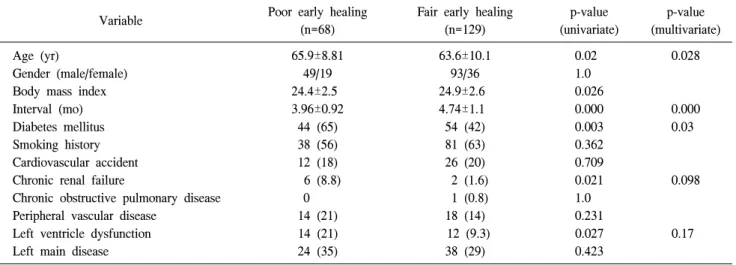
Table 1. Patient characteristics associated with poor early healing

Variable Poor early healing

(n=68)

Fair early healing (n=129)

p-value (univariate)

p-value (multivariate)

Age (yr) 65.9±8.81 63.6±10.1 0.02 0.028

Gender (male/female) 49/19 93/36 1.0

Body mass index 24.4±2.5 24.9±2.6 0.026

Interval (mo) 3.96±0.92 4.74±1.1 0.000 0.000

Diabetes mellitus 44 (65) 54 (42) 0.003 0.03

Smoking history 38 (56) 81 (63) 0.362

Cardiovascular accident 12 (18) 26 (20) 0.709

Chronic renal failure 6 (8.8) 2 (1.6) 0.021 0.098

Chronic obstructive pulmonary disease 0 1 (0.8) 1.0

Peripheral vascular disease 14 (21) 18 (14) 0.231

Left ventricle dysfunction 14 (21) 12 (9.3) 0.027 0.17

Left main disease 24 (35) 38 (29) 0.423

Values are presented as mean±standard deviation or number (%).

Fig. 1. Scoring of sternal healing.

cording to location. Sternal healing was analyzed and com- pared at monthly intervals from three to six months after the operation to evaluate the chronological progression of early sternal healing. In order to assess the risk factors for poor early sternal healing, we divided the patients into two groups:

a poor early healing group (the P group) and a fair or com- plete early healing group (the F group). Medical records were also retrospectively reviewed to identify perioperative varia-

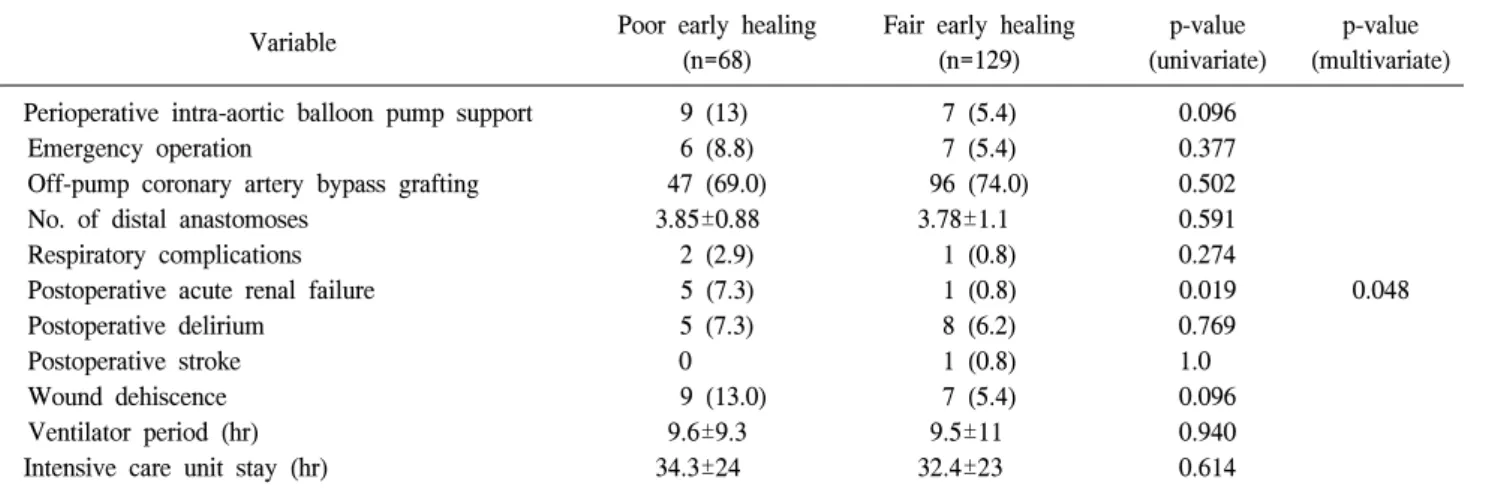
bles associated with early poor sternal healing, and these var- iables were compared between the two groups (Tables 1, 2).

Using the same coronary CT scoring techniques, we eval- uated the long-term sternal healing of 108 patients who un- derwent coronary CT 24 to 48 months after the operation.

We compared the three locations and the two groups (the P group vs. the F group) to evaluate long-term sternal healing.

All analyses were performed with PASW Statistics for

(4)

Table 2. Perioperative variables associated with poor early healing

Variable Poor early healing

(n=68)

Fair early healing (n=129)

p-value (univariate)

p-value (multivariate)

Perioperative intra-aortic balloon pump support 9 (13) 7 (5.4) 0.096

Emergency operation 6 (8.8) 7 (5.4) 0.377

Off-pump coronary artery bypass grafting 47 (69.0) 96 (74.0) 0.502

No. of distal anastomoses 3.85±0.88 3.78±1.1 0.591

Respiratory complications 2 (2.9) 1 (0.8) 0.274

Postoperative acute renal failure 5 (7.3) 1 (0.8) 0.019 0.048

Postoperative delirium 5 (7.3) 8 (6.2) 0.769

Postoperative stroke 0 1 (0.8) 1.0

Wound dehiscence 9 (13.0) 7 (5.4) 0.096

Ventilator period (hr) 9.6±9.3 9.5±11 0.940

Intensive care unit stay (hr) 34.3±24 32.4±23 0.614

Values are presented as number (%) or mean±standard deviation.

Table 3. Scoring of early and late sternal healing

Score No.

of patient

Manubrium Upper sternum Lower sternum Overall

Av. 0 1 2 Av. 0 1 2 Av. 0 1 2 Av. 0–1 2–4 5–6

Early CT 197 0.33 143 43 11 0.88 60 100 37 0.86 60 105 32 2.07 68 116 13

Late CT 108 1.97 1 1 106 1.97 0 6 102 1.94 1 5 102 5.88 0 2 106

Av., average; CT, computed tomography.

Fig. 2. Sternal healing from three to six months after the operation.

Windows ver. 18.0 (SPSS Inc., Chicago, IL, USA).

Continuous data were expressed as mean±standard deviation.

Categorical data were expressed as percentages. Univariate analysis of categorical data was performed with the chi-square and Fisher’s exact tests for categorical variables, and the unpaired t-test or the Mann-Whitney U-test for con- tinuous variables. Multivariate analysis with logistic re- gression was performed to identify risk factors for poor early sternal healing. p-values less than 0.05 were considered to in- dicate statistical significance.

RESULTS 1) Early sternal healing

During the period from three to six months after surgery, the average total early sternal healing score was 2.07±1.52.

Sixty-eight patients (34.5%) showed poor healing, whereas only 13 patients (6.6%) demonstrated complete healing. Poor healing was more frequently found in the manubrium (average score 0.33, score of zero in 72.6% of patients) than

in the upper sternum (average score of 0.88, score of zero in

30.5% of patients) or the lower sternum (average score of

0.86, score of zero in 30.5% of patients) (Table 3). The mean

total score continuously increased over time between three and

six months after surgery, increasing from 1.3±1.08 at three

months after operation to 1.54±1.15 at four months, 1.98±1.18

at five months, and 3.57±1.54 at six months (Fig. 2).

(5)

Complete sternal healing was not observed in any patients at three months, in only two patients between four and five months, and in 11 patients at six months after CABG.

Table 1 shows the baseline characteristics of patients with and without poor early sternal healing. Among patients with poor early sternal healing, there was a greater proportion of older age, shorter CT interval from surgery, diabetes mellitus, chronic renal failure, and left ventricular dysfunction. There was no significant difference with respect to sex, body mass index, smoking, cerebrovascular accidents, chronic obstructive pulmonary disease, peripheral vascular disease, or left main disease. The prevalence of perioperative variables is shown in Table 2. Compared to the F group, the P group had more postoperative renal dysfunction. There was no significant dif- ference with respect to the occurrence of emergencies, off- pump coronary artery bypass grafting, number of distal anas- tomoses, respiratory complications, postoperative delirium, wound dehiscence, postoperative cardiovascular accidents, ven- tilator duration, or intensive care unit stay hours. According to multivariate analysis, the independent risk factors associated with poor early healing were a shorter interval from surgery, older age, diabetes mellitus, and postoperative renal dysfunction.

2) Long-term sternal healing

In the later CT images, the long-term sternal healing score was 5.88±0.38 and complete healing was observed in 106 pa- tients (98.2%). The score was 1.97±0.21 in the manubrium, 1.94±0.23 in the upper sternum, and 1.94±0.28 in the lower sternum. There was no difference in long-term sternal healing according to location. The average long-term total healing score was 5.78±0.53 in the P group and 5.93±0.26 in the F group. Despite poor early sternal healing, long-term sternal healing did not differ in the two groups and almost all pa- tients showed complete sternal healing (Table 3).

DISCUSSION

In the cases we reviewed, no instances of complete sternal healing were found three months after the operation. At six months, 23.4% of patients (11/47) showed complete sternal healing. Bitkover et al. [9] reported that none of the CT scans they examined showed radiological signs of healing at

three months, but that half of the patients had healed com- pletely at six months. They suggested that sternal gaps seen on a CT scan are not necessarily indicative of dehiscence and that minor gaps seen up to six months postoperatively should not be regarded as pathological unless correlated to a clinical instability [9]. In another study, none of 68 patients showed complete radiological sternal healing at three months after the operations [10]. We usually explained to patients that it takes six to eight weeks for the sternum to fuse, but that guidance may not be correct in light of the above studies, including ours. These results suggest that it may take more than three months for radiologically complete sternal healing to take place after an operation regardless of the use of sBITA.

We think that several reasons exist for delayed sternal healing. First, the only cohesive force acting upon the newly fused sternum in the initial postoperative period is the hold- ing power of the sternal sutures, but this is opposed by coun- terforces such as the action of the respiratory muscles and the negative intrathoracic pressures associated with the volume changes of normal respiration. Vigorous coughing or sneezing can exacerbate these dynamics [11]. These counterforces are thought to cause sternal instability and delay sternal healing.

Recently, Pai et al. [12] concluded that rigid plate fixations

result in superior sternal stability compared to sternal wiring,

and Raman et al. [3] used chest CT to demonstrate that ster-

nal reconstruction using rigid fixation with plates improved

bone healing compared to wire cerclage. Second, the in-

creased incidence of sternal complications after internal thora-

cic artery grafting is believed to result from damaged blood

supply to the sternum [13,14] and skeletonization of internal

thoracic artery grafts has been suggested as a technique that

results in less devascularization of the sternum [15]. Although

we used sBITA grafts, the blood supply to the sternum may

be somewhat decreased after the harvest of sBITA, which

may delay sternal healing. Third, the use of bone wax may

delay sternal closure. Vestergaard et al. [10] documented that

bone healing was significantly impaired in patients treated

with bone wax compared to both controls and patients treated

with water-soluble polymer wax at three and six months

postoperatively. We have generally used bone wax for hemo-

stasis, especially in the manubrium, which may explain why

the healing was poorest in the manubrium. Dasika et al. [16]

(6)

have demonstrated that the lower sternum is the most unstable site and that reinforcement of this area with an additional wire effectively stabilizes the closure. We usually use eight to 10 wires and almost always close the sternoxyphoid junction to stabilize the lower sternum. This may explain why the lower sternum did not have the poorest healing in our cases.

Our results indicate that the risk factors for poor early healing are a shorter period after operation, older age, dia- betes mellitus, and postoperative renal dysfunction. Old age, diabetes mellitus, and renal dysfunction are well-known risk factors for postoperative sternal wound complications [17,18].

Therefore, we conclude that the risk factors for delayed ster- nal healing may be similar to those for sternal wound com- plications.

Our results demonstrated that the sternum healed com- pletely in almost all patients undergoing CABG using sBITA within two years after the operation. We also showed that al- most all patients had complete long-term sternal healing de- spite poor early sternal healing. These findings suggest that the use of sBITA does not cause significant problems for long-term sternal healing and that the presence of risk factors may not be a contraindication for the use of sBITA.

This study has some limitations. It is a retrospective ob- servation of a subset of patients who underwent isolated CABG using sBITA. Despite these limitations, we conclude that complete sternal healing takes more than three months after a median sternotomy for CABG using sBITA and that healing is most delayed in the manubrium. However, almost all patients showed complete sternal healing 24 to 48 months after the operation and delayed early healing did not affect the long-term healing outcome. Our results provide baseline data for investigating the impact of different methods of ster- nal closure and the association between poor sternal healing and prolonged wound pain.

CONFLICT OF INTEREST

No potential conflict of interest relevant to this article was reported.

ACKNOWLEDGMENTS

This work was partly funded by Seoul National University Bundang Hospital (grant number 11-2008-040) and a Grant of the Samsung Vein Clinic Network (Daejeon, Anyang, Cheongju, Cheonan) (Fund No. KTCS04-016).

REFERENCES

1. Melly L, Gahl B, Meinke R, et al. A new cable-tie-based sternal closure device: infectious considerations. Interact Cardiovasc Thorac Surg 2013;17:219-23.

2. Bejko J, Tarzia V, De Franceschi M, et al. Nitinol flexigrip sternal closure system and chest wound infections: insight from a comparative analysis of complications and costs. Ann Thorac Surg 2012;94:1848-53.

3. Raman J, Lehmann S, Zehr K, et al. Sternal closure with rigid plate fixation versus wire closure: a randomized con- trolled multicenter trial. Ann Thorac Surg 2012;94:1854-61.

4. Vestergaard RF, Jensen H, Vind-Kezunovic S, Jakobsen T, Soballe K, Hasenkam JM. Bone healing after median sternot- omy: a comparison of two hemostatic devices. J Cardiothorac Surg 2010;5:117.

5. Lytle BW, Blackstone EH, Loop FD, et al. Two internal thoracic artery grafts are better than one. J Thorac Cardiovasc Surg 1999;117:855-72.

6. Deo SV, Shah IK, Dunlay SM, et al. Bilateral internal thoracic artery harvest and deep sternal wound infection in diabetic patients. Ann Thorac Surg 2013;95:862-9.

7. Puskas JD, Sadiq A, Vassiliades TA, Kilgo PD, Lattouf OM.

Bilateral internal thoracic artery grafting is associated with significantly improved long-term survival, even among dia- betic patients. Ann Thorac Surg 2012;94:710-5.

8. Boodhwani M, Lam BK, Nathan HJ, et al. Skeletonized in- ternal thoracic artery harvest reduces pain and dysesthesia and improves sternal perfusion after coronary artery bypass surgery: a randomized, double-blind, within-patient compa- rison. Circulation 2006;114:766-73.

9. Bitkover CY, Cederlund K, Aberg B, Vaage J. Computed to- mography of the sternum and mediastinum after median sternotomy. Ann Thorac Surg 1999;68:858-63.

10. Vestergaard RF, Nielsen PH, Terp KA, Soballe K, Andersen G, Hasenkam JM. Effect of hemostatic material on sternal healing after cardiac surgery. Ann Thorac Surg 2014;

97:153-60.

11. Robicsek F, Fokin A, Cook J, Bhatia D. Sternal instability after midline sternotomy. Thorac Cardiovasc Surg 2000;48:

1-8.

12. Pai S, Gunja NJ, Dupak EL, et al. In vitro comparison of

wire and plate fixation for midline sternotomies. Ann Thorac

(7)

Surg 2005;80:962-8.

13. Grossi EA, Esposito R, Harris LJ, et al. Sternal wound in- fections and use of internal mammary artery grafts. J Thorac Cardiovasc Surg 1991;102:342-6.

14. Carrier M, Gregoire J, Tronc F, Cartier R, Leclerc Y, Pelletier LC. Effect of internal mammary artery dissection on sternal vascularization. Ann Thorac Surg 1992;53:115-9.

15. Cohen AJ, Lockman J, Lorberboym M, et al. Assessment of sternal vascularity with single photon emission computed to- mography after harvesting of the internal thoracic artery. J Thorac Cardiovasc Surg 1999;118:496-502.

16. Dasika UK, Trumble DR, Magovern JA. Lower sternal re- inforcement improves the stability of sternal closure. Ann Thorac Surg 2003;75:1618-21.

17. Shahian DM, O’Brien SM, Filardo G, et al. The Society of Thoracic Surgeons 2008 cardiac surgery risk models: part 1--coronary artery bypass grafting surgery. Ann Thorac Surg 2009;88(1 Suppl):S2-22.

18. Fowler VG Jr, O’Brien SM, Muhlbaier LH, Corey GR, Ferguson TB, Peterson ED. Clinical predictors of major in- fections after cardiac surgery. Circulation 2005;112(9 Suppl):

I358-65.

수치

Fig. 1. Scoring of sternal healing.
Table 2. Perioperative variables associated with poor early healing

참조

관련 문서

The purpose of this study to investigate the background of revision, educational objectives, organization, contents of the high school earth science curriculum

LIPUS therapy is a recently developed method for application of mechanical stress, and used clinically to promote bone healing. Author evaluated the effect

The locations of aneurysms were middle cerebral artery in 15 patients, cerebral artery in 15 patients, cerebral artery in 15 patients, cerebral artery in

They also showed significantly improved cell migration and proliferation with respect to negative control in the scratch - wound healing assay using confluent monolayers

This study aimed to evaluate the site and extent of injury, injury mechanism, player position, and the reinjury incidence in the hamstring by using magnetic

The purpose of the present study was to evaluate the effect of Tisseel™, used as an adjunct to tooth ash and plaster of Paris mixture, on the early healing of surgically

Ha(2020), “The Effect of Forest Healing Program Experience on Psychological and Physiological Changes of Office Workers Exposed to Task Stress.” Chonnam

Incident major cardiovascular events (coronary artery disease, ischemic stroke, hemorrhagic stroke and cardiovascular mortality) were set as primary end points.