Erythropoietin Improves Long-Term Outcomes in Patients with Acute Kidney Injury after Coronary Artery Bypass Grafting
Previous studies reported the beneficial effect of erythropoietin (EPO) in acute injuries. We followed patients with and without acute kidney injury (AKI) after coronary artery bypass grafting (CABG) and evaluated the effect of EPO on long-term outcome. We also assessed the efficacy of urinary neutrophil gelatinase-associated lipocalin (uNGAL) as a predictive marker of AKI. Seventy-one patients scheduled for elective CABG were randomly given either 300 U/kg of EPO or saline before CABG. The primary outcome was AKI, and the secondary outcome was the all-cause-mortality and composite of all-cause-mortality and end stage renal disease (ESRD). Twenty-one patients had AKI, 14 (66.7%) in the placebo group and 7 (33.3%) in the EPO group (P = 0.05). Also, uNGAL was higher in the patients with AKI than in those without AKI at baseline, 2, 4, 24, and 72 hr after CABG (P = 0.011).
Among patients with AKI, 2-week creatinine (Cr) was not different from baseline Cr in the EPO group, but 2-week Cr was significantly higher than baseline Cr in the placebo group (P = 0.009). All-cause-mortality (P = 0.022) and the composite of all-cause-mortality and ESRD (P = 0.003) were reduced by EPO. EPO reduces all-cause-mortality and ESRD in patients with AKI, largely due to the beneficial effect of EPO on recovery after AKI.
Key Words: Erythropoietin; Neutrophil Gelatinase-Associated Lipocalin Protein; Mortality Se Won Oh1, Ho Jun Chin1,2,
Dong Wan Chae1,2, and Ki Young Na1,2
1Division of Nephrology, Seoul National University Bundang Hospital, Seongnam; 2Department of Internal Medicine, Seoul National University College of Medicine, Seoul, Korea
Received: 26 September 2011 Accepted: 26 January 2012 Address for Correspondence:
Ki Young Na, MD
Department of Internal Medicine, Seoul National University Bundang Hospital, 166 Gumi-ro, Bundang-gu, Seongnam 463-707, Korea
Tel: +82.31-787-7014, Fax: +82.31-787-4051 E-mail: [email protected]
http://dx.doi.org/10.3346/jkms.2012.27.5.506 • J Korean Med Sci 2012; 27: 506-511 Nephrology
INTRODUCTION
Erythropoietin (EPO) is the hormone that regulates blood cell production and is mainly produced by peritubular fibroblasts of the renal cortex and outer medulla (1). In the presence of ischemic or hypoxic insult, endogenous production of EPO is increased in the kidney, liver, and brain (2). EPO facilitates oxy- gen delivery and erythropoiesis and reduces apoptosis, oxida- tive stress, and inflammation (4, 5). Therefore, the hypothesis has emerged that pre-conditioning or pre-treatment of EPO reduces the severity of injuries that typically mediate apoptosis, oxidative stress, and inflammation. In addition, it has been re- ported that pre-conditioning or pre-treatment of EPO has pro- tective effects in the context of injury to the brain, heart, lung and kidney (6-12).
We reported that EPO administration could prevent acute kidney injury (AKI) in patients undergoing coronary artery by- pass grafting (CABG) (8). Other studies also reported the bene- ficial effect of EPO in acute injury or short-term outcomes (6-9), however, few studies evaluated the long-term outcome of EPO administration. Recent studies reported that AKI was a risk fac- tor for long-term mortality, end-stage renal disease (ESRD), and hospitalization (13, 14). We followed patients with and without AKI after CABG and evaluated the association between AKI and mortality or ESRD.
Urinary neutrophil gelatinase-associated lipocalin (uNGAL) has been recently studied as a biomarker for the prediction of AKI, mortality and ESRD (15, 16). Serum creatinine (Cr) has sev- eral limitations because of its dependence on age, sex and mus- cle mass. In addition, it has limited usefulness in the early detec- tion of AKI because it does not accurately reflect renal function during the non-steady state of AKI (17). NGAL is highly up-reg- ulated after renal tubular injury and has been investigated in different clinical settings of AKI, such as CABG, coronary angi- ography and critical illness (15, 16, 18). Urinary NGAL concen- tration was increased several hours after CABG (15, 16). How- ever, it has not been determined whether baseline NGAL is as- sociated with AKI and long-term outcome.
In this study, we investigated the effect of EPO on mortality or the development of ESRD in patients undergoing CABG. We also evaluated whether urine NGAL could predict AKI in these patients.
MATERIALS AND METHODS Patients
This investigation is a prospective, randomized, double-blind, placebo-controlled trial performed at Seoul National University Bundang Hospital. We included patients over 18 yr of age who were scheduled for elective CABG. Emergent CABG, AKI before
randomization, chronic renal replacement therapy, uncontrolled hypertension, known allergy or hypersensitivity to EPO, use of nephrotoxic drugs within 3 days of the planned operation or use of EPO prior to CABG were criteria for exclusion. This study is a follow-up of the prospective trial published in 2009 (8).
Study protocol
The patients received either EPO (EPO group) or saline (placebo group) before CABG. A research coordinator performed random- ization and prepared the study drugs: 300 U/kg of EPO (Recor- mon, Roche, Basel, Switzerland) was administered intravenous- ly immediately following induction of anesthesia in the EPO group, and normal saline was administered in the placebo group.
Healthcare clinicians, investigators, and patients were blinded to treatment assignment. A randomization code list with a block size of two was generated by Medical Research Collaborating Center Seoul National University Hospital. The randomization was stratified by serum Cr (< 1.5 and ≥ 1.5 mg/dL) and use of cardiopulmonary bypass during surgery. Treatments were allo- cated to patients through the Internet in accordance with the pre- defined randomization list (1:1 ratio for EPO or placebo group).
Blood samples were obtained preoperatively (‘baseline’) and at 4, 12, 24, 72, and 120 hr postoperatively. Urine samples were obtained at 2, 4, 24, and 72 hr postoperatively. Serum Cr was measured using the modified Jaffe method on a Toshiba 200FR Analyzer (Toshiba, Tokyo, Japan). Estimated glomerular filtra- tion rate (eGFR) was calculated using the Modification of Diet in Renal Disease study equation.
ELISA for NGAL quantification
Urine NGAL ELISA was performed using a commercially avail- able assay (NGAL ELISA Kit 036; AntibodyShop, Grusbakken, Denmark). This assay was performed according to the manu- facturer’s protocol. Briefly, 100 μL of NGAL standards or diluted patient specimen was applied on to the precoated microwells in duplicate. Microwells were subsequently incubated for 1 hr at room temperature. In succession, 100 μL of biotinylated NGAL antibody and 100 μL of HRP-streptavidin were incubated in the wells for 1 hr, respectively. TMB substrate was incubated for 10 min in the dark before the addition of stop solution. Finally, optical densities were measured at 450 nm wavelength with a reference reading at 620 nm in blank wells by microplate reader.
The laboratory investigators were blinded to the specimen sourc- es and clinical outcomes.
Outcomes
The primary outcome is acute kidney injury. The diagnostic cri- teria for AKI is followed by an absolute increase in the serum Cr concentration ≥ 0.3 mg/dL from baseline, ≥ 50% increase in the serum Cr concentration in the first 72 hr after CABG, or less than 0.5 mL/kg per hour of oliguria for more than six hours.
The secondary outcome is the mortality and the composite outcome of ESRD and mortality. We combined the mortality data from Statistics Korea (19) and the ESRD incidence from the ESRD registry of the Korean Society of Nephrology (20) with our dataset using each individual’s unique identifier as the pri- mary key element. We obtained the mortality and ESRD data collected prior to December 2009. The cause of death could not be specified and only all-cause-mortality was examined because the data did not specify individual causes of death.
Statistical analysis
Descriptive statistics were reported as the median [25%-75%] or the mean ± standard deviation for continuous variables or fre- quency for categorical variables. Differences in continuous vari- ables were analyzed by a Mann-Whitney U test for unequal vari- ance or by two-tailed, unpaired t-tests for equal variance and by chi-square tests for categorical variables. Paired t-test was used to evaluate the relationship between 2-week Cr or 72-hr Cr and baseline Cr. We compared the cumulative incidence of ESRD and all-cause mortality among patients, who were categorized into four groups according to AKI status or EPO administration by a log-rank test. Two-sided P values were reported with 0.05 taken as the level of statistical significance. All analyses were conducted using SPSS (version 15.0, SPSS, Chicago, IL, USA).
Ethics statement
The protocol was approved by the institutional review board of Seoul National University Bundang Hospital (No. B-0608/036- 004). This trial was registered at ClinicalTrials.gov (www.clini- caltrial.gov), No. NCT 00654992. All of the subjects submitted informed consent for this study.
RESULTS
Baseline characteristics
Seventy-one patients were randomized to receive EPO (n = 36) or saline (n = 35) and completed the trial from September 2006 to February 2008. The similarities of baseline characteristics and intra-operative data between EPO and placebo groups were pre- viously mentioned (8). The mean age of participants was 66.7 ± 9.8 yr. In total, 53 (74.6%) patients were male, 53 (74.6%) patients had hypertension, 30 (42.3%) were diabetic, 11 (15.5%) had pe- ripheral vascular diseases, mean estimated GFR was 69.7 ± 22.3 mL/min/1.73 m2 and six patients had a left ventricular ejection fraction (LVEF) less than 40%.
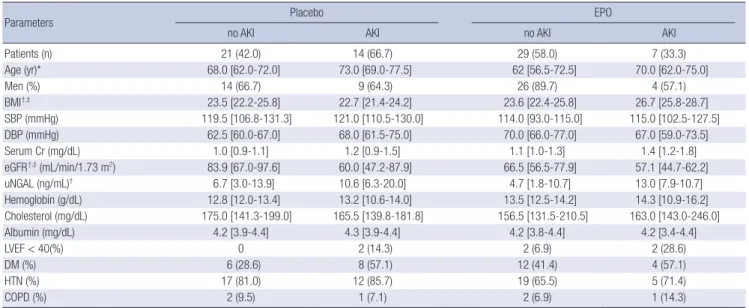
We reanalyzed data stratified by the existence of AKI in the EPO and placebo groups. Among 71 patients, 21 patients had AKI; 14 (66.7%) in the placebo group and 7 (33.3%) in the EPO group (P = 0.05). In the placebo group, the patients with AKI were older than those without AKI. In the EPO group, the pa- tients with AKI had higher BMI (23.6 [22.4-25.8] vs 26.7 [25.8-28.7]),
higher baseline urine NGAL (4.7 [1.8-10.7] ng/mL vs 13.0 [7.9- 10.7] ng/mL) and lower eGFR (66.5 [56.5-77.9] mL/min/1.73 m2 vs 57.1 [44.7-62.2] mL/min/1.73 m2) than those without AKI had. Otherwise, no significant differences were observed when patients were stratified by the existence of AKI in both the pla- cebo and EPO groups. Among patients with AKI, higher BMI was noted in EPO group than in the placebo group (Table 1).
Change of urine NGAL and the development of AKI The baseline urine NGAL was significantly higher in the patients with AKI compared to those without AKI. In 50 patients who did not have AKI, the baseline urine NGAL was 5.0 [2.2-14.2] μg/L, which was significantly lower than the value observed in 21 pa- tients who had AKI (11.3 [7.5-90.7] μg/L) (P = 0.009). At 2, 4, 24, and 72 hr after CABG, higher concentrations of urine NGAL were noted in patients with AKI (Table 2).
With respect to the baseline urine NGAL, the area under the ROC curve (AUC) was 0.713 (95% confidence interval [CI], 0.586- 0.841) for the prediction of AKI. A cutoff of 5 ng/mL showed a sensitivity of 0.89, a specificity of 0.48, and a negative predictive value of 0.91. For urine NGAL collected 2 hr after CABG, the AUC for the prediction of AKI was 0.804 (95% CI, 0.696-0.911). Being divided by the level of baseline urine NGAL, the patients with
≥ 5 ng/mL of urine NGAL had less AKI than those with < 5 ng/
mL of urine NGAL (16 patients [41.0%] vs 2 patients [8.7%], P = 0.007).
Recovery from acute kidney injury
In 21 patients with AKI, one patient met urine output criteria and one patient met both Cr and urine output criteria. We ana-
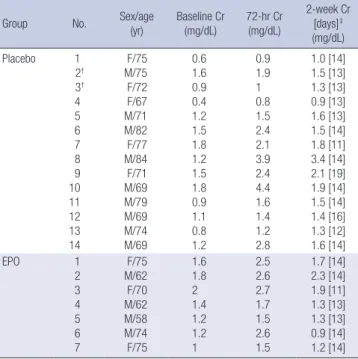
lyzed serum Cr at 2 weeks after CABG (2-week Cr) to assess the severity and duration of AKI (Table 3). In patients with AKI, the mean value of 72-hr Cr was 2.02 ± 1.09 in the placebo group and 2.16 ± 0.56 in the EPO group. The mean of 2-week Cr was 1.63 ± 0.60 and 1.51 ± 0.48, respectively. The 72-hr Cr values were sig- nificantly higher than baseline Cr values in both groups (P = 0.003). In the EPO group, 2-week Cr was not significantly higher than the baseline Cr (P = 0.578). However, 2-week Cr in the pla- cebo group remained higher than the baseline Cr (P = 0.009) (Fig. 1).
Outcome of mortality and ESRD
Over 27.9 ± 8.8 months of follow-up, the overall mortality rate was 14.1%. Seven patients in the placebo group (20.0%) died;
3 patients (8.3%) in the EPO group died. ESRD developed in only 1 (1.4%) patient, who was in the placebo group. Higher mortali- ties or higher incidence of ESRD were observed during follow- up in patients who had AKI (log-rank test, P = 0.031).
We grouped participants according to the development of
Table 1. Baseline characteristics
Parameters Placebo EPO
no AKI AKI no AKI AKI
Patients (n) 21 (42.0) 14 (66.7) 29 (58.0) 7 (33.3)
Age (yr)* 68.0 [62.0-72.0] 73.0 [69.0-77.5] 62 [56.5-72.5] 70.0 [62.0-75.0]
Men (%) 14 (66.7) 9 (64.3) 26 (89.7) 4 (57.1)
BMI†,‡ 23.5 [22.2-25.8] 22.7 [21.4-24.2] 23.6 [22.4-25.8] 26.7 [25.8-28.7]
SBP (mmHg) 119.5 [106.8-131.3] 121.0 [110.5-130.0] 114.0 [93.0-115.0] 115.0 [102.5-127.5]
DBP (mmHg) 62.5 [60.0-67.0] 68.0 [61.5-75.0] 70.0 [66.0-77.0] 67.0 [59.0-73.5]
Serum Cr (mg/dL) 1.0 [0.9-1.1] 1.2 [0.9-1.5] 1.1 [1.0-1.3] 1.4 [1.2-1.8]
eGFR†,‡ (mL/min/1.73 m2) 83.9 [67.0-97.6] 60.0 [47.2-87.9] 66.5 [56.5-77.9] 57.1 [44.7-62.2]
uNGAL (ng/mL)† 6.7 [3.0-13.9] 10.6 [6.3-20.0] 4.7 [1.8-10.7] 13.0 [7.9-10.7]
Hemoglobin (g/dL) 12.8 [12.0-13.4] 13.2 [10.6-14.0] 13.5 [12.5-14.2] 14.3 [10.9-16.2]
Cholesterol (mg/dL) 175.0 [141.3-199.0] 165.5 [139.8-181.8] 156.5 [131.5-210.5] 163.0 [143.0-246.0]
Albumin (mg/dL) 4.2 [3.9-4.4] 4.3 [3.9-4.4] 4.2 [3.8-4.4] 4.2 [3.4-4.4]
LVEF < 40(%) 0 2 (14.3) 2 (6.9) 2 (28.6)
DM (%) 6 (28.6) 8 (57.1) 12 (41.4) 4 (57.1)
HTN (%) 17 (81.0) 12 (85.7) 19 (65.5) 5 (71.4)
COPD (%) 2 (9.5) 1 (7.1) 2 (6.9) 1 (14.3)
*P < 0.05, no AKI vs AKI in placebo group, †P < 0.05, no AKI vs AKI in EPO group, ‡P < 0.05, EPO vs placebo group in patients with AKI. Descriptive statistics were reported as median values [25%-75%] for continuous variables. EPO, erythropoietin; AKI, acute kidney injury; BMI, body mass index; SBP, systolic blood pressure, DBP, diastolic blood pres- sure; GFR, glomerular filtration rate; uNGAL, urinary neutrophil gelatinase-associated lipocalin; LVEF, left ventricular ejection fraction, DM, diabetes mellitus; HTN, hypertension;
COPD, chronic obstructive pulmonary disease.
Table 2. Change of urine NGAL after coronary artery bypass grafting stratified by development of AKI
Group Urine NGAL (ng/mL) after
0 hr 2 hr 4 hr 24 hr 72 hr
Non-AKI 5.0
[2.2-14.2]
2.7 [1.8-8.3]
6.1 [2.5-14.0]
26.8 [17.6-91.0]
26.2 [11.4-51.3]
AKI 11.3*
[7.5-90.7] 12.0*
[6.5-89.0] 10.3*
[6.1-95.3] 72.2*
[44.4-147.4] 71.5*
[29.6-136.2]
Concentration of urine neutrophil gelatinase-associated lipocalin (NGAL) after coro- nary artery bypass grafting was noted according to time changes in patients with acute kidney injury (AKI) and without AKI. Descriptive statistics were reported as median val- ues [25%-75%] for continuous variables. *P < 0.05, AKI vs non-AKI group.
AKI and the administration of EPO: group A, AKI in EPO group;
group B, no AKI in placebo group; group C, no AKI in EPO group;
group D, AKI in placebo group. Kaplan-Meier curves showed that a higher rate of mortality occurred in group D compared to that of groups A, B, and C (log-rank test, P = 0.022). Also, a higher composite outcome of mortality or ESRD occurred in group D compared to groups A, B, and C (log-rank test, P = 0.003) (Fig. 2).
In patients who had AKI, the administration of EPO reduced the mortality and the composite outcome of mortality or ESRD.
DISCUSSION
We reported previously that pretreatment with EPO had a pro- tective effect on AKI (8). We defined AKI in this study as an in- crease in the serum Cr concentration of ≥ 0.3 mg/dL from base- line, a percentage increase in the serum Cr concentration of
≥ 50% in the first 72 hr after CABG, or < 0.5 mL/kg per hour of oliguria for more than six hours. We chose a 72-hr time point instead of a 48-hr time point, which is recommended by the AKI Network criteria (21). Because hemodilution occurs during cardiac surgery (22), a 72-hr time point has been chosen in clin- ical studies of cardiac surgery (23, 24).
First, we confirmed that pre-treatment of EPO reduced the incidence of AKI. It has been reported that EPO could improve AKI, neurocognitive dysfunction after cardiac surgery, left ven- tricular ejection fraction after acute myocardial infarction, oxi-
dative stress, inflammation, and nutritional status in humans (5-9). In animal studies, EPO modulated apoptosis by decreas- ing the ratio of Bax to Bcl-2 protein in the aorta (3). EPO also attenuates superoxide production and medial hyperplasia and restores the expression of endothelial nitric oxide synthase in nephrectomized rat aorta (4). Taken together, these results show that EPO has protective effects on inflammation, oxidative stress and apoptosis.
In contrast, higher death rate was reported in the EPO group compared with placebo group (25). Recently, randomized con- trolled study reported no benefit of EPO on the outcome of AKI in patients with elevated two urinary markers in intensive care units (26). However, imperfect triaging into the intervention arm and heterogeneous timing of screening limits their results regard- Table 3. Recovery from acute kidney injury after coronary artery bypass grafting
Group No. Sex/age
(yr)
Baseline Cr (mg/dL)
72-hr Cr (mg/dL)
2-week Cr [days]‡ (mg/dL) Placebo 1
2† 3† 4 5 6 7 8 9 10 11 12 13 14
F/75 M/75 F/72 F/67 M/71 M/82 F/77 M/84 F/71 M/69 M/79 M/69 M/74 M/69
0.6 1.6 0.9 0.4 1.2 1.5 1.8 1.2 1.5 1.8 0.9 1.1 0.8 1.2
0.9 1.9 1 0.8 1.5 2.4 2.1 3.9 2.4 4.4 1.6 1.4 1.2 2.8
1.0 [14]
1.5 [13]
1.3 [13]
0.9 [13]
1.6 [13]
1.5 [14]
1.8 [11]
3.4 [14]
2.1 [19]
1.9 [14]
1.5 [14]
1.4 [16]
1.3 [12]
1.6 [14]
EPO 1
2 3 4 5 6 7
F/75 M/62 F/70 M/62 M/58 M/74 F/75
1.6 1.8 2 1.4 1.2 1.2 1
2.5 2.6 2.7 1.7 1.5 2.6 1.5
1.7 [14]
2.3 [14]
1.9 [11]
1.3 [13]
1.3 [13]
0.9 [14]
1.2 [14]
*P < 0.05, placebo group vs EPO group. †These patients met the urine output criteria of acute kidney injury. ‡The measured time of 2-week Cr [days after coronary artery bypass grafting] was recorded. 72-hr Cr, Cr concentration 72 hr after coronary artery bypass grafting; 2-week Cr, Cr concentration 2 weeks after coronary artery bypass grafting; Cr, creatinine; EPO, erythropoietin.
Fig. 1. Changes of serum creatinine after coronary artery bypass grafting in patients with AKI. *P < 0.05 vs 0 days, both EPO and placebo group; †P < 0.05 vs 0 days, placebo group only. Error bars show the standard deviation of mean.
Serum creatinine (mg/dL)
Day
PLACEBO EPO
*
†
0 3 14
2.5 2 1.5 1 0.5 0
Fig. 2. Kaplan-Meier curves for composite outcome of mortality or ESRD. Participants were classified according to the development of AKI and the administration of EPO:
group A, AKI in EPO group; group B, no AKI in placebo group; group C, no AKI in EPO group; group D, AKI in placebo group.
Cumulative survival
Month
All-cause mortality + end stage renal disease
P = 0.003
Group A
Group B Group C
Group D
0 10 20 30 40
1.0 0.8 0.6 0.4 0.2 0.0
ing the efficacy of EPO.
In our study, we found that EPO pre-treatment reduced mor- tality or ESRD in patients with AKI, but it did not reduce mortal- ity or ESRD in patients without AKI. We presumed that lower mortality in the EPO group might be due to a beneficial effect of EPO on recovery after AKI. We analyzed the comparison 2-week Cr to baseline Cr, and 72-hr Cr to baseline Cr to determine the severity and duration of AKI. In the EPO group, 2-week Cr was not different from baseline Cr. However, 2-week Cr in the pla- cebo group was higher than baseline Cr. Although the extent of AKI 72 hr after CABG did not show any difference, renal func- tion was recovered more easily in the EPO group than in the placebo group. This result might imply that EPO had a preven- tive effect on AKI and thus enhanced the recovery after AKI.
Therefore, EPO administration could be beneficial, at least in patients with high risk for AKI.
NGAL has been known as a biomarker for the prediction of AKI (15, 16). NGAL levels are increased in bacterial infection, systemic disease and renal tubular injury. NGAL mRNA is syn- thesized at high levels in the loop of Henle and collecting ducts in the ischemic kidney (18, 27). In previous reports, the concen- tration of urine NGAL at 2 hr after cardiac surgery was the best predictor of AKI (15). Similarly, urine NGAL at 2 hr after CABG showed the highest AUC in our study. Although the AUC of base- line urine NGAL was less than urine NGAL at 2 hr after CABG, the cutoff value of baseline urine NGAL 5 ng/mL yielded excel- lent sensitivity and negative predictive values. However, depend- ing on the definition of AKI, clinical setting, or measurement time, NGAL varies greatly with respect to cutoff and exhibits a low degree of specificity (16). Dysregulation of the NGAL bind- ing protein that inhibits its degradation was found in type I dia- betes (28). In addition, urine NGAL was also elevated in chronic kidney disease (CKD) as well as in AKI (29, 30). Also, we noticed that the baseline urine NGAL was significantly higher in patients with eGFR < 60 mL/min/1.73 m2 than those with eGFR ≥ 60 mL/min/1.73 m2 (P = 0.002). Despite the association of urine NGAL and baseline renal function, urine NGAL at the baseline and 2 hr after CABG showed higher AUC values than baseline Cr (baseline urine NGAL, AUC 0.713 [95% CI 0.586-0.841]; urine NGAL at 2 hr, 0.804 [95% CI 0.696-0.911]; baseline Cr, 0.670 [95%
CI 0.509-0.831]). Accordingly, urine NGAL might provide the better prediction of AKI than serum Cr at early time points, and the baseline urine NGAL could provide the additive informa- tion to decide pretreatment with EPO.
Our study had several limitations. First, the wide variability of the baseline urine NGAL was noted in this study. This variabili- ty could be attributed to the heterogeneity of patients, who had hypertension (75%), diabetes (42%), and baseline eGFR < 60 mL/min/1.73 m2 (26%). Second, small numbers of patients were included in this study. Third, the duration of the follow-up was short. Finally, the individual causes of death were not specified.
In spite of these limitations, our study has certain strengths.
First, we determined that the long-term outcome could be im- proved by EPO administration, largely due to beneficial effect of EPO on the recovery after AKI. Second, we assessed the value of baseline urine NGAL as a predictive marker of AKI in patients undergoing CABG. Further investigations with larger patient numbers of will be necessary to confirm our results.
In conclusion, EPO reduces all-cause-mortality and ESRD in patients with AKI, largely due to the beneficial effect of EPO on recovery after AKI.
REFERENCES
1. Maxwell PH, Osmond MK, Pugh CW, Heryet A, Nicholls LG, Tan CC, Doe BG, Ferguson DJ, Johnson MH, Ratcliffe PJ. Identification of the re- nal erythropoietin-producing cells using transgenic mice. Kidney Int 1993;
44: 1149-62.
2. Weidemann A, Johnson RS. Nonrenal regulation of EPO synthesis. Kid- ney Int 2009; 75: 682-8.
3. Warren JS, Zhao Y, Yung R, Desai A. Recombinant human erythropoie- tin suppresses endothelial cell apoptosis and reduces the ratio of Bax to Bcl-2 proteins in the aortas of apolipoprotein E-deficient mice. J Cardio- vasc Pharmacol 2011; 57: 424-33.
4. Toba H, Nakashima K, Oshima Y, Kojima Y, Tojo C, Nakano A, Wang J, Kobara M, Nakata T. Erythropoietin prevents vascular inflammation and oxidative stress in subtotal nephrectomized rat aorta beyond haemato- poiesis. Clin Exp Pharmacol Physiol 2010; 37: 1139-46.
5. Malgorzewicz S, Lichodziejewska-Niemierko M, Lizakowski S, Liberek T, Lysiak-Szydlowska W, Rutkowski B. Oxidative stress, inflammation and nutritional status during darbepoetin alpha treatment in peritoneal dialysis patients. Clin Nephrol 2010; 73: 210-5.
6. Ozawa T, Toba K, Suzuki H, Kato K, Iso Y, Akutsu Y, Kobayashi Y, Takeya- ma Y, Kobayashi N, Yoshimura N, et al. Single-dose intravenous admin- istration of recombinant human erythropoietin is a promising treatment for patients with acute myocardial infarction: randomized controlled pilot trial of EPO/AMI-1 study. Circ J 2010; 74: 1415-23.
7. Haljan G, Maitland A, Buchan A, Arora RC, King M, Haigh J, Culleton B, Faris P, Zygun D. The erythropoietin neuroprotective effect: assessment in CABG surgery (TENPEAKS): a randomized, double-blind, placebo con- trolled, proof-of-concept clinical trial. Stroke 2009; 40: 2769-75.
8. Song YR, Lee T, You SJ, Chin HJ, Chae DW, Lim C, Park KH, Han S, Kim JH, Na KY. Prevention of acute kidney injury by erythropoietin in patients undergoing coronary artery bypass grafting: a pilot study. Am J Nephrol 2009; 30: 253-60.
9. Johnson DW, Pat B, Vesey DA, Guan Z, Endre Z, Gobe GC. Delayed ad- ministration of darbepoetin or erythropoietin protects against ischemic acute renal injury and failure. Kidney Int 2006; 69: 1806-13.
10. Lee DW, Kwak IS, Lee SB, Song SH, Seong EY, Yang BY, Lee MY, Sol MY.
Post-treatment effects of erythropoietin and nordihydroguaiaretic acid on recovery from cisplatin-induced acute renal failure in the rat. J Korean Med Sci 2009; 24: S170-5.
11. Kim SS, Lee KH, Sung DK, Shim JW, Kim MJ, Jeon GW, Chang YS, Park WS. Erythropoietin attenuates brain injury, subventricular zone expan- sion, and sensorimotor deficits in hypoxic-ischemic neonatal rats. J Korean
Med Sci 2008; 23: 484-91.
12. Lee JH, Sung DK, Koo SH, Shin BK, Hong YS, Son CS, Lee JW, Chang YS, Park WS. Erythropoietin attenuates hyperoxia-induced lung injury by down-modulating inflammation in neonatal rats. J Korean Med Sci 2007; 22: 1042-7.
13. James MT, Ghali WA, Knudtson ML, Ravani P, Tonelli M, Faris P, Pannu N, Manns BJ, Klarenbach SW, Hemmelgarn BR; Alberta Provincial Proj- ect for Outcome Assessment in Coronary Heart Disease (APPROACH) Investigators. Associations between acute kidney injury and cardiovas- cular and renal outcomes after coronary angiography. Circulation 2011;
123: 409-16.
14. Mehta RH, Honeycutt E, Patel UD, Lopes RD, Shaw LK, Glower DD, Harrington RA, Califf RM, Sketch MH Jr. Impact of recovery of renal func- tion on long-term mortality after coronary artery bypass grafting. Am J Cardiol 2010; 106: 1728-34.
15. Mishra J, Dent C, Tarabishi R, Mitsnefes MM, Ma Q, Kelly C, Ruff SM, Zahedi K, Shao M, Bean J, et al. Neutrophil gelatinase-associated lipo- calin (NGAL) as a biomarker for acute renal injury after cardiac surgery.
Lancet 2005; 365: 1231-8.
16. Haase M, Bellomo R, Devarajan P, Schlattmann P, Haase-Fielitz A; NGAL Meta-analysis Investigator Group. Accuracy of neutrophil gelatinase-as- sociated lipocalin (NGAL) in diagnosis and prognosis in acute kidney injury: a systematic review and meta-analysis. Am J Kidney Dis 2009; 54:
1012-24.
17. Herget-Rosenthal S, Marggraf G, Hüsing J, Göring F, Pietruck F, Janssen O, Philipp T, Kribben A. Early detection of acute renal failure by serum cystatin C. Kidney Int 2004; 66: 1115-22.
18. Schmidt-Ott KM, Mori K, Li JY, Kalandadze A, Cohen DJ, Devarajan P, Barasch J. Dual action of neutrophil gelatinase-associated lipocalin. J Am Soc Nephrol 2007; 18: 407-13.
19. KOSIS. Korean Statistical Information Service. Available at http://kosis.
kr/eng/index/index.jsp [accessed on 22 September 2011].
20. Kim SY, Jin DC, Bang BK. Current status of dialytic therapy in Korea.
Nephrology (Carlton) 2003; 8: S2-9.
21. Mehta RL, Kellum JA, Shah SV, Molitoris BA, Ronco C, Warnock DG,
Levin A; Acute Kidney Injury Network. Acute Kidney Injury Network:
report of an initiative to improve outcomes in acute kidney injury. Crit Care 2007; 11: R31.
22. Rosner MH, Okusa MD. Acute kidney injury associated with cardiac surgery. Clin J Am Soc Nephrol 2006; 1: 19-32.
23. Liangos O, Tighiouart H, Perianayagam MC, Kolyada A, Han WK, Wald R, Bonventre JV, Jaber BL. Comparative analysis of urinary biomarkers for early detection of acute kidney injury following cardiopulmonary by- pass. Biomarkers 2009; 14: 423-31.
24. Han WK, Wagener G, Zhu Y, Wang S, Lee HT. Urinary biomarkers in the early detection of acute kidney injury after cardiac surgery. Clin J Am Soc Nephrol 2009; 4: 873-82.
25. Ehrenreich H, Weissenborn K, Prange H, Schneider D, Weimar C, Wart- enberg K, Schellinger PD, Bohn M, Becker H, Wegrzyn M, et al. Recom- binant human erythropoietin in the treatment of acute ischemic stroke.
Stroke 2009; 40: e647-56.
26. Endre ZH, Walker RJ, Pickering JW, Shaw GM, Frampton CM, Hender- son SJ, Hutchison R, Mehrtens JE, Robinson JM, Schollum JB, et al. Ear- ly intervention with erythropoietin does not affect the outcome of acute kidney injury (the EARLYARF trial). Kidney Int 2010; 77: 1020-30.
27. Munshi R, Johnson A, Siew ED, Ikizler TA, Ware LB, Wurfel MM, Him- melfarb J, Zager RA. MCP-1 gene activation marks acute kidney injury. J Am Soc Nephrol 2011; 22: 165-75.
28. Thrailkill KM, Moreau CS, Cockrell GE, Jo CH, Bunn RC, Morales-Poz- zo AE, Lumpkin CK, Fowlkes JL. Disease and gender-specific dysregula- tion of NGAL and MMP-9 in type 1 diabetes mellitus. Endocrine 2010;
37: 336-43.
29. Nickolas TL, Barasch J, Devarajan P. Biomarkers in acute and chronic kidney disease. Curr Opin Nephrol Hypertens 2008; 17: 127-32.
30. Meijer E, Boertien WE, Nauta FL, Bakker SJ, van Oeveren W, Rook M, van der Jagt EJ, van Goor H, Peters DJ, Navis G, et al. Association of uri- nary biomarkers with disease severity in patients with autosomal domi- nant polycystic kidney disease: a cross-sectional analysis. Am J Kidney Dis 2010; 56: 883-95.