—106—
INTRODUCTION
Fishes of the family Macrouridae (grenadiers, also called rattails) represent a large family composed of about 400 species in 30 or more genera, occurring in all oceans from tropical to high-latitude waters of the Arc- tic and Antarctic oceans (Iwamoto, 2008), although their greatest diversity lies in tropical and subtropical seas.
They are primarily benthopelagic in life, and typically occupy depths of 200~2,000 m (Nelson, 2006), alth- ough a few live at depths exceeding 4,000 m. There have been numerous systematic studies of the family Macro- uridae (Okamura, 1970; Marshall and Cohen, 1973; Iwa- moto and Stein, 1974; Iwamoto, 1989; Cohen et al., 1990), but this group has attracted little attention in Ko- rea. Mori (1952) was the first to record a macrourid fish from Korea, Coelorinchus japonicus Temminck and Schlegel, 1842 from Pohang near the southeastern tip of the Korean Peninsula and within the East Sea. Chyung and Kim (1959) recorded C. multispinulosus Katayama,
1942 and C. longissimus Matsubara, 1943 from Pusan in the Korea Strait at the southern end of the East Sea.
Katoh et al. (1956:331, after Yanai, 1950 [references not seen]) recorded C. parallelus (Günther, 1877) from the East Sea off the southwestern coast of the island of Honshu, Japan. The family Macrouridae was reported with a provisional key from Korea (Kim et al., 2005).
In the course of investigating coastal fish collections from Korea, we recognized specimens of four macrou- rid species of the genera Coryphaenoides and Coelorin- chus that represent new records for Korea. In this paper, we record these species and provide a key to the species of the family Macrouridae in Korea, along with their dis- tributions.
Measurements and counts were made according to Iwamoto (1978): measurements were made to the near- est 0.1 mm with dial calipers. Radiographs by soft x-ray were used in counting the number of vertebrae. Fish spe- cimens examined are deposited in the fish collections of the Department of Biology, Chonbuk National Univer- sity, Chonju (CNUC) and are from the bottom trawl sur- veys of the East Sea Fisheries Research Institute, Korea (Fig. 1A, B). They were compared with specimens exa-
Four New Records of Grenadiers (Macrouridae, Gadiformes, Teleostei) from Korea
Seong-Yong Kim*, Tomio Iwamoto
1and Mamoru Yabe
Laboratory of Marine Biology and Biodiversity (Systematic Ichthyology), Graduate School of Fisheries Sciences, Hokkaido University, 3-1-1 Minato-cho, Hakodate Hokkaido 041-8611, Japan
1Hokkaido University Museum, 3-1-1 Minato-cho, Hakodate, and California Academy of Sciences, 55 Concourse Drive, San Francisco, CA 94118 USA
ABSTRACT A taxonomic study of the family Macrouridae was conducted using fish collections deposited in the Department of Biology, Chonbuk National University, Chonju, Korea and the East Sea Fisheries Research Institute, Korea. Among these collections were specimens of four species belong- ing to the genera Coryphaenoides and Coelorinchus: Coryphaenoides marginatus, C. microps, Coelo- rinchus (Abyssicola) macrochir, and C. formosanus. These specimens represent the first records of the species from Korean waters and from the East Sea (Japan Sea). Only four species (Coelorinchus longissimus, C. multispinulosus, C. japonicus, and C. parallelus) had previously been recorded from the East Sea. The Korean names “Keun-nun-gin-ga-si-min-te” (for Coryphaenoides marginatus), “Jak- eun-nun-gin-ga-si-min-te” (for C. microps), “Gin-pal-kko-ri-min-te” (for Coelorinchus macrochir), and
“Ta-i-wan-kko-ri-min-te” (for Coelorinchus formosanus) are herein given to these species.
Key words : Coryphaenoides marginatus, C. microps, Coelorinchus (Abyssicola) macrochir, Coelorinchus formosanus, Macrouridae, grenadiers, Korea, East Sea
*Corresponding author: Seong-Yong Kim Tel: 81-138-40-5538, Fax: 81-138-40-5538, E-mail: [email protected]
Accepted: June 23, 2009
http://www.fishkorea.or.kr
mined in the Hokkaido University Museum (HUMZ);
National Science Museum, Tokyo (NSMT); Research Center for Biodiversity, Academia Sinica, Taipei (ASIZ);
National Museum of Natural History, Washington DC (USNM); California Academy of Sciences, San Francis- co (CAS); and Institute of Marine Sciences, University of the Philippines, Manila (UPIMS). The classification used follows that of Iwamoto in Cohen et al. (1990).
TAXONOMIC ACCOUNTS Family Macrouridae
Genus Coryphaenoides Gunnerus, 1765
(New Korean genus name: Gin-ga-si-min-tae-sok)
1. Coryphaenoides marginatus Steindachner and Döderlein, 1887
(Fig. 2; Table 2)
(New Korean name: Keun-nun-gin-ga-si-min-tae) Coryphaenoides marginatus Steindachner and Döder-
lein, 1887: 284 (holotype in Natural History Museum, Vienna; from Tokyo, Japan); Jordan and Gilbert, 1904:
609; Jordan, Tanaka and Snyder, 1913: 415, fig. 387 (listed); Gilbert and Hubbs, 1916: 164-166 (43 spec., East China Sea and Suruga Gulf [Pacific coast], 271
~805 m); Okamura, 1970: 136-140, pl. 30, text-fig.
54-55 (43 specimens, southern Japan and East China Sea, 250~790 m).
Coryphaenoides awae Jordan and Gilbert, 1904: 608- 609, fig. (holotype CAS-SU 8547; off Tokyo Bay, Ja- pan); Gilbert and Hubbs, 1916: 166-167 (measurements of holotype); Okamura, 1970: 139-140 (synonymized C. awae with C. marginatus).
Specimens examined. CNUC 36808 (40.0 HL, 207 mm TL); off Gampo-eup, Gyeongju-si, Gyeongsangbuk- do, Korea; 35�53′584′′N, 129�38′337′′E; 115 m depth (Fig. 1); temp. surface 13.4�C, bottom 2.6�C; 21 March 2006. HUMZ 170850 (35.2 mm HL, 200 mm TL); Ta- shi,Taiwan; May 2000. HUMZ 195630 (65.5 mm HL, 385 mm TL); Numazu fish market, Shizuoka-Prefec- ture, Japan; 27 Nov. 2005. NSMT P124479 (56.8 mm HL, 335 mm TL); Suruga Bay, Japan. NSMT P6859 (63.8 mm HL, 362++mm TL); Suruga Bay, Japan; 34�
57.1′N, 131�41.8′E, 320~600 m. NSMT P46099 (4 of 11; 37.3~53.6 mm HL, 204++~280++mm TL); Suruga Bay, Japan, 34�59.6′N, 138�44.7′E, 310~680 m. NSMT P11247 (40.2 mm HL, 222 mm TL); Suruga Bay, Japan, 1 April 1967.
Diagnosis. This species is distinguished from other members of the genus in the western North Pacific by the combination of pelvic-ray count (7~8, usually 8);
greatly prolonged serrated spinous first-dorsal fin ray measuring about 1.5~2.5 of HL (serrations become re- duced in size and number in larger individuals); body scales deciduous, densely covered with short spinules
37�N
36�
35�
34�
129� 130� 131�E
Ulleung-do
Dok-do
Pohang Korea
Ulsan Busan
Yamaguchi Pref.
Tsushima
A B
Korea Strait
Fig. 1. Map of region around East Sea of Korea with collection local- ities plotted as square (A: off Gampo-eup, B: off Ulsan).
Fig. 2. Coryphaenoides marginatus Steindachner and Döderlein, 1887, CNUC 36808 (207 mm TL), from the East Sea, Gampo-eup, Gyeongju-si, Gyeongsangbuk-do, Korea.
arranged in numerous, slightly convergent rows in adults; preopercle broadly rounded, its posterior margin nearly vertical, the preopercle ridge nearly vertical and rounded at its ventral angle; a large, stout terminal snout scute; small, subinferior mouth, upper jaw 28~34% HL, posterior end of the maxilla reaches to below anterior one-third to one-half of orbit; rictus (mouth slit), how- ever, falls well short of that, snout relatively short and narrow, protruding in front of mouth a distance less than, or slightly more than, diameter of pupil (more protrud- ing in young); orbit 26~33% HL; internasal and inter- orbital narrow, 16~19% and 17~21% HL, respectively.
Description. Counts and measurements are given in Table 1. Body rather high, strongly compressed poste- riorly. Head small, laterally compressed, greatest width about equal to postorbital length. Infraorbital ridge pro- minent, nearly extending backward to vertical from posterior margin of orbit. Mouth small, its rictus res- tricted posteriorly by lip folds, extending only to below nostrils. Teeth small, conical, in broad bands on both jaws, slightly enlarged on outer premaxillary series. Late- ral line distinct, rising in a low curve anteriorly, and running parallel to, but above, mid-axis of body side posteriorly. Scales hexangular, moderate in size, rather deciduous; small scales covering head except for naked underside of snout, nakedness extending backward to along lower margin of suborbital region, narrow area surrounding nostrils, and gular and branchiostegal mem- branes and axillary fossa. Dorsal fin originating poste- rior to base of pectoral and of pelvic fins; anal fin in- serted posterior to vent. Pectoral fin about as long as postorbital part of head. Pelvic fin inserted between pec- toral and first dorsal.
Coloration in alcohol. Tawny and brown body, dor- sal surface of head light brown, and ventral surface of head pale. Upper part of suspensorium gray to blackish, breast and belly silvery. Branchial cavities blackish gray;
branchiostegal membranes becoming darker toward pos- terior margin; oral lining and gill arches whitish.
Comparisons with other species. The only two Japan- ese species of Coryphaenoides with which C. marginatus is likely to be mistaken are C. microps and C. nasutus.
Coryphaenoides microps is distributed primarily from the East China Sea to the Philippines; it can be disting- uished from C. marginatus by its smaller orbit, broader interorbital, and longer spinous ray of first dorsal fin (Table 2 and Fig. 2). Coryphaenoides nasutus has a broad distribution, ranging from the northern island of Hokkaido south along the Pacific coast of Japan to the East China Sea and Taiwan, to the South China Sea and the Philippines. It differs from C. marginatus in having predominantly 9 pelvic-fin rays (although four smaller specimens --HUMZ 149933-149935, 149937-- had 8 each), decidedly convergent spinule rows on body scales, a broader snout (width between nasal ridges 20~25%
HL vs. 16~18%), a broader interorbital (21~24% HL vs. 17~21%), less compressed and deep body, tail not as sharply tapered ventrally to a knife-edge in cross-sec- tion, and shorter spinous ray of first dorsal fin (about 75~125% HL, vs. about 122~187%).
Distribution. Known from southern Japan, East China Sea, South China Sea off Taiwan, Philippines (Okamura, 1970; Cohen et al., 1990), and Korea (off Gampo-eup, Gyeongju-si, Gyeongsangbuk-do [Fig. 1A]; present stu- dy)
Remarks. The single CNUC specimen is relatively well preserved although most body scales are lost. The specimen represents a small immature individual that is far from maximum size, judging from the largest of Okamura’s (1970) specimens, which was 550 mm TL, and the 620 mm holotype of C. awae Jordan and Gilbert, 1904, a species Okamura (1970: 136) synonymized with C. marginatus. The second spinous ray of the first dor- sal fin was approximately equal to the length of the head and not the 1.5 to more than 2.0 times HL that accord- ing to Okamura (1970: 138) is characteristic of the spe- cies. However, there was some obvious early develop- mental damage to the ray, which presumably affected the final length. The almost complete absence of body scales (deciduous scales appears to be characteristic for this species) preclude making a firm judgment on the mor- phology and arrangement of scale spinules. A few ‘half scales’ remaining (along the mesial-dorsal line anterior- ly on the tail) had short, reclined spinules arranged in parallel rows, not the convergent rows found in C. mar- ginatus. We suggest that the spinules on full-sized sca- les become arranged in rows that are more convergent in larger individuals.
Coryphaenoides marginatus is apparently a common species in Suruga Bay and the East China Sea (Gilbert and Hubbs, 1916: 164; Okamura 1970: 140). Yatou (in Okamura et al. 1984) has recorded it from the Okinawa Trough in the East China Sea, a region that appears to be an area of overlap between C. microps and C. margi- natus. An in-depth study of the two species and also C.
semiscaber Gilbert and Hubbs, 1920 is warranted, as there remain some questions in our minds concerning characters that can be used to distinguish the three spe- cies and the distributional boundaries of each.
2. Coryphaenoides microps (Smith and Radcliffe, 1912)
(Figs. 3, 4; Tables 1, 2)
(New Korean name: Jak-eun-nun-gin-ga-si-min-tae)
Macrourus microps Smith and Radcliffe in Radcliffe, 1912:116-117, pl 25, fig. 2 (holotype USNM 72933, 43 cm; east coast Luzon, Philippines; 13�37′30′′N, 123�
41′09′′E, 560 fm [1,024 m]; Albatross st. 5470).
Coryphaenoides microps: Gilbert and Hubbs, 1920: 418-
419; Schcherbachev and Iwamoto, 1995: 300-301.
Specimen examined. CNUC 36807 (53.8 mm HL, 305 mm TL); off Gampo-eup, Gyeongju-si, Gyeongsang- buk-do, Korea; 35�53′584′′N, 129�38′337′′E; 115 m dep- th (Fig. 1); temp. surface 13.4�C, bottom 2.6�C; 21 Mar- ch 2006. Holotype: USNM 72933 (82.0 mm HL, 413++ mm TL); Philippines, 13�37′30′′N, 123�41′09′′E, 560 fm [1,024 m], Albatross st. 5470. Paratypes: CAS-SU 2446 (2: 23.7~39.9 mm HL, 124++~187++mm TL); off northern Luzon, Philippines, 18�34′15′′N, 121�51′15′′
E; 224 fm [410 m], 15 Nov. 1908. HUMZ 170850 (35.1 mm HL, 211 mm TL); Tashi, Taiwan. ASIZ P66786 (64.9 mm HL) and P63792 (78.5 mm HL, 367++mm TL); Taiwan. UPIMS (81 mm HL, 380 mm TL); Phili- ppines, MUSORSTOM II (no other data). UPIMS (5:
43.2~52.0 mm HL); Philippines, 13�31.6′N, 120�33′E, 326~240 m, MUSORSTOM II, St. 79, 1 Dec. 1980.
CAS 224171 (35.3 mm HL, 190++ mm TL) and CAS 224172 (81.6 mm HL, 395++mm TL); Tashi, Taiwan, 18 May 2005.
Diagnosis. Pelvic-fin rays 7~8; greatly prolonged ser- rated spinous first-dorsal-fin ray measuring about 1.8 to almost 3 times HL (serrations reduced in size and num-
ber in larger individuals); body scales deciduous, dense- ly covered with short spinules arranged in numerous, subparallel rows; preopercle broadly rounded, its poste- rior margin nearly vertical, preopercle ridge nearly ver- tical and rounded at its ventral angle; a large, stout ter- minal snout scute; small, subinferior mouth, upper jaw 30~32% HL, maxilla extending posteriorly to below anterior quarter of orbit; snout relatively short and nar- row, protruding in front of mouth a distance less than, or slightly more than, diameter of pupil (more protrud- ing in young), preoral length 11~16% HL; orbit small 17~25% HL; internasal and interorbital narrow, 15~
21% and 18~26%, respectively.
Description. The species is so closely similar in mor- phology to C. marginatus that the description of that species can be used for C. microps with the exception of the few character differences enumerated in the diagno- sis, Table 1, and Fig. 2.
Coloration in alcohol. Tawny and warm-brown body, dorsal surface of head light warm-brown, and ventral surface of head whitish. Upper part of suspensorium gray to blackish, breast and belly pale. Fins dark brown.
Branchial cavities dark gray; branchiostegal membranes becoming darker toward posterior margin.
Distribution. Known from South China Sea off Tai- wan (Chiou et al., 2004, Philippines (Gilbert and Hubbs, 1920: 418-419; Shcherbachev and Iwamoto, 1995: 300- 301), and East China Sea and East Sea off Korea (off Gampo-eup, Gyeongju-si, Gyeongsangbuk-do [Fig. 1A];
present study).
Remarks. The presence of a second, closely similar species of Coryphaenoides in the CNUC collections came as a bit of a surprise. We had initially identified CNUC 36087 as C. marginatus, thinking it the same as CNUC 36088, although we were aware of its smaller orbit. It was not until we examined other specimens of C. marginatus and C. microps and compared various proportional measurements that we realized the error.
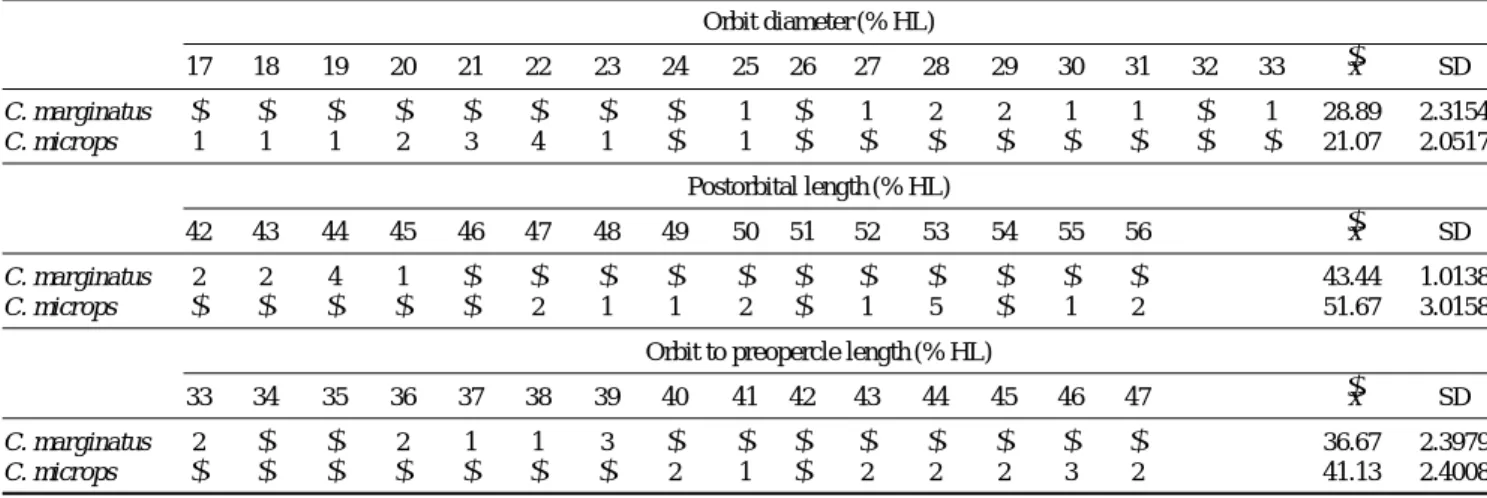
Three proportional measurements in combination distin- guish the two species (Table 1): Coryphaenoides microps has a smaller orbit, 17~23% HL [25% as an outlier]
compared with 25~33% in C. marginatus, longer orbit- to-preopercle distance, 40~46% HL cf. 33~39%, and somewhat longer postorbital length 47~56% HL cf. 42
Fig. 3. Coryphaenoides microps (Smith and Radcliffe, 1912), CNUC 36807 (305mm TL), from the East Sea, Gampo-eup, Gyeongju-si, Gyeong- sangbuk-do, Korea.
50 45 40 35 30 25 20 15 10 5 0
PL (C. marginatus) POL (C. marginatus)
POL (C. microps)
PL (C. microps)
0 10 20 30 40 50 60 70 80 90
Head length (mm)
Postorbital length(POL) & Preoral length(PL)
Fig. 4. Scatter diagram comparing measurements of the postorbital length and preoral length of Coryphaenoides marginatus and C.
microps.
~48%. The low value (47% HL) for postorbital length of CNUC 36807 brings it closer to the trendline of C.
marginatus in the scatter diagram Fig. 6. The preoral length is somewhat shorter in C. microps, 11~16% cf.
14~18% (usually 16~18%), but there is overlap (see also scatter diagram Fig. 6.++3) and CNUC 36808 actu- ally falls within the trendline of C. microps. The length of the second spinous ray of the first dorsal fin has been considered somewhat distinguishing, but there is consi- derable overlap in this character also: (106%) 179~
293% in C. microps, (85%) 122-215% in C. margina- tus, based on our examined specimens.
Genus Coelorinchus Giorna, 1803
(New Korean genus name: Kko-ri-min-tae-sok)
3. Coelorinchus (Abyssicola) macrochir (Günther, 1877)
(Fig. 5; Table 2)
(New Korean name: Gin-pal-kko-ri-min-tae) Macrurus macrochir Günther, 1877: 438, Enoshima,
Kanagawa Pref. (original description). Günther, 1887:
148.
Abyssicola macrochir Goode and Bean, 1895: 417;
Jordan and Snyder, 1900: 376; Jordan and Starks 1902 (1904): 607; Franz, 1910: 26; Gilbert and Hubbs, 1916:
183; Gilbert and Hubbs, 1920: 425; Kamohara, 1938:
71; 1952: 98; Masuda et al., 1984: 96; Okamura and Kitajima, 1984: 221; Nakabo, 2002: 429; Shinohara et al., 2005: 416.
Caelorinchus macrochir Shinohara et al., 1996: 169;
Shinohara et al., 2001: 305.
Coelorinchus macrochir Cohen et al., 1990: 171; Bala- nov, 2003: 565.
Specimens examined. CNUC 37699 (44.8 mm HL, 204.9 mm TL): off Ulsan, Gyeongsangnam-do, Korea;
35�16′921′′N, 129�50′003′′E; 158 m depth (Fig. 1); temp.
surface 14.5�C, bottom 4.2�C; 25 March 2006. HUMZ 134999 (37.8 HL, 185.6 TL), HUMZ 135000 (40.7 HL, 198.4 TL), HUMZ 135001 (45.2 HL, 223.2 TL), HUMZ 135002 (43.1 HL, 205.6 TL): off Miyagi Prefecture, Ja- pan; 17 Oct. 1994. HUMZ 135060 (38.8 HL, 193.2 TL), HUMZ 135061 (30.4 HL, 150.5 TL), HUMZ 135062 (36.9 HL, 179.9 TL): off Ibaraki Prefecture, Japan; 25 Oct. 1994.
Diagnosis. Coelorinchus (Abyssicola) macrochir is dis- tinguished from other members of the genus Coelorin- chus in the western North Pacific by its relatively blunt snout tip; large mouth, upper jaw decidedly longer than 1/3 length of head and extending to below posterior end of orbit; weak infraorbital ridge, strongly curved ante-
Table 1. Comparison of orbit diameter, postorbital length, preoral length, and orbit to preopercle Length in two species of Coryphaenoides Orbit diameter (% HL)
17 18 19 20 21 22 23 24 25 26 27 28 29 30 31 32 33 -x SD
C. marginatus - - - - - - - - 1 - 1 2 2 1 1 - 1 28.89 2.3154
C. microps 1 1 1 2 3 4 1 - 1 - - - - - - - - 21.07 2.0517
Postorbital length (% HL)
42 43 44 45 46 47 48 49 50 51 52 53 54 55 56 -x SD
C. marginatus 2 2 4 1 - - - - - - - - - - - 43.44 1.0138
C. microps - - - - - 2 1 1 2 - 1 5 - 1 2 51.67 3.0158
Orbit to preopercle length (% HL)
33 34 35 36 37 38 39 40 41 42 43 44 45 46 47 -x SD
C. marginatus 2 - - 2 1 1 3 - - - - - - - - 36.67 2.3979
C. microps - - - - - - - 2 1 - 2 2 2 3 2 41.13 2.4008
Fig. 5. Coelorinchus macrochir Günther, 1877, CNUC 37699 (204.9 mm TL), from the East Sea, Ulsan, Gyeongsangnam-do, Korea.
riorly; suborbital region almost vertical; head relatively compressed, or at least not depressed anteriorly, higher than wide at middle of length; premaxillary teeth in rou- ghly three series, mandibular teeth in two series.
Description. Counts and measurements are given in Table 1. Body moderately high and compressed. Head moderately long, compressed. Snout high, subconic, about as wide as deep above anterior end of premaxil- lary, and moderately projection beyond mouth. Orbit slightly oval, usually less than interorbital width. Mouth inferior, moderate in size; upper jaw much longer than 1/3 length of head, extending backward to below poste- rior rim of orbit. Teeth conical, triserial on upper jaw, biserial on lower jaw. Barbel slender. Lateral line dis- tinct, continuous, very slowly ascending anteriorly with a long curve. Scales rather deciduous, covered with short, broad spinules, in 4~9 widely divergent rows; scales cover most of head except for gular and branchiostegal membranes, groove behind anterolateral margin of snout, and along posterior portion of occipital and postorbital ridges. Dorsal fin originating above middle of pectoral- fin base, second spine not serrated, nor filamentous. Anal fin inserted below end of first dorsal fin. Pectoral fin oblong, longer than length between outer pelvic fin and anal-fin origin.
Coloration in alcohol. Brownish or dusky-brown head and body. Upper part of suspensorium, breast and
belly blackish; branchial cavities blackish but with hy- oid area and posterior margin whitish.
Distribution. Known from Japan (Okinawa Trough, Pacific coast southward from Hokkaido), East China Sea (off Kagoshima Prefecture), Sea of Okhotsk (Bala- nov, 2003), and Korea (off Ulsan, Gyeongsangnam-do [Fig. 1B]; present study).
Comparisons with other species. Coelorinchus mac- rochir differs markedly from all other members of the genus in North Pacific waters. It is readily distinguished from C. longissimus, C. multispinulosus, C. formosanus and other members of the species group (recognized by some as subgenus Quincuncia) by its blunter, shorter snout and the absence of an elongated light organ (in sub- genus Quincuncia fossa behind isthmus connected by long midventral dark stripe to second fossa immediately before vent). Two other congeners recorded from the East Sea, C. parallelus and C. japonicus, differ from C.
macrochir in each having a long, stoutly armored, sharp- ly pointed snout, and adherent scales with strong spi- nules arranged in sharp, high, keel-like rows.
Remarks. The CNUC 37699 specimen is relatively well preserved although most body scales are lost. The specimens we examined represent small to mid-sized immature adults that are far from maximum size, judg- ing from the largest of Okamura’s (1970) specimens, which was 680 mm TL. The CNUC specimen is the
Table 2. Comparison of counts and measurements between the Korean, Japan, and Taiwan specimens the of Macrouridae species
Coryphaenoide C. microps Coelorinchus C. formasanus
marginatus (n==9) (n==15) macrochir (n==8) (n==2) Counts
1st dorsal fin rays II, 9~10 II, 8~10 II, 9~11 II, 8~9
Pectoral fin rays I, 17~22 I, 18~21 I, 16 I, 16
Pelvic fin rays 7~8 7~8 7 7
Gill-rakers 2++8~10 1~2++7~9 2++9~10 1~2++8
TL mm / HL mm 204~385/ 124~395/ 150.5~198.4/ 154~165.9/
21.7~65.2 23.7~81.6 30.4~57.9 38.1~44.5
Measurements (in HL)
Snout length 29 (25~32) 30 (25~33) 31 (34~48) 42 (39~44)
Preoral length 16 (15~18) 14 (11~16) 28 (22~36) 32 (30~35)
Internasal width 17 (16~18) 18 (15~21) 30 (28~33) 27 (26~28)
Interorbital width 20 (17~21) 22 (18~27) 35 (32~37) 30 (27~32)
Orbit diameter 29 (25~33) 21 (17~25) 31 (27~33) 28 (27~28)
Suborbital width 12 (10~13) 13 (11~15) 12 (12~14) 13 (12~13)
Postorbital length 44 (42~45) 52 (47~56) 38 (36~40) 36 (34~40)
Orbit to preopercle 37 (33~39) 44 (40~47) 68 (65~70) 63 (61~65)
Upper jaw 30 (28~33) 31 (30~32) 35 (33~37) 31 (26~37)
Length barbel 11 (9~13) 10 (5~14) 9 (6~12) 19 (19~19)
Length 1stgill Slit 7 (5~15) 7 (6~8) 17 (14~19) 19 (17~21)
Preanal length 167 (155~175) 163 (162~190) 143 (108~152) 151 (150~152)
Pelvic to anal origin Length 52 (43~64) 59 (43~68) 42 (39~50) 57 (55~59)
Isth. to anal origin Length 94 (85~104) 99 (83~113) 74 (65~86) 85 (80~90)
Body depth (great) 81 (78~85) 80 (69~97) 66 (61~75) 67 (65~68)
Body depth (at Anal) 71 (60~76) 74 (67~90) 58 (51~68) 53 (49~56)
1D-2D interspace 28 (14~49) 21 (15~38) 42 (38~47) 42 (41~43)
Height 1D 145 (85~187) 236 (106~388) 49 (34~61) 42 (41~43)
first record of C. macrochir from the East Sea. The dis- covery of C. macrochir in the southern part of the East Sea is somewhat anomalous in that the normal depth range of the species is 235 to 785 m (fide Okamura 1970:
148), but the maximal sill depth at the Korea Strait is only 150 m. The distribution of the species is somewhat unusual for a grenadier in ranging from southern Japan and the East China Sea, into the East Sea off the Korean coast, and northward along the Pacific coast of Japan to Hokkaido and into the southwestern Sea of Okhotsk (Balanov, 2003). That the only record of C. macrochir from the East Sea is of a single immature juvenile sug- gests that the species may as juveniles or larvae occa- sionally surmount the shallow sills of the basin, but those individuals do not fully develop to establish reproduc- tive populations.
4. Coelorinchus formosanus Okamura, 1963 (Fig. 6; Table 2)
(New Korean name: Ta-i-wan-kko-ri-min-tae) Coelorinchus formosanus Okamura, 1963: 37 (holotype:
FAKU 35856; from Ta-shi, Taiwan); Masuda et al., 1984: 97 (compiled); Iwamoto in Cohen et al., 1990:
158 (compiled); Nakabo 2000: 430 (compiled); Ran- dal and Lim, 2000: 595 (listed); Nakabo, 2002: 430 (compiled); Shinohara et al., 2005: 416 (list).
Coelorinchus intermedius Chu and Lo, 1963: 173 (holo- type in SFI. paratypes: SFI (5); from north of East China Sea, China). Okamura, 1963 (synonymized C.
intermedius with C. formosanus).
Coelorinchus abbreviatus Chu and Lo, 1963: 174 (holo- type in SFI. paratypes; SFI (3); from north of East China Sea, China); Okamura, 1963 (synonymized C.
intermedius with C. formasanus).
Specimens examined. CNUC 37697 (38.1 mm HL, 154.07 mm TL); CNUC 37698 (44.5 mm HL, 165.9 mm TL): off Ulsan, Gyeongsangnam-do, Korea; 35�16′921′′
N, 129�50′003′′E; 158 m depth (Fig. 1); temp. surface
14.5�C , bottom 4.2�C; 25 March 2006.
Distinguishing features of the species. Coelorinchus formosanus can be distinguished from other members of the genus in the East China Sea and southern Japan (Okinawa) by its light organ very long; anus just in front of anal fin; snout long (43 to 45% of head length);
large naked region on dorsal surface of snout; underside of head covered with scales both on tip of snout and behind mouth.
Description. Counts and measurements are given in Table 1. Body slender and compressed. Head slightly compressed. Snout long, sharply produced. Median and lateral processes of nasal bone not united. Body scales with spinules arranged in roughly divergent rows. Orbit oblong. Mouth small, wholly contained on underside of head. Teeth small, conical on both jaws. Lateral line dis- tinct, with a long and low curve anteriorly. Scales on body widely hexangular, not deciduous, with short but sharp triangular spinules. Dorsal fin originating above pectoral base, the second spine not filamentous; anal fin inserted immediately behind vent; pectoral fin about as long as distance between posterior end of head and mid- dle of pupil; outer pelvic ray slightly filamentous, but the tip far remote from vent.
Coloration in alcohol. Body light brown, with irre- gular and indefinite grayish markings dorsally and sil- very reflections ventrally. Dorsal surface of head pale tawny; ventral surface paler. Upper part of suspensori- um and belly grayish. Branchial cavities gray; branchio- stegal membranes dusky, becoming whitish along poste- rior margin.
Distribution. Known from the East China Sea, off southern Japan (Okamura, 1970; Cohen et al., 1990), Taiwan, and Korea (Fig. 1B).
Remarks. Although the CNUC specimens are rather poorly preserved and most body scales are lost, they are confidently assignable to C. formosanus based on com- parison with other HUMZ specimens and the excellent, detailed descriptions by Okamura (1963, 1970). The specimens represent small to mid-sized immature adults that are far from maximum size, judging from the lar- gest of Okamura’s (1970) specimens, which was 250 mm TL. Although the species has been known from the East China Sea and off southern Japan since originally described, these specimens from off the Ulsan coast, Gyeongsangnam-do, of Korea represent the first record of the species from Korea and the East Sea.
DISCUSSION
The East Sea is a large, deep basin, much of which exceeds 2,000 m depth. It forms almost the entire east- ern boundary of the Korean Peninsula, extending north- ward along the Maritime Province of Russia to the tip
Fig. 6. Coelorinchus formosanus Okamura, 1963, CNUC 37698 (165.9 mm TL), from the East Sea, Ulsan, Gyeongsangnam-do, Korea.
of Sakhalin Island at a latitude higher than 50�N. On the entire eastern side of the sea are two of the major islands of Japan, Honshu and Hokkaido. Shallow sill depths (deepest in the Korea Strait at 140 m) restrict the ingress of deepwater benthic fishes from the East China Sea in the south, from the Pacific Ocean at the Tsugaru Strait between Honshu and Hokkaido, and in the far north, from the Okhotsk Sea at the Soya (La Pérouse) Strait bet- ween Hokkaido and Sakhalin Peninsula, and the narrow strait between Sakhalin and the mainland. Warm north- ward-flowing waters from a branch of the Kuroshio Cur- rent enter the basin from the south through the Korea Strait and travel mostly along the coast of Japan, while cold waters from the Okhotsk Sea and the Oyashio Cur- rent of the North Pacific flow into the basin through the northern straits. Much of the deep bottom and interme- diate water masses in the basin are formed in place during the cold winter months.
The East Sea is a biologically unique and productive body of water that supports major fisheries of warm- water and cold-water species of fish and invertebrates.
There are impressive numbers of species of invertebra- tes and vertebrates (including 1,130 fish species [Kafa- nov et al., 2000] numerous pinnepids, and a few whale species) found in the basin, many of which appear sea- sonally, with their presence at any given locality, and the timing of their occurrences, determined in large part by their ability to tolerate waters of varying temperatures and salinities. The absence of a truly deep-water ben- thopelagic fishes is not surprising owing to the shallow sill depths, which apparently prevent transit of most such individuals into the basin from rich adjacent waters.
Many shallow-water fishes and invertebrates, however, make the passage through the straits at various life stages and are able to proliferate, at least as temporary if not permanent residents. The absence of an archaic deep- water fauna can be explained by its history: during Plei- stocene times, what is now a deep basin was once a shal- low sea or lake, and there apparently is no evidence of a previous deepwater connection with the Pacific or the two adjacent seas.
Nishimura (1965, 1966, 1968, 1969, 1982), in a brilli- ant series of papers on the zoogeography of the East Sea, has provided an exceptionally clear picture of the physi- cal and biological dynamics occurring within this unique body of water. In discussing the deep-water fishes that penetrate into the sea from the East China Sea, he hypo- thesizes that they are likely transported there as epipel- agic larva and settle down onto the broad continental shelf in the San’in District off the southwestern coast of Honshu and “occasionally even reproduce there, since the bottom water covering the shelf of this region is warm enough even in midwinter...to permit these sub- tropical species to do so” (Nishimura 1969: 117). They are unlikely to survive in more northerly regions, how-
ever, because of the narrow shelf north of Wakasa Bay and its close proximity to deep cold waters. Nishimura concluded that the East Sea acts “as a dead end” to the majority of these deep-water tropical and subtropical invaders, because even if adults survive and propagate in the southern parts of the sea, their pelagic eggs and larvae will be driven northward by prevailing currents, where they will perish when they settle to the bottom in the cold deep waters of the north.
Only four species of the diverse deep-water fish family Macrouridae had previously been recorded from the East Sea: Coelorinchus multispinulosus Katayama, 1942, C.
japonicus (Temminck and Schlegel), C. longissimus Mat- subara, 1943, and C. parallelus (Günther). Coelorinchus multispinulosus is a widely distributed grenadier known from southern Japan to northeastern Taiwan and into the East China Sea off Japan. It is one of the shallowest- living of all grenadiers in the North Pacific, frequenting depths from 50 m to around 350 m. It appears to be an exception to Nishimura’s concept of the East Sea acting as a dead-end to subtropical species, as substantial and widespread populations are found along the southeas- tern margins of the sea (Yamada et al., 2007). The abun- dant population of the species in shallow (50~335 m) waters off Jeju Island (Yamada et al. 2007: 312) near the mouth of the Korea Strait can provide a vast pool of re- cruits that use the Kuroshio Current to invade the East Sea.
Coelorinchus japonicus is widespread in tropic to sub- tropic waters of the Indo-Western Pacific and confined off Japan to southern waters from Kanagawa Prefecture to Nagasaki, to the Okinawa Trough, and apparently in the East Sea. Mori (1952: 72) recorded the species off Pohang on the southeastern coast of the Korean Penin- sula and later (Mori 1956: 10) off the north coast of Hyogo Prefecture on the southwestern coast of Honshu, Japan, along with C. multispinulosus. Okamura (1970:
186) questioned Mori’s 1952 record of C. japonicus, without explaining why, although the absence of spe- cimens to confirm the identification may have been the reason. Lindberg and Legesa (1965: 257-258) reported Coelorinchus parallelus (Günther, 1877) as occurring in the East Sea off the San’in district and the Oki Islands off Japan, based on Katoh et al. (1956; after Yanai, 1950 [neither reference seen]). Okamura (1970) and subsequ- ent Japanese workers seem to have ignored that record from the East Sea (perhaps, as with C. japonicus, be- cause of the absence of known voucher specimens). The species is widely distributed and recorded from south- ern Japan, the East China Sea, the Philippines, Australia and New Zealand, and possibly the Indian Ocean; it inhabits depths of 630 to 990 m. We have been unable to locate specimens that would validate the presence of C. japonicus and C. parallelus in the East Sea, and so must consider their occurrence there as questionable.
The substantially deeper depth range of these two spe- cies, as compared with Coelorinchus multispinulosus, C. formosanus, C. longissimus, and C. macrochir cast doubt on their ability to surmount the shallow sill depths at the southern end of the East Sea.
The depth ranges of Coryphaenoides microps (about 300~1,024 m), C. marginatus (227~1,062 m, most com- monly below about 300~400 m), and Coelorinchus macrochir (235~785 m) are considerably greater than those of C. multispinulosus, C. formosanus, and C. long- issimus. Coryphaenoides marginatus and Coelorinchus macrochir also have a much broader distribution off Ja- pan than those species (Hokkaido to the East China Sea, and C. macrochir has been recorded also from the south- eastern Okhotsk Sea) (Balanov, 2003). One might spe- culate how these deeper-living species were able to bre- ach the formidable barrier of the shallow Korea and Tsushima straits and whether there is a viable popula- tion of the species in the East Sea, or are they simply ex- patriates representing a dead-end population. That the specimens of Coryphaenoides marginatus, C. microps, and Coelorinchus macrochir here recorded are juveniles, far from their maximum adult size, may suggest that they represent only strays into the sea and that they may have gained access as pelagic eggs or larvae. The cap- ture of a large adult (550 mm TL) of Coelorinchus mac- rochir from the Okhotsk Sea suggests another avenue of entry for that species into the East Sea: via the La Pérouse Strait between Hokkaido and Sakhalin. The thermal tolerance of C. macrochir is rather remarkable;
in the southern portions of its distribution, Okamura (1970: 148) reports temperatures of 5~10�C in the depths (235~785 m) frequented by the species, whereas bottom temperatures of less than 1�C to about 4.5�C are the norm in the Okhotsk Sea (Orlov and Tokranov, 2008:
236). It is apparent that much remains to be learned about the grenadiers of this unique body of water.
Key to genera and species of family Macrouridae from Korea
1a. Upper jaw falls short of reaching below posterior 1/3 of orbits; rakers present on lateral side of first gill arch; spinous ray of first dorsal fin greatly elo- ngated, with a serrated leading edge∙∙∙∙∙∙∙∙∙∙∙∙∙∙∙∙∙∙∙∙∙∙∙2 1b. Upper jaw extends to posterior 1/3 of orbits or be-
yond; rakers absent on lateral side of first gill arch;
spinous ray of first dorsal fin not prolonged, length
⁄HL, with smooth leading edge∙∙∙∙∙∙∙∙∙∙∙∙∙∙∙∙∙∙∙∙∙∙∙∙∙∙∙∙3 2a. Spinous ray of first dorsal fin about 1.2~1.9 times
HL; preoral length 15~18% HL, orbit diameter 26~
33%, postorbital length 42~45; length orbit to preo- percle 33~39%∙∙∙∙∙∙∙∙∙∙∙Coryphaenoides marginatus 2b. Spinous ray of first dorsal fin about 1.8~2.9 times
HL; preoral length 11~16% HL, orbit diameter 17~
25%, postorbital length 47~56%, length orbit to pre- opercle 40~47%∙∙∙∙∙∙∙∙∙∙∙∙∙∙Coryphaenoides microps 3a. Vent far removed from anal fin, about midway bet-
ween pelvic-fin bases and anal fin origin∙∙∙∙∙∙∙∙∙∙∙∙∙∙∙∙∙∙
∙∙∙∙∙∙∙∙∙∙∙∙∙∙∙∙∙∙∙∙∙∙∙∙∙∙∙∙∙∙∙∙∙∙∙∙∙∙∙∙∙∙∙∙Coelorinchus macrochir 3b. Vent immediately before or close to anal fin origin∙∙
∙∙∙∙∙∙∙∙∙∙∙∙∙∙∙∙∙∙∙∙∙∙∙∙∙∙∙∙∙∙∙∙∙∙∙∙∙∙∙∙∙∙∙∙∙∙∙∙∙∙∙∙∙∙∙∙∙∙∙∙∙∙∙∙∙∙∙∙∙∙∙∙∙∙∙∙∙∙∙∙∙4 4a. Light organ short, confined to immediately before
vent and lacking anterior fossa (dermal window) on chest; small naked regions on dorsal surface of snout;
spinules on scales strong∙∙∙∙∙∙∙∙∙∙∙∙∙∙∙∙∙∙∙∙∙∙∙∙∙∙∙∙∙∙∙∙∙∙∙∙∙∙∙∙∙5 4b. Light organ long, an anterior fossa on chest connect-
ed by a dark stripe to light organ in front of vent;
large naked regions on dorsal surface of snout; spinu- les on scales minute∙∙∙∙∙∙∙∙∙∙∙∙∙∙∙∙∙∙∙∙∙∙∙∙∙∙∙∙∙∙∙∙∙∙∙∙∙∙∙∙∙∙∙∙∙∙∙∙6 5a. Spinules on scales in parallel to subparallel keel-like
rows, the middle row distinctly enlarged; median and lateral processes of nasal bone not united∙∙∙∙∙∙∙∙∙∙∙
∙∙∙∙∙∙∙∙∙∙∙∙∙∙∙∙∙∙∙∙∙∙∙∙∙∙∙∙∙∙∙∙∙∙∙∙∙∙∙∙∙∙∙∙Coelorinchus parallelus 5b. Spinules on scales in widely divergent keel-like rows,
the middle row not especially enlarged; median and lateral processes of nasal bone united along antero- lateral snout margin∙∙∙∙∙∙∙∙∙∙∙∙Coelorinchus japonicus 6a. Underside of head with broad margin of scales be-
low anterior end of snout and on preopercle behind mouth∙∙∙∙∙∙∙∙∙∙∙∙∙∙∙∙∙∙∙∙∙∙∙∙∙∙∙∙∙∙∙Coelorinchus formosanus 6b. Underside of head with scales on tip and antero-
lateral margin of snout, but otherwise naked∙∙∙∙∙∙∙∙∙∙7 7a. Dark markings on body indistinct; nasal fossa scaly
along posteroventral margin; upper jaw length about equal to orbit diameter∙∙∙∙∙Coelorinchus longissimus 7b. Vermiculated dark markings on body distinct; nasal
fossa entirely naked; upper jaw length longer than orbit diameter∙∙∙∙∙∙∙∙∙∙∙∙Coelorinchus multispinulosus
ACKNOWLEDGMENTS
We express our gratitude to Dr. Kazuhiro Nakaya (former Professor, Hokkaido University) for his advice during this study, and to Associate Professor Hisashi Imamura (HUMZ) and Dr. Toshio Kawai (The Hokkai- do University Museum) for valuable suggestions. We are deeply indebted to Dr. Ik-Soo Kim (former Profes- sor, Chonbuk University) and Associate Professor Jong- Young Park (CNUC) for the loan of specimens. The first author thanks Dr. Seon-Jae Hawang (National Fish- eries Research and Development Institute, Korea) for providing the opportunity to sample in the East Sea. TI gratefully acknowledges The Hokkaido University Mu- seum and Dr. S. Mawatari, Director of the Museum, for making possible his three-month’s Visiting Professor- ship at the university. Dr. Imamura deserves special thanks for initiating the visit and providing incalculable assistance before, during, and after TI’s visit. TI also
gratefully thanks Drs. K. Nakaya and M. Yabe, and all the staff and students of the laboratory for their help and hospitality throughout his stay; Mr. T. Kaga was parti- cularly helpful in retrieving literature and providing tech- nical assistance in numerous ways.
REFERENCES
Balanov, A.A. 2003. Additions to the ichthyofauna of the south western part of the Sea of Okhotsk. Voprosy Ikhtiologii, 43: 565-567. (in Russian. English trans- lation in Journal of Ichthyology, v. 43: 483-485 Chiou, M.-L., K.-T. Shao and T. Iwamoto. 2004. A new
species, Caelorinchus sheni, and 19 new records of grenadiers (Pisces: Gadiformes: Macrouridae) from Taiwan. Zoological Studies, 43: 35-50.
Chu, Y. T., C.L. Chan and C. T. Chen. 1963. Ichthyofauna of East China Sea. Science Press, Beijing, 642pp. (In Chinese)
Chyung, M.K. and K.H. Kim. 1959. Thirteen unrecorded species of fish from Korean waters. Korean J. of Zoology, 2: 1-10.
Cohen, D.M., T. Inada, T. Iwamoto and N. Scialabba. 1990.
FAO species catalogue. Vol. 10. Gadiform fishes of the world (order Gadiformes). An annotated and illu- strated catalogue of cods, hakes, grenadiers and oth- er gadiform fishes known to date. FAO (Food and Agriculture Organization of the United Nations) Fisheries Synopsis, No. 125, v. 10: i-x + 1-442.
Gilbert, C.H. and C.L. Hubbs. 1916. Report on the Japanese macrouroid fishes collected by the United States Fish- eries Steamer “Albatross” in 1906, with a synopsis of the genera. Proceedings of the United States Natio- nal Museum, 51(2149): 135-214, pls. 8-11.
Gilbert, C.H. and C.L. Hubbs. 1920. The macrouroid fishes of the Philippine Islands and the East Indies. U. S.
National Museum Bull., 100, 1: 369-588, figs. 1-40.
Goode, G.B. and T.H. Bean. 1895. Oceanic ichthyology, a treatise on the deep-sea and pelagic fishes of the world, based chiefly upon the collections made by the steamers Blake, Albatross, and Fish Hawk in the northwestern Atlantic, with an atlas containing 417 figures. Special Bulletin U. S. National Museum, No. 2: text: i-xxxv + 1-26 + 1-553, atlas: i-xxiii, 1-26, 123 pls.
Gunnerus, J. E. 1765. Efterretning om Berglaxen, en rar Norsk fisk, som kunde kaldes: Coryphaenoides ru- pestris. Drontheim. Gesell. Schrift., 3: 50-58, pl. 3.
Günther, A. 1877. Preliminary notes on new fishes collected in Japan during the expedition of H. M. S. ‘Chal- lenger.’ Annals and Magazine of Natural History, ser.
4, 20: 433-446.
Iwamoto, T. 1978. Eastern Pacific macrourids of the genus Coelorinchus Giorna (Pisces: Gadiformes), with de- scription of a new species from Chile. Proceedings of the California Academy of Sciences, ser. 4, 41: 307- 337.
Iwamoto, T. 1989. Phylogeny of grenadiers (suborder Ma- crouroidei): another interpretation. In: Cohen, D.M.
(ed.), Papers on the systematics of gadiform fishes.
Natural History Museum of Los Angeles County, Sci- ence Series, 32, pp. 159-174
Iwamoto, T. and D.L. Stein. 1974. A systematic review of the rattail fishes (Macrouridae: Gadiformes) from Oregon and adjacent waters. Occasional Papers Cali- fornia Academy of Sciences, (111): 1-79.
Jordan, D.S. and J.O. Snyder. 1900. A list of fishes collect- ed in Japan by Keinoske Otaki, and by the United Stated steamer Albertross, with description of four- teen new species. Proceedings of the United States National Museun, 23: 335-380, pls. 9-20.
Jordan, D.S. and C.H. Gilbert. 1904. Review of the Japanese Macrouridae. pp. 602-621 In: Jordan, D.S. and E.C.
Starks (eds.). List of fishes dredged by the steamer Albatross off the coast of Japan in the summer of 1900, with descriptions of new species and a review of the Japanese Macrouridae. Bulletin of the U.S. Fish Commission, 1902: 577-630, 52 figs., pls. 1-8.
Jordan, D.S., S. Tanaka and J.O. Snyder. 1913. A catalogue of the fishes of Japan. Journal of the College of Sci- ence, Imperial University, Tokyo, 33: 1-497, 396 figs.
Kafanov, A.I., I.V. Volvenko, V., V. Fedorov and D.L.
Pitrunk. 2000. Ichthyofaunistic biogeography of the Japan (East) Sea. Journal of Biogeography, 27: 915- 933.
Kamohara, T. 1938. On the offshore bottom-fishes of Prov.
Tosa, Shikoku, Japan. Maruzen Kobushiki Kaisha, Tokyo, 1-86.
Kamohara, T. 1952. Revised descriptions of the offshore bottom-fishes of Prov. Tosa. Shikoku, Japan. Rept.
Kochi University, (Ser.) Natural Science, 3: 1-122.
Katayama, M. 1942. A new macrouroid fish from the Japan Sea. Zoological Magazine Tokyo, 54: 332-334 Katoh, G. 1956. A list of marine-fishes recorded in the
Japan Sea (rev. ed). Japan Sea Regional Fisheries Re- search Laboratory, Niigata: 24pp., 1 fold-out. Table.
(in Japanese)
Kim, I.S., Y. Choi, C.L. Lee, Y.J. Lee, B.J. Kim and J.H.
Kim. 2005. Illustrated book of Korean fishes. Kyo- Hak Publishing Seoul, Korea, 613pp. (in Korean) Lindberg, G.U. and M.I. Legaz. 1965. Fishes of the Japan
Sea and adjacent waters of the Okhotsk and Yellow seas. Part 2. Teleostomi XII. Acipenseriformes- XXVII. Polynemiformes. Academy of Sciences of the
union of Soviet Socialist Republics, 391pp (Trans- lated from Russian by the Israel Program for Scienti- fic Translations Jerusalem, 1969).
Marshall, N.B. and D.M. Cohen. 1973. Order Anacanthini (Gadiformes). In: Cohen, D.M. (ed.) Fishes of the western North Atlantic. Memoirs of the Sears Foun- dation for Marine Research, 1: 479-495.
Masuda, H., K. Amaoka., C. Araga., T. Uyeno. and T. Yo- shino. 1984. The fishes of the Japanese Archipelago.
Tokai Univ. Press. Text: i-xxii+1-437, Atlas: Pls. 1- 370.
Mori, T. 1952. Check list of the fishes of Korea. Memiors of the Hyogo University of Agriculture, 1: 28.
Mori, T. 1956. Fishes of San-in District including Oki Is- lands and its adjacent waters (Southern Japan Sea).
Memoirs of the Hyogo University of Agriculture.
Agronomical series, 2: 1-62. (in Japanese)
Nakabo, T. 2002. Fishes of Japan with pictorial keys to the species, English edition. Tokai University Press, 1: i- lxi+1-866.
Nelson, J.S. 2006. Fishes of the world. 4th edition. Wiley- Interscience, New York. xix+600pp.
Nishimura, S. (1965-69). The zoogeographical aspects of the Japan Sea. Publications of the Seto Marine Bio- logical Laboratory, 1965, part 1, 13: 35-79; 1965, part 2, 13: 81-101; 1966, part 3, 13: 365-384; 1967, part 4, 15: 329-352; 1969, part 5, 17: 67-142.
Nishimura, S. 1982. Okhotsk Sea, Japan Sea, East China Sea. Chapter 15. pp. 375-401 In: Ketchum, B.H. (ed.) Estuaries and enclosed seas. Elsevier Scientific Pub- lishing Company: Amsterdam.
Okamura, O. 1963. A new macrouroid fish found in the adjacent waters of Formosa. Bulletin of the Misaki Marine Biological Institute Kyoto University, 4: 37- 42.
Okamura, O. 1970. Fauna Japonica Macrourina (Pisces).
Biogeographical Society of Japan: Tokyo. 216pp., 44 pls.
Okamura, O. and T. Kitajima, editors. 1984. Fishes of the Okinawa Trough and the adjacent waters. Vol. 1.
The intensive research of unexploited fishery reso- urces on continental slopes. Japan Fisheries Resource Conservation Association, Tokyo. Fishes of the Oki-
nawa Trough and the adjacent waters. v. 1:1-414, Pls. 1-205. (In Japanese and English; various auth- ors)
Orlov, A.M. and A.M. Tokranov. 2008. Some ecological and biological features of Giant and Popeye grena- diers in the Pacific waters off the northern Kuril Is- lands and southeastern Kamchatka. pp. 225-260 In:
Orlov, A.M. and T. iwamoto (eds.). Grenadiers of the world oceans: biology, stock assessment, and fisheries.
American Fisheries Society, Symposium 63, Bethes- da, Maryland.
Randal, J.E. and K.K.P. Lim. 2000. A checklist of the fishes of the South China Sea. The Raffles Bulletin of Zoo- logy Supplement No. 8: 569-667.
Shcherbachev, Yu. N. and T. Iwamoto. 1995. Indian Ocean grenadiers of the subgenus Coryphaenoides, genus Coryphaenoides (Macrouridae, Gadiformes, Pisces).
Proceedings of the California Academy of Sciences, 48: 285-314.
Shinohara, G., H. Endo and K. Matsuura. 1996. Deep-water fishes collected from the Pacific coast of northern Honshu, Japan. Memoirs of the National Science Museum Tokyo, 29: 153-185.
Shinohara, G., H. Endo, Matsuura, K., Machida, Y. and H.
Honda. 2001 Annotated checklist of the deepwater fishes from fishes from Tosa Bay, Japan. Memoirs of the National Science Musuem Tokyo, 20: 283-343.
Shinohara, G.T. Sato, Y. Aonuma, H. Horikawa, K. Matsu- ura, T. Nakabo and K. Sato. 2005. Annotated check- list of deep-sea fishes from the waters around the Ryukyu Islands, Japan. Deep-sea fauna and pollu- tants in the Nansei Islands. Memoirs of the National Science Museum Tokyo, 29: 385- 452.
Steindachner, F. and L. Döderlein. 1887. Beiträge zur Ken- ntniss der Fische Japans. I-IV, 295 pp. Wien.
Temminck, C. and H. Schlegel. 1842. Fauna Japonica. 2.
Pisces. 345pp., 143 pls. Leiden.
Yamada, U., T. Munehara, H. Horikawa, and T. Nakabo.
2007. Fishes and fisheries of the East China and Yel- low Seas. Tokai University Press, Kanagawa, Japan, 1262pp.
Yanai, T. 1950. Fishes of Sanin District. Zoological Maga- zine, Tokyo 59: 17-22.
한국산 민태과 Grenadiers (대구목) 어류 4 미기록종
김성용∙Tomio Iwamoto1∙Mamoru Yabe
Graduate School of Fisheries Sciences, Hokkaido University, Japan,
1Hokkaido University Museum, Japan and California Academy of Sciences, San Francisco, USA
요 약 :한국 동해안에서 채집된 민태과 어류 표본을 검토한 과정에서 Coryphaenoides (속명신칭: 긴가시민태 속)에 포함되는 2종 Coryphaenoides marginatus (국명신칭: 큰눈긴가시민태), C. microps (국명신칭: 작은눈긴가시 민태)과 Coelorinchus (속명신칭: 꼬리민태속)에 속하는 2종 Coelorinchus macrochir (국명신칭: 긴팔꼬리민태), C.
formosanus (국명신칭: 타이완꼬리민태)은 한국미기록종으로 확인되어 사진과 함께 재기재하고 한국 동해안에 분포하는 민태과(Macrouridae) 2속 8종의 속 및 종검색표를 제시하였으며 지리적 분포에 대하여 기록하였다.
찾아보기 낱말 :Macrouridae, 민태과, 긴가시민태속, 꼬리민태속, 한국미기록종