* 본 연구는 본인의 박사학위논문(Song, 2012) 내 미발표 부분 및 한국환경복원기술학회 2013년도 추계 학술대회발표집 초록(Song, 2013)을 바탕으로 작성되었음. 본 연구를 진행하는데 도움을 주신 Kyoto University의 Morimoto, Yukihiro 교수님과 Imanishi, Junichi 교수님께 사의를 표하는 바임.
First author:Song, Youngkeun, Brain Korea 21 Plus Team, Seoul National University, Tel:+82-2-880-4741, E-mail:[email protected]
Corresponding author:Song, Yougnkeun, Brain Korea 21 Plus Team, Seoul National University, Tel:+82-2-880-4741, E-mail:[email protected]
Received:9 June, 2014. Revised:13 August, 2014. Accepted:23 July, 2014.
- 57 -
도시공원에 식재된 왕벚나무 수종을 중심으로 한
수목활력도의 정량평가지표 개발 및 이론적 고찰에 관한 연구*
송 영 근
서울대학교 Brain Korea 21 Plus 사업팀
Indicators for the Quantitative Assessment of Tree Vigor Condition and Its Theoretical Implications:
A Case Study of Japanese Flowering-cherry Trees in Urban Park*
Song, Youngkeun
Brain Korea 21 Plus Team, Seoul National University.
ABSTRACT
The vigor condition of trees is an important indicator for the management of urban forested area.
But difficulties in how to assess the tree vigor condition still remain. Previous efforts were limited in the 1) measurement of single indicator rather than using multiple indices, 2) purpose-oriented measurement such as for air-pollution effect or specific pathological symptom, and 3) ordinal-scale evaluations by field crews 4) despite human errors based on his/her experiences or prior knowledge.
Therefore, this study attempted to develop a quantitative and objective methodology for assessing tree vigor condition, by measuring multiple modules and building the profile inventory. Furthermore, the possibility and limitations were discussed in terms of schematic frames describing tree vigor condition.
The vigor condition of 56 flowering cherry plants in urban park were assessed by in-situ
measurements of following eight items; growth of crown(Gc), growth of shoots, individual tree
volume(Vol), plant area index, woody area index, leaf area index, leaf chlorophyll content(Lc) and leaf water content(Lw). For validation, these measurements were compared with the ranks of holistic tree vigor condition, which were visually assessed using a 4-point grading scale based on the expert’s knowledge.
As a result, the measures of each evaluation item successfully highlighted a variety of aspects in tree vigor condition, including the states of both photosynthetic and non-photosynthetic parts. The variation in the results depending on evaluated parts was shown within an individual tree, even though the broad agreement among the results was found. The result of correlation analysis between the tested measurements and 4-point visual assessment, demonstrated that the state of water-stressed foliage of the season (Lw) or the development of plant materials since sapling phase (Vol) could be better viewed from the outer appearance of trees than other symptoms. But only based on the visual assessment, it may be difficult to detect the quality of photosynthesis (Lc) or the recent trend in growth of trees (Gc). To make this methodology simplified for the broad-scale application, the tested eight measurements could be integrated into two components by principal component analysis, which was labelled with ‘the amount of plant materials’ and ‘vigor trend’, respectively.
In addition, the use of these quantitative and multi-scale indicators underlies the importance of assessing various aspects of tree vigor condition, taking into account the response(s) on different time and spatial scale of pressure(s) shown in each evaluated module. Future study should be advanced for various species at diverse developing stages and environment, and the application to wide areas at a periodic manner.
Key Words:Tree vitality, Tree health, Crown condition, Prunus × yedoensis, Somei-yoshino, Urban tree
management.I. 서 론
도시에서의 수목은 녹지를 구성하는 기본 단 위이면서 다양한 생태계 서비스를 제공하고 지 역의 생물다양성에 기여하는 중요한 경관요소이 다. 따라서 더 나은 도시 녹지의 관리를 위해서 는, 단목(單木) 수준에서의 수목의 생육상태를 보다 정확하게 진단하고 지속적으로 모니터링하 는 것이 요구된다고 하겠다. 실제로 단목단위로
관리되어야 하는 가로수의 경우만 보더라도, 2008 년 조사 결과 우리나라 전국 약 481만본 이상의 가로수가 매년 1000억여원 규모의 사업규모로 조성, 관리되고 있는 바(Korean Forest Service, 2009), 체계적인 모니터링 수법의 수립이 절실 하고 할 수 있다.
이러한 수목의 상태를 진단하는 방법으로는, 미 국 농림부의 국유림 센서스(http://fhm.fs.fed.us/)
1)나 유럽의 국제협력 산림모니터링프로그램에서
1) National Forest Health Monitoring Program by the USDA (United States Department of Agriculture) Forest Service, in cooperation with Forest Inventory and Analysis National Program; the Nation's Forest Census (http://www.fia.fs.fed.us/program-features/indicators/).
Table 1. Visual assessment of tree condition using 4-point grading scale method in Japan (translated from Hamano, 2007).
Evaluation item Rank and Criteria
4 (good) 3 (above average) 2 (below average) 1 (poor)
Tree vigor trend Vigorous Partly affected but not apparent
Apparently abnormal state
Poor and the rehabilitation to be unexpected Crown shape Keeping natural Partly disturbed but
near to natural state
Substantially disturbed
Far from natural state, deformed Growth of shoots
(distance among bud scale scars)
Normal (more than 30-cm in the terminal shoot of high trees)
A little short Getting short, narrow
Extremely short and shaped as ginger
Dieback on the
edge of branches Not found Partly found but not apparent
Substantial dead branches, or apparent trimmed parts
Many dead branches, or large trimmed parts
Crown density Closed, dense with leaves & branches
Less dense than rank 4
Apparent gaps, sparse leaves/branches
Many dead branches, few leaves, apparently sparse crown Shape and size
of leaves Normal A little deformed or
partly small
Intermediately deformed or a little small overall
Severely deformed or small overall
Color of leaves Normal Getting light, a few local lesions
Abnormal (light green, getting red, or local lesions)
Apparently abnormal (changing to yellow/red/brown or many local lesions)
Bark Rough by vigorous
stem growth, or new Normal Rarely renewed or perforated, injured
Aged or remarkably injured, decomposed
제공하는 가이드라인(http://icp-forests)
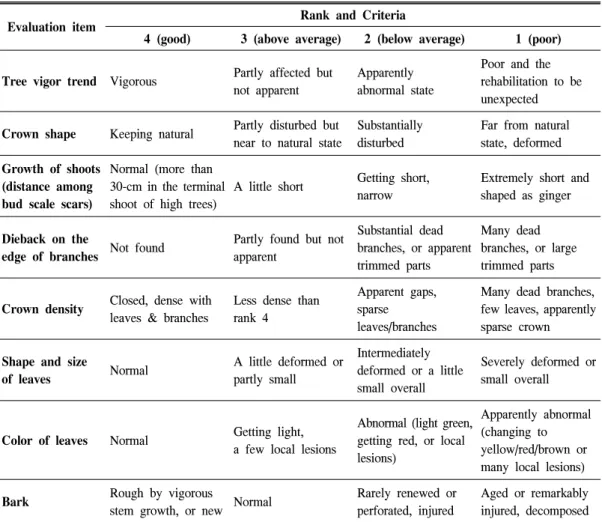
2), 좀 더 간소화된 형태로는 일본의 목시(目視) 4단계 평 가법(Hamano, 2007; Table 1) 등을 참고할 수 있 다. 특히 이 4단계 평가법은 평가항목 및 기준 (Table 1)이 간편하고 비교적 신뢰할 수 있어 일 본 녹화공학 및 수목의학 분야에서 이용되어 왔 다. 그러나 이러한 평가법의 한계로서 평가자의 숙련도나 배경지식의 깊이에 따라 결과가 달라 질 수 있다는 점과, 정성적인 점수 구분과 각 등
급이 순위 척도로 되어 있는 경우가 많다는 점을 들 수 있다. 또한 그 평가기준이 만들어진 배경 이 특정 병충해의 진단이나 대기오염의 피해 진 단, 목재생산관리를 위한 조림학적 진단 등에 기 초하고 있어, 일반적인 도심의 수목활력도 관리 에 그대로 적용하기에는 무리가 있다. 따라서 정 량적이고 객관적인 지표에 기반한 수목활력도 의 평가체계의 개발을 통해, 평가결과가 특정 시 기, 장소, 증상 등에 국한되지 않고 시공간적으
2) International Co-operative Programme on Assessment and Monitoring of Air Pollution Effects on Forests operating under the UNECE (United Nations Economic Commission for Europe) Convention on Long-range Transboundary Air Pollution.
로 확장하여 응용할 수 있는 기반을 만들어가는 것이 중요하다.
수목활력도의 정량 계측의 예로써, 엽내 당질 측정(McCullough & Wagner, 1987; Martinez- Trinidad et al., 2010), 엽록소 측정(Maxwell &
Johnson, 2000), 광합성인자 측정(Xu & Baldocchi, 2003), 특히 국내 수목활력도 관련 연구들의 경 우 디지털저항계(Shigometer)를 사용한 수간(樹 幹) 내 형성층의 전기저항 측정(Kim et al., 2002), 초음파측정기(PiCUS)를 사용한 수간 내 부 부후율(腐朽率) 측정(Kang et al., 2014) 등을 들 수 있다. 이러한 선행연구에서 흔히 지적되는 문제점으로는, 각각의 계측값과 앞서 언급한 전 문가 평가 간의 불일치, 계측 지표들 간의 경향 불일치 등을 들 수 있다(Martinez-Trinidad et al., 2010). 이는, 각 지표들이 반영하고 있는 수목의 상태와 요인이 다르기 때문에, 하나의 계측치만 으로는 그 수목의 전체 활력도를 대변할 수 없다 는 점을 나타낸다. 따라서 그 지표가 반영하고 있는 수목의 상태에 대한 이해가 선행되어야 하 고, 나아가 복수의 지표사용을 통한 다면적 평가 가 필요하다 하겠다.
이에 본 연구에서는, 일본의 도시 녹지에 널 리 식재되고 있는 재배종인 왕벚나무(Prunus ×
yedoensis)3)수종을 대상으로, 복수의 정량평가 지표들을 이용하여 수목활력도를 진단하고자 하였다. 다면적이고 종합적인 평가를 위하여, 동 화부분(잎)과 비동화부분(가지, 수간 등)의 각 구성요소의 진단뿐만 아니라 성장세 및 수형 등 전체적 형상 진단을 포괄할 수 있는 지표들이 적 용되었다. 시도된 지표들을 검증하기 위해 목시 4단계평가법(Table 1)에 따른 전문가 평가결과 와의 상관관계를 분석하였고, 수목활력도에 대 한 개념도 제시를 통해 본 연구의 수법을 보다 널리 적용하기 위한 고려사항을 논의하였다.
II. 연구대상 및 방법
1. 연구 대상
연구 대상으로는, 도시공원(일본 오사카부 스 이타시 소재 만박기념공원)내에 가로수로 식재 된 56주의 왕벚나무를 선정하였다. 수종 선정의 이유는, 본 수종이 일본에서도 도시의 가로수목 중 은행나무에 이어 가장 많이 식재된 수종이 며, 우리나라에서도 전국 가로수의 23%에 달하 는 약 1,111천본 이상이 현재 식재, 관리되고 있 어(Korean Forest Service, 2009), 도시경관관리 차원에서 체계적인 관리가 요구되는 대상이라 고 생각했기 때문이다. 대상목들은 1972년 공원 조성 당시 일제히 식재되었으며 보행자 안전상 의 소규모 전정이나 갈수기의 관수 이외에는 특 별한 관리 없이 자연 상태에서 생육하였으나, 2012년 현재 흉고직경이 36.5±12.8cm정도로 생 육상태에 큰 차이를 보이고 있다. 따라서 이들 의 활력도 차이는 생육조건에 기인한 것이며, 수종 및 수령간의 변이는 적절히 통제되었다고 볼 수 있으므로, 본 연구의 활력도 지표들을 테 스트하기에 적합한 대상이라고 판단되었다.
2. 조사 및 분석
조사 항목은 수목활력도의 정량적, 다면적 계 측을 위해, 기존의 산림학 및 수목학 연구들에 서 널리 쓰이는 지표들 중, 수관(樹冠)성장(Gc;
Growth of crown), 가지성장(Gs; Growth of shoots), 수간의 부피(vol; Individual tree volume), 엽면적 지수(LAI; Leaf Area Index), 지면적지수(WAI;
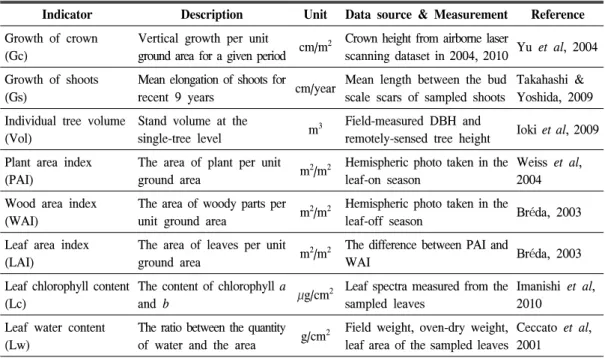
Wood Area Index), 지엽면적지수(PAI; Plant Area Index), 엽수분함유량(Lw; Leaf water content), 엽록소함유량(Lc; Leaf chlorophyll content), 이 상 8개 항목을 선정하였다(Table 2). 각각의 지 표들은 수목의 다양한 모듈의 상태를 반영하고
3) 왕벚나무의 학명과 기원은 여전히 논쟁의 여지가 있다. 본 연구는 일본 도시공원에 식재된 왕벚나무를 대상으로 하였으므로, 교배종 소메이요시노의 학명을 사용하였다. Song (2012) 과 Song et al.(2011a,b) 에서는 동일 대상에 대해 학명 Cerasus × yedoensis ‘Somei-yoshino’를 사용하였다.
Table 2. Description of tree-condition indicators tested in this study (modified from Song et al, 2011a).
Indicator Description Unit Data source & Measurement Reference
Growth of crown (Gc)
Vertical growth per unit
ground area for a given period cm/m2 Crown height from airborne laser
scanning dataset in 2004, 2010 Yu et al, 2004 Growth of shoots
(Gs)
Mean elongation of shoots for
recent 9 years cm/year Mean length between the bud scale scars of sampled shoots
Takahashi &
Yoshida, 2009 Individual tree volume
(Vol)
Stand volume at the
single-tree level m3 Field-measured DBH and
remotely-sensed tree height Ioki et al, 2009 Plant area index
(PAI)
The area of plant per unit
ground area m2/m2 Hemispheric photo taken in the leaf-on season
Weiss et al, 2004 Wood area index
(WAI)
The area of woody parts per
unit ground area m2/m2 Hemispheric photo taken in the
leaf-off season Bréda, 2003 Leaf area index
(LAI)
The area of leaves per unit
ground area m2/m2 The difference between PAI and
WAI Bréda, 2003
Leaf chlorophyll content (Lc)
The content of chlorophyll a
and b µg/cm2 Leaf spectra measured from the sampled leaves
Imanishi et al, 2010
Leaf water content (Lw)
The ratio between the quantity
of water and the area g/cm2 Field weight, oven-dry weight, leaf area of the sampled leaves
Ceccato et al, 2001
Figure 1. Measurement plan of the selected tree-condition indicators (Song et al, 2011a).
있으며, 이는 크게 동화부분, 비동화부분, 수목 의 전체상을 골고루 반영하도록 계획되었다 (Figure 1).
주된 지표의 측정은 8월중 약 2주간 강수가 기록되지 않은 기간 동안을 이용하여 실시되었 다. 그 이유는 갈수 스트레스가 심한 이 기간에 활력도의 차이가 더 분명하게 날 것으로 기대했
기 때문이다. 측정을 위해 먼저 수목 개체별 중 상부의 수관 중 수목을 대표한다고 생각되는 3 개소의 가지를 샘플링 하였는데, 최근 3∼9년간 의 아린흔이 포함되도록 약 20∼60 cm길이를 절단 채취하였고 즉시 실험실로 운반하여 분석 하였다. 가지성장(Gs)은 지난 9년간의 평균 아 린흔 사이의 거리로부터 측정되었다. 잎 분석을 위해 끝가지와 곁가지를 포함하여 가지 당 3매, 즉 수목 개체 당 총 9매의 잎을 샘플링하였다.
각각의 잎에 대해서는, 미 Anaytical Spectral Devices 사의 분광측정기(FieldSpec HandHeld spectroradiometer)와 잎 측정 모듈(plant probe of 10-mm spot, leaf clip attachment)을 이용하여, 잎 중앙부 반경 10mm의 원형부에 대해 325nm 에서 1075nm까지의 분광특성을 3.5nm 반높이 너비(FWHM, Full width at half maximum)로 측 정하였다. 각 잎의 분광특성은 Imanishi et.al.
(2010)에 의한 엽록소함유량(Lc) 추정방법에 따
라, Savitzky-Golay 필터링 후 일차미분 반사도
스펙트럼지수 (fR
555-fR
755)/fR
560를 인자로 하는
Figure 2. Example of tree condition profiles.
회귀모형(cross validated R
2= 0.903, cross validated root mean square error = 33.3)을 통해 동일수종 의 엽록소량(chlorophyll a + b)으로 변환하여 사 용하였다. 엽수분함유량(Lw)을 구하기 위해 잎 의 면적과 무게, 60°C 오븐에서 48시간 건조한 건중량을 측정하여, (생중량 - 건중량)/엽면적을 계산하였다.
수관성장(Gc)은 2004년과 2010년에 각각 측량 된 항공기레이져스캐닝(airborne laser scanning) 데이터로부터 추정되었다. 통상 지형의 정밀측 량에 이용되는 이 데이터에는 지상 대상물의 3 차원 형상이 십 수센티미터 이하의 정확도로 기 록되어 있으므로, 수관 형상의 변화도 신뢰가능 한 범위 내에서 관측되었다고 보았다. 항공측량 영상에서 수목 개체별 수관범위를 폴리곤으로 작성 후 각 수관 내의 20cm격자 당 2004년에서 2010년 내의 높이변화, 즉 수직방향 성장량을 산출하여 단위면적당 수관성장(Gc)을 계산하였 다. 또한 개체별 수관범위 내의 최대 높이값인 수고와 현장 측정된 흉고직경으로부터, 지상 바 이오매스 상대성장식을 이용하여 수간의 부피 (Vol)를 계산하였다.
추가로 착엽시(6월)와 낙엽시(1월)에 각각 개체별 수관에 대하여 반구형 어안렌즈 사진 (hemispheric fish-eye image)을 동일지점에서 천정방향으로 촬영하였다. 개체별 화상분석을 위해 주변 수목을 마스크처리 후, 수관 내부 틈 새 정도(Gap fraction)로부터 착엽시의 지엽면 적지수(PAI), 낙엽시의 지면적지수(WAI)를 구 하였고, 엽면적지수(LAI)는 두 지수의 차이로 부터 산출하였다.
나아가 본 연구에서 시도된 지표들이 기존의 목시 평가방법에 따른 진단결과와 어떤 관계에 있는지 검토하기 위해, 일본의 목시 4단계평가 법(Table 1)을 동시에 수행하여 그 상관관계를 분석하였다. 또한 본 연구에서 시도된 다양한 정량지표들을 실제로 다수의 개체를 모니터링 하는 데에 적용하기에는 많은 시간과 노동력이
들 것으로 생각되므로, 다면적 평가의 효율적 적 용을 위해 주성분분석(PCA; Principal Component Analysis)을 통해 지표들의 통합을 시도하였다.
끝으로, 수목의 생애주기 및 환경요인이 활력도 평가결과에 어떠한 영향을 미치는가에 대한 개 념도를 제시하고, 각각의 지표가 반영하는 시공 간스케일에 대한 이해의 중요성을 고찰하였다.
III. 결과 및 고찰
1. 수목활력도의 정량적 평가와 인벤토리 구축
우리가 시도한 Figure 1의 8개의 지표를 통
해, 수목의 다양한 구성요소(동화부분, 비동화
부분, 수목 전체)에 대한 활력도 평가결과를 얻
을 수 있었다. 56그루의 대상 수목은 8개의 세
부 평가항목별로 정량화된 활력도 인벤토리가
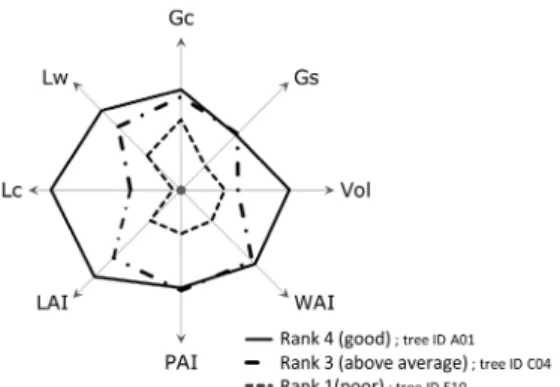
작성되었는데 (예를 들어 Figure 2), 이는 타 지
역 다른 시기의 상태라 할지라도 서로 직접적으
로 비교될 수 있는 기록이라는 점에서 의미있는
평가치라고 보았다. 세부적으로 보면, 한 수목
안에서도 각각의 항목별 활력도의 양호/불량의
정도 간에는 다소 차이가 있었으나, 전반적인
경향은 Table 1에 의한 4단계평가법의 결과와
높은 상관관계를 보였다(Table 3). 이로 미루어
볼 때 수목의 어떤 모듈이나 부분의 상태만을
가지고 그 개체의 종합적 활력도를 결정해 버리
는 것은 바람직하지 않다고 생각되었다. 따라서
Table 3. Spearman's rank correlation coefficients between the tested indicators and tree condition rank.
(p < 0.01, N = 56).
Tree condition rank assessed by Table 1 Mean rank of assessments by
each evaluation item
Assessment for a whole tree
Quantitatively measured indicators
in this study (Figure 1)
Lw 0.870 0.851
WAI 0.808 0.790
Vol 0.804 0.840
Gs 0.789 0.725
PAI 0.698 0.685
LAI 0.648 0.640
Lc 0.477 0.506
Gc 0.416 0.456
Table 4. Integration of tested quantitative in-situ indicators using PCA (modified from Song et al, 2011a).
Tested Indicators (Figure 1)
Rotated Component Matrix
Label of group Principal Component 1 Principal Component 2
PAI 0.960 0.149
The amount of plant materials
LAI 0.937 0.089
WAI 0.911 0.331
Vol 0.633 0.508
Lw 0.602 0.598
Gs 0.284 0.822
Vigor trend
Gc -0.026 0.777
Lc 0.329 0.712
여러 측면의 평가 결과들을 상호 참고한 뒤 종 합적인 진단을 내리는 것이 중요하고, 다만 전 정, 토양개량, 소독이나 방역처리 등 특정 관리 의 목적에 따라 특정 항목의 결과를 더 중요하 게 반영하여 평가할 수 있다고 생각된다.
2. 목시 평가와의 상관관계
Table 1에 의한 목시진단결과와 상관분석을 실 시한 결과, 엽수분함유량(Lw), 지면적지수(WAI), 수간의 부피(Vol)와는 높은 상관 (Spearman r > 0.8,
p < 0.01, N = 56)이, 수관성장(Gc) 및 엽록소함유량(Lc) 등과는 낮은 상관(Spearman r < 0.5,
p < 0.01, N = 56)이 나타났다 (Table 3). 이를
통해 우리는 갈수 스트레스, 개체 전체의 크기, 수세(樹勢) 등을 주로 염두하여 목시 평가를 하 게 되며, 그에 비해 경년적 성장세나 광합성효 율과 같은 요소들은 상대적으로 진단에서 간과 하기 쉽다고 생각되었다.
3. 평가지표의 통합
시도된 8개 항목별 수목활력도 평가결과에
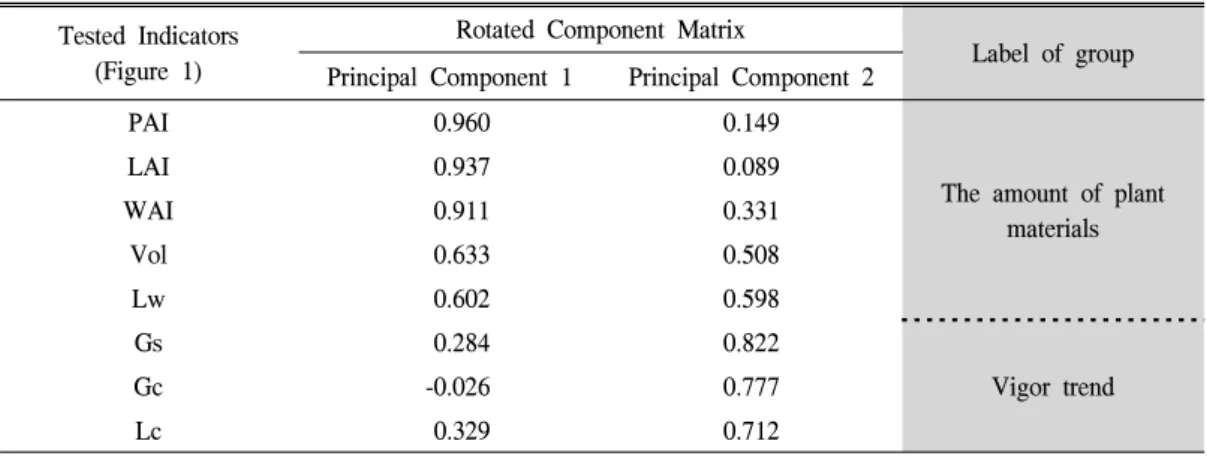
대해 주성분분석을 실시한 결과, 평가항목의 차
원을 Table 4와 같이 줄일 수 있었다. Varimax
회전을 통해 고유값 1.0 이상인 요인만을 추출
한 결과 크게 2개의 성분으로 구분되었으며, 총 누적분산은 76.5%로 나타났다. Lw를 제외한 나 머지 지표들은 두 주성분 중 어느 한 쪽으로는 분명히 귀속되는 경향을 보였다. 그 내용을 보 면 주성분 1그룹은 PAI, WAI, LAI, Vol 등을 포함하며, 현재의 외관 전체 상태의 풍성함을 나타내므로 ‘지엽량(枝葉量, the amount of plant materials)’으로 명명할 수 있었다. 주성분 2그롭 에는 Gc, Gs, Lc 등이 속하므로, 최근의 광합성 효율과 성장세를 포괄하는 개념인 ‘활력경향 (vigor trend)’으로 명명할 수 있었다.
IV. 이론적 시사점
1. 적절한 용어의 사용
본 연구와 선행연구간의 관계를 분명히 하기 위해, 먼저 본 연구에서 사용된 수목활력도의 성격을 명확히 할 필요가 있다. 선행연구들에서 도 수목의 건강한 정도를 나타내는 용어로써, 수목활력도(樹木活力度), 수목건전도(樹木健全度), tree condition, tree vitality, tree vigor 등 다양한 단어들이 사용되고 있다. Innes (1993)은 이러한 용어간의 공통분모가 있는 것은 사실이나 각 용 어들이 의미하는 바와 차이는 분명하게 기술되 어야 한다고 강조하였다. 각 용어들이 가리키는 바를 엄격히 구분하자면(Ferretti, 1997), tree health는 수목에 영향을 끼치는 생물적, 비생물 적요인의 정도를 나타내며 특히 병리학적 측면 이 강조된 개념이다. 이에 비해 tree condition이 라 함은 보다 일반적인 용어로써 수목의 외관 상태를 주로 평가한 것이다. tree vigor는 최적 상태의 가정 하에서 시간에 따른 수목의 성장세 를 나타내는 개념이다. Tree vitality나 crown vigor 와 같은 용어 역시 condition, health와 같 은 맥락에서 동시에 쓰이고 있다. Song (2012) 및 Song et al. (2011b)은 수목관리에 실제 응용 될 수 있는 기준으로서 일반적인 외관평가 (condition)뿐만 아니라 시간에 따른 성장세
(growth) 및 병리학적 측면(health)을 포함하는 종합적 평가개념인 tree vigor condition이라는 단어를 제안한 바 있다. Table 4에서 보여지듯 이, 본 연구에서 평가된 수목활력도는 일정 기 간 내의 성장세(vigor)의 측면과 외관이나 전체 적 형상에 나타나는 상태(condition)이 통합된 형태이므로, tree vigor condition (TVC)을 사용 함이 적절하다고 생각된다.
2. 평가 지표에 반영되는 수목활력도의 다양한 시공간 스케일
이렇게 수목활력도에 대한 정의가 어려운 것 은 평가되는 특정 부분의 상태가 수목 전체의 상태를 얼마만큼 대표할 수 있을 것인가에 대한 문제와 그 평가되는 항목이 어느 정도의 기간의 상태를 반영하는가가 각각 다르기 때문인 것으 로 생각된다. 이상적인 수목활력도의 진단은 복 수의 평가모듈, 즉 잎에서부터 줄기, 가지, 수간 (樹幹), 수관(樹冠)등에 대해 다면적으로 행해져 야 하는데(Dobbertin, 2005), 여기에서 필수적으 로 고려되어야 할 것은 각 모듈의 상태는 각기 다른 시공간적 환경요인에 대한 반응의 결과라 는 점이라 할 수 있다.
이 점을 좀 더 자세히 설명하기 위해, 시간에
따른 수목활력도(TVC; tree vigor condition)의
변화에 대한 간단한 개념도를 Figure 3에서 제
시하였다. 수목이 이상적인 조건에서 경년 변동
없이 로지스틱 성장에 준하여 자란다고 가정했
을 때, 유년목 시기의 활력도는 두드러지며 노
령목으로 갈수록 활력도는 저하될 것이다
(Figure 3(a)). 만약 어떤 수목의 활력도가 엽내
엽록소(Lc)나 수분함량(Lw)을 기준으로 평가되
었다고 한다면, 이는 그 시점에서의 잎의 상태,
즉 수목활력도 곡선 상의 한 점을 나타낸다. 그
러나 일정 기간 동안의 수목의 변화와 관련된
것, 예를 들어 수관 부피의 성장(Gc)이나 가지
의 성장길이(Gs)와 같은 지표를 통해 활력도가
평가되었다면, 이는 Figure 3(a)의 곡선 상에서
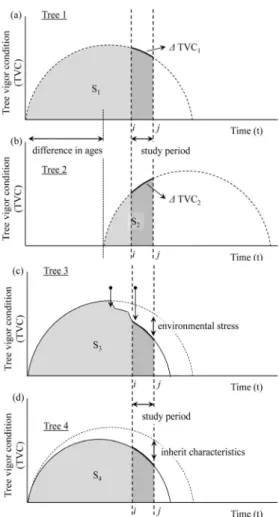
Figure 3. The schema of hypothetical tree vigor condition (Song, 2012).
Figure 4. Hypothetical patterns of tree vigor condition depending on growing stages (Song, 2012).
는 시간당 변화량인 ΔTVC에 해당된다. 활력도 곡선을 시간에 따라 적분한 면적(S)에 해당하는 지표에는, 예를 들어 전체 잎이나 가지의 양 (LAI, PAI, WAI), 수간의 부피(Vol) 등이 있으 며, 이들은 그 수목의 묘목 때부터 누적된 종합 적인 상태를 반영한다고 할 수 있다. Figure 3(b)는 건강한 수목과 건강하지 않은 수목의 활 력도를 도식화한 것이다. 특히 조경수의 경우 토양이나 배수, 식재기반, 일사 조건 등 환경적 요인에 따라 활력도가 저하될 수 있는데, 이를 잘 관리해 줌으로써 활력도 곡선은 개선될 수 있다.
Figure 4는 수목의 성장단계와 장해요인에 따 라 활력도평가 결과를 어떻게 해석해야 하는가를 보여주고 있다. Tree 1과 Tree 2는 수령 이외의 모든 활력도에 관한 조건이 동일하다고 가정된 경우이다. 따라서 수목활력도 평가 결과는 수령을 고려하여 같은 결과가 나와야 한다(TVC
1= TVC
2).
그러나 만일 수령이 고려되지 않는다면 어떻게 될까? 예를 들어 t = i인 시점에서는 Tree 1이 Tree 2 보다 활력도가 좋은 것으로 평가된다 (TVC
1> TVC
2). 반면 t = j인 시점에서는 반대의 평가 결과가 나오게 된다(TVC
1< TVC
2). t = i에 서 t = j까지 일정 기간 동안의 성장량으로부터 수목활력도를 평가하는 경우에도, 노령목 Tree 1 의 경우에는 점점 활력도(ΔTVC
1)가 떨어지는 것 으로, 유령목 Tree 2의 경우에는 활력도(ΔTVC
2) 가 증가하는 것으로 평가될 것이다. 수목의 전체 적 외관과 같은 생애주기의 누적상태 지표에 의 한 평가에서는 아름드리 노령목이 최근 식재된 유령목보다 좋은 결과를 얻을 것이나(S
1> S
2), 이는 수목활력도라기 보다 단지 수령에 기인한 것일 수 있다.
Tree 3과 Tree 4의 예에서는 활력도 저하의
원인에 따라 결과의 해석이 달라질 수 있는 경우
를 보인다. t = i, t = j 각각의 시점에서의 평가
결과나 그 기간 동안의 상태변화 추이, 그리고
누적 상태의 평가의 경우(S
3, S
4)에도 두 수목의
활력도는 비슷하게 진단된다(TVC
3≒ TVC
4). 그 러나 관리 측면에서 두 경우에 대한 대처는 달라 진다. Tree 3의 경우에는 환경적 스트레스에 의 해 활력도가 저하된 경우이므로 원인을 제거하 는 등의 노력이 유용할 수 있으나, Tree 4의 경 우에는 유전적 특성이 그러하거나 분재와 같은 제한된 환경에서 자라는 경우이므로 관리 방식 이 달라질 것이다.
V. 결 론