• 검색 결과가 없습니다.

IEG 환경지질연구정보센터

N/A
N/A
Protected

Academic year: 2021

Share "IEG 환경지질연구정보센터"

Copied!
10
0
0

로드 중.... (전체 텍스트 보기)

전체 글

(1)

The welding of Shan-Thai

ABSTRACT: The Shan-Thai Terrane is viewed as a remnant of paleo-Tethys in South East Asia. The more internal “Thai” ele- ments of Shan-Thai, bordering with Indochina, are of Cathaysian type, while the more central part of the terrane is of transitional

“Sibumasu” character. The external “Shan” elements of Shan- Thai that left Gondwana last have a clear cold-water imprint.

Petrological and paleontological evidence corroborates the end Triassic – earliest Jurassic Late Indosinian orogeny, as the main Paleotethyan tectonic closure event. Its main axis consists of the Mae-Sariang Zone, which can be followed over Mae Sot to Kan- chanaburi and Chanthaburi, from where it extends into south- ern Thailand and Peninsular Malaysia. Cenozoic Himalayan escape tectonics, alternating strike-slip movements and rotation severely compressed Shan-Thai, opened the Gulf of Thailand, disrupted the original alignment of the Mae Sariang zone and Gondwana-Tethys divide, and shaped the present tectonic con- figuration of SE Asia.

Key words: Indosinian orogeny, paleo-Tethys, Shan-Thai, Mae-Sariang Zone, Gondwana-Tethys Divide

1. INTRODUCTION

Facing the complex concept of Shan-Thai calls to mind the question whether Shan-Thai represents a terrane (e.g., Burrett et al., 1990), a block or micro-continent, composed of several small terrane units (Chonglakmani, 2002; Buno- pas et al., 2002). Is the term “Sibumasu”, used by several authors (Nie et al., 1993; Metcalfe, 1998; Hada et al., 1997), just a synonym of Shan-Thai, or does it design the paleo-lati- tudinal transitional faunal province that characterizes part of Shan-Thai during Permian times (Shi and Archbold, 1998)?

How many smaller tectonic elements constitute Shan-Thai?

When did the welding of Shan-Thai with Indochina take place and where does this fit within the concepts of Indochina orogenies and the closure of paleo-Tethys? Our geological observations in Western Thailand (Mae Sot/ Umphang, Tak Province) provide a number of clues that we try to integrate into the wider spectrum of Shan-Thai (e.g., Ishida et al., 2006).

2. ELEMENTS OF SHAN-THAI

2.1. General Consensus on the Paleogeographical Setting The paleo-Tethys was a poly-island oceanic system (Liu et al., 1993), also called archipelagic (Yin et al., 2004). It consisted during the Paleozoic and Early Mesozoic of northwards drifting terrane-elements that rifted from the Gondwana margin, leaving freshly opened oceanic branches behind. In early Permian times, the elements composing South China, Indochina and internal parts of Shan-Thai had not yet docked with Laurasia and the most external Shan- Thai elements were barely detached from Gondwana. Among the first waves of these slivers, the more internal elements of Shan-Thai were brought alongside Indochina by the clo- sure of older ocean branches that are now marked by sutures like the one of Nan-Uttaradit (Sengor, 1979; Stock- lin, 1980; Barr and McDonald, 1987; Scotese and Golonka, 1992; Metcalfe, 1990a). Successive waves of northwards moving Shan-Thai elements reached the lower paleolati- tudes of the Sibumasu facies-realm (Shi and Archbold, 1998).

This considerable ocean space thus originally divided the internal “Laurasia” elements from the external “Gondwana”

elements. It encompasses a set of intermediary or “Sibumasu”

elements, the limit of which with the external elements pres- ently constitutes the Gondwana -Tethys Divide (Ueno 1999;

Wang et al., 1997). For Charusiri et al. (2002), a Nakhon- Thai ocean floor and a Lampang-Chang Rai volcanic arc intervened between Shan-Thai and Indochina during the Middle Paleozoic. Boucot (2003) discussed masterfully the ambiguity of some of the biotic links of these elements to Gondwana and Eurasia, broadly assuming the integrity of Shan-Thai, as well as suggesting an eventual Late Devonian to Early Carboniferous pre-Indosinian amalgamation of some of the blocks composing Shan-Thai, after they had moved independently for some time.

2.2. The Indosinian Orogenies

The welding together of the terranes forming SE Asia

F. Hirsch*

K. Ishida T. Kozai A. Meesook

Laboratory of Geology, Faculty of Science Education, Naruto University of Education, 748 Takashima, 772-8502 Naruto, Japan

Laboratory of Geology, Faculty of Integrated Arts and Sciences, University of Tokushima, 1-1 Minamijosan- jima, Tokushima 770-8502, Japan

Laboratory of Geology, Faculty of Science Education, Naruto University of Education, 748 Takashima, 772-8502 Naruto, Japan

Geological Survey Division, Department of Mineral Resources, Bangkok 10400, Thailand

*Corresponding author: [email protected]

(2)

took place during several Late Paleozoic-Mesozoic Indosin- ian orogenies. These encompass for Fontaine and Workman (1978) latest Permian – Triassic and Late Triassic – Early Juras- sic phases, the latter being also known as the Thai-Malay or Malay-Yunnan orogenies. Estimations of the timing of the earliest docking of Shan-Thai vary from late Middle Permian (Helmcke, 1985) to Latest Permian -Early Triassic (Cooper et al., 1989; Metcalfe, 1990a, 1991), Late Triassic (Ridd, 1980;

Bunopas, 1981; Sengor et al., 1988; Dheeradilok et al., 1992;

Sashida and Igo, 1999; Charusiri et al., 2002; Boucot, 2003) or Early Jurassic (Mitchell et al., 2002). For Sashida and Igo (1999), Shan-Thai and East Malaya collided in Early Triassic. For Barr and McDonald (1991), the Sukhotai ter- rane, located between Shan-Thai and Indochina, accreted to Indochina in the Middle Permian, while Shan-Thai fol- lowed in the Late Triassic.

For Charusiri et al. (2002), the amalgamation of the Shan- Thai, Lampang-Chang Rai and Nakhon-Thai blocks with Indochina, as well as the termination of paleo-Tethys resulted from the Late Triassic collision of all terranes and thrusting.

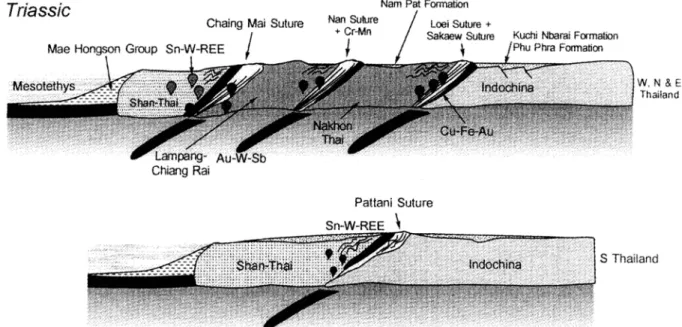
The respective thrust planes correspond to the Chang Mai, Nan and Loei sutures (Fig. 1).

2.3. Subdivision of SE Asia and the Proposed Concept of Shan-Thai

A satellite picture from space, may suggest the tectonic subdivisions of SE Asia (Nie et al, 1993). All major sutures of SE Asia seem to pass through the narrow 200 km wide bottle neck of western Yunnan, opening like a fan into Thai- land (Wang et al., 1997, Fig. 1, p.106). In their review paper, these authors have summarized their SE Asian plate-tec- tonic interpretation of western Yunnan and northern Thailand.

Ueno (1999) and Chonglakmani et al. (2001) have differ- entiated several tectonic - stratigraphic units that run from Yunnan into Thailand.

In our proposed concept, the SE Asian area is subdivided into the following tectonostratigraphic terranes (Fig. 2), with reference to the Permian and Triassic facies (Table 1):

The Yangtse-Indochina border zone: To the north-east of the SE Asian subcontinent and subparallel to the Paleo- gene Red River Fault, runs the Ailaoshan belt, as a part of the Yangtse block. Bound by the Song Ma and Ailaoshan sutures, the Song La marine furrow encompasses a substan- tial Paleozoic (4000 m) and an approximately 1000 m Tri- assic cover that consists of carbonates ending in plant and coal bearing clastics (Martini et al., 1998).

The Indochina Block consists of the Loei-Jiangchen and Phetchabun units. While Loei-Jiangchen has a Paleozoic cover, with a Devonian – Carboniferous history of rifting and compressional deformation, a gap spans the interval between Permian and Late Triassic. The Phetchabun fold and thrust belt (Helmcke, 1984, 1986) includes remnants of a Permian oceanic seaway that closed in the Late Middle or earliest Late Permian. Bound by the Nan – Uttaradit suture to the west and by the Loei suture to the east, Helmcke’s Phetchabun belt corresponding to part of the Nakhon-Thai block of Charusiri et al. (2002). The Mesozoic cover is con- tinental and consists of the Khorat Group starting with the Carnian –Norian Huai Hin Lat and Nam Pong formations (Helmcke, 1983).

The Nan-Uttaradit suture has been considered by many to represent the main divide between the Shan-Thai and Indochina terranes (Carey et al., 1995). The Paleozoic Lan- cang - Uttaradit ocean, characterized by radiolarian cherts, serpentinites and siliciclastic turbidites, was closed in late

Fig. 1. Middle - Upper Triassic Plate Tectonic reconstructions of Thailand (Charusiri et al., 2002).

(3)

Middle Permian (Helmcke, 1986; Chonglakmani and Helmcke, 1989; Carey et al., 1995). As the Nan-Uttaradit suture seems to contain the remnants of the Paleozoic early Indosinian orogenic event, Middle Triassic radiolarian cherts in the region (Feng et al., 2002), were possibly thrusted in from the west (Chonglakmani, 2002). This view is now also sup- ported by thrusting along the Nan Suture (Charusiri et al., 2002). Fontaine et al. (2002), following Ueno (1999), do not regard the Nan-Uttaradit suture as the main closure of paleo-Tethys.

The Shan-Thai Block extends west of the Nan-Uttaradit suture. Its eastern part comprises the internal and central zones of “Thai”. Its western part, across the “Gondwana –Tethys Divide” (Ueno, 1999), encompasses the external “Western”

zones of “Shan”, bound by the Sagaing Fault. The elements of Shan-Thai consist of four main elements or zones (Fig. 2), three of them being characterized by distinctive Triassic strati- graphic sequences in the Malay Peninsula (Fig. 3).

(1) The Sukhothai zone (Bunopas, 1981; Barr and McDonald, 1991; sensu Ueno, 1999; Chonglakmani, 2002) lies adjacent to the Nan-Uttaradit suture. It consists of a Paleozoic substratum of phylites. Where less affected by Permian metamorphism, these phylites are separated by a Middle Permian regional angular unconformity. Acid mag- matism is either post-orogenic or related to a Permian -Triassic volcanic arc. Extensional semi-grabens or intra-continental rifts that formed since Late Permian times are filled with the Triassic Lampang Group that includes turbidites, as the Hong-Hoi Formation. Representing a fore-arc basin for Bunopas et al. (2002), Chonglakmani and Helmcke (1989) compared the turbidites and deepwater fauna of the Lam- pang Group to marine intra-montane molasses, similar to the marine intracratonic Dien Bien Phu basin in Vietnam (Staritskyi et al., 1973). The Semantan Formation of the

Central Belt in Peninsular Malaysia, situated east of the Bentong-Raub suture (Metcalfe, 1990b), has been seen as correlative with the Lampang Group (Chonglakmani, 2002).

The Sukhotai zone is bound to the west by the Chiang Rai

zone. This dislocated zonal border is characterized by a deep marine and oceanic furrow that yields Late Paleozoic - Triassic radiolarian cherts (Feng et al., 2001; Sashida et al., 1995). Chonglakmani (2002) connects the Chiang Rai zone southwards into the Chanthaburi zone and further south with the Bentong-Raub suture.

(2) The Inthanon Zone (Barr and McDonald, 1991;

sensu Ueno, 1999) in N. Thailand, corresponds to the Doi- Inthanon – Lincang unit of Chonglakmani et al. (2001), also called Chiang-Mae terrane (Chonglakmani, 2002) and most recently Inthanon Terrane (Feng et al., 2005). It is bound, west of the Chiang Mai basin, by high grade metamorphic core complexes (McDonald et al., 1993). Granite intrusions are mostly Triassic. The oldest sediments are Cambrian or Ordovician. Carboniferous and Permian shallow marine carbonate platforms are tropical or subtropical (Toriyama, 1944, 1984; Konishi, 1953; Fontaine et al., 1993). Late Paleo- zoic – Middle Triassic siliciclasts and radiolarian ribbon cherts occur locally (Luning, 1994) and Middle Triassic radiolaria ar found at Lamphun (Feng et al., 2002). Jurassic red beds fill local graben structures (Luning et al., 1995). Toefke et al. (1993) interpreted this zone as the disrupted passive Late Permian continental margin of paleo-Tethys with immature clastic deposition during the Triassic. Helmcke (1984) sug- gested a Late Devonian or Early Carboniferous detachment from Gondwana and its close vicinity to paleo-Eurasia for most of the upper Paleozoic. This assertion is based on Wal- chia piniformis as well as Middle Carboniferous – Early Permian fusulinids in Western and Eastern Thailand alike (Toriyama et al., 1978; Ingavat et al., 1980). The associated Table 1. Paleozoic - Triassic facies and tectono-environments characterize each of the Shan-Thai Zones. The proposed scheme is based on Chonglakmani and Grant- Mackie (1993), Sashida and Igo (1999), Meesook (2002) and Chonglakmani (2002).

ZONE Northern Thailand Chanthaburi Peninsular Thailand -Malaysia

Sukhothai-Zone

Paleozoic-Triassic clastics, carbonates and turbidites associated with rhyolitic and andesitic volcanism reaching 5000m in the Lampang- Phrae basins of NE Thailand (L);

East Malaysia: Triassic Semantan Formation

Chiang Rai suture Permian-Triassic radiolarian cherts cryptic Bentong- Raub Suture

Inthanon Zone Paleozoic and Triassic Triassic of Songhkla (So)

Mae Sariang Zone

Permian and Triassic oceanic bedded cherts and oro- genic deep marine shale, extending from Mae Hong Son – Mae Sariang (Ms) - Mae Sot – Umphang (TAK) – Kantchanaburi (Ka)

Permian-Triassic oceanic/orogenic deposits

Triassic oceanic/orogenic Phatthalung (P) , Chaiburi (C) , Semanggol (Sg)

Gondwana-Tethys Divide

“Western” Zone Tengchon-Tenasserim Zone Permian tillites

Triassic epicontinental platform, devoid of volcanics

Phuket Zone Early Permian tillites Triassic

Kodiang limestone (K)

(4)

Changnin - Menglian Belt to the north has Devonian deep- water sediments and Carboniferous -Permian shallow warm platform carbonates of Tethyan faunal affinity (Feng et al., 2005).

(3) The Mae Sariang Zone runs along the NS-trending Tertiary strike-slip valley of Mae Nam Yuam, northwest of Mae Sariang, where Permian and Triassic ribbon cherts and true pelagic limestones occur that Hahn and Siebenhuner (1982) and Fontaine and Suteethorn (1988) attribute to the Shan-Thai Terrane. The pelagic sequence is followed by syn- orogenic siliciclastic turbidites (Toefke et al., 1993), which are located near the western border of Lower Permian warm-water limestones (Helmcke et al., 1993). A conglomerate with radi-

olarite pebbles yielding radiolarians determines the age of the Mae Sariang orogeny. Their Guadalupian (Late Kazanian to Early Tatarian) and Middle Triassic (Anisian –Ladinian) age (Caridroit et al., 1993), confers the host-conglomerate a Late Triassic or younger age, probably Jurassic. Kamata et al. (2002) put in evidence the palaeogeographic significance of the Spathian to Carnian radiolarians in the closure of paleo- Tethys. Fontaine and Suteethorn (1988) first mentioned pelagic limestone along the highway Tak - Mae Sot (km 49.750), indicating the southern continuation of the Mae Sariang terrane boundary (Helmcke, 1994). Chonglakmani et al. (1991) extends the Mae Sariang Basin into the Kan- chanaburi Basin where siliciclasts are exposed along Khwae Fig. 2. Tectonostratigraphic terranes of Southeast Asia (modified after Hada et al., 1997; Ueno, 1999; Bunopas et al., 2002; Chonglakmani et al., 2001;

Gondwana-Tethys Divide after Myo Min et al., 2001). Triassic basins are after Chonglakmani and Grant-Mackie (1993) and Meesook et al. (2002).

Legend: 1. Sukhothai Zone; 2. Intha- non-Zone; 3. Mae-Sariang Zone; 4.

“Western” zones (Tengchon -Tenasse- rim and Phuket); 5. Gondwana-Tethys Divide (GTD). Triassic basins and for- mations: C: Chaiburi Formation; K:

Kodiang Limestone; Ka: Kancha- naburi; Kho: Khorat Group; L: Lam- pang–Phrae basin; Ms: Mae Sariang;

P: Phatthalung basin; S: Semantan For- mation; TAK: Mae Sot - Umphang area;

Sg: Semanggol Formation; So: Songh-

kla basin.

(5)

Yai, at Ban Chong Khap (Bunopas, 1981). Sediments yield- ing Permian and Triassic radiolarian faunas occur in the Mae Hon Son area of northwestern Thailand (Saesaengseerung et al., 2005).

The continuity within the Mae-Sariang – Kanchanaburi Basin is supported by the sequence of shale, sandstone and conglomerate, intercalated with chert and limestone, yield- ing Daonella and Halobia . Such sediments are exposed in the Tak - Mae Sot and Umphang areas. At km 34 of the Tak- Mae-Sot road, mudstone with Halobia , wood fragments and poorly preserved radiolarians occur, topped by chert beds, containing fine vitritic-tuff and yielding radiolarians of Middle to Late Triassic age (Ishida et al., 2004, 2006).

There it is covered by a breccia, composed of poorly sorted angular-subangular clasts of limestone and chert with red sandstone and siltstone. Among the fragments of limestone and cherty tuff, limestone fragments contain Early and Late Triassic conodonts, whereas the cherty tuff fragments con-

tain Middle and Late Triassic radiolarians. The Chantaburi chert-clastic sequence (Hada et al., 1997) contains Late Per- mian - Late Triassic radiolarians that can be associated with those of the Mae Sariang zone. In Peninsular Thailand, Tri- assic Na Thawi and Chaiburi mud- and limestone in the Phatthalung area have been singled out (Ampornmaha, 1995; Sashida and Igo, 1999). Other sediments, similar to those of Mae Sariang, are found in the Semanggol Forma- tion (Sashida et al., 1995), in Kedah, Malaysia (Fig. 3).

In the southern Shan States, Myanmar, along the Pan Laung Fault, Garson et al. (1976) described the Triassic turbidites of the Maubin Formation, sealed by Rhaetian coal seams and Middle Jurassic red beds.

(4) The external “ Western ” Zone encompasses Ueno’s (1999) “Sibumasu Block”, the Tengchong-Tenasserim and Phuket zones of the “Western Units” of Chonglakmani et al.

(2001) as well as the Shan block of Feng et al. (2005). It com- prises Gondwana derived Cimmerian terranes that docked Fig. 3. Triassic stratigraphy of the Shan-Thai Block of the Malay Peninsula: (Metcalfe, 1990b): (1) “Western-zone”; (2) Mae-Sariang Zone;

(3, 4, 5) Sukhotai-Zone.

(6)

during a Triassic orogenic event. Crystalline pebbles of gla- cial-marine origin, as young as Stephano-Asselian, covered by late Early Permian limestone with impoverished faunas.

Its Triassic cover is represented by the Kodiang-Limestone (Fig. 3).

2.3.1. The Sutures

As it appears from the work of many researchers, the Shan- Thai and Indochina terranes consisted of several structural subunits each. The Carboniferous, Permian and Triassic radiolarian ribbon chert and pelagic limestone, as well as the Late Permian and Triassic platform deposits, bear witness for the history of several marine furrows, primarily along or within the suture zones that frame Shan-Thai and Indochina terrane-fragments.

Among these, the Nan-Uttaradit-Raub-Bentong suture has been long regarded as the Late Triassic-Earliest Jurassic welding of the blocks that compose Thailand (Nie et al, 1993; Metcalfe 1998; Shi and Archbold, 1998). Since Hada et al., (1997) the tracing of this line makes a bend that includes the Sra Kaeo – Chantaburi zone (Fig. 4).

The connection by Chonglakmani (2002) of the Sra Kaeo- Chanthaburi zone with the dislocated or ‘cryptic’ Chiang Rai zonal border (Ueno, 1999), which runs between Sukhotai and Inthanon, opens the way to a different interpretation.

Based on the understanding that the Nan-Uttaradit suture most probably represents an Early Indosinian Late Mid- dle Permian event (Chonglakmani and Helmcke, 1989), the Chiang Rai zonal border, or Chang Mai Geosuture (Feng et al., 2005) and the better documented Mae Sar- iang oceanic furrow indicate a Late Indosinian Late Tri- assic event (Fig. 2).

Since the region has been wrenched by sinistral strike slip faults (Mae Ping, Three Pagodas) during the Cenozoic, the original spatial relations between the area of Kanchanaburi and that of Chantaburi may have changed substantially.

Given the structural narrowing of the Inthanon zone towards the south, the Mae Sariang and Chiang Rai zones may nearly merge within the Chanthaburi zone, where the several Shan-Thai elements are compressed into a single sutural bundle (Fig. 2). The abundant petrological and micropaleontological evidences brought forward by Caridroit et al. (1993), Hada et al. (1997), Ishida et al.(2004) and Sae- saengseerung et al. (2005) corroborate the similarity of the Mae Hon(g) Son – Mae Sariang – Mae Sot – Kanchanaburi and Chantaburi zones. South of Chantaburi, the Shan-Thai elements can be identified again. East of the Bentong-Raub suture, East Malaya, characterized by the Semantan Formation, a Triassic Lampang Facies equivalent, is correlative with the Sukhothai zone (Chonglakmani, 2002). Yet, in Peninsular Thailand, the space between Bentong-Raub and Gondwana- Tethys Divide is occupied by Triassic deposits of the Songkhla basin, Phatthalung and the Semangol turbidites that suggest equivalence with the Inthanon - Mae Sariang zones.

2.4. The Gondwana-Tethys Divide

The line that signals approximately the margin between Early Permian subtropical paleo-Eurasian and glacial marine Gondwanid elements (Ingavat-Helmcke and Helmcke, 1994;

Ueno, 1999; Chonglakmani et al., 2001; Myo Min et al., 2001; Feng et al., 2005) runs west of the Mae Sariang basi- nal type sediments that separate the Inthanon zone from the Tengchong - Mergui-Tenasserim zones. Helmcke et al. (1993) speculated a huge ocean, located westward of the shallow Paleozoic platform in northern Thailand. For Toefke et al.

(1993), the region of Mae Sariang hosts the boundary zone to the Gondwana derived terranes of Southeast Asia. In other words, the region east of Mae Sariang can be regarded as the paleo-Eurasian margin of paleo-Tethys while the region west of Mae Sariang has a Gondwanian origin (Car- idroit et al., 1993).

This Gondwana-Tethys Divide (GTD) (Ueno, 1999; Wang et

al., 1997) follows the Nujiang Fault/Suture in Yunnan and

the Mae Yuam Fault in northern Thailand. Besides paleon-

Fig.4. Tectonographic terranes of Southeast Asia (Hada et al., 1997).

(7)

tological and tectonic aspects, abundant chromium spinels in the “Mae Sariang Group” of the Mae Hong Son – Mae Sar- iang area, possibly of intraplate origin may indicate a suture or other tectonic boundary, suggesting that the GTD is located along the Mae Yuam Fault zone (Hisada et al., 2003). In Pen- insular Thailand and Malaysia, the GTD apparently corre- sponds to the border between the glacial pebble (Phuket) and carbonate (Rat Buri) facies.

2.5. Stages of evolution of Shan-Thai

The evolution of the Shan-Thai terrane took place in a succession of phases:

2.5.1. Paleozoic

The paleo-Tethys poly-island ocean (Liu et al., 1993) spread over several palaeo- latitudes, expressed in biogeo- graphical criteria (Shi and Archbold, 1998). These include the cold- water Gondwana type facies, predominant in the more external “Shan” elements of Shan-Thai, while the transitional Sibumasu type and the paleotropical warm- water Cathaysian type occur in the intermediary and more internal “Thai” elements of Shan-Thai. A first phase of oce- anic extension, approximately at 360 Ma created the Nan- Uttaradit rift basin, floored by oceanic crust (ophiolites).

This basin closed at 265 Ma (Middle Permian) creating the intra-Permian unconformity. This end Middle Permian clo- sure of the Nan-Uttaradit suture (Early Indochina orogeny) probably merged the most internal part of Shan-Thai to Indochina, making it a part of Laurasia (Helmcke, 1985;

Chonglakmani et al., 2001).

2.5.2. Late Permian – Triassic

Several marine basins remained open, reopened or were newly developed. Their varied facies can be summarized after Chonglakmani (2002) and Meesook et al. (2002) into three main types: (a) epicontinental platform, devoid of volca- nics, found in the Semanggol and Chaiburi formations in Peninsular southern Thailand; (b) the disputed fore-arc (Bunopas et al., 2002) versus intramontane clastic, carbon- atic and turbiditic type (Chonglakmani and Helmcke, 1989), associated with rhyolitic and andesitic volcanism, reaching a thickness of 5000m in the Lampang-Phrae basins of NE Thailand; (c) deep marine shale and oceanic bedded cherts.

The end Triassic- Early Jurassic Late Indochina Orogeny closed all these paleo-Tethys basins, amalgamating all Shan- Thai and Indochina elements into a new SE Asian basement.

The Late Permian - Triassic basins primarily occur along or within suture zones that weld Shan-Thai and Indochina ele- ments. The main event took place within the string of oce- anic type furrows that runs from NW into SE Thailand, representing a single zone from Mae Hon(g) Son – Mae Sari- ang – Kanchaburi to Chantaburi, as corroborated by petrolog- ical and micropaleontological evidence (Caridroit et al., 1993;

Hada et al., 1997; Ishida et al., 2004; Saesaengseerung et al., 2005; Ishida et al., 2006).

2.5.3. Jurassic-Cretaceous-Early Paleogene

The end Triassic tectonic phase not only completed the assemblage of the allochthonous elements forming the Shan- Thai, it brought the paleo-Tethys to its end. The newly formed South East Asian basement, being the product of the weld- ing of several blocks together became part of Eurasia.

While accretionary complexes are suspected to have formed only along the sutures, the block-like pattern of the units lying in between, suggests fairly undisturbed platform frag- ments, the bulk of which had docked before being tecton- ically deformed by the End-Triassic – Early Jurassic Late Indosinian orogeny. The new basement has a marine Juras- sic cover with faunas of strict autochthonous character (Kozai et al., 2006). The Early Jurassic Mogok orogeny in Myanmar (Mitchell et al., 2002) is probably a Late Indosin- ian phase, possibly related to Early Jurassic stitching plu- tons (Hada et al., 1997). The Mid-Cretaceous Shan orogeny (Mitchell et al., 2002) belongs into the Mesotectonic Stage (Charusiri et al., 2002), further contributing to compression in Thailand.

2.5.4. Cenozoic

The Oligo-Miocene Alpine-Himalayan Indo-Eurasian colli- sion inflicted severe chaos on the rather structurally quies- cent Jurassic-Cretaceous SE Asian subcontinent. The collision resulted in the clockwise rotation of SW Asia, squeezing the tectonic units of western Yunnan into a narrow structural bottle neck and eventually resulting into extrusion tectonics (Leloup et al., 2001). The extrusion of Shan-Thai and Indochina took place along the Sagiang and Red River transforms (Lacassin et al., 1997). For Morley (2004), the left lateral motion on the NW–SE-trending strike-slip fault zones (Mae Ping and Three Pagodas) is part of a diffuse, branch- ing network of faults with important north–south as well as NW–SE trends that may represent a substantial Late Creta- ceous–Palaeogene transpressional belt, Himalayan escape tectonics representing later increments of deformation with both Oligocene sinistral and late Oligocene–Recent dextral reactivation. The Cenozoic tearing apart along the Wang Chao (Mae Ping) fault Zone, initially a sinistral transform colliding with the dextral Sagiang fault, and the Three Pagodas Fault Zone, among others, have wrenched Thai- land to pieces.The subsequent change in sense of strike slip movement of some of these faults (e.g., Mae Ping Fault) further dislocated the Shan-Thai puzzle (Fig. 2).

3. CONCLUSIONS

The Shan-Thai Terrane, as a remnant of paleo-Tethys in

South East Asia, consists of three main Late Paleozoic facial

developments: the warm water Cathaysian facies, alongside

(8)

Indochina, the central intermediary “Sibumasu” facies and the Gondwana facies. The first two are found in the “Thai”

elements of the Sukhotai-Lampang Zone, Inthanon-Chiang Mai Zone and Mae-Sariang Zone. The third consists of the external “Western” Zone of Tengchon-Tenasserim- Phuket or “Shan” elements, characterized by Permian glacial sed- iments.

The Nan-Uttaradit suture is the Early Late Permian Lower Indosinian scar between “Thai” and Indochina, having no major role in the final welding of Shan -Thai.

The final welding of SE Asia took place during the Late Indosinian orogeny, in Late Triassic - Earliest Jurassic times.

A major scar, for which the Jurassic basal breccia bears wit- ness, runs along a line of deep sea facies, known from Mae Hon - Mae Sariang -Tak – Kantchanaburi to Chantaburi. This orogenic axis is strongly offset by Cenozoic strike slip faults (Mae Ping, Three Pagodas, Ranong and Khlong Marui). In the traverse of Chantaburi most of Shan-Thai is reduced to a narrow bundle of several sutures, resembling the compa- rable Yunnan bottle neck. This is the result of extreme tec- tonic compression, as a consequence of Cenozoic Himalayan escape tectonics along the Sagiang and Red River transforms.

The links across eastern Thailand’s Chanthaburi to south- ern Thailand and Malaysia are tentative. East of the Ben- tong-Raub suture in the Central Belt of Peninsular Malaysia, the development of the Semantan Formation, similar to the Lampang facies in Northern Thailand (Chonglakmani, 2002), suggests the extension of the Sukhotai Zone to Peninsular Thailand and the equivalence of the Bentong-Raub and Chiang Rai sutures.

The Mae Sariang Zone of Northern Thailand is deflected in the Chantaburi structural bundle. In southern Thailand, the Inthanon- Mae Sariang border line apparently corre- sponds to the Pattani suture of Charusiri et al. (2002). The southern Thailand Phatthalung facies, Chaiburi Formation and the NW Malaysian Semanggol Formation are equiva- lent to the facies of Mae Sariang. Across the GTD, the Kodiang limestone facies belong into the “Western” Zone.

ACKNOWLEDGMENTS: We are indebted to the Geological Sur- vey DMR in Bangkok for providing us the logistic support in the field during our stay in Thailand as well as to Prof. Hirano (Waseda Uni- versity), the driving force and leader of the IGCP 434 project. The late Prof. Dietrich Helmcke (Goettingen University) read and commented an early draft of this study, for which we will thankfully remember his immense contribution to the research of Thailand. We wish to express our sincere thank to Dr. Clive Burrett (Hobart) for reviewing the manuscript and to Prof. Graciano P. Yumul, Jr. and Dr. Carla Dimal- anta (NIGS, Quezon City) for improving the manuscript with their per- tinent comments.

REFERENCES

Ampornmaha, A., 1995, Triassic carbonate rocks in the Phatthalung area, Peninsular Thailand. Journal of Southeast Asian Earth Sci- ences, 11, 225 − 236.

Barr, S.M. and McDonald, A.S., 1987, Nan river suture zone, north- ern Thailand. Geology, 15, 907 910.

Barr, S.M. and McDonald, A.S., 1991, Toward a late Paleozoic-early Triassic tectonic model for Thailand. Journal of Thai Geo- sciences, 1, 11 − 22.

Baum, F., Braun, E., Hess A., Koch, K.E., Kruse, G., Quarch, H., and Siebenhuener, M, 1970, On the geology of northern Thailand.

Geologisches Jahrbuch, 102, 23p.

Boucot, A., 2003, Some thoughts about the Shan-Thai terrane. Pro- ceedings of The Symposium on the Geology of Thailand, Bangkok, 4 − 13.

Bunopas, S., 1981, Paleogeographic history of western Thailand and adjacent parts of South-East Asia – A plate tectonics interpreta- tion. Ph.D. Thesis, Victoria University of Wellington, New Zealand.

810 pp.

Bunopas, S., Vella, P., Fontaine, H., Hada, S., Burrett, C., Haines, P., Potisat, S., Wongwanich, Th., Chaodumrong, P., Howard, K.T.

and Khositanoui, S., 2002, Growing of asia in the Late Triassic continent-continent collision of Shan-Thai and Indochina against South China. Proceedings of The Symposium on Geology of Thailand, Bangkok, 129 135.

Burrett, C., Long, J. and Stait, B., 1990, Early-Middle Paleozoic bio- geography of Asian terranes derived from Gondwana. In: McK- errow, W.S. (ed.), Palaeozoic Palaeogeography and Biogeography, Geological Society Memoir Series, 12, 163 − 174.

Carey, S.P., Burrett, C.F., Chaodumrong, P., Wongwanich, T. and Chonglakmani, C., 1995, Triassic and Permian conodonts from the Lampang and Ngao Groups, northern Thailand. Courier For- schungsinstitut Senckenberg, 182, 497 − 513.

Caridroit, M., Bohlke, D., Lamchuan, A., Helmcke, D. and De Wever, P., 1993, A mixed radiolarian fauna (Permian/Triassic) from clas- tics of the Mae Sariang area, Northwestern Thailand. In: Thana- suthipitak, T. (ed.), Proceedings of the International Symposium on Biostratigraphy of Mainland Southeast Asia: Facies and Pale- ontology, 2, 401 − 413.

Charusiri, P., Daorerk, V., Archibald, D., Hisada, K. and Ampaiwan, T., 2002, Geotectonic evolution of Thailand: A new synthesis.

Journal of the Geological Society of Thailand, 1, 1 20.

Chonglakmani, C., 2002, Current status of Triassic stratigraphy of Thailand and its implication for geotectonic evolution. Proceed- ings of the Symposium on Geology of Thailand, Bangkok, 1 3.

Chonglakmani, C., Gabel, J., Helmcke, D., Lamchuan, A. and Meischner, D., 1991, Geodynamic interpretation of marine Tri- assic basins in northern Thailand. Seventh Regional Conference on Geology, Mineral and Hydrocarbon Resources of Southeast Asia (GEOSEA VII) (Abstract), Bangkok, p. 13.

Chonglakmani, C. and Grant-Mackie, J.A., 1993, Biostratigraphy and facies variation of the marine Triassic sequences of Thailand.

Proceedings of the International Symposium on Biostratigraphy of Mainland Southeast Asia: Facies and Paleontology, 1, 97 − 123.

Chonglakmani, C. and Helmcke, D., 1989, The Triassic Lampang Group of northern Thailand: Fore-arc basin deposits or sediment of intramontane basins. International Symposium on Intermontane Basins: Geology and Resources, 265 − 275.

Chonglakmani, C., Feng, Q., Meischner, D., Ingavat-Helmcke, R.

and Helmcke, D., 2001, Correlation of tectono-stratigraphic units in northern Thailand with those of Western Yunnan (China). Journal of China University of Geosciences, 12, 207 213.

Cooper, M.A., Herbert, R. and Hill, G.S., 1989, The structural evo- lution of Triassic intermontane basins in northeastern Thailand.

International Symposium on Intermontane Basins: Geology and

(9)

Resources, 231 242.

Dheeradilok, P., Wongwanich, T., Tanathien, W. and Chaodumrong, P., 1992, An introduction to the geology of Thailand. Proceed- ings of the National Conference on the Geologic Resources of Thailand - Potential for future development, DMR Bangkok, 737 − 752.

Feng, Q., Chonglakmani, C., Helmcke, D., Ingavat-Helmcke, R. and Liu, B., 2002, Middle Triassic radiolarian fauna from Lamphun, Northern Thailand. Proceedings of the Symposium on Geology of Thailand, Bangkok, 108 − 116.

Feng, Q., Chonglakmani, C., Helmcke, D., Ingavat-Helmcke, R. and Liu, B., 2005, correlation of Triassic stratigraphy between the Simao and Lampang-Phae Basins: implications for the tectono- paleogeography of Southeast Asia. Journal of Asian Earth Sci- ences, 24, 77 − 785.

Fontaine, H. and Workman, D.R., 1978, Review of the geology and mineral resources of Kampuchea, Laos and Vietnam. In: Nuta- laya, P. (ed.), Geology and Mineral Resources of southeast Asia.

Asian Institute of Technology, Bangkok, 538 − 603.

Fontaine, H. and Suteethorn, V., 1988, Late Paleozoic and Mesozoic fossils of West Thailand and their environments. Committee for Cooperation of Joint Prospecting for Mineral Resources in Asian Offshore Areas (CCOP), 20, 1 108.

Fontaine, H., Chonglakmani, C., Sangat, P., Bin Amnan, I. and Han Peng, K., 1993, Triassic limestones within and around the gulf of Thailand. Journal of Southeast Asian Earth Sciences, 8, 83 − 95.

Fontaine, H., Sirot, S., Duc Tien, N. and Vachard, D., 2002, Permian Fossils Recently Collected from Limestones of Nana Area, North Thailand. Proceedings of the Symposium on Geology of Thai- land, Bangkok, 45 − 57.

Garson, M.S., Amos, B.J. and Mitchell, A.H.G., 1976, The geology of the country around Neyaunngga and Yengan, Southern Shan States, Burma. Institute of Geological Sciences Overseas Divi- sion Memoirs, 1, 1 − 112.

Hada, S., Bunopas, S., Ishii, K. and Yoshikura, S., 1997, Rift-drift history and the amalgamation of Shan-Thai and Indochina/East Malaya Blocks. National Conference on the Stratigraphy and Tectonic Evolution of SE Asia and the South Pacific, Bangkok, 143 157.

Hahn, L. and Siebenhuener, M., 1982, Explanatory notes (paleontol- ogy) on the geological map of northern and western Thailand 1:250,000. Bundesanstalt Geowissenschaften Rohstoffe, 76 pp.

Helmcke, D., 1983, Variscan and Indosinian Orogeny in central south- east-Asia: a contradiction or a completion. In: Thanasuthipitak, T.

(ed.), Proceedings of the Annual Technical Meeting, Department of Geological Sciences, Chiang Mai University, 101 − 107.

Helmcke, D., 1984, The orogenic evolution (Permian-Triassic) of central Thailand. Implications on paleogeographic models for mainland SE-Asia. Mémoires de la Societe Géologique de France, NS, 147, 83 − 91.

Helmcke, D., 1985, The Permo-Triassic ‘Paleotethys’ in mainland Southeast Asia and adjacent parts of China. Geologische Rund- schau, 74, 215 − 228.

Helmcke, D., 1986, Die alpiden und die Kimmeriden: Die verdop- pelte Geschichte der Tethys – discussion. Geologische Rundschau, 74, 495 − 499.

Helmcke, D., 1994, Distribution of Permian and Triassic Syn-Oro- genic Sediments in Central Mainland SE-Asia. Proceedings of the International Symposium on Stratigraphic Correlation of Southeast Asia, Bangkok, Thailand, 123 128.

Helmcke, D., Ingavat-Helmcke, R. and Meischner, D., 1993, Spät-

variszische Orogenese und Terranes in Südost-Asien. Göttinger Arbeiten zur Geologie und Palaeontologie, 58, 29 38.

Hisada, K., Sugiyama, M., Ueno, K., Charusiri, P. and Arai, S. 2003, Missing ophiolitic rocks along the Mae Yuam as the Gondwana- Tethys divide in north-western Thailand. The Island Arc, 13, 119 − 127.

Ingavat, R., Toriyama, R., Pitakpaivan, K., 1980, Fusuline zonation and faunal characteristics of the Ratburi Limestone in Thailand and its equivalents in Malaysia. Geology and Paleontology of Southeast Asia, 21, 43 − 56.

Ingavat-Helmcke, R. and Helmcke, D., 1994, Permian Facies Realms in Thailand. Proceedings of International Symposium on Strati- graphic Correlation of Southeast Asia, Bangkok, Thailand, Bangkok, 100 − 105.

Ishida, K., Nanba, A., Hirsch, F., Kozai, T. and Meesook, A., 2004, Microfossil analysis of the Shan-Thai Terrane Jurassic Basal con- glomerate in NW Thailand. Sixth International Symposium of IGCP 434 “Cretaceous geology and resources in South, East Asia and adjacent areas”, Ha Noi, Viet Nam, (Abstract), 29 − 30.

Ishida, K., Nanba, A., Hirsch, F., Kozai, T., Meesook, A., 2006, New Micro- palaeontological evidence for the Late-Triassic Shan-Thai orogeny. Geoscience Journal, this volume.

Kamata, Y., Sashida, K. and Ueno, K., 2002, Triassic radiolarian fau- nas from the Mae Sariang area, northern Thailand and their paleogeographic significance. Journal of Asian Earth Sciences, 20, 491 − 506.

Kemper, E., Maronde, H.-D. and Stoppel, D., 1976, Triassic and Jurassic limestone in the region northwest and west of Si Sawat (Kanchanaburi Province, Western Thailand). Geologisches Jahr- buch, 21, 93 − 127.

Konishi, K., 1953, New Boultonia and other microfossils from North Thailand. Transactions and Proceedings of the Palaeontological Society of Japan, 12, 103 − 110.

Kozai, T., Hirsch, F., Ishida, K. and Meesook, A., 2006, Faunal affin- ity of Toarcian- Aalenian (Early Jurasic) bivalves from Mae Sot and Umphang, Tak Province, NW Thailand. Geoscience Journal, this volume.

Lacassin, R., Maluski, H., Leloup, P.H., Tapponnier, P., Hinthong, C., Siribhakdi, K., Chuaviroj, S. and Charoenravat, A., 1997, Tertiary diachronic extrusion and deformation of western Indochina: Struc- tural and

40

Ar/

39

Ar evidence from NW Thailand. Journal of Geo- physical Research, 102, 10013 10037.

Leloup, P.H., Arnaud, N., Lacassin, R., Kienast, J.R., Harrison, T.M., Phan, T.T., Replumaz, A. and Tapponnier, P., 2001, New constraints on the structure, thermochronology and timing of the Ailao Shan - Red River shear zone, SE Asia. Journal of Geophysical Research, 106, 6657 − 6671.

Liu, B., Feng, Q. and Fang, N., 1993, Tectonic evolution of Paleo- Tethys poly-island-ocean in Changning-Menglian and Lancangjiang belts, southwestern Yunnan, China. Earth Science (in Chinese with English abstract), 18, 529 − 539.

Luning, S., 1994, Geologie des Gebietes um Ban Mae Suya (NW Thailand). Ph.D. thesis, Goettingen University, Germany, 184 p.

Luning, S., Tantiwanit, W. and Helmcke, D., 1995, Mesozoische ter- restrische rotsedimente in NW Thailand (Provinz Mae Hon Son) hinweis auf extension im Jura. Nachrichten Deutsche Geologis- che Gesellschaft, 54, 123 − 124.

Martini, R., Zaninetti, L., Cornee, J., Villeneuve, M., Tran N. and

Trong Thang, T., 1998, Decouverte de foraminifers du Trias dans

les calcaires de la region de Ninh Binh (Nord Vietnam). Comptes

Rendus Academie Sciences (Earth and Planetary Sciences), 326,

(10)

113 119.

McDonald, A.S., Barr, S.M. and Dunning, G.R., 1993, The Doi Inth- anon metamorphic core complex in NW Thailand: Age and tec- tonic significance. Journal of Southeast Asian Earth Sciences, 8, 117 − 125.

Meesook, A., Suteethorn, V., Chaodumrong, P., Teerarungsipul, N., Sardsud, A. and Wangprayoon T., 2002, Mesozoic Rocks of Thailand: A summary. Proceedings of The Symposium on Geol- ogy of Thailand, Bangkok, 82 − 85.

Metcalfe, I., 1990a, Allochthonous terrane processes in Southeastern Asia. Philosophical Transactions of the Royal Society of London, A331, 625 − 640.

Metcalfe, I., 1990b, Stratigraphic and tectonic implications of Trias- sic conodonts from northwest Peninsular Malaysia. Geological Magazine, 127, 567 − 578.

Metcalfe, I., 1991, Late Paleozoic and Mesozoic palaeogeography of southeast Asia – Palaeogeography, Palaeoclimatology, Palaeo- ecology, 87, 211 − 221.

Metcalfe, I., 1998, Paleozoic and Mesozoic geological evolution of the SE Asian region: Multidisciplinary constraints and implica- tions for biogeography. In: Hall, R., Holloway, J.D. and Rosen, B.R. (eds), Biogeography and Geological Evolution of SE Asia.

SPB Publishers, Amsterdam, p. 25 41.

Mitchell, A., Hlaing, T. and Htay, N., 2002, Mesozoic orogenies along the Mandalay-Yangon Margin of the Shan Plateau. Proceedings of The Symposium on Geology of Thailand, Bangkok, 137 − 149.

Morley, C.K. 2004, Nested strike-slip duplexes, and other evidence for Late Cretaceous–Palaeogene transpressional tectonics before and during India–Eurasia collision, in Thailand, Myanmar and Malaysia. Journal of the Geological Society, 161, 799 − 812.

Myo Min, K., Feng, Q., Chonglakmani, C., Meischner, D., Ingavat- Helmcke, R., Mitchell, A., Hlaing, T., and Htay, N., 2000, Early Jurassic and mid-Cretaceous collisions, Alpine style orogeny and assembly of Myanmar. IGCP 434 Second International Sympo- sium (Abstracts), Myanmar, p. 7 − 9.

Myo Min, K., Feng, Q., Chonglakmani, C., Meishner, D., Ingavat- Helmcke, R. and Helmcke, D., 2001, Tracing disrupted outer margin of Paleoeurasian continent through Union of Myanmar. Journal of China University of Geosciences, 12, 201 206.

Nie, S., Rowley, D., Van der Voo, R. and Maosong, L., 1993, Pale- omagnetism of Late Paleozoic rocks in the Tianshan, northwest- ern China. Tectonics, 12, 568 579.

Ridd, M.F., 1980, Possible Palaeozoic drift of Southeast Asia and Triassic collision with China. Journal of the Geological Society of London, 137, 635 − 640.

Saesaengseerung, D., Sashida, K. and Sardsud, A., 2005, Permian and Triassic radiolarian faunas from the Mae Hon Son area, northwestern Thailand. Abstracts of the 154

th

meeting of the Paleontological Society of Japan, Yamagata, January 2005, p. 42.

Sashida, K., Adachi, S., Igo, H., Koike, T. and Ibrahim, A. B., 1995, Middle and Late Permian radiolarians from the Semanggol For- mation, northwest Peninsular Malaysia. Transactions and Pro- ceedings of the Palaeontological Society of Japan, New Series 177, 43 − 58.

Sashida, K. and Igo, H., 1999, Occurrence and tectonic significance of Paleozoic and Mesozoic Radiolaria in Thailand and Malaysia.

In: Metcalfe, I. (ed.), Gondwana Dispersion and Asian Accretion.

IGCP321 Final Results Volume, A.A. Balkema, Rotterdam, Netherlands, 175 − 196.

Scotese, C.R. and Golonka, J., 1992, Paleomap Paleographic Atlas, Paleomap Progress Report No. 20, Department of Geology, Uni- versity of Texas at Arlington.

Sengor, A.M.C., 1979, Mid-Mesozoic closure of Permo-Triassic Tethys and its implications. Nature 279, 590 − 593.

Sengor, C., Altiner, D., Cin, A., Ustaomer, T. and Hsu, K., 1988, Ori- gin and assembly of the Tethyside orogenic collage at the expense of Gondwana Land. Geological Society of London Special Pub- lications, 37, 119 − 181.

Shi, G.R. and Archbold, N.W., 1998, Permian marine biogeography of SE Asia. Permian marine biogeography of SE Asia. In: Hall, R. and Holloway, J.D. (eds), Bioegography and Geological Evo- lution of SE Asia, Backhuys Publishers, Leiden, The Nether- lands, 57 72.

Staritskyi, Y.K., Maymin, Y.S., and Trofimov, V.A., 1973, Tectonic development of North Vietnam. International Geology Review, 15, 1381 1390.

Stocklin, J., 1980, Geology of Nepal and its regional frame. Journal of the Geological Society of London, 137, 1 − 34.

Toefke, T., Lumjuan, A., and Helmcke, D., 1993, Triassic synoro- genic siliciclastics from the area of Mae Sariang (northwestern Thailand). In: Thanasuthipitak, T. (ed.), International Symposium of Biostratigraphy of Mainland southeast Asia: Facies and Pale- ontology, 2, 391 − 400.

Toriyama, R., 1944, On some Fusulinida from Northern Thai. Jap- anese Journal of Geology and Geography, 19, 243 − 247.

Toriyama, R., 1984, Summary of the fusuline faunas in Thailand and Malaysia. Geology and Palaeontology of Southeast Asia, 23, 137 − 146.

Toriyama, R., Pitakpaivan, K. and Ingavat, R., 1978, The paleogeo- graphic characteristics of fusuline faunas of the Ratburi Group in Thailand and its equivalents in Malaysia. In: Nutulaya, P. (ed.), Proceedings of the Third Regional Conference on the Geology and Mineral Resources of Southeast Asia (GEOSA III), Bangkok, 107 111.

Ueno, K., 1999, Gondwana/Tethys Divide in East Asia: Solution from Late Paleozoic Foraminiferal Paleobiography. Proceedings of the International Symposium on Shallow Tethys (ST) 5, 45 54.

Wang, Y., Bannert, D., Helmcke, D., Ingavat-Helmcke, R., Steinbach, V., Duan, J., Zhang, G. and Bei, J., 1997, Contribution to the plate- tectonic interpretation of Sanjiang-Arc of Western Yunnan. Pro- ceedings of the 30th International Geologic Congress, 6, 105 − 119.

Yin, H., Zhang, K. and Feng, Q., 2004, The archipelagic ocean sys- tems of the Eastern Eurasian Tethys. Acta Geologica Sinica, 78, 230 − 236.

Manuscript received September 8, 2005

Manuscript accepted July 6, 2006

수치

Fig. 1. Middle - Upper Triassic Plate Tectonic reconstructions of Thailand (Charusiri et al., 2002).

참조

관련 문서

44 글의 첫 번째 문장인 The most important thing in the Boat Race is harmony and teamwork.을 통해 Boat Race에서 가장 중요한 것은 조 화와 팀워크임을

Now that you have the right bike for you, it is important to learn the right riding position.. A poor riding position can lead to injuries

 The Dutch physicist Pieter Zeeman showed the spectral lines emitted by atoms in a magnetic field split into multiple energy levels...  With no magnetic field to align them,

Modern Physics for Scientists and Engineers International Edition,

If both these adjustments are considered, the resulting approach is called a bootstrap-BC a -method (bias- corrected-accelerated). A description of this approach

③ A student who attended Korean course at KNU Korean Language Program and holds TOPIK Level 3 or a student who completed Korean course Level 4 at the KNU Korean Language

· 50% exemption from tuition fee Ⅱ for the student with a TOPIK score of level 3 or higher or completion of level 4 or higher class of the Korean language program at the

2재화 2요소 헥셔-올린 모형에서는 어느 한 경제에서 어느 한 요소의 양이 증가하면, 그 요소를 집약적으로 사용하는 산업의 생산량은 증가하고 다른