New model for the Early Cretaceous development of SW Japan based on basic rocks of the Chichibu Composite Terrane
ABSTRACT: The Kurosegawa Terrane in SW Japan is a fault zone that divides the Chichibu Composite Terrane into the North- ern Chichibu and Southern Chichibu Terranes. It contains exotic tectonic blocks including granitoids, variously metamorphosed rocks and Siluro-Devonian deposits together with tectonic slices of the Jurassic-Early Cretaceous accretionary complexes. It is also intimately associated with Cretaceous forearc basin deposits.
Understanding of the Kurosegawa Terrane is regarded as a key to clarify the Mesozoic geotectonic history of the western circum- Pacific orogenic belts. Detailed studies of the geochemistry of basic rocks of the Chichibu Composite Terrane in eastern Kii Peninsula revealed that HIMU basalts are included in basic rocks. The pres- ence of HIMU basalts provides further evidence for the existence of the Kurosegawa Terrane in this area and supports our model on the tectonic evolution of the Kurosegawa Terrane as a transform fault zone formed due to oceanic ridge subduction in the late Early Cretaceous. This model can comprehensively describe not only the features of the Kurosegawa Terrane but also the coeval key situ- ations of the western circum-Pacific orogenic belts.
Key words: Southwest Japan, Kurosegawa Terrane, accretionary com- plex, transform fault, HIMU basalt
1. INTRODUCTION
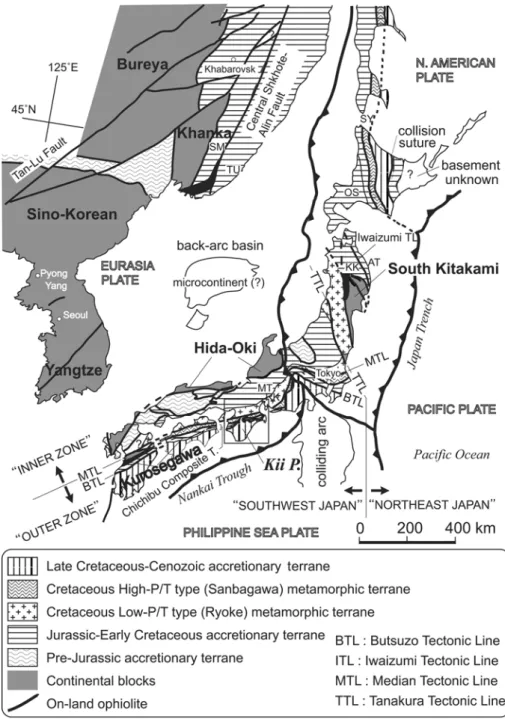
The basement of the Japanese Islands is made up of sev- eral terranes. All of them are composed mainly of pre-Neo- gene accretionary complexes. They are comprised mainly of mélange facies and subordinately of coherent chert-clas- tics (oceanic-terrigenous stratigraphic) sequences. These complexes had accreted to the Hida-Oki Continental Block which belongs to the Sino-Korean and/or Yangtze Cratons (e.g., Otsuki, 1992; Isozaki, 1996) and had grown succes- sively ocean-ward to 450 my until the Japan Sea opened in the Miocene (Fig. 1). Therefore, the Japanese Islands are fundamentally a product of convergence of oceanic and continental plates along an active margin (e.g., Isozaki, 1997).
The Jurassic-Early Cretaceous accretionary complexes occupy a wide belt within the Japanese Islands. A part of these accretionary complexes experienced low P/T metamor- phism, and some other parts high P/T metamorphism dur- ing the Cretaceous. These metamorphism phenomena are
called the paired metamorphic terranes by Miyashiro (1961) and can be found juxtaposed along a major transcurrent fault called the Median Tectonic Line (MTL). The low P/T Ryoke Metamorphic Terrane lies immediately north of the MTL and the high P/T Sanbagawa Metamorphic Terrane in the south.
The Kurosegawa Terrane, originally called the Kuroseg- awa Tectonic Zone (Ichikawa et al., 1956), is a longitudinal fault zone that divides the Chichibu Composite Terrane into the Northern Chichibu and Southern Chichibu Terranes. Both of these terranes are composed mainly of the Jurassic-Early Cretaceous accretionary complexes. Besides the Jurassic- Early Cretaceous accretionary complex, the Kurosegawa Terrane contains exotic tectonic rocks (the Kurosegawa rocks) which include granitoids (Mitaki igneous rocks) hav- ing ages of about 440 Ma (Hada et al., 2000), variously metamorphosed rocks (Terano high-grade metamorphic rocks dated at 400 Ma (Yoshikura et al., 1990); high P/T metamorphic Ino Formation), Siluro-Devonian deposits (Aitchison et al., 1991, 1996), Late Permian accretionary complex and Late Paleozoic-Jurassic carapace deposits.
The sources of these rocks are found nowhere within the adjacent accretionary terranes of SW Japan. It is also found to be closely associated with Cretaceous forearc basin deposits.
Basic rocks are ubiquitous in the accretionary complexes of Japanese Islands. They are composed mainly of basaltic lava and tuff. It is likely that they were incorporated into the accretionary complexes by peeling of the superficial parts of the oceanic crust during subduction. The Kurosegawa rocks in eastern Kii Peninsula also include basic rocks.
Recently we found metagabbro in Nara Prefecture and suggested that it belongs to the Kurosegawa rocks (Kato and Saka, 2003). However, its origin and tectonic setting is still a subject of debate (Sato, 2003; Yamato Omine Research Group, 2004).
This paper reviews the geology of the Chichibu Com- posite Terrane in eastern Kii Peninsula and describes the geochemistry of basic rocks found there. Also, based on the studies of the origin of the basic rocks, a new model on the tectonic evolution of the Kurosegawa Terrane is hereby pro- posed.
Kiyoshi Kato*
Yukiyasu Saka
Advanced Research Institute for Science and Engineering, Waseda University, Shinjuku, Tokyo, 169-8550 Japan Institute of Earth Sciences, School of Education, Waseda University, Shinjuku, Tokyo, 169-8050 Japan*Corresponding author: [email protected]
2. GEOLOGY OF KII PENINSULA
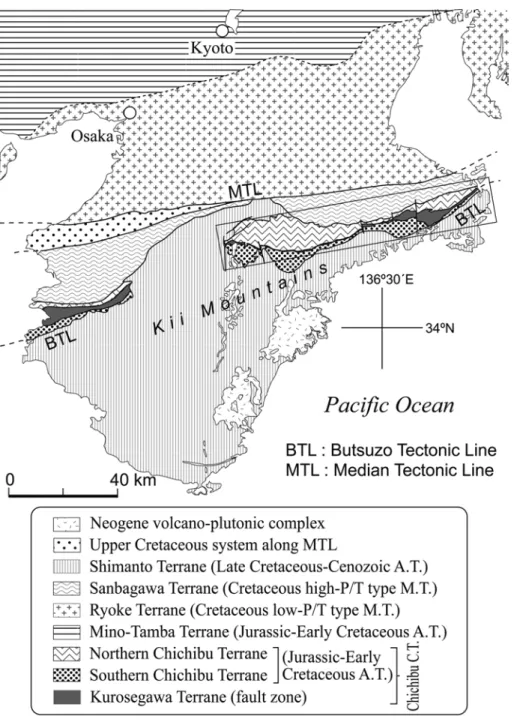
Southwest Japan is extensively divided by the MTL into two geological provinces: the Inner Zone on the Japan Sea side and the Outer Zone on the Pacific side (Fig. 1). The Inner Zone is composed mainly of the Hida-Oki Continen- tal Block and accretionary complexes ranging from the Devonian to Early Cretaceous in age. The Outer Zone is composed mainly of the Jurassic-Paleogene accretionary complexes (Fig. 2).
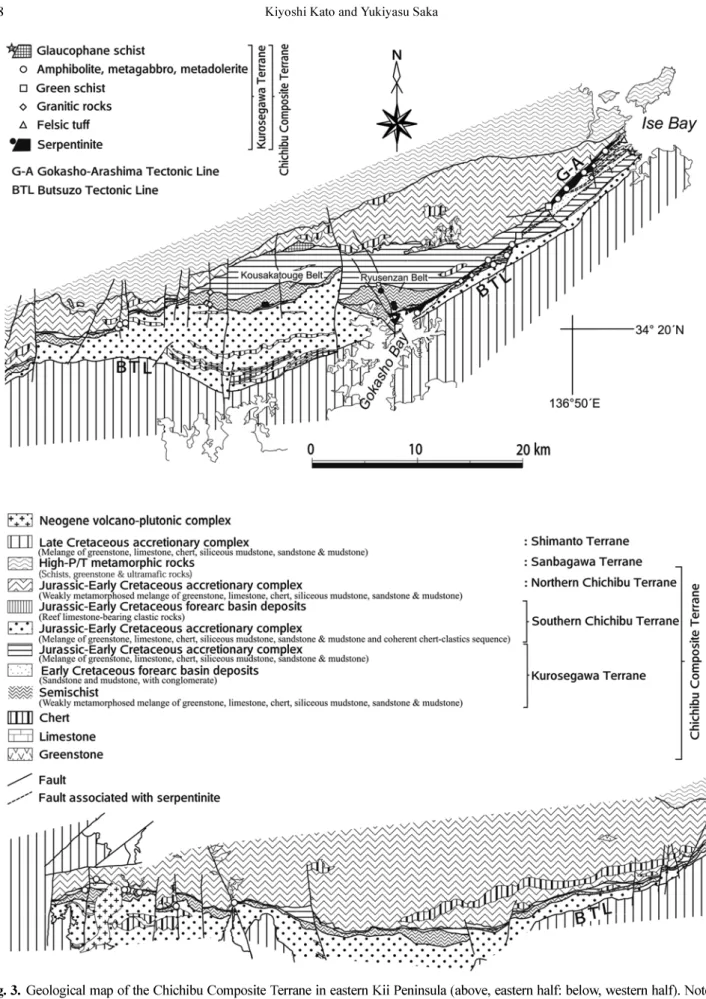
The Outer Zone of Kii Peninsula is divided (N-S) into the Sanbagawa, Chichibu Composite and Shimanto Terranes (Fig. 3). The Sanbagawa Terrane is composed of two units,
the Sanbagawa metamorphic rocks and Mikabu ophiolite.
The E-W continuity of the Chichibu Composite and San- bagawa Terranes is truncated (Kurimoto et al., 1998) in cen- tral Kii Peninsula where rocks of these terranes comprise a large-scale half-klippe overlying the Shimanto Terrane and bounded by listric faults. The interruption is attributed to neotectonic uplift and subsequent erosion of this area.
Elsewhere in SW Japan, the Chichibu Composite Terrane is divided into the Northern and Southern Chichibu Ter- ranes by the Kurosegawa Terrane. The Chichibu Composite Terrane in the Kii Mountains has long been thought to lack the units found in the Northern Chichibu and Kurosegawa Terranes (Yamato-Omine Research Group, 1992).
Fig. 1.
Tectonic map of Japan and the
adjacent areas (compiled and modified
after Kirillova, 2003a; Kojima and
Kametaka, 2000; Isozaki and
Maruyama, 1991). Note the ocean-
ward growth of the accretionary com-
plexes in Japan, which had accreted to
the Sino-Korean and/or Yangtze Cra-
tons. The abbreviations are the same as
in Figure 11.
Recently, based on differences in lithology, structure and metamorphic grade, we have shown that the Chichibu Composite Terrane in this area can be subdivided into the above-mentioned three terranes bounded by E-W or ENE- WSW trending longitudinal faults (Kato and Saka, 2003).
Although each of these terranes is composed mainly of the Jurassic-Early Cretaceous accretionary complexes, tectonic blocks lithologically dissimilar to the accretionary com- plexes are found in the Kurosegawa Terrane alone.
3. CHICHIBU COMPOSITE TERRANE OF EASTERN KII PENINSULA
The Chichibu Composite Terrane of eastern Kii Peninsula
is composed mainly of the Jurassic-Early Cretaceous accre- tionary complexes. The accretionary complexes consist mainly of mélange with subordinate coherent chert-clastic sequences.
Differences in the facies and structure of the accretionary complexes depend on the degree and the kind of deforma- tion affecting them at the time of, and subsequent to, accre- tion: offscraping or underplating, out-of-sequence thrusting and avalanche or mud diapirism. Mélange is represented by a chaotic mixture of allochthonous lensoid blocks of vari- ous sizes set in a matrix of mudstone and/or siliceous mud- stone. The coherent chert-clastic sequence consists, in ascending order, of greenstones, pelagic radiolarian chert, hemipelagic siliceous mudstone and terrigenous clastic rocks such as trench-fill turbidites. It is stacked by underthrusting to form
Fig. 2.
Geological map of Kii Penin-
sula (compiled and modified after
Kurimoto et al., 1998; Tanaka et al.,
1982; Kato et al., 2002). Note inter-
ruption of the E-W continuity of the
Chichibu Composite Terrane in the
central part of the peninsula. This is
attributed to neotectonic uplift. See
Figure 1 for the locality of Kii Penin-
sula.
Fig. 3.
Geological map of the Chichibu Composite Terrane in eastern Kii Peninsula (above, eastern half: below, western half). Note the
middle part (Kurosegawa Terrane) including granitic rocks, metamorphic rocks, serpentinite and so on, which can be observed nowhere
in the adjacent accretionary terranes.
duplex structures with downward-younging polarity.
The Northern Chichibu Terrane comprises the Jurassic- Early Cretaceous accretionary complex consisting of weakly metamorphosed mélange (Fig. 3). It contains flattened len- ticular blocks, mainly of greenstones, banded chert, sand- stone and limestone, within a matrix of slate or phyllite.
The mélange complex displays gently undulating bedding plane schistosity parallel to the surface plane of lenticular rocks.
The Kurosegawa Terrane contains exotic rocks (Kurose- gawa rocks) along longitudinal faults bounding and/or within the terrane together with the Jurassic-Early Creta- ceous accretionary complex. The Kurosegawa rocks known from eastern Kii Peninsula include granitic rocks (A-type granite, M-type granite), variously metamorphosed rocks (amphibolite, metagabbro, glaucophane schist, greenschist and semischist), silicic volcaniclastic rocks and serpentinite (Kato and Saka, 2003). The accretionary complex in the Kurosegawa Terrane is characterized by non-metamorphosed mélange containing allochthonous blocks of sandstone, chert, greenstones and limestone.
A serpentinite belt called the Gokasho-Arashima Tectonic Line (G-A Line) runs slightly oblique to the general trend of the Chichibu Composite Terrane in easternmost Kii Pen- insula (Yamagiwa and Saka, 1967; Saka et al., 1979, 1988).
Lower Cretaceous brackish water- or shallow marine deposits occur in some fault-bounded tectonic slices, and locally overlie the accretionary complex unconformably. Within the Kurosegawa Terrane, the geometry of longitudinal faults displays dextral strike-slip duplexes (Kato and Saka, 2003).
In the southeastern part of the G-A Line, the inward-dip-
ping geometry of imbricate fault arrays trapping the Lower Cretaceous deposits forms a negative flower structure, whereas its northwestern part exhibits a positive flower structure (Kato, 1995; Kato and Saka, 1997; Kato et al., 2002). Farther to the northwest of the G-A Line a negative flower structure is developed trapping the Lower Creta- ceous deposits (Kato et al., 1992). The Kurosegawa rocks that occur along longitudinal faults represent exotic duplexes (Woodcock and Fischer, 1086) formed by strike-slip faults (Fig. 4).
The Southern Chichibu Terrane mainly comprises the Jurassic-Early Cretaceous accretionary complex that con- sists of either mélange or coherent chert-clastics sequence.
Mélange occupies the northern and southern parts of the terrane and also intervenes between chert-clastic sequences.
Early Cretaceous forearc basin- or slope deposits are dis- tributed along the northern margin of this terrane. They are composed of fine-grained clastic rocks containing blocks of reef limestone (Torinosu Limestone). These clastic deposits cover the accretionary complex unconformably.
4. DESCRIPTION OF BASIC ROCKS
Basic rocks (greenstone) occur in the accretionary com- plexes as allochthonous blocks contained in mélange. They are weakly metamorphosed to the degree of greenschist and bear prehnite-pumpellyite facies to form chlorite, epidote, actinolite, pumpellyite, albite and quartz. The rocks gener- ally retain initial igneous textures and minerals such as cli- nopyroxene and plagioclase, and are basaltic lava and tuff.
Basic rocks that we regard as the Kurosegawa Rocks in
Fig. 4.
Schematic block diagrams of eastern Kii Peninsula. Note the faults within the Kurosegawa Terrane cut by the BTL.
eastern Kii Peninsula include amphibolite, metagabbro (metadolerite), glaucophane schist and basic rocks in semi- schist.
Metagabbro as well as metadolerite are composed chiefly of kaersutite (Sato, 2003) and plagioclase with small amount of titanaugite. Saussuritization is ubiquitous in plagioclase grains. The samples contain biotite, muscovite, chlorite, epi- dote, actinolite, calcite, quartz, pumpellyite, prehnite and opaque mineral.
Glaucophane schist contains chlorite, epidote, actinolite, glaucophane, pumpellyite, calcite, dolomite, albite, quartz and muscovite. It generally retains initial igneous textures and minerals such as clinopyroxene and plagioclase, and is mainly basaltic lava and tuff. It is demarcated by faults to form exotic duplex.
Basic rocks in semischist have their origin as allochtho- nous blocks contained in weakly metamorphosed accretion- ary complex to form semischist. They are metamorphosed to the degree of greenschist to prehnite-pumpellyite facies and contain chlorite, epidote, actinolite, pumpellyite, calcite, albite and quartz. They generally retain initial igneous tex- tures and minerals such as clinopyroxene and plagioclase, and are mainly basaltic lava and tuff. Semischist is dis- sected by faults to form positive flower structure in a nar- row zone demarcated by longitudinal faults from the non- metamorphosed accretionary complexes (e.g., the Ryusen- zan Belt).
5. CHEMICAL ANALYSIS
We analyzed 147 samples of basic rocks in eastern Kii Peninsula in order to clarify their origin. The number of
samples taken from each unit are as follows: Sanbagawa metamorphic rocks, 5; Mikabu greenstones, 7; accretionary complex of the Northern Chichibu Terrane, 35; non-meta- morphosed accretionary complex of the Kurosegawa Ter- rane, 14; accretionary complex of the Southern Chichibu Terrane, 25; accretionary complex of the Shimanto Terrane, 4; Kurosegawa rocks, 57 (metagabbro, 11; glaucophane schist, 10; basic rocks in semischist of the Ryusenzan Belt, 20; basic rocks in semischist of the Kousakatouge Belt which is the western extension of the Ryusenzan Belt, 16).
Major and trace element analyses of these rocks were car- ried out using the X-ray fluorescence spectrometry (Rigaku System 3070E) at Waseda University. Major elements were determined on glass beads prepared by fusing the powdered samples with lithium tetraborate. Trace elements were deter- mined on pressed powder discs. Calibrations were based on similar fusion discs and pressed powder samples of stan- dard rocks by Geological Survey of Japan (Ando, 1981).
The conditions for measurement of each element and accu- racy are described in detail by Kato (1995).
6. PETROCHEMISTRY
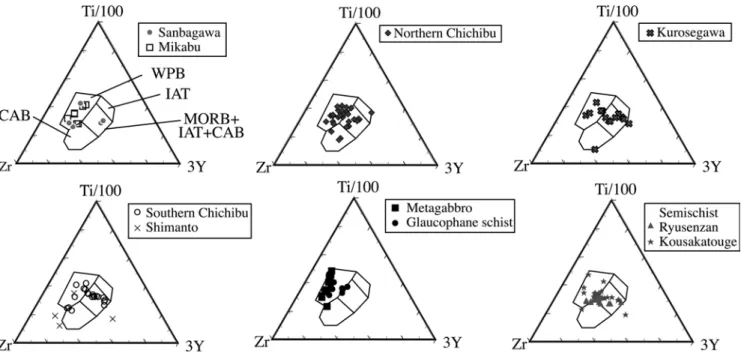
Analyzed data are shown in the Ti-Zr-Y discriminant dia- grams (Fig. 5), which were devised by Pearce and Cann (1973), and are most effective to discriminate within-plate basalts and the other basalt types (Rollinson, 1993). Most of the basic rocks of the Jurassic-Early Cretaceous accretion- ary complexes in the Northern Chichibu, Kurosegawa and Southern Chichibu Terranes fall in the fields of WPB (within-plate basalts) and MORB+IAT+CAB (mid-ocean ridge basalts, island-arc tholeiites and calc-alkali basalts).
Fig. 5.
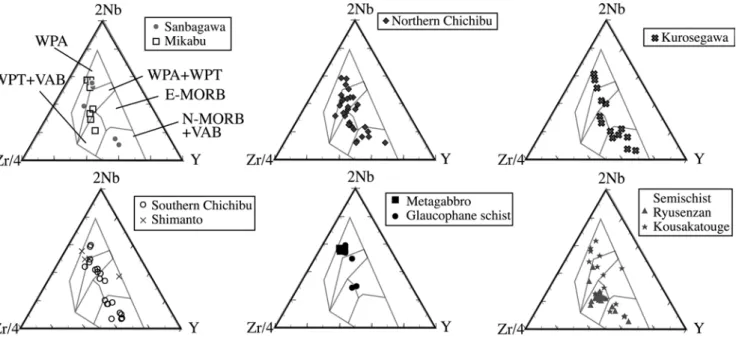
Ti-Zr-Y discrimination diagrams for basalts (after Pearce and Cann, 1973).
Some fall in the field of CAB. As for the Kurosegawa Rocks, most of metagabbro and glaucophane schist fall in the field of WPB. Basic rocks in semischist fall in the fields of WPB and MORB+IAT+CAB.
As shown in the Zr-Nb-Y discriminant diagrams (Fig.6) devised by Meschede (1986), basic rocks of the Jurassic- Early Cretaceous accretionary complexes in the above men- tioned three terranes are plotted in all the fields. Regarding the Kurosegawa Rocks, metagabbro falls in the field of WPA (within-plate alkali basalts). Glaucophane schist falls in the fields of WPA, WPA+WPT, WPT+VAB (within-plate tholeiites and volcanic-arc basalts) and E-MORB. Basic rocks in semischist fall in all the fields.
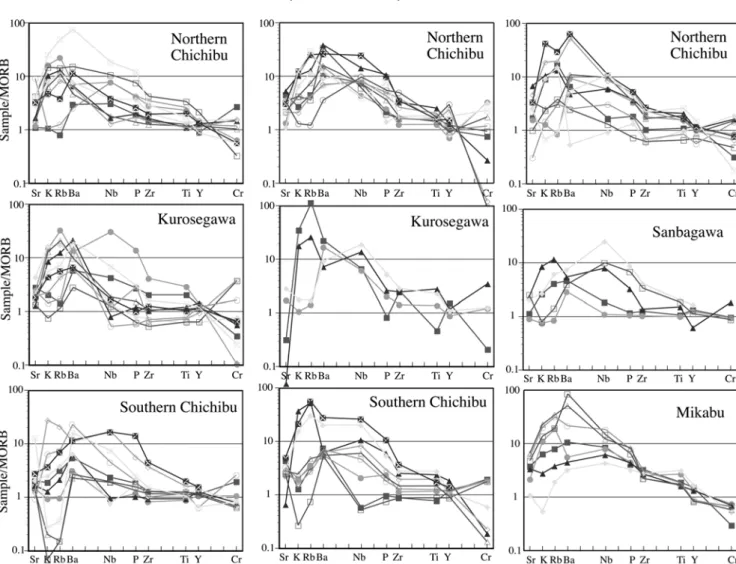
In the MORB-normalized spider diagrams (Fig. 7) using normalizing factors by Pearce (1983), most of the basic rocks of the Jurassic-Early Cretaceous accretionary com- plexes in the three terranes show patterns that resemble OIA (ocean island alkali basalts), OIT (ocean island tholei- ites), T-type tholeiite and N-type tholeiite (MORB). Some samples from the Kurosegawa Terrane may show patterns of island-arc basalts which are characterized by low abun- dances of Nb and/or HFS (high-field strength) elements.
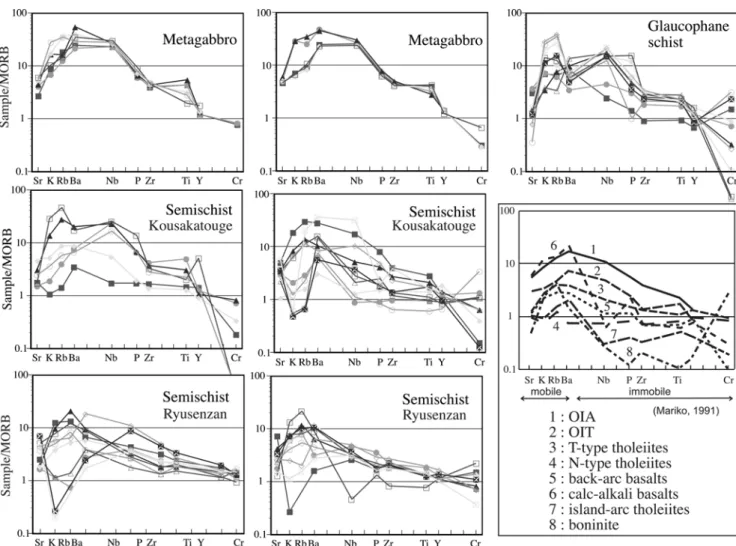
These old samples have been more or less varied from the original composition in mobile elements (such as Sr, K, Rb, Ba). However, the concentrations and ratios of HFS ele- ments, which are immobile, can identify their origin. Con- cerning the Kurosegawa Rocks (Fig. 8), metagabbro shows OIA affinities. Glaucophane schist shows patterns of OIA, OIT and T-type tholeiite. Basic rocks in semischist are sim- ilar in pattern to OIA, OIT or T-type tholeiite except for one sample which bears resemblance to CAB.
The TiO
2/Al
2O
3-FeO*/MgO and Nb/Y-Nb/Zr discrimi-
nant diagrams for HIMU (high µ; µ=
238U/
204Pb) basalts were devised by Tatsumi (1995) and Tatsumi et al. (1998), respectively. HIMU basalts with extremely high
206Pb/
204Pb isotope ratios (>20.5) occur in the Polynesian region where a present-day superplume is in activity. HIMU basalts are distinctive in their high Nb/Zr ratios and low
87Sr/
86Sr and high
143Nd/
144Nd. These characteristics are also consistent with the lower mantle. The presence of HIMU basalts may be indicative of the activity of a superplume. However, Pb isotope geochemical signatures might not be applied to old, altered and/or metamorphosed samples simply because of compositional changes during these secondary processes.
Tatsumi et al. (1998) stress that geochemical characteristics based on HFS elements may be valid for identifying rocks of ancient superplume origin with exception of strongly alkalic basalts or differentiated rocks. In the field of the HIMU basalts on these diagrams (Fig. 9a, b), are included some of the Mikabu greenstones, metagabbro, glaucophane schist, semischist belonging to the Kurosegawa rocks and basic rocks hitherto attributed to the Jurassic-Early Creta- ceous accretionary complexes. An important point is that HIMU basalts, which had not been known in the Chichibu Composite Terrane up to now, occur in its middle part as discussed below.
7. DISCUSSION
7.1. Results of Geochemical Measurements and Their Tectonic Implications
The comprehensive results of geochemical measurements are shown in Figure 10. If alteration has not progressed so
Fig. 6.
Zr-Nb-Y discrimination diagrams for basalts (after Meschede, 1986).
much, most of the basic rocks of the Jurassic-Early Creta- ceous accretionary complexes and Kurosegawa Rocks in eastern Kii Peninsula represent WPB with E-MORB and N- MORB on the basis of the various discriminant diagrams as discussed above. Interestingly, some basic rocks in the Kurosegawa Terrane may represent island arc basalts. How- ever, further work is needed to evaluate whether it would be connected with the magmatism of the South Kitakami microcontinent or the subduction zone of East Asia.
Three samples of the HIMU basalts in Figure 9 were taken from the boundary zone between the Sanbagawa Ter- rane and the Northern Chichibu Terrane (in the center on the map below of Fig. 10). It is highly possible that HIMU basalts belonging to the Mikabu greenstones were errone- ously assigned to be the constituent of the Northern Chich- ibu Terrane due to ambiguity of the accurate location of the boundary fault.
All the other samples of the HIMU basalts are taken from the middle part of the Chichibu Composite Terrane. These HIMU basalts occur as follows: 1. Within the Kurosegawa
Terrane. 2. Along the faults developed within the Kurose- gawa Terrane. 3. Along the northern and southern boundary faults of the Kurosegawa Terrane. 4. Immediately on the northern or southern side of the Kurosegawa Terrane. The last mentioned occurrence (4) is also plausibly regarded to the Northern Chichibu and Southern Chichibu Terranes, respectively due to lack of otherwise diagnostic feature of the Kurosegawa Terrane (e.g., glaucophane schist as exotic tectonic blocks along the faults developed within the Kuro- segawa Terrane). No HIMU basalt has been found in the Jurassic-Early Cretaceous accretionary complexes of the Chichibu Composite Terrane in Kyushu and Shikoku (Ish- izuka et al., 2003; Onoue et al, 2004). Judging from their limited occurrence and petrochemical peculiarity, it may be reasonable to consider that the HIMU basalts in the Chich- ibu Composite Terrane belong to the Kurosegawa rocks irrespective of metamorphic conditions. If these HIMU basalts are regarded as part of the Kurosegawa rocks, the width of the Kurosegawa Terrane is somewhat wider than what is hitherto known.
Fig. 7.
MORB-normalized spider diagrams for basic rocks of the Jurassic-Early Cretaceous accretionary complexes (after Pearce, 1983).
Fig. 8.
MORB-normalized spider diagrams for basic rocks of the Kurosegawa Rocks (after Pearce, 1983).
Fig. 9.
(a) TiO
2/Al
2O
3-FeO*/MgO discrimination diagram (after Tatsumi, 1995). (b) Nb/Y-Nb/Zr discrimination diagram (after Tatsumi et
al., 1998).
The Chichibu Composite Terrane in eastern Kii Peninsula is subdivided into three terranes based on differences in lithology, structure and metamorphic grade. Besides, semi- schist of the Kurosegawa Rocks extends in the Chichibu Composite Terrane from the eastern end of Kii Peninsula to the Kii Mountains without interruption.
These facts suggest that the Kurosegawa Terrane with exotic tectonic blocks completely intervenes in the Jurassic-Early Cretaceous accretionary complexes of the Chichibu Composite Terrane in eastern Kii Peninsula at every level of erosion as in western Kii Peninsula (Figs.
2 and 4). Therefore, it is likely that the Kurosegawa Ter- rane was a large-scale strike-slip fault zone within the Jurassic-Early Cretaceous accretionary wedge in the late Early Cretaceous.
7.2. Tectonic Evolution of the Continental Margin of East Asia
We propose a model for the tectonic evolution of the Kurosegawa Terrane in which the Kurosegawa Terrane was a transform fault zone formed due to oceanic ridge
subduction (Kato and Saka, 2003). We came up with the model based on the synchroneity of the grand-scale strike- slip movement of the Kurosegawa Terrane (Kato and Saka, 2003), the strike-slip faulting within the South Kitakami region (Otsuki, 1992), the age gap among formations within the accretionary complexes (Matsuoka, 2000), the eruption of adakites (e.g., Tsuchiya and Kanisawa, 1994), the formation of the paired metamorphic terranes (e.g., Maruyama, 1997) and similar events towards SW and NW Japan (Fig. 11).
The large-scale dextral strike-slip faulting of the Kurose- gawa Terrane may be generated by the breakout of a trans- form fault which can jump the plate boundary and change the relative plate motion because the dextral sense cannot be explained by a transcurrent fault under the alleged sin- istral oblique subduction. The coeval faulting and affinity in the constituents between the Kurosegawa Terrane and South Kitakami region suggest that the Kurosegawa rocks derived from the South Kitakami microcontinental block were dispersed along the large-scale strike-slip fault. The age gap may be due to tectonic erosion caused by a young plate subducting at a shallow angle. The impermanent erup-
Fig. 10.
Result of geochemical measurements. The limited distribution of the HIMU basalts is shown.
tion and intrusion of adakite and high-magnesian andesite suggest the approach and subduction of an oceanic ridge.
The young subducting slab (< 10 my) is estimated by Iwamori (2000), based on the P-T conditions of the high P/T type Sanbagawa metamorphism. These facts suggest an oceanic ridge subduction.
The model attaches importance to the changes of tec- tonic regime (from subduction to transform faulting and from transform faulting to subduction again) initiated by the oceanic ridge subduction. It can describe the following key situations in SW and NW Japan (Fig. 12); 1. A grand- scale dextral slip movement of the Kurosegawa Terrane parallel to the ancient trench in the late Early Cretaceous.
2. Dispersion of fragments of the South Kitakami micro- continental block as the Kurosegawa rocks. 3. Clockwise rotation of the South Kitakami block indicated by its pale- omagnetism. 4. Age gap within the accretionary prism in Japan. 5. Eruption and intrusion of adakite and high-mag- nesian andesite. 6. Formation and juxtaposition of the paired metamorphic terranes on the continental side of the Kurosegawa Terrane. According to currently prevailing models, the formation of the Kurosegawa Terrane and the
adjacent accretionary terranes of Japan is attributed to sim- ple nappe-movement during accretion or sinistral strike- slip faulting due to oblique subduction. However, none of them has fully explained the features of the Kurosegawa Terrane, the zonal arrangement of the terranes bearing the paired metamorphic terranes and the above-mentioned syn- chroneity.
In our model, the sense of the main faulting of the Kuro- segawa Terrane was dextral in spite of many Japanese geol- ogists’ views that attribute it to sinistral faulting. According to Tashiro (2000), the Lower Cretaceous fauna is divided into the Tethyan and Northern Tethyan types in Japan. Some of the Lower Cretaceous deposits of the Kurosegawa Ter- rane indicate the Northern Tethyan type in the lower part and the Tethyan type in the upper part. This gap may be described by dextral faulting along the Kurosegawa Terrane sometime in the middle Cretaceous.
How can this model be extrapolated to the continental margin of E Asia? What kind of events can be explained by this model? The continental margin covering Eastern China, Hokkaido and Far Eastern Russia should have been affected extensively by these shifts of tectonic regime. Our model
Fig. 11.
Reconstructed oceanic plate stratigraphy for the Mesozoic accretionary wedge in Japan and Far Eastern Russia (compiled
and modified after Isozaki, 1996; Kirillova, 2003b; Kojima and Kametaka, 2000; Matsuoka, 2000; Nakae, 2000; Tsuchiya and
Kanisawa, 1994; Ueda et al., 2001; Watanabe et al., 1986). The synchroneity in the orogeny and modification in the Early Cre-
taceous is shown.
Fig. 12.
Tectonic sketch map of east Asia: (a) Collision of the South Kitakami Microcontinent (ca. 155 Ma). (b) Start of tectonic erosion and the Tan-Lu fault system (ca. 125 Ma).
proposes the following events. Collision of the South Kitakami microcontinent with the continental margin upheaved the continental margin regionally (Fig. 12a). The initiation of the sinistral Tan-Lu fault system in the Hauterivian may be due to the strong coupling between the continental and oce- anic plates due to approaching of the oceanic ridge (Fig.
12b). The synchronism in the age gap, serpentinite diapir and high P/T type of metamorphism in Hokkaido (Watanabe et al., 1986; Ueda et al., 2001) may be northern equivalent of the synchroneity in SW Japan (Fig. 11). The magma- tism of the Khingan-Okhotsk Belt (Sato, 2000; Kirillova, 2003b) seems to be connected to the coeval magmatism of the Ryoke Metamorphic Terrane probably by slab win- dow (Fig. 12c). The timing of the end of the Kurosegawa transform faulting is concordant with the inception of the accretion of the Shimanto Terrane in Japan, episodic appearance of a giant volcanic belt (> 4000 km) along the
continental margin in Far East and E Russia (Kirillova, 2003b) and the onset of rapid Pacific-hotspot motion toward the northwest (Engebretson et al., 1985). This fact suggests the re-commencement of the subduction of an oceanic plate along the continental margin of E Asia (Fig. 12d).
The model is very simple. Just one ridge subduction can comprehensively describe not only the features of the Kurosegawa Terrane but also the key situations of the adjacent areas. The indication of the synchroneity in orogeny and modification in the accretionary wedge will enhance additional researches in isotopic geochro- nology, orogeny and accretion process in every place, and will contribute interdisciplinary elucidation of the western circum-Pacific orogenic belts and the other sim- ilar orogenic belts (e.g., Dimalanta and Yumul, 2006;
Faustino et al., 2006).
ACKNOWLEDGMENTS: We wish to thank Dr. H. Hirano for his enduring encouragement and providing research facilities. We also thank Dr. I. Iwasaki for the comments on the age of the metamorphic rocks in Hokkaido. Constructive reviews by Professor T. Ahmad and Dr. R. Santos are also appreciated. This paper is a contribution to the UNESCO-IGCP Project 434.
REFERENCES
Aitchison, J.C., Hada, S. and Yoshikura, S., 1991, Kurosegawa ter- rane: disrupted remnants of low latitude Paleozoic terrane accreted to SW Japan. Journal of Southeast Asian Earth Sciences, 6, 83
−92.
Aitchison, J.C., Hada, S. Ireland, T.R. and Yoshikura, S., 1996, Ages of Silurian radiolarians from the Kurosegawa terrane, SW Japan constrained by U/Pb SHRIMP data. Journal of Southeast Asian Earth Sciences, 14, 53
−70.
Ando, A., 1981, Chemical composition of standard rocks samples GSJ--JG-1, JB-1, JR-2, JA-1 and JR-1. Abstracts of 81 Annual
Meeting, Geochemical Society of Japan, 357
−358.
Dimalanta, C.B. and Yumul, G.P., Jr., 2006, Magmatic and amagmatic contributions to crustal growth in the Philippine island arc sys- tem: Comparison of the Cretaceous and post Cretaceous periods.
Geosciences Journal, 10, 321
−329.
Engebretson, D.C., Cox, A. and Gordon, R.G., 1985, Relative motions between oceanic and continental plates in the Pacific basin. Geo- logical Society of America Special Paper No. 206, 59p.
Faustino, D.V., Yumul, G.P., Jr., Dimalanta, C.B., de Jesus, J.V., Zhou, M-F., Aitchison, J.C. and Tamayo, R.A., Jr., 2006, Volcanic-hypabys- sal rock geochemistry of a subduction-related marginal basin ophi- olite: Southeast Bohol Ophiolite Cansiwang Mélange Complex, Central Philippines. Geosciences Journal, 10, 291
−303.
Hada, S., Yoshikura, S. and Gabites, J. E., 2000, U-Pb zircon ages for the Mitaki igneous rocks, Siluro-Devonian tuff, and granitic boulders in the Kurosegawa Terrane, Southwest Japan. Memoirs of the Geo- logical Society of Japan, 56, 183
−198.
Ichikawa, K., Ishii, K., Nakagawa, C., Suyari, K. and Yamashita, N.,
Fig. 12.Continued