http://dx.doi.org/10.12925/jkocs.2016.33.2.391
Nutritional Evaluation of Korean Yam ( Dioscorea batatas D
ECNE.)
Yishan Duan․Gyeong-Hwuii Kim1․Su-Jin Joung2․Han-Soo Kim✝
Department of Food Science and Technology, Pusan National University, Miryang 50463, Korea
1Department of Biological Science and Technology, Yonsei University, Seoul 03722, Korea
2College of Nano Science and Technology, Office of Administration, Pusan National University, Miryang 50463, Korea
(Received February 17, 2016; Revised June 20, 2016; Accepted June 28, 2016)
Abstract : The aim of this study was conducted to investigate the proximate and nutritional compositions including mineral, vitamin, amino acids and fatty acids in Korean yam (Dioscorea batatas DECNE.). Carbohydrate (68.1%) possessed the large single constituent of yam. Small amounts of crude protein (16.9%), crude ash (5.8%) and crude fat (2.0%) contents were found. Yam was found to be good sources of essential minerals such as K (1295.5 mg/100 g), Mg (115.3 mg/100 g), Na (99.0 mg/100 g) and Ca (56.5 mg/100 g) but Zn (0.3 mg/100 g) content was low.
Relatively abundant vitamin B1 (11.5 mg/100g) could be observed while vitamin A, B3 and B6 were not found. The amino acid analysis revealed that the yam was superior with respect to glutamic acid (1770.6 mg%), lysine (1210.6 mg%) and urea (550.9 mg%). Essential amino acids were calculated to be 2954.5 mg%. The amino acid profiles showed that yam to be limiting in valine and leusine. Palmitic acid and linoleic acid were the most predominant fatty acids with the value of 31.5% and 41.5%, respectively. And the polyunsaturated fatty acids including linoleic acid and linolenic acid were present in a large quantities in yam. And it also contained higher amounts of unsaturated fatty acids compared saturated fatty acids.
Keywords : yam (Dioscorea batatas DECNE.), proximate composition, mineral, amino acids, fatty acids
1. Introduction
Yam (Dioscorea batatas DECNE.) is widely produced throughout East Asia such as Korea, China and Japan, which is the perennial trailing herb and belongs to the Dioscoreaceae
✝Corresponding author
(E-mail: [email protected])
family [1]. Due to its component characteristics, yam is usually served as the crucial staple food as well as traditional medicine ingredient to treat asthma, abscesses, chronic diarrhea and ulcers in many parts of world [2, 3].
Yam is mainly composed of starch (75.6–
84.3%) with small amounts of crude protein, crude fat, crude fiber and crude ash, whose contents are in the range of 6.7–7.9%, 1.0–
1.2%, 1.2–1.8%, 2.8–3.8%, respectively.
Furthermore, yam tubers also contain vitamin C (13.0–24.7 mg/100 g dry weight), minerals (K, Na, P, Ca, Mg, Cu, Fe, Mn, Zn) [4] and organic acids (succinic acid, citric acid, malic acid, oxalic acid) [5].
In plants, the scavenging of peroxide was accomplished by means of the ascorbic acid (AsA)-glutathione pathway. This is a coupled series of redox reactions involving four enzymes: AsA-specific peroxidase, mono- dehydroascorbate reductase, dehydroascorbate reductase and glutathione reductase. Numerous studies have conclusively conducted that dioscorins are the storage proteins of yam tubers, which exhibit dehydroascorbate (DHA) reductase and monodehydroascorbate (MDA) reductase activities as well as antioxidant activities against both DPPH and hydroxyl radicals [6, 7]. Steroidal saponins, furostanol and spirostanol glycosides are the remarkable functional compounds in yams [1]. For the past few years, some relevant biological studies on the steroid saponins of Dioscorea species described in the literature are related to cytotoxic (anti-tumor) and antifungal properties that will be used as drug formulas to treat some diseases. And other biological functions about active steroidal saponins from Dioscorea species are summarized in the follows:
immunomodulating, antimicrobial, hormonal, anti-osteoporotic, anti-inflammatory, and anti-allergic activities [8].
In this study, in order to investigate the nutritional compounds in yam, the proximate composition, mineral, vitamin, amino acid and fatty acid compositions will be determined and analyzed.
2. Materials and Methods 2.1. Materials and chemicals
Yam (Dioscorea batatas DECNE.) was purchased from Andong (Korea), which was seeded in March or April and harvested in the end of October or December. The fresh yam
was washed, sliced (thickness, 0.4–0.6 cm) and dried in the hot air for 18–24 h at 60–70℃.
Then the dried chips were smashed (150- mesh) into raw yam meals (RY, commonly called white yam).
2.2. Proximate and nutritional analysis Moisture, crude protein, crude fat and crude ash contents of raw yam meals and thermal treatment yam meals were analyzed according to AOAC 934.01, 984.13, 954.02 and 942.05, respectively [9]. Total sugar content was assayed by anthrone-sulphuric acid colorimetry according to the method of Loewus [10].
Cholesterol content determination was assayed by gas chromatography using flame ionization detection. And sample preparation and gas chromatography operating conditions was performed according to the method of KFDA (Korea Food and Drug Association) [11].
2.3. Mineral analysis
Mineral analysis was determined by atomic absorption spectrophotometry (Perkin-Elmer, Model Aanalyst 400, USA) at different wavelength for each mineral element (Zn-213.9, Ca-422.7, Fe-248.3, Mg-285.2, Na-589 and K-766.5 nm) according to the method of Novozamsky et al. [12].
2.4. Vitamin analysis
The analyses of vitamin A, B1, B2, B6 and E were according to the method of KFDA (Korea Food and Drug Association) [13] with some modification by a high performance liquid chromatographic (HPLC) system with fluorescence detection (F1080, Hitachi, Japan).
Vitamin C content determination was according to by Kubola, Siriamornpun and Meeso [14].
HPLC was performed on a C18 column (2504.6 mm, 5 µm) using a mobile phase of 0.05 M KH2PO4/methanol at a flow rate of 1 mL/min as follows: KH2PO4/methanol (97:3).
Column temperature was maintained. UV detection was performed at 254 nm. Niacin content was assayed according to Maria et al.
[15] and a high performance liquid chromatograph coupled with a Photo Diode Array (PDA, Waters 996) detector was used.
2.5. Protein bound amino acid analysis Protein bound amino acid analysis was conducted according to the method of Kim [16]. The sample (0.5 g) was hydrolysed by 6 N HCl at 150℃ for 1 h in the Waters Pico-tag system (Pico-Tag workstation, Waters). After the sample cooling to the room temperature, NaOH was added in order to neutralize the sample. The mixture was diluted with 0.2 N sodium citrate loading buffer (pH 2.2), then filtered with 0.22 µm membrane filter. The filtrate was injected into the Amino Acid Analyzer (Biochrom 20, Pharmacia Biotech. Ltd, UK) equipped with sodium type of ion exchange resin column.
2.6. Free amino acid analysis
Free amino acid analysis was performed by the method of Kim [16]. Samples were mixed with 0.2 N lithium citrate loading buffer (pH 2.2) in a ratio of 1:10, and then homogenized at 300 rpm for 10 min. After the mixture filtering with 0.22 µm membrane filter, the filtrate was injected into the Amino Acid Analyzer (Biochrom 20, Pharmacia Biotech.
Ltd, UK) equipped with lithium type of ion exchange resin column.
2.7. Fatty acid analysis
Fatty acid compositions were determined by using the method of Kim [16]. Lipids were extracted from raw yam meals and thermal treatment yam meals with the mixture chloroform-methanol (C:M=2:1, v/v). Extracted lipid or oil was converted to methyl ester by using 14% BF3-MeOH. And the fatty acid methyl esters were analyzed using a gas chromatography (Hewlett Packard HP 6890 series, GC, USA) fitted with ultra 2 column (cross linked 5% Ph Me silicone, 25 m×0.32 mm×0.52 μm) and a flame ionization detector.
Nitrogen was used as the carrier gas and its
flow rate was 1.4 mL/min. The column initial temperature was 160℃ rising to a final temperature of 250℃ while the injection port and the detector were maintained at 210 and 250℃, respectively. The contents of fatty acid were expressed as peak area to relative percentage (%).
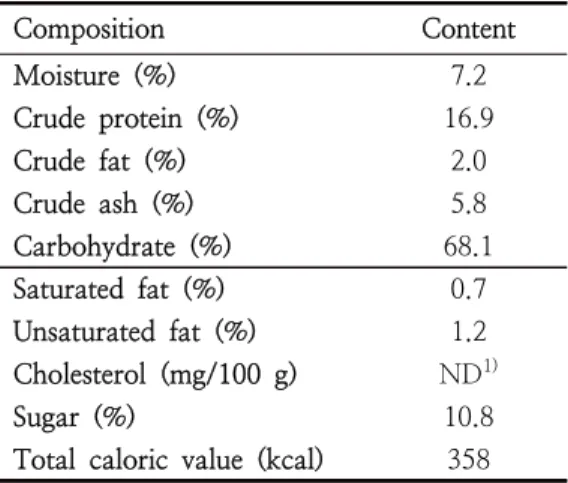
3. Results and discussion 3.1. Proximate and nutritional composition The proximate and nutritional compositions of yam available for this study were presented in Table 1. Carbohydrate possessed the large single constituent of yam meals, which was determined to be 68.1%. The most abundant carbohydrate content obtained in yam (68.1%) was in accordance with previous study [17].
Crude protein content (16.9%) was the second abundant. This value was high compared with crude protein-rich food such as legume [18].
Low crude fat content (2.0%) were found. The similar results were also reported by Hsu et al.
[19]. Crude ash contents were found to be 5.8%, which reflected the mineral contents of the yam meals. Yam flours manufactured by hot air-drying are reported to contain low level of moisture [19]. And the cholesterol was not found in this assay. However, total caloric value and sugar content were determined to be 358 kcal and 10.8%, respectively.
3.2. Mineral composition
The result of mineral estimation of yam was presented in Table 2. The results revealed that potassium was the most abundant yam- contained minerals and calculated to be 1295.5 mg/100 g. These levels would appear to be similar to values reported for yam species by other researchers [4]. And the magnesium content (115.3 mg/100 g) was greater than the reported values for several cultivated yam species [20, 21]. These followed by Na (99.0 mg/100 g) and Ca (56.5 mg/100 g). A little amount of Zn (0.3 mg/100 g) was found, but
ion was not detected.
Table 1. Proximate and nutritional
compositions of raw yam (Dioscorea batatas DECNE.)
Composition Content
Moisture (%) 7.2
Crude protein (%) 16.9
Crude fat (%) 2.0
Crude ash (%) 5.8
Carbohydrate (%) 68.1
Saturated fat (%) 0.7
Unsaturated fat (%) 1.2
Cholesterol (mg/100 g) ND1)
Sugar (%) 10.8
Total caloric value (kcal) 358
1)ND: not detected.
Table 2. Mineral compositions of raw yam (Dioscorea batatas DECNE.)
Composition Content (mg/100 g)
Na 99.0
Ca 56.5
Mg 115.3
K 1295.5
Fe ND1)
Zn 0.3
1)ND: not detected.
3.3. Vitamin composition
A summary of the vitamin content of yam was shown in Table 3. In the previous study, yam was conducted to possess high content of vitamin C, ranging from 13.0 to 24.7 mg/100 g [4]. The vitamin C content of yam appeared to be little (2.2 mg/100 g) as the hot air drying, which was consistent with the values reported for tropical yam species from the Sri Lanka [22]. The vitamin A, vitamin B3 and vitamin B6 were not found. On the contrary, yam was relatively rich in vitamin B1 (11.5 mg/100 g), which was higher than the
reported values for Dioscorea species [22].
Small concentration of vitamin B2 (0.01 mg/100 g) could be found in this study, which appeared to be similar to the corresponding value reported elsewhere for other yam species [22].
Table 3. Vitamin compositions of raw yam (Dioscorea batatas DECNE.)
Composition Content
Vitamin A (µg RE1)/100 g) ND2) Vitamin E (mg/100 g) 1.2 Vitamin C (mg/100 g) 2.2 Vitamin B1 (mg/100 g) 11.5 Vitamin B2 (mg/100 g) 0.01 Vitamin B3 (mg/100 g) ND Vitamin B6 (mg/100 g) ND
1)µg RE: micrograms of retinol equivalent.
2)ND: not detected.
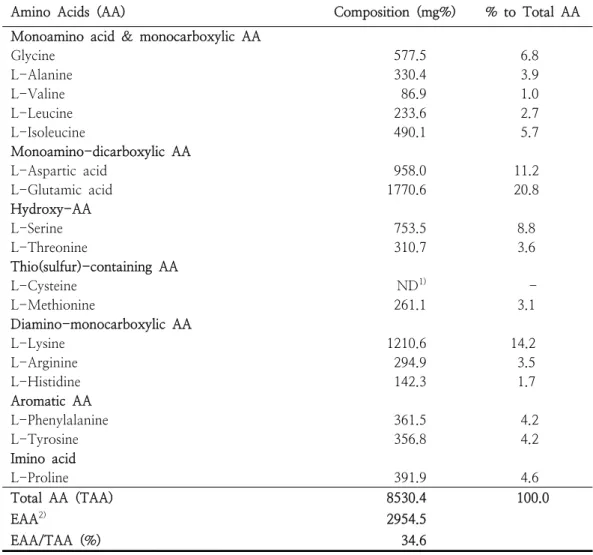
3.4. Protein bound amino acid composition The result for the protein bound amino acid composition of yam was presented in Table 4.
Yam contained a considerable diversity of protein bound amino acids, whose total amino acid contents were 8530.4 mg%. Amongst the protein bound amino acids analyzed herein, the content of L-glutamic acid (1770.6 mg%), L-aspartic acid (958.0 mg%) and L-lysine (1210.6 mg%) tended to predominate in RY.
The present results were in line with the results in yam tubers where aspartic acid and glutamic acid are the major abundant amino acids [23]. Essential amino acids apart from L-tryptophan in RY were of 2954.5 mg%, which accounted for 34.6% of total amino acids. The limiting amino acids were found to be L-valine and L-leusine. The sulfur- containing amino acid level (261.1 mg%) was lower than the reported values for Nigerian yam varieties [24].
3.5. Free amino acid composition
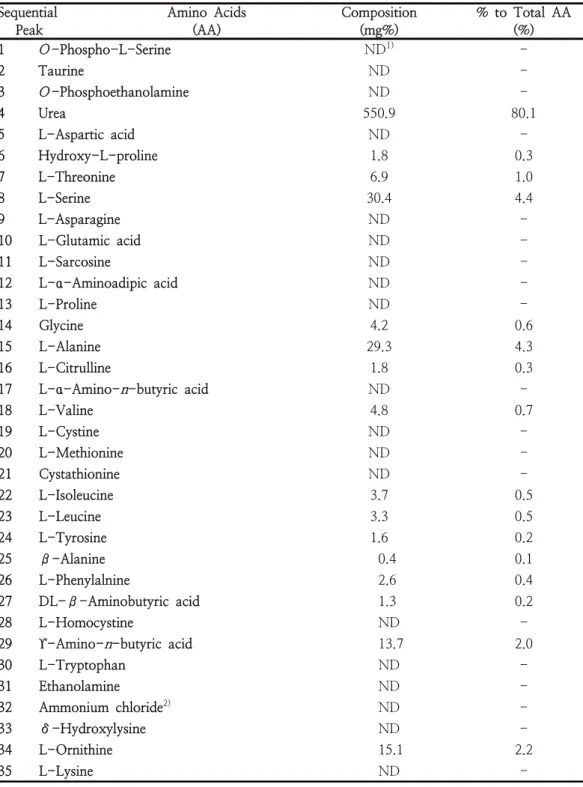
A summary of the free amino acid composition in yam was presented in Table 5.
Table 4. Protein bound amino acid compositions of raw yam (Dioscorea batatas DECNE.)
Amino Acids (AA) Composition (mg%) % to Total AA
Monoamino acid & monocarboxylic AA
Glycine 577.5 6.8
L-Alanine 330.4 3.9
L-Valine 86.9 1.0
L-Leucine 233.6 2.7
L-Isoleucine 490.1 5.7
Monoamino-dicarboxylic AA
L-Aspartic acid 958.0 11.2
L-Glutamic acid 1770.6 20.8
Hydroxy-AA
L-Serine 753.5 8.8
L-Threonine 310.7 3.6
Thio(sulfur)-containing AA
L-Cysteine ND1) -
L-Methionine 261.1 3.1
Diamino-monocarboxylic AA
L-Lysine 1210.6 14.2
L-Arginine 294.9 3.5
L-Histidine 142.3 1.7
Aromatic AA
L-Phenylalanine 361.5 4.2
L-Tyrosine 356.8 4.2
Imino acid
L-Proline 391.9 4.6
Total AA (TAA) 8530.4 100.0
EAA2) 2954.5
EAA/TAA (%) 34.6
1)ND: not detected.
2)EAA: essential amino acids (valine, leucine, isoleucine, threonine, methionine, lysine, phenylalanine).
Yam contained a small amount of free amino acids, whose total amino acid contents were 688.0 mg%. Amongst the free amino acids analyzed herein, urea as a major amino acid accounted for about 80.1% of the total free amino acids. The results showed that L-serine (30.4 mg%) was the second abundant followed by L-alanine (29.3 mg%), L-arginine (16.2 mg%) and L-ornithine (15.1 mg%) in RY.
The results showed that L-threonine (6.9 mg%) in yam was less than soybean (0.35-
0.90 nmol/mg) [25]. The relatively higher content of β-alanine (0.4 mg%) could be observed in RY compared with roots from alfalfa plants [26].
3.6. Fatty acid composition
The fatty acid composition for yam was showed in Table 6. The saturated fatty acids (SFA) content was of 37.0% of total fatty acids for RY. Saturated fatty acids were found to be mainly composed of palmitic acid,
Table 5. Free amino acid compositions of raw yam (Dioscorea batatas DECNE.)
Sequential Amino Acids Composition % to Total AA
Peak (AA) (mg%) (%)
1 Ο-Phospho-L-Serine ND1) -
2 Taurine ND -
3 Ο-Phosphoethanolamine ND -
4 Urea 550.9 80.1
5 L-Aspartic acid ND -
6 Hydroxy-L-proline 1.8 0.3
7 L-Threonine 6.9 1.0
8 L-Serine 30.4 4.4
9 L-Asparagine ND -
10 L-Glutamic acid ND -
11 L-Sarcosine ND -
12 L-ɑ-Aminoadipic acid ND -
13 L-Proline ND -
14 Glycine 4.2 0.6
15 L-Alanine 29.3 4.3
16 L-Citrulline 1.8 0.3
17 L-ɑ-Amino-n-butyric acid ND -
18 L-Valine 4.8 0.7
19 L-Cystine ND -
20 L-Methionine ND -
21 Cystathionine ND -
22 L-Isoleucine 3.7 0.5
23 L-Leucine 3.3 0.5
24 L-Tyrosine 1.6 0.2
25 β-Alanine 0.4 0.1
26 L-Phenylalnine 2.6 0.4
27 DL-β-Aminobutyric acid 1.3 0.2
28 L-Homocystine ND -
29 ϒ-Amino-n-butyric acid 13.7 2.0
30 L-Tryptophan ND -
31 Ethanolamine ND -
32 Ammonium chloride2) ND -
33 δ-Hydroxylysine ND -
34 L-Ornithine 15.1 2.2
35 L-Lysine ND -
Table 5. Continued
Sequential Amino Acids Composition % to Total AA
Peak (AA) (mg%) (%)
36 1-Methyl-L-histidine ND -
37 L-Histidine ND -
38 3-Methyl-L-histidine ND -
39 Anserine ND -
40 ɑ-Aminoguanidinopropionic acid ND -
41 L-Carnosine ND -
42 L-Arginine 16.2 2.4
Total AA 688.0 100.0
1)ND: not detected.
2)not calculation.
Table 6. Fatty acid compositions of raw yam (Dioscorea batatas DECNE.)
Fatty Acid Peak Area (%)
Myristic acid (C14:0) 0.3
Palmitic acid (C16:0) 31.5
Heptadecanoic acid (C17:0) 0.4
Stearic acid (C18:0) 1.5
Arachidic acid (C20:0) 0.3
Behenic acid (C22:0) 0.6
Tricosanoic acid (C23:0) 0.7
Lignoceric acid (C24:0) 1.7
Saturates 37.0
Palmitoleic acid (C16:1) 0.7
Elaidic acid (C18:1t, n-9) 0.4
Oleic acid (C18:1c, n-9) 13.9
Nervonic acid (C24:1) 0.7
Monoenes 15.7
Linolelaidic acid (C18:2t, n-6) 1.0
Linoleic acid (C18:2c, n-6) 41.5
Linolenic acid (C18:3, n-3) 4.9
Polyenes 47.4
accounting for 31.5%. Monounsaturated fatty acids (MUFA) represented approximately 15.7% of total fatty acids. And the major MUFA in RY were oleic acid (13.9%), which appeared to be higher than the African yam
bean [27]. Linoleic acid was the most abundant among the fatty acids analyzed in this study, which was determined to be 41.5%.
This value compared favourably with common bean (43.1%) reported by Grela and Günter
[28], however higher than the reported value for cashew nut (2.5%) reported by [29]. Yam contained enough essential fatty acids such as linoleic acid (41.5%) and linolenic acid (4.9%).
Our results differed from those of African yam beans, the composition of fatty acids were:
53.4%-60.2% SFA, 1.29%-3.60% MUFA and 28.3%-38.9% PUFA [27].
4. Conclusions
The proximate and nutritional compositions including mineral, vitamin, amino acids and fatty acids in Korean yam (Dioscorea batatas DECNE.). Carbohydrate (68.1%) possessed the large single constituent of yam. Small amounts of crude protein (16.9%), crude ash (5.8%) and crude fat (2.0%) contents were found.
Yam was found to be good sources of essential minerals such as K (1295.5 mg/100 g), Mg (115.3 mg/100 g), Na (99.0 mg/100 g) and Ca (56.5 mg/100 g) but Zn (0.3 mg/100 g) content was low. Relatively abundant vitamin B1 (11.5 mg/100g) could be observed while vitamin A, B3 and B6 were not found. The amino acid analysis revealed that the yam was superior with respect to glutamic acid (1770.6 mg%), lysine (1210.6 mg%) and urea (550.9 mg%). Essential amino acids were calculated to be 2954.5 mg%. The amino acid profiles showed that yam to be limiting in valine and leusine. Palmitic acid and linoleic acid were the most predominant fatty acids with the value of 31.5% and 41.5%, respectively. And the polyunsaturated fatty acids including linoleic acid and linolenic acid were present in a large quantities in yam.
And it also contained higher amounts of unsaturated fatty acids compared saturated fatty acids.
Acknowledgement
This work was supported by a 2-Year
Research Grant of Pusan National University.
References
1. J. T. Lin, and D. J. Yang, Determination of steroidal saponins in different organs of yam (Dioscorea pseudojaponica Yamamoto), Food Chem., 108, 1068 (2008).
2. C. S. Hariprakash and B. Nambisan, Carbohydrate metabolism during dormancy and sprouting in yam (Dioscorea) tubers:
changes in carbohydrate constituents in yam (Dioscorea) tubers during dormancy and sprouting, J. Agric. Food Chem., 44, 3066 (1996).
3. S.Y. Kim, H. J. Jwa, Y. Yanagawa, and T. S. Park, Extract from Dioscorea batatas ameliorates insulin resistance in mice fed a high-fat diet, J. Med. Food, 15, 527 (2012).
4. J. P. D. Wanasundera and G. Ravindran, Nutritional assessment of yam (Dioscorea alata) tubers, Plant Foods Human Nut., 46, 33 (1994).
5. M. R. Bhandari and J. Kawabata, Organic acid, phenolic content and antioxidant activity of wild yam (Dioscorea spp.) tubers of Nepal, Food Chem., 88, 163 (2004).
6. W. C. Hou, H. J. Chen, and Y. H. Lin, Dioscorins, the major tuber storage proteins of yam (Dioscorea batatas Decne), with dehydroascorbate reductase and monodehydroascorbate reductase activities, Plant Sci., 149, 151 (1999).
7. W. C. Hou, M. H. Lee, H. J. Chen, W.
L. Liang, C. H. Han, Y. W. Liu, and Y.
H. Lin, Antioxidantactivitiesofdioscorin, thestorageproteinofyam(Dioscorea batatas Decne) tuber, Food Chem., 49, 4956 (2001).
8. M. Sautour, A. C. Mitaine-Offer, and M.
A. Lacaille-Dubois, The Dioscorea genus:
a review of bioactive steroid saponins, J.
Natu. Med., 61, 91 (2007).
9. AOAC, Official methods of analysis. 16th eds., Association of Official Analytical Chemists, Washington, D. C. (1998).
10. F. A. Loewus, Improvement in anthrone method for determination of carbohydrates, Anal. Chem., 24, 219 (1952).
11. KFDA, Korea Food and Drug Association.
Health functional food standards codex.
Korean foods industry association, Seoul.
Korea, P 3.5.4-1 (2010).
12. I. Novozamsky, V. J. G. Houba, E. C. K.
Van, and V. W. Van, Plant nitrogen and phosphorus in plant tissue, novel digestion technique for multi-element, Plant Anal.
Comm. Soil Sci. plant anal., 14, 239 (1983).
13. KFDA, Korea Food and Drug Association.
Food standards codex. Korean foods industry association, Seoul, Korea, 365 (2005).
14. J. Kubola, S. Siriamornpun, and N. Meeso, Phytochemicals, vitamin C and sugar content of Thai wild fruits, Food Chem., 126, 972 (2011).
15. P. R. Maria, A. Nicula, A. T. Nicula, and C. Socaciu, The optimization of extraction and HPLC analysis of vitamins b from yeast products, Bull. Univ. Agric. Sci.
Veter Med. Agric., 65, 323 (2008).
16. H. S. Kim, Studies on the amino acid and fatty acid compositions in the seed and pulpy substance of feral peach (Prunus persica Batsch var. davidiana Max.), J.
Life Sci., 17, 125 (2007).
17. E. O. Afoakwa and S. Sefa-Dedeh, Chemical composition and quality changes occurring in Dioscorea dumetorum pax tubers after harvest, Food Chem., 75, 85 (2001).
18. M. O. Aremu, O. Olaofe, and T. E.
Akintayo, A Comparative Study on the Chemical and Amino Acid Composition of Some Nigerian Under-Utilized Legume Flours, Pak J. Nut., 5, 34 (2006).
19. C. L. Hsu, W. Chen, Y. M. Weng, and C. Y. Tseng, Chemical composition,
physical properties, and antioxidant activities of yam flours as affected by different drying methods, Food Chem., 83, 85 (2003).
20. S. O. Agunbiade and O. G. Longe, African yam bean hull chemical composition and its effects on rat’s mineral retention, serum biochemical components and enzymatic activities, Nahrung, 42, 89 (1998).
21. T. Agbor-Egbe and S. Treche, Evaluation of the chemical composition of Cameroonian yam germplasm, J. Food Comp. Anal., 8, 274 (1995).
22. D. E. Oku and C. U. Ndu, Evaluation of the phytonutrients, mineral and vitamin contents of some varieties of yam (Dioscorea sp.), Int. J. Mol. Med. Adv.
Sci., 2, 199 (2006).
23. C. C. Huang, P. Y. Chiang, Y. Y. Chen, and C. C. R. Wang, Chemical compositions and enzyme activity changes occurring in yam (Dioscorea alata L.) tubers during growth, LWT–Food Sci.
Technol., 40, 1498 (2007).
24. Y. Alozie, M. I. Akpanabiatu, E. U.
Eyong, I. B. Umoh, and G. Alozie, Amino acid composition of Dioscorea dumetorum varieties, Pak J. Nut., 8, 103 (2009).
25. C. Hernández-Sebastià, F. Marsolais, C.
Saravitz, D. Israel, R. E. Dewey, and S. C.
Huber, Free amino acid profiles suggest a possible role for asparagine in the control of storage-product accumulation in developing seeds of low- and high-protein soybean lines, J. Exp. Bot., 56, 1951 (2005).
26. F. Fougère, D. L. Rudulier, and G. J.
Streeter, Effects of salt stress on amino acid, organic acid, and carbohydrate composition of roots, bacteroids, and cytosol of alfalfa (Medicago sativa L.), Plant Physiol., 96, 1228 (1991).
27. A. A. Oshodi, K. O. Ipinmoroti, E. I.
Adeyeye, and G. M. Hall, Amino and fatty acids composition of African yam
bean (Sphenostylis stenocarpa) flour, Food Chem., 53, 1 (1995).
28. E. R. Grela and K. D. Günter, Fatty acid composition and tocopherol content of some legume seeds, Animal Feed Sci.
Technol., 52, 325 (1995).
29. M. O. Aremu, I. Ogunlade, and A.
Olonisakin, Fatty acid and amino acid composition of protein concentrate from cashew nut (Anarcadium occidentale) grown in Nasarawa State, Nigeria, Pak J.
Nut., 6, 419 (2007).