© Korean Powder Metallurgy Institute 851
-1. Introduction
Powder metallurgy (PM) is a convenient and effective way to produce net-shape metal matrix composite (MMC) parts. However, the introduction of ceramic particulate into metallic powder lowers the compressibility and formability of the mixed powder. Warm compaction is a simple and cost-effective technique to produce high density PM parts with high green strength [1-2].
Different ceramic particulate reinforced iron-based composites have been studied [3-4]. Carbides, oxides and nitrides, such as SiC, WC, TiC, VC, Mo2C, NbC, Al2O3 and TiN etc. are commonly used in MMC. In this study, we used NbC particulate, which has a density of 7.85 g/cm3 and a wetting angle of 21º with Fe-P-C alloy at 1280℃ [5], as the reinforced particles [6]. The aim of this paper is to study the tribological behavior of the NbC particulate reinforced Fe-based composite that was prepared by warm compaction technique and its application in the valve-guide cup.
2. Experimental and Results
Water atomized iron powder and NbC particulate with an average particle size of ≦75 µm and 3 µm, respectively, were used as starting materials. Fe and NbC were first mixed in a stir type ball milling machine for 5 hours, and
then annealed at 800°C. The mixed powder for the matrix were composed of 2%Cu, 2%Ni, 1%Mo, 1%C, 0.6%P, with Fe as the balance. The mixed powder was then warm compaction at 120 under 600 MPa. Emulsified PTFE ℃ was brushed on the inner die wall for lubrication. Sintering was carried out at 1280°C for 80 minutes with dissociated ammonia atmosphere, then subsequently cooled to room temperature. Friction coefficient (µ) and wear behavior of the sintered samples were studied by MM200 block on ring tribotester. The counterpart was GCr15 steel ring with a hardness of HRC58-60. A speed of 200 r/min and a load of 980 N were used. The total linear sliding distance was 2,500 m. The 20# engine oil was used as lubricant. Wear volume was determined by measuring the width of the worn surface on the block using a traveling microscope.
Results showed that NbC was evenly distributed in the Fe matrix and the overall binding between the particle and the matrix are fairly good. Ball milling can minimize agglomeration and provided good binding interface between the NbC particles and the matrix, hence assured good mechanical property of the sintered sample. The mechanical properties and tribological behaviors of the composites are listed in Table 1.
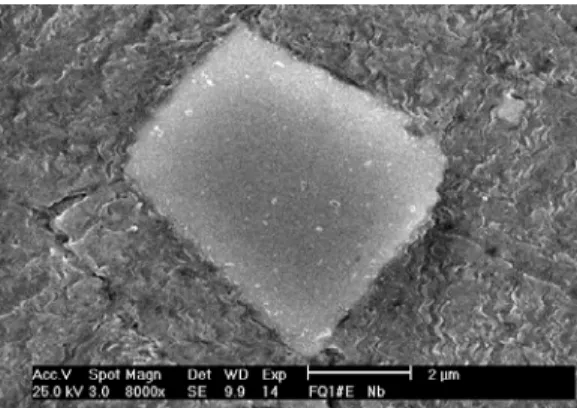
Fig.1 is the SEM micrograph showing the binding between a NbC particle and the matrix. Fig.2 is the wear surface morphology of the composite after wear test. Very minor ploughs can be seen on the wear surface and no
2006 POWDER METALLURGY World Congress C03-02-2 Sample RD [%] [MPa]
σ
b [J/cmα
k2] HRC Shrinkage [%] Friction coef.Normalized Wear volume [x10-11 mm3/N.mm]
15%NbC 98 515 6.0 58 -4.42 0.085 1.306
Preparation of Warm Compacted NbC Reinforced Iron-based Composite
and its Tribological Behavior
Zhiyu Xiaoa, Tungwai Leo Ngaib, Liping Wenc, and Yuanyuan Lid
College of Mechanical Engineering, South China University of Technology, Guangzhou, China a
[email protected], [email protected], [email protected], [email protected] Abstract
The introduction of ceramic particulate into metallic powder will unavoidably lower the compressibility and formability of the mixed powder. In this study, warm compaction, which is a simple and low cost technique to produce high density PM parts, was introduced in preparing composite. The aim of this paper is to prepare the warm compacted NbC particulate reinforced Fe-based composite, then study its tribological behavior and application in the valve-guide cup. A 15 wt.% NbC reinforced iron-based composite was prepared. It possesses a relative density of 98%, a tensile strength of 515 MPa, a hardness of HRC 58 and a remarkable tribological behavior.
Keywords: Fe-based composite, NbC particulate, tribological behavior, warm compaction
© Korean Powder Metallurgy Institute 852
-1cm 1cm
plough out of NbC particles can be observed. After a total linear sliding distance of 2500 m in the lubricated wear test, only 0.032 mm3 of the sintered materials was lost.
Fig. 1. A NbC particle embedded in matrix.
Fig. 2. Wear surface of the sample.
The warm compacted NbC particulate reinforced Fe-based composite was applied in the valve-guide cup of a combustion engine. The working surface of the cup is in contact with the cam periodically. It is working under high temperature and high pressure. Severe wear of the working surface will lead to the failure of the engine. The valve-guide cups successfully passed a 500 hours bench test. For comparison reason, cups that make of 12CrNi3A steel were also tested. The test divided into 50 cycles and each cycle last 10 hours.
Figures 3(a) and (b) show the wear surfaces of the valve-guide cups that make up the composite and 12CrNi3A steel, respectively, after the bench test. No significant wear can be seen on the working surface of the valve-guide cup made of the composite while the 12CrNi3A steel cup can be seen to be severely worn out. NbC is a very hard ceramic material; this hard phase bore most of the load, causing it to have direct contact with the counterpart. Its presence
dramatically reduced the abrasive wear of the cup’s working surface. Furthermore, the iron and NbC showed poorer compatibility than that between iron and iron. This indicates that use of NbC can minimize adhesive wear. Since we observed good binding between the matrix and NbC particles in this warm compacted composite, it is not easy to plough out the reinforced phase from the matrix. Therefore, considering the foregoing, we can conclude that, compared to the 12CrNi3A steel, the reinforced iron-based composite is a superior material in terms of wear resistance.
(a) Sintered composite (b) 12CrNi3A steel Fig. 3. Wear surface of the cups after the bench test.
3. Summary
Fe on NbC is known to provide good binding interface after the liquid phase sintering. Ball milling successfully overcomes the problems of agglomeration and powder separation during the powder mixing procedure. In this study, a warm compacted NbC particulate reinforced iron-based composite with excellent tribological behaviors was prepared. It was found to be a suitable material for wear-resisting parts that are exposed to severe wear condition. This composite was applied in the valve-guide cup of a combustion engine. The cup successfully passed a 500 hours bench test.
4. References
1. H. G. Rutz and F.G. Hanejko, Int. J. Powder Metall., 31[1], 9 (1995).
2. W.B. James, Int. J. Powder Metall., 30, 157(1994). 3. S.K. Mukherjee, B. Cotterell and Y.W. Mai, J. Mater. Sci.,
28, 729(1993).
4. J.D.Bolton and A.J.Gant, Powder Metall.,40,143 (1997). 5. F. Thuemmler and C. Gutsfeld, Powder Metall. Inter., 23,
285(1991).
6. Y. Li, Z. Xiao, T. L. Ngai, Z. Zhou and M. Shao, Trans. Nonferrous Metall. Soc. China, 12, 663 (2002).