Original Articles 순환기:순환기:제순환기:순환기:제제제 2 7 권권 제권권 제제 2 호제 호호 1997호
경피적 경혈관 혈관확장술 및 스텐트 삽입술을
이용한 상장간막동맥 협착 치료 1예
연세대학교 의과대학 심장혈관센타 심장내과학교실김종현·안신기·심원흠
=
=
=
= Abstract =
=
=
=
A Case Report of Percutaneous Transluminal Angioplasty with Stenting in
Treatment of Superior Mesenteric Artery Stenosis
Jong-Hyun Kim, M.D., Shinki Ahn, M.D., Won-Heum Shim, M.D.
Cardiology Division Yonsei Cardiovascular Center, Yonsei University, Seoul, Korea
Percutaneous transluminal angioplasty(PTA) was first described by Dotter and Jukins in 1964 and subsequently modified by Gruentzig and Hoff in 1974. PTA has proved a safe and effective trea-tment for focal atherosclerotic disease of the aorta and its major extremity branches. The com-plications of PTA of the peripheral vessels are less frequent and less severe than those associated with the comparable surgical procedure. Intestinal angina is a clinical syndrome compromising po-stprandial abdominal pain, nausea, vomiting, diarrhea, weight loss, and eventually fear of eating. The syndrome is thought to be due to visceral ischemia, with stenosis or occlusion of two of the three visceral arteries being necessary for the syndrome to occur. Although the first report of mesenteric PTA appeared in 1980, the series of PTA with stenting of the visceral arteries reported in the lite-rature have been small or included limited follow-up. We report a case of a intestinal angina due to superior mesenteric arterial stenosis. A 69-year-old male complained of severe postprandial pain, chronic diarrhea for 1 year. PTA with stening in superior mesenteric artery result in recannulation of obstructed artery and relief of symptom.
KEY WORDS:PTA with stenting·Superior mesenteric artery stenosis·Intestinal angina.
서 론
장간막 동맥(mesenteric artery)의 폐쇄는 복강내 혈류 장애를 유발하고 장 협심증을 일으키는데 장 협심 증은 식후 복통, 오심, 구토, 설사를 특징으로 하는 임상 증후군으로 결국에는 체중 감소와 음식에대한 두려움을 나타낸다. 만성적인 장 허혈(intestinal ischemia)을 가 지고 있는 환자는 갑작스런 혈전 및 광범위한 괴사의 위험이 높은데 보통 3개의 내장동맥(visceral rtery) 중 2개에 심하게 병변이 있을때까지는 증상이 나타나지 않는다1,2,3). 한편 내장동맥의 동맥경화성 병변의 치료에 있어서 지금까지 제일 좋은 방법은 대동맥장간막이식 법(aortomesenteric graft)과 경대동맥 동맥내막절제술(transaortic endarterectomy)로 생각되어 왔다4,5). 그러나 수술에 의한 사망율은 3~85%, 재발율 또한 7.5~50%로 다양하다6-11). 아울러 장 허혈은 대개 노 인들에서 다발하고 동맥경화증을 악화시킬 수 있는 질 환을 동반하는데 이러한 환자들은 보통 수술 부적합 자 들이고 광범위한 수술에 따른 위험성이 높다. 한편 1964 년 Dotter와 Judkins가 종래의 경피적 경혈관 확장술 을 이용하여 동맥 경화증에 의한 말초동맥 폐쇄의 성 공적인 치료를 보고 하였다12). 이 방법의 도입 이후 경 피적 경혈관 확장술은 혈관 또는 비혈관의 협착 및 폐 쇄 병변의 치료에 성공적으로 이용되고 있다. 그러나 국내에서는 현제까지 내장동맥 폐쇄 및 협착에 의한 장 허혈 치료에 있어 주로 수술적 방법을 이용해 왔으 며 경피적 경혈관 확장술에 의한 치료한 예의 보고는 없었다. 저자들은 1년전 상장간막 동맥(superior me-senteric artery) 혈전에 의한 소장경색으로 장 절제술 을 시행한 후에도 지속적인 식후복통 및 만성설사를 호 소하던 환자에서 병변 부위에 경피적 경혈관 확장술 및 스텐트를 이식한 후 증상의 완화를 보인 1예를 문 헌고찰과 함께 보고하는 바이다.
증 례
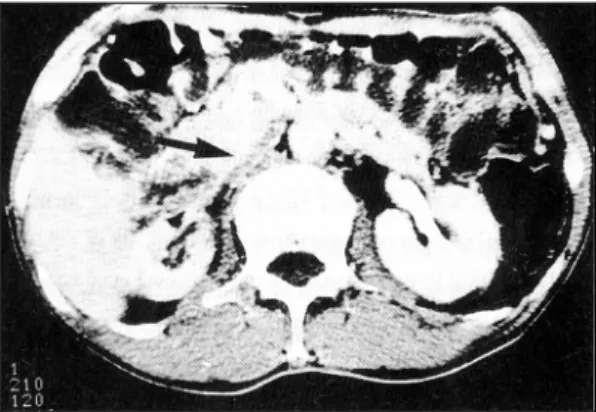
환 자:엄○운, 남자, 69세. 주 소:만성 설사, 식후 복통. 현병력:상기 환자는 95년 1월 식후 악화되는 복 통을 주소로 본원을 방문하여 상장간막 동맥 혈전에 의한 소장경색으로 진단받고 공장(jejunum) 및 회장 (ileum) 부분절제술, 횡공장 대장절개술(jejunotran-severse colostomy)을 시행하였던 환자로 수술 이후 로도 지속되는 설사 및 간헐적인 식후 복통을 주소로 내원하였다. 과거력:39세 때 폐결핵으로 1년간 약물을 투약했으 며 3년전 고혈압으로 진단받고 불규칙적으로 약물을 복용하였다. 가족력:특이사항 없음. 이학적소견:내원당시 혈압은 180/130mmHg, 맥 박 60/min, 호홉수 18/min, 체온은 36.5℃였다. 환자 는 만성병색을 보였고 두부와 경부, 폐 및 복부 검사 에서 특이사항은 없었으며 심장 청진상 심잡음은 들리 지 않았다. 검사실 소견: 내원당시 말초혈액 검사상 백혈구 8,900/mm3(중성구 73%, 임파구 18%, 단핵구 8%) 였으며, 혈색소 13mg/dl, 헤마토크리트 42%, 혈소판 256,000/mm3였다. 대변 및 소변검사는 정상소견이 었다. 생화학적 검사상 BUN 18.6mg/dl, Creatinine 1.6mg/dl, 공복시 혈당 79mg/dl Total-Protein 7.7g /dl, Albumine 4.4g/dl, SGOT 22 IU/L, SGPT 24 IU/ L, Alkaline Phosphatase 128 IU/L, Total-Bilirubin 0.7mg/dl, Na 145mEq/L, K 3.8mEq/L Total-Ch-olesterol 107mg/dl, HDL-ChTotal-Ch-olesterol 34mg/dl, Tr-iglyceride 124mg/dl Lp(a) 71.8mg/dl였다. 심전도소견:내원당시 시행한 12유도 표준 심전도상 유도 Ⅱ, Ⅲ, aVF에서 Q파가 관찰되었다. 방사선학적 소견:흉부 및 복부 X선상 특이 소견은 관찰되지 않았다. 복부 컴퓨터 촬영소견:경피적 경혈관 확장술 시행후Fig. 1. Contrast-enhanced CT scan shows severe
narro-wing of right renal artery(arrow) and atropic ch-ange of right kidney.
Fig. 2. Contrast-enhanced CT scan shows
well-deploy-ed J-J stent at ostium of superior mesenteric artery(arrow).
촬영한 복부 컴퓨터 촬영 상 우측 신동맥의 심한폐쇄와 동측 신장의 위축성 변화(Fig. 1) 상장간막 동맥에 삽 입된 스텐트를 확인할 수 있었다(Fig. 2).
경피적 경혈관 확장술 및 스텐트삽입
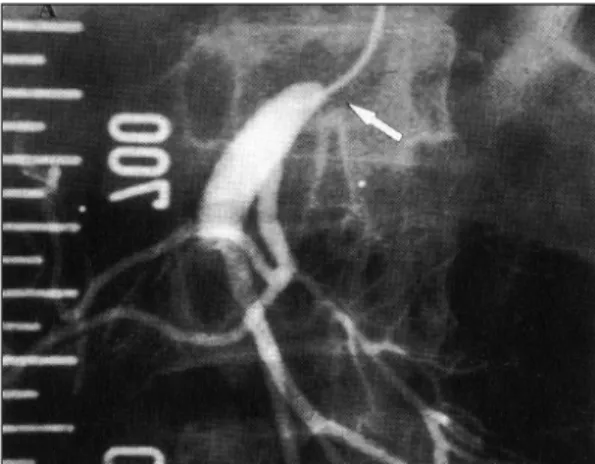
좌측 상완동맥(brachial artery)을 쉘딩거 방법에의 해 천자한후 5Fr 다용도(multipurpose) 카테터를 대 동맥의 원위부에 위치시켰다. 대동맥 촬영상 우측 신 동맥이 심하게 협착되었고 선택적 상장간막동맥 촬영 상 기시부에 80% 정도의 협착소견을 보였다(Fig. 3). 유도철선(guide wire), Roadrunner 018으로 병변 부 위를 통과시킨 후 철선을 따라 다용도 카테터을 전진 시켰다. 병변부위를 기준으로 압력차는 최대 117mmHg, 평균 74mmHg였다. 이어서 유도철선을 보다 뻣뻣한 035로 바꾼 후 Ultrathin(5×20mm) 풍선을 병변 부 위에 위치시키고 4기압에 40초 동안 팽창시켰다. J-J 스텐트(8×10mm)를 Ultrathin(8×20mm) 풍선위 에 장치시켜 병변 부위에 위치시켜 부풀렸으나 풍선 의 이탈(migration)로 인해 스텐트의 성공적인 삽입이 이루어지지 않았다. 다시 스텐트의 복구를 시도하였으 나 혈관의 원위부위로 이동하여 포기한 후 J-J 스텐 트(8×20mm)을 Blue Max(8×40mm)풍선에 장치 시킨 후 성공적으로 병변부위에 삽입시켰다. 이어서 Ultrathin(5×20mm) 풍선으로 혈관 말단부위로 이동 한 스텐트를 그 위치에서 6기압에 40초 동안 충분히 부풀렸다. 추가로 병변 부위에 삽입했던 스텐트도 Blue Max(8×40mm) 풍선을 이용하여 15기압에 1분 15 초 동안 풍선의 만입이 없어질 때 까지 부풀렸다(Fig. 4). 추적 혈관촬영 및 압력차 검사상 잔류협착은 없었고 병변 부위를 기준으로 유의한 압력차는 없었다(Fig. 5).경 과
시술 후 10일동안 입원하여 시행한 경과관찰상 식후 복통 및 장기간 지속되던 설사는 다음날부터 현저히 감 소했으며 퇴원시에 내원당시에 비해 2.5Kg의 체중이 증가하였다.Fig. 3. Selective angiogram shows significant narrowing
at ostium of superior mesenteric artery(arrow). Fig. 4. After stent deployment, adjavant high pressureballooning with Ultrathin-Balloon was done suc-cessfully(arrow, right lower of figure).
Fig. 5. After adjuvant high pressure ballooning,
angiogr-am shows fully-expanded J-J stent at ostium of superior mesenteric artery(arrow, arrow head).
고 안
만성 장 허혈은 대부분 무증상으로 증상을 호소하는 경우는 드물지만 식후복통, 만성 설사, 음식 거부증, 체 중 감소를 특징으로하는 잘 알려진 임상 증후군으로 그 중에서도 식후 복통이 가장 흔한 증상이다13-16). 광 범위한 측부 혈류망이 내장 내에 존재하기 때문에 보 통 한 개의 동맥의 폐쇄로 인해서는 내장허혈의 명백 한 증상은 나타나지 않으며 이러한 증상은 통상 3개의 내장동맥(visceral artery) 중 2개 이상에 협착이 있을 때 유발할 수 있는 것으로 알려져 있다. 원인은 내장동맥의 동맥경화성 변화가 가장 흔한 원 인이나 복강동맥의 압박, 섬유근성증식증(fibromus-cular hyperplasia), 방사선손상(radiation injury)등 도 장 허혈을 일으킬 수 있다13). 장 허혈은 여성에서 보다 많고 연령은 60대에서 다발하며, 통상적으로 치 료하지 않은 급성 장간막허혈은 대개 치명적이다. 복부 검사상 40%의 환자에서 심와부 잡음(epigastric bru-it)이 들리는데 이는 장 협심증의 중요한 지표다. 진단은 비침습적인 방법으로 새로운 초음파 기술이 도입되어 사용되고 있으나 많은 제한이 있으며17) 혈관 조영술이 가장 우수한 방법이며 질환의 분포정도 및 치 료계획을 세우기 위해서도 긴요하게 이용되고 있다. 한 편 Valentine등의 보고에 의하면18) 75%이상의 진행 된 신동맥(renal artery) 협착이 있는 경우 대조군에 비해 보다 많은 복강동맥 및 상장간막 동맥의 협착을 보고하고 있다. 본 증례도 신동맥 협착과 복강동맥, 상 장간막 동맥, 하장간막 동맥 폐쇄가 동반되었던 경우로 다른 혈관의 동반된 병변의 유무를 확인하기 위해선 측 부 대동맥 조영술이 필수적이라 하겠다. 만성 장 허혈의 경우 장의 생존력에 영향을 주지않 은 상태에서 장간막 혈관의 폐쇄 부분을 우회(bypass) 함으로써 허혈 자체를 호전시킬 수 있다. 상장간막 동 맥의 폐쇄로인한 내장 허혈에대한 최초의 혈관 재생술 (revasculrization)은 1958년 Shaw와 Maynard에 의해서 보고되었다. 단단문합술(end-to-end anasto-mosis)과 경대동맥 동맥내막 절제술(Transaortic en-darterectomy)이 현제 가장 많이 이용되는 폐쇄성 내장허혈의 수술적 치료요법이다19). 그러나 혈관 재생 술은 장기추적검사에서 7.5~50%정도의 재발율을 보 이며 수술에따른 보고된 이환율 과 사망율은 각각 17 ~47%, 3~85%이다9,10). 또한 급성 내장 허혈시에는 조기 혈관조영술, 혈관 확장제 주입 및 수술에도 불구 하고 사망율은 54%로 매우높다20). 내장 우회로술의 경 우도 93%에서 초기 개방성(patency)을 유지하나 재 수술율은 30%로 높다7,9,21). 초기 사망(30일 이내)의 가장 흔한 원인은 심근경색이나 신부전, 장경색, 폐색 전증등 여러 내부장기의 기능부전이 여전히 수술기간 의 중요한 사망의 원인이다. 우회로술의 장기 추적 결 과는 매우 제한적인데, McCollum등이 발표한 결과에 의하면 대동맥 장간막 우회로(Aortomesenteric byp-ass)을 시행한 33명의 환자에서 5년 생존율은 83%, 10 년 생존율은 62%였다9). 혈관이식에 따른 높은 이환율 사망율 및 재발율에도 불구하고 내장의 경피적 경혈관 확장술의 첫번째 보고가 이루어진 1980년대 까지는 22) 여전히 수술적요법이 내장허혈의 유일한 치료법이 었다. 비록 작은 규모의 제한된 추적검사의 결과이지 만 혈관확장술은 기술적인 발전으로 인해 낯은 이환 율과 사망율을 보고하고 있다22-31). Hallisey등32)은 급성 또는 만성 내장허혈을 가지고 있는 16명의 환자 에서 경피적 경혈관 확장술을 실시하여 14명(88%)에 서 기술적으로 성공했으며, 평균 2.5년 동안 추적한 결 과 12명 중 9명(75%)에서 초기 개방성을 유지하고 증 상의 완화를 보였다. Matsumoto등30)은 19명 중 15명 에서 성공적으로 시술했으며 사망은 없었으며 15명 중 12명에서 임상적으로 건강하였다. 25개월 동안 추적한 결과 83%에서 일차성공율(primary success rate)을 나타내었다. Sniderman31)은 13명의 환자에서 혈관 확 장술을 실시하여 기술적으로 85%에서 성공하였고, 합병증은 없었으며, 82%에서 장기간 임상증상의 호전 을 보고하였다. 그러나 경피적 경혈관 확장술은 많은 장점에도 불구하고 재발이 높은 단점이 있는데 재발 율에 대한 보고는 다양하여 Matsumoto등30)은 17%, Sniderman31)은 45%, Odurny등25)은 63%로 보고하 고 있다. 따라서 반복 시술이 증상의 완화를 위해서 필 요하지만 어떤 환자들에서는 한차례의 시술에도 증상의 완화를 보인다. 한편 동맥경화성 만성허혈성 장질환이 있는 환자들은 대부분 연령적으로 고령이며, 동맥경화 증을 일으킬 수 있는 질환을 가지고 있는 경우가 많으 며 신동맥이나, 경동맥(carotid artery)과 같은 위험한 혈관에 병변이 동반될 가능성이 높으므로 간혹 재확장이 요구되기도하지만 경피적 경혈관 확장술이 가장 적 절한 치료의 수단이라 할수 있다. 또한 혈전에의한 급 성 장간막 폐쇄의 경우도 전통적인 수술방법이 갗는 많 은 문제점33,34,35) 때문에 경피적 경혈관 확장술이 이용 되고 있다28).
요 약
저자들은 식후 복통 및 만성 설사를 주소로 내원하여 내장허혈로 진단받은 69세 남자에서 상장간막 동맥의 경피적 경혈관 확장술 및 스텐트 삽입술을 성공적으로 시행받고 증상의 완화를 보인 1예를 경험하여 문헌고 찰과 함께 보고하는 바이다.References
1) Santon P Jr, Hollier PA, Seidel TW, Rosenthal D, Clark M, Lamis PA:Chronic intestinal ischemia:Diagnosis and therapy. J Vasc Surg 4:338-344, 1986
2) Becker GJ, Katzen BT, Dake MD:Noncoronary angio-plasty. Radiology 170:921-940, 1986
3) Novelline RA:Percutaneous transluminal angioplasty: Newer applications. AJR 135:983-988, 1980 4) Hollier LH, Brenatz PE, Pairolero PC, Payne WS,
Osm-andson PJ:Surgical Management of chronic intestinal ischemia:A reappraisal. Sugery 90:940-946, 1981 5) Boley SJ, Brandt LJ, Veith FJ:Ischemic disorders of the
intestines. Curr Prob Surg 15:1-85, 1978
6) Stoney RJ, Ehrenfeld WK, Wylie EJ:Revascularization methods in chronic visceral ischemia caused by athero-sclerosis. Ann Surg 186:468-476, 1977
7) Hallett JW, James ME, Ahlquist DA:Recent trends in diagnosis and management of chronic intestinal ische-mia. Ann Surg 4:126-132, 1990
8) Rapp JH, Reilly LM, Qvarfordt PG, Goldstone J, Ehren-feld WK, Stoney RJ:Durability of endarterectomy and antegrade grafts in the treatment of chronic visceral ischemia. J Vasc Surg 3:799-806, 1986
9) McCollum Ch, Graham JM, DeBakey ME:Chronic me-senteric arterial insufficiency:Results of vascular-rization in 33 cases. South Med J 69:1266-1268, 1976 10) Ottinger LW:The surgical management of acute
occlus-ion of superior mesenteric artery. Ann Surg 188: 721-731, 1978
11) Reul Gj Jr, Wukasch DC, Sandiford FM, Chiarillo L, Ha-llman G, Cooley DA:Surgical treatment of abdominal angina:Review of 25 patients. Sugery 75:682-689, 1974
12) Dotter CT, Judkins MP:Transluminal treatment of arte-riosclerotic obstruction:Description of a new technique and a preliminary report of its application. Circulation 30:654-670, 1964
13) Moneta GL:Diagnosis of chronic intestinal ischemia. Sem Vasc Surg 3(3):176-85, 1990
14) Taylor LM, Porter JM:Treatment of chronic intestinal ischemia. Sem Vasc Surg 3(3):186-99, 1990
15) Hollier LH, Bernatz PE, Pairolero PC:Surgical mana-gement of chronic intestinal ischemia:A Reappraisal Sugery 90:940-3, 1981
16) Reul GJ, Wukasch DC, Sandiford FM:Surgical treatm-ent of intestinal angina:Review of 25 patients. Sugery 75:682-9, 1974
17) Reilly PM, Bronwyn J, Bulkley GB:Noninvasive asse-ssment of ischemic bowel syndromes In:Earnst, Stanley eds. Current therapy in vascular sugery, 2nd ed. Phila-delphia:BC Decker, 718-24, 1991
18) Valentine RJ, Martin JD, Myers SI, Rossi MB, Clagett GP:Asymptomatic celiac and superior mesenteric art-ery stenosis are more prevalent among patients with un-suspected renal artery stenosis. J Vasc Surg 14:195-9, 1991
19) Shaw RS, Maynard EP III:Acute and chronic thrombosis of mesenteric arteries with malabsorption:A report of two cases successfully treated by thromboendarterectomy. N Engl J Med 258:874-878, 1958
20) Boley SJ, Spraygen S, Siegelman SS, Veith FJ:Initial re-sults from an aggressive roentgenological and surgical approach to acute mesenteric ischemia. Sugery 82: 848-855, 1977
21) Zelenock GB, Graham LM, White-house WM Jr, Erlan-dson EE, Kraft RO, Lindenauer SM, Stanley JC:Splan-chnic arteriosclerotic disease and intestinal angina. Arch Surg 115:497-501, 1980
22) Furr J, Grntzig A, Kugelmeier J, Goebel N:Treatment of abdominal angina with percutaneous dilatation of an arteria mesenterica superior stenosis. Cardiovasc Interv-ent Radiol 3:43-44, 1980
23) Roberts L Jr, Wertman DA, Mills SR, Moore AV, Heaston DK:Transluminal angioplasty of the superior mesen-teric artery an alternative to surgical revascularization. AJR 141:1039-1042, 1983
24) Golden DA, Ring EJ, Mclean GK, Freiman DB:Percut-aneous Transluminal angioplasty in treatment of abdo-minal angina. AJR 139:247-249, 1982
25) Odurny A, Sniderman KW, Colapinto RF:Intestinal an-gina:Percutaneous transluminal angioplasty of the celi-ac and superior mesenteric arteries. Radiology 167: 59-62, 1988
26) Uflacker R, Goldany MA, Constant S:Resolution of me-senteric angina with percutaneous transluminal angio-plasty of a superior mesenteric artery stenosis using a balloon catheter. Gastrointest Radiol 5:367-369, 1980
27) Birch SJ, Colapinto RF:Transluminal dilatation in the management of mesenteric angina:A report of two ca-ses. J Can Assoc Radiol 33:46-47, 1982
28) VanDenise WH, Zawcki JK, Phillips D:Treatment of acute mesenteric ischemia by percutaneous transluminal angioplasty. Gastroenterology 91:475-478, 1986 29) Warnock NG, Gaines PA, Beard JD, Cumber
DC:Trea-tment of intestinal angina by percutaneous transluminal angioplasty of a superior mesenteric occlusion. Clin Ra-diol 45:18-19, 1992
30) Matsumoto AH, Tegtmeyer CJ, Fitzcharles EK:Percuta-neous transluminal angioplasty of visceral arterial ste-nosis:Results and long-term clinical follow-up. JVIR 6: 165-174, 1995
31) Sniderman KW:Transluminal angioplasty in manage-ment of chronic intestinal ischemia. In:Strandness DE, van Breda A, eds. Vascular diseases:Surgical and in-terventional therapy. New York, NY:Churchill Livin-gstone, 803-809, 1994
32) Hallisey MJ, Deschaine Jason, Illescas FF, Sussman SK, Vine HS, Ohki SK, Straub JJ:Angioplasty for the trea-tment of visceral ischemia. JVIR 6:785-791, 1995 33) Ottinger LW:Current concepts. Mesenteric ischemia. N
Engl J Med 307:535-7, 1982
34) Boley SJ, Spraygen S, Siegelman ss, Veith FJ:Initial results from an aggressive roentgenological and surgical approach to acute mesenteric ischemia. Sugery 82: 848-55, 1977