Constructions for uniform (m, 3)-splitting systems
Dongyoung Roh1,∗and Sang Geun Hahn21 Attached Institute of Electronics and Telecommunications Research Institute, Daejeon,
Republic of Korea
2 Korea Advanced Institute of Science and Technology, Daejeon, Republic of Korea
Received October 7, 2011; accepted June 2, 2012
Abstract. Suppose m and t are integers such that 0 < t ≤ m. An (m, t)-splitting system is a pair (X, B), where |X| = m and B is a set of subsets of X, called blocks, such that for every Y ⊆ X and |Y | = t, there exists a block B ∈ B such that |B ∩ Y | = bt/2c. An (m, t)-splitting system is uniform if every block has size bm/2c. We present new construction methods of uniform splitting systems for t = 3 that have a smaller number of blocks as compared to previous results.
AMS subject classifications: 05B20, 94A60
Key words: splitting systems, baby-step giant-step algorithms, low Hamming weight discrete logarithm problem
1. Introduction
Splitting systems were used by Stinson [3] in baby-step giant-step algorithms for the low hamming weight discrete logarithm problem. It is known that the smaller the splitting systems are, the better the algorithms are.
In 2004, Ling, Li and van Rees presented results on uniform splitting systems for t = 2 and 4 using their newly obtained results for separating systems [2]. Later, Deng, Stinson, Li, van Rees, and Wei gave several constructions and bounds for splitting systems for t = 3 [1]. In this paper, we present some new results on uniform splitting systems for t = 3 that improve upon the previous results in [1].
We begin with the definitions of a splitting system and a uniform splitting system. Definition 1. Let m and t be integers greater than 1. An (m, t)-splitting system is
a set system (X, B) that satisfies the following properties:
1. X is a finite set of m points (i.e., |X| = m). 2. B is a collection of subsets of X, called blocks.
3. For every Y ⊆ X with |Y | = t, there exists a block B ∈ B such that |B ∩ Y | =
bt
2c.
We will use the notation (N ; m, t)-SS to denote an (m, t)-splitting system having N blocks.
∗Corresponding author. Email addresses: [email protected] (D. Roh), [email protected]
(S. G. Hahn)
Definition 2. Let m and t be integers greater than 1. A uniform (m, t)-splitting system is an (m, t)-splitting system in which every block has cardinality bm
2c. We will
use the notation (N ; m, t)-uniform SS to denote a uniform (m, t)-splitting system having N blocks.
For convenience in constructing the splitting systems, we define the incidence matrix of a splitting system as follows.
Definition 3. Let (X, B) be an (N ; m, t)-SS, where X = {xj : 1 ≤ j ≤ m} and B = {Bi: 1 ≤ i ≤ N }. The incidence matrix of (X, B) is an N ×m matrix A = (ai,j)
where
ai,j = ½
1, if xj∈ Bi; 0, otherwise. We present an example of a uniform splitting system.
Example 1. 1 1 1 1 1 0 0 0 0 0 0 1 1 1 0 1 1 0 0 0 1 1 0 0 0 1 1 1 0 0 0 0 0 0 0 1 1 1 1 1 1 0 0 0 1 0 0 1 1 1
is the incidence matrix of a (5; 10, 3)-uniform SS.
The following is a very useful lemma to determine whether the given set system is a splitting system with t = 3 using the incidence matrix of the system. It is due to Deng, Stinson, Li, van Rees, and Wei [1].
Lemma 1. Suppose that A = (ai,j) is an N × m matrix having entries in the set
{0, 1}. Then, A is the incidence matrix of an (N ; m, 3)-SS if and only if, for all choices of three columns c1, c2, c3 of A, the following property is satisfied:
There is a row r such that (ar,c1, ar,c2, ar,c3) ∈ {(0, 0, 1), (0, 1, 0), (1, 0, 0)} (1)
The remainder of this paper is organized as follows. In Section 2, we present the preliminary results on uniform splitting systems. In Section 3, we describe a new construction method for uniform (m, 3)-splitting systems when m is odd. In section 4, we provide another construction method for uniform (m, 3)-splitting systems different from that of Section 3. Finally, we conclude in Section 5.
2. Preliminary results
In this section, we review some preliminary results on the number of blocks of uniform (m, 3)-splitting systems. First, we give a general lower bound for a (m, t)-splitting system. It is due to Deng, Stinson, Li, van Rees and Wei [1].
Theorem 1. For all m ≥ t + 1, an (m, t)-splitting system has at least blog2(m −
The following two theorems pertain to the upper bounds for the number of blocks of uniform (m, 3)-splitting systems [1]. We only give the constructions methods. Theorem 2. Let m ≥ 4 be even. Then there exists an (N ; m, 3)-uniform SS, with
N = 2dlog2me − 2.
Proof. Denote l = dlog2me − 2. Construct an l × m/2 binary matrix, named Tm, as follows. The columns of Tmare (in order) c0, . . . , cm/2−1, where
ci = ½
the binary representation of i, if i ≤ 2l− 1; the binary representation of i − 2l, if 2l≤ i ≤ m/2 − 1. Each ci is a column vector of length l.
Now construct a (2l + 2) × m matrix A as follows:
A = 1 0 0 1 Tm Tmc Tc m Tm , where Tc
mis the complement of Tm(i.e., every entry “0” is replaced by “1” and vice versa). Here and elsewhere, 1 and 0 denote row or column vectors of “1”s and “0”s, respectively.
Theorem 3. For any odd integer m ≥ 7, there exists an (N ; m, 3)-uniform SS
where N ≤ 2dlog2(m − 3)e + 2.
Proof. Denote m0= m − 3. Construct the (dlog
2m0e − 2) × m0/2 matrix Tm0 as in
Theorem 2. Then construct the following incidence matrix A:
A = 1 0 1 0 0 0 1 1 0 0 1 0 0 1 0 0 1 0 1 0 1 0 0 0 1 0 1 0 0 1 Tm0 Tmc0 0 0 1 Tc m0 Tm0 0 0 1
Next, we observe that we can construct a uniform (2m, 3)-splitting system from a uniform (m, 3)-splitting system for even m as follows [1].
Theorem 4. Suppose that m is even. If there exists an (N ; m, 3)-uniform SS, then
there exists an (N + 2; 2m, 3)-uniform SS.
Proof. Let A be the N × m incidence matrix of the (N ; m, 3)-uniform SS. We construct the incidence matrix of the uniform (2m, 3)-splitting system on (N + 2) blocks as follows: A0 = A A1 0 0 1
3. Constructions for uniform (m, 3)-SS when m is odd
In this section we present a new construction method for (m, 3)-uniform splitting systems when m is odd. This method improves upon the result of Theorem 3.
First, we give two examples of uniform (m, 3)-splitting systems. They will be used in the proof of the following theorems.
Example 2. 1 1 1 0 0 0 01 0 0 1 1 0 0 1 0 0 0 0 1 1
is the incidence matrix of a (3; 7, 3)-uniform SS.
Example 3. 1 1 1 1 1 0 0 0 0 0 0 0 0 0 0 0 1 1 1 1 0 1 1 1 0 0 0 1 1 0 0 1 0 0 1 1 0 0 0 0 1 1 0 1 0 1 0 1 1 0 1 0 1 0 0
is the incidence matrix of a (5; 11, 3)-uniform SS.
We now give an upper bound for a uniform (m, 3)-splitting system when m is odd. This upper bound is lower than that of Theorem 3. We prove this by dividing it into three cases. In the first case, (m − 3) is a power of 2.
Theorem 5. For any integer n ≥ 2, there exists a (2n − 1; 2n+ 3, 3)-uniform SS. Proof. By Examples 2 and 3, the theorem is true for n = 2, 3. We prove the theorem by using mathematical induction. Let’s assume that there exists a¡2k − 1; 2k+ 3, 3¢ -uniform SS for k ≥ 3. Let A2k+3 denote its incidence matrix. Also, there exists a
¡
2k − 2; 2k, 3¢-uniform SS by Theorem 2. Let A
2k denote its incidence matrix.
By changing positions of rows and columns in A2k+3, we obtain the following
matrix A0
2k+3 that is also an incidence matrix of a (2k − 1; 2k+ 3, 3)-uniform SS
(later in this proof, we will show that A2k+3contains the last two columns of A02k+3):
A0 2k+3 = B1 0 0 B2 0 1 B3 1 0 B4 0 1 B5 0 0
where B1 and B2denote (k − 2) by
¡ 2k+ 1¢submatrices of A0 2k+3and B3, B4, and B5 denote 1 by ¡ 2k+ 1¢submatrices of A0 2k+3.
A = B1 0 0 T2k T2ck B2 0 1 T2ck T2k B3 1 0 0 1 B4 0 1 1 0 B5 0 0 1 0 0 1 1 0 0 0 0 0 0 1 1 1 ,
where the matrix obtained by taking the first (2k − 1) rows and the first ¡2k+ 3¢ columns is A0
2k+3, and T2k is the (2k − 2) ×
¡
2k¢ matrix we used in the proof of Theorem 2. Also, 1 and 0 in the (2k − 1)-th row denote the row vectors of length 2k−2. Let L
1denote the first
¡
2k+ 1¢columns of A, let L
2denote the next column
of A, let L3 denote the next column of A, let R1 denote the next 2k−1 columns of
A, and let R2 denote the last 2k−1 columns of A. Note that the first (2k − 1) rows
of L2 and L3 are parts of A02k+3 and the first (2k − 2) rows of R1 and R2 form a
¡
2k − 2; 2k, 3¢-uniform SS, as in the proof of Theorem 2.
First, we claim that we can construct the above matrix inductively. To construct the above matrix inductively, A2k+3 should contain two kinds of columns. The
first must have only one “1”, and “0” elsewhere. There exists such column in the (5; 11, 3)-uniform SS of Example 3. The second must have (k − 1) “1”s and k “0”s, and the element of the row where the first kind of column that has “1” must be “0”. There exist such column in the (5; 11, 3)-uniform SS of Example 3. In addition, the constructed matrix A above also has these two kinds of columns. Therefore, we can construct the above matrix inductively.
Now we prove that A is the incidence matrix of a ¡2k + 1; 2k+1+ 3, 3¢-splitting system.
1. Three columns from {L1, L2, L3}: If we delete the last two rows and the last
2kcolumns of A, then we obtain the incidence matrix, A0
2k+3, of a
¡
2k −1; 2k+ 3, 3¢-uniform SS. Therefore, (1) is satisfied.
2. Three columns from {R¡ 1, R2}: If we delete the last three rows and the first
2k+ 3¢columns of A, then we obtain the incidence matrix, A
2k, of a
¡ 2k − 2; 2k, 3¢-uniform SS. Therefore (1) is satisfied.
3. Two columns from L1and one column from {R1, R2}: Then (1) is satisfied by
taking the last row of A.
4. One column from each L1, {L2, L3}, and {R1, R2}: Then (1) is satisfied by
taking the second last row of A.
5. The columns L2, L3, and one column from {R1, R2}: Then (1) is satisfied by
taking one of the (2k − 2)-th row and (2k − 3)-th row of A.
6. One column from L1and two columns from {R1, R2}: Then (1) is satisfied by
taking the second last row of A.
7. One column from each {L2, L3}, R1, and R2: Then (1) is satisfied by taking
8. One column from {L2, L3} and two columns from R1: We call these three
columns c1, c2, and c3, respectively. If |c2− c3| 6= 2k−2, then there exists a
row r in T2k such that ar,c2 6= ar,c3. Then (1) is satisfied, since ar,c1 = 0. On
the other hand, if |c2− c3| = 2k−2, then (1) is satisfied by taking the third last
row of A.
9. One column from {L2, L3} and two columns from R2: The proof of this case
is similar to the previous proof.
Finally, it is straightforward that each row of A has exactly¡2k+ 1¢“1”s. Therefore, the splitting system is uniform.
By using Theorem 5, we construct the incidence matrix of a (7; 19, 3)-uniform
SS from the incidence matrix of a (5; 11, 3)-uniform SS in Example 3.
Example 4. 1 1 1 1 1 0 0 0 0 0 0 0 1 0 1 1 0 1 0 0 0 0 0 0 1 1 1 1 0 1 1 0 1 0 0 1 0 1 1 1 0 0 0 1 1 0 0 1 0 0 0 0 0 1 1 1 1 0 1 1 0 0 0 0 1 1 0 1 1 1 1 1 0 0 0 0 0 1 0 1 1 0 1 0 1 0 0 1 1 0 0 0 0 1 1 1 1 1 1 1 1 1 1 1 0 0 0 0 0 0 0 0 0 0 0 0 0 0 0 0 0 0 0 0 1 1 1 1 1 1 1 1 1
In the second case, (m − 1) is a power of 2. To prove the second case we give the following lemma that can be obtained from the splitting systems constructed by Theorem 5.
Lemma 2. For any integer n ≥ 3, there exists a (2n − 1; 2n+ 3, 3)-uniform SS
whose incidence matrix has two columns such that one is the complement of the other.
Proof. The lemma is true for n = 3 by Example 3. We show this by using the recursive construction method of Theorem 5 starting from Example 3. Actually, we show that the first column is the complement of the first column of R1 in the
matrix A (in terms of Theorem 5). For n = 4, we know that the first column is the complement of R1by Example 4.
Suppose that the first column is the complement of the first column of R1 in
A2k+3. Extract the last two rows of A2k+3 and put these two rows between the
(k − 3)-th row and (k − 2)-th row. Next, extract the ¡2k−1+ 2¢-th column and ¡
2k−1+ 3¢column and put these two columns after the last column. We can then construct A2k+1+3 using Theorem 5 without exchanging any rows or columns. It is
easy to see that the first column of A2k+1+3 is the complement of the first column
of R1 of A2k+1+3.
Now we can prove the second case using the above lemma.
Proof. By Lemma 2, we know that there exists a (2n − 1; 2n+ 3, 3)-uniform SS that has two columns such that one is the complement of the other. If we delete these two columns from its incidence matrix, we obtain the incidence matrix of a (2n − 1; 2n+ 1, 3)-uniform SS.
Lastly, we prove the case where neither log2(m − 3) nor log2(m − 1) is an integer. Theorem 7. For any odd integer m ≥ 9, there exists an (N ; m, 3)-uniform SS
where N = 2dlog2(m − 3)e − 1, if neither log2(m − 3) nor log2(m − 1) is an integer
(i.e., there does not exist an integer n such that m = 2n+ 3 or m = 2n+ 1). Proof. Denote m0 = m − 3 and l = dlog
2m0e − 2. Construct an l × m0/2 binary
matrix, named Um0, as follows. The columns of Um0 are (in order) c0, . . . , cm0/2−1,
where
ci = ½
the binary representation of (i + 1), if i ≤ 2l− 3
the binary representation of ¡i + 3 − 2l¢, if 2l− 2 ≤ i ≤ m0/2 − 1. Each ci is a column vector of length l.
Now construct a (2l + 3) × m matrix A as follows:
A = 0 1 1 0 0 1 0 0 1 0 0 1 0 1 0 Um0 Umc0 0 0 1 Uc m0 Um0 1 0 0 .
Let L1denote the first m0/2 columns of A, let L2denote the next m0/2 columns
of A, and let R1, R2, R3denote the last three columns of A, respectively.
Now we prove that A is the incidence matrix of a (2dlog2(m − 3)e − 1; m, 3)-splitting system.
1. Three columns from {L1, L2}: Note that if we delete the first row and the last
three columns of A, then we obtain the incidence matrix of a (2dlog2(m−3)e−
2; m − 3, 3)-uniform SS. This can be proved by using the same argument as proved in Theorem 2. Therefore, (1) is satisfied.
2. Three columns R1, R2, and R3: Then (1) is satisfied by taking the first row of
A.
3. Two columns from L1and one column from {R1, R2}: Then (1) is satisfied by
taking the first row or the third row of A.
4. Two columns from L1 and the column R3: We call these three columns c1, c2,
and c3, respectively. If |c1− c2| 6= 2l− 2, then there exists a row r in Umc0 such
that ar,c1 6= ar,c2. Then (1) is satisfied, since ar,c3 = 0. On the other hand, if |c1− c2| = 2l− 2, then there exists a row r in Um0 such that ar,c1= ar,c2 = 0.
Then (1) is satisfied, since ar,c3= 1.
5. Two columns from L2and one column from {R1, R3}: Then the proof is similar
6. Two columns from L2 and the column R2: Then (1) is satisfied by taking the
second row of A.
7. One column from each L1, L2, and {R1, R2, R3}: Then (1) is satisfied by
taking one of the first three rows of A.
8. One column from {L1, L2} and two columns from {R1, R2, R3}: Then (1) is
satisfied by taking one of the first three rows of A.
To complete the proof, we observe that every row of A contains exactly m0/2 + 1 = (m − 1)/2 “1”s.
By combining the previous three theorems, we obtain the following result. Theorem 8. For any odd integer m ≥ 7, there exists an (N ; m, 3)-uniform SS
where N ≤ 2dlog2(m − 3)e − 1.
4. Constructions for uniform (m, 3)-SS
In the previous section, we showed better construction methods than the previous results for uniform (m, 3)-splitting systems when m is odd . In this section, we present more construction methods for uniform (m, 3)-splitting systems for both odd and even m.
Suppose that there is an (N ; m, 3)-nonuniform SS. Let A denote its incidence matrix. We can then obtain the incidence matrix of (N ; m − 1, 3)-nonuniform SS by deleting any column from A. However, it does not work when the splitting system is uniform. To perform a similar construction, we give the following definition. Definition 4. Suppose that there exists an (N ; m, 3)-uniform SS and let A denote
its incidence matrix. We say that the (N ; m, 3)-uniform SS has k pairs of comple-mentary columns if there exist xi’s and yi’s for 1 ≤ i ≤ k such that
1. xi, yi∈ {1, 2, . . . , m},
2. xi’s and yi’s are all distinct, i.e., |{x1, . . . , xk, y1, . . . , yk}| = 2k, 3. for every i ∈ {1, . . . , k}, aj,xi 6= aj,yi for 1 ≤ j ≤ N .
Suppose that there exists an (N ; m, 3)-uniform SS having k pairs of complemen-tary columns. This means that we can obtain an (N ; m − 2k, 3)-uniform SS by deleting k pairs of complementary columns.
We prove our main theorem by dividing it into two cases, when m is odd and even. We first look at the case where m is even. To prove this case we need the following lemma which states the number of pairs of complementary columns of the splitting system constructed recursively when m is even.
Lemma 3. For an even integer m, suppose that there exists an (N ; m, 3)-uniform
SS that has k pairs of complementary columns. Then there exists an (N + 2; 2m, 3)-uniform SS that has 2k pairs of complementary columns.
Proof. Let A denote the incidence matrix of an (N ; m, 3)-uniform SS that has k pairs of complementary columns. Then there exist xi’s and yi’s that satisfy the condition of Definition 4. We use the same construction method as in Theorem 4. Construct the incidence matrix of the (N + 2; 2m, 3)-uniform SS as follows:
A0= A A0 1 1 0 .
We know that this is the incidence matrix of (N + 2; 2m, 3)-uniform SS. Next, we show that this splitting system has 2k pairs of complementary columns. For every 1 ≤ i ≤ k, a0 j,xi 6= a 0 j,yi+m and a 0 j,xi+m 6= a 0
j,yi for 1 ≤ j ≤ N + 2. This means
that each pair of complementary columns in the (N ; m, 3)-uniform SS gives two pairs of complementary columns in the (N + 2; 2m, 3)-uniform SS. Hence, the third condition of Definition 4 is satisfied, and the other two conditions can be easily checked. Therefore, there exists an (N + 2; 2m, 3)-uniform SS that has 2k pairs of complementary columns.
We now show the even case of our main theorem.
Theorem 9. For every integer n ≥ 3, there exists a (2n − 1; 2n+ 2k, 3)-uniform SS
where 0 ≤ k ≤ 2n−3.
Proof. We know that there exists a (5; 10, 3)-uniform SS that has 3 pairs of com-plementary columns from Example 1. Therefore, by Lemma 3, there exists a (2n − 1; 2n+ 2n−2, 3)-uniform SS that has 3 × 2n−3 pairs of complementary columns. If we delete (2n−3− k) pairs of complementary columns from the incidence ma-trix of a (2n − 1; 2n + 2n−2, 3)-uniform SS, we obtain the incidence matrix of a (2n − 1; 2n+ 2k, 3)-uniform SS.
Next, we prove the second case of our main theorem where m is odd. Before looking at the second case, we give an example that will be used in the following lemmas and theorem.
Example 5. 1 1 1 1 1 0 0 0 0 0 0 1 1 1 0 0 1 1 0 0 0 0 1 1 0 1 0 0 0 1 1 0 0 0 0 1 1 0 1 1 0 0 1 1 0 0 0 1 1 0 0 1 1 1 1
is the incidence matrix of a (5; 11, 3)-SS. This is not a uniform SS. Note that the first 10 columns of this matrix form the incidence matrix of a (5; 10, 3)-uniform SS. This is an important property.
Before giving the second case of our main theorem, we give two lemmas that will be used in the proof of the theorem. The first lemma states that there exists a (2n − 1; 2n+ 2n−2+ 1, 3)-SS containing a (2n − 1; 2n+ 2n−2, 3)-uniform SS for
Lemma 4. For any integer n ≥ 3, there exists a (2n − 1; 2n+ 2n−2+ 1, 3)-SS such
that the first¡2n+ 2n−2¢columns of its incidence matrix form the incidence matrix
of a ¡2n − 1; 2n+ 2n−2, 3¢-uniform SS.
Proof. We know that the lemma is true for n = 3, by Example 5. We use the mathematical induction to prove the lemma. Let’s assume that there exists a ¡
2k − 1; 2k+ 2k−2+ 1, 3¢-SS such that the first ¡2k+ 2k−2¢ columns of its inci-dence matrix form the inciinci-dence matrix of a¡2k − 1; 2k+ 2k−2, 3¢-uniform SS. Let
A denote the incidence matrix of a¡2k − 1; 2k+ 2k−2+ 1, 3¢-SS. Let B denote the incidence matrix of a¡2k − 1; 2k+ 2k−2, 3¢-uniform SS that is formed by the first ¡
2k+ 2k−2¢columns of A. And let c denote the last column of A. Now construct a (2k + 1) ס2k+1+ 2k−1+ 1¢matrix D as follows:
D = B B c1 0 0 0 1 0 .
We know that the first¡2k+1+ 2k−1¢columns of D form the incidence matrix of a ¡
2k + 1; 2k+1+ 2k−1, 3¢-uniform SS. We will prove that D is the incidence matrix of a ¡2k + 1; 2k+1+ 2k−1+ 1, 3¢-SS. Let L
1 denote the first
¡
2k+ 2k−2¢ columns of D, let L2 denote the next
¡
2k+ 2k−2¢columns of D, and let R denote the last columns of D.
1. Three columns from {L1, L2}: (1) is satisfied, since the first
¡
2k+1+ 2k−1¢ columns of D form the incidence matrix of a (2k + 1; 2k+1+ 2k−1, 3)-uniform
SS, (1) is satisfied.
2. Two columns from L1 and the column R: Since B and c form the incidence
matrix of a¡2k − 1; 2k+ 2k−2+ 1, 3¢-SS, (1) is satisfied.
3. One column from each L1 and L2, and the column R: Then (1) is satisfied by
taking the last row of D.
4. Two columns from L2and the column R: This is similar to the second case.
Therefore, there exists a ¡2k + 1; 2k+1+ 2k−1+ 1, 3¢-SS such that the first ¡2k+1 +2k−1¢columns of its incidence matrix form the incidence matrix of a¡2k+1; 2k+1+ 2k−1, 3¢-uniform SS.
The second lemma states that there exists a ¡2n − 1; 2n+ 2n−2+ 1, 3¢-uniform
SS for n ≥ 3. We prove this by using the (nonuniform) splitting systems constructed
in the first lemma.
Lemma 5. For any integer n ≥ 3, there exists a (2n − 1; 2n+ 2n−2+ 1, 3)-uniform
SS.
Proof. Actually, we will prove that there exists a (2n − 1; 2n+ 2n−2+ 1, 3)-uniform
By Example 3, we know that the lemma is true for n = 3. We use the mathemat-ical induction on n. Suppose that the lemma is true for n = k ≥ 4. By Lemma 4, there exists a¡2k − 1; 2k+ 2k−2+ 1, 3¢-SS such that the first¡2k+ 2k−2¢columns of its incidence matrix form the incidence matrix of a¡2k − 1; 2k+ 2k−2, 3¢-uniform
SS. Let B denote the incidence matrix of this ¡2k − 1; 2k+ 2k−2, 3¢-uniform SS. And let c denote the last column of the incidence matrix of a (2k−1; 2k+2k−2+1,
3)-SS. Note that c has only two “1”s if we construct a (2k − 1; 2k+ 2k−2+ 1, 3)-SS using the matrix in Example 5.
By the assumption, there exists a ¡2k − 1; 2k+ 2k−2+ 1, 3¢-uniform SS whose incidence matrix has a column with only two “1”s. Let D denote this incidence matrix. By exchanging some rows and columns we can obtain the matrix D0 whose first column is the same as c. Let E denote the matrix formed by deleting the first column from D0.
Now construct a (2k + 1) ס2k+1+ 2k−1+ 1¢matrix A as follows:
A = B c E1 0 0 0 0 1 .
We will prove that A is the incidence matrix of a (2k + 1; 2k+1+ 2k−1+ 1, 3)-uniform
SS. Let L denote the first¡2k+ 2k−2¢columns of A, let R
1denote the next column
of A, and let R2 denote the next
¡
2k+ 2k−2¢columns of A.
1. Three columns from L: Since B is the incidence matrix of a uniform ¡2k + 2k−2, 3¢-SS, (1) is satisfied by taking one of the first (2k − 1) rows of A. 2. Two columns from L and the column R1: Since (B|c) is the incidence matrix
of a ¡2k − 1; 2k+ 2k−2+ 1, 3¢-SS, (1) is satisfied by taking one of the first (2k − 1) rows of A.
3. Two columns from L and one column from R2: Then (1) is satisfied by taking
the last row of A.
4. One column from L and two columns from {R1, R2}: Then (1) is satisfied by
taking the 2k-th row of A.
5. Three columns from {R1, R2}: Since (c|E) is the incidence matrix of a
¡ 2k − 1; 2k+2k−2+1, 3¢-uniform SS, (1) is satisfied by taking one of the first (2k − 1) rows of A.
Finally, it is readily apparent that each row of A has exactly (2k + 2k−2) “1”s; therefore, this splitting system is uniform. And the (2k+ 2k−2+ 1)-th column has exactly two “1”s. Thus, there exists a (2k + 1; 2k+1+ 2k−1+ 1, 3)-uniform SS having a column that has only two “1”s.
Now we give the odd case of our main theorem. It will be proved by using the previous two lemmas and counting the number of pairs of complementary columns of the constructed splitting systems.
Theorem 10. For any integer n ≥ 3, there exists a (2n − 1; 2n+ 2k + 1, 3)-uniform
SS where 0 ≤ k ≤ 2n−3.
Proof. We know that this is true for n = 3, 4. Let’s assume that n ≥ 5. There ex-ists a¡2n − 5; 2n−2+ 2n−4+ 1, 3¢-nonuniform SS such that the first¡2n−2+ 2n−4¢ columns of its incidence matrix form a uniform splitting system and this ¡2n − 5; 2n−2+ 2n−4, 3¢-uniform SS has 2n−4 pairs of complementary columns. It can be made by using Lemma 4 starting from Example 5. Let A denote the matrix formed by the first ¡2n−2+ 2n−4¢ columns of the incidence matrix of the above ¡
2n − 5; 2n−2+ 2n−4+ 1, 3¢-SS. And let c denote the last column.
Furthermore, there exists a ¡2n − 5; 2n−2+ 2n−4+ 1, 3¢-uniform SS such that its incidence matrix has the same column as c. It can be made by using Lemma 5. Let B denote the matrix formed by deleting the same column as c from the incidence matrix of this (2n − 5; 2n−2+ 2n−4+ 1, 3)-uniform SS.
We can then construct the incidence matrix of (2n − 1; 2n+ 2n−2+ 1, 3)-uniform
SS as follows: A A c A B 1 0 0 1 0 0 1 0 0 1 1 0 0 0 0 1
Since A has 2n−4pairs of complementary columns, this splitting system has at least 2n−3pairs of complementary columns. Therefore we can find a¡2n−1; 2n+2k+1, 3¢ -uniform SS where 0 ≤ k ≤ 2n−3 by deleting ¡2n−3− k¢ pairs of complementary columns from the above splitting system.
By combining Theorems 9 and 10, and several splitting systems in the appendix, we finally can obtain our main theorem.
Theorem 11. For any integer n ≥ 4, there exists a (2n − 1; 2n+ k, 3)-uniform SS
where 0 ≤ k ≤ 2n−1+ 1.
5. Conclusion
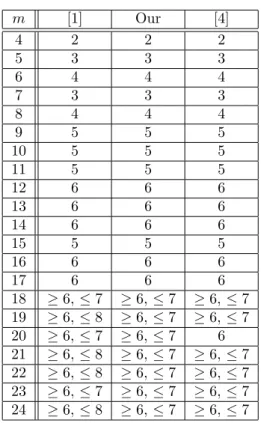
In this paper, we find new constructions for uniform (m, 3)-splitting systems. They improve some of the known upper bounds on the size of such systems. For instance, we improved some bounds of Table 1 in [1] (for m = 19, 21, 22, 24). Recently, van Rees and Lau improve the bound for m = 20 using disjunct splitting systems [4]. We compare bounds for uniform (m, 3)-splitting systems for m ≤ 24 in Table 1. We also present Table 2 that summarizes our results and compare them with previous results [1].
Asymptotically, van Rees and Lau recently gave a better result that one can construct ¡4j + 2; 4¡1.4953j¢, 3¢-uniform SS using disjunct splitting systems [4]. However, there remains a large gap between the lower bounds and the upper bounds for uniform (m, 3)-splitting systems. It would be nice if the difference between the two could be bounded by a constant.
m [1] Our [4] 4 2 2 2 5 3 3 3 6 4 4 4 7 3 3 3 8 4 4 4 9 5 5 5 10 5 5 5 11 5 5 5 12 6 6 6 13 6 6 6 14 6 6 6 15 5 5 5 16 6 6 6 17 6 6 6 18 ≥ 6, ≤ 7 ≥ 6, ≤ 7 ≥ 6, ≤ 7 19 ≥ 6, ≤ 8 ≥ 6, ≤ 7 ≥ 6, ≤ 7 20 ≥ 6, ≤ 7 ≥ 6, ≤ 7 6 21 ≥ 6, ≤ 8 ≥ 6, ≤ 7 ≥ 6, ≤ 7 22 ≥ 6, ≤ 8 ≥ 6, ≤ 7 ≥ 6, ≤ 7 23 ≥ 6, ≤ 7 ≥ 6, ≤ 7 ≥ 6, ≤ 7 24 ≥ 6, ≤ 8 ≥ 6, ≤ 7 ≥ 6, ≤ 7
Table 1: Upper bounds for the number of blocks in (m, 3)-uniform SS for m ≤ 24
m [1] Theorem 8 Theorem 11 2n 2n − 2 - 2n − 1 2n+ 1 2n + 2 2n − 1 2n − 1 2n+ 2 2n - 2n − 1 2n+ 3 2n + 2 2n − 1 2n − 1 2n+ 4 2n - 2n − 1 2n+ 5 2n + 2 2n + 1 2n − 1 .. . ... ... ... 2n+ 2n−1 2n - 2n − 1 2n+ 2n−1+ 1 2n + 2 2n + 1 2n − 1 2n+ 2n−1+ 2 2n - -2n+ 2n−1+ 3 2n + 2 2n + 1 -.. . ... ... ... 2n+1− 2 2n - -2n+1− 1 2n + 2 2n + 1
A. Some examples of splitting systems
Example 6. 1 1 1 1 1 0 0 0 0 0 1 0 0 1 0 0 0 1 1 1 0 0 1 1 1 0 1 1 0 0 0 0 1 0 1 0 0 1 0 1 0 1 1 1 0 0 0 1 1 1 0 0 0 0 1 1 1 1 1 0 0 0 0 0 0 0 0 0 1 1 1 1 1 0 1 0 1 1 0 0 0 0 1 1 1 0 0 0 1 0 0 1 1 1 1 0 0 0 0 1 1 1 1 0 0 1 1 1 1 1 1 1 1 1 1 0 0 0 0 0 0 0 0 0 0 0 0 0 0 0 0 0 0 0 0 0 0 1 1 1 1 1 1 1 1 1 1 is the incidence matrix of a (7; 21, 3)-uniform SS.
Example 7. 11111100000 11111000000 11100011000 11100111000 10010011100 11000110110 10000000111 00111001111 10001111011 00100110001 11111111111 00000000000 00000000000 11111111111
is the incidence matrix of a (7; 22, 3)-uniform SS. It has 4 pairs of complementary columns. And note that the upper left submatrix and the upper right submatrix are the incidence matrices of (5; 11, 3)-SS (nonuniform).
Example 8. 1111110000011111000000 0 1110001100011100111000 1 1001001110011000110110 0 1000000011100111001111 1 1000111101100100110001 0 1111111111100000000000 0 0000000000011111111111 0
is the incidence matrix of a (7; 23, 3)-nonuniform SS. Note that the first 22 columns of this matrix form the incidence matrix of a (7; 22, 3)-uniform SS.
Example 9. 11000110001110001100011 10100101001101001010011 10010100101100101001011 01110000011011100000111 00001011101000010111011 00000111110000001111101 11111000000111110000001
Example 10. The blocks {1, . . . , 6, 12, . . . , 16, 24, 25, 29, 30, 33, 34, 35, 39, 40, 44, 45}, {1, 2, 3, 7, 8, 12, 13, 14, 17, 18, 19, 23, 25, 26, 27, 33, 35, 36, 37, 43, 44, 45}, {1, 4, 7, 8, 9, 12, 13, 17, 18, 20, 21, 24, 27, 29, 32, 33, 34, 37, 39, 42, 44, 45}, {1, 9, 10, 11, 14, 15, 16, 19, . . . , 23, 29, . . . , 32, 39, . . . , 43, 45}, {1, 5, . . . , 8, 10, 11, 14, 17, 18, 22, 24, . . . , 28, 34, . . . , 38, 45}, {1, . . . , 11, 28, 30, . . . , 33, 38, 40, 41, 42, 44, 45}, {12, . . . , 22, 24, 26, 29, 31, 33, 34, 36, 39, 41, 44, 45}, {1, . . . , 22}, {24, . . . , 45}
form a (9; 45, 3)-uniform SS on the set {1, . . . , 45}. It has 6 pairs of complementary columns. Example 11. 111110000000 111001101001 100001110000 100110011111 111001101001 111110000000 011001100110 011001100110 100110011111 100001110000 111111111111 000000000000 000000000000 111111111111
is the incidence matrix of a (7; 24, 3)-uniform SS. It has 2 pairs of complementary columns. And note that the upper left submatrix and the upper right submatrix are the incidence matrices of (5; 12, 3)-SS.
Example 12. 111110000000 111001101001 100001110000 100110011111 111001101001 111110000000 011001100110 011001100110 100110011111 100001110000 111111111111 000000000000 000000000000 111111111111
is the incidence matrix of a (7; 24, 3)-uniform SS. It has 2 pairs of complementary columns. And note that the upper left submatrix and the upper right submatrix are the incidence matrices of (5; 12, 3)-SS.
Example 13. The blocks
{1, . . . , 5, 13, 14, 15, 18, 19, 21, 24}, {1, 6, 7, 8, 13, 16, 17, 20, . . . , 25}, {1, 2, 3, 6, 7, 9, 12, . . . , 17}, {2, 3, 6, 7, 10, 11, 14, 15, 18, 19, 21, 22},
{1, 4, 5, 8, . . . , 13, 18, 19, 20, 25}, {1, . . . , 12}, {13, . . . , 24}
form a (7; 25, 3)-nonuniform SS on the set {1, . . . , 25}. Note that it contains a
(7; 24, 3)-uniform SS on the set {1, . . . , 24}. Example 14. The blocks
{5, 9, . . . , 12, 14, 15, 16, 20, . . . , 23}, {3, 4, 5, 8, 11, . . . , 18}, {3, . . . , 7, 10, 14, 15, 16, 19, 24, 25}, {1, 2, 5, . . . , 8, 13, 14, 17, 20, 21, 25},
{1, . . . , 5, 9, 14, 18, 19, 22, 23, 24}, {14, . . . , 25}, {1, . . . , 12}
form a (7; 25, 3)-uniform SS on the set {1, . . . , 25}. It has 4 pairs of complementary columns. And note that it contains two (5; 13, 3)-SS’s on the set {1, . . . , 13} and {13, . . . , 25} using the first 5 blocks.
Example 15. The blocks
{1, . . . , 5, 13, 14, 15, 18, 19, 21, 24, 30, 34, . . . , 40, 44, . . . , 47}, {1, 6, 7, 8, 13, 16, 17, 20, . . . , 25, 28, 29, 30, 33, 36, . . . , 42}, {1, 2, 3, 6, 7, 9, 12, . . . , 17, 28, . . . , 32, 35, 38, 39, 40, 43, 48, 49}, {2, 3, 6, 7, 10, 11, 14, 15, 18, 19, 22, 23, 26, . . . , 30, 34, 38, 42, 43, 46, 47, 48}, {1, 4, 5, 8, . . . , 13, 18, 19, 20, 25, 26, 27, 30, . . . , 33, 38, 41, 44, 45, 49}, {1, . . . , 12, 38, . . . , 49}, {13, . . . , 24, 26, . . . , 37}, {1, . . . , 24}, {26, . . . , 49} form a (9; 49, 3)-uniform SS on the set {1, . . . , 49}. It has 10 pairs of complementary columns.
Acknowledgement
The authors would like to thank the referees for their helpful suggestions.
References
[1] D. Deng, D. R. Stinson, P. C. Li, G. H. J. van Rees, R. Wei, Constructions and Bounds for (m, t)-Splitting Systems, Discrete Math. 307(2007), 18–37.
[2] A. C. H. Ling, P. C. Li, G. H. J. van Rees, Splitting Systems and Separating Sys-tems, Discrete Math. 279(2004), 355–368.
[3] D. R. Stinson, Some Baby-Step Giant-Step Algorithms for the Low Hamming Weight Discrete Logarithm Problem, Math. Comput. 71(2002), 379–391.