ICCAS2005 June 2-5, KINTEX, Gyeonggi-Do, Korea
1. INTRODUCTION
The postural balance of human is maintained by a complex mechanism utilizing the functions of cerebellum, equilibrium, and other various organs. Today, the number of the traffic accidents keeps increasing due to an increase in traffic volume. At the same time, the population of the elderly has been also increasing. Such increases in the traffic accidents and the populations of the elderly are some of the main causes of many reported cases of the injuries to central nervous system such as stroke, traumatic brain injury, and various ailments in the musculoskeletal system [1-2]. Furthermore, there are many reported cases of the loss in the ability to control the postural balance due to such injuries to the central nervous systems or the musculoskeletal system. Such a loss of ability in controlling postural balance results in many kinds of complications in the rehabilitative treatments.
A study on the training or the diagnosis of the postural balance can be categorized into either a clinical assessment or an engineering assessment. A clinical assessment of postural balance was first suggest in 1984 by Ruskin [3] who classified the degree of keeping lateral postural balance and standing postural balance into 4 steps. Many other researchers have also reported the methods of assessing the postural balance control by indexes based on clinical assessment. However, such methods still remain incomplete, and there is a great room for improvements in the aspect of objective and quantitative analysis. An engineering assessment has the advantages in that it quantifies various parameters such as swaying degrees. Engineering assessments have been used in the postural balance control training using visuoauditory biofeedback. Drowatzkey et al. [4] demonstrated the reliability of the method of measuring postural balance control using a force plate with normal healthy subjects. Shumway-cook et al. [5] and Lehmann et al. [6] examined the patients with disorder in vestibular function. However, conventional measurement
systems not only fail to stimulate all the sense required for rehabilitation of the postural balance but also make the subject feel monotonous during training or test session. Therefore, there is a great demand for a new rehabilitation training system that not only provides a simulative environment that can stimulate all the senses related to postural balance but also enables quantitative analysis of related factors.
Improvement of Equilibrium Sensory of the Elderly Using A Virtual Bicycle
Training System
Sung-Hwan Jeong, Yong-Jun Piao, Woo-Suk Chong, Young-Yook Kim,* Tae-Kyu Kwon**,
Chul-Un Hong**, and Nam-Gyun Kim**
Dept. of Biomedical Engineering, Chonbuk National University, Jeonju, Korea (Tel : +82-63-270-2246; E-mail: [email protected], [email protected], [email protected]) *Center for Healthcare Technology Developments, Chonbuk National University, Jeonju, Korea
( Tel : +82-63-270-2246; E-mail: [email protected])
**Division of Bionics and Bioinformatics, Chonbuk National University, Jeonju, Korea (Tel : +81-63-270-2247; E-mail: kwon10, cuhong, [email protected])
Abstract:
The purpose of this study was to explore the effectives of a virtual bicycle system in improving the ability of
equilibrium sense of normal healthy adults. Experiments were performed to find the factors related to the training of equilibrium sense. The subjects consisted of young and elderly people and the group of young people was compared against the group of elderly people. We investigated three different running modes of virtual bicycle system with two successive sets in total. W measured the parameters related to the running time, the velocity, the weight movement, the degree of the deviation from the road, and the location of the center of pressure (COP). The results showed that the running capability of the elderly became much better after repeated training. In addition, it was found out that the ability to control postural balance and the capability of equilibrium sensory were improved with the presentation of the visual feedback information of the distribution of weight. We also found that the running time and the running velocity reduced when there was no visual feedback information. From the results, our newly developed bicycle system seems to be effective in the diagnosis of equilibrium sense as well as in the improvement of the sense of sight, and vestibular function of the elderly in the field of rehabilitation training.Keywords: Virtual bicycle system, Equilibrium sensory, Visual feedback, Vestibular function
In this study, a new system that simultaneously stimulates various senses that related to postural balance and at the same time analyzes the effect of the stimulation has been suggested overcoming the shortcomings of the conventional rehabilitation training system. Moreover, the new system was developed in a way that the ability of controlling the postural balance and the effect of the rehabilitation training can be quantitatively assessed.
2. SYSTEM CONFIGURATION
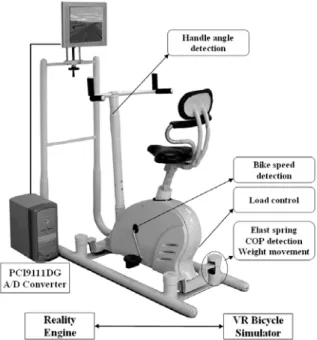
2.1. System featuresThe new bicycle training system shown in Fig. 1 has an an effecter and a reality engine, where a computer system provides visual stimuli and analyzes the effect of the training. The reality engine comprises of the software programs (WTKTM, C++) for providing virtual cycling environment, a computer hardware (Pentium Ⅳ, Windows 2000 Professional), a high-performance graphic accelerating board (Intense 3D Pro 2200STM), and an A/D converter (8 ch., 16 bit, PCI-9111DG). The effecter uses a visual display that shows virtual cycling environment to the rider. The sensor interface device accesses the measurements related to equilibrium sense. The parameters that are related to the riding speed, the rotation angle of handlebars, and the head movement are acquired real time. These parameters enable the construction of an interactive environment where the rider can interact with the objects in the virtual environment. The cycling system enables the control of cycling direction in virtual environment by
ICCAS2005 June 2-5, KINTEX, Gyeonggi-Do, Korea
manipulating the handlebars like in an actual bicycle. Also, the cycling speed in the virtual environment can be determined by stepping on the pedals faster or slower. A load control device attached to the wheel of the bicycle applies appropriate load back to the pedals on an uphill road or a downhill road in the virtual environment. Figure 3 shows the connections between input and output and between the reality engine and the sensing devices.
Fig. 1 A training system for postural control rehabilitation 2.2. Orientation angle detection
The orientation angle of the handle bars was also measured using a one-turn potentiometer converter (±5V full scale). The analog voltage from the potentiometer converter was digitized by an analog-to-digital converter. In determining the heading direction of the handlebars, the middle value of the converter of the potentiometer was fixed at 2.5V when they were heading in frontal direction. The direction of the handlebars was determined to be the right direction whenever the output voltage from the converter is higher than 2.5V, and the direction of the handlebars was determined to be the left direction if it is lower than 2.5V. As illustrated in Fig. 2. The orientation angle of handle bar is fed into the computer through an A/D converter.
Fig. 2 The diagram of the system interface 2.3. Cycling velocity detection
The cycling speed is determined through the sensing of the stepping speed on the pedals. A magnet and a hole sensor were used to measure the speed. The sensor was attached to the part equivalent to the rear wheel which is rotated by the
stepping on the bicycle pedals. As illustrated in Fig. 3, the rotating speed can be computed based on the input from the hole sensor through the A/D converter. When the rotating speed is obtained, the cycling speed in the virtual environment is determined.
2.4. The forward, backward and lateral tilt device
The tilt device lets the rider to slightly pitch or rotate the bicycle by moving his or her weight so that the rider can feel as if he or she is riding a real bicycle. The elasticity of the four springs was chosen in full consideration of the weight of the bicycle and the rider. The springs were installed in front left, front right, rear left, and rear right parts of the supporting frame. In result, the bicycle can be in a motion corresponding to the rider's motion and the rider can feel more comfort. Moreover, the bicycle was designed in full consideration of safety. Even when the center of the weight of the bicycle and the rider shifts to one side beyond a normal degree, the bicycle was designed to maintain a safe angle to prevent the rider from falling.
Fig. 3 The major mechanical parts of the virtual bicycle system
Fig. 4 Block diagram of the virtual bicycle simulator software Figure 4 shows the block diagram of our developed VR bicycle simulator program. First, a road map is loaded as a trajectory and then the parameters such as bicycle velocity, the handle angle, the riding time, the COP, the weight shift are measured and stored. The virtual space includes about 720m of circular road, bicycle wheel, grass, trees, cloud, sky, rose garden, café, and et al. A width of the road is 6m and the distance from the central line of the road to the edge is 3m. Figure 5 shows an analysis program by LabVIEW 6.1.
ICCAS2005 June 2-5, KINTEX, Gyeonggi-Do, Korea
Fig. 5 An analysis program for the bicycle training
4. METHODS
We compared the crucial factors from the virtual cycling test of the elderly people in their seventies with those of the normal health adult males in their twenties to find the effects of virtual cycling on the sense of equilibrium for the elderly. The experiment quantitatively compared the postural balance control in terms of the movement of weight and the shift of COP with the postural balance control when visual feedback was presented with those when the visual feed was not presented. Subject rode a virtual road which had 720m of length and 3m of width. Before conducting an experiment, we informed all the subjects of the outline of the test and the testing system for their preparation of mind. Before the actual measurements were taken place, the subject rode a session as a practice. We made up three types of ride modes, which are non-visual feedback (NVF), visual feedback of the weight (VFW), and visual feedback of the center of pressure (VFC). The experiments were carried out twice per each mode with 5 minute break between each mode and trial.
(a) NVF (b) VFW (c) VFC Fig. 6 Three training modes using virtual cycling simulator:
(a) Non-visual feedback (b) Visual feedback of the weight shift (c) Visual feedback of the center of pressure
Fig. 7 Experimental procedure
5. RESULTS AND DISCUSSION
We compared the riding speed, the riding time, and the mean of the movement of weight of the subjects in their twenties with those of the subjects in their seventies in N-VF, VF-COP and VF-W modes so that we can adapt the system to the riders in their seventies.
5.1. Riding time and riding speed
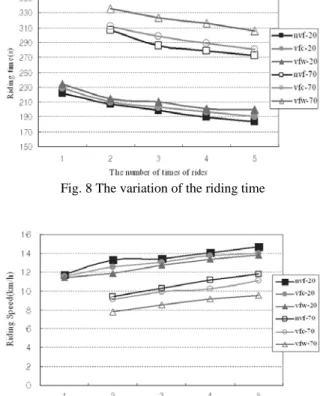
The time to finish the ride and the average riding speed of the subjects in two different age groups for each ride mode are shown in Fig. 8 and 9. Here, the riding time is the time it takes for a subject to reach the end of the road. In general, with
visual feedback the riding time increased about 41 second for the subjects in their twenties and it decreased 39 seconds for the subjects in their seventies compared with the case without visual feedback. The decrement of riding speed was about 2.96km/h for the subjects in their twenties and about 2.38km/h for the subject in their seventies with visual feedback. Most subjects in their seventies complained that it was too difficult for them to continue with the experiment in VF-W mode where a subject is fed with the scenery and the visual feedback information of equilibrium through the monitor. The paired t-test gave out the value of p as less than 0.05 from these data.
Fig. 8 The variation of the riding time
Fig. 9 The variation of the riding speed 5.2. Weight shift
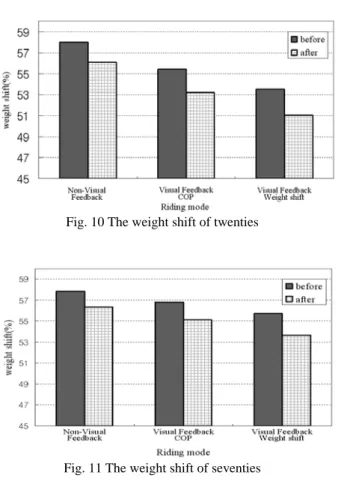
The factor related to weight shift is one of the most important factors in keeping the balance in bicycle ride. The mean of weight shift were 58.02% for the subjects in their twenties and 57.83% for the subject in their seventies respectively in NVF mode without the feedback of the information of the weight movement. This implies that the subjects in their twenties were more active than the subject in their seventies in riding a bicycle. Figure 10 and 11 show the weight sifts before and after the training. The weight shift of the subjects in their twenties decreased from 53.17% to 51.05% and that of the subjects in their seventies also decreased from 55.1% to 53.63% in VFC and VFW riding modes. While the weight shift of the subjects in their twenties was close to 50% (equilibrium state) with 1.05% gap, the weight shift of the subjects in their seventies had a 3.07% gap from 50% (equilibrium state). The paired t-test of the data showed the value of p to be less than 0.05.
Therefore, the mode with visual feedback seems to help both subjects controlling the equilibrium. While the riding speed got better without the visual feedback of the information on equilibrium, the weight shift related to equilibrium got better with the visual feedback.
ICCAS2005 June 2-5, KINTEX, Gyeonggi-Do, Korea
Fig. 10 The weight shift of twenties
Fig. 11 The weight shift of seventies
6. CONCLUSIONS
In this study, we have developed a virtual bicycle riding system for improving the equilibrium sense using virtual reality technology. The experimental result showed that the equilibrium sense of the subjects improved by the training using this system. Following is our findings.
1. As a result of repeated riding training, the sense of equilibrium improved in all riding modes.
2. The weight shift reduced when the information of weight shift were shown in the monitor,
3. Virtual bicycle system had a good effect on not only the aged but also the young people in stimulating and improving the sense of equilibrium.
Through these studies, we confirmed that the developed system can be used not only for the quantitative measurement and analysis of equilibrium sense but also for the enhancement of the control and the function of equilibrium sense of the young and the elderly by offering motivating and stimulating training environment.
ACKNOWLEDGMENTS
This research was supported by the Korean Ministry of Education & Human Resources Development through the Center for Healthcare Technology Development.
REFERENCES
[1] S. P. Cass, J. M. Kartush and M. D. Graha, “Clinical assessment of postural stability following vestibular
nerve section,” Larngoscope, Vol. 101, pp. 1-56-1059, 1991.
[2] D. A. Winter, F. Prince, J. S. Frank, C. Powell and K. F. Zabjek, “Unified theory regarding A/P and M/L Balance in Quiet Stance,” Journal of Neurophysiology, Vol. 75, pp, 2334-2343, 1996.
[3] A. P. Ruskin, Current therapy inphysiatry, WB saunders, Philadelphia, pp. 26-27. 1984.
[4] J. N. Drowatzky, and F. C. Ziccato, “Interrelationships between selected measures of static and dynamic balance,” Research Quaterly, Vol. 38, pp. 509-510, 1967. [5] A. Shumway-Cook, and F. B. Horak, “Assesing
influence of sensory interaction on balance suggestion from field,” Physical Therapy, Vol. 66, pp. 1548-1550, 1986.
[6] J. F. Lehmann, S. Boswell, R. Price, A. Burleigh, B. J. deLateur, K. M. Jaffe, and D. Hertling, “Quantitative evaluation of sway as an indicator of functional balance in post traumatic brain injury,” Archives of Physical Medicine and Rehabilitation, Vol. 70, pp. 955-966, 1990. [7] C. G. Song, J. Y. Kim, and N. G. Kim, “A New Postural Balance Control System for Rehabilitation Training Based on Virtual Cycling,” IEEE, Vol. 8, No. 2, pp. 200-207, 2004.
[8] R. G. Hamman, I. Mekjavic, A. I. Mallinson, and N. S. Longridge, “Training effects during repeated therapy sessions of balance training using visual feedback,” Archives of Physical Medicine and Rehabilitation, Vol. 7, pp. 738–744, 1992.
[9] M. Armengot, R. Barona, and J. Basterra, “The effect of visual feedback exercises on balance in normal subjects,” Acta. Otor. Espa., Vol. 76, pp. 961–965, 1994. [10] P. H. Timo, H. Meeli, and A. Heikki, “Postural control
measured by visual feedback posturography,” ORL, Vol. 64, pp. 186–190, 2002.
[11] J. S. Feigenson, M. L. McCarthy, S. D. Greenberg, and W. D. Feigenson, “Factors influencing outcome and length of stay in a stroke rehabilitation unit,” Stroke, Vol. 8, No. 6, pp. 657–662, 1977.
[12] P. W. Duncan, S. Studenski, J. Chandler, R. Bloomfeld, and L. K. LaPoint, “Electromyographic analysis of postural adjustments in two methods of balance testing,” Physical Therapy, Philadelphia, PA: Lippincott, Vol. 70, pp. 88–96, 1990.
[13] N. G. Kim, C. K. You and J. J. Im, “A New Rehabilitation Training System for Postural Balance Control Using Virtual Reality Technology,” IEEE Transaction on rehabilitation engineering, Vol. 7, No. 4, pp. 482-485, 1999.
[14] M. A. Dettmann, M. T. Linder, and S. B. Sepic, “Relationships among walking performance, postural stability, and functional assessments of hemiplegic patient,” Am. J. Phys, Med., Vol. 66, pp. 77-90, 1987.