• 검색 결과가 없습니다.

A Study on the Globalization Strategy of Korean Spatial Information for Expansion into An Emerging Market -Focused on the Cases of Asian Developing Countries-

N/A
N/A
Protected

Academic year: 2021

Share "A Study on the Globalization Strategy of Korean Spatial Information for Expansion into An Emerging Market -Focused on the Cases of Asian Developing Countries-"

Copied!
10
0
0

로드 중.... (전체 텍스트 보기)

전체 글

(1)

This is an Open-Access article distributed under the terms of the Creative Commons Attribution Non-Commercial License (http://creativecommons.org/licenses/

*

Kirl Kim, Assistant Professor, Dept. of Geography Education, Korea National University of Education. [email protected]

A Study on the Globalization Strategy of Korean Spatial Information for Expansion into An Emerging Market

-Focused on the Cases of Asian Developing Countries-

신흥시장 진출을 위한 한국 공간정보의 글로벌화 전략 연구

-아시아 개발도상국의 사례를 중심으로-

Kirl Kim*

김걸*

요 약 1995년부터 추진한 국가지리정보체계 구축사업으로 국가공간정보인프라의 활용수준은 높아졌으나, 국내시 장 규모의 한계와 대기업의 시장진출에 대한 법률적 규제로 인해 한국의 공간정보 시장은 산업경쟁력 측면에서 정체하 고 있다. 이러한 문제점을 극복하고 과열된 국내의 레드오션 시장을 벗어나기 위해서는 새로운 공간정보의 블루오션 시 장을 발굴할 필요가 있다. 해외 공간정보 시장은 2015년까지 연평균 10.5% 성장하고 150조원(1,250억 달러)로 성장할 것으로 예측되고 있다. 따라서, 아시아의 공간정보 시장은 커다란 성장 잠재력을 가지며, 한국에게는 새롭게 부상하는 블루오션 시장이 되고 있다. 핀란드, 독일, 스웨덴, 일본 등의 선진국들은 이미 오래전부터 개발도상국의 공간정보 시장 에 진출하고 있으므로 선진국과 발을 맞추기 위해서 신흥공간정보 시장으로의 진출 확대를 위한 한국 공간정보의 새로 운 글로벌화 전략 마련이 시급한 상황이다. 이 연구의 목적은 국내의 공간정보에 대한 강점-약점-기회-위협 요인을 분석 하고 아시아 개발도상국의 공간정보 현황을 고찰하며, 한국 공간정보의 신흥시장 진출을 위한 글로벌화 전략을 제시하 는데 있다. K-FBI 글로벌화 전략은 지식 플랫폼 구축전략, 신개척지 전략, 기본 공간정보 공략 전략, 현지 맞춤형 내재화 전략의 4가지 영역으로 구성될 수 있다. 향후 K-FBI 글로벌화 전략에 기반한 공간정보 로드맵의 수립과 시행은 우리 공 간정보 기업의 아시아 개발도상국 진출에 큰 디딤돌이 될 것이다.

키워드 : 국가지리정보체계, 국가공간정보인프라, 블루오션 시장과 레드오션 시장, K-FBI 글로벌화 전략, 개발도상국 Abstract Korean government has promoted the projects of National Geographic Information Systems since 1995 and the utilization level of Korean National Spatial Data Infrastructure based on them has also developed. However, due to the limit to domestic market size and the legal regulation on prohibition of large sized companies’ expansion into domestic spatial information markets, Korean spatial information markets are tied up in term of industrial competitiveness.

To overcome those problems and evade the domestic red oceans, it is necessary to find new one in overseas’ blue ocean markets. It is estimated that overseas spatial information market will be grown to 125 billion-dollar size and the annual growth rate of it will be reached to 10.5% until 2015. Thus, Asian spatial information market has a huge growth potential and it is newly rising blue oceans for Korea. Advanced countries such as Finland, Germany, Sweden, and Japan have already expanded their market size into the newly industrializing countries. To step with advanced countries, it is time to set up the new globalization strategy of Korean spatial information for expansion into newly industrializing markets. The purpose of this study is to analyze the SWOT of domestic spatial information, investigate the status on spatial information of Asian developing countries, and suggest the globalization strategy of Korean spatial information for expansion into them. The globalization strategy can be labelled as K-FBI composed of 4 domains such as Knowledge sharing platform, Frontier, Back to the basic, and Internalization. In near future, the establishment and performance of road map based on the strategy will be the milestone for Korean spatial information companies’

advance into Asian developing countries.

Keywords : National Geographic Information Systems, National Spatial Data Infrastructure, Blue and Red Ocean

Market, Globalization Strategy of K-FBI, Asian Developing Countries

(2)

1. Introduction

Korean government has promoted the projects of National Geographic Information Systems (NGIS) since 1995 and the project is now in the stage of performing the 5

th

National Spatial Data Infrastructure (NSDI) Policy (MOLIT[1];[2]). The NGIS had improved the productivity of administrative work and the quality of spatial information service for the people. The utilization of spatial information is generalized in the economic and social activity, and the size of spatial information market is increasing. In 2010, Korean spatial information market size had reached to 2,400 billion Korean Won and it had ranked at the 8

th

order by occupying the 3 to 4% of worldwide (Hwang et al.[3]).

Korean spatial information markets have evolved from surveying and system integration to service market.

Although the Korean spatial information market size is increasing, Korean spatial information companies has encountered the stagnation because of the severe competitiveness between companies (red ocean) and the decrease in growth potential of surveying and system integration market (grey ocean). In order to overcome these problems, Korean government and companies are seeking for the new spatial information markets based on the experience accumulated through the NGIS project promotion. That is to say, it is necessary to find a new blue ocean market.

ARC Advisory Group[4] estimated that overseas spatial information market will be grown from 74 billon-dollar in 2010 to 125 billion-dollar size in 2015 and the annual growth rate of it will be reached to 10.5%

until 2015. Software market of spatial information has increased at the rate of over 15%. Especially, U.S.A., and Europe markets have grown at the rate of over 30% and the spatial information software market of U.S.A. had occupied 50% of worldwide (IDC[5]). In comparison to U.S.A and Europe, Korean spatial information market size is still small.

A number of newly industrializing countries under the United Nations have a huge interest on the construction of spatial data infrastructure through UN-GGIM founded in 2011. Especially, Asian developing countries are keeping an eye on the experience of Korean GIS transformed from recipient to donor

country in the international support and assistantship.

Asian developing countries are seeking for utilization of spatial information related to land plan and NSDI.

Generally, Asian developing countries have used inaccurate small scaled maps. In near future, those countries need exact and detailed spatial information to accelerate their economic growth. Thus, Asian spatial information market has a huge growth potential and it is newly rising blue oceans for Korea.

Advanced countries such as Finland, Germany, Sweden, and Japan have already expanded their market size to the newly industrializing countries (Williamson;

Wallace[6]). To step with advanced countries, it is time to set up the new globalization strategy of Korean spatial information for expansion into newly industrializing markets.

The purpose of this study is to analyze the SWOT of domestic spatial information markets, investigate the status on spatial information markets of Asian developing countries, and suggest the globalization strategy of Korean spatial information for expansion into them.

The spatial scope of this study is confined to three Asian countries such as Cambodia, Vietnam, and Mongolia.

These three countries are in immature for spatial information and have a big potential on its growth.

Selected countries are good case study areas in that they are in the early stage of spatial information development.

The research methods include the literature review, the SWOT analysis, the on-site field trip, and the interview with public officials in Asian developing countries. The on-site field trip and interview had been performed from 2007 to 2010.

There are a few of research on overseas spatial information. Kim et al.[7] suggested the overseas export strategy and fund-raising method of spatial open platform by analyzing the gap of spatial information between the Kingdom of Cambodia and the Emirate of Abu Dhabi, titled as ‘A Study on Abroad Export Strategy by Country of Spatial Open Platform: Focused on the Kingdom of Cambodia and the Emirate of Abu Dhabi.’

The direct studies related to Korean spatial information

companies’ overseas expansion include Choe et al.[8],

Jin et al.[9], Hwang et al.[3], and Lee[10].

(3)

Choe et al.[8] suggested the framework of the establishment of abroad expansion strategy and the proper environment on the construction and application of NSDI in newly developing countries by using system dynamics method, literature review, and survey. They argued that Korean spatial information companies should have an interest on the strategic framework composed of understanding on requirement and policy needs that Asian developing countries have encountered, searching for the demand characteristics and response scenarios, carving out proper technology, and securing international competitiveness of Korean spatial informa- tion companies.

Jin et al.[9] analyzed the relevance between Korean support policy and the Korean spatial information companies’ industrial competitiveness. Yet, the study has a limit that it only analyzed the causation between domestic company’s requirement and government policy using structural model without considering an overseas specific country.

Hwang et al.[3] investigated the status on spatial information industry and abroad expansion plan of Korean spatial information companies. They also analyzed the competitiveness of domestic spatial information companies using survey and in-depth interview. The competitiveness was evaluated as two tracks such as inner and outer capability. Based on the result, They suggested the policy agenda and road map for carving out overseas expansion strategy.

Lee[10] argued that domestic spatial information companies should have an armor of package outlined in strengthening of competitiveness and accustomed in overseas environment by investigating related literature and abroad expansion case study. In addition to above research, Kim[11] dealt with small and medium sized companies’ competitiveness fortification for abroad expansion.

Previous research usually suggested various ideal domestic spatial information companies’ abroad expansion method by eliciting the implementation of policy using survey and status investigation without considering any strategy and Asian developing countries’ situation. This study has a difference from the existing research in that it focused on the recipient countries’ real situation on spatial information and elicited the internalized

strategy optimized to case study countries.

2. The Current Status on Korean Spatial Information and the Characteristics in Overseas Ex- pansion of Korean Spatial Infor- mation Companies

2.1 The Current Status on Korean Spatial Information

Korean spatial information has 20 years history. The 1

st

NGIS project started from 1995 and now is in the 5

th

NGIS project. Korean spatial information policy is promoted by the framework plan and the enforcement decree plan categorized into legal planning based on the three laws such as the National Spatial Data Infrastructure Act, Act on Land Survey, Waterway Survey and Cadastral Records, and Spatial Data Industry Promotion Act. Based on reviewing on the 1

st

to the 5

th

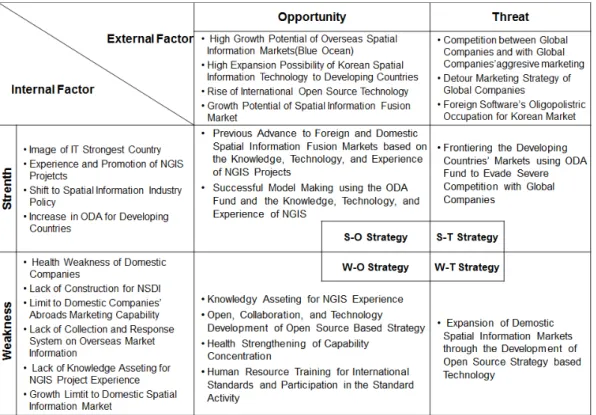
spatial data policy master plan and related literatures (MOLIT[1];[2]), the status of Korean spatial information can be summarized as the results of SWOT analysis in the following Table 1.

The most widely used tool for the spatial information status is SWOT analysis (Kim[12];[13]; Crompvoets[14]).

The main objective of this tool is to analyze internal strategic factors such as strengths and weaknesses at- tributed to the Korean spatial information markets, and external factors such as opportunities and threats be- yond control of the Korean spatial information markets.

In terms of strengths, Korea has a strong image on information and communication technology. It also has full experience and promotion of NGIS projects. Korean government has transformed from the construction policy to the fortification policy of spatial information industry, and increased in ODA (Official Development Assistant) fund for the developing countries.

In terms of weakness, Korean companies have weak health compared to that of the advanced countries.

Although Korean government has focused on the con-

struction of NSDI, the completion of the construction

of NSDI still stays in immature status. Korean companies

still have a limit to marketing capability for overseas

market. Korea has an weakness in that it cannot have

(4)

Table 1. The Results of SWOT Analysis for Korean Spatial Information

collection and response system on overseas market in- formation and it has not embodied the knowledge as- sets through NGIS project experience. In essence, Korean spatial information market has a limit to market size.

In terms of opportunities, Korea has a blue ocean of overseas spatial information that has a high growth potential. Thus, it has high expansion possibility of Korean spatial information technology into the developing countries. As the international open source technology is rapidly growing, the growth potential of spatial in- formation fusion market is also rising.

In terms of threats, Korean companies have encountered the severe competition between global companies and with global companies’ aggressive marketing. Korean companies should have a situation to detour the marketing strategy of global companies by overcoming the foreign software’s oligopolistic occupation in Korean markets.

According to SWOT status, 4 strategies can be made as the followings. The S-O strategy is seeking for ahead advance to foreign and domestic spatial information fusion markets based on the knowledge, technology, and experience of NGIS projects. It focuses on successful

model making using the ODA fund and the knowledge, technology, and experience of NGIS.

The W-O strategy means the embodiment of the knowledge assets through NGIS experience and the open, collaboration, and technology development of open source based strategy. To eliminate weakness and raise opportunity, Korea should strengthen its health by concentrating on the capability for selected spatial information, and take an effort to educate human resource for international standards and participate in that activity.

The S-T strategy is seeking for reclaiming the devel- oping countries’ markets using the ODA fund to evade severe competition with global companies. The W-T strategy means the expansion of Korean spatial in- formation markets through the development of open source strategy based technology.

2.2 The Characteristics in Overseas Expansion

of Korean Spatial Information Companies

The case of overseas expansion of Korean spatial

information companies is shown in Figure 1. Korean

(5)

Figure 1. Korean Spatial Information Companies’

Overseas Expansion Status Source: cited from Kim[16], p.51.

Note: Point( •) refers to the country where Korean companies had advanced.

spatial information companies had advanced to overseas’

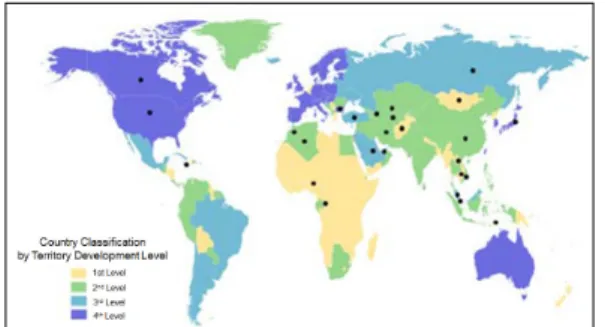
27 countries until 2010. The number of advance to overseas is amount to 59 (Choe et al.[15]).

Korean spatial information companies have usually concentrated on China, Cambodia, and South and East Asian countries until the early of 2000, but after that, they are widely expanding to Central Asia, Eastern Europe, North America, and so on. The 15 out of 27 countries (56%) are included in the developing countries at the territory development level

1)

of the first (yellow color) and second (green color) stage.

2)

In comparison to the developing countries, Korean spatial information companies had a few expanded to the advanced coun- tries (44%) categorized in the third and the forth level of territory development. The number of expansion case into the advanced countries is at most 9.

The overseas fund sources of Korean spatial informa- tion companies are originated from bilateral aids that Korean government through KOICA (Korea International Cooperation Agency) and EDCF (Economic Develop- ment Cooperation Fund) directly provides the funds for the developing countries. The contents of overseas ex- pansion include the construction of labor-intensive sur- veying and the production of digital maps, GIS consult-

1) The territory development level refers one country’s spatial development level representing the country growth index, urbanization rate, subscribe rate for high speed internet, length of railroad, pavement rate, per capita energy generation, and rate of water supply (Kim[16]).

2) The countries included in the first and second level of territory development level refer to the developing ones.

ing, education, and establishment of GIS planning in or- der of importance from the first to the end. The export of high value added Korean spatial information sol- ution stays in a low level.

3. Spatial Information Status on Asian Developing Countries

The chapter 3 investigates the three Asian countries’

cases such as Cambodia, Vietnam, and Mongolia of NSDI implementation and spatial information status.

The NSDI can be defined as “the technologies, policies, and people necessary to promote sharing of spatial information throughout all levels of government, the private and non-profit sectors, and the academic community (GSDI[17];Budhatho et al.[18]).” It is an infrastructure that includes various components such as technology, policy, criteria, standard and people. In the developing countries, the NSDI activities vary among countries depending on countries’ own backgrounds and needs.

3.1 Status of Cambodia

The establishment of spatial information in Cambodia was generally supported by the advanced countries under the project of ODA. As it is the country that is extending its economic and political capacity into the global field, urban development plans and policy implications are actively on progress, and yet some of social challenges are still needed to be improved. Maps, expecially digital topographic map is the key method which would provide the extensive national plans not only for the tourism and garment manufacturing but also for the agricultural development since digital topographic map enables Cambodia to produce national base map.

During the early stage of the 20

th

century (the French

colonial period), Clark Ellipsoid and Bonne Projection

were introduced by virtue of SGI (Service Geographique

de Indochina Geographic Service), and that those made

established modern surveying technology to Cambodia

(KRIHS[19]). Cambodia has set up a plan to build a

(6)

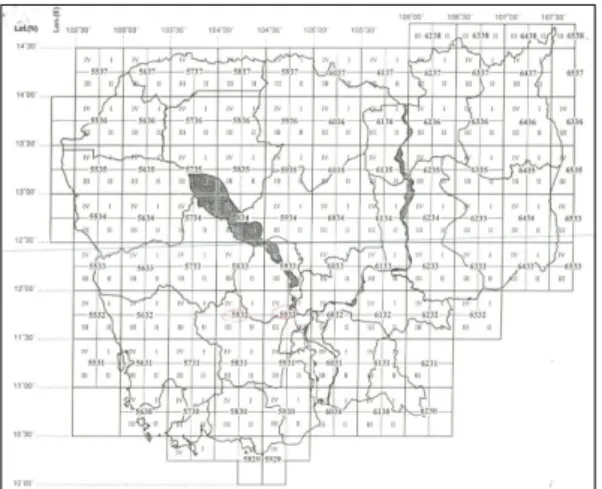
Figure 2. 1:50,000 Cambodia Map Index produced by KOICA

Source: cited from KRIHS[19], p.IV-10.

spatial information database since 1997, and in the year of 1999, legislation was designed to support spatial information and cartography in terms of geographical data. All these concerns were achieved by GDCG (General Department of Cadastre and Geography) which had been established under MLMUPC (Ministry of Land Management, Urban Planning and Construction).

Major activities of GDCG are production of topographic map, production of cadastral map and management of cadastral surveying control point.

Currently, GDCG obtained different scales of topo- graphic maps and those are covering the entire area of Cambodia. The production of topographic map was supported by France, United States and Soviet, and aerial photos and satellite images were used for making them. Most of topographic maps were 20 years old and out dated because the lack of spatial information is inappropriate to be applied to the real world construc- tion. The ones completed and recently used topographic map were produced by JICA from 1996 to 1997 and KOICA from 2010 to 2012 (see Figure 2).

The GDCD of MLMUPC is the principal coordinator and provider of fundamental spatial information. It has promoted LMAP (Land Management Project), NSDI, surveying and map production, MRC (Mekong River Committee), and E-Gov (Electronic Government) policy.

Although the sub-decree on the management of spatial information and mapping activities (1999) committing to administer map generation, updating, and distribution was identified as the initiative for an NSDI in Cambodia, there still exist issues such as unclear data sharing policy, redundancy of spatial information, lack of spatial information for decision support and crisis management, low awareness of GIS, and etc. The setting up of a coordination mechanism to improve the communication between the agencies involved in GIS, GPS, and remote sensing through the establishment of a national GIS task force was presented. Yet, the NSDI in Cambodia is still at its foundation level and a lot of effort need to be input for its development.

Cambodia also has a lot of difficulty to implement the NSDI. The first difficulty is that no national policy and Act on the NSDI exist for the management of spatial information. The second one is that there is no organization to coordinate and implement the NSDI.

The third one is that there is no data sharing between agencies and it has no clearinghouse under any ministry.

The forth one is that Cambodia does not have any human resource program and budget, and standards of spatial information including metadata.

As investigated above, Cambodia is in the lowest level of NSDI. Reversely, Cambodia has a huge potential to develop its capacity and will be a blue ocean for Korean companies in that it has a wide spatial information markets in the baby walking stage.

3.2 Status of Vietnam

Hanoi is the capital of Vietnam and the country’s second largest city followed by city of Ho Chi Minh.

The city lies on the right bank of the Red River (see Figure 3-A).

The city of Hanoi is rapidly spreading its area to the periphery across the Red River. Hanoi is experiencing severe flooding during tropical forest rainy season.

Thus, although the city need a well equipped sewer

system, the situation is not good because of lack of

(7)

A. Satellite Image of Hanoi B. 369 Street of Old Town of Hanoi C. Sewer System in Hanoi Figure 3. Urban Status of Hanoi in Vietnam

Source: photographed by author on March 8, 2010.

spatial information (Figure 3-C).

The city has a lot of deteriorated old towns (Figure 3-B) and it need an urban regeneration project in city centers. However, Vietnam does not have enough spatial information related to topographic maps and city planing maps because of lack of NSDI construction. Therefore, it has no opportunity to regenerate its inner city.

The city of Hanoi is experiencing rapid urban sprawl caused by urbanization and environmental pollution by not-well equipped infrastructure. In comparison to the rapid economic growth, the level of informatization is very low. Thus, cable communication is worse than wireless one.

Although the level of Vietnam’s NSDI is better than that of Cambodia, Vietnam still has an weakness in the construction of NSDI components. The major steering organizations for spatial information vary and any control tower does not exist. The Ministry of Environment and Resource, the Ministry of Construction, and the Ministry of Transport have its own NSDI organization. There is no spatial data sharing between Ministries. Vietnam also has a low level of human resource training and international standard. Although Vietnam has a low level of NSDI, it has promoted various projects of the VLAP (Vietnam Land Administra- tion Project), NSDI, UPIS (Urban Planning Information System), U-City (Ubiquitous City project), land law establishment, and the construction of flooding preven- tion system.

Like Cambodia, Vietnam is at the low level of NSDI.

likewisely, Vietnam has a big potential to develop its

capacity and will be a blue ocean for Korean companies in that it has a wide spatial information markets in the early stage.

3.3 Status of Mongolia

Mongolia has promoted its strategy of good land ad- ministration and spatial information policy establishment since early 2000s. It has implemented the projects of MOLAAP (Mongolian Land Administration), surveying and map production, and K-water (clear water supply).

However, its procedure is unclear because of political restructuring due to rise of new government regime.

Mongolia as one of socialist countries takes an effort to establish cadastral map and land administration plan to secure spatial information.

Yet, it has an weak NSDI situation like Cambodia and Vietnam. Even the situation of Mongolia is worse than the that of previous two countries. Mongolia also has a low telecommunication level worldwide (see Figure 4-B&C). Because of bad infrastructure, pay phone card seller and pay telephony seller are on the street to sell their service for walking guests. The GIS product used by government is entirely dependent on that of the ESRI company and the independent technology for spatial information does not exist. Likewise, human resource training for the GIS and international standards are rare at the level of its country.

3.4 Comprehensive Status of Three Countries

There are common things for spatial information in

the cases of three countries. Asian countries including

Cambodia, Vietnam, and Mongolia have no underground

(8)

A. City of Ulaanbaatar B. Pay Phone Card Seller C. Pay Telephony Seller Figure 4. Urban Status of Ulaanbaatar in Mongolia

Source: photographed by author on May 15, 2007.

Figure 5. Globalization Strategies of Korean Spatial Information

infrastructure and facility, and experience the lack of cable communication. There are also uneven develop- ment between capital city and the periphery, and the environment of education is very deteriorated. Although Asian countries have a cheap and enough labor force, specialized human resources for GIS are rare. Despite rapid economic growth, the level of informatization is too low and the quality of environment is too bad.

Paradoxically, although the situation of three countries for spatial information is poor, their spatial information markets are blue oceans for Korea because they have a high potential to develop the NSDI and spatial in- formation industry. Thus, Korean spatial information companies to advance to overseas markets should have set up the proper globalization strategies considering Asian countries’ situation.

4. K-FBI Globalization Strategies of Korean Spatial Information

Korean markets have become the gray and red ocean because of severe competition between domestic com- panies and global companies. To evade the burned up domestic markets and find a new blue ocean for the overseas market, Korean government and companies should be seeking for the establishment of the new di- rection for spatial information.

By combining the results of Korean spatial in- formation SWOT analysis and three Asian countries’

cases, the globalization strategies of Korean spatial in- formation can be elicited (see Figure 5). The global- ization strategies can be labelled as K-FBI composed

of 4 domains such as Knowledge sharing platform, Frontier, Back to the basic, and Internalization.

The strategy of knowledge sharing platform repre- sents the packaging and the construction of technology, experience, and knowledge for spatial information.

Korean government and companies should monitor the current status continuously and make the manuals for planning, bidding, and management about overseas spatial information projects. The spatial information knowledge should be specialized and printed out in English for overseas’ customers. That is to say, the NSDI framework plans and Acts should be prepared in English written version and analyze the competing countries’ cook book for spatial information.

To develop the good quality of product, GIS engine,

technology, and system, star technology and system for

spatial information should be excavated. When collab-

orating with the developing countries, human resource

in recipient countries is preferentially considered to be

subjects for official human network cooperation, but

(9)

not brokers. In addition, overseas export model should be also established and sustainable international pro- motion should be held. Korean government and com- panies should make a fully charged organization and a task force team to speed up the decision making for expanding of spatial information to the developing countries.

The strategy of frontier refers to reclaiming the new blue ocean markets for spatial information. For this, Korean government and companies should strengthen the capacity of private sector using international funds without focusing on only domestic public funds. To improve the frontier capacity, Korean government and companies should participate in the international con- ference and forum and the government should prepare for the incentive for the successful companies ad- vanced to overseas markets.

The strategy of back to the basic means the funda- mental approach to turn back to the early stage and the bottom and root of base. This strategy is focused on the projects providing for basic necessity required to the developing countries. In short, Korean govern- ment and companies should concentrate on the basic businesses and projects like NSDI master plan estab- lishment, digital map production, cadastral digitizing, and surveying project as a big advantage of Korean spatial information. Although the early cost is con- sumed, continuous experts’ dispatch and human re- source training program’s preparation are required to harden and widen the overseas expansion fields.

The strategy of internalization refers to being friend- ly accustomed to the on-site culture and environment.

Before advancing to overseas markets, the under- standing on the developing countries’ economy, poli- tics, history, culture, and mother tongue is an essential requirement. This strategy will improve the friendship with local human networks.

5. Conclusions

Asian developing countries are a major customer for Korean government and companies. Their markets are rising as a new frontier for spatial information. It is time to reclaim the new overseas markets and it is nec- essary to set up the customized strategies internalized

in the developing countries.

Korean government has promoted the projects of NGIS since 1995 and the utilization level of Korean NSDI based on them has improved. However, due to the shrinkage to domestic market size and the legal regulation on prohibition of large sized companies’ ex- pansion into domestic spatial information markets, Korean spatial information markets are tied up in term of industrial competitiveness.

To overcome those problems and evade the domestic red oceans, it is necessary to find new one in overseas’

blue ocean markets. It is estimated that overseas spatial information market will be grown to 125 billion-dollar size and the annual growth rate of it will be reached to 10.5% until 2015. Thus, Asian spatial information market has a huge growth potential and it is newly rising blue oceans for Korea. Advanced countries such as Finland, Germany, Sweden, and Japan have already expanded their market size to the newly industrializing countries (Williamson;Wallace[6]). To step with ad- vanced countries, it is time to set up the new global- ization strategy of Korean spatial information for ex- pansion into newly industrializing markets such as Cambodia, Vietnam, and Mongolia.

Based on the results of the SWOT of domestic spa- tial information and the review on the status of spatial information of Asian developing countries, this study suggests the globalization strategy of Korean spatial information for expansion into them.

The globalization strategy can be labelled as K-FBI composed of 4 domains such as Knowledge sharing platform, Frontier, Back to the basic, and Internalization.

In near future, the establishment and performance of road map based on the strategy will be the milestone for Korean spatial information companies’ advance in- to Asian developing countries.

References

[1] MOLIT. 2010, White Paper on the 3

rd

National GIS Project, Ministry of Land, Infrastructure, and Transport.

[2] MOLIT. 2014, A Promoting Plan on Korea

National Spatial Information Policy, Ministry of

(10)

Land, Infrastructure, and Transport.

[3] Hwang, J. S; Shin, H.S; Kim, S. S. 2010, A Study on Roadmap for Overseas Expansion of Korea’s Geospatial Information Industry, NIA.

[4] ARC Advisory Group. 2010, Geospatial Information Systems Worldwide Outlook.

[5] IDC. 2008, Intelligent Distributed Computing, Systems and Applications, Proceedings of the 2

nd

International Symposium on Intelligent Distributed Computing, Studies in Computational Intelligence, 162:11-21.

[6] Williamson, I; Wallace, J. 2009, Land Administra- tion for Sustainable Development Emirate of Abu Dhabi.

[7] Kim, K; Jeong, J. D; Lee, J. Y. 2014, A Study on Abroad Export Strategy by Country of Spatial Open Platform: Focused on the Kingdom of Cambodia and the Emirate of Abu Dhabi, Journal of Korea Spatial Information Society, 22(3):9-21.

[8] Choe, B. N; Kang, H. K; Han, S. H; Sung, H.

J; Kim, D. J. 2012, A Study on Spatial Data Infrastructure Establishment and Usage in Developing Countries: Focused on Strategies and Policy Agendas for Overseas Market Expansion, KRIHS.

[9] Jin, H. C; Choe, B. N; Han, S. H. 2014, A Study on Relationship between National Policy Support and Recognized Competitiveness of Spatial Information Company, Journal of Korea Spatial Information Society, 22(3):59-69.

[10] Lee, J. H. 2005, Internationalization Strategy and Policy Implications of SMEs in Korea for Strengthening the Global Competitiveness, KOSBI.

[11] Kim, S. I. 2008, Strengthening SME Competitiveness through Corporate Diagnosis, KOSBI.

[12] Kim, K. 2013, Spatial Information Global Expansion Strategy for Newly Industrializing Markets, Workshop Proceeding of KRIHS.

[13] Kim, K. 2015, A Study on the Spatial Data Infrastructure Development Methods in Abu Dhabi through Gap Analyses on Spatial Information

between the Emirate of Abu Dhabi and the Republic of Korea, Journal of Korea Spatial Information Society, 23(3):101-111.

[14] Crompvoets, G. 2008, Performance Indicators a Tool to Support Spatial Data Infrastructure Assess- ment, Computers, Environment and Urban Systems, 32(5):365-376.

[15] Choe, B. N; Kim, K; Kang, H. K; Sung, H. J.

2013, Overseas Geospatial Information Market Expansion Strategy and its Policy Agenda, KRIHS Policy Brief, 421:1-6.

[16] Kim, Y. P. 2010, Strategies for Carving Out Global Soft Territory and Overseas Markets of Infrastructure Development Project, KRIHS.

[17] GSDI, 2009, Spatial Data Infrastructure Cookbook.

[18] Budhathoki, N. R; Bruce, B; Nedovic-Budic, Z.

2008, Reconceptualizing the Role of the User of Spatial Data Infrastructure, GeoJournal, 72:149-160.

[19] KRIHS. 2012, The Production of the National Base Map and the Establishment of the Master Plan for the National Spatial Data Infrastructure in Cambodia, KOICA.

Received :2015.09.01

Revised :2015.10.22

Accepted :2015.10.23

수치

Table 1. The Results of SWOT Analysis for Korean Spatial Information
Figure 1. Korean Spatial Information Companies’
Figure 2. 1:50,000 Cambodia Map Index produced  by KOICA
Figure 5. Globalization Strategies of Korean Spatial  Information

참조

관련 문서

PORSCHE will start with an initial investment of 20 million euros and is planning to use the E- Fuels from Chile in Porsche’s motorsport fleet, at Porsche Experience Centers

The eruption of East Asian financial crisis in 1997 has aroused heated debate on the re-evaluation of past economic achievements of East Asian countries

“Exit Strategy” are the researches on the cause and effect of the global financial crisis, the trend of the financial stability of capital market in G20 countries, the

• 이명의 치료에 대한 매커니즘과 디지털 음향 기술에 대한 상업적으로의 급속한 발전으로 인해 치료 옵션은 증가했 지만, 선택 가이드 라인은 거의 없음.. •

On the other hand, the restriction on exports of generics prohibits developing producer countries of generic drugs to export them into countries in need, even if there

segmentation; determining distribution, pricing and promotion strategies; developing a communications strategy; budgeting; and visioning long-term market

A business adopting the single target market strategy:. • Concentrates resources on

1 John Owen, Justification by Faith Alone, in The Works of John Owen, ed. John Bolt, trans. Scott Clark, "Do This and Live: Christ's Active Obedience as the