Effect of dietary supplementation of tapioca on growth performance and meat quality in pigs
Jae-Won Park
1, Jing-Ai Cui
2, Sang-In Lee
1, Young-Hwa Kim
3, Joon-Cheol Park
3, Byung-Jo Chae
4, In-Ho Kim
1*
1
Department of Animal Resource and Science, Dankook University, Chungnam, Cheonan, 31116, Republic of Korea
2
College of Food Science and Engineering, Jilin-Agricultural University, Changchun, Jilin, 130118, China
3
National Institute of Animal Science, Rural Development Administration, Chungnam, Cheonan 331-801, Korea
4
College of Animal Life Sciences, Kangwon National University, Kangwon, chuncheon, 24341, Republic of Korea
Received on 18 October 2015, revised on 6 November 2015, accepted on 9 November 2015
Abstract : This study evaluated whether dietary supplementation of tapioca could alleviate the negative effects of palm kernel meal (PKM) on growth performance and meat quality in growing and finishing pigs. In experiment 1, 120 73-dold crossbred growing pigs [(Yorkshire × Landrace) × Duroc], with an average body weight of 31.7±4.5kg, were used in a 3-week trial. In experiment 2, 120 108-d-old crossbred finishing pigs [(Yorkshire × Landrace) × Duroc], with an average BW of 52.6±4.2kg were used in a 10-week trial. Treatments were: CON, a corn-soybean meal-based diet; PKM, 8%
PKM, and TPKM, 8% PKM and 10% tapioca. No difference was observed in growth performance or meat quality among treatments in growing pigs. In finishing pigs, no difference was observed in growth performance or meat quality among CON and TPKM dietary treatments. Finishing pigs fed PKM decreases in final BW and ADG compared with those fed CON. Meat quality was not affected by dietary treatments. In conclusion, dietary supplementation of tapioca alleviated anti-nutritional effect of PKM on growth performance in growing and finishing pigs. Thus, the PKM with tapioca could be an available alternative energy source to reduce the cost of pig diets.
Key words : Growth performance, Palm kernel meal, Tapioca, Pigs
*Corresponding author: Tel: +82-41-550-3652 E-mail address: [email protected]
I. Introduction
Economic concerns about animal diets are important in the agricultural industry due to the increasing price of ingredient of diets. Many researchers in the animal industry focused on various by-products to help reduce the cost of animal diets. Such by-products can be obtained from a variety of sources; grain processing, the production of foods and beverages, and the manufacturing of fiber products has been important feed component sources for animal diets (Ponce and Gernat, 2002; Soukoulis and Aprea, 2012;
Hall and Chase, 2014).
Palm kernel meal (PKM), a by-product of the oil palm, is an important feed ingredient for ruminants
rather than non-ruminants because of its low pal- atability, high fiber, and low availability of amino acids and energy (Rhule, 1996; Agunbiade et al., 1999;
Carvalho et al., 2006). Attempts to compensate for the negative effects of palm kernel meal on the growth performance and meat quality have been reported in pigs (Ao et al., 2011; Park et al., 2012; Son et al., 2012). Ao et al. (2011) demonstrated that supple- mentation with a carbohydrase cocktail in 5% palm kernel meal diet can improve the growth performance and energy and nutrient digestibility in finishing pigs (Ao et al., 2011). In addition, dietary supplementation of palm kernel cake with cassava mixed fermentation improved carcass weight in broilers (Sukaryana, 2013).
It is well known that the tapioca is a starch extracted
from cassava root and used as energy source due to
consist of carbohydrates, with low in saturated fat, protein and sodium (Wu, 1991; Tzudir et al., 2012).
It has been reported that the starch of tapioca is better digested in pig compared to maize and can be included in the diet of pigs up to a level of 50% with dis tinct economic advantage (Tzudir et al., 2012).
Thus, the objective of the study was to evaluate whether dietary supplementation of tapioca could compensate the negative effects of palm kernel meal on growth performance and meat quality to reduce the cost of the diet for growing and finishing pigs.
II. Material and methods
The animal care and use protocol was approved by the Animal Care and Use Committee of Dankook Uni- versity. In Exp. 1, 120 crossbred growing pigs [(Yorkshire
× Landrace) × Duroc], 73 d of age, with a BW of 31.7
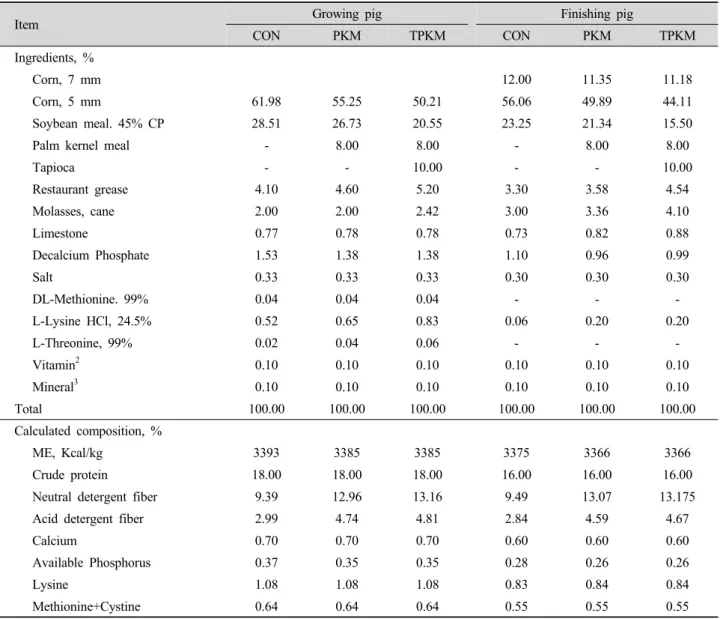
± 4.5 kg, were used in a 3-wk trial. In Exp. 2, 120 crossbred finishing pigs [(Yorkshire × Landrace) × Duroc], 108 d of age, with a BW of 52.6 ± 4.2 kg, were used in a 10-wk trial. Growing and finishing pigs were allotted randomly to three experimental diets with ten replicate pens with four pigs per pen (two males, two females). Dietary treatments were: CON, a corn-soybean meal-based diet, PKM, 8% palm kernel meal, and TPKM, 8% palm kernel meal and 10% tapioca (Table 1).
All the diets were formulated to meet the nutrition requirement (NRC, 1998). Dietary Ca was assayed by atomic absorption spectrophotometry after wet ash procedures and P was determined by colorimetry. Amino acids content were measured using an amino acid analyzer (Beckman 6300, Beckman Coulter, Inc., Fullerton, California, U.S.A.) after 24-h 6 N-HCl hydrolysis at 110°C (AOAC, 2012). Energy was determined by using a Parr 6100 oxygen bomb calorimeter (Parr instrument Co., Moline, Illinois, U.S.A.). All the pigs were housed in an environmentally controlled room with a slatted plastic floor. Each pen (1.8 m wide × 1.8 m long) was equipped with a one-sided self-feeder and a water
nipple to allow the pig ad libitum access to feed and water throughout the experiment.
Dried PKM and tapioca were soaked in distilled water (50% moisture contents for PKM and 45% for tapioca) for 1h. Hydrated PKM and tapioca were then cooked in a steam tank at 60 – 70°C for 1h. Thereafter, cooked PKM and tapioca cooled to 25°C. The PKM and tapioca were ground in a hammer mill and refrigerated (4°C) until there were mixed in the experimental diets.
Individual pig BW and feed intake per pen was determined at the beginning and end in Exp. 1 (28 d) and biweekly in Exp. 2. Feed consumption was recorded on a pen basis during the experiment. At the end of the experiment, all the pigs were transferred to the slaughter house and treated with conventional pro- cedures. Back fat thickness, muscle percentage, and lean ratio measurements were performed using a real- time ultrasound instrument (Piglot 105, SFK Technology, Herlev, Denmark). Carcasses were chilled at 2°C for 24 h and a piece of the right loin was taken through a perpendicular cut between the 10th and 11th ribs.
Before the meat quality evaluation, meat samples were thawed at ambient temperature. The color meas- urement of lightness (L*), redness (a*), and yellowness (b*) values were determined with a Minolta CR410 chromameter (Konica Minolta Sensing, Inc., Osaka, Japan). Sensory evaluation (color, marbling, and firmness scores) was evaluated according to the National Pork Producers Council standards (NPPC, 1991). At the same time, duplicate pH values of each sample were measured with a pH meter (Fisher Scientific, Pittsburgh, PA, USA). The water-holding capacity (WHC) was measured according to previous report (Kauffman et al., 1986). Briefly, a 0.2 g sample was pressed at 3000 psi for 3 min on a 125-mm-diameter filter paper. The areas of the pressed sample and expressed moisture were delineated and then determined with a digitizing area-line sensor (MT-10S, M.T.
Precision Co. Ltd., Tokyo, Japan). The ratio of
Table 1. Basal diet composition (as-fed basis)
1.
Item Growing pig Finishing pig
CON PKM TPKM CON PKM TPKM
Ingredients, %
Corn, 7 mm 12.00 11.35 11.18
Corn, 5 mm 61.98 55.25 50.21 56.06 49.89 44.11
Soybean meal. 45% CP 28.51 26.73 20.55 23.25 21.34 15.50
Palm kernel meal - 8.00 8.00 - 8.00 8.00
Tapioca - - 10.00 - - 10.00
Restaurant grease 4.10 4.60 5.20 3.30 3.58 4.54
Molasses, cane 2.00 2.00 2.42 3.00 3.36 4.10
Limestone 0.77 0.78 0.78 0.73 0.82 0.88
Decalcium Phosphate 1.53 1.38 1.38 1.10 0.96 0.99
Salt 0.33 0.33 0.33 0.30 0.30 0.30
DL-Methionine. 99% 0.04 0.04 0.04 - - -
L-Lysine HCl, 24.5% 0.52 0.65 0.83 0.06 0.20 0.20
L-Threonine, 99% 0.02 0.04 0.06 - - -
Vitamin
20.10 0.10 0.10 0.10 0.10 0.10
Mineral
30.10 0.10 0.10 0.10 0.10 0.10
Total 100.00 100.00 100.00 100.00 100.00 100.00
Calculated composition, %
ME, Kcal/kg 3393 3385 3385 3375 3366 3366
Crude protein 18.00 18.00 18.00 16.00 16.00 16.00
Neutral detergent fiber 9.39 12.96 13.16 9.49 13.07 13.175
Acid detergent fiber 2.99 4.74 4.81 2.84 4.59 4.67
Calcium 0.70 0.70 0.70 0.60 0.60 0.60
Available Phosphorus 0.37 0.35 0.35 0.28 0.26 0.26
Lysine 1.08 1.08 1.08 0.83 0.84 0.84
Methionine+Cystine 0.64 0.64 0.64 0.55 0.55 0.55
1
Abbreviation: CON, corn-soybean meal based diet; PKM, 8% palm kernel meal; TPKM, 8% palm kernel meal with 10% tapioca.
2
Provided per kg of complete diet: vitamin A, 11,025 IU; vitamin D3, 1,103 IU; vitamin E, 44 IU; vitamin K, 4.4 mg; riboflavin, 8.3 mg; niacin, 50 mg; thiamine, 4 mg; pantothenic acid, 29 mg; choline, 166 mg; and vitamin B12, 33 μg
3
Provided per kg of complete diet: Cu, 12 mg; Zn, 85 mg; Mn, 8 mg; I, 0.28 mg; and Se, 0.15 mg.
water:meat areas was calculated, giving a measure of WHC (a smaller ratio indicates higher WHC). The loin muscle area (LMA) was measured by tracing the loin muscle surface at the 10th rib, which also used the above-mentioned digitizing area-line sensor. Drip loss was measured using a-2-g meat sample according to the plastic bag method (Honikel, 1998).
All data were subjected to statistical analyses as a randomized complete block design using the GLM procedure of the SAS software (SAS Institute, 1996),
with the pen as the experimental unit. Variability in the data was expressed as the pooled standard error (SE). A p value < 0.05 was considered to indicate statistical significance.
III. Results
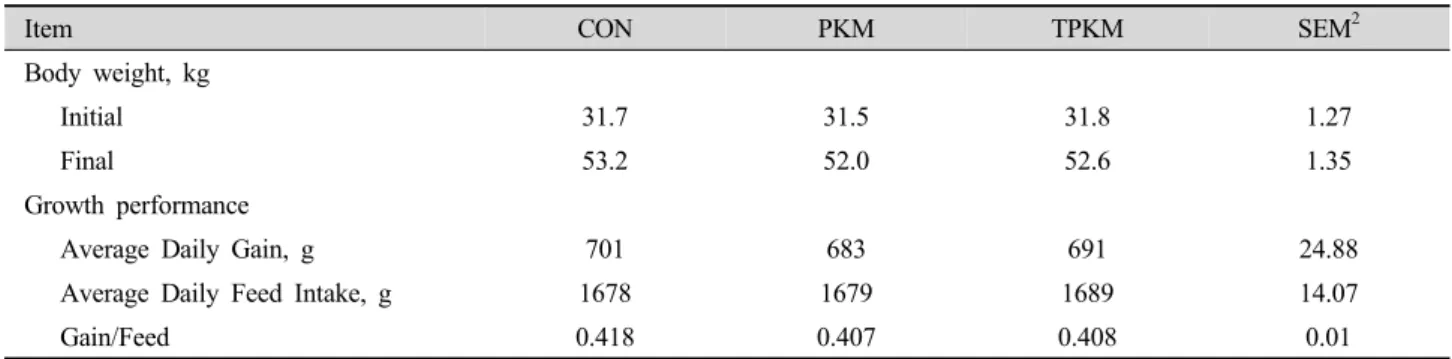
In experiment 1, no difference was observed in final
BW, ADG, ADFI, or G:F ratio among the dietary treat-
ments (Table 2). Back fat thickness and lean meat
Table 2. The effect of palm kernel meal with tapioca supplementation on growth performance in growing pig
1.
Item CON PKM TPKM SEM
2Body weight, kg
Initial 31.7 31.5 31.8 1.27
Final 53.2 52.0 52.6 1.35
Growth performance
Average Daily Gain, g 701 683 691 24.88
Average Daily Feed Intake, g 1678 1679 1689 14.07
Gain/Feed 0.418 0.407 0.408 0.01
1
Abbreviation: CON, corn-soybean meal based diet; PKM, 8% palm kernel meal; TPKM, 8% palm kernel meal with 10% tapioca.
2
Standard error of means.
Table 3. The effect of palm kernel meal with tapioca supplementation on back fat thickness and lean meat percentage in growing pig
1.
Item CON PKM TPKM SEM
2Back fat thickness, mm
Initial 7.8 7.9 7.75 0.21
Final 10.55 11.1 10.6 0.30
Lean meat percentage, %
Initial 62.06 61.615 62.15 0.25
Final 56.61 56.125 56.52 0.35
1
Abbreviation: CON, corn-soybean meal based diet; PKM, 8% palm kernel meal; TPKM, 8% palm kernel meal with 10% tapioca.
2
Standard error of means.
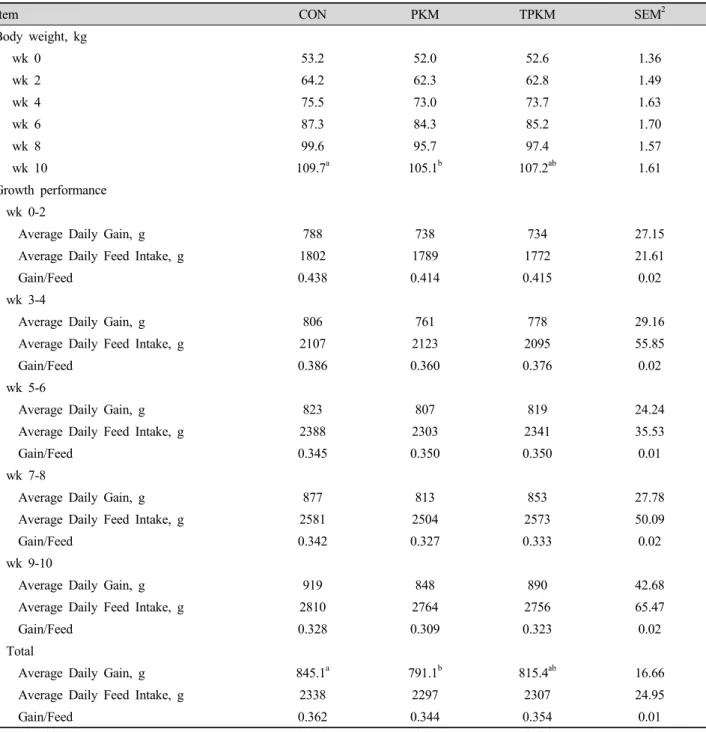
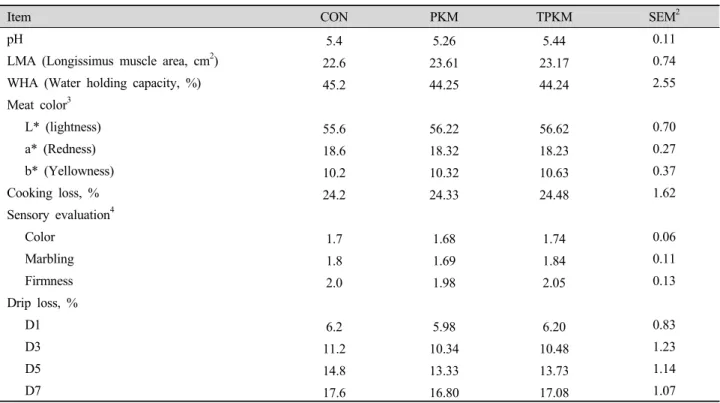
percentage showed no effect of PKM and PKM with tapioca supplementation during the entire experiment (Table 3). In experiment 2, finishing pigs fed PKM had lower BW at 10wk and total ADG compared those fed CON (P<0.05). However, finishing pigs fed with PKM with tapioca had no difference on growth performance (Table 4). No difference was observed in back fat thickness or lean meat percentage among the dietary treatments (Table 5). There are no differences on meat quality such as pH, LMA, WHA, meat color, marbling, firmness, and drip loss during the experimental period among the dietary treatments (Table 6).
IV. Discussion
Grains, such as soybean, wheat, and corn, are important feed ingredients for pigs and thus strongly influence the cost of animal production. Increasing demand for major grain meals has resulted in an increase in the
cost of pig diets (Laudadio and Tufarelli, 2010). Many attempts to replace major grain meals with lower cost ingredients have been made. By-products generally have been important feed components in animal diets to help reduce the cost of animal diets. Palm kernel meal, a by-product of palm oil, is an attractive in- gredient for pig diets, due to its low cost compared with ingredients such as maize grain and soybean.
However, despite its low cost, palm kernel meal has been used for ruminant feed, rather than pig feed, due to its high fiber content, low energy digestibility, and ME contents.
It is well known that growth performance is decreased
by supplementation with palm kernel meal in pig diets
(Rhule, 1996; Kim et al., 2001). Indeed, the inclusion
of palm kernel meal in pig diets tended to decrease
growth performance, likely attributable to the high
non-starch polysaccharide content, to the low
palatability of the meal, and its low amino acids and
Table 4. The effect of palm kernel meal with tapioca supplementation on growth performance in finishing pig
1.
Item CON PKM TPKM SEM
2Body weight, kg
wk 0 53.2 52.0 52.6 1.36
wk 2 64.2 62.3 62.8 1.49
wk 4 75.5 73.0 73.7 1.63
wk 6 87.3 84.3 85.2 1.70
wk 8 99.6 95.7 97.4 1.57
wk 10 109.7
a105.1
b107.2
ab1.61
Growth performance wk 0-2
Average Daily Gain, g 788 738 734 27.15
Average Daily Feed Intake, g 1802 1789 1772 21.61
Gain/Feed 0.438 0.414 0.415 0.02
wk 3-4
Average Daily Gain, g 806 761 778 29.16
Average Daily Feed Intake, g 2107 2123 2095 55.85
Gain/Feed 0.386 0.360 0.376 0.02
wk 5-6
Average Daily Gain, g 823 807 819 24.24
Average Daily Feed Intake, g 2388 2303 2341 35.53
Gain/Feed 0.345 0.350 0.350 0.01
wk 7-8
Average Daily Gain, g 877 813 853 27.78
Average Daily Feed Intake, g 2581 2504 2573 50.09
Gain/Feed 0.342 0.327 0.333 0.02
wk 9-10
Average Daily Gain, g 919 848 890 42.68
Average Daily Feed Intake, g 2810 2764 2756 65.47
Gain/Feed 0.328 0.309 0.323 0.02
Total
Average Daily Gain, g 845.1
a791.1
b815.4
ab16.66
Average Daily Feed Intake, g 2338 2297 2307 24.95
Gain/Feed 0.362 0.344 0.354 0.01
1
Abbreviation: CON, corn-soybean meal based diet; PKM, 8% palm kernel meal; TPKM, 8% palm kernel meal with 10% tapioca.
2
Standard error of means.
energy digestibility (Kim et al., 2001). To overcome the negative effects of palm kernel meal, we used palm kernel meal with tapioca meal in growing and finishing pig diets. In the present study, supple- mentation of palm kernel meal with tapioca had no effect on growth performance compared with only palm kernel meal supplementation in the growing and
finishing pigs. The tapioca is a starch extracted from
cassava root and used as energy source in pig diets
(Wu, 1991; Tzudir et al., 2012). It has been reported
that the tapioca consist of low saturated fat and
protein and high carbohydrates such as starch that
is better digested in pig compared to maize and can
be included in the diet of pigs up to a level of 50%
Table 5. The effect of palm kernel meal with tapioca supplementation on back fat thickness and lean meat percentage in finishing pig
1.
Item CON PKM TPKM SEM
2Back fat thickness, mm
wk 0 9.8 9.7 9.5 0.38
wk 2 11.6 11.4 11.4 0.32
wk 4 14.5 13.9 14.3 0.29
wk 6 16.0 16.0 16.3 0.36
wk 8 17.5 17.3 17.2 0.38
wk 10 20.9 20.7 21.0 0.39
Lean meat percentage, %
wk 0 63.9 63.6 64.1 0.59
wk 2 60.5 60.7 61.0 0.59
wk 4 57.1 58.3 57.4 0.65
wk 6 54.9 55.2 55.1 0.64
wk 8 52.7 52.8 52.9 0.56
wk 10 49.2 50.2 49.9 0.39
1
Abbreviation: CON, corn-soybean meal based diet; PKM, 8% palm kernel meal; TPKM, 8% palm kernel meal with 10% tapioca.
2
Standard error of means.
Table 6. The effect of palm kernel meal with tapioca supplementation on meat quality in finishing pig
1.
Item CON PKM TPKM SEM
2pH 5.4 5.26 5.44 0.11
LMA (Longissimus muscle area, cm
2) 22.6 23.61 23.17 0.74
WHA (Water holding capacity, %) 45.2 44.25 44.24 2.55
Meat color
3L* (lightness) 55.6 56.22 56.62 0.70
a* (Redness) 18.6 18.32 18.23 0.27
b* (Yellowness) 10.2 10.32 10.63 0.37
Cooking loss, % 24.2 24.33 24.48 1.62
Sensory evaluation
4Color 1.7 1.68 1.74 0.06
Marbling 1.8 1.69 1.84 0.11
Firmness 2.0 1.98 2.05 0.13
Drip loss, %
D1 6.2 5.98 6.20 0.83
D3 11.2 10.34 10.48 1.23
D5 14.8 13.33 13.73 1.14
D7 17.6 16.80 17.08 1.07
1
Abbreviation: CON, corn-soybean meal based diet; PKM, 8% palm kernel meal; TPKM, 8% palm kernel meal with 10% tapioca
2
Standard error of means.
3
Lightness: measure of lightness to darkness (a larger number indicates a lighter color); redness: measure of redness (a larger number indicates a more intense red color); and yellowness: measure of yellowness (a larger number indicates more yellow color).
4