Review Appl. Chem. Eng., Vol. 26, No. 3, June 2015, 247-250
http://dx.doi.org/10.14478/ace.2015.1061
247
OLED 조명을 위한 Yellow, Orange, Red 인광 재료
정효철⋅박영일*⋅김범진*⋅박종욱†
가톨릭대학교 화학화, *한국화학연구원 그린정밀화학연구센터 (2015년 5월 11일 접수)
Yellow, Orange, and Red Phosphorescent Materials for OLED Lightings
Hyocheol Jung, Young-Il Park*, Beomjin Kim*, and Jongwook Park†
Department of Chemistry, Catholic University of Korea, 43 Jibongro, Wonmigu, Bucheonsi, Gyenggido 420-743, Republic of Korea
*Research Center for Green Fine Chemicals, Korea Research Institute Technology, 45 Jonggaro, Junggu, Ulsan 681-802, Republic of Korea
(Received May 11, 2015)
초 록
유기 발광 다이오드(OLED)는 학문 및 산업 분야에서 많은 관심을 받아왔다. OLED는 기존에 사용되고 있는 광원들과 는 달리 면 발광, 친환경적인 에너지 사용, 대면적, 초경량, 그리고 초박형 등의 차별화된 특징을 가지고 있기 때문에 최근 조명 시장에서 많은 관심을 받고 있다. 게다가, OLED 조명은 LED 형광등을 대체할 수 있는 차세대 조명으로써 주목되고 있다. 본 논문에서는 white OLED (WOLED)에 적용되고 있는 대표적인 인광 발광 재료들을 소개하며, 특히 yellow, orange, red 인광 물질들의 화학구조와 소자효율을 정리하였다. 이러한 선행연구의 물질들을 이해하고 인광 물질들을 체계적으로 분류함으로써 새로운 발광 재료를 연구하고 개발함에 있어서 많은 도움이 되리라고 생각한다.
Abstract
Organic light-emitting diode (OLED) research field has received great attention from academic and industrial circles. Recently, The technical feature of OLEDs is more and more attractive in the lighting market, including area emission characteristics different from other existing light sources. Features are environmentally friendly and efficient use of energy, large area, ul- tra-light weight, and ultrathin shape, etc. Furthermore, OLED light became the mainstream of next-generation lighting to re- place the light emitting diode (LED) fluorescent light. This article summarizes phosphorescent emitting materials that have been applied to white OLEDs. In particular, the chemical structures and device performances of the important yellow, orange, and red phosphorescent emitting materials is discussed. Systematic classification and understanding of the phosphorescent ma- terials can aid the development of new light-emitting materials.
Keywords: OLED lightings, phosphorescence, yellow, orange, red
1. 서 론1)
유기 발광 다이오드(OLED)는 1987년에 Tang과 Vanslyke에 의해 연구되어진 이후에 산업 분야와 학술 분야에서 많은 관심을 받아왔다 [1]. 최근 유기 발광 다이오드는 MP3, PMP, 휴대전화 등 다양한 분야 에서 많은 응용과 개발이 이루어졌으며 유연성, 자체 발광, full-color emission, 저전압, 빠른 응답 속도[2-5]와 같은 장점을 활용하여 OLED TV와 OLED 조명에서도 많은 연구가 이루어지고 있다. 특히, OLED 조명은 기존의 광원과 달리 면 발광 특성을 가지고 있고, 에너지 절감 효과가 우수하며, 대면적, 초경량, 초박형의 특징을 가진 친환경적인
† Corresponding Author: Catholic University of Korea,
Department of Chemistry, 43 Jibongro, Wonmigu, Bucheonsi, Gyenggido 420-743, Republic of Korea
Tel: +82-2-2164-4821 e-mail: [email protected]
pISSN: 1225-0112 eISSN: 2288-4505 @ 2014 The Korean Society of Industrial and Engineering Chemistry. All rights reserved.
조명이다. OLED 조명은 기존의 형광등, 백열등을 대체할 차세대 조 명으로 그 활용분야와 연구의 중요성이 대두되고 있는 추세이다[6].
OLED 조명은 red, green, blue (RGB) 발광체를 이용한 three color white OLED (WOLED)[7,8,9]와 sky-blue, yellow나 orange 그리고 sky-blue, red를 이용한 two color WOLED가 기술적으로 가능하다. 특 히, OLED 조명 분야의 경우에는 display 분야와는 달리 높은 생산성 과 낮은 비용이 중요하기 때문에 상대적으로 소자 구조가 간단한 two color WOLED에 대한 연구가 더 집중적으로 이루어지고 있다. 또한, 일반적으로 유기 재료의 emission spectrum은 무기 재료의 emission spectrum보다 넓은 파장을 갖고 있기 때문에 sky-blue와 orange 혹은 sky-blue와 red의 두 color 조합만으로도 조명에 적용 가능한 높은 col- or rendering index (CRI)를 가지는 WOLED를 제작할 수 있다.
Two color WOLED에 적용되는 발광체는 형광 재료와 인광 재료로 분류할 수 있다. 형광 재료는 polycyclic aromatic hydrocarbons (PAHs) 으로 구성된 물질로 물질 자체의 안정성이 뛰어나 장수명 소자 제작 에 유리하지만, 단일항만을 사용하기 때문에 물질 자체의 최대 내부
248 정효철⋅박영일⋅김범진⋅박종욱
공업화학, 제 26 권 제 3 호, 2015
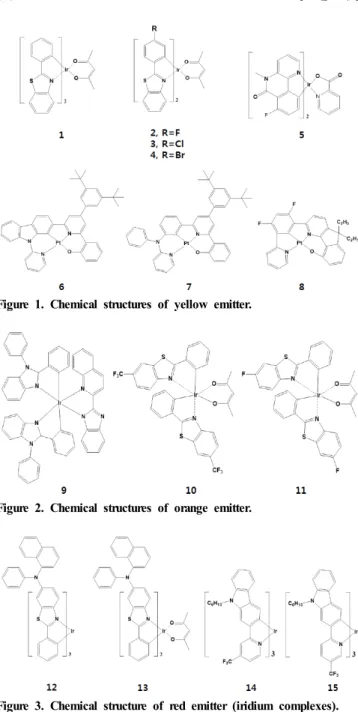
Figure 1. Chemical structures of yellow emitter.
Figure 2. Chemical structures of orange emitter.
Figure 3. Chemical structure of red emitter (iridium complexes).
양자 효율이 25%에 그친다. 인광 재료는 단일항과 삼중항을 둘 다 사 용할 수 있기 때문에, 100%의 내부 양자 효율을 얻을 수 있다고 이론 적으로 알려져 있다. Intersystem crossing을 통한 삼중항 여기자 har- vesting은 분자 내에 강한 spin-orbit coupling을 유도하는 heavy atom에 의해 효율적으로 일어나게 되는데, 일반적으로 iridium, platinum, os- mium 등을 이용한 전이 금속 복합체들로 많은 연구가 이루어져 왔다.
본 논문에서는 WOLED에서 sky-blue 재료와 함께 인광 구현을 위 해 사용되는 yellow, orange, red 도판트 재료들에 최근 연구동향을 살 펴보고자 한다.
2. OLED 조명을 위한 Yellow 발광체
2013년에 Dongge Ma와 Chuluo Yang 그룹은 새로운 iridium com- plex를 개발하였다[10]. 합성한 물질은 리간드에 할로겐 원소들(F, Cl,
Br)에 따라 optoelectronic property를 체계적으로 연구하였다. 합성한 물질은 할로겐 원소가 치환되지 않은 발광체 1의 경우 69.7 cd/A의 luminance efficiency (LE)와 69 lm/W의 power efficiency (PE)를 보인 데 반해 할로겐 원소가 치환된 Ir complex의 경우 PE가 55.9~83.2 lm/W의 범위를 보였다. 특히, F 원소가 치환된 발광체 2의 경우 International Commission on Illumination (CIE) (0.45, 0.53)의 yellow emission에서 76.8 cd/A의 LE와 83.2 lm/W의 PE로 할로겐 원소가 치 환되지 않은 발광체 1보다 향상된 소자 효율을 보였다.
2014년에 Jwo-Huei Jou 그룹은 습식 공정과 건식 공정으로 모두 제 작이 가능한 새로운 yellow emitting iridium complex를 개발하였다 [11]. 합성된 물질은 Figure 1에서 보는 바와 같이 2번 위치에 할로겐 원소를 F로 치환하여 자체 소광의 원인이 되는 molecular packing을 막아 71%의 높은 external quantum efficiency (EQE)를 나타내었다.
증착을 이용한 건식 공정의 경우 22.6%의 EQE와 75.1 lm/W의 PE로 높은 효율을 나타내었고, 소자를 spin coating 방식의 습식 공정으로 제작하였을 때 18.5%의 EQE와 52.3 lm/W의 PE로 습식 공정으로 제 작된 yellow 소자들 중 최고 효율을 보였다.
2013년에 Chi-Ming Che 그룹은 dianionic tetradentate 리간드를 가 지는 새로운 platinum(II) complex 유도체를 합성하였다[12]. 합성된 물질 중 발광체 6의 경우 양자 효율이 용액 상태에서 86%로 높은 효 율을 보였고, 소자로 제작하였을 때 ELmax 568 nm, CIE (0.52, 0.47)의 yellow emission에서 52 lm/W의 PE를 보였다. Firpic을 blue dopant로 하여 two color WOLED에 적용하였을 때 CIE (0.34, 0.44)와 61 lm/W 의 PE로 높은 효율을 보고하였다[13]. 이후 2014년에 기존 발표된 Pt(II) complex를 수정하여 Figure 1의 발광체 7, 8을 합성하였다. 발광 체 7의 경우 yellow emission으로 118 lm/W의 PE와 26%의 EQE로 매 우 높은 효율을 나타내었다. 또한, 발광체 8의 경우 단일 발광체로서 WOLED에 적용하여 CIE (0.38, 0.47)와 25.1%의 EQE를 나타내었다.
3. OLED 조명을 위한 Orange 발광체
2013년에 Wenfa Xie 그룹은 573 nm의 orange emission을 가지는 발 광체 9를 합성하였다[14]. 합성한 물질의 LE와 PE는 각각 20.2 cd/A, 23.6 lm/W로 높은 효율을 보였으며 CIE는 (0.53, 0.46)로 나타났다. 특 히, FIr6을 dopant로 사용하여 ITO/MoO3 (3 nm)/TAPC (30 nm)/TCTA 5 nm)/POAPF : 발광체 9 (7%) (6 nm)/POAPF : FIr6 (10%) (24 nm)/BmPyPhB (35 nm)/Liq (1 nm)/Mg : Ag 구조로 제작한 WOLED에 서 LE와 PE는 각각 22.1 cd/A, 25.5 lm/W를 나타냈다. Color rendering index (CRI)는 80으로 높은 수치를 보였으며, CIE는 (0.33, 0.36)으로 standard white emission에 가까운 결과를 보고하였다.
2011년에 Jiuyan Li 그룹은 2-phenylbenzothioazole을 리간드로 가 지는 새로운 iridium complex인 orange 발광 재료를 개발하였다[15].
발광체 10의 LE와 PE는 각각 76 cd/A, 45 lm/W로 매우 높은 효율을 보였으며 CIE는 (0.52, 0.47)로 나타났다. 게다가, blue emission 물질 인 Firpic을 이용하여 two color WOLED를 다음과 같은 구조로 제작 하였다. ITO/PEDOT : PSS (40 nm)/orange phosphor : CBP (1 wt%, 10 nm)/Firpic : CBP (10 wt%, 20 nm)/TPBI (45 nm)/LiF (1 nm)/Al.
이때, LE는 68.6 cd/A, EQE는 26.2%로 높은 효율을 보였으며, CIE (0.35, 0.44)로 나타났다.
OLED 조명을 위한 Yellow, Orange, Red 인광 재료 249
Appl. Chem. Eng., Vol. 26, No. 3, 2015 Figure 4. Chemical structure of red emitter (osmium and platinium
complexes).
4. OLED 조명을 위한 Red 발광체
2012년에 Jiuyan Li 그룹은 N-phenylnaphthyl이 치환된 2-phenyl- benzothiozole를 리간드로 사용하여 새로운 신규 iridium complex인 발 광체 12, 13을 합성하였다[16]. CBP를 host로 사용하고, 발광체 12와 발광체 13을 dopant로 하여 5% doping 소자를 제작하였다. 그 결과, 발 광체 12과 발광체 13의 device의 PE는 6.56, 7.38 lm/W, EQE 6.49, 8.73%로 매우 높은 효율을 나타냈다. 또한 CIE는 각각 (0.56, 0.44)와 (0.60, 0.40)로 red 영역에서의 emission을 보였다. ITO/PEDOT : PSS (40 nm)/발광체 13 (0.5 wt%) : Firpic (8 wt%) : CBP (60 nm)/TPBI (45 nm)/LiF (1 nm)/Al 구조로 WOLED 소자를 제작한 결과 PE는 5.49 lm/W, EQE는 4.9%를 보였고, CIE는 (0.33, 0.35)로서 real white emis- sion에 가까운 값을 얻었다.
2012년에 Martin R. Bryce 그룹은 carbazolyl pyridine 리간드를 기 반으로 한 다양한 새로운 Ir complex를 합성하였다[17]. 합성한 물질 중 발광체 14와 15의 경우 PLmax가 각각 637, 633 nm로 red 영역에서 emission을 보였다. 이를 용액 공정으로 간단한 소자(ITO/PEDOT : PSS-HIL 1.5 (60 nm)/PVK : PBD : Ir complex (90 nm)/Ba (4 nm)/Al (100 nm))에 적용한 결과, PE는 0.6~1.1 lm/W, EQE는 4.0∼5.8%로 높은 수치를 보였다.
앞에서 설명한 것처럼 red emission 인광 dopant는 높은 효율을 보 이는 Ir(piq)3(tris[1-phenylisoquinolinato-C2,N]iridium(III))과 같은 Ir complex가 많이 사용되었다[18]. 하지만 최근에 새로운 heavy metal 을 이용한 인광 red dopant 개발이 이루어지고 있다.
2012년에 Pi-Tai Chou 그룹은 3-(thiazol-2-yl), 3-(benzothiazol-2-yl), 3-(imidazol-2-yl) and 3-(benzimidazol-2-yl) azole chelate를 가지는 새 로운 발광체 16을 개발하였다[19]. Figure 4에 제시된 Os(II) complexe 들은 치환 그룹에 따라 green에서 red 영역까지 emission을 나타낸다.
특히, 발광체 16의 경우에는 ITO/PEDOT : PSS/VB-FNPD/TCTA : 발 광체 16/TPBi/CsF/Al의 소자 구조에 적용하여 CIE (0.63, 0.37)의 red emission 을 보였으며 LE와 PE는 각각 18.3 cd/A, 17.6 lm/W, EQE는 15.6%로 우수한 효율을 보였다.
2012년에 Hirohiko Fukagawa는 Figure 4에서 보는 바와 같이 red emission을 내는 신규 platinum complexe들을 합성하였다[20]. Bebq2
를 host로 사용하여 ITO/ND-1501 (30 nm)/α-NPD (50 nm)/Bebq2 : dopant (6 wt% doped, 35 nm)/ETM-143 (40 nm)/LiF (1 nm)/Al (100 nm) 구조로 소자를 제작하였다. 이때, 발광체 17과 발광체 18의 경우 각각 PE는 20.7, 25.2 lm/W, EQE 18.5, 18.2%로 기존에 Ir complex보 다 매우 높은 효율을 보였으며 CIE는 (0.66, 0.33), (0.65, 0.34)로 red 영역에서의 emission을 나타냈다. 또한, 소자 수명은 1000 cd/m2에서 8,200 h와 15,000 h로 높은 device 안정성을 보였다.
5. 결 론
WOLED는 산업과 학술 분야에서 가장 많은 관심을 받고 있는 연구 분야 중 하나이다. WOLED 기술이 적용되는 OLED 조명은 형광등과 백열등을 대체할 수 있는 차세대 조명으로써 상업화가 가능할 만큼의 소자 효율과 수명이 요구되고 있다. 오늘날 많은 연구진들은 고효율, 장수명의 특성을 가지는 OLED 조명을 구현하기 위해서 많은 노력을 하고 있다. 고효율, 장수명에 WOLED를 제작하기 위해서는 무엇보다 도 관련 재료 개발에 대한 체계적인 이해가 요구된다. 특히, 본 논문 에서는 WOLED에 sky-blue 또는 blue 재료와 함께 적용되는 인광 재 료들을 yellow, orange, red로 구분하여 정리하였으며, 각 재료들의 중 요한 화학적 구조와 그에 따른 소자 성능을 기반으로 분류 정리하였 다. 이러한 재료들의 체계적인 분류와 구조의 이해는 발광 재료의 연 구에 도움이 될 것으로 기대된다.
감 사
본 연구는 산업통상자원부 핵심소재원천기술개발사업의 연구비 지 원으로 수행되었습니다(과제번호 : 10050215).
References
1. C. W. Tang and S. A. Vanslyke, Organic electroluminescent di- odes, Appl. Phys. Lett., 51, 913-915 (1987).
2. Z. Shen, P. E. Burrows, V. Bulović, S. R. Forrest, and M. E.
Thompson, Three-color, tunable, organic light-emitting devices, Science, 276, 2009-2011 (1997).
3. S. R. Forrest, The road to high efficiency organic light emitting devices, Org. Electron., 4, 45-48 (2003).
4. A. R. Duggal, J. J. Shiang, C. M. Heller, and D. F. Foust, Organic light-emitting devices for illumination quality white light, Appl.
Phys. Lett., 80, 3470-3472 (2002).
5. B. W. D’Andrade and S. R. Forrest, White organic light-emitting devices for solid-state lighting, Adv. Mater., 16, 1585-1595 (2004).
6. C. P. Wang, M. H. Wu, H. W. Lin, H. C. Pan, B. H. Liu, and J. H. Jou, High-efficiency flexible white organic light-emitting di- odes, J. Mater. Chem., 20, 6626-6629 (2010).
7. Y. L. Chang, Y. Song, Z. Wang, M. G. Helander, J. Qiu, L. Chai, Z. Liu, G. D. Scholes, and Z. Lu, Highly efficient warm white or- ganic light-emitting diodes by triplet exciton conversion, Adv.
Funct. Mater., 23, 705-712 (2012).
8. S. Reineke, F. Lindner, G. Schwartz, N. Seidler, K. Walzer, B.
Lüssem, and K. Leo, White organic light-emitting diodes with flu- orescent tube efficiency, Nature, 459, 234-238 (2009).
9. M. Thomschke, S. Reineke, B. Lüssem, and K. Leo, Highly effi- cient white top-emitting organic light-emitting diodes comprising laminated microlens films, Nano Lett., 12, 424-428 (2012).
10. C. Fan, L. Zhu, B. Jiang, Y. Li, F. Zhao, D. Ma, J. Qin, and C.
Yang, High power efficiency yellow phosphorescent OLEDs by using new iridium complexes with halogen-substituted 2-phenyl- benzo[d]thiazole ligands, J. Phys. Chem. C, 117, 19134-19141 (2013).
11. J. H. Jou, Y. X. Lin, S. H. Peng, C. J. Li, Y. M. Yang, C. L.
Chin, J. J. Shyue, S. S. Sun, M. Lee, C. T. Chen, M. C. Liu, C.
C. Chen, G. Y. Chen, J. H. Wu, C. H. Li, C. F. Sung, M. J. Lee,
250 정효철⋅박영일⋅김범진⋅박종욱
공업화학, 제 26 권 제 3 호, 2015
and J. P. Hu, Highly efficient yellow organic light emitting diode with a novel wet- and dry-process feasible iridium complex emit- ter, Adv. Funct. Mater., 24, 555-562 (2014).
12. S. L. Lai, W. Y. Tong, S. C. F. Kui, M. Y. Chan, C. C. Kwok, and C. M. Che, Highly efficiency white organic Light emitting de- vices incorporating yellow phosphorescent platinium(Ⅱ) complex and composite blue host, Adv. Funct. Mater., 23, 5168-5176 (2013).
13. G. Cheng, S. C. F. Kui, W. H. Ang, M. Y. Ko, P. K. Chow, C.
L. Kwong, C. C. Kwok, C. Ma, X. Guan, K. H. Low, S. J. Su, and C. M. Che, Structurally robust phosphorescent [Pt(O^N^C^N)]
emitters for high performance organic light-emitting devices with power efficiency up to 126 lm W-1 and external quantum effi- ciency over 20%, Chem. Sci., 5, 4819-4830 (2014).
14. H. Cao, G. Shan, X. Wen, H. Sun, Z. Su, R. Zhong, W. Xie, P.
Lia, and D. Zhua, An orange iridium(Ⅲ) complex with wide-band- width in electroluminescence for fabrication of high-quality white organic lught-emitting diodes, J. Mater. Chem. C, 1, 7371-7379 (2013).
15. R. Wang, D. Liu, H. Ren, T. Zhang, H. Yin, G. Liu, and J. Li, Highly efficient orange and white organic light emitting diodes based on new orange iridium complexes, Adv. Mater., 23, 2823-2827 (2011).
16. R. Wang, D. Liu, R. Zhang, L. Deng, and J. Li, Solution-process-
able iridium complexes for efficient orange-red and white organic light-emitting diodes, J. Mater. Chem., 22, 1411-1417 (2012).
17. M. Tavasli, T. N. Moore, Y. Zheng, M. R. Bryce, M. A. Fox, G.
C. Griffiths, V. Jankus, H. A. Al-Attar, and A. P. Monkman, Colour tuning from green to red by substituent effects in phos- phorescent tris-cyclometalated iridium(Ⅲ) complexes of carba- zole-based ligands: synthetic, photophysical, computational and high efficiency OLED studies, J. Mater. Chem., 22, 6419-6428 (2012).
18. A. Tsuboyama, H. Iwawaki, M. Furugori, T. Mukaide, J. Kamatani, S. Igawa, T. Moriyama, S. Miura, T. Takiguchi, S. Okada, M.
Hoshino, and K. Ueno, Homoleptic cyclometalated iridium com- plexes with highly efficient red phosphorescence and application to organic light-emitting diode, J. Am. Chem. Soc., 125, 12971-12979 (2003).
19. B. S. Du, J. L. Liao, M. H. Huang, C. H. Lin, H. W. Lin, Y. Chi, H. A Pan, G. L. Fan, K. T. Wong, G. H. Lee, and P. T. Chou, Os(Ⅱ) based green to red phosphors: a great prospect for sol- ution-processed, highly efficient organic light-emitting diodes, Adv.
Funct. Mater., 22, 3491-3499 (2012).
20. H. Fukagawa, T. Shimizu, H. Hanashima, Y. Osada, M. Suzuki, and H. Fujikake, Highly efficient and stable red phosphorescent or- ganic light-emitting diodes using platinum complexes, Adv. Mater., 24, 5099-5103 (2012).