http://dx.doi.org/10.12925/jkocs.2017.34.1.101
Simple modification of anthracene for the blue emitting materials
Si Hyun Kim․Seung Hee Lee✝
Department of chemical system engineering, Hongik University, Sejong 2639, Korea (Received February 8, 2017; Revised February 15, 2017; Accepted March 28, 2017)
Abstract : Anthracene has been a motive molecule for the blue-emitting materials in OLED.
Since the blue emission needs big band gap between HOMO and LUMO, the blue-emitting materials are rare. In this paper, some anthracene derivatives containing simple aryl groups are synthesized and characterized. Regardless of the substituents the absorption and the emission bands are similar to each other and similar to the derivatives with the bulky silyl groups. The thermal and the CIE tests imply that among the tested 9-(2-naphthyl)-10-phenylanthracene is most promising for the diode. The material for the emission layer has to be investigated, which is simple to be prepared as well as good in the electrical and the thermal properties.
Keywords : deep-blue emission, anthracene, synthesis, OLED, excimer
1. Introduction
Since Tang et.al. have reported the possibility of a flat panel display, OLED, a lot of materials and systems have been studied and developed [1-3]. There must be many layers like hole transporting, electron transporting, hole blocking, electron blocking, and emission layers in order to composit the diodes. Full color display essentially needs red, green, and blue color emitting materials. While the red and the green color emitting materials have shown sufficient efficiency and life time for OLED, the blue color emitting materials have not shown the satisfactory data yet, due to the wide band gap. Therefore, the research of the blue color emitting materials has aimed
✝Corresponding author (E-mail:[email protected])
to the longer life time and the purer color emission [4-6]. The blue emitting materials have been studied such as carbazole (λem:344 nm) [7], fluorathene (368 nm) [8], fluorene (415 nm) [9], and anthracene (396 nm) [10,11]. Some blue color emitting materials are synthesized including anthracene as a backbone because of brightly emitting characteristics by itself.
Since the hydrogen of anthracene are labile at the 9- and 10-positions they would be substituted more easily than the other ones [12]. Therefore, the derivatives of anthracene could be the good candidates for the blue color emitting material due to the color fidelity as well as the simple preparation.
2. Experimental details 2.1. Materials
9,10-Dibromoanthracene, phenyl boronic acid, p-tolyl boronic acid, 4-(trifluoromethyl) phenyl boronic acid, 1-naphthyl boronic acid, 2-naphthyl boronic acid, tetrakis (triphenylphosphine)palladium were purchased from Sigma Aldrich Korea Co.
2.2. Synthesis and characterization
Suzuki cross coupling reaction has been applied throughout all the procedure under N2.
1H- and 13C- NMR were measured on JNM-Lambda series Zeol Co in CDCl3. Low resolution mass spectroscopy were measured by 5973N Mass selective detector. Elemental analysis was carried out on a FLASH EA-2000 Thermo scientific Co.
2.2.1. 9-bromo-10-phenylanthracene (BPA, 1)
9,10-Dibromoanthracene (2.98 mmol) and phenyl boronic acid (2.98 mmol) were mixed in THF. 2 M K2CO3 aqueous solution (50 ml) and tetrakis(triphenylphosphine)palladium (0.1 mmol) were added to the mixture. The resultant solution was refluxed for 8hr at 6 0℃. After cooling, the mixture was worked up, purified by column chromatography, and recrystallized in methanol to get yellow solid (58%). 1H-NMR (CDCl3); 8.54 (d, 2H), 7.52 (m. 7H), 7.31 (m, 4H); 13C-NMR (CDCl3);
138.3, 137.7, 131.1, 131.0, 130.19, 128.4, 127.8, 127.7, 127.3, 126.9, 125.5, 122.7.
2.2.2. 9,10-diphenylanthracene (DPA, 2) Phenyl boronic acid (2.98 mmol) was added to BPA (1). The synthetic procedure was similar to the one of 1. Yellow solid (87%) was obtained. 1H-NMR (CDCl3); 7.62 (m, 4H), 7.52 (m. 6H), 7.42 (m, 4H), 7.26 (m, 4H); 13C-NMR (CDCl3); 139.0, 137.0, 131.3, 129.8, 128.4, 127.4, 126.9, 124.9.
2.2.3. 9-(1-naphthyl)-10-phenylanthracene (1-NPA, 3)
The synthetic procedure of 1-NPA (3) was similar to the one of 1 except 1-naphthyl boronic acid (2.98 mmol) instead of phenyl boronic acid. Yellow solid (83%) was obtained. 1H-NMR (CDCl3); 7.97 (m, 2H), 7.65 (m. 3H), 7.51 (m, 6H), 7.39 (t, 3H), 7.25 (m, 2H), 7.18~7.09 (m, 4H); 13C-NMR (CDCl3); 139.0, 137.4, 136.7, 134.9, 133.6, 133.5, 131.3, 130.6, 129.8, 128.4, 128.2, 128.1, 127.4, 126.6, 126.2, 125.9, 125.5, 127.0, 125.1, 125.0.
2.2.4. 9-(2-naphthyl)-10-phenylanthracene (2-NPA, 4)
The synthetic procedure of 2-NPA (4) was similar to the one of 3 except 2-naphthyl boronic acid (2.98 mmol) instead of 1-naphthyl boronic acid to get white solid (87%). 1H-NMR (CDCl3); 7.98 (m, 4H), 7.70 (m, 4H), 7.59 (m, 6H), 7.49 (t, 2H), 7.35~7.26 (m, 4H); 13C-NMR (CDCl3);
139.0, 137.2, 136.8, 136.6, 133.4, 132.7, 131.3, 130.2, 130.0, 129.9, 129.5, 128.4, 128.0, 127.9, 127.4, 127.0, 126.4, 126.2, 125.0; MS: m/z 380 (M+ for C26H20); Anal calcd for C26H20; C, 94.7; H, 5.3. Found: C, 94.0; H, 5.3.
2.2.5. 9-phenyl-10-(p-tolyl)anthracene (PTA, 5)
The synthetic procedure of PTA (5) was similar to the one of 2 except p-tolyl boronic acid (2.98 mmol) to get yellow solid (95%).
1H-NMR (CDCl3); 7.68(m, 4H), 7.53(m, 4H), 7.39(t, 4H), 7.34~7.27(m, 4H), 2.53(s, 3H);
13C-NMR (CDCl3); 139.1, 137.2, 137.0, 136.9, 135.9, 131.3, 131.1, 129.9, 129.8, 129.1, 128.3, 127.4, 127.0, 126.9, 124.9, 124.8, 21.5; MS: m/z 344(M+ for C27H20);
Anal calcd for C27H20; C, 94.1; H, 5.9.
Found: C, 92.7; H, 5.80.
X = H, CH3, CF3
B(OH)2
Br Br
K2CO3, THF Pd(PPh3)4 B(OH)2
B(OH)2
Br
Br
Br
B(OH)2
X K2CO3, THF
Pd(PPh3)4
(2), (5), (8)
(3), (6), (9)
(4), (7), (10)
Scheme 1. Synthetic routes of compounds 2~10. 2.2.6. 9-(1-naphthyl)-10-(p-tolyl)
anthracene (1-NTA, 6)
The synthetic procedure of 1-NTA (6) was similar to the one of 3 except p-tolyl boronic acid (2.98 mmol) to get a yellow solid (91%). 1H-NMR (CDCl3); 8.02 (m, 2H), 7.77~7.66 (m, 3H) 7.55 (d, 1H), 7.49~7.38 (m, 7H), 7.29 (m, 2H), 7.18 (m, 4H), 2.54 (s, 3H); 13C-NMR (CDCl3); 137.5, 137.1, 136.8, 135.9, 134.8, 133.6, 133.5, 131.2, 130.6, 130.0, 129.2, 129.1, 128.2, 128.0, 127.1, 127.0, 126.6, 126.2, 125.9, 125.5, 125.1, 124.9, 21.4; MS: m/z 394 (M+ for C31H22);
Anal calcd for C31H22; C, 94.4; H, 5.6.
Found: C, 93.6; H, 5.7.
2.2.7. 9-(2-naphthyl)-10-(p-tolyl) anthracene (2-NTA, 7)
The synthetic procedure of 1-NTA (7) was similar to the one of 4 except p-tolyl boronic acid (2.98 mmol) to get white solid (92%).
1H-NMR (CDCl3); 7.93 (m, 4H), 7.66 (m, 4H), 7.54 (m, 3H), 7.30 (m, 8H), 2.49 (s, 3H); 13C-NMR (CDCl3); 137.3, 137.0, 136.6, 135.9, 133.3, 132.7, 131.1, 130.2, 130.0, 129.9, 129.5, 129.1, 128.0, 127.9, 127.8, 127.1, 126.9, 126.3, 126.1, 125.0, 124.9, 21.5;
MS: m/z 394 (M+ for C31H22); Anal calcd for C31H22; C, 94.4; H, 5.6. Found: C, 91.9; H, 5.5.
2.2.8. 9-phenyl-10-(4-(trifluoromethyl) phenyl)anthracene (PFTA, 8)
The synthetic procedure of PFTA (8) was similar to the one of 5 except 4-(trifluoromethyl)phenyl boronic acid (2.98 mmol) to get white solid (82.7%). 1H-NMR (CDCl3); 7.86 (d, 2H), 7.69 (m, 2H), 7.62~7.54 (m, 7H), 7.46 (t, 2H), 7.34 (m, 4H); 13C-NMR (CDCl3); 138.7, 137.6, 135.1, 131.7, 131.2, 129.7, 129.5, 128.4, 127.5, 127.1, 126.3, 125.4, 125.1; MS: m/z 398 (M+ for C27H17F3); Anal calcd for C27H17F3; C, 81.4; H, 4.30. Found: C, 79.7; H, 4.27.
2.2.9. 9-(1-naphthyl)-10-(4-(trifluoromethyl) phenyl)anthracene (1-NFTA, 9)
The synthetic procedure of 1-NFTA (9) was similar to the one of 6 except 4-trifluoromethylphenyl boronic acid (2.98 mmol) to get white solid (91.4%). 1H-NMR (CDCl3); 8.04 (m, 2H), 7.89 (t, 2H), 7.66 (m, 5H), 7.49 (m, 4H), 7.36~7.31 (m, 2H), 7.21 (m, 3H), 7.13 (d, 1H); 13C-NMR (CDCl3);
136.4, 135.8, 133.4, 131.8, 131.7, 130.8, 130.5, 129.6, 129.1, 128.7, 128.2, 128.2, 127.8, 127.7, 127.2, 126.5, 126.4, 126.3, 126.0, 125.9, 125.5, 125.2; MS: m/z 448 (M+ for C31H19F3); Anal calcd for C31H19F3; C, 83.0; H, 4.3. Found: C, 80.6; H, 4.39.
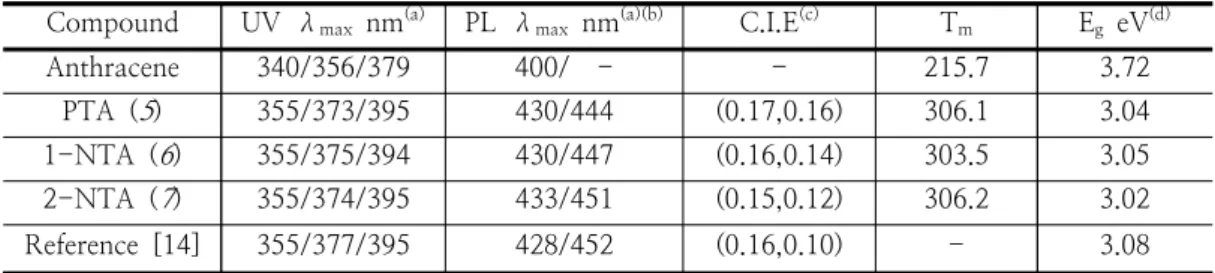
Compound UV λmax nm(a) PL λmax nm(a)(b) C.I.E(c) Tm Eg eV(d)
Anthracene 340/356/379 400/ - - 215.7 3.72
PTA (5) 355/373/395 430/444 (0.17,0.16) 306.1 3.04
1-NTA (6) 355/375/394 430/447 (0.16,0.14) 303.5 3.05
2-NTA (7) 355/374/395 433/451 (0.15,0.12) 306.2 3.02
Reference [14] 355/377/395 428/452 (0.16,0.10) - 3.08
(a) In Cyclohexane. (b) Solid PL emission. (c) At 6V. (d) Energy level measured by absorption edge [16]
Table 1. Spectral and physical properties of compounds.
2.2.10. 9-(2-naphthyl)-10-(4-(trifluoromethyl) phenyl)anthracene (2-NFTA, 10) The synthetic procedure of 2-NFTA (10) was similar to the one of 7 except 4-(trifluoromethyl)phenyl boronic acid (2.976 mmol) to get white solid (90%). 1H-NMR (CDCl3); 8.04 (m, 2H), 7.91 (m, 4H), 7.72 (d, 2H), 7.61 (m, 7H), 7.37~7.28 (m, 4H);
13C-NMR (CDCl3); 133.4, 133.3, 132.7, 131.7, 130.1, 129.9, 129.6, 129.3, 128.0, 127.9, 126.4, 126.3, 126.2, 125.5, 125.2; MS:
m/z 448 (M+ for C31H19F3); Anal calcd for C31H19F3; C, 83.0; H, 4.3. Found: C, 81.7;
H, 4.2.
2.3. Physical measurements
Absorption and Florescence spectra were measured in cyclohexane using Evolution 60s and Cary Eclipse respectively.
Thermogravimetric analysis was conducted using N-1000 system at a heating rate of 10℃/min from 25 to 500℃.
3. Results and discussion The general synthetic route to the nine compounds are shown in Scheme 1, applying Suzuki Cross Coupling reactions.
Commercialized BPA (1), DPA (2), 1-NPA (3), 2-NPA (4) have been synthesized.
The naphthyl group substitution of anthracene prior to the phenyl group results in better yield than the reverse (phenyl
substitution prior to the naphthyl) by 58% vs.
83%.
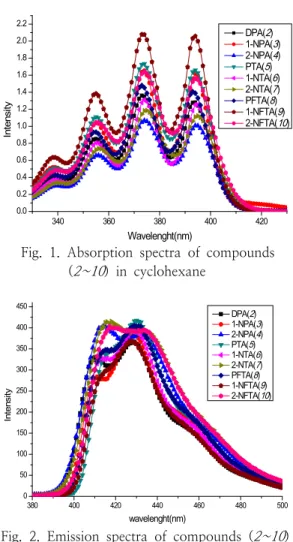
The UV-vis absorption spectra are shown in Figure 1 and summarized in Table 1. Three major bands of anthracene (λmax; 340 nm, 356 nm, 379 nm) are bathochromic-shifted in all the compounds (2~10).
The PL spectra are shown in Fig 2. and summarized in table 1. The emission bands of all the compounds have three bands similar to anthracene. However intensity ratios are different depending on the substituents. The ones with 2-naphthyl group have stronger emission in higher energy (~430 nm) than with phenyl or 1-naphthyl, which result in deeper blue emission referred from C.I.E. data (Table 2), regardless of the substituents at the other side: comparing the compounds of 2, 5, 8 and 3, 6, 9 with 4, 7, 10.
As concentrated, the PL bands of the solution are shifted to the longer wavelength indicating existence of the excimer (Figure 3).
The melting points of the compounds (303~333℃) implicate thermal stability in OLED [13].
The C.I.E data shown in Table 2 suggest all the compounds are suitable for the blue emitters. 2-Naphthyl derivatives shows deeper blue than the other ones, even the derivative with a triphenylsilane [14].
substituents phenyl 1-naphthyl 2-naphthyl phenyl 2 (0.163, 0.150) 3 (0.157, 0.130) 4 (0.156, 0.111) p-tolyl 5 (0.173, 0.169) 6 (0.162, 0.146) 7 (0.158, 0.128) p-(trimethyl)phenyl 8 (0.167, 0.230) 9 (0.173, 0.204) 10 (0.172, 0.185) Table 2. C.I.E. data of anthracene derivatives 2~10.
340 360 380 400 420
0.0 0.2 0.4 0.6 0.8 1.0 1.2 1.4 1.6 1.8 2.0 2.2
Intensity
Wavelenght(nm)
DPA(2) 1-NPA(3) 2-NPA(4) PTA(5) 1-NTA(6) 2-NTA(7) PFTA(8) 1-NFTA(9) 2-NFTA(10)
Fig. 1. Absorption spectra of compounds (2~10) in cyclohexane
380 400 420 440 460 480 500
0 50 100 150 200 250 300 350 400 450
Intensity
wavelenght(nm)
DPA(2) 1-NPA(3) 2-NPA(4) PTA(5) 1-NTA(6) 2-NTA(7) PFTA(8) 1-NFTA(9) 2-NFTA(10)
Fig. 2. Emission spectra of compounds (2~10) in cyclohexane.
Molecular orbitals of all the compounds have been checked. They are similar to the other anthracene derivatives [14,15], not co-planar between anthracene and side aryl groups. The aryl substituents contribute little to the orbitals of anthracene. The dihedral angle between anthracene and 2-naphthyl is the largest among them.
Band gap energy (Eg) of compounds have
been calculated from UV-vis spectrum in Fig 1. There seems to show little variation throughout the derivatives.
380 400 420 440 460 480 500 520
0 50 100 150 200 250 300 350 400 450
Intensity
Wavelength(nm)
0.002M 0.004M 0.0002M 0.00004M
Fig. 3. PL spectra of 2-NTA in different concentrations (10 ~10 M)
4. Conclusion
Some anthracene derivatives with aryl groups are prepared for the blue emitting materials in OLED. Molecular modeling shows that the HOMO and LUMO of those molecules are mostly focused at the anthracene rather than the substituents. Absorption and emission spectra bands of the compounds are similar to each other, irrelevant to the substituents. The emission bands of solid state as well as of the concentrated solution are red-shifted by about 20nm implying that the excimer is produced.
According to preliminary test of OLED, all the compounds in this paper are suitable for device. In particular, 2-NTA (7) is most promising than the others. In conclusion, anthracene derivatives are surely blue emitting regardless to the substituents. Even simple
derivatives show deep-blue emission and thermal stability. The electric properties for the OLED application are under investigation.
Acknowledgment
This research was supported by the Hongik university.
References
1. C. W. Tang, and S. A. VanSlyke, Organic eletroluminescent diodes, J. App. Phys., 51(12), 913 (1987).
2. T. Fuhrmann, and J. Salbeck, Organic Materials for Photonic Devices, MRS Bull., 28, 354 (2003).
3. K. Mori, Y. Sakaguchi, Y. Iketsu, and J.
Suzuki, Full-color passive-matrix organic EL displays, Display. 22, 43-47 (2001).
4. S. J. Cha, N. S. Han, J. K. Song, S. R.
Park, Y. M. Jeon, and M. C. Suh, Efficient deep blue fluorescent emitter showing high external quantum efficiency, Dyes and Pigments. 120, 200-207 (2015).
5. J. Y. Hu, Y. J. Pu, F. Satoh, S. Kawata, H. Katagiri, H. Sasabe, and J. Kido, Bisanthracne-Based Donor-Acceptor-type Light-Emitting Dopants: Highly Efficient Deep-Blue Emission in Organic Lught-Emitting Devices, Adv. Funct.
Mater., 24, 2064-2071 (2014).
6. S. O. Kim, K. H. Lee, S. W. Kang, J. Y.
Seo, Y. K. Kim. S. and S. Yoon, Highly Efficient Blue-Light-Emitting Diodes Based on Styrylamine Derivatives End-capped with a Diphenylvinyl Group, Bull. Korean Chem Soc., 31(2), 389 (2010).
7. P. Kundu, K. R. Justin Thomas, J. T. Lin, Y. T. Tao, and C. H. Chien, High-T
Carbazole Derivatives as Blue-Emitting Hole-Transporting Materials for Electroluminescent Devices, Adv. Funct.
Mater., 13(6), 445-452 (2003).
8. R. C. Chiechi, R. J. Tseng, F. Marchioni, Y. Yang, and F. Wudl, Efficient Blue-Light-Emitting Electroluminescent Devices with a Robust Fluorphore:
7,8,10-Triphenylfluoranthene, Adv. Funct.
Mater., 18, 325-328 (2006).
9. S. Tao, Z. Peng, X. Zhang, P. Wang, C.
S. Lee, and S. T. Lee, Highly Efficient Non-Doped Blue Organic Light-Emitting Diodes Based on Fluorene Derivatives with High Thermal Stability, Adv. Funct.
Mater., 15, 1716-1721 (2005).
10. O. Cakmak, R. Erenler, A. Tutar, and N.
J. Celik, Synthesis of New Anthracene Derivatives, J. Org. Chem., 71, 1795-1801 (2006).
11. A. Touhami, R. B. Chaabane, and A. R.
Allouche, Theoretical investigation on electronic, optical, and charge transport properties of new anthracene derivatives, J.
Comptc., 9, 123-130 (2015).
12. Y. C. Chang, S. C. Yeh, Y. H. Chen, C.
T. Chen, R. H. Lee, and R. T. Jeng, New carbazole-substituted anthracene derivatives based non-doped blue light-emitting devices with high brightness and efficiency, Dyes and Pigments, 99, 577-587 (2013).
13. J. Wang, X. Lou, Y. Liu, G. Zhao, A.
Islam, S. Wang, and Z. Ge, Controllable molecular configuration for significant improvement of blue OLEDs based on novel twisted anthracene derivatives, Dyes and Pigments, 118, 137-144 (2015).
14. J. Y. Song, S. B. Lee, S. J. Lee, Y. K.
Kim, and S. S. Yoon, Organic light-emitting diodes based on 9-(2-naphtyl)anthracene derivatives with a triphenylsilane unit as the deep-blue emitting layer, Thin Solid Films, 577, 42-48 (2015).
15. H. W. Lee, H. J. Kim, S. Y. Kim, J. Kim, S. E. Lee, H. W. Lee, Y. K. Kim, and S.
S. Yoon, Emitting materials based on phenylanthracene-substituted naphthalene derivatives for organic light-emitting diodes, J. Luminescence, 165, 99-104
(2015).
16. J. H. Kim, and H. S. Lee, Measurement of Physical Properties of Conducting Polymers, Polymer Sci. Techn., 18, No. 5 (2007).