Abstract
We have synthesized and demonstrated a red emission in Organic Light Emitting Diodes (OLEDs) using phosphorescent iridium(III) complexes based on the 2-phenylpyridine ligands with electron-withdrawing carbonyl groups. Among those, a device exhibited highly efficient red-orange emission with the luminance of 20460 cd/m2 at 12 V, the luminous efficiency of 22.0 cd/A at 20 mA/cm2, and the CIE
x,y coordinates of (x=0.560, y=0.439 ) at 10 V.
1. Introduction
Since Forrest and Thompson’s group reported the first example of electrophosphorescence at room temperature, phosphorescent materials have attracted much attention because of high external quantum efficiencies in their electroluminescence (EL) devices.1,2 The introduction of iridium(III) containing complexes led to very efficient multilayered OLEDs, reaching internal conversion efficiency of almost 100%.3 To fabricate highly efficient, red-emission
OLEDs, it is necessary to search for red-emissive metal complexes with large luminescence quantum yields. However, such a red-emissive complex is not easy to find because the luminescence quantum yield tends to decrease with increasing emission peak wavelength according to the energy gap law.4-6
Generally, the emission wavelength of an iridium(III)-ppy complex is red-shifted when an electron-donating group is introduced to the phenyl moiety of ppy, the π-conjugation length of the ligand is expended or an electron-withdrawing group is added to the pyridyl moiety of ppy.7 In this paper, a series of red
phosphorescent iridium(III) complexes, based on the 2-phenylpyridine ligands with carbonyl substituents such as acetyl, benzoyl, and isobutyl groups, were synthesized and their photophysical and electrophosphorescent properties were investigated
2. Experimental
2.1. Synthesis and characterization
All reactions were performed under N2. Solvents
were carefully dried and distilled from appropriate drying agents prior to use. 1H-nuclear magnetic resonance (NMR) and 13C-NMR spectra were obtained using a Varian (Unity Inova 300Nb) or Varian (Unity Inova 500NB) spectrometer at 300 MHz and 500 MHz, respectively. Low- and high-resolution mass spectra were recorded using a Jeol JMS-AX505WA spectrometer in FAB mode. UV-vis absorption spectra were measured on a Shimadzu UV-1650PC spectrometer. Photoluminescence (PL) spectra were obtained on an Aminco-Bowman series 2 luminescence spectrometer. The UV-vis and PL spectra of the iridium complexes were measured in a 10-5 M dilute CH
2Cl2 solution.
General procedure for the synthesis of IrIII
complexes. L1 (0.98 g, 2.2mmol) was dissolved in
2-ethoxyethanol (9 mL) in a 30 mL round-bottom flask. IrCl3·3H2O (0.30 g, 1.0 mmol) and water (3 mL) were
then added to the flask. The mixture was stirred under nitrogen at 120 for 24 h and cooled to room ℃ temperature. The precipitate formed in the mixture was collected and washed with methanol, hexane an
Phosphorescent Iridium(III) Complexes based on the ppy
Ligands Containing Electron-withdrawing Carbonyl
Groups
Kum Hee Lee
1, Jeong Keun Park
1, Jae Nam You
1, Ji Hyun Seo
2,
Young Kwan Kim
2*, Seung Soo Yoon
1*
1Dept. of Chemistry, Sungkyunkwan University, Suwon, Gyungi-do, Korea
Tel.:82-31-290-7071, E-mail: [email protected]
2Dept. of Information Display, Hongik University, Seoul, Korea
dried in vacuum to give the corresponding cyclometalated IrIII-µ-chloro-bridge dimmer. In a 20
mL flask, the dimmer complex, acetylacetone (1.5 mL, 1.5 mmol) and Na2CO3 (0.32 mg, 3.0 mmol) were
mixed with 2-ethoxyethanol (10 mL) and the mixture was heated at 100 for 6 h. After cool℃ ing to room temperature, the precipitation solid was collected by filtration, and washed with ethanol and hexane. The residue was dissolved in dichloromethane and the solid was filtered off. The solution was concentrated in vacuo and the residue was purified on a silica gel column using dichloromethane and hexane as eluent. The product was obtained after recrystallization from dichloromethane/ethanol. Similar procedures were also employed for the synthesis of other iridium complexes. The yields and spectral data of all iridium complexes are as follows.
(Acppy)2Ir(acac): The yield of Ir(Acppy)2(acac) was
0.63 g (46%) as a red solid. 1H-NMR (300 MHz, CDCl3): δ 9.06 (d, J = 2.0 Hz, 2H), 8.26 (dd, J = 2.0 Hz, 8.6 Hz, 2H), 7.93 (d, J = 8.7 Hz, 2H), 7.62 (d, J = 7.7 Hz, 2H), 6.88-6.83 (m, 2H), 6.76-6.70 (m, 2H), 6.28 (d, J = 7.7 Hz, 2H), 5.29 (s, 1H), 2.60 (s, 6H), 1.84 (s, 6H); 13C-NMR (125 MHz, CD 2Cl2): δ 194.5, 185.5, 172.2, 150.0, 149.3, 144.0, 137.0, 133.8, 130.9, 130.4, 125.8, 121.6, 118.4, 100.9, 28.5, 26.4; IR (KBr): 3047, 1686, 1596, 1576, 1516, 1389, 1256, 1055, 1027, 739 cm-1; FAB-MS (m/z): 684 [M+].
HRMS-FAB+ calcd for C
31H27IrN2O4 684.1600: found,
684.1585.
(Bzppy)2Ir(acac): The yield of (Bzppy)2Ir(acac)was
0.32 g (39%) as a red solid. 1H-NMR (300 MHz, CDCl3): δ 8.89 (d, J = 1.2 Hz, 2H), 8.30 (dd, J = 1.8 Hz, 8.4 Hz, 2H), 7.98 (d, J = 8.7 Hz, 2H), 7.83-7.80 (m, 4H), 7.65-7.58 (m, 4H) 7.53-7.48 (m, 4H), 6.86 (td, J = 1.2 Hz, 7.5 Hz, 2H), 6.74 (td, J = 1.5 Hz, 7.5 Hz, 2H), 6.30 (dd, J = 1.2 Hz, 7.8 Hz, 2H), 5.29 (s, 1H), 1.55 (s, 6H); 13C-NMR (125 MHz, CDCl 3): δ 192.9, 185.2, 172.5, 151.0, 150.6, 143.6, 138.8, 137.2, 133.7, 133.0, 130.8, 130.6, 130.1, 128.9, 125.9, 121.5, 118.4, 100.9, 28.8; IR (KBr): 3054, 2999, 1659, 1597, 1577, 1515, 1434, 1399, 1315, 1284, 1265, 947, 739, 712, 661 cm-1; APCI-MS (m/z): 808 [M+]. HRMS-FAB+ calcd for C41H31IrN2O4 808.1913: found,
808.1910.
(Ibppy)2Ir(acac): The yield of (Ibppy)2Ir(acac was
0.289 g (39%) as a red solid. 1H-NMR (300 MHz, CDCl3): δ 9.09 (d, J = 1.8 Hz, 2H), 8.28 (dd, J = 1.8 Hz, 8.4 Hz, 2H), 7.94 (d, J = 8.4 Hz, 2H), 7.63 (dd, J = 1.2 Hz, 8.4 Hz, 2H), 6.87-6.83 (m, 2H), 6.76-6.71 (m, 2H), 6.30 (d, J = 0.9 Hz, 7.8 Hz, 2H), 5.29 (s, 1H), 3.42 (m, 2H), 1.83 (s, 6H), 1.27 (d, J = 7.2 Hz, 12H); 13C-NMR (125 MHz, CDCl 3): δ 201.0, 185.3, 172.5, 150.4, 149.3, 143.7, 137.3, 133.7, 130.7, 129.2, 125.8, 121.5, 118.3, 100.9, 36.2, 28.9, 19.6, 18.8; IR (KBr): 3019, 2974, 1686, 1599, 1565, 1516, 1474, 1434, 1389, 1262, 1226, 1016, 992, 747, 670 cm-1; FAB-MS
MS (m/z): 740 [M+]. HRMS-FAB+ calcd for
C35H35IrN2O4 740.2226: found, 740.2222.
2.2. Devices fabricaion and characterization
For fabricating OLEDs, indium-tin-oxide (ITO) thin films coated on glass substrates were used, which was 30 Ω/square of the sheet resistivity, and 1000 Å of thickness. The ITO-coated glass was cleaned in an ultrasonic bath by the following sequence: acetone, methyl alcohol, distilled water, and stored in isopropyl alcohol for 48 h and dried by a N2 gas gun. The
substrates were treated by O2 plasma under 2.0 10ⅹ -2
torr at 125 W for 2 min.8 All organic materials and
metals were deposited under high vacuum (5 10ⅹ -7
torr). The organic materials were deposited in the following sequence: ITO/N,N'-diphenyl-N,N'-(1-napthyl)-(1,1'-phenyl)-4,4'-diamine(NPB) (650 Å) / Ir complexes doped in 4,4,N,N’-dicarbazolebiphenyl (CBP) (300 Å) /bathocuproine(BCP) (100 Å) / tris-(8-hydroxyquinoline)aluminum(Alq3) (250 Å)/ (lithium
quinolate (Liq) (20 Å) /Al (1000 Å). The typical organic deposition rate was 0.1 nm/sec. Finally, 100 nm of Al was deposited as a cathode. The active area of the OLEDs was 0.09 cm2. After the fabrication, the
current density–voltage (J-V) characteristics of the OLEDs were measured with a source measure unit (Kiethley 236). The luminance and CIE chromaticity coordinates of the fabricated devices were measured using a chromameter (MINOLTA CS-100A). All measurements were performed in ambient conditions under DC voltage bias.
3. Results and discussion
The ligands used in the preparation of the complexes were based on substituted 2-phenylpyridine. The ligands were synthesized by the Suzuki reaction with moderated yield. The Ir(III) complexes were obtained by cyclometallation of the ligands with IrCl3 and
subsequent with acetylacetone.9 The complexes are
shown in Fig. 1 and new complexes obtained were characterized by 1H-NMR, 13C-NMR, IR, and
high-resolution mass spectroscopy.
The UV-vis and PL spectra of Ir complexes in air equilibrated CH2Cl2 solution are shown in Fig. 2 and
the data are summarized in Table 1. The strong absorption bands between 250 and 400 nm in the UV
TABLE 1. Optical properties of Ir complexes.
Compound Absorption (293 K) λabs [nm] [a] PL λ[nm] em FWHM [b] Ф[c] p [eV] [d]HOMO LUMO[eV]
Ir(Acppy)2(acac) 288(3.34), 298(3.33), 510(0.42) 603 83 0.42 -5.34 -3.09
Ir(Bzppy)2(acac) 2.67(4.14), 289 (4.31), 330 (4.30),523(0.20) 619 84 0.29 -5.28 -3.06
Ir(Ibppy)2(acac) 255 (3.03), 281 (3.09), 319 (3.16), 520 (0.41) 597 76 0.48 -5.34 -2.80
[a] measured in CH2Cl2 at a concentration of 10-5 M and molar extinction coefficient (ε) values (104 M-1 cm-1) are shown in parentheses. [b] Full width at half maximum. [c] degassed CH2Cl2 relative to fac-[Ir(ppy)3] (Фp = 0.40), λem = 400 nm. sh = shoulder. [d] The energy levels were measured with a low-energy photo-electron spectrometer (Riken-Keiki, AC-2).
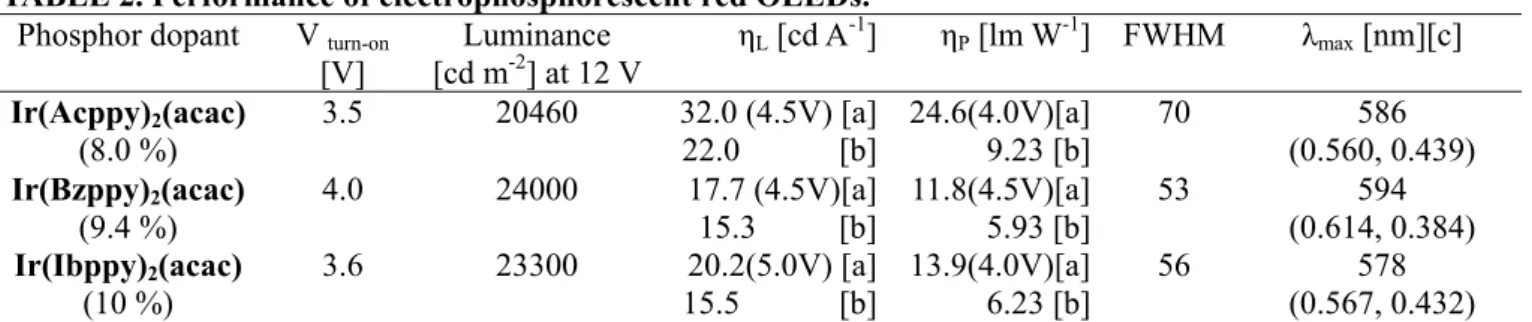
TABLE 2. Performance of electrophosphorescent red OLEDs.
Phosphor dopant V turn-on
[V] Luminance [cd m-2] at 12 V ηL [cd A -1] η P [lm W-1] FWHM λmax [nm][c] Ir(Acppy)2(acac) (8.0 %) 3.5 20460 32.0 (4.5V) [a]22.0 [b] 24.6(4.0V)[a]9.23 [b] 70 586 (0.560, 0.439) Ir(Bzppy)2(acac) (9.4 %) 4.0 24000 17.7 (4.5V)[a] 15.3 [b] 11.8(4.5V)[a] 5.93 [b] 53 594 (0.614, 0.384) Ir(Ibppy)2(acac) (10 %) 3.6 23300 20.2(5.0V) [a] 15.5 [b] 13.9(4.0V)[a] 6.23 [b] 56 578 (0.567, 0.432) [a] Maximum values of devices. Values in parentheses are the voltages at which the maximum values were obtained. [b] Values collected at 20mA cm-2. [c] Values were collected at 10V and CIE coordinates (x, y) are shown in parentheses.
region with district vibronic features were assigned to the spin-allowed, 1π-π* transition of the cyclometalated ligands in complexes. The somewhat weaker, broad, and featureless absorption bands located in the lower part of the energy spectrum (λmax>400nm) suggested the attribution of these bands
to the coexistent, spin-allowed, metal-to-ligand charge transfer 1(MLCT) and spin-forbidden 3MLCT/3π-π*
transitions, as a result of spin-orbit coupling of iridium(III), according to the bands position and size.9
This result revealed the strong 3MLCT energy bands,
with a corresponding λmax value of 510 nm for
(Acppy)2Ir(acac), 523 nm for (Bzppy)2Ir(acac), and
520 nm for (Ibppy)2Ir(acac). In the PL spectra, the
maximum emission wavelengths (λ max) were 603nm
for (Acppy)2Ir(acac), 619 nm for (Bzppy)2Ir(acac),
and 597 nm for (Ibppy)2Ir(acac). Compared to the PL
spectrum of (Bzppy)2Ir(acac), those of
(Acppy)2Ir(acac) and (Ibppy)2Ir(acac) showed a
blue- shift of 16 and 22 nm, respectively, due to shortening of the π-conjugation length of the ligand. The emission quantum yields of (Acppy)2Ir(acac),
(Bzppy)2Ir(acac), and (Ibppy)2Ir(acac) were 0.42,
0.29, and 0.48, respectively, as determined by using (ppy)3Ir, which has a value of 0.4, as a reference.10
Fig. 1. The structure of iridium complexes.
Fig. 2. (a) Absorption and (b) emission spectra of Ir complexes in a 10-5 M CH
2Cl2 solution at room
temperature.
To explore the electroluminescent properties of these materials, multilayered OLEDs were fabricated by employing the complexes as a dopant material. The devices were fabricated with the same configurations by employing x % iridium complexes
(Acppy)2Ir(acac), (Bzppy)2Ir(acac), and
(Ibppy)2Ir(acac) as a dopant within a CBP host in the
emitting layers. The results are summarized in Table 2. The current–voltage V) and current-luminance
(J-L) characteristics of devices (Acppy)2Ir(acac),
Fig. 3(a) and 3(b). The maximum luminances were 20460cd/m2, 24000 cd/m2, and 23300 cd/m2 at 12 V,
and the turn-on voltages were 3.5, 4.0 and 3.6 V for devices (Acppy)2Ir(acac), (Bzppy)2Ir(acac), and
(Ibppy)2Ir(acac), respectively.
Fig. 4 indicates that the carrier injection into the red emitting layer of device (Acppy)2Ir(acac) was more
effective than those of devices (Bzppy)2Ir(acac), and
(Ibppy)2Ir(acac). The power efficiencies and
luminous efficiencies of three devices are shown in Fig. 5(a) and 5(b). The power efficiency were 9.23,
5.93, and 6.23 lm/W at 20 mA/cm2, and luminous
efficiencies were 22.0, 15.3, and 15.5 cd/A at 20 mA/cm2 and for devices (Acppy)
2Ir(acac),
(Bzppy)2Ir(acac), and (Ibppy)2Ir(acac), respectively.
Fig. 3. (a) Current density vs. voltage and (b) luminance vs. voltage relations of of the devices.
Fig. 5. (a) Power efficiency and (b) luminous efficiency vs. current density relationship of the devices.
Fig. 6. EL spectra of red OLEDs at 10V
Fig. 6 shows the EL spectra of the devices
(Acppy)2Ir(acac), (Bzppy)2Ir(acac), and
(Ibppy)2Ir(acac) recorded at 10 V. A CIE coordinate
of (0.560, 0.439) was obtained for (Acppy)2Ir(acac),
while a CIE coordinate of (0.614, 0.384) was achieved in (Bzppy)2Ir(acac). The red-shifted CIE coordinate
of (Bzppy)2Ir(acac) can be attributed mainly to the
the extention of π-conjugation length of
(Bzppy)2Ir(acac).
4. Summary
Three iridium complexes, (Acppy)2Ir(acac),
(Bzppy)2Ir(acac), and (Ibppy)2Ir(acac), with
electron-withdrawing moiety on the 2-phenylpyridine ligands were synthesized and fully characterized. Particularly, in the device employing complex
(Bzppy)2Ir(acac) as a dopant, the luminance of 24000
cd/m2 at 12V and the luminance efficiency of 15.3
cd/A at 20 mA/cm2 were achieved for the red OLED.
The peak wavelength of the electroluminescence was at 594 nm with the CIE coordinates of (0.614, 0.384), and the device also showed a stable color chromaticity with various voltages. Also, (Acppy)2Ir(acac) device
exhibited highly efficient orange-red emission with the luminance of 20460 cd/m2 at 12 V, the luminous
efficiency of 22.0 cd/A at 20 mA/cm2, and the CIE x,y
coordinates of (x=0.560, y=0.439 ) at 10 V. The red-orange phosphorescent iridium complexes can be utilized as a promising candidate for white OLEDs with a matching blue-green emitter.
5. References
1. M. A. Baldo, D. F. O’Brien, Y. You, A. Shoustikov, S. Sibley, M. E. Thompson, S. R. Forrest, Nature,
395, 151(1998).
2. E. Holder, B. M. W. Langeveld, U. S. Schubert, Adv.
Mater., 17, 1109 (2005).
3. C. Adachi, M. A. Baldo, M. E. Thompson, S. R. Forrest, J. Appl. Phys., 90, 5048 (2001).
4. T. J. Meyer. Pure. Appl. Phys. Lett. 58, 1193 (1986). 5. S. D. Cummings, R. Eisenberg, J. Am. Chem. Soc.
118, 1949 (1996).
6. J. V. Casper, T. J. Meyer, J. Phys. Chem. 87, 952 (1983)
7. K. Dedeian, J. Shi, N. Shepherd, E. Forsythe, D. C. Morton, Inorg. Chem., 44, 4445 (2005).
5, 1131 (2003)
9 S. Lamansky, P. Djurovich, D. Murphy, F. Abdel-Razzaq, H. E. Lee, C. Adachi, P. E. Burrows, S. R. Forrest, M. E. Thompson, J. Am. Chem. Soc., 23, 4304 (2001).
10. K. A. King, P. J. Spellane, R.–J. Watts, J. Am.