1. 서론
현대 사회는 IT와 사회 전반의 모든 인프라를 융합하 고 연결하여 인류의 보다 낳은 삶의 질 향상을 지향하고 있다. 이에 대한 결과로 IOT를 비롯한 인공지능 등 4차 산업혁명이 사회 이슈가 되고 있고, 우리의 일상생활 가 까이에서 다양한 형태로 활용되고 있다[1,2]. 최근에 중소 기업의 ICT를 활용한 의사 결정을 위한 최적화 방안 연 구 및 IOT 기술을 이용하여 제조 환경 개선에 대한 연구 와 같이 정보기술을 활용한 연구가 계속하여 이루어지고
있는 상황이다[3,4]. 그러나 모든 사회의 기초 인프라를 제공해 주는 건설 산업은 각종 IT 장비와 기술을 도입함 에도 불구하고, 수 많은 안전사고로 귀중한 인명의 손실 이 계속되고 있으며, 이러한 문제를 해결하기 위해 정부 와 각종 관련기관들은 다양한 노력과 제도를 도입하여 시행하고 있고, 특히 위험개소와 근로자의 동선을 관리 하는 센서 네트워크, 데이터베이스 기반의 모니터링 시 스템과 기존의 3D 관리 시스템에 개체 개념을 도입한 BIM(Building Information Modeling) 기법 등이 시행되 고 있으며[5-8], BIM 기반의 안전 모니터링 시스템 연구
유사도검사 기법을 이용한 안전관리 개선시스템 연구
박구락
공주대학교 컴퓨터공학부
A Study on Safety Management Improvement System Using Similarity Inspection Technique
Koo-Rack Park
Division of Computer Science & Engineering, Kongju National University
요 약 건설현장에서 흔히 발생하는 안전관리 문제점 중 시정조치 지연으로 인해 발생하는 재해율을 낮추기 위해, 기존의 시스템 중 점검 후 시정조치를 할 때까지 발생하는 시간을 단축하기 위하여 사전에 사고유형 데이터베이스를 구축하고 점검 시 유사도 검사를 이용하여 점검자에게 문제점을 실시간으로 알려주어 현장에서 바로 시정조치를 수행할 수 있는 시스템을 모델링하여, 안전사고에 보다 적극적으로 대처할 수 있는 시스템을 연구하였다. 연구 결과 90 %이상의 개방 효과와 60 %이 상의 안전사고 감소율이 있음을 알 수 있었다. 이 시스템을 기반으로 음성 인식과 딥러닝을 결합하여 보다 효과적인 시스템 을 지속적으로 연구 할 것이다.
주제어 : 안전관리 시스템, 유사도 검사, 경보 시스템, 단문 메시지, 융합
Abstract To reduce the accident rate caused by the delay of corrective action, which is common in the construction site, in order to shorten the time from correcting the existing system to the corrective action, I used a time similarity check to inform the inspectors of the problem in real time, modeling the system so that corrective action can be performed immediately on site, and studied a system that can actively cope with safety accidents. The research result shows that there is more than 90% opening effect and more than 60% safety accident reduction rate. I will continue to study more effective system combining voice recognition and deep learning based on this system.
Key Words :Safety Management System, Similarity check, Alarm System, SMS, Convergence
*This work was supported by the research grant of the Kongju National University in 2017
*Corresponding Author : Koo-Rack Park([email protected]) Received Feburuary 23, 2018
Accepted April 20, 2018
Revised March 30, 2018 Published April 28, 2018
가 이루어지고 있다[9]. 이러한 노력과 연구 결과에도 불 구하고 우리 주위의 건설안전 사고로 인한 재해율은 좀 처럼 줄어들지 않고 있으며, 특히 소규모 건설현장의 재 해율은 대형건설현장의 2.0배 이상으로 높게 나타나고 있다[10-12]. 본 논문에서는 이러한 안전관리 개선 시스 템 중 현재 점검과 시정조치 사이에 발생하는 시간적 문 제를 해결하기 위하여 사전에 사고유형별 데이터베이스 를 구축하고, 현장 점검 시 유사도 검사를 이용하여 점검 자에게 발생할 수 있는 문제점을 실시간으로 통보하여 점검과 동시에 시정조치를 수행할 수 있는 시스템을 모 델링하여 안전사고를 미연에 방지할 수 있도록 한다.
2. 관련연구
2.1 안전관리 시스템
현재 우리나라의 산업재해로 인한 사망률은 OECD국 가 중 최고수준으로 여러 산업분야 중 특히 건설업에 집 중되어 발생 되고 있다[13,14]. 이러한 결과는 국가와 사 회안전망 구축에 지대한 손실로 이어지고 있어 안전관리 에 다양한 연구와 기법이 운영되고 있다. 이러한 안전관 리시스템의 프로세스는 계획, 실시, 평가, 조치의 4단계 로 구분되어 운영되고 있다. 다음의 Table 1은 안전관리 프로세스의 4단계를 설명한 것으로[10], 안전관리 프로세 스와 같은 안전관리의 기본 틀을 가지고 BIM등과 같은 IT를 이용한 안전관리 기법이 제시된 바 있다[4]. 그러나 안전사고를 유형별로 데이터베이스화하여 이를 검측(평 가)시 검측자와 연동해 실시간으로 조치를 시행하는 연 구는 미미한 상태이다. 본 논문에서는 이러한 안전관리 기법의 개선을 위하여 데이터베이스화한 안전사고 분석 데이터를 유사도 검사를 이용하여 검측자에게 실시간으 로 알려주어 문제점을 사전에 파악하고 조치할 수 있는 시스템을 모델링하였다.
Table 1. Safety Management Process
Classification Personality
Planning Before the construction starts, the contractor documents the risk countermeasure plan Implementation Operator performs risk prevention in advance
according to the plan
Evaluation Assess whether activities under the plan are performed properly
Action Identify and correct the problems found through the evaluation as appropriate
2.2 유사도 검사
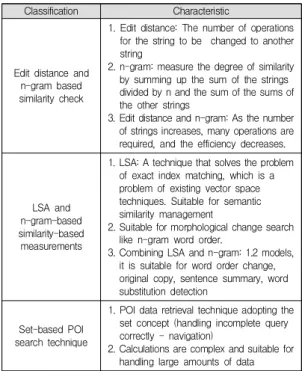
다음의 Table 2는 유사도 검사 기법의 특징을 정리한 것이다.
Table. 2. Comparison of similarity checking techniques
Classification Characteristic
Edit distance and n-gram based similarity check
1. Edit distance: The number of operations for the string to be changed to another string
2. n-gram: measure the degree of similarity by summing up the sum of the strings divided by n and the sum of the sums of the other strings
3. Edit distance and n-gram: As the number of strings increases, many operations are required, and the efficiency decreases.
LSA and n-gram-based similarity-based measurements
1. LSA: A technique that solves the problem of exact index matching, which is a problem of existing vector space techniques. Suitable for semantic similarity management
2. Suitable for morphological change search like n-gram word order.
3. Combining LSA and n-gram: 1.2 models, it is suitable for word order change, original copy, sentence summary, word substitution detection
Set-based POI search technique
1. POI data retrieval technique adopting the set concept (handling incomplete query correctly - navigation)
2. Calculations are complex and suitable for handling large amounts of data
유사도검사는 논문표절 검사나 스팸 필터링 등을 위한 기법으로 하드매칭 기법인 편집거리 n-gram기반 문장 유사도 측정[15-17]과 LSA(Latent Semantic Analysis), n-gram 기반 문장 유사도 검사 측정 방법이 있으며[15], 보다 발전된 형태의 집합기반 POI(Point to Insert)기법 이 주로 사용된다[18-26]. 본 논문에서는 집합기반 POI 검색기법을 채택하였다.
3. 개선 시스템 모델링
3.1 개선 시스템 프로세스
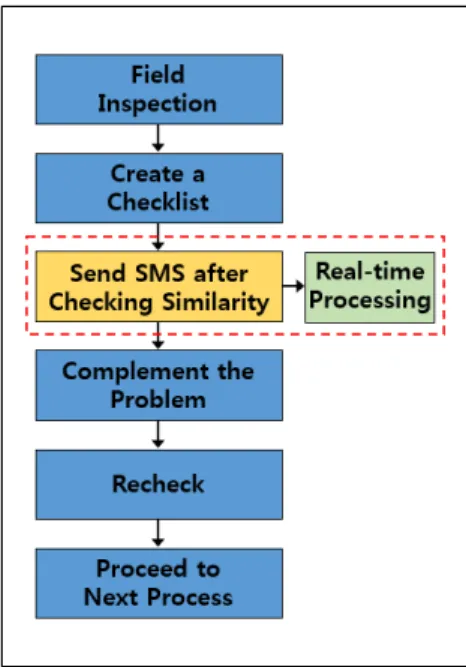
안전관리 개선 요구 사항 중 특히 건설현장에서 체크 리스트 작성시 사전에 구축한 사고유형 데이터베이스와 연동된 유사도 검사를 통해, 문제점을 검측자에게 문자 메시지를 실시간 통보함으로서, 즉각적인 시정조치를 취 해 안전사고를 미연에 방지할 수 있는 시스템으로서, 기 존 시스템은 현장 점검시 체크리스트를 작성 후, 의사결
정 시스템을 통해 문제점을 시정 지시하기까지 최소 1∼
2일의 시간이 소요된다. 이로 인해 이 기간 동안 안전사 고가 발생할 경우 대처 효율이 현격히 떨어지는 구조적 결함을 내포하고 있다. 다음의 Fig 1은 기존 안전관리 시 스템 프로세스를 개선한 시스템 프로세스이다.
Fig. 1. Improvement System Process
본 논문에서 모델링한 개선 시스템은 체크리스트 작 성시 사전에 구축한 사고유형 데이터베이스와 연동하여, 실시간으로 문제점 및 대안을 검측자에게 문자 메시지를 통하여 전달함으로서 의사결정에 불필요한 시간을 단축 하여, 안전관리를 보다 효과적으로 할 수 있도록 모델링 한 시스템이다.
3.2 개선 시스템 알고리즘
다음의 Fig 2의 (a)는 개선 시스템의 전체 알고리즘으 로, 현장에서 체크리스트에 있는 문제점을 선택하면 유 사도 검사를 이용하여 데이터베이스를 검색해 해당 데이 터를 담당자에게 문자 메시지를 전송하는 형태이며, (b) 는 개선 시스템을 모델링 하기 위한 사전 작업인 사고유 형 데이터베이스 구축을 위한 알고리즘이다.
(a) Improvement System (b) DB Algorithm Fig. 2. Improvement system and DB Algorithm
다음의 Fig 3은 사고 유형별 데이터베이스를 구축하 기 위한 알고리즘으로, 사고 데이터를 신규 및 업데이트 할 수 있는 형태로 설계하였다
public static void accident_manager() {
rs = st.executeQuery("select item_cd from base_setting where item_cd="+item_cd);
if (rs.next()) {
String Query = "UPDATE base_setting set gubn_cd='"+gubn_cd+"', subject='"+subject+"', acc_date='"+acc_date+"',acc_txt='"+acc_txt+"', acc_url='"+acc_url+"' where item_cd="+item_cd;
Statement stmt = con.createStatement();
rowCount = stmt.excuteUpdate(strQuery);
} else {
String Query = "INSERT INTO base_setting (item_cd,gubn_cd,subject...";
Statement stmt = conn.createStatement();
stmt.excuteUpdate(strQuery);
}
request_msg("saved");
}
Fig. 3. DB Registration Source
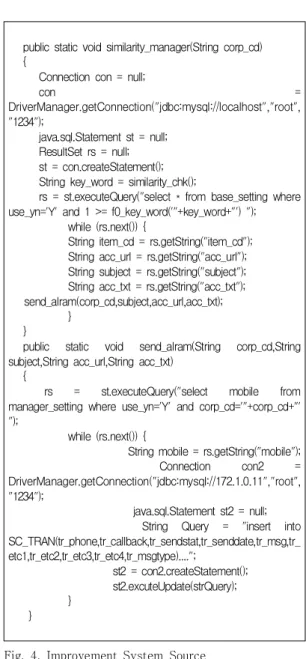
다음의 Fig 4는 구축된 데이터베이스를 JDBC를 이용 하여 웹과 연동시키고 사용자가 입력한 체크리스트의 문 제점과 데이터베이스를 유사도 검사를 이용하여 검색해 해당 데이터를 사용자에게 실시간으로 전송하는 것이다.
public static void similarity_manager(String corp_cd) {
Connection con = null;
con =
DriverManager.getConnection("jdbc:mysql://localhost","root",
"1234");
java.sql.Statement st = null;
ResultSet rs = null;
st = con.createStatement();
String key_word = similarity_chk();
rs = st.executeQuery("select * from base_setting where use_yn='Y' and 1 >= f0_key_word('"+key_word+"') ");
while (rs.next()) {
String item_cd = rs.getString("item_cd");
String acc_url = rs.getString("acc_url");
String subject = rs.getString("subject");
String acc_txt = rs.getString("acc_txt");
send_alram(corp_cd,subject,acc_url,acc_txt);
} }
public static void send_alram(String corp_cd,String subject,String acc_url,String acc_txt)
{
rs = st.executeQuery("select mobile from manager_setting where use_yn='Y' and corp_cd='"+corp_cd+"'
");
while (rs.next()) {
String mobile = rs.getString("mobile");
Connection con2 =
DriverManager.getConnection("jdbc:mysql://172.1.0.11","root",
"1234");
java.sql.Statement st2 = null;
String Query = "insert into SC_TRAN(tr_phone,tr_callback,tr_sendstat,tr_senddate,tr_msg,tr_
etc1,tr_etc2,tr_etc3,tr_etc4,tr_msgtype)....";
st2 = con2.createStatement();
st2.excuteUpdate(strQuery);
} }
Fig. 4. Improvement System Source
개선 시스템의 주요한 요소인 similarity_manager 함 수는 사고 유사도 검사 후 담당자에게 SMS를 이용해 메 시지를 전송하기 위한 모듈로서 첫째, similarity_chk() 해당 함수를 통해 유사도 검사를 통한 키워드를 가져오 고, 둘째, 가져온 키워드로 사고 데이터에서 자료를 가져 온다. 셋째, send_ararm함 수를 이용하여 담당자에게 문 자를 전송한다. 다음의 Fig 5는 웹으로 구현된 관리자 콘 솔이다.
Fig. 5. Administrator console
다음의 Fig 6은 유형별 데이터베이스 구축을 위한 사 용자 입력 화면이다. 점검자가 사용하는 사용자 화면으 로 체크리스트 상에서 문제점을 체크하면 데이터베이스 와 연동하여 유사도 검사를 통해 점검자에게 SMS를 발 송한다.
Fig. 6. User Console
4. 성능분석 및 기여점
제안 시스템의 성능 효과를 검증하기 위하여 검측자 와 작업자 각각 100명, 총 200명을 대상으로 기대효과를 확인한 결과 다음의 Table 3과 같이 92%가 효과적임을 확인하였다.
Table 3. Improvement System Effect Evaluation Table
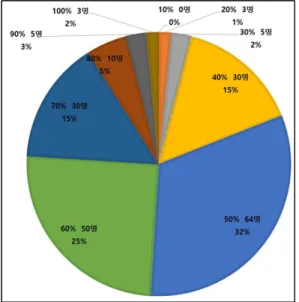
다음의 Fig 7은 제안 시스템을 이용하여 획득할 수 있 는 안전사고 절감율을 확인한 결과이다.
Fig. 7. Safety Accident Suppressor
그래프에서 23명만이 40%이내의 안전사고 절감율을 기대했고, 대다수의 구성원인 177명이 50%이상의 기대 율을 나타냈으며, 특히 60%이상의 안전사고 예방효과를 기대한 숫자는 96명으로, 전체적으로 60%이상의 안전사 고율 절감효과가 기대되는 것으로 나타났다. 이상과 같 은 결과를 볼 때, 제안 시스템을 적극 활용한다면 현재 사회적으로 큰 문제가 되고 있는 건설현장의 안전사고 예방에 기대효과가 클 것으로 예상된다.
5. 결론
본 논문에서는 다양한 안전관리 개선 요구 사항 중 특 히 건설현장에서 체크리스트 작성시 사전에 구축한 사고 유형 데이터베이스와 연동된 유사도 검사를 통해, 문제 점을 검측자에게 실시간으로 SMS를 이용해 통보함으로 서, 즉각적인 시정조치를 취해 안전사고를 미연에 방지
할 수 있는 시스템을 모델링한 것이다.
이러한 안전관리 시스템은 기존의 프로세스에서 발생 하는 검측과 수정, 보완까지의 시간을 단축함으로서 안 전사고 발생에 보다 효과적으로 대처할 수 있을 것으로 기대된다.
제안 모델의 특징은 기존의 안전관리 시스템의 문제 점이었던 시간상의 제약을 웹과 데이터베이스를 연동한 실시간 시스템으로 설계하여 문제점 파악과 시정지시 사 이에 발생하는 위험요소를 없앨 수 있는 특징을 가지고 있으며, 개발 방안은 사회적 합의를 통해 각 시공사나 지 역적으로 가지고 있던 데이터를 하나로 통합할 수 있는 중앙 데이터센터를 구축하여 모든 현장에 적용할 수 있 는 시스템으로 발전시킬 수 있는 적극적인 노력이 필요 할 것이다. 또한 향후 개선방향으로 TTS 등을 이용한 음 성인식 시스템과 딥러닝을 이용한 보다 적극적이고 전방 위적인 시스템을 연구함으로서 개별 상황에 따른 보다 빠르고 정확한 안전관리 개선 시스템을 지속적으로 연구 해야 할 것이다.
REFERENCES
[1] J. H. Kim. & K. H. Lee. (2014). Measures to Improve the Work Process Through the Convergence of Social Welfare based on IT. Journal of the Korea Convergence Society, 5(4), 33-38.
DOI : 10.15207/JKCS.2014.5.4.033
[2] Y. S. Jeong. (2016). An Efficient IoT Healthcare Service Management Model of Location Tracking Sensor.
Journal of Digital Convergence, 14(3), 261-267.
DOI : 10.14400/JDC.2016.14.3.261
[3] J. Y. Park, K. I. Kim. (2018). ICT Utilization for Optimization of SME Decision Making. Journal of Convergence for Information Technology, 8(1), 275-280.
DOI : 10.22156/CS4SMB.2018.8.1.275
[4] Y. S. Jeong. (2017). A Study on improving manufacturing environment using IoT technology in small business environment. Journal of Convergence for Information Technology, 7(2), 83-90.
DOI : 10.22156/CS4SMB.2017.7.2.083
[5] S. D. Park & S. C. Bae. (2013). USN-based construction site safety management monitoring system. Conference of Korean Society of Civil Engineers, 22-25.
[6] H. S. Na & W. S. Choi. (2013). IT-based construction site safety management concept model. Conference of
Div Survey Contents Effect
rate(%) Effective Ineffective Abandon
Geometry 90 4 6 90%
Working
Operator 94 3 3 93%
sum 184 7 9 92%
the Korean Academy of Industrial Science, 248-249.
[7] D. M. Kang. D. R. Cho & C. K. Lee. (2016). A Preliminary Study on the Establishment of LCC Library for BIM Utilization in Building Maintenance. Conference of Architectural Institute of Korea, 36(1), 455-456.
[8] J. H. Yu & K. R. Kim. (2015). [Contribution] Global Trends of Augumented Reality & BIM Semantic Web Technologies - Observation of building SMART International Summit at London. Review of Architecture and Building Science, 59(5), 73-77.
[9] C. H. Kwon. (2016). A Study on the Ubiquitous Safety Monitoring througn Utilizing BIM Technology. Journal of Digital Convergence, 14(6), 61-67.
DOI : 10.14400/JDC.2016.14.6.61
[10] K. B. Shim. (2013). Industrial Safety Characteristics and Disaster Reduction Plan in Construction Site.
Construction economy, 41-54.
[11] W. S. Shin. S. G. You. Lee & G. H. Son. (2017). An Analysis of Influence Factors on the Safety Disease in Construction Site based on Social Networks Analysis and Its Management Plan. Conference of Architectural Institute of Korea, 37(1), 871-872.
[12] S. R. Kim. (2016). A Study on the Status of Occupational Accidents and its Improvement in Small-Scale Business Sites. Legal Theory & Practice Review, 4(1), 33-54.
[13] H. J. Yoon. (2015). Improvement plan of construction safety management system to realize safe society.
National policy Brief, (520), 1-8.
[14] T. W. Kim. H. S. Han & S. W. Park. (2017). A Study on Mitigation Method of Industrial Accidents through Risk Assessment : Focusing on Construction Safety Administration. Korean Review of Corporation Management, 8(3), 219-234.
DOI : 10.20434/KRICM.2017.10.8.3.219
[15] J. I. Kim. (2012). An Efficient Edit Similarity Search Technique using Prefix Element Selection. Journal of Information Science : Computing realities and letters, 18(9), 654-659.
[16] D. J. Kim & H. W. Kim. (2006). Context-Weighted Metrics for Example Matching. Journal of the Institute of Electronics Engineers of Korea-CI, 43(6), 43-51.
[17] H. S Ji, J. H. Joh & H. S. Lim. (2010). A Detection Method of Similar Sentences Considering Plagiarism Patterns of Korean Sentence. Journal of the Korean Association of Computer Education, 13(6), 79-89.
[18] E. B. Ko. J. W. Lee & J. W. Lee. (2013). Efficient set-based POI data retrieval algorithm. Journal of Information Science : Computing realities and letters,
19(5), 242-251.
[19] E. B. Ko & J. W. Lee. (2014). Sentence Similarity Measurement Method Using a Set-based POI Data Search. Journal of The Information Science Society of Korea, 20(12), 711-716.
DOI : 10.5626/KTCP.2014.20.12.711
[20] J. I. Kim. (2016). An Efficient String Similarity Search Technique based on Generating Inverted Lists of Variable-Length Grams. Journal of KIISE, 43(11), 1275-1280.
DOI : 10.5626/JOK.2016.43.11.1275
[21] D. W. Lee, S. H. Baek, M. J. Park, J. H. Park, H. W. Jung
& J. H. Lee. (2012). Document Summarization Using Mutual Recommendation with LSA and Sense Analysis.
Journal of Korean Institute of Intelligent Systems, 22(5), 656-662.
DOI : 10.5391/JKIIS.2012.22.5.656
[22] J. H. Park, H. Y. Kang & J. Y. Lee. (2016). A Spatial-temporal POI Data Model for Implementing Location-based Services. Journal of the Korean Society of Surveying, Geodesy, Photogrammetry and Cartography, 34(6), 609-618.
DOI : 10.7848/ksgpc.2016.34.6.609
[23] B. S. Kim, Y. Lee, G. B. Kim & H. Y. Bae. (2012). The Development of Users Interesting Points Analyses Method and POI Recommendation System for Indoor Location Based Services. Journal of the Korea Society of Computer and Information, 17(5), pp. 81-91.
DOI : 10.9708/jksci.2012.17.5.081
[24] H. J. Oh, Y. J. Bae, H. K Kim, N. H. Choi & B. H. Yun.
(2014). Correlation Analysis of Point of Interests Based on User Profile in Tweets. Journal of the Korean Institute of Information Technology, 12(9), 107-113.
DOI : 10.14801/kitr.2014.12.9.107
[25] K. Lee. J. T. Lim. K. S. Bok & J. S. Yoo. (2018).
Recommending Personalized POI Considering Time and User Activity in Location Based Social Networks.
Journal of the Korea Contents Association, 18(1), 64-75.
DOI : 10.5392/JKCA.2018.18.01.064
[26] S. B. Ou & J. W. Lee. (2017). Implementation of a Spam Message Filtering System using Sentence Similarity Measurements. Journal of the KIISE Transactions on Computing Practices, 23(1), 57-64.
DOI : 10.5626/KTCP.2017.23.1.57
박 구 락(Park, Koo Rack) [정회원]
▪1986년 2월 : 중앙대학교 전기공 학과(공학사)
▪1988년 2월 : 숭실대학교 전자계 산학과(공학석사)
▪2000년 2월 : 경기대학교 전자계 산학과(이학박사)
▪1991년 4월 ~ 현재 : 공주대학교 컴퓨터공학부 교수
▪관심분야 : 경영정보, 정보통신, 고성능컴퓨팅, 전자상 거래
▪E-Mail : [email protected]