INTRODUCTION
With aging of the global population, the incidence of joint dis- eases in older adults has increased year by year. Total knee ar-
throplasty is one of the main methods of treating knee joint dis- eases.1,2 Although total knee arthroplasty can significantly improve the quality of life and walking ability of older adult pa- tients, the risk of postoperative deep venous thrombosis (DVT) is high in these patients: a study has reported that the incidence of DVT after total knee arthroplasty is about 5–22%.3 In recent years, due to the increase of total knee arthroplasty surgeries in older adult patients, the incidence of DVT has also followed an increasing trend.4
The treatment of anticoagulant drugs can significantly reduce the risk of postoperative DVT.5 Low molecular weight heparin (LMWH) is a commonly used medicine for the prevention and treatment of DVT after orthopedics surgery. A study has re- ported that LMWH is effective and can significantly reduce the incidence of DVT within 3 months after total knee arthroplasty.6 However, LMWH also has many limitations, especially in old- er adult patients discharged from the hospital. For example, the subcutaneous injection method is complicated, medication compliance is poor, blood coagulation function needs to be
Comparison of Apixaban and Low Molecular Weight Heparin in Preventing Deep Venous Thrombosis after Total Knee Arthroplasty in Older Adults
Hui Jiang*, Jia Meng*, Ting Guo, Jian-ning Zhao, Yi-cun Wang, Jun Wang, Yang Qiu, and Hao Ding
Department of Orthopedics, Jinling Hospital, Nanjing Clinical School of the Second Military Medical University, Nanjing, Jiangsu, China.
Purpose: To compare the effect of apixaban and low molecular weight heparin (LMWH) in the prevention and treatment of deep venous thrombosis (DVT) after total knee arthroplasty in older adult patients.
Materials and Methods: A total of 220 patients (average age of 67.8±6.4 years) undergoing total knee arthroplasty were randomly selected as research subjects and were divided into apixaban and LMWH groups (110 in each group).
Results: The incidence of DVT was lower in the apixaban group than in the LMWH group (5.5% vs. 20.0%, p=0.001). Activated partial thromboplastin times (35.2±3.6 sec vs. 33.7±2.2 sec, p=0.010; 37.8±4.6 sec vs. 34.1±3.2 sec, p<0.001; 39.6±5.1 sec vs. 35.7±3.0 sec, p=0.032) and prothrombin times (14.0±1.0 sec vs. 12.8±0.9 sec, p<0.001; 14.5±1.2 sec vs. 13.0±1.1 sec, p<0.001; 15.3±1.4 sec vs.
13.2±1.3 sec, p=0.009) in the apixaban group at 1 week after surgery, 3 weeks after surgery, and the end of treatment were higher than those in the LMWH group. Platelet and fibrinogen levels in the apixaban group were lower than those of the LMWH group.
Also, capillary plasma viscosity and erythrocyte aggregation in the apixaban group at 1 week after surgery, 3 weeks after surgery, and the end of treatment were lower than those in the LMWH group.
Conclusion: Apixaban, which elicits fewer adverse reactions and is safer than LMWH, exhibited better effects in the prevention and treatment of DVT after total knee arthroplasty in older adults.
Key Words: Apixaban, low molecular weight heparin, total knee arthroplasty, deep venous thrombosis
pISSN: 0513-5796 · eISSN: 1976-2437
Received: January 22, 2019 Revised: April 23, 2019 Accepted: May 9, 2019
Co-corresponding authors: Ting Guo, PhD, Department of Orthopedics, Jinling Hospital, Nanjing Clinical School of the Second Military Medical University, No.
305 Zhongshan East Road, Nanjing 210002, Jiangsu, China.
Tel: 86-025-80860015, Fax: 86-025-80860015, E-mail: [email protected] and Jian-ning Zhao, PhD, Department of Orthopedics, Jinling Hospital, Nanjing Clinical School of the Second Military Medical University, No. 305 Zhongshan East Road, Nanjing 210002, Jiangsu, China.
Tel: 86-025-80860015, Fax: 86-025-80860015, E-mail: [email protected]
*Hui Jiang and Jia Meng contributed equally to this work.
•The authors have no potential conflicts of interest to disclose.
© Copyright: Yonsei University College of Medicine 2019
This is an Open Access article distributed under the terms of the Creative Com- mons Attribution Non-Commercial License (https://creativecommons.org/licenses/
by-nc/4.0) which permits unrestricted non-commercial use, distribution, and repro- duction in any medium, provided the original work is properly cited.
Yonsei Med J 2019 Jul;60(7):626-632 https://doi.org/10.3349/ymj.2019.60.7.626
regularly monitored, and so on.7 In recent years, new antico- agulant oral preparations have been developed. Apixaban is a new potent oral FXa inhibitor that can rapidly combine with FXa and transform prothrombin into thrombin.8,9 One study has shown that apixaban can significantly reduce the inci- dence of DVT and the associated mortality after orthopedic surgery.10 At present, there are few clinical studies comparing the efficacy of apixaban and LMWH in preventing and treating DVT after total knee arthroplasty in older adult patients. There- fore, this research sought to compare the efficacy of apixaban and LMWH in older adult patients undergoing total knee ar- throplasty in order to provide an experimental and theoretical basis for the development of clinical anticoagulant strategies therein.
MATERIALS AND METHODS
General information
A total of 220 older adult patients undergoing total knee ar- throplasty admitted to our hospital from January 2015 to No- vember 2017 were selected. They were randomly divided into apixaban and LMWH groups (110 patients in each group). Pa- tients in the apixaban group were treated with apixaban orally at 12 h after surgery, twice a day, 2.5 mg each time.11 Patients in the LMWH group were given LMWH (purchased from GlaxoS- mithKline Co., Ltd., Tianjin, China) via hypodermic injection at 12 h after surgery, 4000 IU per day.12 The doses of apixaban and LMWH were not adjusted according to indicators such as activated partial thromboplastin time (APTT). The course of treatment in the two groups both lasted for 5 weeks. Alleviating analgesia and early ambulation were routinely conducted for postoperative patients. This study was approved by the Ethics Committee of Jinling Hospital (2016NZKY-020-02). All patients or their families signed informed consent.
The inclusion criteria were older adults (>60 years old), pa- tients with total knee arthroplasty indications, patients with- out surgical contraindications, and patients with no history of DVT before surgery. Exclusion criteria were patients with ma- lignant tumors; patients with liver, kidney, heart, lung, or other important organ dysfunction; patients with blood coagulation dysfunction; patients whose preoperative ultrasonography of blood vessels revealed DVT; patients who were allergic to the drugs being studied in this research; patients with a history of mental illness; patients who refused to provide informed con- sent; and patients who did not meet the experimental ethical standards.
Observation index
The visual analogue scale (VAS) scoring system was used to evaluate pain experienced by patients before surgery and at the end of treatment. VAS scores ranged from 0 to 10, with 0 indicating no pain and 10 indicating severe pain.
The incidence of DVT between the two groups within 3 months after surgery were compared. The clinical manifesta- tions of symptomatic DVT were dark purple skin, elevated skin temperature, swollen lower limbs, shallow vein engorge- ment, and tenderness in the femoral triangle, which was con- firmed by color doppler ultrasound. If there were no symp- toms, color doppler ultrasound was used to examine for DVT.
The patients were re-checked by ultrasound once every 2 weeks, with follow up by outpatient appointment after discharge.
Blood coagulation function indexes in two groups were com- pared. APTT, prothrombin time (PT), platelets (PLT), and fi- brinogen (FIB) were measured using a full-automated blood coagulation analyzer at 1 week after surgery, 3 weeks after sur- gery, and the end of treatment, and then averaged. Also, we compared hemodynamic indexes of the two groups, including capillary plasma viscosity and erythrocyte aggregation. Hemo- dynamic indexes were evaluated at 1 week after surgery, 3 weeks after surgery, and the end of treatment, and then averaged.
The movement ability and state of knee joint were compared between the two groups. The hospital for special surgery (HSS) knee joint scoring system was used to evaluate postoperative function of the knee joint at 1 week after surgery, 3 weeks after surgery, and the end of treatment, and mean values were cal- culated to compare patients in the two groups. The HSS scoring system comprises six main aspects, including pain, function, joint mobility, muscle strength, knee flexion deformity, and knee instability, with a total score of 100 points. The higher the score, the better the movement ability and state of the knee joint.
Adverse reactions in the two groups were compared. Post- operative drainage volume, bleeding events (cerebral hemor- rhage, primae viae bleeding, and subcutaneous hemorrhage), and liver and kidney function were observed.
Statistical analysis
SPSS 20.0 statistical software (IBM Corp., Armonk, NY, USA) was used to analyze all data. Measurement data were expressed as a mean±standard deviation (x–±SD). The t test was used for comparisons between groups, and paired t test was used for the comparison of indicators before and after intervention.
The comparison of indexes at different time points was ana- lyzed by ANOVA of repeated measurements combined with post-Bonferroni test. Enumeration data are expressed as per- centages, and the χ2 test was used for comparison between groups. There was a significant difference at p<0.05.
RESULTS
Comparison of basic data
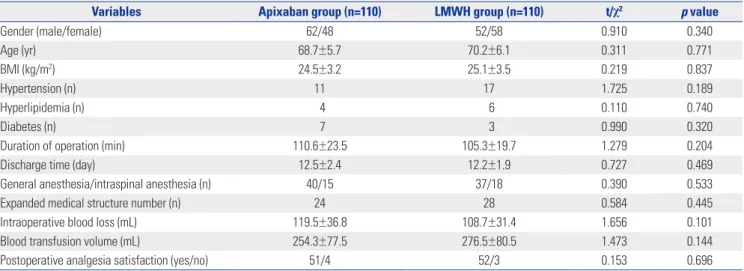
Between the two study groups, there were no significant dif- ferences in gender, age, body mass index, underlying disease, duration of operation, discharge time, ratio of general anesthe- sia to intraspinal anesthesia, expanded medical structure num-
after surgery, and the end of treatment in two groups were signif- icantly lower than those before surgery. Capillary plasma vis- cosity and erythrocyte aggregation in the apixaban group were significantly lower than those in the LMWH group at 1 week after surgery, 3 weeks after surgery, and the end of treatment (Tables 4 and 5, Figs. 3 and 4).
Comparison of HSS scores
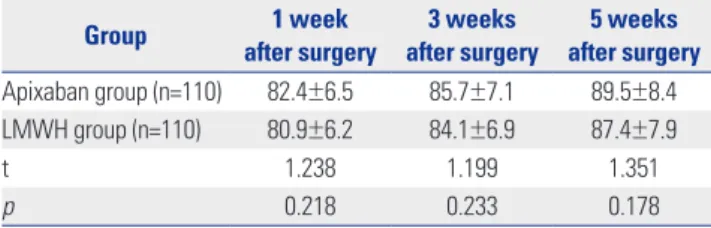
The HSS scores for patients in the apixaban group at 1 week, 3 ber, intraoperative blood loss, blood transfusion volume, and
postoperative analgesia satisfaction (all p>0.05) (Table 1).
Comparison of VAS scores
There was no significant difference in preoperative VAS scores between the two groups. There was also no significant differ- ence in VAS scores between the two groups at the end of treat- ment. VAS score of the end of the treatment, however, was sig- nificantly lower than that of before surgery in both groups (Table 2).
Comparison of the incidence of DVT
Vascular ultrasound revealed DVT in 6 patients in the apixa- ban group, including three in the iliac vein, one in the femoral vein, and two in the popliteal vein. There were 22 cases of DVT in the LMWH group, including 12 in the iliac vein, six in the fem- oral vein, and four in the popliteal vein. There was a significant difference in the incidences of DVT between the two groups (5.5% vs. 20.0%, χ2=410.480, p=0.001) (Fig. 1).
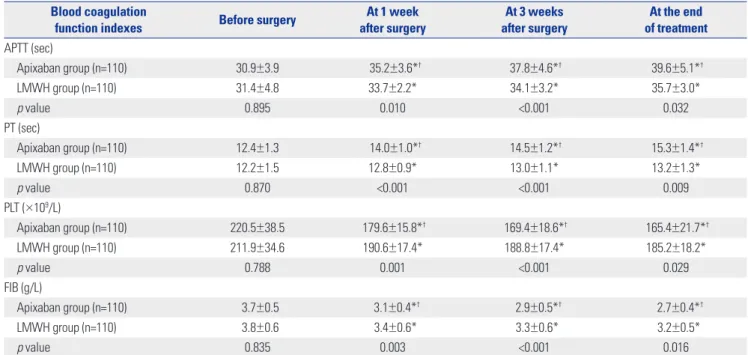
Comparison of blood coagulation function indexes ANOVA of repeated measurements revealed significant differ- ences in APTT, PT, PLT, and FIB at different time points. APTT and PT indexes were increased and PLT and FIB indexes were decreased at 1 week after surgery, 3 weeks after surgery, and the end of treatment in two groups, compared to before sur- gery. APTT and PT indexes in the apixaban group were higher than those in the LMWH group at 1 week after surgery, 3 weeks after surgery, and the end of treatment, while PLT and FIB index- es were lower than those in the LMWH group (Table 3, Fig. 2).
Comparison of hemorheology indexes
ANOVA of repeated measurements showed significant differ- ences in capillary plasma viscosity and erythrocyte aggregation at different time points. Capillary plasma viscosity and erythro- cyte aggregation index values at 1 week after surgery, 3 weeks Table 1. Comparison of Basic Data between Groups
Variables Apixaban group (n=110) LMWH group (n=110) t/χ2 p value
Gender (male/female) 62/48 52/58 0.910 0.340
Age (yr) 68.7±5.7 70.2±6.1 0.311 0.771
BMI (kg/m2) 24.5±3.2 25.1±3.5 0.219 0.837
Hypertension (n) 11 17 1.725 0.189
Hyperlipidemia (n) 4 6 0.110 0.740
Diabetes (n) 7 3 0.990 0.320
Duration of operation (min) 110.6±23.5 105.3±19.7 1.279 0.204
Discharge time (day) 12.5±2.4 12.2±1.9 0.727 0.469
General anesthesia/intraspinal anesthesia (n) 40/15 37/18 0.390 0.533
Expanded medical structure number (n) 24 28 0.584 0.445
Intraoperative blood loss (mL) 119.5±36.8 108.7±31.4 1.656 0.101
Blood transfusion volume (mL) 254.3±77.5 276.5±80.5 1.473 0.144
Postoperative analgesia satisfaction (yes/no) 51/4 52/3 0.153 0.696
BMI, body mass index; LMWH, low molecular weight heparin.
Table 2. Comparison of Visual Analogue Scale Scores before Surgery and at the End of Treatment
Group Before
surgery End
of the treatment t p value Apixaban group (n=110) 4.5±0.9 3.6±0.5 6.483 <0.001 LMWH group (n=110) 4.7±1.0 3.8±0.7 5.468 <0.001
t 1.102 1.724
p value 0.273 0.088
LMWH, low molecular weight heparin.
30
15
0 Apixaban group LMWH group
Incidence rate of DVT (%) *
Fig. 1. Comparison of the incidence of DVT between the study groups.
Compared with the LMWH group, *p<0.05. LMWH, low molecular weight heparin; DVT, deep venous thrombosis.
300
150
0
6
3
0
PLT (×109/L) FIB (g/L)
50
25
0
20
10
0
APTT (sec) PT (sec)
*
Apixaban group LMWH group
Apixaban group LMWH group Apixaban group
LMWH group
Apixaban group LMWH group
*†
*†
* *† *
*†
* *† *
*†
*
* Before
surgery
Before surgery
Before surgery
Before surgery
*†
*
At one week after surgery
At one week after surgery
At one week after surgery
At one week after surgery
*†
At three weeks after surgery
At three weeks after surgery
At three weeks after surgery
At three weeks after surgery
*†
*
At the end of treatment
At the end of treatment
At the end of treatment
At the end of treatment
*†
* *
*†
*
Fig. 2. Comparison of APTT, PT, PLT, and FIB indexes between the study groups. Compared with before surgery within the same group, *p<0.05; com- pared with the LMWH group, †p<0.05. APTT, activated partial thromboplastin time; PT, prothrombin time; PLT, platelets; FIB, fibrinogen; LMWH, low molecular weight heparin.
Table 3. Comparison of Blood Coagulation Function Indexes Blood coagulation
function indexes Before surgery At 1 week
after surgery At 3 weeks
after surgery At the end of treatment APTT (sec)
Apixaban group (n=110) 30.9±3.9 35.2±3.6*† 37.8±4.6*† 39.6±5.1*†
LMWH group (n=110) 31.4±4.8 33.7±2.2* 34.1±3.2* 35.7±3.0*
p value 0.895 0.010 <0.001 0.032
PT (sec)
Apixaban group (n=110) 12.4±1.3 14.0±1.0*† 14.5±1.2*† 15.3±1.4*†
LMWH group (n=110) 12.2±1.5 12.8±0.9* 13.0±1.1* 13.2±1.3*
p value 0.870 <0.001 <0.001 0.009
PLT (×109/L)
Apixaban group (n=110) 220.5±38.5 179.6±15.8*† 169.4±18.6*† 165.4±21.7*†
LMWH group (n=110) 211.9±34.6 190.6±17.4* 188.8±17.4* 185.2±18.2*
p value 0.788 0.001 <0.001 0.029
FIB (g/L)
Apixaban group (n=110) 3.7±0.5 3.1±0.4*† 2.9±0.5*† 2.7±0.4*†
LMWH group (n=110) 3.8±0.6 3.4±0.6* 3.3±0.6* 3.2±0.5*
p value 0.835 0.003 <0.001 0.016
APTT, activated partial thromboplastin time; LMWH, low molecular weight heparin; PT, prothrombin time; PLT, platelets; FIB, fibrinogen.
Compared with before surgery within the same group, *p<0.05; compared with the LMWH group, †p<0.05.
*†
weeks, and 5 weeks after surgery were 82.4±6.5, 85.7±7.1, and 89.5±8.4, respectively. The HSS scores for patients in the LMWH group at 1 week, 3 weeks, and 5 weeks after surgery were 80.9±
6.2, 84.1±6.9, and 87.4±7.9, respectively. ANOVA of repeated measurements showed that there were no significant differenc- es in HSS scores at the different time points between groups (Table 6).
Comparison of adverse reactions
No deaths occurred during follow up in either group, and no liver and kidney function damage occurred during medication.
In the LMWH group, some patients experienced ecchymosis and allergic reactions at the injection site, which recovered after active symptomatic treatment. Some patients in the apixaban group complained of nausea and anemia, and recovered sig- nificantly after symptomatic treatment. Compared with the LMWH group, postoperative drainage volume in the apixaban group was significantly lower (215.7±20.5 mL vs. 298.2±26.2
mL, t=4.295, p=0.013). There was no significant difference in the incidence of bleeding events between groups (10.9% vs.
5.5%, χ2=1.089, p=0.297) (Fig. 5).
DISCUSSION
DVT is a common complication after clinical orthopedic sur- gery, especially in older adult patients undergoing artificial joint arthroplasty. The formation of DVT can lead to organ dysfunc- tion, such as pulmonary embolism and so on, which is one of the major causes of perioperative death and seriously threat- ens the life and health of patients.11 One study has reported that the incidence of DVT after artificial joint arthroplasty can reach up to 30%, if no corresponding measures are taken.12 The high incidence of DVT in older adult patients after artificial joint arthroplasty may be associated with more underlying diseases in older adult patients, physiological function degeneration, Table 4. Comparison of Capillary Plasma Viscosity
Group Before intervention 1 week after intervention 3 weeks after intervention 5 weeks after intervention
Apixaban group (n=110) 1.3±0.3 1.0±0.3 0.9±0.2 0.8±0.2
LMWH group (n=110) 1.4±0.4 1.2±0.4 1.1±0.3 1.0±0.2
t 0.511 2.966 4.114 2.638
p value 0.620 0.004 <0.001 0.011
LMWH, low molecular weight heparin.
Table 5. Comparison of Erythrocyte Aggregation Index
Group Before intervention 1 week after intervention 3 weeks after intervention 5 weeks after intervention
Apixaban group (n=110) 2.0±0.3 1.5±0.3 1.4±0.3 1.3±0.2
LMWH group (n=110) 2.1±0.4 1.8±0.4 1.7±0.3 1.6±0.3
t 0.346 4.450 5.244 2.882
p value 0.746 <0.001 <0.001 0.011
LMWH, low molecular weight heparin.
3.0
1.5
0.0
Plasma viscosity in blood capillary
Apixaban group LMWH group
*†
*
Before intervention After intervention
Fig. 3. Comparison of capillary plasma viscosity at the end of treatment between the study groups. Compared with the same group before in- tervention, *p<0.05; compared with the LMWH group after intervention,
†p<0.05. LMWH, low molecular weight heparin.
3.0
1.5
0.0
Red cell assembling index
Apixaban group LMWH group
*†
*
Before intervention After intervention
Fig. 4. Comparison of erythrocyte aggregation at the end of treatment between the study groups. Compared with the same group before in- tervention, *p<0.05; compared with the LMWH group after intervention,
†p<0.05. LMWH, low molecular weight heparin.
blood in a hypercoagulable state, a lack of postoperative func- tional exercise, surgical injury to the vascular endothelium, and activation of the coagulation-fibrinolytic system.13,14
At present, the prevention and treatment of DVT after artifi- cial joint arthroplasty have primarily relied on drug therapy with LMWH, unfractionated heparin, and vitamin K antago- nists. Although these drugs have a desirable effect, there are also many adverse reactions.15,16 Therefore, it is of great signifi- cance to find a safe and effective drug to prevent DVT after arti- ficial joint arthroplasty in older adult patients. LMWH has been widely used as a thromboprophylaxis drug after total knee ar- throplasty. LMWH can target complex enzymes in the internal and external pathways of the coagulation cascade, and it can also be combined with anticoagulant enzymes to enhance its effect.17 However, research has shown that it is inconvenient for patients undergoing total hip arthroplasty, especially for older adults, given its route of administration.18 Apixaban, a new type of oral anticoagulant, has a simpler route of admin- istration than LMWH. Through the selective inhibition of the coagulation FXa, apixaban can block endogenous and exoge- nous pathways generated by thrombin and can inhibit throm- bus formation.19 In recent years, a study revealed that apixa- ban has a certain effect in the prevention and treatment of DVT after surgery of hip fracture.20 However, the differences in the prevention of DVT between apixaban and LMWH in older adult patients undergoing total knee arthroplasty have re- mained unclear. The results of the present study showed a sig- nificantly lower incidence of DVT with apixaban than with LMWH. The study of Lanitis, et al.21 also suggested that apixa-
ban had obvious advantages in the prevention and treatment of DVT, compared with LMWH. Notwithstanding, previous re- search has reported that there was no significant difference in the incidence of DVT between the apixaban group and the LMWH group, which may be due to the subject selection (older adult patients), different sample size, and patient compliance in this study.10
In terms of blood coagulation function and hemorheology indices, the results of this research showed that blood coagu- lation function and hemorheology after intervention in the apixaban group were significantly better than those in the LMWH group. In the aspect of adverse drug reactions, postop- erative drainage volumes in the apixaban group were signifi- cantly lower than those in the LMWH group. While the inci- dence of bleeding events in the apixaban group was higher than that in the LMWH group, the difference was not statistical- ly significant. These findings further indicate that apixaban is more effective than LMWH in the prevention of DVT after total knee arthroplasty in older adult patients, as it elicits fewer ad- verse reactions and is safer. The results of a study on 520 acute symptomatic DVT patients who received different doses of apixaban also showed that apixaban was effective in reducing DVT and was safe.22
There are certain limitations in this research. Although digi- tal subtraction angiography is the “gold standard” for the di- agnosis of DVT, in view of its large trauma and high cost, vas- cular doppler ultrasound examination was used in this study.
Also, the sample size enrolled in this study was small, and this study reflects results at a single center. Further studies need to collect and increase the number of cases and conduct pro- spective studies of multi-center follow-up control, confirming changes in index values at multiple time points, studying the risk of thrombosis over a longer period of time, and studying drugs at different doses.
In summary, the efficacy and safety of apixaban in the pre- vention of DVT after total knee arthroplasty in older adult pa- tients was better than that of LMWH. Apixaban, as an oral agent, is an effectively antithrombotic and anticoagulant drug 400
200
0
Postoperative drainage volume (mL)
Apixaban group LMWH group
*
12
6
0
Incidence of bleeding events (%)
Apixaban group LMWH group
* Table 6. Comparison of Hospital for Special Surgery Scores
Group 1 week
after surgery
3 weeks after surgery
5 weeks after surgery Apixaban group (n=110) 82.4±6.5 85.7±7.1 89.5±8.4 LMWH group (n=110) 80.9±6.2 84.1±6.9 87.4±7.9
t 1.238 1.199 1.351
p 0.218 0.233 0.178
LMWH, low molecular weight heparin.
Fig. 5. Comparison of the postoperative drainage volume and the incidence of bleeding events between the study groups. Compared with the LMWH group, *p<0.05. LMWH, low molecular weight heparin.
worth promoting in the treatment of DVT after artificial joint arthroplasty.
ACKNOWLEDGEMENTS
This work was supported by the Chinese Medical Doctor As- sociation-Special Fund for Thrombosis Prevention after Major Orthopedics Surgery (No. 2015COS0810) and Nanjing General Hospital Subject (No. 2017003).
AUTHOR CONTRIBUTIONS
Conceptualization: Hao Ding. Data curation: Hao Ding and Yi-cun Wang. Formal analysis: Yang Qiu. Funding acquisition: Jun Wang. In- vestigation: Hui Jiang. Methodology: Hui Jiang. Project administration:
Ting Guo. Resources: Jian-ning Zhao. Software: Ting Guo. Supervision:
Jia Meng. Validation: Jian-ning Zhao. Visualization: Yang Qiu. Writ- ing—original draft: Hui Jiang. Writing—review & editing: Jia Meng.
ORCID iDs
Hui Jiang https://orcid.org/0000-0002-0419-8128 Jia Meng https://orcid.org/0000-0002-8121-8882 Ting Guo https://orcid.org/0000-0002-6417-999X Jian-ning Zhao https://orcid.org/0000-0002-0093-4423 Yi-cun Wang https://orcid.org/0000-0003-4067-1637 Jun Wang https://orcid.org/0000-0003-2557-4978 Yang Qiu https://orcid.org/0000-0003-2537-882X Hao Ding https://orcid.org/0000-0003-2688-3852
REFERENCES
1. Bonutti PM, Sodhi N, Patel YH, Sultan AA, Khlopas A, Chughtai M, et al. Novel venous thromboembolic disease (VTED) prophy- laxis for total knee arthroplasty-aspirin and fish oil. Ann Transl Med 2017;5(Suppl 3):S30.
2. Zhou LY, Gu W, Liu Y, Ma ZL. Effects of inhalation anesthesia vs.
total intravenous anesthesia (TIVA) vs. spinal-epidural anesthesia on deep vein thrombosis after total knee arthroplasty. Med Sci Monit 2018;24:67-75.
3. Falck-Ytter Y, Francis CW, Johanson NA, Curley C, Dahl OE, Schul- man S, et al. Prevention of VTE in orthopedic surgery patients.
Antithrombotic Therapy and Prevention of Thrombosis, 9th ed:
American College of Chest Physicians Evidence-Based Clinical Practice Guidelines. Chest 2012;141(2 Suppl):e278S-e325S.
4. Wakabayashi H, Hasegawa M, Niimi R, Yamaguchi T, Naito Y, Sudo A. The risk factor of preoperative deep vein thrombosis in patients undergoing total knee arthroplasty. J Orthop Sci 2017;22:698-702.
5. Zou Y, Tian S, Wang Y, Sun K. Administering aspirin, rivaroxaban and low-molecular-weight heparin to prevent deep venous throm- bosis after total knee arthroplasty. Blood Coagul Fibrinolysis 2014;25:660-4.
6. Warwick D, Friedman RJ, Agnelli G, Gil-Garay E, Johnson K, FitzGerald G, et al. Insufficient duration of venous thromboembo- lism prophylaxis after total hip or knee replacement when com- pared with the time course of thromboembolic events: findings from the Global Orthopaedic Registry. J Bone Joint Surg Br 2007;89:
799-807.
7. Beyer-Westendorf J, Lützner J, Donath L, Tittl L, Knoth H, Radke
OC, et al. Efficacy and safety of thromboprophylaxis with low-mo- lecular-weight heparin or rivaroxaban in hip and knee replace- ment surgery: findings from the ORTHO-TEP registry. Thromb Haemost 2013;109:154-63.
8. Aryal MR, Pandit A, Ghimire S, Pathak R, Karmacharya P, Poudel DR, et al. Thromboprophylaxis with apixaban and the risk of pul- monary embolism in patients undergoing knee replacement sur- gery. J Community Hosp Intern Med Perspect 2015;5:27889.
9. King DA, Pow RE, Dickison DM, Vale PR. Apixaban versus enoxa- parin in the prevention of venous thromboembolism following total knee arthroplasty: a single-centre, single-surgeon, retrospec- tive analysis. Intern Med J 2016;46:1030-7.
10. Lassen MR, Raskob GE, Gallus A, Pineo G, Chen D, Portman RJ.
Apixaban or enoxaparin for thromboprophylaxis after knee re- placement. N Engl J Med 2009;361:594-604.
11. Cafri G, Paxton EW, Chen Y, Cheetham CT, Gould MK, Sluggett J, et al. Comparative effectiveness and safety of drug prophylaxis for prevention of venous thromboembolism after total knee arthro- plasty. J Arthroplasty 2017;32:3524-8.
12. Bala A, Huddleston JI 3rd, Goodman SB, Maloney WJ, Amanatul- lah DF. Venous thromboembolism prophylaxis after TKA: aspirin, warfarin, enoxaparin, or factor Xa inhibitors? Clin Orthop Relat Res 2017;475:2205-13.
13. Kang J, Jiang X, Wu B. Analysis of risk factors for lower-limb deep venous thrombosis in old patients after knee arthroplasty. Chin Med J (Engl) 2015;128:1358-62.
14. Kuperman EF, Schweizer M, Joy P, Gu X, Fang MM. The effects of advanced age on primary total knee arthroplasty: a meta-analysis and systematic review. BMC Geriatr 2016;16:41.
15. Pierce TP, Elmallah RK, Jauregui JJ, Cherian JJ, Mont MA. What’s new in venous thromboembolic prophylaxis following total knee and total hip arthroplasty? An update. Surg Technol Int 2015;26:
234-7.
16. Lieberman JR, Hsu WK. Prevention of venous thromboembolic disease after total hip and knee arthroplasty. J Bone Joint Surg Am 2005;87:2097-112.
17. Lazo-Langner A, Fleet JL, McArthur E, Garg AX. Rivaroxaban vs.
low molecular weight heparin for the prevention of venous throm- boembolism after hip or knee arthroplasty: a cohort study. J Thromb Haemost 2014;12:1626-35.
18. O’Donnell M, Linkins LA, Kearon C, Julian J, Hirsh J. Reduction of out-of-hospital symptomatic venous thromboembolism by ex- tended thromboprophylaxis with low-molecular-weight heparin following elective hip arthroplasty: a systematic review. Arch In- tern Med 2003;163:1362-6.
19. Li X, Keshishian A, Hamilton M, Horblyuk R, Gupta K, Luo X, et al. Apixaban 5 and 2.5 mg twice-daily versus warfarin for stroke prevention in nonvalvular atrial fibrillation patients: comparative effectiveness and safety evaluated using a propensity-score- matched approach. PLoS One 2018;13:e0191722.
20. Venker BT, Ganti BR, Lin H, Lee ED, Nunley RM, Gage BF. Safety and efficacy of new anticoagulants for the prevention of venous thromboembolism after hip and knee arthroplasty: a meta-analy- sis. J Arthroplasty 2017;32:645-52.
21. Lanitis T, Leipold R, Hamilton M, Rublee D, Quon P, Browne C, et al. Cost-effectiveness of apixaban versus low molecular weight heparin/vitamin k antagonist for the treatment of venous throm- boembolism and the prevention of recurrences. BMC Health Serv Res 2017;17:74.
22. Lassen MR, Davidson BL, Gallus A, Pineo G, Ansell J, Deitchman D. The efficacy and safety of apixaban, an oral, direct factor Xa in- hibitor, as thromboprophylaxis in patients following total knee replacement. J Thromb Haemost 2007;5:2368-75.