INTRODUCTION
Hip fractures mostly occur from falls among patients of older age, and are known to cause complications, such as pneumonia, pressure sore, sepsis, infections in the urinary system, and deep vein thrombosis (DVT). Among these, DVT is a major complica- tion that can lead to pulmonary embolism (PE) and even death.
Thrombosis has been reported to occur in more than 40% of hip fracture cases, and PE in 11%.1-3 However, a study on the in- cidence of DVT after hip fracture among Koreans reported inci- dences of 3.5% for those with symptoms4 and 11.3% for those without symptoms,5 indicating a difference in incidence rates from those in studies conducted in Western populations.6 More- over, reports have indicated that aspirin is effective in prevent- ing venous thromboembolism (VTE) in Western patients, but is not as effective in Koreans.4 As such, the authors investigat- ed the efficacy of low molecular weight heparin (LMWH) for the prevention of VTE in Korean patients who underwent hip frac- ture surgery (HFS).
MATERIALS AND METHODS
All procedures were approved by the Institutional Review Board of our institution. Between October 1, 2011 and Octo-
The Efficacy of Low Molecular Weight Heparin for the Prevention of Venous Thromboembolism after Hip Fracture Surgery in Korean Patients
Kwang-Kyoun Kim1,2, Yougun Won2,3, and Ye-Yeon Won4
1Department of Orthopedic Surgery, Stanford University College of Medicine (Visiting professor), Stanford, CA, USA;
2Department of Orthopaedic Surgery, Konyang University School of Medicine, Deajeon;
3Department of Orthopaedics, Graduate School of Medicine, Yonsei University, Seoul;
4Department of Orthopaedic Surgery, Ajou University School of Medicine, Suwon, Korea.
Purpose: The aim of this study was to investigate the efficacy of low-molecular-weight heparin (LMWH) for the prevention of ve- nous thromboembolism in Korean patients who underwent hip fracture surgery (HFS).
Materials and Methods: Prospectively, a total 181 cases were classified into the LMWH user group (116 cases) and LMWH non- user group (65 cases). Each group was sub-classified according to fracture types as follows: 81 cases of intertrochanteric fracture (group A: 49, group B: 32) and 100 cases of neck fracture (group C: 67, group D: 33). We compared the incidence of deep vein thrombosis (DVT) and pulmonary embolism (PE) according to LMWH use.
Results: Of the 181 cases, four DVTs were found in the LMWH user groups (1 in group A, and 3 in group C). One case of PE was found in LMWH non-user group D. The incidences of DVT and PE showed no statistically significant differences between the LMWH user and non-user groups (p=0.298 and 0.359, respectively). In subgroup analysis, no statistically significant differences were found between groups A and B and between groups C and D.
Conclusion: The administration of LMWH was not effective in the prevention of venous thromboembolism and PE in the Korean patients who underwent HFS.
Key Words: Low molecular weight heparin, deep vein thrombosis, pulmonary embolism, hip fracture Yonsei Med J 2016 Sep;57(5):1209-1213
http://dx.doi.org/10.3349/ymj.2016.57.5.1209 pISSN: 0513-5796 · eISSN: 1976-2437
Received: October 5, 2015 Revised: February 4, 2016 Accepted: February 17, 2016
Corresponding author: Dr. Yougun Won, Department of Orthopaedic Surgery, Konyang University School of Medicine, 158 Gwanjeodong-ro, Seo-gu, Daejeon 35365, Korea.
Tel: 82-42-600-9862, Fax: 82-42-545-2373, E-mail: [email protected]
•The authors have no financial conflicts of interest.
© Copyright: Yonsei University College of Medicine 2016
This is an Open Access article distributed under the terms of the Creative Com- mons Attribution Non-Commercial License (http://creativecommons.org/licenses/
by-nc/3.0) which permits unrestricted non-commercial use, distribution, and repro- duction in any medium, provided the original work is properly cited.
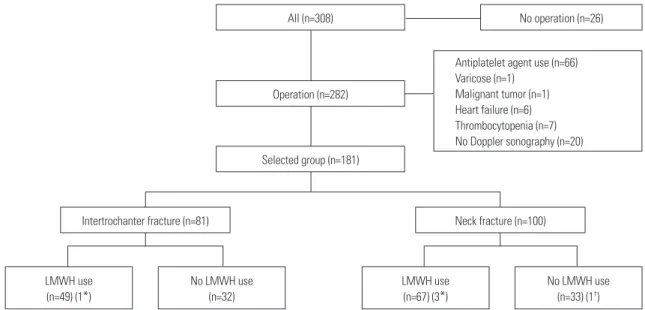
ber 1, 2013, 308 patients were admitted to our hospital, be- cause of femur intertrochanteric or neck fractures. Among these patients, 26 did not undergo surgery, 66 received anti- platelet drugs for a cerebrovascular or cardiovascular disease, one was diagnosed with varicose vein, one had malignant tu- mor, six had chronic heart failure, seven had a platelet short- age (number of platelet <100×103/μL), and 20 did not undergo Doppler ultrasonography; these were excluded from the study. The remaining 181 patients were enrolled for analysis (Fig. 1). Randomly selecting patients who had visited the hos- pital during odd-number weeks, LMWH was administered.
In the LMWH user group, patients were administered 2500 IU of LMWH via subcutaneous injection of 2500 IU of LMWH within 8 hours from their arrival at the recovery room after op- eration. After which, they were administered LMWH once a day until 10 days after surgery. After discharge, a low dose of as- pirin (100 mg) was administered up to 35 days after operation.
Other pharmacological or physical methods to prevent VTE were not used.
In the patients who had no symptoms of VTE, we routinely checked for the possible occurrence of DVT at 10 days after surgery. A radiologist used Doppler ultrasonography, and se- lectively checked the proximal or distal vein and deep or super- ficial vein for possible occurrence of DVT. Acute lesions con- firmed by the radiologist were included. In patients with clinically suspected VTE, Doppler ultrasonography was used even at less than 10 days after surgery. For patients with clinically sus- pected PE, computer tomographic (CT) pulmonary angiogra- phy was performed. To analyze symptoms known to be direct- ly related to a bleeding tendency, we investigated whether the patient had any melena, hematuria, nasal bleeding, hematoma, bleeding in the injured area, and re-operation due to bleeding or thrombocytopenia (platelet count <100×103/μL). After dis- charge, the patients were routinely followed up at 6 weeks, 3
months, 6 months, and 12 months after the operation with a specific interview regarding VTE and bleeding tendency related complications. Patients who were not scheduled for follow-up visits were contacted by telephone.
Statistical analysis
For statistical analysis of the measured data, PASW statistics 18 (SPSS Inc., Chicago, IL, USA) was used. The statistical sig- nificance of the difference was determined by using Student’s t- test for continuous variables and the chi-square test for cate- gorical variables. A p value ≤0.05 was considered significant.
RESULTS
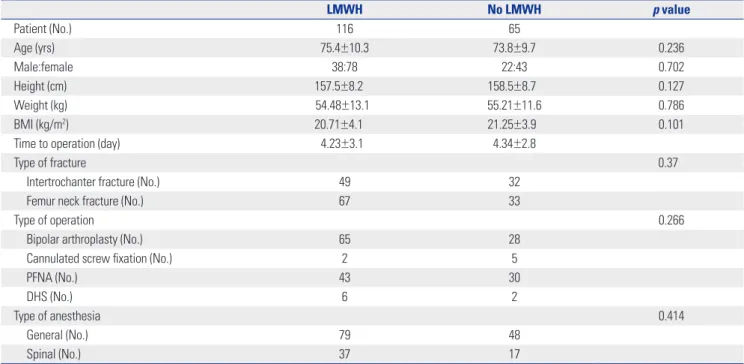
Of the 181 patients evaluated, 116 were LMWH users and 65 were LMWH non users. The demographic data of each group are presented in Table 1. In order to analyze the results of using or not using LMWH for individual types of fracture, the 181 pa- tients were categorized according to type of fracture and wheth- er LMWH was used or not: 81 had a fracture in the intertro- chanteric femur (of which 49 used LMWH and 32 did not) and 100 had a fracture in the femoral neck (Fig. 1).
Of the 181 patients, four had DVT (2.20%), all of whom were in the LMWH user group (3.44%). All DVT cases occurred in the calf vein and did not propagate to the proximal vein. No significant difference was found between the group that used LMWH and the group that did not use LMWH (p=0.298) (Ta- ble 2). In the subgroups analysis there was no significant dif- ferences (Table 3 and 4).
There were no cases in either group that showed melena, hematuria, nasal bleeding, or hematoma requiring re-operat- ing. While three cases of thrombocytopenia (platelet <100×103/ μL) occurred in the group that used LMWH and two cases in
Fig. 1. Flowchart and proportion of patients with surgery type and LMWH use confirmed deep vein thrombosis. *Deep vein thrombosis, †Pulmonary thromboem- bolism. LMWH, low molecular weight heparin.
All (n=308)
Operation (n=282)
Selected group (n=181)
LMWH use (n=49) (1*)
LMWH use (n=67) (3*) No LMWH use
(n=32)
No LMWH use (n=33) (1†) No operation (n=26)
Antiplatelet agent use (n=66) Varicose (n=1)
Malignant tumor (n=1) Heart failure (n=6) Thrombocytopenia (n=7) No Doppler sonography (n=20)
Intertrochanter fracture (n=81) Neck fracture (n=100)
the group that did not use LMWH, there was no statistically sig- nificant difference therein (p=0.591).
DISCUSSION
The prevalence rate of VTE after orthopedic surgery is known to be 40–84% for total knee replacement (TKR), 45–57% for total hip replacement (THR), and 40–84% for hip fracture. In the case of THR, the incidence is higher among black people than among Caucasians, and the incidence is lowest among Asians.7-10
Our study results show that the incidence of VTE after HFS is 2.2%, which is similar to the 3.5% incidence rate reported by Ji, et al.,4 although this is a lower rate than those reported in studies conducted in Caucasians. The difference in results of THR had been reported to be affected by genetics, such as the activated protein C resistance known as factor V Leiden,11 pro- thrombin G 20210A variation,12 and shortage of anti-thrombin.13 Kim and Kim.14 explained that DVT after THR in a Korean pop- ulation showed a significantly lower prevalence rate than that in Caucasians, that no mutation was present in activated pro- tein C or prothrombin G 20210A, and that anti-thrombin was within the normal level. The authors thought that the differ- ence in these factors also played a role in the occurrence of VTE after hip fracture. The authors also thought that another reason why the incidence of VTE was low in their study was associated with the fact that most of the fractures were fall re- lated osteoporotic fracture. Osteoporosis is correlated with a low body mass index rather than obesity, which are related risk factors of VTE. In addition, in our study, the body mass index of the patients was lower than the normal range (Table 1 and 2).15,16
Type of surgery type may affect differences in the incidence of VTE after HFS. Schiff, et al.17 reported that existing risk fac- Table 1. Baseline Demographics and Clinical Characteristics of Population According to Use of Low Molecular Weighted Heparin
LMWH No LMWH p value
Patient (No.) 116 65
Age (yrs) 75.4±10.3 73.8±9.7 0.236
Male:female 38:78 22:43 0.702
Height (cm) 157.5±8.2 158.5±8.7 0.127
Weight (kg) 54.48±13.1 55.21±11.6 0.786
BMI (kg/m2) 20.71±4.1 21.25±3.9 0.101
Time to operation (day) 4.23±3.1 4.34±2.8
Type of fracture 0.37
Intertrochanter fracture (No.) 49 32
Femur neck fracture (No.) 67 33
Type of operation 0.266
Bipolar arthroplasty (No.) 65 28
Cannulated screw fixation (No.) 2 5
PFNA (No.) 43 30
DHS (No.) 6 2
Type of anesthesia 0.414
General (No.) 79 48
Spinal (No.) 37 17
BMI, body mass index; PFNA, proximal femur nail anti-rotation; DHS, dynamic hip screw; LMWH, low molecular weighted heparin; No., number.
Table 4. Patient Number of Pulmonary Embolism and Deep Vein Throm- bosis in the Femur Neck Fracture
Femur neck fracture
p value
LMWH No LMWH
DVT 3 0 0.549
PE 0 1 0.330
DVT, deep vein thrombosis; PE, pulmonary embolism; LMWH, low molecular weighted heparin.
Table 3. Patient Number of Pulmonary Embolism and Deep Vein Throm- bosis in the Femur Intertrochanteric Fracture
Femur intertrochanteric fracture
p value
LMWH No LMWH
DVT 1 0 1.000
PE 0 0
DVT, deep vein thrombosis; PE, pulmonary embolism; LMWH, low molecular weighted heparin.
Table 2. Patient Number of Pulmonary Embolism and Deep Vein Throm- bosis in the All Fracture
LMWH No LMWH p value
DVT 4 0 0.298
PE 0 1 1.000
DVT, deep vein thrombosis; PE, pulmonary embolism; LMWH, low molecular weighted heparin.
tors of VTE, such as old age, sex, obesity, malignant tumor, heart failure or a recent myocardial infarction, increases the occurrence of VTE by two- to nine-fold. However, the effects of such factors have been reported to be minimal after orthope- dic surgery. In particular, TKR and THR have been found to be important factors affecting prevalence rate. In our study, none of the 93 patients with femoral neck fracture had undergone THR, and only bipolar hemiarthroplasty was performed.
Non-movement is an important risk factor for DVT. Two days after operation, we removed the drainage, and continuous passive motion (CPM) devices were started. From 3 days after operation, we started a tilt-table standing practice. If the pa- tients withstand the tilt-table standing, ambulation was started.
In this study, recovery of ambulation took an average of 4.61 days. Rosendaal18 reported that, compared with patients with- out paralysis, those whose limbs are paralyzed had a nine-fold increased prevalence rate of DVT. They also reported that the time from which the patient is injured to the actual surgery af- ter hip fracture has an effect and that, in cases where the sur- gery is delayed by more than 1 day, the incidence increases by 14.5%. In cases where it was delayed by 7 days or more, the rate increased by 33.3%.1,19 Collaboration with other depart- ments is necessary to operate as soon as possible for the treat- ment of older patients with hip fractures. Hence, forming a team specialized in hip fracture can help reduce the duration from injury to surgery and may help prevent the occurrence of VTE.
In our study, we did not observe any melena, hematuria, nasal bleeding, and hematoma that required re-operation. We think that this may be because we used a low dosage of 2500 IU; however, we did not compare this with an administration of 5000 IU. Seven patients had thrombocytopenia, although no significant difference was found between the LMWH user and non-user groups.
The incidence of VTE across the different types of fracture was compared in the sub-group analysis. No significant differ- ence was found between whether LMWH was used or not in the two groups. This may be because the overall prevalence rate of VTE is low, or we assume it may be because none of the 93 patients with femoral neck fracture had undergone THR, as only bipolar hemiarthroplasty had been done.20
Proximal DVT that progresses into PE has significance. In studies on DVT with symptoms, proximal vein thrombosis has been reported to occur in 50–90% of patients who under- went THR and 40–50% of patients who underwent TKR.21,22 However, in our study all DVT cases occurred in the calf vein, accompanying no PE. This difference may be due to the above- mentioned ethnic differences, although it could also be due to a difference in the surgical method. In particular, for TKR, this can be explained by the use of a tourniquet and damage to the inner cellular lining of the arteries when the inserted ob- ject enters.3 While it is rare for a thrombus in the calf vein to develop into PE, when thrombus with symptoms is not treated,
it has been reported to progress to the proximal vein in 16–
33% of the cases and develop into PE in 40–50% of the cases.
Therefore, if thrombus occurs in the calf vein, continuous treat- ment is required.23
One case of PE occurred in the LMWH non-user group in this study, although no significant difference in usage of LMWH was found. In the group with PE, DVT was not observed. In cases where only PE occurs without DVT, the mechanism has yet to be explained fully. This can be explained by cases where it occurs in the pulmonary artery, cases where the thrombus is completely separated from the distal artery, or cases where a false negative result might be obtained in the ultrasound test.24
This study has a few limitations. First, while it was conduct- ed prospectively, selection bias is possible owing to the in- stances of administering LMWH every 2 weeks. Second, con- sidering that the incidences of DVT and PE in Asians are low, the study subjects were relatively few. Therefore, the results may not be representative of the entire Korean population. In power analysis, we found that a sample size of 181 cases pro- vided 90% power (β=0.1; α=0.05) to detect a significant differ- ence in the incidence of DVT or PE between LMWH user group and non-LMWH user group using the McNemar test of equality of paired proportions (nQuery Advisor 4.0, Statistical Solutions, Cork, Ireland). Third, Doppler ultrasonography, which was used in this study is non-invasive and could be used repeatedly. However, the results differ depending on the size and location of the thrombus, the skill of the test conduc- tor, and whether the patient was cooperative. In particular, for the femoral vein, the diagnostic rate is low. Fourth, the au- thors conducted the ultrasonographic test on the 10th day af- ter discharge; however, VTE and PE have been reported to oc- cur naturally up to 30 days after surgery. Therefore, this study is limited in that it only assessed the likelihood of DVT and PE in the early stages.25
In conclusion, the administration of LMWH was not fond to be effective in the prevention of VTE and PE in Korean patients who underwent HFS.
REFERENCES
1. Geerts WH, Bergqvist D, Pineo GF, Heit JA, Samama CM, Lassen MR, et al. Prevention of venous thromboembolism: American College of Chest Physicians Evidence-Based Clinical Practice Guidelines (8th Edition). Chest 2008;133(6 Suppl):381S-453S.
2. Zahn HR, Skinner JA, Porteous MJ. The preoperative prevalence of deep vein thrombosis in patients with femoral neck fractures and delayed operation. Injury 1999;30:605-7.
3. Falck-Ytter Y, Francis CW, Johanson NA, Curley C, Dahl OE, Schul- man S, et al. Prevention of VTE in orthopedic surgery patients: An- tithrombotic Therapy and Prevention of Thrombosis, 9th ed:
American College of Chest Physicians Evidence-Based Clinical Practice Guidelines. Chest 2012;141(2 Suppl):e278S-325S.
4. Ji HM, Lee YK, Ha YC, Kim KC, Koo KH. Little impact of antiplate- let agents on venous thromboembolism after hip fracture surgery.
J Korean Med Sci 2011;26:1625-9.
5. Cha SI, Lee SY, Kim CH, Park JY, Jung TH, Yi JH, et al. Venous thromboembolism in Korean patients undergoing major ortho- pedic surgery: a prospective observational study using computed tomographic (CT) pulmonary angiography and indirect CT ve- nography. J Korean Med Sci 2010;25:28-34.
6. Lee SY, Ro du H, Chung CY, Lee KM, Kwon SS, Sung KH, et al. In- cidence of deep vein thrombosis after major lower limb orthope- dic surgery: analysis of a nationwide claim registry. Yonsei Med J 2015;56:139-45.
7. Gillum RF. Pulmonary embolism and thrombophlebitis in the Unit- ed States, 1970-1985. Am Heart J 1987;114:1262-4.
8. Baker LW, Prajapat DK. Deep vein thrombosis in African and In- dian patients. S Afr J Surg 1974;12:127-31.
9. Cunningham IG, Yong NK. The incidence of postoperative deep vein thrombosis in Malaysia. Br J Surg 1974;61:482-3.
10. Kniffin WD Jr, Baron JA, Barrett J, Birkmeyer JD, Anderson FA Jr.
The epidemiology of diagnosed pulmonary embolism and deep venous thrombosis in the elderly. Arch Intern Med 1994;154:861-6.
11. Dahlbäck B, Carlsson M, Svensson PJ. Familial thrombophilia due to a previously unrecognized mechanism characterized by poor anticoagulant response to activated protein C: prediction of a cofactor to activated protein C. Proc Natl Acad Sci U S A 1993;90:
1004-8.
12. Poort SR, Rosendaal FR, Reitsma PH, Bertina RM. A common ge- netic variation in the 3’-untranslated region of the prothrombin gene is associated with elevated plasma prothrombin levels and an increase in venous thrombosis. Blood 1996;88:3698-703.
13. Heijboer H, Brandjes DP, Büller HR, Sturk A, ten Cate JW. Defi- ciencies of coagulation-inhibiting and fibrinolytic proteins in outpatients with deep-vein thrombosis. N Engl J Med 1990;323:
1512-6.
14. Kim YH, Kim JS. The 2007 John Charnley Award. Factors leading to low prevalence of DVT and pulmonary embolism after THA:
analysis of genetic and prothrombotic factors. Clin Orthop Relat Res 2007;465:33-9.
15. Lee KH, Kim JY, Yim SJ, Moon do H, Choi GH, Moon KH. Inci- dence and risk factors of subsequent hip fractures in Korea: mul- ticenter study. J Korean Med Sci 2014;29:992-4.
16. Compston JE, Flahive J, Hosmer DW, Watts NB, Siris ES, Silver- man S, et al. Relationship of weight, height, and body mass index with fracture risk at different sites in postmenopausal women: the Global Longitudinal study of Osteoporosis in Women (GLOW). J Bone Miner Res 2014;29:487-93.
17. Schiff RL, Kahn SR, Shrier I, Strulovitch C, Hammouda W, Cohen E, et al. Identifying orthopedic patients at high risk for venous thromboembolism despite thromboprophylaxis. Chest 2005;128:
3364-71.
18. Rosendaal FR. Risk factors for venous thrombotic disease. Thromb Haemost 1999;82:610-9.
19. Smith EB, Parvizi J, Purtill JJ. Delayed surgery for patients with fe- mur and hip fractures-risk of deep venous thrombosis. J Trauma 2011;70:E113-6.
20. Sharnoff JG, DeBlasio G. Prevention of fatal postoperative throm- boembolism by heparin prophylaxis. Lancet 1970;2:1006-7.
21. Kearon C, Hirsh J. Starting prophylaxis for venous thromboembo- lism postoperatively. Arch Intern Med 1995;155:366-72.
22. Hull RD, Pineo GF, Stein PD, Mah AF, MacIsaac SM, Dahl OE, et al. Timing of initial administration of low-molecular-weight hep- arin prophylaxis against deep vein thrombosis in patients follow- ing elective hip arthroplasty: a systematic review. Arch Intern Med 2001;161:1952-60.
23. Kearon C. Natural history of venous thromboembolism. Circula- tion 2003;107(23 Suppl 1):I22-30.
24. Schwartz T, Hingorani A, Ascher E, Marks N, Shiferson A, Jung D, et al. Pulmonary embolism without deep venous thrombosis. Ann Vasc Surg 2012;26:973-6.
25. Dahl OE, Gudmundsen TE, Haukeland L. Late occurring clinical deep vein thrombosis in joint-operated patients. Acta Orthop Scand 2000;71:47-50.