Venous Thromboembolism Following Hip and Knee
Replacement Arthroplasty in Korea: A Nationwide Study Based on Claims Registry
The aim of this study was to examine the incidence and trends of clinically relevant venous thromboembolism (VTE) including deep vein thrombosis (DVT) and pulmonary embolism (PE) after hip and knee replacement arthroplasty (HKRA) in Korea. Between January 1 and December 31, 2010, 22,127 hip replacement arthroplasty (HRA) patients and 52,882 knee replacement arthroplasty (KRA) patients were enrolled in the analysis using the
administrative claims database of the Health Insurance Review and Assessment Service (HIRA). All available parameters including procedure history and clinically relevant VTE during the 90 days after HKRA were identified based on diagnostic and electronic data interchange (EDI) codes. The overall incidence of VTE, DVT, and PE during the 90 days was 3.9% (n = 853), 2.7% (n = 597), and 1.5% (n = 327) after HRA, while the incidence was 3.8% (n = 1,990), 3.2% (n = 1,699), and 0.7% (n = 355) after KRA. The incidence of VTE after HKRA was significantly higher in patients who had previous VTE history (odds ratio [OR], 10.8 after HRA, OR, 8.5 after KRA), chronic heart failure (2.1, 1.3), arrhythmia (1.8, 1.7), and atrial fibrillation (3.4, 2.1) than in patients who did not. The VTE incidence in patients with chemoprophylaxis was higher than that in patients without chemoprophylaxis.
The incidence of VTEs revealed in this retrospective review was not low compared with the results of the studies targeting other Asian or Caucasian populations. It may warrant routine prevention including employment of chemoprophylaxis. However, the limitation of the reviewed data mandates large scale prospective investigation to affirm this observation.
Keywords: Venous Thromboembolism; Replacement Arthroplasty; Hip; Knee;
Chemoprophylaxis; Korea Sahnghoon Lee,1 Jee-In Hwang,2
Yunjung Kim,3 Pil Whan Yoon,4 Jeonghoon Ahn,3 and Jeong Joon Yoo1,3
1Department of Orthopedic Surgery, Seoul National University College of Medicine, Seoul; 2Department of Nursing Management, Kyung Hee University College of Nursing Science, Seoul; 3Office of Health Services Research, National Evidence-based Healthcare Collaborating Agency (NECA), Seoul;
4Department of Orthopedic Surgery, University of Ulsan College of Medicine, Asan Medical Center, Seoul, Korea
Received: 26 November 2014 Accepted: 18 August 2015 Address for Correspondence:
Jeong Joon Yoo, MD
Department of Orthopedic Surgery, Seoul National University College of Medicine, Seoul National University Hospital, 101 Daehak-ro, Jongno-gu, Seoul 03080, Korea Tel: +82.2-2072-2368, Fax: +82.2-764-2718 E-mail: [email protected]
Funding: This study was supported by grants from the National Evidence-based Healthcare Collaborating Agency
(NECA-B-12-003) and from the Seoul National University Hospital Research Fund (grant 3020130080).
http://dx.doi.org/10.3346/jkms.2016.31.1.80 • J Korean Med Sci 2016; 31: 80-88
INTRODUCTION
Postoperative venous thromboembolism (VTE), which includes deep vein thrombosis (DVT) and pulmonary embolism (PE), is a serious and potentially life-threatening complication and an important safety issue in acute care hospitals (1). Among major surgical procedures, hip and knee replacement arthroplasty (HKRA) carries the greatest risk of VTE. In the absence of pro- phylactic therapy, the incidence of postoperative VTE is partic- ularly high after lower extremity arthroplasty. The incidence of imaging-confirmed asymptomatic DVT was known to vary from 42% to 57% after hip arthroplasty, and from 41% to 85%
after knee arthroplasty. The incidence of PE varies from 0.9% to 28% after hip arthroplasty, and from 1.5% to 10% after knee ar- throplasty (2). Clinically significant symptomatic VTE has been reported to be less common (2,3).
It has been suggested that there is a substantially lower inci- dence of VTE after HKRA in Asian populations compared with
Western populations (4-6). However, in recent multicenter pro- spective studies performed in Asia, incidences of VTE after ma- jor orthopedic surgery including arthroplasty were comparable to those in Western populations (7-9). Moreover, there are few reports on the incidence of clinically-relevant symptomatic VTE after HKRA in East Asian patients (5,6). To determine to use thromboprophylactic agents routinely after HKRA, a study of symptomatic VTE in a large number of patients is necessary.
There is marked discrepancy among reference studies. Major confounding factors might be various diagnostic modalities with different sensitivity, monitoring duration, lack of informa- tion on the use of mechanical device, study design, and surgeon vigilance.
In this study, we evaluated nationwide data regarding the in- cidence of VTE after HKRA in Korea using the administrative claims database of the Health Insurance Review and Assess- ment Service (HIRA), which comprises fully adjudicated medi- cal and pharmacy claims for 50 million beneficiaries in Korea.
Surgery
Every clinic, hospital, and pharmacy in Korea is obliged to sub- mit patient data regarding healthcare services and medical costs to the HIRA for reimbursement (10). Therefore, almost all clini- cally-relevant VTE events can be identified by analyzing the HIRA database.
The aim of this study was to examine the incidence and trends of clinically-relevant VTE including PE among patients who had undergone HKRA in Korea.
MATERIALS AND METHODS Data source
We analyzed the Korean National Health Insurance (NHI) claims database from HIRA, which examines the accuracy of claims for NHI and National Medical Aid (NMA) programs. The NHI database includes the entire Korean population (approximately 96.6% of the entire 48.6 million population as well as registered foreign-nationals) as a compulsory insurance system, with ex- ceptions for cases applicable to the NMA program covering the remaining 3.4% of the population and foreign military person- nel. The claims data covered by NMA program are also reviewed by HIRA. Thus, nearly all information about patients is available from the HIRA database. Information in the HIRA database in- cludes a unique identification number for each patient, age, sex, and all medical services rendered, along with the diagnos- tic code (based on the International Classification of Diseases, ICD, Tenth Edition), all prescription medications dispensed (based on code for drug ingredient), and procedure history (based
on electronic data interchange [EDI] code). Additional informa- tion includes hospital type where the surgery was performed and the duration of hospitalization.
Study population and baseline characteristics
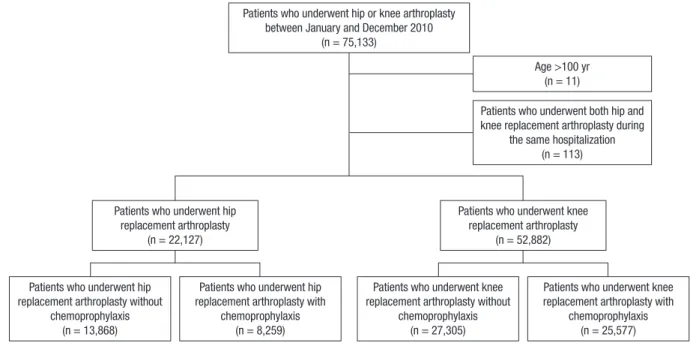
We identified 22,127 patients who underwent hip replacement arthroplasty (HRA) and 52,882 patients who underwent knee replacement arthroplasty (KRA) at 882 hospitals nationwide between January 1 and December 31, 2010. The date of index surgery was defined as the initiation date of hospitalization for HKRA on claims registry data. HRA procedure codes included N0715 for primary bipolar hip hemiarthroplasty, N0711 for pri- mary total hip arthroplasty, N1715 and N1725 for revision par- tial hip arthroplasty (acetabular or stem revision only), and N1711 and N1721 for revision total hip arthroplasty. KRA pro- cedure codes included N2712 (primary unicompartmental knee arthroplasty), N2072 (primary total knee arthroplasty), N4712 and N4722 (revision partial knee arthroplasty), N3712 and N3722 (revision total knee arthroplasty). Patients over 100 yr of age and those who received HRA and KRA at the same hospitalization were excluded. The use of pharmacological VTE prophylaxis such as aspirin, fondaparinux, rivaroxaban, and low molecular weight heparin (LMWH) was identified for each patient. 37.3% of 22,127 HRA patients (n = 8,259) and 48.4% of 52,882 KRA patients (n = 25,577) had received chemoprophy- laxis. The results of the patients in chemoprophylaxis group were assessed and compared with those of 13,868 HRA patients (62.7%) and 27,305 KRA patients (51.6%) who had not received
Fig. 1. Selection process and flowchart of study population. A flowchart shows the selection process of study population. A total of 22,127 patients who underwent hip replace- ment arthroplasty (HRA) and 52,882 patients who underwent knee replacement arthroplasty (KRA) at 882 hospitals nationwide were finally enrolled in the analysis between January 1 and December 31, 2010. Multiple hospitalizations were defined as one episode of hospitalizaton if the interval between the two successive hospitalizations was less than 2 days. Index procedure: the first replacement arthroplasty during the study period. Index date: the first date of hospitalization during which the index replacement arthro- plasty was performed.
Age >100 yr (n = 11)
Patients who underwent both hip and knee replacement arthroplasty during
the same hospitalization (n = 113)
Patients who underwent hip replacement arthroplasty without
chemoprophylaxis (n = 13,868)
Patients who underwent hip replacement arthroplasty with
chemoprophylaxis (n = 8,259)
Patients who underwent knee replacement arthroplasty without
chemoprophylaxis (n = 27,305)
Patients who underwent knee replacement arthroplasty with
chemoprophylaxis (n = 25,577) Patients who underwent hip
replacement arthroplasty (n = 22,127)
Patients who underwent knee replacement arthroplasty
(n = 52,882) Patients who underwent hip or knee arthroplasty
between January and December 2010 (n = 75,133)
chemoprophylaxis (Fig. 1). All clinically relevant VTE during hospitalization and 90 days after HKRA were recorded using the ICD-10 code classification (180, 182 for DVT; 126 for PE).
Baseline characteristics and potential risk factors including pa- tient age, sex, comorbidities, and surgery characteristics were summarized using descriptive statistics such as proportion, mean, and standard deviation. Items for baseline characteris- tics and preoperative morbidities of the patients were listed with reference to the Korean Guideline for the Prevention of VTE in 2010, Guideline for the Prophylaxis of Venous Throm- boembolism in Hip Surgery Patients in 2011, American Acade- my of Orthopaedic Surgery (AAOS) guideline in 2011, 9th edi- tion of the American College of Chest Physicians (ACCP) evi- dence-based clinical practice guideline, NICE guideline in 2010, and the literature. All listed items were reviewed by statisticians and clinical experts.
Statistical analyses
Hospital type was categorized into four groups (tertiary hospi- tal, general hospital, hospital, and clinic). Independent t-test was used for comparison of continuous variables, and chi-square test or Fisher’s exact test was used for categorical variables. The chi-square test of independence was used to evaluate the dif- ference in the incidence among arthroplasty type; and the cu- mulative incidence of VTE was analyzed with the Kaplan-Meier method. Multivariate logistic regression was used to calculate the adjusted odds ratio. Chi-square test was performed to com- pare the incidence between patients with and without comor- bidities. A P value < 0.05 was considered statistically significant.
SAS® statistical software version 9.2 (SAS Institute, Cary, NC, USA) was used for data management and statistical analyses.
Ethics statement
This study protocol was reviewed and approved by the institu- tional review board of the National Evidence-based Healthcare Collaborating Agency (NECAIRB 12-004-1) and Seoul National University Hospital (E-1304-066-482). The board waived inform- ed consent from involved subjects.
RESULTS
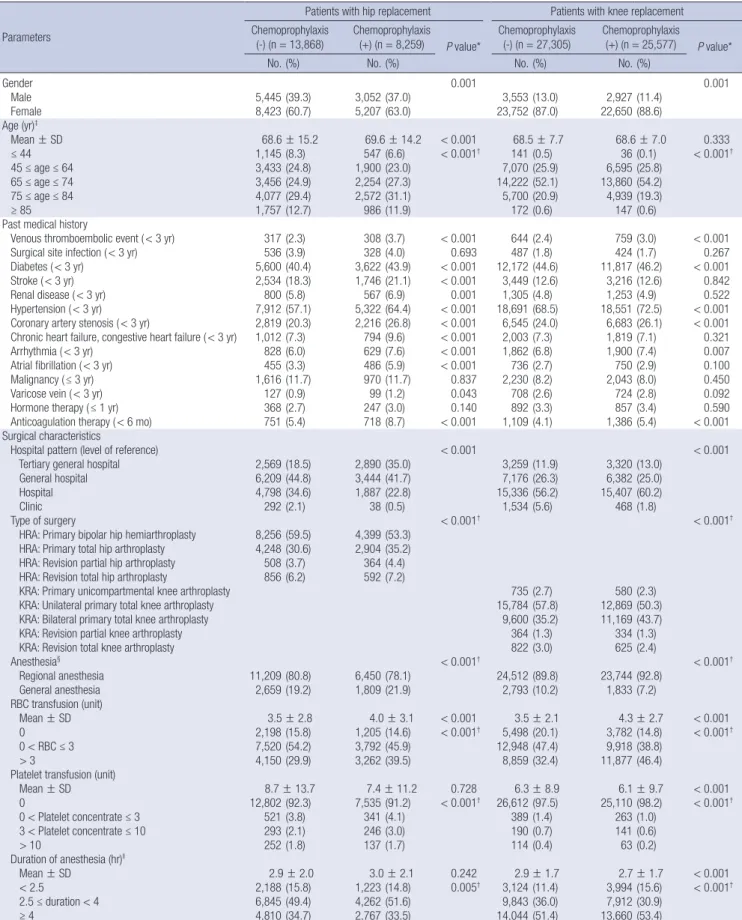
The percent of female patients with knee replacement was high- er than that with hip replacement. The age of most patients with hip replacement was evenly distributed between 45 and 84 yr, while more than half of the patients with knee replacement (52.1%) were between 65- and 74-yr-of-age. Hypertension show- ed the highest prevalence (57.1% to 72.5%) among past medical morbidities. Diabetes, coronary artery stenosis, malignancy and stroke also showed high prevalence. Most hip and knee re- placements were performed in general and secondary level hospitals, whereas more hip replacements were performed in
tertiary general hospitals (35.0%) than hospitals (22.8%) in the group receiving chemoprophylaxis. More than half of HRAs were primary bipolar hip hemiarthroplasty (57.2%) and one- third was primary total hip arthroplasty (32.3%). Regarding KRA, unilateral primary total knee arthroplasty comprised 54.2% of surgeries and bilateral total knee arthroplasty 39.3%. It was un- known whether the bilateral surgeries were simultaneous or staged. Regional anesthesia was used in 87.9% and packed red blood cells were transfused in 83.1%. In 96.1% of HKRA cases, platelets were not transfused. The mean duration of anesthesia was 2.9 hr for HRA and 2.8 hr for KRA. Gender ratio, age, VTE history, diabetes, stroke, hypertension, coronary artery steno- sis, arrhythmia, anticoagulation therapy, surgical characteris- tics, and RBC transfusion differed between the group with che- moprophylaxis and the group without chemoprophylaxis among baseline characteristics (Table 1).
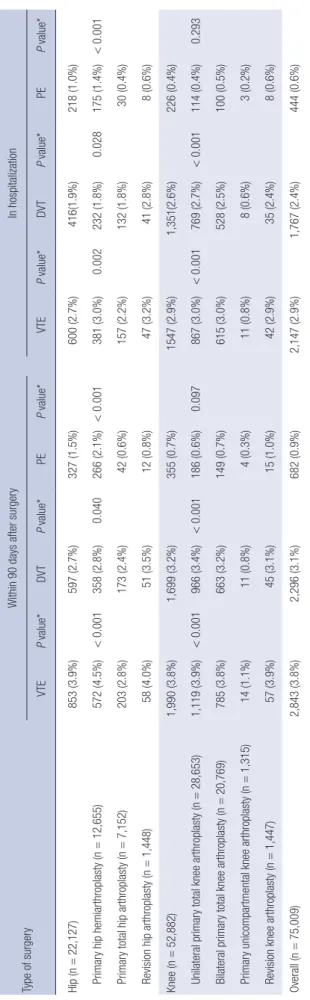
The overall incidence of VTE, DVT, and PE during the 90 days after HRA was 3.9% (853 of 22,127), 2.7% (597 of 22,127), and 1.5% (327 of 22,127), respectively. During hospitalization, 70.3%
of VTE, 69.7% of DVT, 66.7% of PE developed. After KRA, the incidence of VTE, DVT, and PE during 90 days was 3.8% (1,990 of 52,882), 3.2% (1,699 of 52,882), and 0.7% (355 of 52,882). Dur- ing hospitalization, 77.7% of VTE, 79.5% of DVT, and 63.7% of PE developed (Table 2).
Postoperative VTE and PE occurred the most frequently after primary hip hemiarthroplasty; and the incidence of DVT was the highest after revision hip arthroplasty. PE incidence after hemiarthroplasty was more than twice that of primary total or revision hip arthroplasty. VTE incidence after KRA was similar among unilateral primary total knee arthroplasty, bilateral pri- mary total knee arthroplasty, and revision knee arthroplasty.
DVT occurred the most frequently after unilateral primary total knee arthroplasty; and PE incidence was the highest after revi- sion knee arthroplasty. VTE, DVT and PE incidence of primary unicompartmental knee arthroplasty was the lowest among various types of knee surgery (Table 2).
Chemoprophylaxis was used for VTE prevention more fre- quently in KRA (48.4%) than in HRA (37.3%). The incidence of VTE of the group with chemoprophylaxis was compared with that of the group without chemoprophylaxis. VTE, DVT and PE incidence was significantly higher in the group with chemopro- phylaxis. Every incidence by the type of surgery was higher in chemoprophylaxis group except for PE incidence after the revi- sion knee arthroplasty (Table 3).
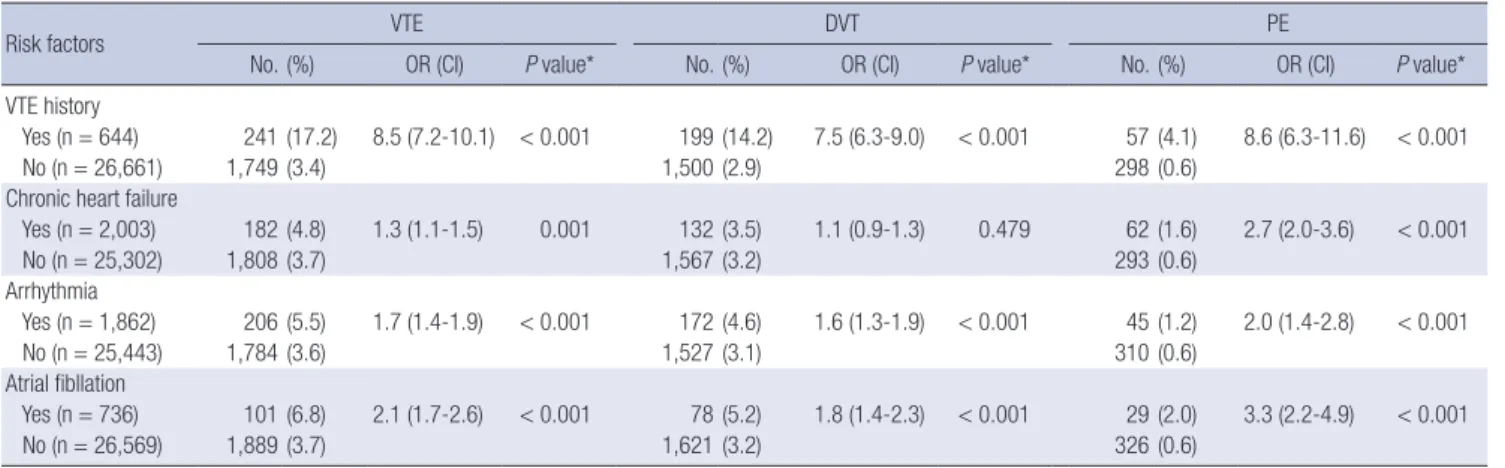
The incidence of VTE, DVT, and PE after HKRA was signifi- cantly higher in patients who had previous VTE history, chronic heart failure, arrhythmia, and atrial fibrillation than those in pa- tients who did not have those risk factors (Tables 4 and 5). Pre- vious VTE history was the strongest risk factor of VTE and PE for both HRA (OR, 10.8 and 9.7) and KRA (OR, 8.5 and 8.6).
Table 1. Baseline characteristics of patients with hip and knee replacement
Parameters
Patients with hip replacement Patients with knee replacement Chemoprophylaxis
(-) (n = 13,868) Chemoprophylaxis (+) (n = 8,259) P value*
Chemoprophylaxis
(-) (n = 27,305) Chemoprophylaxis (+) (n = 25,577) P value*
No. (%) No. (%) No. (%) No. (%)
Gender 0.001 0.001
Male 5,445 (39.3) 3,052 (37.0) 3,553 (13.0) 2,927 (11.4)
Female 8,423 (60.7) 5,207 (63.0) 23,752 (87.0) 22,650 (88.6)
Age (yr)‡
Mean ± SD 68.6 ± 15.2 69.6 ± 14.2 < 0.001 68.5 ± 7.7 68.6 ± 7.0 0.333
≤ 44 1,145 (8.3) 547 (6.6) < 0.001† 141 (0.5) 36 (0.1) < 0.001†
45 ≤ age ≤ 64 3,433 (24.8) 1,900 (23.0) 7,070 (25.9) 6,595 (25.8)
65 ≤ age ≤ 74 3,456 (24.9) 2,254 (27.3) 14,222 (52.1) 13,860 (54.2)
75 ≤ age ≤ 84 4,077 (29.4) 2,572 (31.1) 5,700 (20.9) 4,939 (19.3)
≥ 85 1,757 (12.7) 986 (11.9) 172 (0.6) 147 (0.6)
Past medical history
Venous thromboembolic event ( < 3 yr) 317 (2.3) 308 (3.7) < 0.001 644 (2.4) 759 (3.0) < 0.001
Surgical site infection ( < 3 yr) 536 (3.9) 328 (4.0) 0.693 487 (1.8) 424 (1.7) 0.267
Diabetes ( < 3 yr) 5,600 (40.4) 3,622 (43.9) < 0.001 12,172 (44.6) 11,817 (46.2) < 0.001
Stroke ( < 3 yr) 2,534 (18.3) 1,746 (21.1) < 0.001 3,449 (12.6) 3,216 (12.6) 0.842
Renal disease ( < 3 yr) 800 (5.8) 567 (6.9) 0.001 1,305 (4.8) 1,253 (4.9) 0.522
Hypertension ( < 3 yr) 7,912 (57.1) 5,322 (64.4) < 0.001 18,691 (68.5) 18,551 (72.5) < 0.001 Coronary artery stenosis ( < 3 yr) 2,819 (20.3) 2,216 (26.8) < 0.001 6,545 (24.0) 6,683 (26.1) < 0.001 Chronic heart failure, congestive heart failure ( < 3 yr) 1,012 (7.3) 794 (9.6) < 0.001 2,003 (7.3) 1,819 (7.1) 0.321
Arrhythmia ( < 3 yr) 828 (6.0) 629 (7.6) < 0.001 1,862 (6.8) 1,900 (7.4) 0.007
Atrial fibrillation ( < 3 yr) 455 (3.3) 486 (5.9) < 0.001 736 (2.7) 750 (2.9) 0.100
Malignancy ( ≤ 3 yr) 1,616 (11.7) 970 (11.7) 0.837 2,230 (8.2) 2,043 (8.0) 0.450
Varicose vein ( < 3 yr) 127 (0.9) 99 (1.2) 0.043 708 (2.6) 724 (2.8) 0.092
Hormone therapy ( ≤ 1 yr) 368 (2.7) 247 (3.0) 0.140 892 (3.3) 857 (3.4) 0.590
Anticoagulation therapy ( < 6 mo) 751 (5.4) 718 (8.7) < 0.001 1,109 (4.1) 1,386 (5.4) < 0.001 Surgical characteristics
Hospital pattern (level of reference) < 0.001 < 0.001
Tertiary general hospital 2,569 (18.5) 2,890 (35.0) 3,259 (11.9) 3,320 (13.0)
General hospital 6,209 (44.8) 3,444 (41.7) 7,176 (26.3) 6,382 (25.0)
Hospital 4,798 (34.6) 1,887 (22.8) 15,336 (56.2) 15,407 (60.2)
Clinic 292 (2.1) 38 (0.5) 1,534 (5.6) 468 (1.8)
Type of surgery < 0.001† < 0.001†
HRA: Primary bipolar hip hemiarthroplasty 8,256 (59.5) 4,399 (53.3) HRA: Primary total hip arthroplasty 4,248 (30.6) 2,904 (35.2) HRA: Revision partial hip arthroplasty 508 (3.7) 364 (4.4) HRA: Revision total hip arthroplasty 856 (6.2) 592 (7.2)
KRA: Primary unicompartmental knee arthroplasty 735 (2.7) 580 (2.3)
KRA: Unilateral primary total knee arthroplasty 15,784 (57.8) 12,869 (50.3)
KRA: Bilateral primary total knee arthroplasty 9,600 (35.2) 11,169 (43.7)
KRA: Revision partial knee arthroplasty 364 (1.3) 334 (1.3)
KRA: Revision total knee arthroplasty 822 (3.0) 625 (2.4)
Anesthesia§ < 0.001† < 0.001†
Regional anesthesia 11,209 (80.8) 6,450 (78.1) 24,512 (89.8) 23,744 (92.8)
General anesthesia 2,659 (19.2) 1,809 (21.9) 2,793 (10.2) 1,833 (7.2)
RBC transfusion (unit)
Mean ± SD 3.5 ± 2.8 4.0 ± 3.1 < 0.001 3.5 ± 2.1 4.3 ± 2.7 < 0.001
0 2,198 (15.8) 1,205 (14.6) < 0.001† 5,498 (20.1) 3,782 (14.8) < 0.001†
0 < RBC ≤ 3 7,520 (54.2) 3,792 (45.9) 12,948 (47.4) 9,918 (38.8)
> 3 4,150 (29.9) 3,262 (39.5) 8,859 (32.4) 11,877 (46.4)
Platelet transfusion (unit)
Mean ± SD 8.7 ± 13.7 7.4 ± 11.2 0.728 6.3 ± 8.9 6.1 ± 9.7 < 0.001
0 12,802 (92.3) 7,535 (91.2) < 0.001† 26,612 (97.5) 25,110 (98.2) < 0.001†
0 < Platelet concentrate ≤ 3 521 (3.8) 341 (4.1) 389 (1.4) 263 (1.0)
3 < Platelet concentrate ≤ 10 293 (2.1) 246 (3.0) 190 (0.7) 141 (0.6)
> 10 252 (1.8) 137 (1.7) 114 (0.4) 63 (0.2)
Duration of anesthesia (hr)ll
Mean ± SD 2.9 ± 2.0 3.0 ± 2.1 0.242 2.9 ± 1.7 2.7 ± 1.7 < 0.001
< 2.5 2,188 (15.8) 1,223 (14.8) 0.005† 3,124 (11.4) 3,994 (15.6) < 0.001†
2.5 ≤ duration < 4 6,845 (49.4) 4,262 (51.6) 9,843 (36.0) 7,912 (30.9)
≥ 4 4,810 (34.7) 2,767 (33.5) 14,044 (51.4) 13,660 (53.4)
*Independent t-test for continuous variables; †Chi-square test or Fisher’s exact test for categorical variables; ‡Age at Index date of arthroplasty; §Defined as general anesthesia if inhalant was used; llNo record of anesthesia duration : hip (n = 32), Knee (n = 305).
Table 2. Incidence of VTE in hospitalization and within 90 days after hip and knee replacement Type of surgery Within 90 days after surgeryIn hospitalization VTEP value*DVT P value*PEP value*VTEP value*DVTP value*PEP value* Hip (n=22,127)853 (3.9%)597 (2.7%)327 (1.5%)600 (2.7%)416(1.9%)218 (1.0%) Primary hip hemiarthroplasty (n=12,655)572 (4.5%)<0.001358 (2.8%)0.040266 (2.1%)<0.001381 (3.0%)0.002232 (1.8%)0.028175 (1.4%)<0.001 Primary total hip arthroplasty (n=7,152)203 (2.8%)173 (2.4%)42 (0.6%)157 (2.2%)132 (1.8%)30 (0.4%) Revision hip arthroplasty (n=1,448)58 (4.0%)51 (3.5%)12 (0.8%)47 (3.2%)41 (2.8%)8 (0.6%) Knee (n=52,882)1,990 (3.8%)1,699 (3.2%)355 (0.7%)1547 (2.9%)1,351(2.6%)226 (0.4%) Unilateral primary total knee arthroplasty (n=28,653)1,119 (3.9%)<0.001966 (3.4%)<0.001186 (0.6%)0.097867 (3.0%)<0.001769 (2.7%)<0.001114 (0.4%)0.293 Bilateral primary total knee arthroplasty (n=20,769)785 (3.8%)663 (3.2%)149 (0.7%)615 (3.0%)528 (2.5%)100 (0.5%) Primary unicompartmental knee arthroplasty (n=1,315)14 (1.1%)11 (0.8%)4 (0.3%)11 (0.8%)8 (0.6%)3 (0.2%) Revision knee arthroplasty (n=1,447)57 (3.9%)45 (3.1%)15 (1.0%)42 (2.9%)35 (2.4%)8 (0.6%) Overall (n=75,009)2,843 (3.8%)2,296 (3.1%)682 (0.9%)2,147 (2.9%)1,767 (2.4%)444 (0.6%) *Chi-square homogeneous test for comparing the incidence among types of arthroplasties within the category of hip or knee. VTE, Venous thromboembolism; DVT, Deep vein thrombosis; PE, Pulmonary embolism.
DISCUSSION
The incidence of clinically relevant VTE, DVT and PE following HKRA was 3.8%, 3.1%, and 0.9%, respectively in the present study. More than half of the VTEs occurred during hospitaliza- tion. DVT was found more frequently after KRA whereas the in- cidence of PE after HRA was higher than that after KRA. Che- moprophylaxis was done for VTE prevention more frequently in KRA than HRA. The difference between prophylaxis and non-prophylaxis group makes it difficult to draw firm conclu- sion on the matter of routinely using chemoprophylaxis. Inci- dence of postoperative VTE varies extensively in the literature, not only by ethnic differences and the characteristics of the population, but also by the diagnostic modalities such as ve- nography, CT scan, or duplex ultrasonography, presence of symptoms, the location of the thrombosis, the postoperative monitoring duration, and the use of mechanical preventive de- vices. The results may have been biased similarly in this study.
With all these limitations considered, however, the most im- portant finding was that the incidence of VTE, DVT and PE was not low compared to the incidence in other Asian or Western population studies. This interpretation is mainly based upon the high incidence of VTE in the group of patients who received chemoprophylaxis. The incidence of VTE and DVT that was 7.0%, 5.1% for HRA and 6.2%, 5.4% for KRA, and the incidence of PE that was 2.5% and 1.0% was comparable to those in the high incidence population in the literature. VTE incidence after HKRA decreased dramatically in the past two to three decades and several recent studies showed 0.5%-4.5% PE rate after HRA and 0.0~1.0% after KRA without chemoprophylaxis (11). Even lower rates were shown in a systematic review where symptom- atic VTE and PE were 0.5%-1.1% and 0.1%-0.3% respectively with chemoprophylaxis (1). A Western population-based regis- try data has shown clinically significant VTE as 2.3% after total hip arthroplasty and 1.8% after total knee arthroplasty (12). A meta-analysis of Asian population studies revealed the pooled rate of proximal DVT as 8.9% using venography and 5.9% by ul- trasonography (13). Symptomatic PE was 0.6% in the same study. Overall VTE in this study included events diagnosed with various modalities although they lacked specific information for individual patient. As indicated in other studies with similar methodology, HIRA database has also possibilities that clini- cians had diagnosed the patients as having VTE by clinical sus- picion only, not by using objective diagnostic methods (14).
Along with the possible overestimation of the VTE incidence, there is also possibility of underestimation in this study as there was no way to identify the number of undiagnosed VTE in the population. The observed VTE incidence in the group without prophylaxis was comparable with the relatively low incidence from several Asian studies. A meta-analysis showed a pooled incidence rate as low as 5.8% for proximal DVT diagnosed by
Table 3. Comparison of the VTE incidence according to chemoprophylaxis use after hip and knee replacement Type of surgery
VTE DVT PE
Chemoprophylaxis
P value* Chemoprophylaxis
P value* Chemoprophylaxis
P value*
(-) (+) (-) (+) (-) (+)
Hip (n = 22,127) 274 (2.0%) 579 (7.0%) < 0.001 177 (1.35%) 420 (5.1%) < 0.001 121 (0.9%) 206 (2.5%) < 0.001 Primary hip hemiarthroplasty 198 (2.4%) 374 (8.5%) < 0.001 116 (1.4%) 242 (5.5%) < 0.001 102 (1.2%) 164 (3.7%) < 0.001 Primary total hip arthroplasty 58 (1.4%) 145 (5.0%) < 0.001 46 (1.1%) 127 (4.4%) < 0.001 15 (0.4%) 27 (0.9%) 0.002 Revision total hip arthroplasty 13 (1.5%) 45 (7.6%) < 0.001 11 (1.3%) 40 (6.8%) < 0.001 3 (0.4%) 9 (1.5%) 0.016 Knee (n = 52,882) 406 (1.5%) 1,584 (6.2%) < 0.001 326 (1.2%) 1,373 (5.4%) < 0.001 103 (0.4%) 252 (1.0%) < 0.001 Unilateral primary total knee arthroplasty 250 (1.6%) 869 (6.8%) < 0.001 201 (1.3%) 765 (5.9%) < 0.001 58 (0.4%) 128 (1.0%) < 0.001 Bilateral primary total knee arthroplasty 132 (1.4%) 653 (5.8%) < 0.001 107 (1.1%) 556 (5.0%) < 0.001 36 (0.4%) 113 (1.0%) < 0.001 Primary unicompartmental knee arthroplasty 2 (0.3%) 12 (2.1%) 0.002† 2 (0.3%) 9 (1.6%) 0.014† 0 (0.0%) 4 (0.7%) 0.038† Revision knee arthroplasty 20 (2.4%) 37 (5.9%) < 0.001 14 (1.7%) 31 (5.0%) < 0.001 9 (1.1%) 6 (1.0%) 0.802 Overall (n = 75,009) 680 (1.7%) 2,163 (6.4%) < 0.001 503 (1.2%) 1,793 (5.3%) < 0.001 224 (0.5%) 458 (1.4%) < 0.001
*Chi-square homogeneous test for comparing the incidence between chemoprophylaxis (-) group and chemoprophylaxis (+) group; †Fisher’ exact test. VTE, Venous thrombo- embolism; DVT, Deep vein thrombosis; PE, Pulmonary embolism.
Table 4. Incidence of VTE after hip replacement in patients with significant risk factors
Risk factors VTE DVT PE
No. (%) OR (CI) P value* No. (%) OR (CI) P value* No. (%) OR (CI) P value*
VTE history
Yes (n = 317) 121 (19.4) 10.8 (8.4-13.8) < 0.001 84 (13.4) 9.2 (6.9-12.0) < 0.001 53 (8.5) 9.7 (6.9-13.5) < 0.001
No (n = 13,551) 732 (3.4) 513 (2.4) 274 (1.3)
Chronic heart failure
Yes (n = 1,012) 114 (6.3) 2.1 (1.7-2.6) < 0.001 63 (3.5) 1.5 (1.2-2.0) 0.002 58 (3.2) 2.8 (2.1-3.8) < 0.001
No (n = 12,856) 739 (3.6) 534 (2.6) 269 (1.3)
Arrhythmia
Yes (n = 828) 84 (5.8) 1.8 (1.4-2.2) < 0.001 56 (3.8) 1.7 (1.2-2.2) < 0.001 38 (2.6) 2.1 (1.5-3.0) < 0.001
No (n = 13,040) 769 (3.7) 541 (2.6) 289 (1.4)
Atrial fibllation
Yes (n = 455) 78 (8.3) 3.4 (2.6-4.4) < 0.001 46 (4.9) 2.6 (1.9-3.6) < 0.001 42 (4.5) 4.7 (3.3-6.6) < 0.001
No (n = 13,413) 775 (3.7) 551 (2.6) 285 (1.3)
*Chi-square test for comparing the incidence between patients with and without disease history. VTE, Venous thromboembolism; DVT, Deep vein thrombosis; PE, Pulmonary embolism.
Table 5. Incidence of VTE after knee replacement in patients with significant risk factors
Risk factors VTE DVT PE
No. (%) OR (CI) P value* No. (%) OR (CI) P value* No. (%) OR (CI) P value*
VTE history
Yes (n = 644) 241 (17.2) 8.5 (7.2-10.1) < 0.001 199 (14.2) 7.5 (6.3-9.0) < 0.001 57 (4.1) 8.6 (6.3-11.6) < 0.001
No (n = 26,661) 1,749 (3.4) 1,500 (2.9) 298 (0.6)
Chronic heart failure
Yes (n = 2,003) 182 (4.8) 1.3 (1.1-1.5) 0.001 132 (3.5) 1.1 (0.9-1.3) 0.479 62 (1.6) 2.7 (2.0-3.6) < 0.001
No (n = 25,302) 1,808 (3.7) 1,567 (3.2) 293 (0.6)
Arrhythmia
Yes (n = 1,862) 206 (5.5) 1.7 (1.4-1.9) < 0.001 172 (4.6) 1.6 (1.3-1.9) < 0.001 45 (1.2) 2.0 (1.4-2.8) < 0.001
No (n = 25,443) 1,784 (3.6) 1,527 (3.1) 310 (0.6)
Atrial fibllation
Yes (n = 736) 101 (6.8) 2.1 (1.7-2.6) < 0.001 78 (5.2) 1.8 (1.4-2.3) < 0.001 29 (2.0) 3.3 (2.2-4.9) < 0.001
No (n = 26,569) 1,889 (3.7) 1,621 (3.2) 326 (0.6)
*Chi-square test for comparing the incidence between patients with and without disease history. VTE, Venous thromboembolism; DVT, Deep vein thrombosis; PE, Pulmonary embolism.
venography and 1.9% for symptomatic DVT after KRA in Asian patients which coincides with the results of non-prophylaxis group in the present study (6). Recent Asian studies showed that the incidence of all DVT was 8%-49% in patients not receiv-
ing chemoprophylaxis (15-17). The relatively low incidence of VTE in Asian studies has prompted the disagreement on rou- tine chemoprophylaxis after HKRA (18-20). The low incidence of VTE in Asians is known to be attributed to the low incidence
of obesity and hyperlipidemia as well as the scarcity of some genetic factors (4,19). The current practice includes early post- operative mobilization, the use of stockings and pneumatic compression pumps which may help prevent VTE (21,22).
Given that the rate of symptomatic PE and sudden death are the ultimate targets of VTE prophylaxis and whether an ethnic difference in the incidence of PE exists is still inconclusive, it is vital to explore the incidence of these parameters. The incidence of fatal PE in Western studies appears to have decreased dra- matically when compared to the past records due to early mo- bilization. In one study by Charnley, the PE was 7.8%, despite various approaches of chemical prophylaxis (23). Reported es- timates of symptomatic PE in a more recent meta-analysis with Western populations were 0%-1.5% after HRA and 0%-1.3% af- ter KRA with or without chemoprophylaxis (24,25). Data of the Scottish Arthroplasty Registry revealed an incidence of fatal PE during 90 days was 0.2% after HRA and 0.2% after KRA (12). Sev- eral studies conducted in the United Kingdom with over 1,000 patients reported rates of fatal PE varying from 0.1%-0.4% with- out chemical prophylaxis after HKRA (26,27). For Asian sub- jects, two large-scale trials reported rates of symptomatic PE as 0.5% and 0.4% (7,8). Two recent meta-analyses showed that the rate of symptomatic PE was 0.6% (0%-2.5%) and 0.01% (0.01%- 2.9%) (6,13). The observed PE incidence ranging from 0.0 to 3.7% in the present study corresponded to approximately one third that of VTE and this incidence was not low regardless of chemoprophylaxis. The PE incidence in the patients with pro- phylaxis was rather comparable to that reported in numerous earlier Western studies, whether they were symptomatic or not.
It is notable that overall VTE incidence during 90 days was lower after KRA than after HRA. Bipolar hip hemiarthroplasty and revision surgery of the knee carried a higher risk of VTE and PE occurrence than total hip replacement surgery, revision hip replacement arthroplasty and other type of knee replace- ment surgeries. Higher incidence of overall VTE after KRA than HRA has been demonstrated in many Western and Asian pop- ulations studies (1,7,8,28). High incidence of VTE and PE in bi- polar hip hemiarthroplasty is explained in part by the fact that it corresponds to the surgery for hip fracture. Hip fracture sur- gery has shown greater risk for VTE than THA (7,8). We also should note that the gap between HRA and KRA became small- er or the rates were reversed concerning proximal or symptom- atic DVT or PE in those studies (12,13). It may be due to the size and location of thrombi and postoperative mobilization. The size of their thrombi were smaller and less occlusive after KRA, which caused fewer symptoms than HRA (29).
Another finding was that 20% to 35% of VTE occurred after discharge from the hospital. It has already been proposed that the prophylaxis must be continued after discharge as the risk persists. This vigilance is heightened if the hospitalization is rather short-term as in most western countries where the DVT
prophylaxis is mainly post-discharge procedure. The exact du- ration and selection criteria of at-risk patients for post-discharge chemoprophylaxis, however, is uncertain. The current ACCP thromboprophylaxis guideline recommends extension of pro- phylactic period for up to 35 days (30). Duration of chemopro- phylaxis should be determined considering the cumulative in- cidence of postoperative VTE that changes with prophylaxis.
There is general agreement that the risk of VTE is the highest soon after HKRA during hospitalization and the incidence of asymptomatic DVT decreases as the duration of postoperative prophylaxis increases (31). We should also consider the dura- tion of hospitalization in Asian studies is generally longer than that reported in Western studies. In an Asian multicenter study including 835 patients, no symptomatic VTE occurrence was evident between hospital discharge and 3 months after surgical procedure, in which study the duration of hospital stay was 12- 15 days (8). In the current study, the mean duration of hospital stay was 19.2 days for primary total hip replacement arthroplas- ty and 20.2 days for total knee replacement arthroplasty includ- ing bilateral cases.
Previous history of VTE, chronic heart failure, arrhythmia, and atrial fibrillation were risk factors identified in this study.
They are well known factors from other studies (32). The odds ratio of the incidence of VTE for patients with previous VTE his- tory in this study was 10.8 after HRA and 8.5 for KRA patients when compared to subjects without VTE history. This finding justifies the routine use of chemical prophylaxis for those se- lected patients. However, the individualized therapy that de- pends on risk factors has not yet been endorsed in western gui- delines because the risk of orthopedic replacement surgery far outwei ghs patient-specific factors. A study conducted before 1990 reported that ‘hospitalization with recent surgery’ resulted in an odds ratio of 22 (33). The current clinical practice guide- lines by the Korean Society of Thrombus and Hemostasis in 2014 stratified the joint replacement surgery as moderate risk group with weak recommendation of prophylaxis whereas they stratified the joint replacement surgery with previous VTE as high risk group (34).
This study has several limitations and weaknesses. The in- herent limitation was that the evaluation of data relied solely on the EDI code input by the individual hospital; and the integrity of the information in the registry may vary depending on each hospital. The integrity of the data had been tested by correlating the authentic data in individual hospital and the input informa- tion, but the correlation was not possible. Also, only the items to be reimbursed by the insurance were involved, which meant that mechanical prophylaxis including pneumatic pumps and stockings was not included as they were not reimbursed by the insurance coverage. Subsequent over- or under-estimation of VTE incidence due to various factors is the serious limitation of this study. The data did not include the exact date and time of
prophylaxis initiation, duration of prophylactic treatment, or the date of surgery. The timing of prophylactic treatment initia- tion can affect the efficacy of the anticoagulation along with the incidence of bleeding after hip surgery (35). Body mass index was not estimated as weight or height had not been recorded in the registry. Symptom severity of each patient was evaluated by the surgeon of each hospital and the criteria for positive symp- tomatic DVT or PE was not standardized.
In conclusion, this nationwide database enables an estima- tion of the incidence of total venous thromboembolic disease occurring in Korea after HKRA. The incidence of VTEs in this retrospective review was not low compared with the results of the studies targeting other Asian and Caucasian populations. It may warrant routine prevention including employment of che- moprophylaxis. However, the inconsistency and limitation of the data indicates true incidence may not have been revealed regardless of potential risks. A nationwide prospective investi- gation involving a large-scale controlled trial is required to af- firm this review ed data and to develop the necessary recom- mendations.
DISCLOSURE
The authors declare that they have no potential conflicts of in- terest for this study.
AUTHOR CONTRIBUTION
Conception and design of the work: Lee, S, Ahn J, Yoo JJ. Acqui- sition of data: Hwang JI, Kim Y, Ahn J. Analysis of data: all au- thors. Drafting the manuscript: Lee S, Kim Y, Yoon PW, Ahn J.
Revising and approval of the manuscript: all authors.
ORCID
Sahnghoon Lee http://orcid.org/0000-0003-0725-185X Jee-In Hwang http://orcid.org/0000-0003-2284-5795 Yunjung Kim http://orcid.org/0000-0002-0449-1279 Pil Whan Yoon http://orcid.org/0000-0001-7354-0989 Jeonghoon Ahn http://orcid.org/0000-0002-0177-0192 Jeong Joon Yoo http://orcid.org/0000-0002-6304-0101
REFERENCES
1. Januel JM, Chen G, Ruffieux C, Quan H, Douketis JD, Crowther MA, Colin C, Ghali WA, Burnand B; IMECCHI Group. Symptomatic in-hos- pital deep vein thrombosis and pulmonary embolism following hip and knee arthroplasty among patients receiving recommended prophylaxis:
a systematic review. JAMA 2012; 307: 294-303.
2. Geerts WH, Bergqvist D, Pineo GF, Heit JA, Samama CM, Lassen MR, Colwell CW. Prevention of venous thromboembolism: American College
of Chest Physicians Evidence-Based Clinical Practice Guidelines (8th Edi- tion). Chest 2008; 133: 381S-453S.
3. Eikelboom JW, Karthikeyan G, Fagel N, Hirsh J. American Association of Orthopedic Surgeons and American College of Chest Physicians guide- lines for venous thromboembolism prevention in hip and knee arthro- plasty differ: what are the implications for clinicians and patients? Chest 2009; 135: 513-20.
4. Kim YH, Kim JS. The 2007 John Charnley Award. Factors leading to low prevalence of DVT and pulmonary embolism after THA: analysis of ge- netic and prothrombotic factors. Clin Orthop Relat Res 2007; 465: 33-9.
5. Kang BJ, Lee YK, Kim HJ, Ha YC, Koo KH. Deep venous thrombosis and pulmonary embolism are uncommon in East Asian patients after total hip arthroplasty. Clin Orthop Relat Res 2011; 469: 3423-8.
6. Lee WS, Kim KI, Lee HJ, Kyung HS, Seo SS. The incidence of pulmonary embolism and deep vein thrombosis after knee arthroplasty in Asians remains low: a meta-analysis. Clin Orthop Relat Res 2013; 471: 1523-32.
7. Leizorovicz A, Turpie AG, Cohen AT, Wong L, Yoo MC, Dans A; SMART Study Group. Epidemiology of venous thromboembolism in Asian pa- tients undergoing major orthopedic surgery without thromboprophy- laxis. The SMART study. J Thromb Haemost 2005; 3: 28-34.
8. Piovella F, Wang CJ, Lu H, Lee K, Lee LH, Lee WC, Turpie AG, Gallus AS, Planès A, Passera R, et al. Deep-vein thrombosis rates after major orthopedic surgery in Asia. An epidemiological study based on postoper- ative screening with centrally adjudicated bilateral venography. J Thromb Haemost 2005; 3: 2664-70.
9. Leizorovicz A; SMART Venography Study Steering Committee. Epide- miology of post-operative venous thromboembolism in Asian patients.
Results of the SMART venography study. Haematologica 2007; 92: 1194- 200.
10. Lee YK, Ha YC, Park C, Yoo JJ, Shin CS, Koo KH. Bisphosphonate use and increased incidence of subtrochanteric fracture in South Korea: re- sults from the National Claim Registry. Osteoporos Int 2013; 24: 707-11.
11. Kim KI, Kang DG, Khurana SS, Lee SH, Cho YJ, Bae DK. Thrombopro- phylaxis for deep vein thrombosis and pulmonary embolism after total joint arthroplasty in a low incidence population. Knee Surg Relat Res 2013; 25: 43-53.
12. Howie C, Hughes H, Watts AC. Venous thromboembolism associated with hip and knee replacement over a ten-year period: a population- based study. J Bone Joint Surg Br 2005; 87: 1675-80.
13. Kanchanabat B, Stapanavatr W, Meknavin S, Soorapanth C, Sumanas- rethakul C, Kanchanasuttirak P. Systematic review and meta-analysis on the rate of postoperative venous thromboembolism in orthopaedic surgery in Asian patients without thromboprophylaxis. Br J Surg 2011;
98: 1356-64.
14. Jang MJ, Bang SM, Oh D. Incidence of venous thromboembolism in Ko- rea: from the Health Insurance Review and Assessment Service database.
J Thromb Haemost 2011; 9: 85-91.
15. Chen CJ, Wang CJ, Huang CC. The value of D-dimer in the detection of early deep-vein thrombosis after total knee arthroplasty in Asian patients:
a cohort study. Thromb J 2008; 6: 5.
16. Ko PS, Chan WF, Siu TH, Khoo J, Wu WC, Lam JJ. Deep venous throm- bosis after total hip or knee arthroplasty in a “low-risk” Chinese popula- tion. J Arthroplasty 2003; 18: 174-9.
17. Sudo A, Sano T, Horikawa K, Yamakawa T, Shi D, Uchida A. The inci- dence of deep vein thrombosis after hip and knee arthroplasties in Japa-
nese patients: a prospective study. J Orthop Surg (Hong Kong) 2003; 11:
174-7.
18. Yokote R, Matsubara M, Hirasawa N, Hagio S, Ishii K, Takata C. Is rou- tine chemical thromboprophylaxis after total hip replacement really nec- essary in a Japanese population? J Bone Joint Surg Br 2011; 93: 251-6.
19. Kim YH, Yoo JH, Kim JS. Factors leading to decreased rates of deep vein thrombosis and pulmonary embolism after total knee arthroplasty. J Ar- throplasty 2007; 22: 974-80.
20. Won MH, Lee GW, Lee TJ, Moon KH. Prevalence and risk factors of throm- boembolism after joint arthroplasty without chemical thromboprophy- laxis in an Asian population. J Arthroplasty 2011; 26: 1106-11.
21. Pearse EO, Caldwell BF, Lockwood RJ, Hollard J. Early mobilisation af- ter conventional knee replacement may reduce the risk of postoperative venous thromboembolism. J Bone Joint Surg Br 2007; 89: 316-22.
22. Daniel J, Pradhan A, Pradhan C, Ziaee H, Moss M, Freeman J, McMinn DJ. Multimodal thromboprophylaxis following primary hip arthroplas- ty: the role of adjuvant intermittent pneumatic calf compression. J Bone Joint Surg Br 2008; 90: 562-9.
23. Johnson R, Green JR, Charnley J. Pulmonary embolism and its prophy- laxis following the Charnley total hip replacement. Clin Orthop Relat Res 1977; (127): 123-32.
24. Freedman KB, Brookenthal KR, Fitzgerald RH Jr, Williams S, Lonner JH. A meta-analysis of thromboembolic prophylaxis following elective total hip arthroplasty. J Bone Joint Surg Am 2000; 82-A: 929-38.
25. Westrich GH, Haas SB, Mosca P, Peterson M. Meta-analysis of throm- boembolic prophylaxis after total knee arthroplasty. J Bone Joint Surg Br 2000; 82: 795-800.
26. Warwick D, Williams MH, Bannister GC. Death and thromboembolic disease after total hip replacement. A series of 1162 cases with no routine chemical prophylaxis. J Bone Joint Surg Br 1995; 77: 6-10.
27. Ansari S, Warwick D, Ackroyd CE, Newman JH. Incidence of fatal pul- monary embolism after 1,390 knee arthroplasties without routine pro-
phylactic anticoagulation, except in high-risk cases. J Arthroplasty 1997;
12: 599-602.
28. Geerts WH, Heit JA, Clagett GP, Pineo GF, Colwell CW, Anderson FA Jr, Wheeler HB. Prevention of venous thromboembolism. Chest 2001; 119 Suppl: 132S-75S.
29. Ascani A, Radicchia S, Parise P, Nenci GG, Agnelli G. Distribution and occlusiveness of thrombi in patients with surveillance detected deep vein thrombosis after hip surgery. Thromb Haemost 1996; 75: 239-41.
30. Falck-Ytter Y, Francis CW, Johanson NA, Curley C, Dahl OE, Schulman S, Ortel TL, Pauker SG, Colwell CW. Prevention of VTE in orthopedic sur- gery patients: antithrombotic therapy and prevention of thrombosis, 9th Ed: American College of Chest Physicians Evidence-Based Clinical Prac- tice Guidelines. Chest 2012; 141: e278S-325S.
31. Kearon C. Duration of venous thromboembolism prophylaxis after sur- gery. Chest 2003; 124 Suppl: 386S-92S.
32. Pedersen AB, Sorensen HT, Mehnert F, Overgaard S, Johnsen SP. Risk factors for venous thromboembolism in patients undergoing total hip replacement and receiving routine thromboprophylaxis. J Bone Joint Surg Am 2010; 92: 2156-64.
33. Heit JA, Silverstein MD, Mohr DN, Petterson TM, O’Fallon WM, Melton LJ 3rd. Risk factors for deep vein thrombosis and pulmonary embolism:
a population-based case-control study. Arch Intern Med 2000; 160: 809- 15.
34. Bang SM, Jang MJ, Kim KH, Yhim HY, Kim YK, Nam SH, Hwang HG, Bae SH, Kim SH, Mun YC, et al. Prevention of Venous Thromboembo- lism, 2nd Edition: Korean Society of Thrombosis and Hemostasis Evi- dence-Based Clinical Practice Guidelines. J Korean Med Sci 2014; 29:
164-71.
35. Strebel N, Prins M, Agnelli G, Büller HR. Preoperative or postoperative start of prophylaxis for venous thromboembolism with low-molecular- weight heparin in elective hip surgery? Arch Intern Med 2002; 162: 1451-6.