Received:September 20, 2018, Revised:October 26, 2018, Accepted:November 1, 2018 Corresponding to:Jae-Bum Jun http://orcid.org/0000-0002-0208-0505
Department of Rheumatology, Hanyang University Hospital for Rheumatic Diseases, 222 Wangsimni-ro, Seongdong-gu, Seoul 04763, Korea. E-mail:[email protected]
Copyright ⓒ 2019 by The Korean College of Rheumatology. All rights reserved.
This is a Open Access article, which permits unrestricted non-commerical use, distribution, and reproduction in any medium, provided the original work is properly cited.
Fate of Abstracts Presented at the Korean College of Rheumatology Annual Scientific Meetings
Yong-Gil Kim1, Chan-Bum Choi2, Seong Wook Kang3, Jinseok Kim4, Young Dae Kim5, Jaejoon Lee6, Myeung Su Lee7, Young-Ho Lee8, Jun-Ki Min9, Min-Chan Park10, Sung Hoon Park11, Yong-Wook Park12, Seung Wook Lee13, Jae-Bum Jun2
1Division of Rheumatology, Department of Internal Medicine, Asan Medical Center, University of Ulsan College of Medicine, 2Department of Rheumatology, Hanyang University Hospital for Rheumatic Diseases, Seoul, 3Department of Internal Medicine, Chungnam National University School of Medicine, Daejeon, 4Department of Internal Medicine, Jeju National University Hospital, Jeju, 5Department of Pediatrics, Ilsan Paik Hospital, Inje University College of Medicine, Goyang, 6Division of Rheumatology, Department of Medicine, Samsung Medical Center, Sungkyunkwan University School of Medicine, Seoul, 7Division of Rheumatology, Department of Internal Medicine, Wonkwang University Hospital, Iksan, 8Division of Rheumatology, Department of Internal Medicine, Korea University College of Medicine, 9Division of Rheumatology, Department of Internal Medicine, College of Medicine, The Catholic University of Korea, 10Division of Rheumatology, Department of Internal Medicine, Gangnam Severance Hospital, Yonsei University College of Medicine, Seoul, 11Division of Rheumatology, Department of Internal Medicine, Arthritis and Autoimmunity Research Center, Catholic University of Daegu School of Medicine, Daegu, 12Department of Rheumatology, Chonnam National University Medical School and Hospital, Gwangju, 13Department of Urology, Hanyang University Guri Hospital, Guri, Korea
Objective. To evaluate the fate of abstracts presented at scientific meetings of the Korean College of Rheumatology (KCR).
Methods. This study examined the abstracts presented at annual meetings of the KCR from 2005 to 2014. Only original studies were selected, excluding case reports. A manual search was conducted using PubMed, KoreaMed, Cochrane Library, and Embase to track the published articles. The abstracts were considered to have been published if the authors, title, study design, and results were the same for a published article. In addition, they were considered published if the author and the study design matched, even if the results of the abstract and the results of the published articles were not identical. Results. A total of 928 abstracts from 2005 to 2014 were analyzed. Of the 928 abstracts, 468 (50.43%) abstracts were published in a peer-reviewed journal and the mean time to publication was 19 months. Of the 468 abstracts, 414 were published in a science citation index extended (SCI[E]) journal, and 54 were published in non-SCI(E) journals. The proportion of SCI(E) articles increased annually.
The average impact factor for the SCI(E) journals was 2.93. In subgroup analysis, the abstracts that were awarded the best oral or best poster presentation were more likely to be published as full-length articles with a higher impact factor than the abstracts not awarded. Conclusion. Half of the abstracts presented in the KCR annual meetings were published in a peer-reviewed journal. Approximately 90% of the articles were published in a SCI(E) journal. (J Rheum Dis 2019;26:41-45)
Key Words. Abstract, Publication, Rheumatology, Korea
INTRODUCTION
The Korean College of Rheumatology (KCR), previously called the Korean Rheumatology Association, was or- ganized 37 years ago. Since then, rheumatology has been recognized as a special field in Korea. According to a re- cent study [1], membership of the KCR has increased an- nually, reaching almost 800 member this year.
The academic conference of KCR is held every year in spring, reaching 38th in 2018, and provides an oppor- tunity for rheumatologists, immunologists, orthopedics, pediatricians, and related health care professionals in Korea to share knowledge by gathering relevant medical issues, and exchanging recent experience and scientific information. In particular, the abstracts presented at aca- demic conferences have implications on the experience
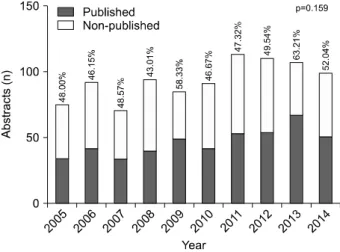
Figure 1. Annul publication rate as a full-length article.
Chi-square test.
and knowledge of each practitioner. In addition, the ab- stract has been published in a medical or scientific journal and plays an important role in sharing the latest knowledge. On the other hand, a large number of ab- stracts cannot be published as papers due to the lack of data, statistical limitations, and lack of originality.
In 1980, the first study revealing the fate of abstracts was published in The New England Journal of Medicine [2].
Goldman and Loscalzo [2] selected 276 cardiology ab- stracts published in conjunction with three national meetings and reported that approximately 50% of ab- stracts led to full-length articles in peer-reviewed journals and the median interval between publication of the ab- stract was 14 months. In a Cochrane review of 46 studies, the publication rate of abstracts was a median of 45%
(ranging from 11% to 78%) [3]. In a recent study [4], the overall 2- and 5-year publication rates of abstracts pre- sented at major international ophthalmology conferences were 33.3% and 47.2%, respectively. Furthermore, a total of 538 abstracts presented at the European Association for Palliative Care (EAPC) congress meeting in 2005 were analyzed to determine the publication rate and the time to publish [5]. Of these, 43% of abstracts were published as a full-length article in peer-reviewed journals.
Approximately one fifth of articles were published within 6 months, a quarter within 12 months, and 39% within 36 months of the presentation at the EAPC conference. In Korea, abstracts presented at the conference of Korean Urological Association (KUA) were analyzed. Approximately 40% of abstracts were published as full-length articles and it took 19 months on average for them to be pub- lished in a journal [6].
Over the past decade, the academic activities of KCR members have grown [1]. Therefore, an objective evalua- tion of the competence of the members of the society is needed. No prior study has evaluated the quality of KCR scientific meetings until now. This study evaluated the quality by analyzing the rate of publication of abstracts presented at the annual scientific meetings of the KCR.
MATERIALS AND METHODS
The subsequent publication rate of the 928 abstracts presented at the KCR conferences from 2005 to 2014 as full-length articles was evaluated because it was esti- mated that the time to publish was mostly within three years according to similar studies [2,5,6]. A manual search was conducted using PubMed, KoreaMed, Cochrane
Library, and Embase. The affiliations (universities or hos- pitals) and author names of each abstract were searched.
Only full-length articles, excluding case reports, letters, reviews, and editorials, were selected. The article was considered published if the author, title, study design, and results were the same in the abstract and article. Even when the results of the abstract and articles published were somewhat different, the abstracts were considered published if the author and study design were similar. If the abstract presented in the KCR conference was de- termined to be published as an article, the published jour- nal, journal impact factor (IF), publication time, and pub- lication year were examined.
The articles published were classified into the science ci- tation index (SCI) or SCI extended (SCIE) journal, and non-SCI(E) journal according to the Web of Science (Clarivate Analytics, Philadelphia, PA, USA) and the IF was established according to InCites Journal Citation Reports (Clarivate Analytics).
The percentage of abstracts that were subsequently pub- lished as full-length articles was calculated. The rate of publication and classification of the published journal ac- cording to years were analyzed using a Chi-square test.
ANOVA was used to determine the time elapsed until publication and the IF of the published journal. For data analysis, PASW statistical software, version 18.0 (IBM Corp., Armonk, NY, USA) was used and a p-value <0.05 was considered significant.
RESULTS
Of the 928 abstracts presented at KCR annual scientific
Table 2. Impact factor of SCI(E) journals published annually Year SCI(E) Impact factor p-value*
2005 28 3.14±2.24 0.34
2006 34 2.96±1.91
2007 32 3.35±1.67
2008 29 2.85±1.06
2009 43 3.07.±2.21
2010 34 2.12±0.90
2011 50 2.94±1.77
2012 48 3.17±2.12
2013 66 2.91±2.05
2014 50 2.77±1.50
Total 414 2.93±1.83
Values are presented as number only or mean±standard deviation. SCI: science citation index, SCI(E): SCI extended.
*ANOVA.
Table 3. Fate of abstracts that win awards
Total Articles SCI(E) p-value*
No award 844 412 (48.81) 364 (43.12) 0.008
Best poster presentation 43 29 (67.44) 23 (53.49)
Best oral presentation 41 27 (65.85) 27 (65.85)
Total 928 468 (50.43) 414 (44.61)
Values are presented as number only or number (%). SCI: science citation index, SCI(E): SCI extended. *Chi-square test.
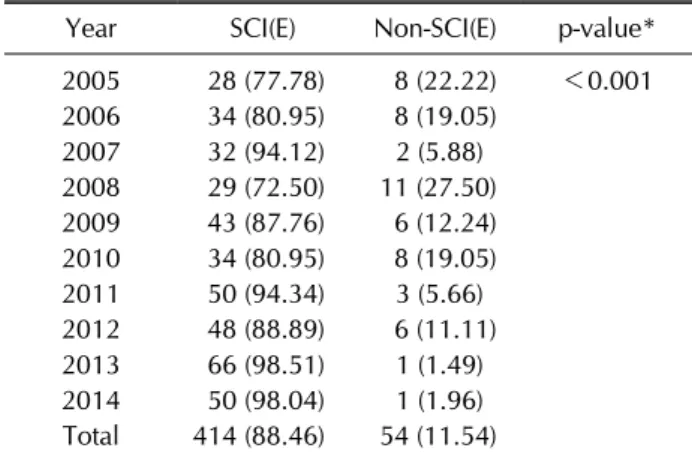
Table 1. Proportion of the SCI(E) journals published annually
Year SCI(E) Non-SCI(E) p-value*
2005 28 (77.78) 8 (22.22) <0.001 2006 34 (80.95) 8 (19.05)
2007 32 (94.12) 2 (5.88) 2008 29 (72.50) 11 (27.50) 2009 43 (87.76) 6 (12.24) 2010 34 (80.95) 8 (19.05) 2011 50 (94.34) 3 (5.66) 2012 48 (88.89) 6 (11.11) 2013 66 (98.51) 1 (1.49) 2014 50 (98.04) 1 (1.96) Total 414 (88.46) 54 (11.54)
Values are presented as number (%). SCI: science citation index, SCI(E), SCI extended. *Chi-square test.
meetings from 2005 to 2014, 468 abstracts (50.43%) were identified as full-length articles in peer-reviewed journals. There was no abstract presented by foreigner during that period. As shown in Figure 1, there was no significant difference in the rate of articles published annually. The rate of publication ranged from 43.01%
(2008) to 63.21% (2013). The time from the abstract to article publication was 19.42±16.79 months, and there was no difference in the time taken for publication in each year (data not shown).
As shown in Table 1, among the 468 articles published, 414 (88.46%) were published in SCI or SCIE journals, and 54 (11.54%) were published in non-SCI(E) journals.
That is, almost 45% of the abstracts presented at KCR sci- entific meetings were applied to the SCI(E) journals. An increase in the proportion of SCI(E) journals over time was noted. An examination of the IF of the year in which the article was published in the SCI(E) journal revealed a mean IF score of 2.93±1.83, which was similar in each year (Table 2).
Through a fair examination of the academic affairs com- mittee and publication committee of KCR, 10% of ab- stracts had been awarded annually as the best oral pre-
sentation or best poster presentation. In subgroup analy- sis (Table 3), the 84 abstracts awarded the best oral pre- sentation or best poster presentation, were more likely to be published compared to the 844 abstracts not awarded (p=0.008). Interestingly, the IF of articles which had best oral presentation (4.21±2.52) or best poster pre- sentation (3.32±1.75), showed a higher IF than those not awarded (2.83±1.74) (p<0.001) (Table 4).
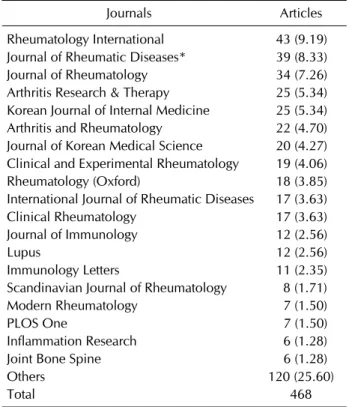
As shown in Table 5, among the journals that published the 468 abstracts as full-length articles, the most frequent was Rheumatology International (9.19%), followed in or- der by the Journal of Rheumatic Diseases (JRD), which is the official journal of the KCR (8.33%), and Journal of Rheumatology (7.26%). The abstracts presented at KCR conferences were published in foreign journals (77.78%) and domestic journals (22.22%), including JRD, Korean Journal of Internal Medicine, and Journal of Korean Medical Science.
DISCUSSION
Several years ago, global scientific progress in the field of
Table 4. Impact factor of articles dependent on a type of award SCI(E) Impact factor p-value†
Not awarded 364 2.83±1.74
Best poster presentation 23 3.32±1.75 0.321† Best oral presentation 27 4.21±2.52
Total 414 2.93±1.83
p-value* <0.001
Values are presented as number only or mean±standard deviation. SCI: science citation index, SCI(E): SCI extended.
*ANOVA between best poster presentation vs. best oral presentation, impact factor. †Mann Whitney test.
Table 5. List of journals published as full-length articles
Journals Articles
Rheumatology International 43 (9.19) Journal of Rheumatic Diseases* 39 (8.33)
Journal of Rheumatology 34 (7.26)
Arthritis Research & Therapy 25 (5.34) Korean Journal of Internal Medicine 25 (5.34) Arthritis and Rheumatology 22 (4.70) Journal of Korean Medical Science 20 (4.27) Clinical and Experimental Rheumatology 19 (4.06)
Rheumatology (Oxford) 18 (3.85)
International Journal of Rheumatic Diseases 17 (3.63)
Clinical Rheumatology 17 (3.63)
Journal of Immunology 12 (2.56)
Lupus 12 (2.56)
Immunology Letters 11 (2.35)
Scandinavian Journal of Rheumatology 8 (1.71)
Modern Rheumatology 7 (1.50)
PLOS One 7 (1.50)
Inflammation Research 6 (1.28)
Joint Bone Spine 6 (1.28)
Others 120 (25.60)
Total 468
Values are presented as number (%). *Official journal of Korean College of Rheumatology.
rheumatology was measured by an evaluation of the num- ber of the publications of rheumatologists between 2000 and 2011 [7]. In 2000, the number of papers published was 3,278; this number has increased annually, reaching 7,461 in 2011, a more than 2-fold increase. On the other hand, Korea was not included in the top 10 countries (ranking in the order of USA, England, Germany, Netherlands, Italy, Japan, France, Canada, Sweden, and Switzerland) publishing papers. At this point, it is im- portant to evaluate the scientific competence of KCR members through objective indicators.
Between 2005 and 2014, a total of 50.43% of abstracts presented at KCR annual conferences were published as full-length articles. The rate of publication appears to be superior to previous studies [3,4,6]. Furthermore, the rate of publication in SCI(E) journals was 88% of the total journals published, which has increased annually. These findings suggest that the abstracts released at the KCR annual meetings are comparable to the global standard and that the research activities of KCR members are also excellent.
In a recent study of the Romanian Society of Gastroenter- ology and Hepatology, only 10% of abstracts presented at the 2013 and 2014 meetings were published as full-length articles in indexed journals [8]. They men- tioned that Romania is a non-native English-speaking re- gion, which was the reason for the low publication rate.
Indeed, the publication rate of abstracts presented at an international emergency medicine meeting was different between native English-speaking countries and non-na- tive English-speaking countries (36.9% vs. 18.8%) [9].
Considering that Korea is a non-native English-speaking country, the high publication rate in the present study highlights the excellent scholarship of the members.
Although publication media and open-assess policy
could influence the journal citation rate, the IF is gen- erally used as a criterion to evaluate the quality of an ar- ticle and to assess the research competence of a research team or individual [10]. In a previous study in the field of radiation oncology in Korea, the average IF was 2.9 for all published SCI(E) journals written by members of the Korean Society of Radiation Oncology from 1981 to 2011 and the average IF tend to decrease with years [11]. In the present study, the overall mean IF was 2.93 when the IF of the year in which the abstract was published in the SCI(E) journal was analyzed, and the IF was not different over time. Interestingly, all articles awarded the best oral presentation were more likely to be published in a SCI(E) journal and the IF (4.21±2.52) was higher than that (2.83±1.74) of articles not awarded. This type of analysis is the first to the authors’ knowledge, and it is believe that it could be a standard to evaluate the methodological rele- vance of whether the abstracts awarded are qualified scientifically.
In a similar study performed in Korea [6], most abstracts were published in the Korean Journal of Urology (57.5%), which is the official journal of the KUA. In the present study, however, only 8.3% of abstracts were published in
the JRD, the official journal of KCR, because it was not a SCI(E) journal and comprised mainly of case reports dur- ing the period of study. Recently, the JRD has been reno- vated to meet the international standards of peer-re- viewed journals. Since 2016, articles of the JRD have been published in English only and comprised mainly of full-length articles. The editors of JRD believe that in- corporation in a SCI(E) journal in the future will be neces- sary for many KCR members to contribute a good article to their official journal.
The limitations of the present study include the possi- bility of missed published articles because a manual search was conducted. Moreover, some abstracts could have been unmatched if the study design had changed when it was published in a journal. On the other hand, the present study is valuable in that it reflects the high scien- tific quality of the KCR annual meetings for a long time.
CONCLUSION
Half of the abstracts presented at the scientific meetings of the KCR from 2005 to 2014 were published as full- length articles in peer-reviewed journals. Approximately 90% of full-length articles were published in the SCI(E) journal, and this ratio has increased over time. Based on our results, the quality of abstracts presented at the KCR annual meetings reaches sufficiently to the international standard.
ACKNOWLEDGMENTS
This work was supported by the research fund of the Korean College of Rheumatology (KCR-2018-01).
CONFLICT OF INTEREST
No potential conflict of interest relevant to this article
was reported.
REFERENCES
1. Kim HY, Song YW. The dynamic evolution of rheumatology in Korea. Nat Rev Rheumatol 2016;12:183-9.
2. Goldman L, Loscalzo A. Fate of cardiology research origi- nally published in abstract form. N Engl J Med 1980;303:
255-9.
3. Scherer RW, Langenberg P, von Elm E. Full publication of results initially presented in abstracts. Cochrane Database Syst Rev 2007;(2):MR000005.
4. Villani E, Vujosevic S, Specchia C, Tresca Carducci F, De Cillà S, Nucci P. The fate of abstracts presented at interna- tional ophthalmology meetings: 2- and 5-year publication rates. Eur J Ophthalmol 2018 Jul 1 [Epub]. DOI: 10.1177/
1120672118784802.
5. Hanchanale SV, Jordan A. From abstract to publication: the fate of research presented at the European Association for Palliative Care Congress Meeting. Palliat Med 2014;28:
534-5.
6. Chung JH, Autorino R, Kang DH, Lee JY, Moon HS, Choi HY, et al. Fate of abstracts presented at the annual meeting of the Korean Urological Association. Korean J Urol 2012;
53:280-4.
7. Tezcan ME. Overview of the publications of rheumatolo- gists after the millennium. Eur J Rheumatol 2015;2:96-8.
8. Trifan A, Chihaia CA, Tanase O, Lungu CM, Stanciu C. The fate of abstracts presented at the 2013 and 2014 annual meetings of the Romanian Society of Gastroenterology and Hepatology. J Gastrointestin Liver Dis 2016;25:533-6.
9. Chan JW, Graham CA. Full text publication rates of studies presented at an International Emergency Medicine Scientific Meeting. Emerg Med J 2011;28:802-3.
10. Oh J, Chang H, Kim JA, Choi M, Park Z, Cho Y, et al.
Citation analysis for biomedical and health sciences jour- nals published in Korea. Healthc Inform Res 2017;23:
218-25.
11. Park W, Huh SJ. Current status and trend of the publication to the SCI and SCIE journals in the field of radiation oncol- ogy in Korea for 30 years. Radiat Oncol J 2012;30:14-9.