Kyung Hee Roh
( )
국립농업과학원 농업생명자원부(Department of Agricultural Biotechnology, National Academy of Agricultural Science, RDA, Suwon 441-707, Korea) e-mail: [email protected]
Bo-Kyung Kwak ・ Jong-Bum Kim ・ Kyeong-Ryeol Lee ・ Hyun Uk Kim ・ Sun Hee Kim ・ Han Chul Kang 국립농업과학원 농업생명자원부
(Department of Agricultural Biotechnology, National Academy of Agricultural Science, RDA, Suwon 441-707, Korea)
절편부위와 사이토키닌이 갓의 재분화에 미치는 영향
노경희 ・ 곽보경 ・ 김종범 ・ 이경렬 ・ 김현욱 ・ 김순희 ・ 강한철
Effects of different types and ages of explants and cytokinins on shoot regeneration in Brassica juncea L.
Kyung Hee Roh ・ Bo-Kyung Kwak ・ Jong-Bum Kim ・ Kyeong-Ryeol Lee ・ Hyun Uk Kim ・ Sun Hee Kim ・ Han Chul Kang
Received: 29 April 2013 / Accepted: 25 May 2013
ⓒKorean Society for Plant Biotechnology
Abstract To establish an efficient protocol for plant re- generation of Brassica juncea L. Czern, the effects of explant types, explant ages and cytokinins on shoot regeneration were examined in this study. Shoot regeneration was mark- edly affected by the explant types used in the following or- der: cotyledon with petiole> hypocotyl> leaf with petiole>
cotyledon> leaf. Five-day-old seedlings of cotyledon with petiole explants showed the maximum shoot regeneration frequency. Of the six cytokinins-6-γ-γ-Dimethylallylamino- purine (2-ip), 6-γ-γ-Dimethylallylamino-purine riboside (2-ip riboside), 6-Benzyl amino-purine (BAP), Thidiazuron (TDZ), Zeatin, Zeatin riboside-TDZ (8 μM) was found to be the best cytokinin for shoot regeneration with the highest shoot in- duction frequency (80%) from cotyledon with petiole after 4 weeks. All the regenerated plantlets were developed well and they produced morphologically normal flowers.
Keywords Brassica juncea, Indian mustard, petiole explant, shoot regeneration, TDZ
서 론
갓(Brassica juncea (L.) Czern, Indian mustard, AABB genome, 2n=36)은 배추(Brassica) 속(屬)의 순무(B. rapa, turnip, AA genome, 2n=20)와 흑겨자(B. nigra, black mustard, BB genome, 2n=16)가 자연상태에서 종간교잡으로 만들어진 야생종 이 기원이라 추정되고 있으며(Hemingway 1976), 형태와 용도에 따라 크게 4개의 아종(Sub-species)으로 나뉜다(Spect and Diederichsen 2001); (1)Brassica juncea ssp. integrifolia, 잎 채소용, (2)Brassica juncea ssp. juncea, 유료용 또는 사 료용, (3)Brassica juncea ssp. napiformis, 덩이뿌리용, (4)Brassica
juncea ssp. taisai, 잎과 줄기 채소용. 우리나라에서 주로채소용으로 재배되고 있는 갓은 잎이 넓고 톡 쏘는 매운 맛이 적고 섬유질이 거의 없어 부드럽고 잎과 줄기에 잔 털이 없는 형태적 특징을 갖는다(농촌진흥청 2003).
갓은 비교적 고온에 잘 견디며 내한발성이 뛰어나고 내병성이 강해 광(廣)지역적응성이 매우 좋은 작물로 알 려져 있다(Wright et al. 1997; Oram et al. 2005). 또한 배추 과 작물에 함유된 ‘글루코시놀레이트(Glucosinolates)’의 항암 예방 효과가 매우 뛰어나다는 연구보고가 다수 발 표된 바 있으며(Zhang et al. 1992; Mithen 2001; Muller and Sieling 2006), 특히 배추보다 적갓과 청갓에서 그 함유량 이 높다는 연구결과가 보고되었다(Kim et al. 2011). 이 외 에도 갓은 자연상태에서 생장속도가 빠르고, 바이오매스 (Biomass)가 크며, 식물체내 중금속 축적능이 뛰어나 중금속 고축적종 식물로 분류되어 식물정화기술(Phytoremediation) 연구에 많이 사용되고 있는 실정이다(Raskin et al. 1997;
Yang and Lee 2008; Park et al. 2011). 최근 카놀라유(Canola oil)와 유사한 기름성분(고올레인산, 저에루진산)을 가진 갓의 품종이 개발되었으며(Potts et al. 1999), 캐나다 및 호주
DOI:http://dx.doi.org/10.5010/JPB.2013.40.2.072Research Article
에서는 갓(B. juncea)을 바이오연료용으로 재배하고 있다.
Brassica 속(屬) 작물은 경제적으로 이용가치가 높아 품종개
량을 위해 다양한 육종방법이 응용되어 왔다. 특히, 식물의 全形成能 (Totipotency)을 이용한 식물조직배양기술(Haberlandt 1902)과 식물형질전환기술(Schilperoort et al. 1967)이 개발 됨에 따라 제초제저항성, 내충성 등 유용 유전자들이 배 추 속(屬) 작물에 도입되어 왔다(Cardoza and Stewart 2004).
주로 배추(B. rapa subsp. pekinensis)와 유채(B. napus)를 중 심으로 연구가 이루어져 왔으며(Radke et al. 1992; Burnett et al. 1994; Akasaka-Kennedy et al. 2005; Maheshwari et al.
2011; Roh et al. 2012), 유채의 경우 제초제저항성 GM품종 이 개발되어 1996년부터 캐나다에서 재배되고 있다. 최 근 갓에 대한 재분화 연구가 이루어지고 있으나 미비한 실정이다(Guo et al. 2005; Bhuiyan et al. 2009). 따라서 본 연구에서는 국내에서 많이 재배되고 있는 청갓의 효율적 재분화조건 확립을 위해서 재분화가 잘되는 적정 절편체 와 재분화능이 가장 양호한 절편체의 나이를 살펴보았으 며, 재분화율 및 식물체 생장에 가장 효과적인 사이토키 닌 종류와 함량을 조사하였다.
재료 및 방법
식물재료
농촌진흥청 국립식량과학원 바이오에너지작물센타로부 터 계통 ‘100-6’을 분양 받아 실험에 사용하였다. 종자를 70% 에탄올에 4분간 침지하여 1차 표면소독 한 후, 0.01%
Tween20이 포함된 1.3% 치아염소산나트륨(NaClO) 용액 에 넣고 30분간 2차 소독한다. 멸균수로 5번 세척한 다음, 멸균된 여과지 위에 종자를 올려 놓고 수분을 제거한다.
멸균된 종자는 Sucrose 30 g/L와 Phytagel 3 g/L이 들어간 MS기본배지(Murashige and Skoog 1962)에 치상하였고, 재 료는 25±1°C가 유지되는 배양실에서 16시간 명배양 조건 으로 육성하였다. 적정 재료부위 선정 실험에서 사용한 하배축, 자엽 그리고 잎자루 달린 자엽은 파종 후 5일된 어린 묘의 절편을 사용하였고, 본엽과 잎자루 달린 본엽 은 파종 후 10일된 어린 묘의 절편을 사용하였다. 적정 사이토키닌 종류와 함량을 알아보는 실험에서는 파종 후 5일된 어린 묘의 잎자루 달린 자엽 절편을 사용하였다.
식물체 재분화 배지
본 실험에서 사용된 시약 중 식물 생장 호르몬과 에틸렌 저해제인 Silver thiosulfate는 재분화 배지를 고압멸균 한 후 첨가되었다. 적정 재료부위 선정 실험에 사용된 재분 화 배지는 MS-MES 배지를 기본으로 하여 NAA (Naphthalene
acid) 1 μM와 BAP (6-Benzylaminopurine) 8 μM와 GA
3(Gibberellic acid 3) 0.1 μM와 Silver thiosulfate 50 μM와 Sucrose 20 g/L 그리고 Phytagel 4 g/L를 첨가하여 만들었 다. Silver thiosulfate는 다음과 같은 방법으로 만들어졌다:
Sodium thiosulfate 1.58 g을 증류수 100 ml에 녹여 0.1M Sodium thiosulfate stock solution을 만들고, Silver nitrate 1.7 g 을 증류수 100 ml에 녹여 0.1 M Silver nitrate stock solution을 만든 후, 각 각을 필터로 멸균한 후, 0.1 M Sodium thiosulfate stock solution 80 ml에 0.1 M Silver nitrate stock solution 20 ml을 천천히 부어가며 섞어주면 0.02 M Silver thiosulfate 용액이 만들어진다. 적정 사이토키닌 종류와 함량 구명 실험에 사용된 재분화 배지 조성은 앞서 기술한 재분화 배지 조성 중 BAP를 제외하고 모두 동일하였다. 사이토 키닌은 2-iP (6-γ-γ-Dimethylallylamino-purine), 2-ip riboside (6-γ-γ-Dimethylallylamino-purine riboside), BAP (6-Benzyl amino- purine), TDZ (Thidiazuron), Zeatin, Zeatin riboside로 총 6종 을 사용하였고, 함량은 각 각 2, 4, 8 μM을 사용하였다.
2-ip와 BAP와 Zeatin은 1N NaOH로 용해하였고, TDZ는 DMSO로 용해하였으며, 2-ip riboside와 Zeatin riboside는 증류수로 용해하여 사용하였다. 배지 pH는 5.8로 조정되 었으며, 배지는 121°C 에서 15분간 고압 멸균되었다. 본 실 험에 사용된 시약은 모두 Duchefa (Haarlem, The Netherlands) 에서 구입하였으며, Phytagel은 Sigma-Aldrich (USA)에서 구입하였다.
재분화 조사 및 통계분석
배양 후 4주째 되는 날, 치상한 절편 한 개체당 재분화된 줄기수, 줄기 길이 그리고 생중을 조사하였다. 재분화된 줄기수는 생장점을 가진 완전한 형태의 줄기수를 의미한 다. 줄기형성율은 한 개의 페트리디쉬에 치상된 10개의 절편에서 줄기수가 형성된 절편수를 백분율로 표시하였 다. 모든 처리는 10개의 절편이 치상된 페트리디쉬를 1반 복으로 하여 최소 5반복 이상 실시하였다. 처리간 평균값 의 유의성은 던컨의 다중검정(Duncan’s multiple range tests) 으로 확인하였다.
결 과
식물체 재료에 따른 재분화능
재분화능이 좋은 재료부위를 살펴본 결과 잎자루 달린
자엽에서의 줄기형성율은 평균 57%로 가장 좋았고, 하배
축에서의 줄기형성율도 평균 50%로 양호하였으며, 잎자
루 달린 본엽과 자엽에서의 줄기형성율은 각 각 평균
39%와 28%였으며, 본엽에서는 재분화가 이루어지지 않
Table 1 Effects of explant types on shoot regeneration in Brassica juncea L.
Explant types Shoot regeneration (%) Number of shoots/explant Length of Shoot (cm) Fresh weight/explant (mg)
Cotyledon 28 ± 4a 1.3 ± 0.2a 1.2 ± 0.2b 789 ± 43b
Cotyledon with petiole 57 ± 3bc 1.6 ± 0.1a 1.1 ± 0.2a 1663 ± 164c
Hypocotyl 50 ± 6b 1.7 ± 0.3a 1.0 ± 0.2a 1260 ± 324bc
Leaf 0 - - 166 ± 61a
Leaf with petiole 39 ± 9a 1.4 ± 0.2a 0.7 ± 0.1a 829 ± 86b
*Each value represents the mean ± standard error of 5 replications each consisting of 10 cotyledons. Different letters in the same column indicate significant differences as determined by Duncan’s multiple tests at P < 0.05
Fig. 1 Shoot regeneration depend on explant types of B. juncea L. (a) Cotyledon, (b) Cotyledon with petiole, (c) Hypocotyl, (d) Leaf, (e) Leaf with petiole
는 것으로 관찰되었다(Table 1). 재료부위에 따른 줄기형 성수와 재분화된 줄기길이를 살펴본 결과 처리간 유의성 이 없는 것으로 보여진다. 재분화된 개체의 생중을 조사 한 결과 잎자루 달린 자엽> 하배축> 잎자루 달린 본엽>
자엽> 본엽 순이었다. 본엽 절편은 재분화 개체를 형성 하지 않고 치상한 절편 자체가 두꺼워지고 확장되는 현 상을 보였으며, 잎자루 달린 본엽 절편은 뿌리를 유기하 면서 재분화 개체를 형성하는 특징을 보였다(Fig. 1). 따 라서 본 실험을 통해서 갓의 재분화에 효율적인 재료부 위로는 잎자루 달린 자엽이 양호하다고 사료되었다.
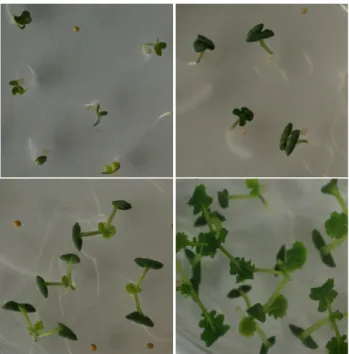
Table 1의 결과에서 얻은 재분화능이 우수한 잎자루 달린 자엽의 조건을 좀 더 세밀하게 살펴보기 위해서 파종 후 발아일수에 따른 잎자루 달린 자엽(Fig. 2)의 재분화율을
조사하였다(Fig. 3). Figure 2에서 보여지듯이 파종 후 3일
된 유묘는 자엽 형성 초기단계로 잎자루가 정상적으로
형성되지 않은 상태이며, 파종 후 5일된 유묘는 자엽이
완전 전개되면서 잎이 뒤로 말리는 형태를 보여주었으
며, 파종 후 7일된 유묘는 자엽의 잎자루가 길게 신장하
면서 본엽이 형성되기 시작하는 것을 관찰 할 수 있었고,
파종 후 14일된 유묘는 본엽 2매가 완전 전개되고 본엽
3-4매 형성 초기단계로 보여졌다. Figure 3의 결과를 보면
완전한 형태의 잎자루가 달린 자엽(파종 후 5일 이후의
유묘)에서의 재분화율이 불완전한 형태의 잎자루가 달린
자엽(파종 후 3일된 유묘)에서의 재분화율보다 양호하다
는 것을 알 수 있었으며, 본엽이 전개됨에 따라 잎자루가
달린 자엽에서의 재분화율이 감소됨을 알 수 있었다.
Fig. 2 Plantlet grown in vitro depending on explant age after seedling (a) 3 day, (b) 5 day, (c) 7 day, (d) 14 day
Fig. 3 Effect of explant age on shoot regeneration from cotyledon with petiole explants in B. juncea L. Each value represents the mean of 5 replications each consisting of 10 explants. Error bars indicate the standard error of explants
Fig. 4 Effect of cytokinins on shoot regeneration from cotyledon with petiole explants in B. juncea L. Each value represents the mean of 5 replications each consisting of 10 explants. Error bars indicate the standard error of explants. Different letters indicate statistical difference by Duncan’s multiple tests (P < 0.05). 2-ip, 6-γ-γ-(Dimethylallylamino)-purine; 2-ip R, 6-γ-γ-(Dimethylallylamino)- purine riboside; BAP, 6-benzylaminopurine; TDZ, Thidiazuron;
Zeatin R, Zeatin riboside.
사이토키닌 종류와 함량에 따른 재분화능
파종 후 5일된 유묘의 잎자루 달린 자엽을 이용하여 사 이토키닌 종류와 함량이 갓의 재분화에 미치는 영향을 살펴보았다(Fig. 4). 재분화율을 보면 BAP와 TDZ 처리구 에서 64% ~ 80%로 양호한 반응을 보였으며, 특히 TDZ 8 μM 처리구에서 재분화율이 평균 80%로 가장 뛰어남을 알 수 있었다. 2-ip와 Zeatin은 함량이 증가할수록 재분화 율이 증가하는 경향인 반면, 2-ip riboside와 Zeatin riboside
은 함량이 증가할수록 재분화율이 감소하는 경향을 보였 는데, 이러한 경향은 2-ip 처리구에서 뚜렷하게 보여졌다.
절편당 형성되는 줄기수를 보면 BAP와 TDZ 처리구에서
평균 2개의 줄기를 형성하며 상대적으로 양호한 반응을
보인 반면, 나머지 처리구에서는 평균 1.0 ~ 1.5개의 줄기
를 형성하였으며, 2-ip riboside와 BAP와 Zeatin riboside 처
리구의 경우 저농도(2 μM)에서 줄기 형성이 더 양호함을
알 수 있었다. 재분화된 줄기의 길이 생장을 보면 모든
처리구에서 줄기길이가 평균 1.2 ~ 2.0 cm였으며, 통계분
석상 처리간 평균값의 유의성이 있다고 보여지나 처리간
그 차이가 크지 않은 것으로 사료되었다. 생중에 있어서
BAP와 TDZ 처리구가 가장 양호하였으며, 특히 TDZ의
4 ~ 8 μM 처리구에서 한 개의 절편당 평균 2 g이상의 재
분화 개체를 형성하였고, 나머지 처리구의 경우 호르몬
함량이 증가할수록 재분화 개체의 생중이 증가하는 것을
볼 수 있었다. 따라서 본 실험을 통해서 갓의 재분화능에
가장 효과적인 사이토키닌은 TDZ임을 알 수 있었으며,
적정 함량은 8 μM로 사료되었다. 이렇게 해서 재분화된
개체가 정상적인 생육을 할 수 있는지를 알아보기 위해
서 활성탄이 들어간 MS기본배지에서 뿌리를 유기한 후,
지피포트를 이용하여 순화과정을 거친 후, 퇴비와 밭흙
이 담긴 포트로 이식하여 온실에서 재배한 결과, 정상적
으로 화아(花芽) 분화가 이루어졌으며, 종자가 들어있는
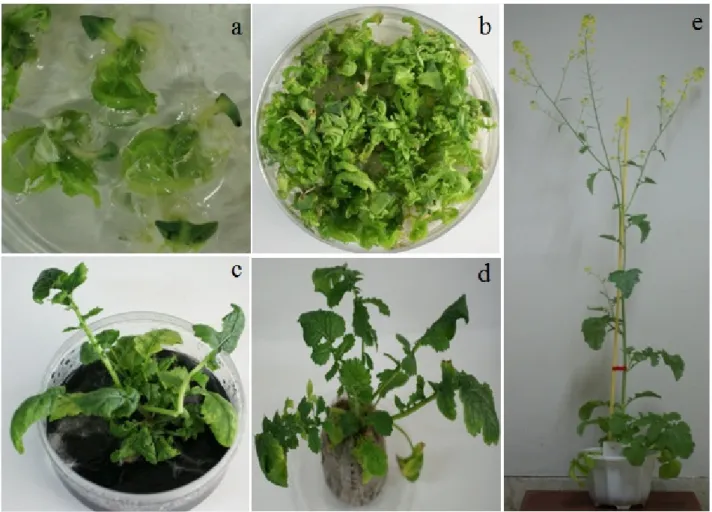
꼬투리가 형성되는 것을 확인할 수 있었다(Fig. 5).
Fig. 5 The regeneration process from cotyledon with petiole explants in B. juncea L. (a) Initial regeneration after culture for 2 weeks, (b) Vigorously shoot formation after culture for 4 weeks, (c) Shoot elongation and rooting on MS medium with 0.3% activated charcoal, (d) Acclimation on jiffy pot for 7 days, (e) Flowering of regenerated plants
고 찰
Brassica 속(屬) 작물의 재분화에 가장 큰 영향을 미치는
요인으로는 유전자형, 식물생장호르몬, 재료부위, 에틸렌 저해제 등이 있다고 알려져 있다(Zhang et al. 1998; Tang et al. 2003). 이 중 재료부위와 식물생장호르몬 조성에 따라 배발생 캘러스 형성 과정을 거쳐 줄기가 분화되는 indirect shoot formation과 캘러스 형성 없이 바로 줄기가 분화되 는 direct shoot formation이 이루어지는데, 전자의 경우 비 교적 많은 줄기를 형성하는 장점이 있는 반면 체세포변 이(somaclonal variation)가 발생할 확률이 높고, 후자의 경 우 상대적으로 적은 수의 줄기가 형성되는 단점이 있는 반면 체세포변이 발생 확률이 매우 낮다는 특징이 있다 (Takagi et al. 2011). 잎자루(petiole)는 체세포조직으로 캘 러스 형성 없이 직접적으로 재분화 줄기를 형성하는 특 징을 갖는다. 최근 잎자루 절편(Petiole explant)을 이용한 유 전적 변이 폭이 적은 ‘true-to-type’ 재분화체를 얻기 위한 연 구들이 많이 수행되고 있다(Agarwal and Raun 2000; Kumar and Reddy 2010; Nada et al. 2011; Zhao et al. 2012). 이제까
지 보고된 갓의 재분화 연구에서는 주로 자엽, 하배축 그 리고 본엽이 이용되어 왔다(Guo et al. 2005; Bhuiyan et al.
2009). 본 실험에서는 자엽, 하배축, 본엽 외에 잎자루 절
편이 포함된 잎자루 달린 자엽(cotyledon with petiole), 잎
자루 달린 본엽(leaf with petiole)을 사용하여 재분화능을
살펴본 결과, 자엽(cotyledon) 그 자체보다는 잎자루가 달
린 자엽에서, 그리고 본엽 그 자체보다는 잎자루가 달린
본엽에서의 재분화율이 증가하는 것을 볼 수 있었다. 이
러한 결과는 Brassica carinata (Babic et al. 1998)와 Brassica
napus (Moloney et al. 1989; Roh et al. 2011)에서 cotyledon-petiole을 이용하였을 때 재분화율 및 형질전환효율이 높
았다는 연구결과와 일치하였다. 또한 Begonia semperflorens
의 잎자루부위(petiole)와 잎(leaf)에서의 재분화 효율을 살
펴본 결과 잎자루부위에서는 평균 5.3개의 줄기가 유기
된 반면, 잎에서는 평균 1.7개의 줄기가 유기되어 잎자루
부위의 재분화능이 잎의 재분화능보다 더 효과적이었다
는 결과가 보고된 바 있다(Kereša et al. 2011). 따라서 본
실험을 통해서 잎자루 절편의 부착 유무가 갓의 재분화
에 매우 큰 영향을 주는 것을 알 수 있었다. 또한 잎자루
조직의 성숙도에 따라 재분화능이 달라지는 것을 관찰할 수 있었다. 파종 후 3일된 미성숙 잎자루 절편은 성숙된 잎자루 절편(파종 후 5일)에 비해 재분화율이 50% 감소 하였고, 본엽이 전개되는 시기(파종 후 7일 이후)의 잎자 루 절편에서의 재분화율은 성숙된 잎자루 절편(파종 후 5일)에서의 재분화율에 비해 점차 감소되는 경향을 보였 다. 이러한 결과들은 발아 전 종자 내부에 형성되어 있는 배(embryo)의 일부 조직인 자엽의 재분화능과 발아 후 정 단부위 생장점으로부터 형성되는 본엽의 재분화능의 차 이에 의한 것으로 보여지며, 이 과정에서 일어나는 자엽 의 잎자루 조직의 성숙도에 따라 잎자루내의 통도조직과 엽신(葉身)내 엽맥과의 물질교류의 원활한 정도가 재분 화능에 영향을 미치는 것으로 사료되었다.
TDZ는 urea-type의 합성 사이토키닌으로 식물 노화 억제 작용이 뛰어나며, adenin-type의 합성 사이토키닌인 BAP 에 비해 사이토키닌 활성이 10-100배 이상 높다고 알려져 있다(Murthy et al. 1998). 또한 TDZ는 재분화가 잘 안 되 는 수목류의 액아 증식과 줄기 형성에 효과적인데, 그 이 유는 오옥신과 사이토키닌 모두를 대체할 수 있기 때문 인 것으로 알려져 있다(Lu 1993; van Staden et al. 2008). 특 히 petiole explant를 이용한 direct shoot induction에 TDZ가 매우 효과적이라는 연구결과가 최근 꾸준히 발표되고 있 다(Kumar and Reddy 2010; Nada et al. 2011; Zhao et al.
2012). 이제까지 Brassica 속 작물의 재분화에 BAP가 가장 많이 사용되어 왔으며(Moloney et al. 1989; Tang et al. 2003;
Bhuiyan et al. 2009), 최근 들어 B. napus (Roh et al. 2011)와 B. juncea (Guo et al. 2005)의 재분화에 BAP보다 TDZ가 더 효과적이라는 연구결과가 보고된 바 있다. 본 실험에서 갓의 재분화에 가장 효과적인 적정 사이토키닌을 조사한 결과, 줄기형성율(재분화율)에 있어 BAP와 TDZ 모두 양 호한 반응을 보인 반면, 줄기형성수, 줄기길이 그리고 생 중 등 전반적인 재분화능에 있어서는 TDZ가 BAP보다 더 양호한 결과를 보여주었다. 이러한 결과를 통해 우리 는 TDZ가 갓의 재분화에 있어 petiole explant를 이용한 direct shoot formation에 매우 효과적이라고 판단되었으며, 이것은 앞서 언급한 여러 연구자들의 연구결과와 일치하 는 경향이었다.
2-ip, 2-ip riboside, Zeatin 그리고 Zeatin riboside 처리구에 서의 재분화능은 BAP와 TDZ와 달리 호르몬 농도에 민 감하게 반응하는 것으로 보여진다. 특히, riboside residual 이 부착된 2-ip riboside와 Zeatin riboside은 저농도 일수록 재분화능이 양호한 반면, riboside residual이 부착되지 않 은 2-ip와 Zeatin은 고농도 일수록 재분화능이 양호하였 다. 이러한 결과를 통해 우리는 riboside residual이 식물 재 분화에 영향을 미치는 것을 알 수 있었으며, 그 민감도가 상대적으로 높다고 사료되었다.
적 요
본 연구는 갓(Brassica juncea L. Czern)의 효율적 재분화 조건 확립을 위해 재분화가 잘되는 절편체 종류와 절편 체의 나이 그리고 재분화율 향상에 관여하는 사이토키닌 종류와 적정 함량을 조사하였다. 절편체 종류에 따른 갓 의 재분화율은 다음과 같았다: 잎자루 달린 자엽> 하배 축> 잎자루 달린 본엽> 자엽> 본엽. 또한 파종 후 5일된 잎자루 달린 자엽에서의 재분화능이 가장 양호하였다. 6 종의 사이토키닌 중에서- 6-γ-γ-Dimethylallylamino-purine (2-ip), 6-γ-γ-Dimethylallylamino-purine riboside (2-ip riboside), 6-Benzyl amino-purine (BAP), Thidiazuron (TDZ), Zeatin, Zeatin riboside-TDZ 8 μM 처리구에서 재분화율이 평균 80%로 가 장 높은 것을 알 수 있었다. 이렇게 획득한 재분화 식물 체는 온실로 옮겨져 재배되었으며, 정상적인 생육과정을 거쳐 개화가 이루어지는 것이 관찰되었다.
사 사
본 연구는 2013년 농촌진흥청 국립농업과학원 농업과학 기술 연구개발사업(과제번호: PJ006745)의 지원에 의해 이루어진 것임.
인용문헌
농촌진흥청 (2003) 표준영농교본. In: 엽채류 재배, Vol. 140, 삼미기획, pp 111-116
Agarwal PK, Ranu RS (2000) Regeneration of plantlets from leaf and petiole explants of Pelargonium X Hortorum. In Vitro Cell Dev Biol-Plant 36:392-397
Akasaka-Kennedy Y, Yoshida H, Takahata Y (2005) Efficient plant regeneration from leaves of rapeseed (Brassica napus L.): the influence of AgNO3 and genotype. Plant Cell Rep 24:649-654
Babic V, Datla RS, Scoles GJ, Keller WA (1998) Development of an efficient Agrobacterium-mediated transformation system for Brassica carinata L. Plant Cell Rep 17:183-188
Bhuiyan MSU, Min SR, Choi KS, Lim YP, Liu JR (2009) Factors for high frequency plant regeneration in tissue cultures of Indian mustard (Brassica juncea L.). J Plant Biotechnol 36:137-143
Burnett L, Arnoldo M, Yarrow S, Huang B (1994) Enhancement of shoot regeneration from cotyledon explants of Brassica rapa spp oleifera through pretreatment with auxin and cytokinin and use of ethylene inhibitors. Plant Cell Tiss Org Cult 37:253-256
Cardoza V, Stewart CN (2004) Brassica biotechnology: Progress in cellular and molecular biology. In Vitro Cell Dev Biol- Plant 40:542-551
Guo DP, Zhu ZJ, Hu XX, Zheng SJ (2005) Effect of cytokinins on shoot regeneration from cotyledon and leaf segment of stem mustard (Brassica juncea var. tsatsai). Plant Cell Tiss Organ Cult 83:123-127
Haberlandt G (1902) Kulturversuche mit isolierten Pflanzenzellen Sitz. Akad Wiss Wien 111:69-92
Hemingway JS (1976) Mustards, Brassica spp. and Sinapis alba (Cruciferae) In: Simmonds NW, (eds), Evolution of Crop Plants, Longman, New York, pp 19-21
Kereša S, Mihovilović A, Barić M, Jerčić IH (2011) Efficient plant regeneration of Begonia semperflorens and Begonia spp.
from petiole and leaf explants. JFAE 9:240-244
Kim H, Kim JY, Kim HJ, Kim DK, Jo HJ, Han BS, Kim HW, Kim JB (2011) Anticancer activity and quantitative analysis of Glucosinolates from green and red leaf mustard. Korea J Food
& Nutr 24:362-366
Kumar N, Reddy MP (2010) Plant regeneration through the direct induction of shoot buds from petiole explants of Jatropha curcas: a biofuel plant. Ann Appl Biol 156:367-375 Lu CY (1993) The use of thidiazuron in tissue culture. In Vitro Cell
Dev Biol 29:92-96
Maheshwari P, Selvaraj G, Kovalchuk I (2011) Optimization of Brassica napus (canola) explants regeneration for genetic transformation. Nature Biotechnology 29:144-155
Mithen R (2001) Glucosinolates-biochemistry, genetics and biological activity. Plant Growth Regulation 34:91-103 Moloney MM, Walker JM, Sharma KK (1989) High efficiency
transformation of Brassica napus using Agrobacterium vectors. Plant Cell Rep 8:238-242
Muller C, Sieling N (2006) Effects of glucosinolates and myr- osinase levels in Brassica juncea on a glucosinolates- seques- tering herbivore-and vice versa. Chemioecology 16:191-201 Murashige T, Skoog F (1962) A revised medium for rapid growth
and bioassays with tobacco tissue cultures. Physiol Plant 15:473-493
Murthy BNS, Murch SJ, Saxena PK (1998) Thidiazuron: A potent regulator of in vitro plant morphogenesis. In Vitro Cell Dev Biol Plant 34:267-275
Nada S, Chennareddy S, Goldman S (2011) Direct shoot bud differentiation and plantlet regeneration from leaf and petiole explants of Begonia tuberhybrida. HortSceince 46:759-764 Oram RN, Kirk JTO, Veness PE, Hurlstone CJ, Edlington JP,
Halsall DM (2005) Breeding Indian mustard (Brassica juncea(L.) Czern.) for cold-pressed, edible oil production-a review. Aust J Agr Res 56:581-596
Park SH, Choi SI, Park JB, Han HK, Bae SD, Sung IJ, Park ER (2011) Phytoremediation on the heavy metal contaminated soil by hyperaccumulators in the greenhouse. J Soil &
Groundwater Env 16:1-8
Potts DA, Rakow GW, Males DR (1999) Canola-Quality Brassica juncea, a New Oilseed Crop for the Canadian Prairies.
Proceedings of the 10th International Rapeseed Congress, Canberra, Australia
Radke SE, Turner JC, Facciotti D (1992) Transformation and re- generation of Brassica rapa using Agrobacterium tumefaciens.
Plant Cell Rep 11:499-505
Raskin I, Smith RD, Salt DE (1997) Phytoremediation of metals:
using plants to remove pollutants from the environment. Curr Opin Biotech 8:221-226
Roh KH, Kwak BK, Kim HU, Lee KR, Kim SH, Suh MC, Kim H, Kim JB (2011) Production of transgenic plants in Brassica na- pus winter cultivar ‘Youngsan’. J Appl Biol Chem 54:26-32 Roh KH, Kwak BK, Kim JB, Lee KR, Kim HU, Kim SH (2012)
The influence of silver thiosulfate and thidiazuron on shoot regeneration from cotyledon explants of Brassica napus. J Plant Biotechnol 39:133-139
Schilperoort RA, Veldstra H, Warnaar SQ, Mulder G, Cohen JA (1967) Formation of complexes between DNA isolated from tobacco crown gall tumours and complementary to Agrobacterium tumefaciens DNA. Biochim Biophys Acta 145:523-525 Spect CE, Diederichsen A (2001) Brassica. In: Hanelt P, (eds),
Mansfeld’s Encyclopedia of Agricultural and Horticultural Crops, Vol. 6, Springer-Verlag, Berlin, pp 1453-1456 Takagi H, Sugawara S, Saito T, Tasaki H, Yuanxue L, Kaiyun G,
Han DS, Godo T, Nakano M (2011) Plant regeneration via di- rect and indirect adventitious shoot formation and chromo- some-doubled somaclonal variation in Titanotrichum old- hamii (Hemsl.) Solereder. Plant Biotechnol Rep 5:187-195 Tang GX, Zhou WJ, Li HZ, Mao BZ, He ZH, Yoneyama K (2003)
Medium, explants and genotype factors influencing shoot regeneration in oilseed Brassica spp. J Agronomy & Crop Science 189:351-358
van Staden J, Zazimalova E, George EF (2008) Plant growth regulators II: Cytokinins, their analogues and antagonists. In Geroge EF, Hall MA, De Kerke GJ, (eds), Plant propagation by tissue culture, Ed 3, Vol. 1, Springer, Dordrecht, pp 205-226
Wright PR, Morgan JM, Jessop RS (1997) Turgor maintenance by osmoregulation in Brassica napus and B. juncea under field conditions. Ann Bot 80:313-319
Yang M, Lee M (2008) Rhizofiltration process with Helianthus annuss L., Phaseolus vulgaris var., and Brassica juncea (L.) Czern. to remediate uranium contaminated groundwater. J KoSSGE 13:30-39
Zhang FL, Takahata Y, and Xu JB (1998) Medium and genotype factors influencing shoot regeneration from cotyledonary explants of Chinese cabbage (Brassica campestris L. ssp.
pekinensis). Plant Cell Rep 17:780-786
Zhang Y, Talalay P, Cho CG, Posner GH (1992) A major inducer of anticarcinogenic protective enzymes from broccoli:
Isolation and elucidation of structure. Proc Natl Acad Sci 89:2399-2403
Zhao J, Cui J, Liu J, Liao F, Henny RJ, Chen J (2012) Direct somatic embryogenesis from leaf and petiole explants of Spathiphyllum ‘Supreme’ and analysis of regenerants using flow cytometry. Plant Cell Tiss Org Cult 110:239-249