• 검색 결과가 없습니다.

Prognostic Implications of Postoperative Infectious Complications in Non-Small Cell Lung Cancer

N/A
N/A
Protected

Academic year: 2021

Share "Prognostic Implications of Postoperative Infectious Complications in Non-Small Cell Lung Cancer"

Copied!
12
0
0

로드 중.... (전체 텍스트 보기)

전체 글

(1)

ISSN: 2233-601X (Print) ISSN: 2093-6516 (Online)

This was presented at the 48th Korean Society for Thoracic and Cardiovascular Surgery fall meeting, October 20, 2016 in Daegu, Korea.

Received: August 2, 2017, Revised: September 14, 2017, Accepted: September 18, 2017, Published online: February 5, 2018

Corresponding author: Sukki Cho, Department of Thoracic and Cardiovascular Surgery, Seoul National University College of Medicine, 103 Daehak-ro, Jongno-gu, Seoul 03080, Korea

(Tel) 82-31-787-7132 (Fax) 82-31-787-4050 (E-mail) [email protected]

© The Korean Society for Thoracic and Cardiovascular Surgery. 2018. All right reserved.

This is an open access article distributed under the terms of the Creative Commons Attribution Non-Commercial License (http://creativecommons.org/

licenses/by-nc/4.0) which permits unrestricted non-commercial use, distribution, and reproduction in any medium, provided the original work is properly cited.

Prognostic Implications of Postoperative Infectious Complications in Non-Small Cell Lung Cancer

Hyo-Jun Jang, M.D. 1 , Jae Won Song, M.D. 1 , Sukki Cho, M.D., Ph.D. 1,2 , Kwhanmien Kim, M.D., Ph.D. 1,2 , Sanghoon Jheon, M.D., Ph.D. 1,2

1

Department of Thoracic and Cardiovascular Surgery, Seoul National University Bundang Hospital,

2
Department of Thoracic and Cardiovascular Surgery, Seoul National University College of Medicine

Background: Few studies have evaluated the long-term impact of postoperative infectious complications in pa- tients with non-small cell lung cancer (NSCLC). We aimed to determine the impact of infectious complications on long-term outcomes after surgical resection for NSCLC. Methods: We performed a retrospective study of 1,380 eligible patients who underwent pulmonary resection for NSCLC from 2003 to 2012. Complications were divided into infectious complications and non-infectious complications. Kaplan-Meier survival analysis was used to compare unadjusted 5-year cancer-specific survival (CSS) rates and recurrence-free survival (RFS) rates. Cox regression was used to determine the impact of infectious complications on 5-year CSS and RFS. Results: The rate of total complications and infectious complications was 24.3% and 4.3%, respectively.

In the node-negative subgroup, the 5-year CSS and RFS rates were 75.9% and 57.1% in patients who had infectious complications, compared to 87.9% and 78.4% in patients who had no complications. Infectious complications were a negative prognostic factor for 5-year RFS (hazard ratio, 1.92; 95% confidence interval, 1.00–3.69; p=0.049). In the node-positive subgroup, the 5-year CSS rate and RFS were 44.6% and 48.4% in patients who had infectious complications, compared to 70.5% and 48.4% for patients who had no complications. Conclusion: Postoperative infectious complications had a negative impact on CSS and RFS in node-negative NSCLC. Our findings may help improve risk assessment for tumor recurrence after pulmonary resection for node-negative NSCLC.

Key words: 1. Non-small-cell lung carcinoma 2. Complication

3. Prognosis

Introduction

Lung cancer is the most common cause of can- cer-related death, and the overall 5-year survival rate for lung cancer is only 16% [1,2]. Recently, video-as- sisted thoracic surgery (VATS) has been widely per- formed to treat early-stage non-small cell lung cancer

(NSCLC), leading to a decreased incidence of post- operative complications [3]. Nevertheless, due to the increasing age of patients who are candidates for surgery, the incidence of complications is still high, with complications observed in 31% of VATS re- sections for lung cancer [4].

These complications are not only relevant for as-

https://doi.org/10.5090/kjtcs.2018.51.1.41

(2)

sessing the short-term outcome of surgery, but are also prognostic factors that may influence post- operative survival. To date, some studies have shown a relationship between postoperative complications and the eventual prognosis of renal cell carcinoma [5], breast cancer [6], esophageal cancer [7], stomach cancer [8,9], and colon cancer [10-12].

The pathophysiology of how postoperative compli- cations can influence long-term survival is not well understood; however, complications could lead to systemic inflammation, which might facilitate the re- currence of cancer [13]. The first study investigating postoperative complications and NSCLC outcomes showed that the presence of complications was re- lated to poor long-term survival [14], and that in- fectious complications showed a strong negative rela- tionship with long-term survival [15]. However, there were no studies in which this correlation between infectious complications and prognosis was evaluated according to stage and recurrence rate.

Therefore, the goal of this study was to evaluate the effect of postoperative complications on post- operative recurrence and overall survival depending on the presence of nodal metastasis in NSCLC.

Methods

1) Patients

A total of 1,621 patients who underwent pulmo- nary resection for NSCLC from June 2003 to December 2012 were included in this study. The fol- lowing patients were excluded: (1) 115 patients who underwent a second operation for recurrence or metachronous cancer, (2) 30 patients who died with- in 90 days after the operation, (3) 13 patients who were diagnosed with small cell lung cancer after sur- gery, and (4) 83 patients who underwent incomplete resection. After exclusion, clinicopathologic data such as age, sex, diabetes mellitus (DM), chronic ob- structive pulmonary disease (COPD), Charlson score, albumin level, histology, the extent of resection, whether VATS was used, lymph node metastasis, pathologic staging (according to the American Joint Committee on Cancer seventh edition), and the pres- ence of complications were collected retrospectively from 1,380 patients, based on a prospective lung cancer database. This study was approved by the Institutional Review Board of Seoul National Univer-

sity Bundang Hospital (B-1503-292-107) and the re- quirement to obtain informed consent from patients was waived due to the retrospective design of the study.

2) Complications

Postoperative complications were defined accord- ing to the criteria outlined in the Society for Thoracic Surgeons database, and were considered to be complications that occurred within the same hos- pitalization or during the first 4 weeks after the op- eration [16]. Postoperative complications were cate- gorized into infectious and non-infectious complica- tions, with infectious complications consisting of pneumonia, acute respiratory distress syndrome (ARDS), empyema, bronchopleural fistula (BPF), wound infection, and sepsis. Non-infectious complica- tions were defined as pulmonary complications (prolonged air leakage for longer than 7 days, ate- lectasis requiring bronchoscopy), cardiovascular com- plications (arrhythmia, myocardial infarction, deep vein thrombosis, pulmonary embolism), neurologic complications (delirium, transient ischemic attack, stroke, vocal cord palsy), ileus requiring a nasogas- tric tube, chylothorax, and renal dysfunction.

3) End point

The primary end point was recurrence-free surviv- al (RFS) from the date of the operation to the date of confirmed recurrence. Recurrences included both local recurrences and distant metastasis, while meta- chronous primary lung cancer and primary cancer in other organs were excluded. The secondary end point was cancer-specific survival (CSS) from the date of the operation to the date of cancer-related death. Cancer-related death included death from the progression of cancer and treatment-related death;

however, deaths from trauma or cardiovascular events and other cancer-related causes of death were not included.

4) Statistical analysis

Univariate analysis using the Kaplan-Meier log-rank

test was used to compare the CSS and RFS according

to each variable. Multivariate analysis using the Cox

proportional hazards model included prognostic fac-

tors that were found to be statistically significant in

univariate analysis. All p-values <0.05 were consid-

(3)

Table 1. Characteristics of patients with and without complications

Characteristic Complications ( −) (n=1,045) Complications (+) (n=335) p-value

Age (yr) <0.001

<60 357 (34.2) 77 (23.0)

≥60 688 (65.8) 258 (77.0)

Sex <0.001

Female 414 (39.6) 72 (21.5)

Male 631 (60.4) 263 (78.5)

Diabetes mellitus 0.832

None 888 (85.0) 286 (85.4)

Yes 157 (15.0) 49 (14.6)

Chronic obstructive pulmonary disease 0.006

None 952 (91.1) 289 (86.3)

Yes 93 (8.9) 46 (13.7)

Albumin (g/dL) 4.19 4.08 0.001

Histology <0.001

Adenocarcinoma 739 (70.7) 182 (54.3)

Squamous cell carcinoma 221 (21.1) 124 (37.0)

Others 85 (8.1) 29 (8.7)

Charlson score 0.007

<2 865 (82.8) 255 (76.1)

≥2 180 (17.2) 80 (23.9)

Type of surgery 0.915

Sublobar 165 (15.8) 56 (16.7)

Simple lobectomy 631 (60.4) 200 (59.7)

Complex lobectomy 195 (18.7) 60 (17.9)

Pneumonectomy 53 (5.1) 19 (5.7)

Video-assisted thoracic surgery <0.001

Yes 640 (61.2) 127 (37.9)

No 405 (38.8) 208 (62.1)

T stage 0.002

T1 517 (49.5) 127 (37.9)

T2 443 (42.4) 175 (52.2)

T3 59 (5.6) 23 (6.9)

T4 26 (2.5) 10 (3.0)

N stage 0.003

N0 767 (73.4) 220 (65.7)

N1 156 (14.9) 59 (17.6)

N2 119 (11.4) 52 (15.5)

N3 3 (0.3) 4 (1.2)

Values are presented as number (%) or mean.

ered to indicate statistical significance, and statistical analysis was performed using IBM SPSS ver. 22.0 (IBM Corp., Armonk, NY, USA).

Results

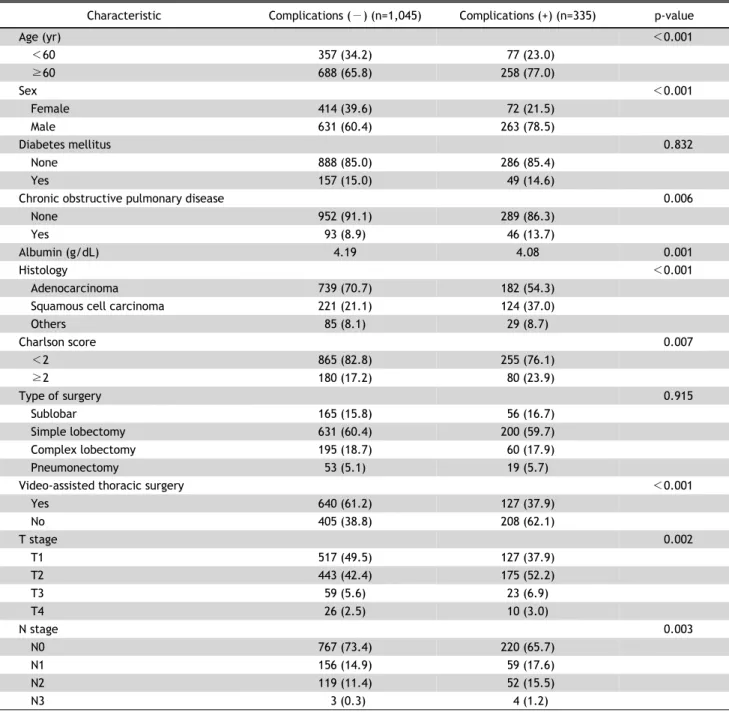
1) All patients

Postoperative complications developed in 335 pa-

tients (24.3%). Table 1 compares the characteristics

of patients with complications and patients without

complications. All factors except the extent of re-

section and incidence of DM were found to be differ-

ent in the 2 groups. Patients with complications had

more COPD and lower preoperative albumin levels

than those without complications. Postoperative com-

plications developed more frequently in patients with

(4)

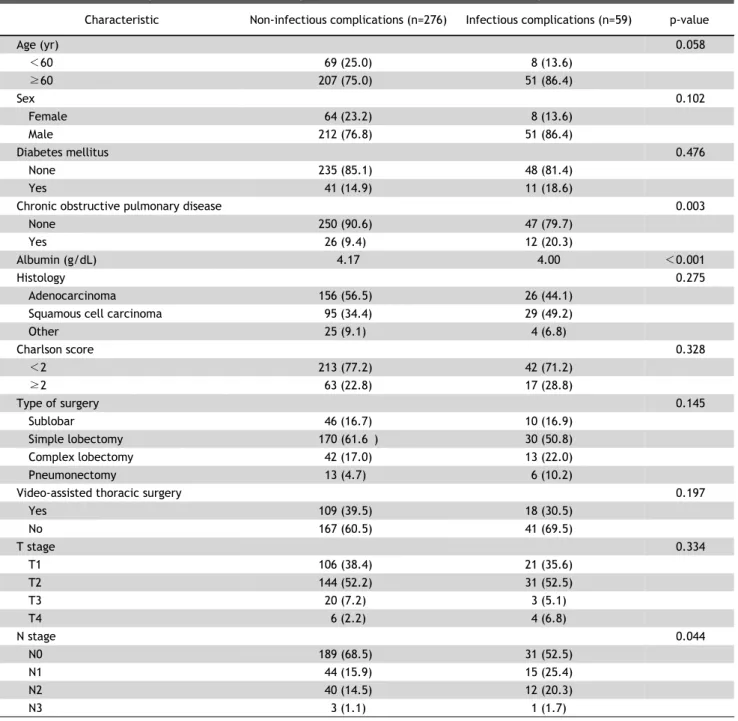
Table 2. Characteristics of patients with infectious complications and those with non-infectious complications

Characteristic Non-infectious complications (n=276) Infectious complications (n=59) p-value

Age (yr) 0.058

<60 69 (25.0) 8 (13.6)

≥60 207 (75.0) 51 (86.4)

Sex 0.102

Female 64 (23.2) 8 (13.6)

Male 212 (76.8) 51 (86.4)

Diabetes mellitus 0.476

None 235 (85.1) 48 (81.4)

Yes 41 (14.9) 11 (18.6)

Chronic obstructive pulmonary disease 0.003

None 250 (90.6) 47 (79.7)

Yes 26 (9.4) 12 (20.3)

Albumin (g/dL) 4.17 4.00 <0.001

Histology 0.275

Adenocarcinoma 156 (56.5) 26 (44.1)

Squamous cell carcinoma 95 (34.4) 29 (49.2)

Other 25 (9.1) 4 (6.8)

Charlson score 0.328

<2 213 (77.2) 42 (71.2)

≥2 63 (22.8) 17 (28.8)

Type of surgery 0.145

Sublobar 46 (16.7) 10 (16.9)

Simple lobectomy 170 (61.6 ) 30 (50.8)

Complex lobectomy 42 (17.0) 13 (22.0)

Pneumonectomy 13 (4.7) 6 (10.2)

Video-assisted thoracic surgery 0.197

Yes 109 (39.5) 18 (30.5)

No 167 (60.5) 41 (69.5)

T stage 0.334

T1 106 (38.4) 21 (35.6)

T2 144 (52.2) 31 (52.5)

T3 20 (7.2) 3 (5.1)

T4 6 (2.2) 4 (6.8)

N stage 0.044

N0 189 (68.5) 31 (52.5)

N1 44 (15.9) 15 (25.4)

N2 40 (14.5) 12 (20.3)

N3 3 (1.1) 1 (1.7)

Values are presented as number (%) or mean.

metastatic lymph nodes than in those without meta- static lymph nodes. Infectious complications devel- oped in 59 (17. 6%) of the 335 patients with com- plications. The most common infectious complication was pneumonia, which occurred in 44 patients, fol- lowed by empyema in 8 patients, ARDS in 7 patients, BPF in 7 patients, and wound infections in 7 patients.

Most instances of ARDS and BPF occurred in combi-

nation with other infectious complications. The most

minor infectious complication, wound infection, did

not occur in combination with other infectious com-

plications, except in 1 case. BPF was confirmed by

bronchoscopy, and 3 of the 7 patients with BPF were

managed by surgical repair. Patients with infectious

complications were more likely to have lymph node

metastasis than patients with non-infectious compli-

(5)

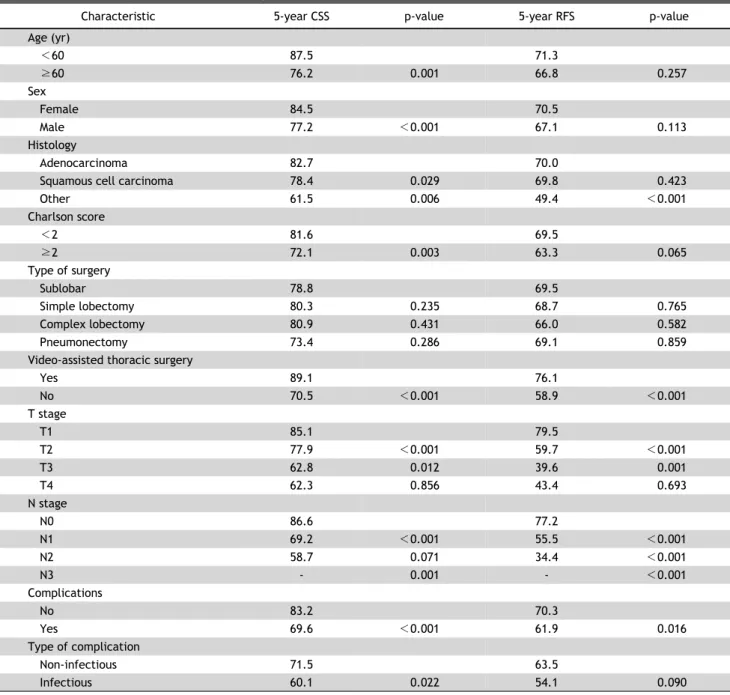
Table 3. Univariate analysis of CSS and RFS in all patients

Characteristic 5-year CSS p-value 5-year RFS p-value

Age (yr)

<60 87.5 71.3

≥60 76.2 0.001 66.8 0.257

Sex

Female 84.5 70.5

Male 77.2 <0.001 67.1 0.113

Histology

Adenocarcinoma 82.7 70.0

Squamous cell carcinoma 78.4 0.029 69.8 0.423

Other 61.5 0.006 49.4 <0.001

Charlson score

<2 81.6 69.5

≥2 72.1 0.003 63.3 0.065

Type of surgery

Sublobar 78.8 69.5

Simple lobectomy 80.3 0.235 68.7 0.765

Complex lobectomy 80.9 0.431 66.0 0.582

Pneumonectomy 73.4 0.286 69.1 0.859

Video-assisted thoracic surgery

Yes 89.1 76.1

No 70.5 <0.001 58.9 <0.001

T stage

T1 85.1 79.5

T2 77.9 <0.001 59.7 <0.001

T3 62.8 0.012 39.6 0.001

T4 62.3 0.856 43.4 0.693

N stage

N0 86.6 77.2

N1 69.2 <0.001 55.5 <0.001

N2 58.7 0.071 34.4 <0.001

N3 - 0.001 - <0.001

Complications

No 83.2 70.3

Yes 69.6 <0.001 61.9 0.016

Type of complication

Non-infectious 71.5 63.5

Infectious 60.1 0.022 54.1 0.090

Values are presented as %.

CSS, cancer-specific survival; RFS, recurrence-free survival.

cations (Table 2).

2) Follow-up

The median follow-up duration among the 1,380 patients was 50.4 months (range, 3.0 to 135.1 months). A total of 25 patients were lost to fol- low-up, and 296 patients (21%) died, including 252 cases of cancer-related death and 44 cases of death

due to other causes. Among the 252 instances of cancer-related death, 194 were due to cancer pro- gression and 58 were treatment-related. Recurrence occurred in 395 patients (29%), with locoregional re- currence in 171 patients and distant metastasis in 224 patients. The 5-year CSS and RFS rates were 79.8% and 68.3%, respectively.

Among the 1,045 patients without postoperative

(6)

Table 4. Multivariate analysis of CSS and RFS in all patients

Characteristic 5-year CSS p-value 5-year RFS p-value

Age (yr)

<60 1.00

≥60 1.70 (1.24 –2.31) 0.001

Sex

Female 1.00

Male 1.31 (0.96 –1.80) 0.086

Charlson score

<2 1.00

≥2 1.33 (0.99 –1.79) 0.058

T stage

T1 1.00 1.00

T2 1.07 (0.79 –1.44) 0.633 1.58 (1.24 –2.00) <0.001

T3 1.99 (1.27 –3.14) 0.003 2.77 (1.92 –4.00) <0.001

T4 1.44 (0.76 –2.70) 0.256 1.95 (1.17 –3.27) <0.001

N-stage

N0 1.00 <0.001 1.00

N1 2.86 (2.06 –3.96) <0.001 2.06 (1.57 –2.68) <0.001

N2 3.41 (2.47 –4.71) <0.001 3.10 (2.40 –4.00) <0.001

N3 17.87 (7.69 –41.51) <0.001 8.43 (3.43 –20.75) <0.001

Histology

Adenocarcinoma 1.00 1.00

Squamous cell carcinoma 0.77 (0.55 –1.07) 0.121 0.75 (0.58 –0.97) 0.029

Other 1.77 (1.22 –2.56) 0.003 1.66 (1.23 –2.24) 0.001

Complications

No 1.00 1.00

Non-infectious 1.48 (1.11 –1.97) 0.007 1.13 (0.89 –1.44) 0.308

Infectious 1.99 (1.24 –3.22) 0.004 1.54 (1.00 –2.38) 0.048

Values are presented as hazard ratio (95% confidence interval).

CSS, cancer-specific survival; RFS, recurrence-free survival.

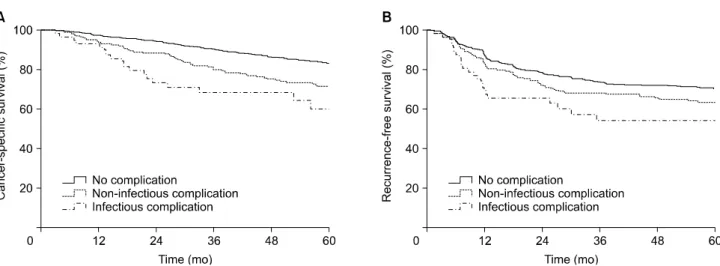
Fig. 1. Kaplan-Meier analysis of cancer-specific survival (A) and recurrence-free survival (B) according to the presence and type of com-

plications in all patients.

(7)

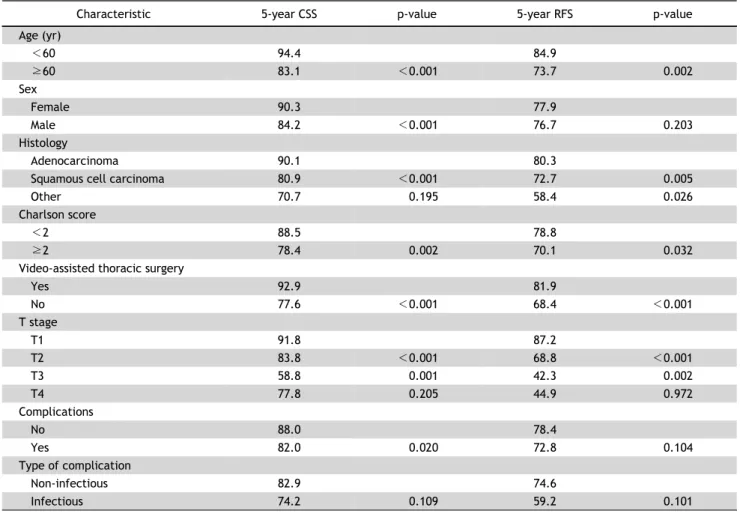
Table 5. Univariate analysis of CSS and RFS in N( −) patients

Characteristic 5-year CSS p-value 5-year RFS p-value

Age (yr)

<60 94.4 84.9

≥60 83.1 <0.001 73.7 0.002

Sex

Female 90.3 77.9

Male 84.2 <0.001 76.7 0.203

Histology

Adenocarcinoma 90.1 80.3

Squamous cell carcinoma 80.9 <0.001 72.7 0.005

Other 70.7 0.195 58.4 0.026

Charlson score

<2 88.5 78.8

≥2 78.4 0.002 70.1 0.032

Video-assisted thoracic surgery

Yes 92.9 81.9

No 77.6 <0.001 68.4 <0.001

T stage

T1 91.8 87.2

T2 83.8 <0.001 68.8 <0.001

T3 58.8 0.001 42.3 0.002

T4 77.8 0.205 44.9 0.972

Complications

No 88.0 78.4

Yes 82.0 0.020 72.8 0.104

Type of complication

Non-infectious 82.9 74.6

Infectious 74.2 0.109 59.2 0.101

Values are presented as %.

CSS, cancer-specific survival; RFS, recurrence-free survival.

complications, 160 (15%) died and 284 (27%) expe- rienced recurrence. In contrast, among the 335 pa- tients with postoperative complications, 92 (28%) died and 111 (33%) experienced recurrence. This was a significant difference. Even more strikingly, of the 59 patients with infectious complications, 21 (36%) died and 23 (39%) experienced recurrence.

In the univariate analysis, an age of 60 years old or more, being male, non-adenocarcinoma histology, a Charlson score of 2 or more, undergoing VATS, a higher T stage, a higher N stage, and the presence of complications were negative prognostic factors for 5-year CSS, and non-adenocarcinoma histology, un- dergoing VATS, a higher T stage, a higher N stage, and the presence of complications were negative prognostic factors for 5-year RFS (Table 3). The 5-year CSS rate was lower to a statistically significant

extent in patients with complications than in those without complications (69.6% versus 83.2%, p<

0.001). The 5-year RFS rate was also lower in pa- tients with complications than in those without com- plications (61.9% versus 70.3%, p=0.016).

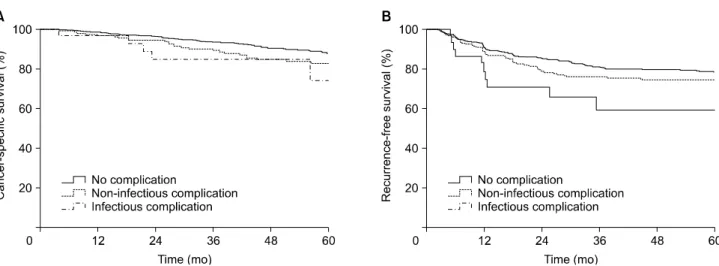
The 5-year CSS rate of patients with infectious complications was statistically significantly lower than the CSS rate of patients without infectious com- plications (60.1% versus 83.2%, p<0.001) and that of patients with non-infectious complications (60.1%

versus 71.5%, p=0.022) (Fig. 1A). In contrast, the

5-year RFS rate of patients with infectious complica-

tions was significantly lower than that of patients

without complications (54.1% versus 70.3%, p=0.004),

but a statistically significant difference was not found

in comparison to patients with non-infectious compli-

cations (54.1% versus 63.5%, p=0.090) (Fig. 1B).

(8)

Fig. 2. Kaplan-Meier analysis of cancer-specific survival (A) and recurrence-free survival (B) according to the presence and type of com- plications in N( −) patients.

Table 6. Multivariate analysis of CSS and RFS in N( −) patients

Characteristic 5-year CSS p-value 5-year RFS p-value

Age (yr)

<60 1.00 1.00

≥60 2.77 (1.59 –4.85) <0.001 1.53 (1.08 –2.17) 0.016

Sex

Female 1.00

Male 1.30 (0.81 –2.08) 0.265

Charlson score

<2 1.00 1.00

≥2 1.32 (0.87 –2.01) 0.189 1.24 (0.89 –1.73) 0.192

Histology

Adenocarcinoma 1.00 1.00

Squamous cell carcinoma 1.38 (0.86 –2.20) 0.171 1.01 (0.71 –1.42) 0.940

Other 2.25 (1.29 –3.91) 0.004 1.80 (1.18 –2.74) 0.006

T-stage

T1 1.00 1.00

T2 1.62 (1.05 –2.48) 0.26 2.51 (1.82 –3.47) <0.001

T3 3.9 (2.14 –7.08) <0.001 4.84 (2.99 –7.84) <0.001

T4 1.89 (0.44 –8.08) 0.387 5.76 (2.58 –12.86) <0.001

Complications

None 1.00 1.00

Non-infectious 1.26 (0.82 –1.94) 0.289 1.03 (0.73 –1.44) 0.867

Infectious 2.23 (1.01 –4.92) 0.046 1.92 (1.00 –3.67) 0.049

Values are presented as hazard ratio (95% confidence interval).

CSS, cancer-specific survival; RFS, recurrence-free survival.

In the multivariate analysis, an age of 60 years or older, non-adenocarcinoma and non-squamous cell carcinoma histology results, a higher N stage, and the presence of complications were independent negative prognostic factors for CSS (Table 4). Infectious and

non-infectious complications were also independent

negative prognostic factors for CSS (hazard ratio

[HR], 1.48; 95% confidence interval [CI], 1.11–1.97

and HR, 1.99; 95% CI, 1.24–3.22, respectively). Non-

adenocarcinoma and non-squamous cell carcinoma

(9)

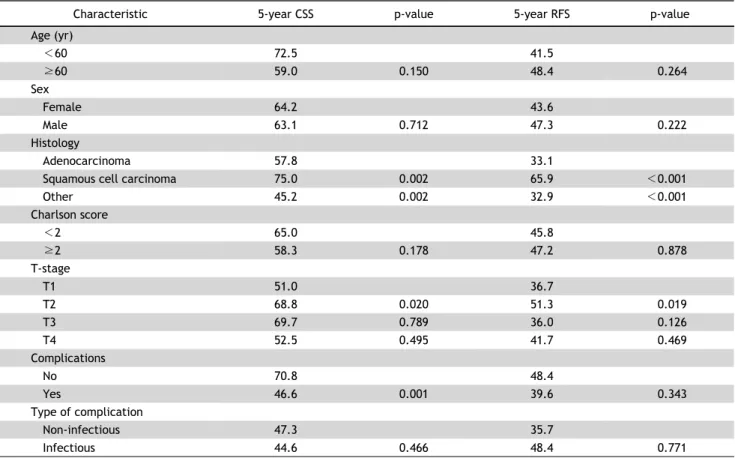
Table 7. Univariate analysis of CSS and RFS in N(+) patients

Characteristic 5-year CSS p-value 5-year RFS p-value

Age (yr)

<60 72.5 41.5

≥60 59.0 0.150 48.4 0.264

Sex

Female 64.2 43.6

Male 63.1 0.712 47.3 0.222

Histology

Adenocarcinoma 57.8 33.1

Squamous cell carcinoma 75.0 0.002 65.9 <0.001

Other 45.2 0.002 32.9 <0.001

Charlson score

<2 65.0 45.8

≥2 58.3 0.178 47.2 0.878

T-stage

T1 51.0 36.7

T2 68.8 0.020 51.3 0.019

T3 69.7 0.789 36.0 0.126

T4 52.5 0.495 41.7 0.469

Complications

No 70.8 48.4

Yes 46.6 0.001 39.6 0.343

Type of complication

Non-infectious 47.3 35.7

Infectious 44.6 0.466 48.4 0.771

Values are presented as %.

CSS, cancer-specific survival; RFS, recurrence-free survival.

histology results, a higher T stage, a higher N stage, and infectious complications were independent neg- ative prognostic factors for RFS; however, non-in- fectious complications were not an independent neg- ative prognostic factor for RFS (Table 4).

3) Node-negative patients

In the univariate analysis of node-negative patients (Table 5), the 5-year CSS rate of patients with in- fectious complications was lower than that of pa- tients without complications (74.2% versus 88.0%, p=0.006); however, no significant difference was ob- served compared to patients with non-infectious complications (74.2% versus 82.9%, p=0.109) (Fig.

2). The same findings were observed for the 5-year RFS rate, in which a significant difference was found when patients with infectious complications were compared to those without any complications (59.2%

versus 78.4%, p=0.012), but no significant difference was found compared to patients with non-infectious

complications (59.2% versus 74.6%, p=0.101) (Fig. 2).

In the multivariate analysis, infectious complications were found to be an independent negative prognostic factor negatively affecting both CSS and RFS (HR, 2.23; 95% CI, 1.01–4.92; p=0.046 and HR, 1.92, 95%

CI, 1.00–3.67; p=0.049, respectively) (Table 6).

4) Node-positive patients

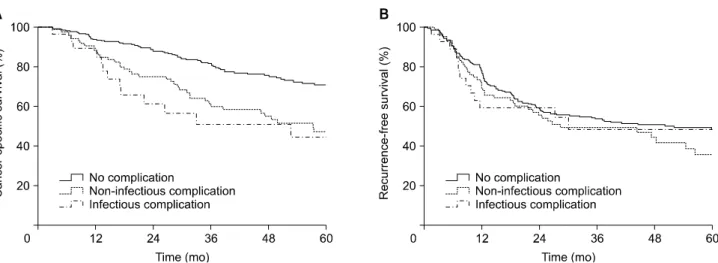
The univariate analysis of prognostic factors in node-positive patients is presented in Table 7. The 5-year CSS rate was lower in patients with infectious complications than in patients without complications (44.6% versus 70.8%, p=0.005), but was not sig- nificantly lower in patients with non-infectious com- plications (44.6% versus 47.6%, p=0.446) (Fig. 3).

The 5-year RFS rate was not significantly different

among node-positive patients with infectious compli-

cations, no complications, and non-infectious compli-

cations (48.4% versus 48.4% versus 35.7%, p=0.614)

(Fig. 3).

(10)

Fig. 3. Kaplan-Meier analysis of cancer-specific survival and recurrence-free survival according to the presence and type of complications in N(+) patients.

Discussion

This study evaluated the relationship between in- fectious complications and postoperative recurrence and survival in NSCLC patients. In node-negative NSCLC patients, infectious complications were an in- dependent negative prognostic factor for cancer-spe- cific death and recurrence after curative surgery. The influence of infectious complications on tumor re- currence is not well understood. Rueth et al. [14]

demonstrated that pulmonary complications were a negative prognostic factor affecting 5-year can- cer-specific mortality in stage I NSCLC. Andalib et al.

[15] reported that patients with major infectious complications, such as pneumonia, empyema, or me- diastinitis, had the lowest overall survival among all patients included in their study. However, some stud- ies have found that postoperative complications were not associated with long-term outcomes in cancer pa- tients [17-19]. Moreover, some studies have even found that infectious complications were a positive prognostic factor for long-term outcomes. Jeys et al.

[20] demonstrated that overall survival was higher in osteosarcoma patients with deep wound infection af- ter surgery. Ruckdeschel et al. [21] also found a higher survival rate in lung cancer patients with postoperative empyema.

There are several possible mechanisms explaining how complications after surgical resection are related to the long-term prognosis. First, the immune re- sponse to infection may influence whether recurrence

occurs. The fact that cell-mediated immunity and hu- moral immunity are involved in the regression and progression of tumors is well established [22].

McGuirk and Mills [23] demonstrated that regulatory

T cells induced by an infection suppress Th1 im-

munity, thereby preventing the development of in-

fection-induced immunopathology, which enhances

the activity of cancer cells [24]. Second, the presence

of an increased amount of cytokines derived from

the response to infection may induce the pro-

liferation of tumor cells. Salvans et al. [25] found

that serum from colorectal cancer patients with anas-

tomotic leaks increased tumor cell proliferation in

vitro. Alonso et al. [26] demonstrated that increased

serum levels of interleukin-6 and vascular endothelial

growth factor resulting from intraperitoneal infection

were associated with tumor recurrence after cancer

surgery. Third, it is possible that confounding factors

are involved, which may be associated not only with

infectious complications, but also with postoperative

recurrence. In this study, patient characteristics such

as age, sex, Charlson score, histology, whether VATS

was performed, and the T stage were found to be

different between patients with complications and

those without complications, even though it is un-

clear whether these factors actually have an effect on

the postoperative prognosis. However, differences

were also observed in patient characteristics in other

studies that assessed postoperative infectious compli-

cations in other cancers [8,9,12]. Since the data were

evaluated using multivariate Cox proportional hazard

(11)

regression models to overcome the confounding ef- fect, the presence of these differences in the baseline characteristics may not pose a major problem.

Finally, adjuvant therapy may be delayed or not be applied in patients with infectious complications.

Artinyan et al. [12] found that chemotherapy was performed less frequently in patients with stage III colon cancer who experienced complications, and they could not clearly determine the effect of delayed adjuvant therapy on tumor recurrence. However, al- though the time sequence of adjuvant therapy was not evaluated in this study, infectious complications showed a significant relationship with recurrence and survival in node-negative patients in whom adjuvant chemotherapy was not scheduled.

In order to control for the effect of nodal status on tumor recurrence, subgroup analysis according to nodal status was performed. In node-negative pa- tients, patients with infectious complications had lower 5-year CSS and RFS rates than those without complications. However, in node-positive patients, the 5-year RFS rate was not significantly different among patients with infectious complications, no complica- tions, and non-infectious complications. Although long-term outcomes according to the presence of pul- monary complications were also analyzed, no statisti- cally significant difference regarding long-term out- comes was found compared to patients with non-pul- monary complications, although the 5-year CSS and RFS rates of both groups were significantly lower than those observed in patients without complications.

The first limitation of this study is that the se- verity and duration of infections were not inves- tigated. All infectious complications, ranging from simple wound infections to severe chronic empyema, were categorized as a single variable. However, the incidence of infectious complications was low, and in particular, few cases of minor infectious complica- tions were observed. Therefore, the authors could not classify cases of infectious complications based on severity. The second limitation is that no con- sensus exists regarding the definition of infectious complications. For example, pneumonia, empyema, and ARDS could be categorized as pulmonary compli- cations or as infectious complications. Rueth et al.

[14] demonstrated that pulmonary complications, in which pneumonia, empyema, and ARDS were in- cluded, were a predictor of 5-year CSS rates. The

third limitation is that that the incidence of compli- cations was 24.4%, which is lower than that of 2 previous studies by about 50% [14,15]. Although the previous 2 studies that have directly addressed this question collected data from a local database based on diagnosis codes in the ninth revision of the International Classification of Diseases, the present study collected data from a single center based on voluntary reporting. The incidence of complications is known to be higher in centers without a specialized thoracic surgeon [27]. Reports regarding the in- cidence of complications in specialized centers have found a complication rate of approximately 32% in thoracotomy and 3%–13. 3% in VATS [28]. In this study, the incidence of complications was 34% in thoracotomy and 16.5% in VATS, similar to pre- viously reported results.

In conclusion, infectious complications were a neg- ative prognostic factor for tumor recurrence in NSCLC patients without node involvement. In order to prevent infectious complications, meticulous surgi- cal procedures should be implemented, along with perioperative care that includes antibiotics. After in- fectious complications occur, follow-up examinations should reflect an elevated level of caution relating to tumor recurrence. Our results may contribute to fur- ther studies assessing whether adjuvant therapy is necessary in early-stage NSCLC patients with severe infectious complications.

Conflict of interest

No potential conflict of interest relevant to this ar- ticle was reported.

Acknowledgments

This study was supported by a Grant of the Samsung Vein Clinic Network (Daejeon, Anyang, Cheongju, Cheonan; Fund no. KTCS04-096).

References

1. Jemal A, Bray F, Center MM, Ferlay J, Ward E, Forman D.

Global cancer statistics. CA Cancer J Clin 2011;61:69-90.

2. Hayat MJ, Howlader N, Reichman ME, Edwards BK. Cancer

statistics, trends, and multiple primary cancer analyses

from the Surveillance, Epidemiology, and End Results

(SEER) Program. Oncologist 2007;12:20-37.

(12)

3. Rueth NM, Andrade RS. Is VATS lobectomy better: peri- operatively, biologically and oncologically? Ann Thorac Surg 2010;89:S2107-11.

4. Villamizar NR, Darrabie MD, Burfeind WR, et al. Thoraco- scopic lobectomy is associated with lower morbidity com- pared with thoracotomy. J Thorac Cardiovasc Surg 2009;

138:419-25.

5. Tan HJ, Hafez KS, Ye Z, Wei JT, Miller DC. Postoperative complications and long-term survival among patients treated surgically for renal cell carcinoma. J Urol 2012;

187:60-6.

6. Murthy BL, Thomson CS, Dodwell D, et al. Postoperative wound complications and systemic recurrence in breast cancer. Br J Cancer 2007;97:1211-7.

7. Rutegard M, Lagergren P, Rouvelas I, Mason R, Lagergren J.

Surgical complications and long-term survival after esoph- agectomy for cancer in a nationwide Swedish cohort study. Eur J Surg Oncol 2012;38:555-61.

8. Tokunaga M, Tanizawa Y, Bando E, Kawamura T, Terashima M. Poor survival rate in patients with post- operative intra-abdominal infectious complications fol- lowing curative gastrectomy for gastric cancer. Ann Surg Oncol 2013;20:1575-83.

9. Hayashi T, Yoshikawa T, Aoyama T, et al. Impact of in- fectious complications on gastric cancer recurrence.

Gastric Cancer 2015;18:368-74.

10. Mavros MN, de Jong M, Dogeas E, Hyder O, Pawlik TM.

Impact of complications on long-term survival after re- section of colorectal liver metastases. Br J Surg 2013;100:

711-8.

11. Katoh H, Yamashita K, Wang G, Sato T, Nakamura T, Watanabe M. Anastomotic leakage contributes to the risk for systemic recurrence in stage II colorectal cancer. J Gastrointest Surg 2011;15:120-9.

12. Artinyan A, Orcutt ST, Anaya DA, Richardson P, Chen GJ, Berger DH. Infectious postoperative complications de- crease long-term survival in patients undergoing curative surgery for colorectal cancer: a study of 12,075 patients.

Ann Surg 2015;261:497-505.

13. Matsuda A, Matsumoto S, Seya T, et al. Does postoperative complication have a negative impact on long-term out- comes following hepatic resection for colorectal liver metastasis?: a meta-analysis. Ann Surg Oncol 2013;20:

2485-92.

14. Rueth NM, Parsons HM, Habermann EB, et al. The long-term impact of surgical complications after resection of stage I nonsmall cell lung cancer: a population-based survival analysis. Ann Surg 2011;254:368-74.

15. Andalib A, Ramana-Kumar AV, Bartlett G, Franco EL, Ferri LE. Influence of postoperative infectious complications on long-term survival of lung cancer patients: a pop-

ulation-based cohort study. J Thorac Oncol 2013;8:554-61.

16. The Society of Thoracic Surgeons. The Society of Thoracic Surgeons Database 2014 [Internet]. Chicago (IL): The Society of Thoracic Surgeons; 2014 [cited 2017 Aug 1].

Available from: https://www.sts.org/.

17. Richards CH, Platt JJ, Anderson JH, McKee RF, Horgan PG, McMillan DC. The impact of perioperative risk, tumor pathology and surgical complications on disease re- currence following potentially curative resection of color- ectal cancer. Ann Surg 2011;254:83-9.

18. Eriksen MT, Wibe A, Norstein J, Haffner J, Wiig JN;

Norwegian Rectal Cancer Group. Anastomotic leakage fol- lowing routine mesorectal excision for rectal cancer in a national cohort of patients. Colorectal Dis 2005;7:51-7.

19. Lindner K, Fritz M, Haane C, Senninger N, Palmes D, Hummel R. Postoperative complications do not affect long-term outcome in esophageal cancer patients. World J Surg 2014;38:2652-61.

20. Jeys LM, Grimer RJ, Carter SR, Tillman RM, Abudu A. Post operative infection and increased survival in osteosarco- ma patients: are they associated? Ann Surg Oncol 2007;14:2887-95.

21. Ruckdeschel JC, Codish SD, Stranahan A, McKneally MF.

Postoperative empyema improves survival in lung cancer:

documentation and analysis of a natural experiment. N Engl J Med 1972;287:1013-7.

22. Grivennikov SI, Greten FR, Karin M. Immunity, in- flammation, and cancer. Cell 2010;140:883-99.

23. McGuirk P, Mills KH. Pathogen-specific regulatory T cells provoke a shift in the Th1/Th2 paradigm in immunity to infectious diseases. Trends Immunol 2002;23:450-5.

24. Kidd P. Th1/Th2 balance: the hypothesis, its limitations, and implications for health and disease. Altern Med Rev 2003;8:223-46.

25. Salvans S, Mayol X, Alonso S, et al. Postoperative peri- toneal infection enhances migration and invasion capaci- ties of tumor cells in vitro: an insight into the association between anastomotic leak and recurrence after surgery for colorectal cancer. Ann Surg 2014;260:939-43.

26. Alonso S, Pascual M, Salvans S, et al. Postoperative in- tra-abdominal infection and colorectal cancer recurrence:

a prospective matched cohort study of inflammatory and angiogenic responses as mechanisms involved in this association. Eur J Surg Oncol 2015;41:208-14.

27. Schipper PH, Diggs BS, Ungerleider RM, Welke KF. The in- fluence of surgeon specialty on outcomes in general thora- cic surgery: a national sample 1996 to 2005. Ann Thorac Surg 2009;88:1566-72.

28. Park BJ. Is surgical morbidity decreased with minimally in-

vasive lobectomy? Cancer J 2011;17:18-22.

수치

Table 1. Characteristics of patients with and without complications
Table 2. Characteristics of patients with infectious complications and those with non-infectious complications
Table 3. Univariate analysis of CSS and RFS in all patients
Table 4. Multivariate analysis of CSS and RFS in all patients
+5

참조

관련 문서

Small- to medium-sized SCLC cells appeared as clusters of tumor cells with a back-to-back appearance (B, 400×, black arrow), and the second type of cells, large NSCLC cells,

Purpose: To investigate short-term response rate, quality of life and toxicities of mannan peptide combined with TP regimen in treating patients with non-small cell

Purpose: To compare computed tomography (CT) images and bronchoscopic findings of local tumor recurrence at the bronchial stump site in post-operative non-small cell lung cancer

When considering curative radiotherapy for recurrent NSCLC after surgical resection, pulmonary function should be carefully evaluated to avoid serious lung damage,

Therefore, we performed this study to evaluate the impact of lifestyle diseases on postoperative com- plications and long-term survival in elderly patients with

The purpose of this study was to assess the relationship between the area and the volume of the psoas muscle at L3 and to assess the feasibility of a psoas muscle volume index as

In the present study, we investigated the association between the presence or degree of dyspnea and clinical outcomes to iden- tify the prognostic role of dyspnea in patients

Conclusion: h-CEA and l-CYFRA 21-1 may be prognostic and predictive serum markers for higher response and longer survival in patients with advanced NSCLC receiving gefitinib