INTRODUCTION
Lung cancer is a commonly diagnosed cancer, and the leading cause of cancer death around the world.1 The socioeconomic burden of lung cancer in many countries has increased drasti- cally. According to a survey by the European Union, lung can- cer had the highest economic cost (€18.8 billion, 15% of overall cancer costs) among all cancers in 2009.2 Advances in treatment modalities (e.g., surgery, radiation, chemotherapy, and molecu- lar targeted therapy) have been made, and have improved pa-
tient outcomes over the past few decades. Additionally, as a screening tool for lung cancer, low dose computed tomography has been shown to reduce the mortality of patients with lung cancer by up to 20%, compared with conventional radiography.3 However, the mortality rate of lung cancer still remains high, and causes tremendous physical and emotional distress to pa- tients.4,5
To develop more effective and individualized treatment for pa- tients with lung cancer, many investigations on prognostic factors have been conducted. As a result, several clinical factors, includ- ing aging, male sex, poor performance status, advanced stage dis- ease, and smoking, have been found to be associated with poor prognosis.6 Most lung cancer patients have smoking history and accompanying chronic obstructive pulmonary disease (COPD).7 COPD is a chronic progressive inflammatory airway disease that primarily occurs in smokers. COPD increases the risk of lung cancer, even after controlling for other important variables, and it is also closely related to poor clinical outcomes.8
Dyspnea is one of the most common symptoms in patients with lung cancer, and clinicians encounter it frequently at initial presentation. Moreover, with aggressive or conservative man-
Dyspnea as a Prognostic Factor in Patients with Non-Small Cell Lung Cancer
Wooho Ban, Jong Min Lee, Jick Hwan Ha, Chang Dong Yeo, Hyeon Hui Kang, Chin Kook Rhee, Hwa Sik Moon, and Sang Haak Lee
Division of Pulmonary, Critical Care and Sleep Medicine, Department of Internal Medicine, College of Medicine, The Catholic University of Korea, Seoul, Korea.
Purpose: To investigate associations between dyspnea and clinical outcomes in patients with non-small cell lung cancer (NSCLC).
Materials and Methods: From 2001 to 2014, we retrospectively reviewed the prospective lung cancer database of St. Paul’s Hospi- tal at the Catholic University of Korea. We enrolled patients with NSCLC and evaluated symptoms of dyspnea using modified Medical Research Council (mMRC) scores. Also, we estimated pulmonary functions and analyzed survival data.
Results: In total, 457 NSCLC patients were enrolled, and 259 (56.7%) had dyspnea. Among those with dyspnea and whose mMRC scores were available (109 patients had no mMRC score), 85 (56.6%) patients had an mMRC score <2, while 65 (43.3%) had an mMRC score ≥2. Significant decreased pulmonary functions were observed in patients with dyspnea. In multivariate analysis, ag- ing, poor performance status, advanced stage, low forced expiratory volume in 1 second (%), and an mMRC score ≥2 were found to be significant prognostic factors for patient survival.
Conclusion: Dyspnea could be a significant prognostic factor in patients with NSCLC.
Key Words: Lung neoplasm, dyspnea, prognosis Yonsei Med J 2016 Sep;57(5):1063-1069
http://dx.doi.org/10.3349/ymj.2016.57.5.1063 pISSN: 0513-5796 · eISSN: 1976-2437
Received: October 14, 2015 Revised: February 15, 2016 Accepted: March 10, 2016
Corresponding author: Dr. Sang Haak Lee, Division of Pulmonary, Critical Care and Sleep Medicine, Department of Internal Medicine, St. Paul’s Hospital, College of Medicine, The Catholic University of Korea, 180 Wangsan-ro, Dongdaemun-gu, Seoul 02559, Korea.
Tel: 82-2-961-4500, Fax: 82-2-968-7250, E-mail: [email protected]
•The authors have no financial conflicts of interest.
© Copyright: Yonsei University College of Medicine 2016
This is an Open Access article distributed under the terms of the Creative Com- mons Attribution Non-Commercial License (http://creativecommons.org/licenses/
by-nc/3.0) which permits unrestricted non-commercial use, distribution, and repro- duction in any medium, provided the original work is properly cited.
agement of lung cancer, most patients with advanced lung can- cer usually suffer from dyspnea. The degree of dyspnea is an im- portant and validated factor for assessment of quality of life (QOL) in cancer patients.9,10 In addition, improvement of health- related QOL and symptoms, such as dyspnea, are related with the efficacy of chemotherapeutic regimens and favorable out- come in lung cancer.11 Therefore, clinicians should be concerned with their patients’ dyspnea for improving clinical outcomes.
However, the prognostic role of dyspnea in patients with lung cancer has not been studied well.
In the present study, we investigated the association between the presence or degree of dyspnea and clinical outcomes to iden- tify the prognostic role of dyspnea in patients with non-small cell lung cancer (NSCLC).
MATERIALS AND METHODS
Study population and data collection
We retrospectively reviewed the lung cancer database of St.
Paul’s Hospital at the Catholic University of Korea. From 2001 to 2014, we recruited patients who were diagnosed with lung cancer histologically and/or cytologically into our lung cancer registry. Following inclusion, clinical data, questionnaire, pul- monary function, and clinical outcomes from each patient were recorded prospectively. In this study, we enrolled patients who were diagnosed with NSCLC and had clinicopathological in- formation on age, sex, smoking history, histologic type, stage, and Eastern Cooperative Oncology Group (ECOG) performan- ce status in the lung cancer database.
We defined a current smoker as a patient who continued smoking upon diagnosis or stopped smoking less than 1 month before diagnosis of lung cancer. A former smoker was defined as a patient who had stopped smoking at least 1 month before the diagnosis. Patients who had never smoked or had smoked fewer than 100 cigarettes in their lifetime were defined as a never smoker. Histologic types were divided into adenocarcino- ma, squamous cell carcinoma, large cell carcinoma, adenosqua- mous cell carcinoma, adenocarcinoma in situ, and other lung cancer. TNM stage was classified according to the 7th American Joint Committee on Cancer tumor, node, and metastasis classi- fication.
At the time of diagnosis, we evaluated symptoms of dyspnea using questionnaires, and assessed pulmonary function pa- rameters in each patient. Patients were categorized into two groups according to the presence of dyspnea at initial presenta- tion. In patients with dyspnea, the degree of dyspnea was mea- sured by the modified Medical Research Council (mMRC) dyspnea scale.12 The mMRC dyspnea scale can range from 0 to 4 (Grade 0, breathless with strenuous exercise; Grade 1, short of breath when hurrying on level ground or walking up a slight hill; Grade 2, walks slower than people of the same age on a level plane because of breathlessness; Grade 3, stops for breath
after walking about 100 yards; Grade 4, too breathless to leave the house or becomes breathless when dressing or undress- ing). Pulmonary function parameters, such as forced expirato- ry volume in 1 second (FEV1), forced vital capacity (FVC), forced expiratory ratio (FEV1/FVC), forced expiratory flow 25–75%
(FEF25–75), diffusion capacity of the lung for carbon monox- ide (DLCO), and residual volume (RV), were collected. Using the Global Initiative for Chronic Obstructive Lung Disease (GOLD) criteria, an obstructive pattern was defined as a FEV1/
FVC ratio less than 0.7. In addition, patients were categorized into four classes according to their airflow limitation severity:
GOLD1 (mild) was FEV1 ≥80% predicted; GOLD2 (moderate) was 50%≤FEV1<80% predicted; GOLD3 (severe) was 30%≤
FEV1<50% predicted; and GOLD4 (very severe) was FEV1
<30% predicted.13
We searched for survival data from the lung cancer database of St. Paul’s Hospital. The last follow-up date was July 2014.
This study was approved by the Institutional Review Board/
Ethics Committee of St. Paul’s Hospital, the Catholic University of Korea (PC15RISI0053).
Statistical analysis
Frequencies and proportions were used to present categorical clinical variables. To estimate the association between dyspnea and other categorical clinical variables, we used the Pearson’s χ2 tests. The unpaired t-test was used to compare pulmonary function parameters between two groups according to the presence of dyspnea. Survival curves according to the putative prognostic factors were drawn using the Kaplan-Meier meth- od, and survival differences were analyzed by the log-rank test. The two-sided significance level was set at p<0.05. The factors that were significantly associated with patient survival in univariate analysis, were further evaluated in multivariate analysis. The Cox proportional hazards modeling technique was applied to identify independent prognostic factors. All statistical analyses were performed using SPSS statistical soft- ware, version 20.0 (IBM SPSS statistics, version 20.0 for Win- dows; SPSS Inc., Chicago, IL, USA).
RESULTS
Clinical characteristics according to presence of dyspnea
Four hundred and fifty-seven patients were enrolled in this study. The median age thereof was 68.5 years. Symptoms of dyspnea were detected in 259 (56.7%) patients at initial pre- sentation. The existence of dyspnea was significantly associat- ed with smoking status and ECOG performance status. How- ever, it was not associated with age, sex, and histologic type or stage (Table 1).
Pulmonary functions between patients with dyspnea and without dyspnea
Among 259 patients who complained of dyspnea at initial pre- sentation, we were able to obtain mMRC scores for 150 (58%) patients. mMRC score showed the following distribution: 23 patients (15.3%) with mMRC 0, 62 (41.3%) with mMRC 1, 23 (15.3%) with mMRC 2, 27 (18.0%) with mMRC 3, and 15 (10.0%) with mMRC 4 (Fig. 1).
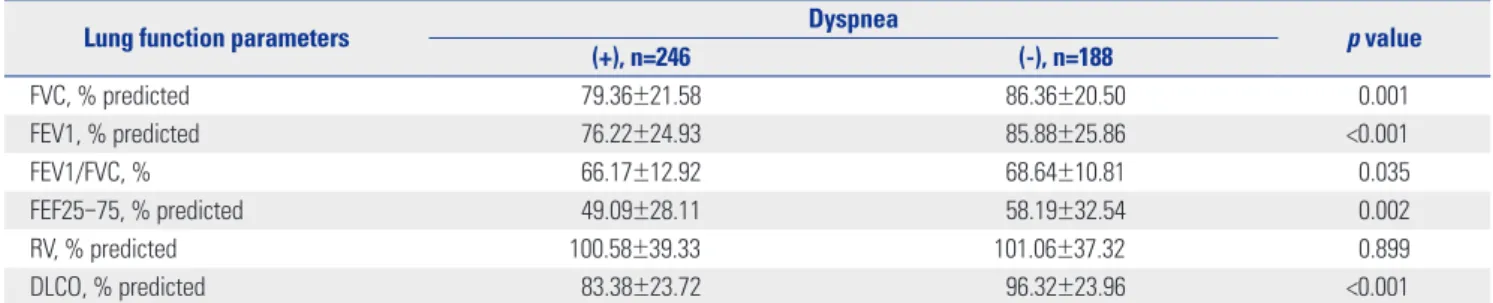
We compared pulmonary function parameters according to the presence of dyspnea. All spirometric values, including FVC (%), FEV1 (%), FEV1/FVC (%), FEF25–75 (%), and DLCO (%), were significantly lower in patients with dyspnea than those without dyspnea (Table 2). However, there was no significant difference in the level of RV between the two groups.
Missing data imputation
According to the results from initial data analysis, there was a Table 1. Patient Characteristics
Variables Dyspnea
p value
(+), n=259 (-), n=198
Age 0.196
>68 162 (59.1) 112 (40.9)
≤68 97 (47.0) 86 (53.0)
Sex 0.263
Male 194 (58.3) 139 (41.7)
Female 65 (52.4) 59 (47.6)
Smoking status 0.023
Never smoker 48 (48.0) 52 (52.0)
Former or current smoker 209 (60.8) 135 (39.2)
Denial 2 11
Histology 0.526
Adenocarcinoma 89 (51.1) 85 (48.9)
Squamous cell carcinoma 154 (59.9) 103 (40.1)
Large cell carcinoma 1 (100.0) 0 (0.0)
Adenosquamous cell carcinoma 7 (70.0) 3 (30.0)
Adenocarcinoma in situ 4 (57.1) 3 (42.9)
Other 4 (50.0) 4 (50.0)
Stage 0.454
I 22 (47.8) 24 (52.2)
II 14 (58.3) 10 (41.7)
III 88 (54.7) 73 (45.3)
IV 135 (59.7) 91 (40.3)
Performance status 0.002
ECOG 0 36 (41.4) 51 (58.6)
1 114 (55.3) 92 (44.7)
2 53 (70.7) 22 (29.3)
3 21 (63.6) 12 (36.4)
4 6 (85.7) 1 (14.3)
Unavailable 29 20
ECOG, Eastern Cooperative Oncology Group.
Values are presented as number (%).
mMRC 0 23 (15.3%)
mMRC 1 62 (41.3%) mMRC 2
23 (15.3%) mMRC 3 27 (18.0%)
mMRC 4 15 (10.0%)
Fig. 1. Distribution of patients with dyspnea according to modified Medi- cal Research Council (mMRC) scale.
substantial amount of missing data on mMRC. All of the miss- ing values were imputed by linear regression model.14 Using this model, we acquired a new data set that consisted of the origi- nal data and the imputed values. The R-squared of this model was 0.5596.
Prevalence of COPD in patients with NSCLC who complained of dyspnea
Among the 246 patients who had dyspnea symptoms and spi- rometric values, 145 patients (56%) had an obstructive pattern (FEV1/FVC <0.7). These patients were divided into four classes according to FEV1 (%) value using the GOLD criteria. Forty one patients (28%) were classified as GOLD1 (mild COPD), 76 (52%) as GOLD2 (moderate COPD), 26 (18%) as GOLD3 (severe COPD), and two (1%) as GOLD4 (very severe COPD) (Fig. 2).
Prognostic factors affecting survival in patients with NSCLC
The overall median survival for all patients was 10.3 months.
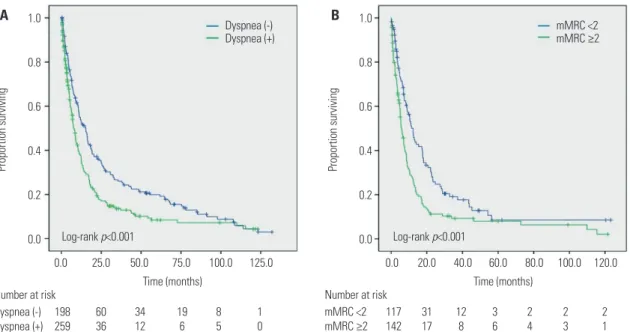
The overall survival of patients with dyspnea was significantly lower than that for patients without dyspnea (median survival,
7.9 months vs. 15.3 months, p<0.001). A significant difference in median survival was also found between patients with mMRC grade 0 or 1 and those with mMRC grade 2 or higher (12.3 months vs. 5.8 months, p<0.001) (Fig. 3). In univariate analysis, presence of dyspnea and the spirometric values FEV1/
FVC (%) and FEV1 (%) were significantly associated with pa- tient survival in addition to other prognostic factors, including aging, poor performance status, smoking history, and ad- vanced stage. Subsequently, we performed multivariate analy- sis to identify independent prognostic factors of patients with lung cancer. Age [hazard ratio (HR), 1.60; 95% confidence in- terval (CI): 1.195–2.137], poor performance status (HR, 3.67;
95% CI: 2.337–5.770), advanced stage (HR, 2.85; 95% CI: 1.927–
4.223), low FEV1 (%) (HR, 0.99; 95% CI: 0.985–0.997), and dys- pnea of mMRC grade 2 or higher (HR, 1.84; 95% CI: 1.452–
2.339) were associated with shorter survival (Table 3).
DISCUSSION
We investigated the prognostic role of dyspnea according to Table 2. Comparisons of Pulmonary Function between Patients with Dyspnea and Those without Dyspnea
Lung function parameters Dyspnea
p value
(+), n=246 (-), n=188
FVC, % predicted 79.36±21.58 86.36±20.50 0.001
FEV1, % predicted 76.22±24.93 85.88±25.86 <0.001
FEV1/FVC, % 66.17±12.92 68.64±10.81 0.035
FEF25–75, % predicted 49.09±28.11 58.19±32.54 0.002
RV, % predicted 100.58±39.33 101.06±37.32 0.899
DLCO, % predicted 83.38±23.72 96.32±23.96 <0.001
DLCO, diffusion capacity of the lung for carbon monoxide; FEF25–75, forced expiratory flow 25–75%; FEV1, forced expiratory volume in 1 second; FEV1/FVC, forced expiratory ratio; FVC, forced vital capacity; RV, residual volume.
Values are presented as mean±standard deviation.
Fig. 2. Prevalence of chronic obstructive pulmonary disease in patients with dyspnea. FEV1, forced expiratory volume in 1 second; FVC, forced vital capacity; GOLD, Global Initiative for Chronic Obstructive Lung Disease.
100%
80%
60%
40%
20%
0%
100%
80%
60%
40%
20%
0%
FEV1/FVC
<70%
145 (56.0%)
GOLD1 GOLD2 GOLD3 GOLD4
41 (28.3%)
76 (52.4%)
26 (17.9%)
2 (1.4%)
the presence and degree of dyspnea in patients with NSCLC.
The present study found the presence of dyspnea and pulmo- nary function parameters of patients with lung cancer to be significantly associated with survival outcomes.
To investigate the prognostic role of dyspnea in patients
with lung cancer, most researchers have concentrated on the short-term morbidity of dyspnea after surgery, radiation, and chemotherapy15-17 or among long term survivors, not newly di- agnosed patients.9,18 In the current study, we focused on dys- pnea at initial presentation in patients with lung cancer. In ad- dition, we measured degree of dyspnea more accurately using the mMRC scale. Simultaneously, we investigated objective parameters of lung function through pulmonary function tests.
In doing so, our study found dyspnea to be associated with clinical outcomes and to hold prognostic value.
Recently, Denehy, et al.19 proposed the prognostic role of body mass index, airflow obstruction, dyspnea, and exercise capacity (BODE) index in inoperable NSCLC. In the study, which includ- ed mMRC and FEV1 (%) as parameters of dyspnea and airflow obstruction, respectively, the BODE index was found to be a strong independent predictor of survival in inoperable NSCLC beyond traditional risk factors. Indeed, the BODE index is a multidimensional and effective scoring system to predict clini- cal outcomes in COPD.20 Among the variables that compose the BODE index, mMRC is an important factor to assess degree of dyspnea and QOL of patients with COPD, even in the GOLD classification, which predicts mortality and patient clinical outcomes.13 In the present study, we showed dyspnea and low FEV1 (%) to be significantly associated with patient prognosis in univariate and multivariate analysis. Our study showed con- sistent results with Denehy’s previous findings in which dys- pnea and reduced pulmonary function suggested a poor prog- nosis in patients with lung cancer. Therefore, individualized and more delicate treatments are required in these patients.
Additionally, we investigated the prevalence of COPD among patients who had dyspnea. Herein, 56% of patients were clas- sified as COPD by the GOLD criteria, and severe or very severe COPD (GOLD 3 and 4) patients comprised up to 20%. These Fig. 3. Kaplan-Meier survival curve of patients according to dyspnea (A) and modified Medical Research Council (mMRC) scale (B).
1.0
0.8
0.6
0.4
0.2
0.0
Proportion surviving
0.0 25.0 50.0 75.0 Time (months) Number at risk
Dyspnea (-) 198 60 34 19 8 1
Dyspnea (-)
Dyspnea (+) 259 36 12 6 5 0
Dyspnea (+)
Log-rank p<0.001
100.0 125.0
A 1.0
0.8
0.6
0.4
0.2
0.0
Proportion surviving
0.0 20.0 40.0 60.0 Time (months) Number at risk
mMRC <2 117 31 12 3 2 2 2
mMRC <2
mMRC ≥2 142 17 8 6 4 3 1
mMRC ≥2
Log-rank p<0.001
80.0 100.0 120.0 B
Table 3. Prognostic Factors for NSCLC by Multivariate Logistic Regres- sion Analysis
Variables HR (95% CI) p value
Age
≤68 1
>68 1.60 (1.195–2.137) 0.002
Performance status (ECOG)
0–2 1
≥3 3.67 (2.337–5.770) <0.001
Dyspnea
Dyspnea (-) 1
Dyspnea (+): mMRC 0–1 1.15 (0.881–1.488) 0.311 mMRC ≥2 1.84 (1.452–2.339) <0.001 Smoking status
Never smoker 1
Former or current smoker 1.23 (0.878–1.709) 0.232 Stage
I–II 1
III–IV 2.85 (1.927–4.223) <0.001
FEV1/FVC, %
≥70 1
<70 1.00 (0.731–1.366) 0.997
FEV1, % predicted 0.99 (0.985–0.997) 0.003
CI, confidence interval; ECOG, Eastern Cooperative Oncology Group; FEV1, forced expiratory volume in 1 second; FEV1/FVC, forced expiratory ratio; HR, hazard ratio; mMRC, the modified Medical Research Council; NSCLC, non- small cell lung cancer.
results showed that the prevalence and severity of COPD in patients with NSCLC is higher than that in the general popu- lation. Similar results were observed in research by Hashimo- to, et al.21 in Japan. However, in clinical settings, dyspnea has not come into the spotlight, and is even ignored sometimes.
Zhang, et al.22 reported COPD is substantially underdiagnosed and undertreated in a hospitalized lung cancer population. Es- pecially, non-respiratory doctors had a lower diagnostic rate and a lack of better treatment for exacerbation of COPD than respiratory physicians. Dyspnea in patients with lung cancer is an important clinical sign that could be accompanied by COPD. To improve patient outcomes and QOL, surveillance of the existence of COPD and proper management, such as smoking cessation and using inhalers, should be undertaken when clinicians diagnose lung cancer in patients with dyspnea at initial presentation. Nevertheless, additional prospective study will be needed to delineate the effects of appropriate monitoring and management on patients with lung cancer and COPD.
There were a few limitations in this study. First, we were un- able to obtain questionnaires from all of the patients in the study population. Before 2008, the mMRC scale was not used fre- quently to evaluate degree of dyspnea in patients with lung can- cer in our hospital. To reduce predictable statistical errors due to the missing data, we used a linear regression model for im- puting the missing values of mMRC. Also, since we consecu- tively gathered mMRC scores from most patients after 2008, we considered that these problems caused few statistical er- rors. Second, we did not describe other pulmonary function parameters, such as inspiratory capacity and functional resid- ual capacity, which are closely associated with the severity of dyspnea.23 We failed to obtain these parameters at the initial course of data acquisition. Third, we did not record the exact cause of death in most patients. Thus, we assessed all-cause mortality instead of NSCLC-specific mortality. Finally, our study was conducted in a single institution retrospectively. However, we consecutively gathered patient data from a well-constructed, prospective lung cancer database, and we used validated questionnaires and spirometry to assess degree of dyspnea more precisely and objectively.
In conclusion, this study showed that the prevalence of COPD and reduced pulmonary function are higher in patients with lung cancer who complain of dyspnea at initial presenta- tion than in those without dyspnea. The existence of dyspnea and low FEV1 (%) were significantly associated with poor prog- nosis. Additionally, the mMRC scale was found to be an inde- pendent factor affecting patient survival. Therefore, clinicians should pay more attention to dyspnea and investigate the ex- istence of COPD to improve patient outcomes and QOL.
REFERENCES
1. Jemal A, Bray F, Center MM, Ferlay J, Ward E, Forman D. Global
cancer statistics. CA Cancer J Clin 2011;61:69-90.
2. Luengo-Fernandez R, Leal J, Gray A, Sullivan R. Economic burden of cancer across the European Union: a population-based cost analysis. Lancet Oncol 2013;14:1165-74.
3. National Lung Screening Trial Research Team, Aberle DR, Adams AM, Berg CD, Black WC, Clapp JD, et al. Reduced lung-cancer mortality with low-dose computed tomographic screening. N Engl J Med 2011;365:395-409.
4. Walters S, Maringe C, Coleman MP, Peake MD, Butler J, Young N, et al. Lung cancer survival and stage at diagnosis in Australia, Can- ada, Denmark, Norway, Sweden and the UK: a population-based study, 2004-2007. Thorax 2013;68:551-64.
5. Carlson LE, Waller A, Groff SL, Bultz BD. Screening for distress, the sixth vital sign, in lung cancer patients: effects on pain, fatigue, and common problems--secondary outcomes of a randomized con- trolled trial. Psychooncology 2013;22:1880-8.
6. Blanchon F, Grivaux M, Asselain B, Lebas FX, Orlando JP, Piquet J, et al. 4-year mortality in patients with non-small-cell lung cancer:
development and validation of a prognostic index. Lancet Oncol 2006;7:829-36.
7. Vermaelen K, Brusselle G. Exposing a deadly alliance: novel insights into the biological links between COPD and lung cancer. Pulm Pharmacol Ther 2013;26:544-54.
8. Young RP, Hopkins RJ, Christmas T, Black PN, Metcalf P, Gamble GD. COPD prevalence is increased in lung cancer, independent of age, sex and smoking history. Eur Respir J 2009;34:380-6.
9. Sarna L, Evangelista L, Tashkin D, Padilla G, Holmes C, Brecht ML, et al. Impact of respiratory symptoms and pulmonary function on quality of life of long-term survivors of non-small cell lung can- cer. Chest 2004;125:439-45.
10. Cella DF, Bonomi AE, Lloyd SR, Tulsky DS, Kaplan E, Bonomi P. Re- liability and validity of the Functional Assessment of Cancer Thera- py-Lung (FACT-L) quality of life instrument. Lung Cancer 1995;12:
199-220.
11. Thongprasert S, Duffield E, Saijo N, Wu YL, Yang JC, Chu DT, et al.
Health-related quality-of-life in a randomized phase III first-line study of gefitinib versus carboplatin/paclitaxel in clinically select- ed patients from Asia with advanced NSCLC (IPASS). J Thorac On- col 2011;6:1872-80.
12. Nishimura K, Izumi T, Tsukino M, Oga T. Dyspnea is a better pre- dictor of 5-year survival than airway obstruction in patients with COPD. Chest 2002;121:1434-40.
13. Vestbo J, Hurd SS, Agustí AG, Jones PW, Vogelmeier C, Anzueto A, et al. Global strategy for the diagnosis, management, and prevention of chronic obstructive pulmonary disease: GOLD executive sum- mary. Am J Respir Crit Care Med 2013;187:347-65.
14. Raghunathan TE, Lepkowski JM, Van Hoewyk J, Solenberger P. A multivariate technique for multiply imputing missing values using a sequence of regression models. Surv Methodol 2001;27:85-96.
15. Charpidou AG, Gkiozos I, Tsimpoukis S, Apostolaki D, Dilana KD, Karapanagiotou EM, et al. Therapy-induced toxicity of the lungs:
an overview. Anticancer Res 2009;29:631-9.
16. De Ruysscher D, Dehing C, Yu S, Wanders R, Ollers M, Dingemans AM, et al. Dyspnea evolution after high-dose radiotherapy in pa- tients with non-small cell lung cancer. Radiother Oncol 2009;91:
353-9.
17. Foroulis CN, Lioulias AG, Papakonstantinou C. Simple laboratory parameters which can determine the clinical state of patients after pneumonectomy for lung cancer. J Thorac Oncol 2009;4:55-61.
18. Feinstein MB, Krebs P, Coups EJ, Park BJ, Steingart RM, Burkhal- ter J, et al. Current dyspnea among long-term survivors of early- stage non-small cell lung cancer. J Thorac Oncol 2010;5:1221-6.
19. Denehy L, Hornsby WE, Herndon JE 2nd, Thomas S, Ready NE,
Granger CL, et al. Prognostic validation of the body mass index, airflow obstruction, dyspnea, and exercise capacity (BODE) index in inoperable non-small-cell lung cancer. J Thorac Oncol 2013;8:
1545-50.
20. Celli BR, Cote CG, Marin JM, Casanova C, Montes de Oca M, Mendez RA, et al. The body-mass index, airflow obstruction, dys- pnea, and exercise capacity index in chronic obstructive pulmo- nary disease. N Engl J Med 2004;350:1005-12.
21. Hashimoto N, Matsuzaki A, Okada Y, Imai N, Iwano S, Wakai K, et al. Clinical impact of prevalence and severity of COPD on the de-
cision-making process for therapeutic management of lung can- cer patients. BMC Pulm Med 2014;14:14.
22. Zhang J, Zhou JB, Lin XF, Wang Q, Bai CX, Hong QY. Prevalence of undiagnosed and undertreated chronic obstructive pulmonary disease in lung cancer population. Respirology 2013;18:297-302.
23. O’Donnell DE, Guenette JA, Maltais F, Webb KA. Decline of rest- ing inspiratory capacity in COPD: the impact on breathing pat- tern, dyspnea, and ventilatory capacity during exercise. Chest 2012;
141:753-62.