—279— ISSN: 1225-8598
서 론
엽상자어(leptocephalus)는 뱀장어목(Anguilliformes) 어류 에서 성어로 변태하기 전에 나타나는 자어기(larval stage)로 몸은 투명하고 측편되어 있으며, 눈이 잘 발달되어 있다 (Tabeta and Mochioka, 1988). 뱀장어목 어류 중 바다뱀과 엽 상자어에 대한 국외 연구로는 대서양에서 다수의 바다뱀과 엽상자어의 형태에 관한 보고가 있으며(Michael and Oben- chain, 1978; Leiby, 1979, 1981, 1982, 1984), 이후 북대서양에 서 바다뱀과 엽상자어를 흑색소포, 근절수, 두부, 비공수, 소 낭수 등에 근거하여 종 수준까지 동정한 연구(Richardson and Cowen, 2004) 등이 있다. 그 외 일본산 바다뱀과 엽상 자어의 아과 수준에서의 동정(Tabeta and Mochioka, 1988), 동아시아산 바다뱀과 엽상자어의 형태 기재(Miller et al, 2002; Miller and Tsukamoto, 2006) 등 다수의 연구보고가 있 다. 국내 바다뱀과 엽상자어에 관한 연구는 7개 type에 관
한 보고(Kim et al., 2004)를 제외하고 전무한 실정이다. 이 들 연구를 종합하면 바다뱀과 엽상자어는 분류군 간 형태 적 차이가 뚜렷하지 않고, 특히 중요한 분류형질인 근절수 (Michael and Obenchain, 1978; Leiby, 1981; Tabeta and Mochioka, 1988)가 중복될 경우 종동정은 더욱 어려워진다.
이처럼 엽상자어기는 성어기의 분류 형태형질을 적용하기 어려워 최근 분자방법을 이용한 동정사례가 증가 추세에 있다(Taylor and Watson, 2004; Hyde et al., 2005; Kim et al., 2008; Paine et al., 2008).
따라서 본 연구는 남해 상주 앞바다에서 채집된 바다뱀 과 엽상자어 4개체를 대상으로 형태 및 분자방법에 의한 종 동정 결과를 제시하고, 이미 보고된 바다뱀과 엽상자어의 형태와 상세히 비교, 고찰하였다.
재료 및 방법
2010년 9월 남해 상주 앞바다(34�43′00′′N, 128�03′25′′E)
남해에서 채집된 바다뱀과 엽상자어(Leptocephali)의 형태 및 분자 동정
지환성∙김진구*
부경대학교 자원생물학과
Molecular and Morphological Identification of Ophichthid Leptocephali from the South Sea of Korea by Hwan sung Ji and Jin Koo Kim*(Department of Marine Biology, Pukyong National University, Busan 608-737, Korea)
ABSTRACT Four leptocephali (TL 109.8~~129.7 mm) of the family Ophichthidae, collected from Sangju in the South Sea of Korea, were identified using morphological and molecular methods. Our four leptocephali were similar to Ophichthus sp. based on morphological characters: the melanophores present in series of eight gut swellings; total myomeres 144~~151; body depth in total length less than 10%; eight or nine black horizontal bands present from anus to caudal fin base. On the other hand, our four leptocephali were identified to Pisodonophis sp. based on 826 base pairs of 12S rRNA gene nucleotide sequences. Our results showed that morphology-based identification did not agree with molecular identification, indicating difficulty in differentiating morphologically between Ophichthus and Pisodonophis leptocephali. We, herein, firstly describe morphological characteristics of Pisodonophis sp. leptocephali from Korea.
Key words : Leptocephali, Ophichthidae, 12S rRNA, Pisodonophis sp., identification
*교신저자: 김진구 Tel: 82-51-629-5927, Fax: 82-51-629-5931, E-mail: [email protected]
Accepted : December 17, 2010
http://www.fishkorea.or.kr
에서 바다뱀과에 속하는 엽상자어 4개체(전장 109.8~129.7 mm)를 정치망으로 채집하였다(Fig. 1). 채집 후 70% 에탄올 에 고정하였으며, 조사가 끝난 표본은 부경대학교(Pukyoung National University, PKU) 어류학실험실 표본실(Ichthyology laboratory collection)에 등록, 보관하였다. 몸의 각 부위의 계 수 및 계측은 Tabeta and Mochioka (1988)의 방법을 따라 입 체현미경(Olympus SZX-16, Japan) 하에서 관찰하였고, ver- nier caliper로 0.1 mm 단위까지 측정하였다.
Genomic DNA는 Chelex resion 100 용액(Bio-rad)을 이용 하여 엽상자어의 우측 눈알을 떼어내 추출하였다. 미토콘드 리아 DNA 12S rRNA 영역을 종특이적인 12S-F (5′-CAAA GGCCTGGTCCTGACTTTAA-3′)와 12S-R (5′-CCTTCCGG TACACTTACCATGTTA-3′) Primer를 제작하여 증폭시켰다.
10X PCR buffer 5μL, 2.5 mM dNTP 4 μL, 12SR primer 5 μL, 12SL primer 5μL, FX Taq DNA polymerase (GnP, Korea) 0.5μL를 섞은 혼합물에 genomic DNA 5 μL (100 ng)를 첨 가한 후, 총 50μL가 될 때까지 3차 증류수를 넣고 Thermal cycler (Bio-rad MJ mini PTC-1148, USA)를 이용하여 다음 과 같은 조건으로 PCR을 수행하였다. Initial denaturation 94�C에서 5분; PCR reaction 35 cycles (denatuation 94�C에 서 30초, annealing 56.5�C에서 30초, extension 72�C에서 1 분); final extension 72�C에서 7분, 정제는 ExoSAP-IT (United States Biochemical Corporation, USA)을 이용하였다.
미토콘드리아 DNA 12S rRNA 염기서열은 BioEdit version 7의 ClustalW (Thompson et al., 1994)를 이용하여 정렬하였
다. 비교 그룹으로 실험실에서 보유하고 있는 바다뱀과 어류 3종(갯물뱀, Muraenichthys gymnopterus; 날붕장어, Echelus uropterus; 돛물뱀속 Pisodonophis sp.)과 NCBI (National Center for Biotechnology, Information)에 등록된 바다뱀과 어류 9종의 염기서열을 이용하였다. 추가적으로 뱀장어목 뱀장어과의 뱀장어 (Anguilla japonica) 및 곰치과의 곰치 (Gymnothorax kidako)를 외집단으로 설정하였다. 유전거리 는 Mega4 (Tamura et al., 2007)에서 Kimura-2-parameter모 델(Kimura, 1980)로 계산하였으며, 계통수는 PAUP version 4.0에서 근린결합법(neighbor joining)을 이용하여 작성하였 고, bootstrap은 1,000번 수행하였다.
결과 및 고찰
1. 형태동정
남해 상주에서 채집된 엽상자어(이하 남해산 엽상자어)의 계수 및 계측은 Table 1과 같다. 남해산 엽상자어는 소낭수 가 배쪽을 따라 항문 앞까지 3개 이상 분포하는 특징에 따 라 바다뱀과 어류의 엽상자어로 판단되었다(Michael and Obenchain, 1978; Leiby, 1981). 바다뱀과 어류의 엽상자어는 1) 전장에 대한 체고(갯물뱀아과, Myrophinae는 10% 이상 vs. 바다뱀아과, Ophichthinae는 10% 이하), 2) 최대 소낭의 위 치(3번째 vs. 2번째), 3) 항문 뒤부터 꼬리지느러미 앞까지 체 측 중앙의 세로띠의 유무(없다 vs. 있다), 4) 꼬리지느러미의 유무(발달 vs. 없거나 흔적적) 등의 형태적 특징에 의거 2개 아과로 잘 구분된다(Michael and Obenchain, 1978; Tabeta and Mochioka, 1988). 남해산 엽상자어는 전장에 대한 체고 가 10% 이하, 2번째 소낭이 최대, 항문 뒤부터 꼬리지느러 미 앞까지 체측 중앙에 8~9개의 흑색소포가 존재, 꼬리지 느러미가 없는 점에서 바다뱀아과(Ophichthinae)에 속한다.
Michael and Obenchain (1978)에 의하면 바다뱀아과(Ophich- thinae) 엽상자어는 체장 60.0 mm 이전에는 꼬리지느러미가 흔적적으로 관찰되지만, 65.0~75.0 mm 이후부터는 사라진 다고 보고하였다. 남해산 엽상자어는 머리가 작고, 양턱에는 날카로운 이빨이 선단에 노출되어 있었다(Fig. 2B). 가슴지 느러미는 잘 발달되어 있고, 등지느러미는 몸의 후방(90%) 에 치우쳐 있었다. 꼬리 끝은 단단한 편이며, 꼬리지느러미 는 관찰되지 않았다(Fig. 2C).
속 수준에서는 분류형질이 항문 앞까지 소낭수, 수직혈관 의 위치, 항문 뒤쪽 세로띠의 수 등이 알려져 있다(Michael and Obenchain, 1978; Leiby, 1981; Tabeta and Mochioka, 1988). 남해산 엽상자어는 상기 분류형질에 의거 Ophich- thinae sp.2 (sensu Yabeta and Mochioka, 1988) 및 까치물뱀 속 (Ophichthus) 일부종 (see Michael and Obenchain, 1978;
Leiby, 1981)과 유사하였다 (Table 1). 돛물뱀속 (Pisodono- Fig. 1. Map showing the sampling area of ophichthid leptocephali (●).
33�50′38�
125� 129�50′ Ε
Korea
Japan China
N
phis)에는 Pisodonophis cruentifer 엽상자어의 형태 기재 (Michael and Obenchain, 1978)가 있으나 이후 까치물뱀속 (Ophichthus)으로 속명 이전됨에 따라 돛물뱀속(Pisodono- phis) 엽상자어에 대한 형태기재는 전무하다. 한편, Richard- son (1974)에 의하면 엽상자어 P. cruentifer 27개체의 단계별
근절수를 관찰한 결과 체장 10.5~19.2 mm 에서는 성어의 근절수에 근접하게 나타났으며, 체장 22.9 mm 이후부터는 성어의 근절수와 일치하는 것으로 보고하였다. 또한 Michael and Obenchain (1978)은 바다뱀과 엽상자어 8종을 관찰한 결과에서도 체장 15.0~95.0 mm 에서 근절수가 동일한 것 Table 1. Comparisons of measurements and counts among the ophichthid leptocephali and Ophichthus gomesi, Ophichthus cruentifer, Ophichthus meplanoporus, Ophichthinae sp. 1, Ophichthinae sp. 2 and Ophichthinae sp. 3
Ophichthus Ophichthus
Ophichthus Ophichthinae Ophichthinae Ophichthinae
Pisodonophis sp. gomesi cruentifer
meplanoporus sp. 1 sp. 2 sp. 3
(present study) (Michael and (Michael and
(Leiby, 1981) (Tabeta and (Tabeta and (Tabeta and Obenchain, 1978) Obenchain, 1978) Mochioka, 1988) Mochioka, 1988) Mochioka, 1988)
Number of specimen 4 150 59 18 3 12 16
Total length (mm, TL) 109.8~129.7 14.5~98.4 13.0~83.5 86.0~120.0 41.0~54.0 61.0~107.0 15.0~72.0
In % of total length
Head length 4.2~4.3 - 8.4~8.5 5.3~11.5 - - -
Predorsal length 95.2~96.2 40.0~49.0 39.0~48.0 30.0~37.3 - - -
Preanal length 49.5~50.3 51.0~53.0 53.0~66.7 44.0~57.3 - - -
Body depth 6.7~8.2 - 8.5~9.0 - - - -
In % of Head length
Eye diameters 14.8~17.7 - 13.3~19.0 13.5~18.0 - - -
Snout length 24.1~31.4 - 43.5~47.6 33.9~42.4 - - -
Upper jaw length 33.3~37.3 - - - - - -
Counts
Total myomeres 144~151 (146.5) 139~150 142~162 176~193 144~149 148~157 149~160
Preanal myomeres 63~68 (65.5) 62~79 66~75 69~76 70~73 51~54 70~75
1st vertical blood vessel 8~10 (9) 10~14 8~18 7~14 - - -
Last vertical blood vessel 60~66 (63) 55~79 55~65 97~103 68~69 51~55 57~60
1st gut swelling 9~11 (10) 10~14 8~12 11~14 - - -
Last gut swelling 58~64 (61) - 62~70 100~109 - - -
Postanal pigment 8~9 (8) 4~5 5 9~11 5 7~9 6~8
Number of nostrill 2 2 2 2 2 2 2
Number of gut swelling 8 8 9 9 9 7 9
Fig. 2. Leptocephalus of ophichthid, TL 120.0 mm South Korea. Sangju, 5 September 2010. Total body (A), magnification of the head part (B), anal part (C), caudal part (D). Scale bar==2.5 mm.
A
B C D
2.5 mm
으로 나타났다. 따라서 체장 20.0 mm 이상의 개체에서는 근 절수가 중요한 분류형질로 간주된다. 남해산 엽상자어의 근 절수(144~151개)를 바다뱀과 어류의 척추골수와 비교하 면, Ophichthus polyophthalmus와 척추골수 (147~149개) (Hatooka, 2002)와 일치하지만, 항문앞 척추골수(남해산 엽 상자어는 63~68개 vs. O. polyophthalmus는 73~74개)에 서는 일치하지 않았다. 따라서 남해산 엽상자어는 기존에
보고된 종들의 형태기재와 일치하는 종이 없었고, 바다뱀과 어류의 엽상자어의 형태에 관한 자료가 전반적으로 부족하 여 종동정이 어려웠다.
2. 분자동정
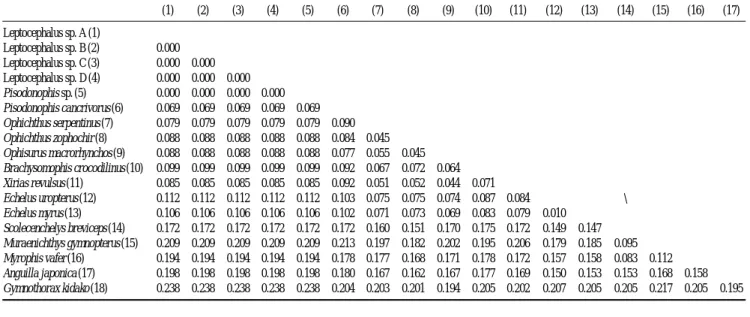
미토콘드리아 DNA 12S rRNA 826 base pair 염기서열에 의한 분자동정 결과 남해산 엽상자어 4개체는 동일 지역에 Table 2. Genetic distance among ophichthid leptocephali and 12 Ophichthid with 2 outgroups
(1) (2) (3) (4) (5) (6) (7) (8) (9) (10) (11) (12) (13) (14) (15) (16) (17)
Leptocephalus sp. A (1)
Leptocephalus sp. B (2) 0.000 Leptocephalus sp. C (3) 0.000 0.000 Leptocephalus sp. D (4) 0.000 0.000 0.000 Pisodonophis sp. (5) 0.000 0.000 0.000 0.000 Pisodonophis cancrivorus (6) 0.069 0.069 0.069 0.069 0.069 Ophichthus serpentinus (7) 0.079 0.079 0.079 0.079 0.079 0.090 Ophichthus zophochir (8) 0.088 0.088 0.088 0.088 0.088 0.084 0.045 Ophisurus macrorhynchos (9) 0.088 0.088 0.088 0.088 0.088 0.077 0.055 0.045 Brachysomophis crocodilinus (10) 0.099 0.099 0.099 0.099 0.099 0.092 0.067 0.072 0.064 Xirias revulsus (11) 0.085 0.085 0.085 0.085 0.085 0.092 0.051 0.052 0.044 0.071
Echelus uropterus (12) 0.112 0.112 0.112 0.112 0.112 0.103 0.075 0.075 0.074 0.087 0.084 \ Echelus myrus (13) 0.106 0.106 0.106 0.106 0.106 0.102 0.071 0.073 0.069 0.083 0.079 0.010
Scolecenchelys breviceps (14) 0.172 0.172 0.172 0.172 0.172 0.172 0.160 0.151 0.170 0.175 0.172 0.149 0.147 Muraenichthys gymnopterus (15) 0.209 0.209 0.209 0.209 0.209 0.213 0.197 0.182 0.202 0.195 0.206 0.179 0.185 0.095 Myrophis vafer (16) 0.194 0.194 0.194 0.194 0.194 0.178 0.177 0.168 0.171 0.178 0.172 0.157 0.158 0.083 0.112 Anguilla japonica (17) 0.198 0.198 0.198 0.198 0.198 0.180 0.167 0.162 0.167 0.177 0.169 0.150 0.153 0.153 0.168 0.158 Gymnothorax kidako (18) 0.238 0.238 0.238 0.238 0.238 0.204 0.203 0.201 0.194 0.205 0.202 0.207 0.205 0.205 0.217 0.205 0.195
Fig. 3. Phylogenetic tree based on partial mt 12S rRNA nucleotide sequences showing the relationships among ophichthid leptocephali and 12 ophichthid species with 2 outgroups. The Neighbor-Joining tree using the Kimura-2-parameter distance model. 1000 replications of bootstrap.
Bar indicates genetic distance of 0.02.
Pisodonophis sp. (PKU3483) Leptocephalus sp. A (PKU4541) Leptocephalus sp. B (PKU4542) Leptocephalus sp. C (PKU4543) Leptocephalus sp. D (PKU4544) Pisodonophis cancrivorus (AF417323)
Ophisurus macrorhynchos (AB049986) Xyrias revulsus (AF417324)
Brachysomophis crocodilinus (DQ645650)
Scolecenchelys breviceps (DQ645652) Echelus uropterus (HQ185623) Echelus myrus (DQ645651)
Myrophis vafer (DQ645654)
Muraenichthys gymnopterus (HQ185625) Anguilla japonica (AF417307)
Gymnothorax kidako (AP002976) 0.02 substitution/site
Ophichthus serpentinus (DQ645655) Ophichthus zophochir (DQ645695)
100 98
38 55 72
81 100 61
100
100
100 59
서 채집된 돛물뱀속(Pisodonophis sp.) 성어와 유전거리(d) 가 0.000으로 최소였고, 동속의 돌기바다뱀 Pisodonophis cancrivorus과는 d==0.069로 비교적 큰 값을 보였다. 비교 그 룹 중 돛물뱀속 어류를 제외하면 까치물뱀속 2종(Ophichthus sepentinus, Ophichthus zophochir)이 남해산 엽상자어와 가까 운 편이었고(d==0.079~0.088), 이어 Ophisurus, Xyrias, Bra- chysomophis, Echelus어류와는 다소 큰 차이를 보였다(d== 0.085~0.112) (Table 2). 한편, 바다뱀아과에 속하는 남해산 엽상자어는 다른 아과인 갯물뱀아과(Myrophinae) 3종(Sco- lecenchelys breviceps, Muraenichthys gymnopterus, Myrophis vafer)과 비교했을 때 더욱 큰 차이를 보였고(d==0.172~
0.209), 외집단인 뱀장어 Anguilla japonica, 곰치 Gymnotho- rax kidako와는 각각 d==0.198, 0.238로 매우 큰 유전 차이를 나타내었다(Table 2). 근린결합수(NJ-tree)에 의하면, 남해산 엽상자어 4개체가 돛물뱀속(Pisodonophis sp.) 성어 1개체 와 일직선상에 유집되었으며, 이어 돌기바다뱀(P. cancrivo- rus)과 유집되었고, Ophichthus sepentinus, Ophichthus zopho- chir와도 다소 가깝게 유집되었다(Fig. 3). 분자분석 결과, 남 해산 엽상자어는 돛물뱀속(Pisodonophis sp.) 성어와 100%
일치하여 Pisodonophis sp.로 동정하였다. 국내에 이미 보고 된 Pisodonophis속 2종(돛물뱀 Pisodonophis zophistius, 돌 기바다뱀 P. cancrivorus)과 남해산 엽상자어를 형태적으로 비교하면, 전체 근절수 또는 전체 척추골수(남해산 엽상자 어는 144~151개 vs. 돛물뱀은 179~182개 vs. 돌기바다뱀 은 153~164개)에서 차이를 보였다(Hatooka, 2002). 바다뱀 과 엽상자어는 종 수준으로 보고된 종이 많지 않은 실정이 며, 전체근절수 및 소낭수, 항문뒤 흑색소포수 등이 엽상자 어기 형태특징을 설명하는 중요한 분류형질로 사료된다. 나 아가 다양한 바다뱀과 엽상자어를 확보하여 형태 및 분자 방법으로 동정한다면 이들 엽상자어 형태특징에 근거하여 종 수준까지의 분류가 가능할 것으로 사료된다. 따라서 본 연구에서 채집된 남해산 엽상자어 4개체는 분자분석 결과 Pisodonophis속에 속하는 엽상자어로 확인되었으며, 근절수 에서 기보고된 돛물뱀 및 돌기바다뱀의 척추골수와 다른 결과를 보여 Pisodonophis sp.로 처리하였다. 본 연구를 통 해 우리나라 남해가 바다뱀과 엽상자어의 보육장인 것으로 사료된다.
요 약
2010년 9월 남해 상주 앞바다에서 정치망으로 바다뱀과 엽상자어 4개체(TL 109.8~129.7 mm)를 채집하였다. 형태적 으로 엽상자어는 8개의 소낭이 항문 앞까지 존재하고, 전체 근절수가 141~151개, 전장에 대한 체고가 10% 이하인 점, 흑색소포가 항문 뒤부터 꼬리지느러미 앞까지 8~9개 분포
하는 특징에 따라 까치물뱀속(Ophichthus sp.) 어류와 유사 한 것으로 확인되었다. 형태적 결과와는 달리 미토콘드리아 DNA 12S rRNA 826 bp의 염기서열을 분석한 결과, 엽상자 어는 돛물뱀속(Pisodonophis sp.) 성어와 100% 일치하였고, 돌기바다뱀(Pisodonophis cancrivorus) 성어와는 98.1% 일 치하였다. 본 연구결과에서는 형태 동정결과가 분자 동정결 과와 일치하지 않는 결과를 보였고, 이는 까치물뱀속과 돛 물뱀속 엽상자어기의 형태적 구분이 매우 어렵다는 것을 의 미한다. 본 연구에서는 처음으로 한국에서 채집된 돛물뱀속 엽상자어의 형태적 특징을 상세히 기술하였다.
사 사
본 연구는 2010년도 국립수산과학원 “난자치어 분류기술 서 발간” 용역과제의 지원으로 이루어졌으며, 지원에 감사드 립니다(인증번호: RP-2010-FR-054).
인 용 문 헌
Hatooka, K. 2002. Ophichthidae. In: Nakabo, T. (ed.), Fishes of Japan with pictorial keys to the species. Tokai Univ. Press, Tokyo, pp. 215-225.
Hyde, J.R., E. Lynn, R. Humphreys, M. Musyl, A.P. West and R.
Vetter. 2005. Shipboard identification of fish eggs and larvae by multiplex PCR, and description of fertilized eggs of blue marlin, shortbill spearfish, and wahoo. Mar. Ecol. Prog. Ser., 286: 269-277.
Kim, B.J., H.S. Seo and J.N. Oh. 2008. Identification of Albula sp.
(Albulidae: Albuliformes) leptocephalus colleted from the Southern coastal wates of Korea using cytochrome b DNA.
Ocean Sci. J., 43: 86-89.
Kim, B.J., Y.B. GO and S.J. Lee. 2004. Morphology of Ophichthidae leptocephalus in coast of Jeju Island. In: Proc. of Biannual Meeting of the Aquaculture Society of Korea, 1: 453-454.
Kimura, M. 1980. A simple method for estimating evolutionary rates of base substitutions through comparative studies of nucleo- tide sequences. J. Mol. Evol., 16: 111-120.
Leiby, M.M. 1979. leptocephalus larvae of the eel family Ophichthi- dae. I. Ophichthus gomesi Castelnau. Bull. Mar. Sci., 29:
329-343.
Leiby, M.M. 1981. Larval morphology of the eels Bascanichthys bascanium, B. scuticaris, Ophichthus melanophorus and O.
ophis (Ophichthidae), with a discussion of larval identifica- tion methods. Bull. Mar. Sci., 31: 46-71.
Leiby, M.M. 1982. Leptochephalus larvae of the tribe Sphagerbran- chini (pisces, Ophichthidae) in the western North Atlantic.
Bull. Mar. Sci., 32: 220-236.
Leiby, M.M. 1984. leptocephalus larvae of the tribe Callechelyini
(Anguilliformes, Ophichthidae, Ophichthinae) in the western North Atlantic. Bull. Mar. Sci., 34: 398-432.
Michael, P. and C.L. Obenchain. 1978. Leptocephali of the ophichthid genera Ahlia, Myrophis, Ophichthus, Pisodonophis, Calle- chelys, Letharchus, and Apterichtus on the atlantic continen- tal shelf of the United states. Bull. Mar. Sci., 28: 442-486.
Miller, M.J. and K. Tsukamoto. 2006. studies on eels and leptoce- phali in Southeast Asia: a new research frontier. Coastal.
Mar. Sci., 30: 283-292.
Miller, M.J., T. Otake, G. Minagawa and T. Inagaki. 2002. Distribu- tion of leptocephali in the Kuroshio current and east China Sea. Mar. Ecol. Prog. Ser., 235: 279-288
Paine, M.A., J.R. McDowell, J.E. Graves. 2008. Specific identifica- tion using COI sequence analysis of scombrid larvae collected off the Kona coast of Hawaii Island. Ichthyol. Res., 55: 7-16.
Richardson, D.E. and R.K. Cowen. 2004. new leptocephlaus types collected around the island of Barbados (West Indies). Copeia, pp. 888-895.
Richardson, S.L. 1974, Eggs and lavae of the ophichthid eel, Pisodo- nophis crentifer from the Chesapeake bight, western north atlantic. Chesapeake Sci., 15: 151-181.
Tabeta, O. and N. Mochioka. 1988. Family Ophichthidae. In: Okiyama M. (ed), An Atlas of the early stage fishes in Japan. Tokai Univ. Press, Tokyo, pp. 58-62. (in Japanese)
Tamura, K., J. Dudley, M. Nei and S. Kumar. 2007. MEGA4: Mole- cular Evolutionary Genetics Analysis (MEGA) software version 4.0. Mol. Biol. Evol., 24: 1596-1599.
Taylor, C.A. and W. Watson. 2004. Utility of larval pigmentation to identify nearshore rockfishes of the Sebastes subgenus Pteropodus from southern California. CalCOFI Rep., 45:
113-117.
Thompson, J.D., D.G. Higgins and T.J. Gibson. 1994. CLUSTAL W: improving the sensitivity of progressive multiple sequence alignment through sequence weighting, positionspecific gap penalties and weight matrix choice. Nucl. Acids Res., 22:
4673-4680.