Copyright ⓒ 2012, The Microbiological Society of Korea
Genotypic Investigation of Multidrug-Resistant Pseudomonas aeruginosa from Clinical Isolates in Korea, 2010
Min Ji Kim1, Min Kyeong Cha1, Do Kyung Lee1, Ju Yeon Kang2, Jae Eun Park1, Young Hee Kim3 Il Ho Park1, Hea Soon Shin2, and Nam Joo Ha1*
1College of Pharmacy, Sahmyook University, Seoul 139-742, Republic of Korea
2College of Pharmacy, DukSung Women’s University, Seoul 132-714, Republic of Korea
3College of Nursing, Chung-Ang University, Seoul 156-755, Republic of Korea
2010년도 국내 임상에서 분리한 다제내성 녹농균의 유전자형 조사
김민지1․차민경1․이도경1․강주연2․박재은1․김영희3․박일호1․신혜순2․하남주1*
1삼육대학교 약학대학
2덕성여자대학교 약학대학
3중앙대학교 간호대학
(Received November 2, 2012 / Accepted December 14, 2012)
Pseudomonas aeruginosa is an opportunistic Gram-negative bacterium that causes serious infection, particularly in immunocompromised patients. Also, P. aeruginosa possessing carbapenem-resistant metallo-β-lactamases (MBL) has been reported with increasing frequency in Korea. We therefore analyzed the level of multidrug-resistant clinical P. aeruginosa isolated from a secondary hospital in Korea in 2010. A total of 92 isolates of P. aeruginosa were collected from Sahmyook Medical Center in 2010. Susceptibility to antimicrobial agents was determined by analysis of the minimum inhibitory concentration test; the inhibitor-potentiated disk diffusion (IPD) test was performed for MBL detection. RAPD-PCR was used for genotyping to rapidly characterize P. aeruginosa strains isolated from clinical patients. The percentages of non-susceptible isolates were as follows: 40.2% to ceftazidime, 58.7% to meropenem, 56.5% to gentamicin, 46.7% to tobramycin, 62.0% to ciprofloxacin and 97.8% to chloramphenicol. The 29 multidrug-resistant strains were screened by the IPD test: of the 21 PCR-positive isolates, 19 were IPM-1 producers and 2 were VIM-2 producers. Among the 19 IMP-1-producing P. aeruginosa isolates, 16 isolates showed similar patterns, and three different banding patterns were observed. The proportion of IMP-1-producing multidrug-resistant P. aeruginosa from clinical isolates steadily increased in this secondary hospital in Korea in 2010. This study provides information about the antimicrobial-resistant patterns and genotype of multidrug-resistant P. aeruginosa isolated from clinical isolates in Korea, 2010.
Keywords: Pseudomonas aeruginosa, antimicrobial resistance, metallo-β-lactamases (MBL), multidrug-resistant
*For correspondence. E-mail: [email protected]; Tel: +82-2-3399-1607;
Fax: +82-2-3399-1617
Pseudomonas aeruginosa is an opportunistic Gram-negative bacterium that causes serious infection, particularly in immunocompromised patients. They play an important role in hospital intensive care units where they cause a wide spectrum of nosocomial infections (Fernández-Cuenca et al., 2003).
Moreover, nosocomial P. aeruginosa strains exhibit high rates of resistance to antibiotics and are frequently multidrug-resistant.
Increasing resistance to many antibiotics has been observed in P. aeruginosa and presents a major therapeutic dilemma (Anna
et al., 1999; Landman and Quale, 2002; Livermore, 2002).
Carbapenem antibiotics such as imipenem and meropenem are last-resort drugs of choice to treat serious infections caused by multidrug-resistant P. aeruginosa. Development of antibiotic resistance to most classes of antibiotics, including carbapenems, has made it difficult to treat such infections even with combination therapy. Intensive use of carbapenems in the treatment of nosocomial P. aeruginosa infections has facilitated the emergence of mechanisms that confer resistance to carbapenems, such as impermeability of the outer membrane, production of carbapenemases, the overexpression of efflux pumps and alterations in penicillin-binding proteins (PBPs) (Tam et al.,
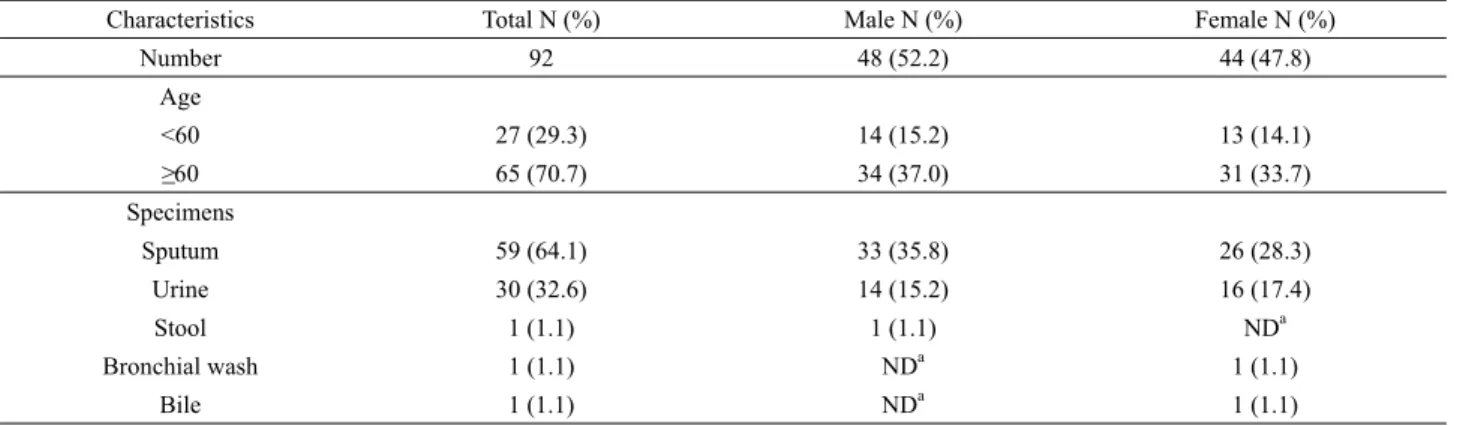
Characteristics Total N (%) Male N (%) Female N (%)
Number 92 48 (52.2) 44 (47.8)
Age
<60 27 (29.3) 14 (15.2) 13 (14.1)
≥60 65 (70.7) 34 (37.0) 31 (33.7)
Specimens
Sputum 59 (64.1) 33 (35.8) 26 (28.3)
Urine 30 (32.6) 14 (15.2) 16 (17.4)
Stool 1 (1.1) 1 (1.1) NDa
Bronchial wash 1 (1.1) NDa 1 (1.1)
Bile 1 (1.1) NDa 1 (1.1)
a ND: Not detected.
Table 1. Prevalence of P. aeruginosa isolated from clinical samples
2007). The most important carbapenemases in P. aeruginosa are class B metallo-β-lactamases (MBL) such as VIM and IMP types (Zhiyong et al., 2003). Twenty-five IMP variants have been described; IMP-1 was the first MBL identified in P.
aeruginosa and its national spread in Gram-negative bacilli was reported in Japan (Senda et al., 1996). Among the VIM types, VIM-2 is the most dominant worldwide and was particularly detected in Europe (Livermore and Woodford, 2000).
Furthermore, carbapenem-resistant MBL-possessing P.
aeruginosa has been reported with increasing frequency in Korea (Oh et al., 2003; Lee et al., 2009; Kim et al., 2011).
In this study, we analyzed the levels of multidrug-resistant clinical P. aeruginosa isolated from a secondary hospital in Korea in 2010. Six antibiotics that are widely used in clinical patients were selected. In addition, epidemiological studies were performed using RAPD-PCR to define the genetic similarity between VIM and IMP types from isolates.
Materials and Methods
Clinical isolates
A total of 92 non-repetitive isolates of P. aeruginosa were collected from Sahmyook Medical Center in 2010. P.
aeruginosa was recovered from various clinical specimens:
sputum (64.1%), urine (32.6%), stool (1.1%), bronchial wash (1.1%) and bile (1.1%), and stored at -70℃ in nutrient broth containing 80% glycerol.
Susceptibility test
The 92 isolates were grown overnight on Mueller Hinton broth (Difco) at 37℃ for 24 h, and were then tested for resistance to the six antimicrobial agents. Minimal inhibitory concentrations (MIC) of the various agents were determined by the agar dilution method, according to the guidelines established by the Clinical Laboratory Standards Institute
(CLSI, 2007). P. aeruginosa ATCC 27853 was concurrently tested as a quality control strain. The antibiotics tested were ceftazidime (GlaxoSmithKline), gentamicin (Sigma), ciprofloxacin (Ildong), chloramphenicol (Fluka AG), meropenem (Yuhan) and tobramycin (Daewoong). Results were included in the analysis only when the quality control isolate results were within the acceptable range according to CLSI guidelines. We selected 29 multidrug resistant isolates from the original 92 isolates. The resistant isolates were identified by Samkwang Medical Laboratories.
Metallo-β-lactamase (MBL) screening
The inhibitor-potentiated disk diffusion (IPD) test was performed for the detection of MBL producing clinical isolates of multidrug P. aeruginosa (Yong et al., 2002). The surface of a Muller-Hinton agar plate was inoculated with a culture suspension of the test strain as recommended by the Clinical Laboratory Standards Institute. After drying, two 10-µg imipenem disks (Becton Dickinson) were placed on the plate at a 3–4 cm center-to-center distance. Subsequently, 10 µl of 0.5 M EDTA (Seoul chemical) solution was added to one of them.
After incubation for 18 h, a difference in the inhibition zones of the imipenem and imipenem-EDTA disks of more than 7 mm was interpreted as a positive IPD test.
MBL gene detection
The blaIMP-1 and blaVIM-2 genes were detected by PCR experiments with the following primers: IMP-F (5′-CAT GGT TTG GTG GTT CTT GT-3′), IMP-R (5′-ATA ATT TGG CGG ACT TTG GC-3′) and VIM-F (5′-ATT GGT CTA TTT GAC CGC GTC-3′), VIM-R (5′-TGC TAC TCA ACG ACT GAG CG-3′). All amplifications were carried out according to the corresponding conditions (Jeon et al., 2005).
RAPD analyses
Antimicrobial agent MIC (µg/ml) Sensitive N (%)
Intermediate N (%)
Resistance N (%)
50% 90%
Ceftazidime 4 128 55 (59.8) 2 (2.2) 35 (38.0)
Meropenem 16 >128 38 (41.3) 2 (2.2) 52 (56.5)
Gentamicin 8 >128 40 (43.5) 4 (4.3) 48 (52.2)
Tobramycin 1 >128 49 (53.3) 0 (0.0) 43 (46.7)
Ciprofloxacin 16 >64 35 (38.0) 0 (0.0) 57 (62.0)
Chloramphenicol 128 >128 2 (2.2) 1 (1.1) 89 (96.7)
Table 2. Antimicrobial susceptibility patterns of P. aeruginosa clinical isolates
Clonal relatedness of the isolates was assessed by RAPD-PCR. Genomic DNA was extracted with the QIAamp DNA mini kit (Qiagen), according to the manufacturer’s instructions. All amplified PCR products were resolved by electrophoresis in 2% agarose gel and stained with SYBR safe DNA gel stain (Gibco). PCR reactions were carried out in 50 µl reaction mixtures containing the DNA template, 20 mM Tris-HCl, 100 mM KCl, 25 mM MgCl2, 2.5 mM of each dNTP, primer, and 5 units of Taq DNA polymerase (TaKaRa, Japan).
The experiments were done with BOXA1R (5′-CTA CGG CAA GGC GAC GCT GAC G-3′) with the following amplification conditions: initial denaturation at 92℃ for 2 min;
followed by 35 cycles consisting of 30 sec at 92℃, 1 min at 5 2℃ and 2 min at 72℃; and a final cycle of 72℃ for 5 min, after which the PCR products were chilled to 4℃ (Koeuth et al., 1995). PCR products were visualized under UV light (VILBER Lourmat, France) at 254 nm. The amplification reaction was repeated three times to establish reproducibility.
Results and Discussion
Antimicrobial therapy is limited against infections caused by multidrug-resistant P. aeruginosa. Many studies have reported significant relationships between antibiotic consumption and resistance, because inappropriate use of antibiotic has created a serious problem in the choice of therapy.
Susceptibility test
Among 92 patients infected with P. aeruginosa, 48 (52.2%) were male and 44 (47.8%) were female (Table 1). The majority of P. aeruginosa were isolated from sputum (64.1%) and urine (32.6%). The percentages of non-susceptible isolates were as follows: 40.2% to ceftazidime, 58.7% to meropenem, 56.5% to gentamicin, 46.7% to tobramycin, 62.0% to ciprofloxacin and 97.8% to chloramphenicol (Table 2). The most active antibiotic was ceftazidime (resistance in 38.0%), and the least active antimicrobial agent was chloramphenicol (resistance in 96.7%).
β-Lactamase genotyping
In the present study, 29 (31.5%) multidrug-resistant (MDR, resistant to three or more antimicrobial classes) isolates were identified among 92 clinical P. aeruginosa isolates collected from a secondary hospital in Korea in 2010. The 29 MDR strains were mostly found in urine specimens (75.8%), indicating that urine may serve as an important reservoir for dissemination of resistant bacteria. The average patient age was 67.2 and 54.4 for males and females, respectively; most multidrug-resistant bacteria were derived from elderly patients around 60 years of age (58.6%).
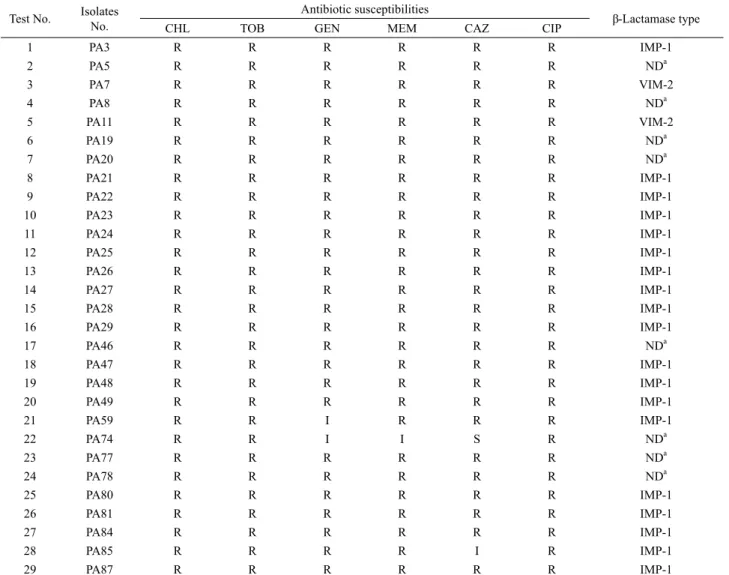
The 29 multidrug-resistant strains were screened by IPD test; 21 were positive for MBL and 8 were negative in this screening test. Of the 21 PCR-positive isolates, 19 were IPM-1 producers and 2 were VIM-2 producers (Table 3). Nucleotide sequencing revealed that all the blaIMP-1 and blaVIM-2 were IMP-1 and VIM-2, respectively. In this study, IPD test results showed that 21 out of 29 isolates produced MBL, but genotyping PCR was not successful in 8 strains. It is possible to obtain a false-positive by using EDTA as MBL inhibitor (Yong, 2009), which suggests that other MBL genes are involved in genotype generation. Based on the determined mechanism of resistance, further studies are required.
Two major MBL families, IMP and VIM, have been found in gram negative bacteria, especially in the Asian Pacific region and Latin America. They have low amino acid homology (approximately 30% to 40%), but their hydrolytic properties are similar (Gibb et al., 2002). Likewise, both are often encoded by mobile gene cassettes inserted into integrons that are sometimes located on plasmids (Levasque et al., 1995; Bush, 1998). Several close relatives of IMP-1 have been reported:
IMP-2 from an isolate of A. baumannii in Italy (Riccio et al., 2000), IMP-3 from Shigella flexneri in Japan (Iyobe et al., 2000), and IMP-4 from Acinetobacter and Citrobacter spp.
from Hong Kong (Chu et al., 2001). VIM-2 which shares 90%
amino acid identity with VIM-1. To date, eleven VIM variants have been reported worldwide, mostly in European and Asian countries (Walsh et al., 2005). In comparison with domestic
Test No. Isolates No.
Antibiotic susceptibilities
β-Lactamase type
CHL TOB GEN MEM CAZ CIP
1 PA3 R R R R R R IMP-1
2 PA5 R R R R R R NDa
3 PA7 R R R R R R VIM-2
4 PA8 R R R R R R NDa
5 PA11 R R R R R R VIM-2
6 PA19 R R R R R R NDa
7 PA20 R R R R R R NDa
8 PA21 R R R R R R IMP-1
9 PA22 R R R R R R IMP-1
10 PA23 R R R R R R IMP-1
11 PA24 R R R R R R IMP-1
12 PA25 R R R R R R IMP-1
13 PA26 R R R R R R IMP-1
14 PA27 R R R R R R IMP-1
15 PA28 R R R R R R IMP-1
16 PA29 R R R R R R IMP-1
17 PA46 R R R R R R NDa
18 PA47 R R R R R R IMP-1
19 PA48 R R R R R R IMP-1
20 PA49 R R R R R R IMP-1
21 PA59 R R I R R R IMP-1
22 PA74 R R I I S R NDa
23 PA77 R R R R R R NDa
24 PA78 R R R R R R NDa
25 PA80 R R R R R R IMP-1
26 PA81 R R R R R R IMP-1
27 PA84 R R R R R R IMP-1
28 PA85 R R R R I R IMP-1
29 PA87 R R R R R R IMP-1
CHL, Chloramphenicol; TOB, Tobramycin; GEN, Gentamicin; MEM, meropenem; CAZ, Ceftazidime; CIP: Ciprofloxacin; I, Intermediate; R, Resistant; S, Susceptible
a ND, Not detected.
Table 3. Antibiotic susceptibility patterns and β-lactamases of multidrug-resistant P. aeruginosa
studies in past years (Lee et al., 2002; Kim et al., 2004), we found IMP-1 in 65.5% of isolates and VIM-2 in 6.9%. The proportion of blaIMP-positive isolates was greater than that of blaVIM-positive isolates. Also IMP-1-producing P. aeruginosa isolates were resistant to all antibiotics except meropenem and ceftazidime. Based on recent reports, our results also indicate that the proportion of IMP-1-producing P. aeruginosa is growing steadily (Kim et al., 2002; Lee et al., 2004).
RAPD analyses
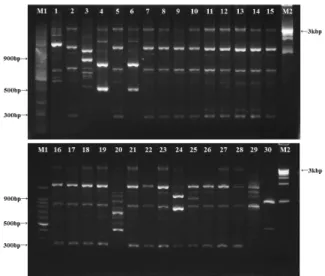
Among the 19 IMP-1 producing P. aeruginosa isolates, 16 isolates showed similar patterns, and three different banding patterns were observed. The two VIM-2-producing P. aeruginosa isolates showed related patterns. These isolates had two common bands of approximately 800 bp and 500 bp (Fig. 1). The
RAPD-PCR results suggest that most of the MBL-producing P.
aeruginosa isolates were genetically related. But, the three different band patterns suggest a horizontal spread in this species.
In conclusion, the proportion of IMP-1-producing multidrug- resistant P. aeruginosa from clinical isolates steadily increased in secondary hospitals in Korea in 2010. This study provides information about the antimicrobial-resistant patterns and genotype of multidrug-resistant P. aeruginosa isolated from clinical isolates in Korea, 2010. Antibiotic use and treatment should be restricted as part of a strategy to control multidrug-resistant P. aeruginosa.
적 요
녹농균은 특히 면역이 저하된 환자에게서 심각한 감염을 일 으키는 그람음성의 기회감염 균주이다. 또한 carbapenem 내성
Fig. 1. BOX-PCR patterns of genomic DNA from clinical isolates of multidrug-resistant P. aeruginosa. Lanes: M1, 100 bp; M2, 1-kb DNA size marker; 1, P. aeruginosa ATCC27853; 2, PA3; 3, PA5; 4, PA7; 5, PA8; 6, PA11; 7, PA19; 8, PA20; 9, PA21; 10, PA22; 11, PA23; 12, PA24; 13, PA25; 14, PA26; 15, PA27; 16, PA28; 17, PA29; 18, PA46; 19, PA47; 20, PA48; 21, PA49; 22, PA59; 23, PA74; 24, PA77; 25, PA78; 26, PA80; 27, PA81; 28, PA84; 29, PA85; 30, PA87.
metallo-β-lactamases (MBL)를 가진 녹농균이 한국에서 증가되 는 추세로 보고되고 있다. 따라서 본 실험에서는 2차 병원인 삼 육 서울 병원에서 수집된 총 92종의 임상 녹농균의 다재내성 수 준을 분석하였다. 항생제에 대한 감수성은 최소억제농도(MIC) 분석에 의해 결정되었고, inhibitor-potentiated disk diffusion (IPD) 분석은 MBL 검출을 위해 수행되었다. RAPD-PCR은 임 상환자에서 분리한 녹농균 계통의 유전적 유형의 특징을 밝히기 위해 사용되었다. 그 결과 임상에서 분리된 녹농균의 40.2%는 ceftazidime에 내성을, 58.7%는 meropenem에 내성을, 56.5%는 gentamicin에 내성을, 46.7%는 tobramycin에 내성을, 62.0%는 ciprofloxacin에 내성을 그리고 97.8%는 chloramphenicol에 내 성을 보였다. IPD 분석에 의해 29종의 다재내성 균주로 관찰 되 었고, RAPD 분석에 의해 19종은 IPM-1 유전자형을, 2종은 VIM-2 유전자형을 만들었다. MBL 유전자 검출 시험을 통해 19 종의 IMP-1 생성 녹농균 중에서 16종이 유사한 유전자형을 보 였고, 3종은 다른 유전자형이 관찰되었다. 임상에서 분리한 IMP-1 생성 다재내성 녹농균의 비율은 꾸준히 증가하고 있다.
이번 연구는 2010년 국내 임상에서 분리한 녹농균의 항생제 다 제내성 패턴과 유전자형에 대한 정보를 제공한다.
Acknowledgements
This work (Grants No. 000449270111) was supported by Business for Cooperative R&D between Industry, Academy, and Research Institute funded Korea Small and Medium Business Administration in 2011. The authors are grateful to the College of Pharmacy of Sahmyook University and for the
financial support provided by the Sahmyook University Research Fund.
References
Anna, S.L., Antonio, A.B., Juliana, P., Marcio, V.S., Ivan, S.M., Erico, G.A., Edison, I.M., and Silvia, F.C. 1999. Intravenous colistin as therapy for nosocomial infections caused by multidrug-resistant Pseudomonas aeruginosa and Acinetobacter baumannii. Clin.
Infect. Dis. 28, 1008–1011.
Bush, K. 1998. Metallo-β-lactamases: a class apart. Clin. Infect. Dis. 27, 48–53.
Chu, Y.-W., Afzal-Shah, M., Houang, E.T., Palepou, M.I., Lyon, D.J., Woodford, N., and Livermore, D. 2001. IMP-4, a novel metallo-β -lactamase from nosocomial Acinetobacter spp. collected in Hong Kong between 1994 and 1998. Antimicrob. Agents Chemother. 45, 710–714.
Clinical and Laboratory Standards Institute (CLSI). 2007. Performance standards for antimicrobial susceptibility testing; seventh informational supplement 27. Suit, USA, 98-114.
Fernández-Cuenca, F., Martínez-Martínez, L., Conejo, M.C., Ayala, J.A., Perea, E.J., and Pascual, A. 2003. Relationship between β -lactamase production, outer membrane protein and penicillin- binding protein profiles on the activity of carbapenems against clinical isolates of Acinetobacter baumannii. J. Antimicrob.
Chemother. 51, 565–574.
Gibb, A.P., Tribuddharat, C., Moore, R.A., Louie, T.J., Krulicki, W., Livermore, D.M., Palepou, M.F., and Woodford, N. 2002. Nosocomial outbreak of carbapenem-resistant Pseudomonas aeruginosa with a new blaIMP allele, blaIMP-7. Antimicrob. Agents Chemother. 46, 255–
258.
Iyobe, S., Kusadokoro, H., Ozaki, J., Matsumura, N., Minami, S., Haruta, S., Sawai, T., and O’Hara, K. 2000. Amino acid substitutions in a variant of IMP-1 metallo-β-lactamase. Antimicrob. Agents Chemother. 44, 2023–2027.
Jeon, B.C., Jeong, S.H., Bae, I.K., Kwon, S.B., Lee, K., Young, D., Lee, J.H., Song, J.S., and Lee, S.H. 2005. Investigation of a nosocomial outbreak of imipenem-resistant Acinetobacter baumannii producing the OXA-23 beta-lactamase in Korea. J. Clin. Microbiol. 43, 2241–
2245.
Kim, J.H., Jeong, S.H., Kim, B.N., Jeong, T.J., Kim, T.S., Kim, J.C., and Jeon, B.C. 2002. Genotypes of metallo-β-lactamase produced by imipenem-resistant Acinetobacter spp. isolates from clinical specimens. Korean J. Infect. Dis. 34, 360–366.
Kim, J.R., Lee, D.K., An, H.M., Kim, M.J., Lee, S.W., Cha, M.K., Lee, K.O., and Ha, N.J. 2011. Antimicrobial activity of commonly used antibiotics and DNA fingerprint analysis of Pseudomonas aeruginosa obtained from clinical isolates and unchlorinated drinking water in Korea, 2010. Arch. Pharm. Res. 34, 1353–1361.
Kim, I.S., Oh, W.I., Song, J.H., and Lee, N.Y. 2004. Screening and identification of metallo-β-lactamase gene in clinical isolates of imipenem-resistant Pseudomonas aeruginosa. Korean J. Lab. Med.
24, 177–182.
Koeuth, T., Versalovic, J., and Lupski, J.R. 1995. Differential subsequence conservation of interspersed repetitive Streptococcus pneumoniae BOX elements in diverse bacteria. Genome Res. 5, 408–
418.
Landman, D. and Quale, J. 2002. Pseudomonas aeruginosa and
Acinetobacter baumannii: pathogens of the millennium. Ochsner Clinic Reports on Serious Hospital Infection. 14, 1–7.
Lee, K., Ha, G.Y., Shin, B.M., Kim, J.J., Kang, J.O., Jang, S.J., Yong, D., Chong, Y., and Korean Nationwide Surveillance of Antimicrobial Resistance (KONSAR) group. 2004. Metallo-β-lactamase-producing Gram-negative bacilli in Korean nationwide surveillance of antimicrobial resistance group hospitals in 2003: continued prevalence of VIM-producing Pseudomonas spp. and increase of IMP producing Acinetobacter spp. Diagn. Microbiol. Infect. Dis. 50, 51–58.
Lee, K., Lim, J.B., Yum, J.H., Yong, D., Chong, Y., Kim, J.M., and Livermore, D.M. 2002. blaVIM-2 Cassette-containing novel integrons in metallo-β-lactamase-producing Pseudomonas aeruginosa and Pseudomonas putida isolates disseminated in a Korean hospital. Antimicrob. Agents Chemother. 46, 1053–1058.
Lee, K.W., Park, A.J., Moon, Y.K., Lee, H.J., Cho, J.H., Kang, J.O., Yong, D.G., Chong, Y.S., and KONSAR group. 2009. Metallo-β -lactamase-producing Pseudomonas spp. in Korea: High prevalence of isolates with VIM-2 type and rmergence of isolates with IMP-1 type. Yonsei Med. J. 50, 335–339.
Levasque, C., Piche, L., Larose, C., and Roy, P.H. 1995. PCR mapping of integrons reveals several novel combinations of resistance genes.
Antimicrob. Agents Chemother. 39, 185–191.
Livermore, D.M. 2002. Multiple mechanisms of antimicrobial resistance in Pseudomonas aeruginosa: our worst nightmare? Clin.
Infect. Dis. 34, 634–640.
Livermore, D.M. and Woodford, N. 2000. Carbapenemases: a problem in waiting? Curr. Opin. Microbiol. 3, 489–495.
Oh, E.J., Lee, S., Park, Y.J., Park, J.J., Park, K., Kim, S.I., Kang, M.W., and Kim, B.K. 2003. Prevalence of metallo-beta-lactamase among
Pseudomonas aeruginosa and Acinetobacter baumannii in a Korean university hospital and comparison of screening methods for detecting metallo-beta-lactamase. J. Microbiol. Methods 54, 411–
418.
Riccio, M.L., Franceschini, N., Boschi, L., Caravelli, B., Cornaglia, G., Fontana, R., Amicosante, G., and Rossolini, G.M. 2000. Characterization of the metallo-β-lactamase determinant of Acinetobacter baumannii AC-54/97 reveals the existence of blaIMP allelic variants carried by gene cassettes of different phylogeny. Antimicrob. Agents Chemother.
44, 1229–1235.
Senda, K., Arakawa, Y., Nakashima, K., Ito, H., Ichiyama, S., Shimokata, K., Kato, N., and Ohta, M. 1996. Multifocal outbreaks of metallo- beta-lactamase-producing Pseudomonas aeruginosa resistant to broad-spectrum beta-lactams, including carbapenems. Antimicrob.
Agents Chemother. 40, 349–353.
Tam, V.H., Chang, K.T., LaRocco, M.T., Schilling, A.N., McCauley, S.K., Poole, K., and Garey, K.W. 2007. Prevalence, mechanisms, and risk factors of carbapenem resistance in bloodstream isolates of Pseudomonas aeruginosa. Diagn. Microbiol. 58, 309–314.
Walsh, T.R., Toleman, M.A., Poirel, L., and Nordmann, P. 2005. Metallo- β-lactamases: the quiet before the storm? Clin. Microbiol. 18, 306–325.
Yong, D.G. 2009. Metallo-β-lactamase producing Gram-negative Bacilli. Korean J. Clin. Microbiol. 12, 103–109.
Yong, D., Lee, K., Yum, J.H., Shin, H.B., Rossolini, G.M., and Chong, Y. 2002. Imipenem-EDTA disk method for differentiation of metallo-beta-lactamase-producing clinical isolates of Pseudomonas spp. and Acinetobacter spp. J. Clin. Microbiol. 40, 3798–3801.
Zhiyong, Z., Xiaoju, L., and Yanyu, G. 2003. Metallo-β-lactamases of non-fermenting Gram-negative bacteria. Rev. Med. Microbiol. 14, 79 –93.