http://dx.doi.org/10.4014/mbl.1805.05007 Microbiol. Biotechnol. Lett. (2018), 46(4), 434–437 http://dx.doi.org/10.4014/mbl.1805.05007 pISSN 1598-642X eISSN 2234-7305
Microbiology and Biotechnology Letters
Antibiotic Susceptibility Pattern and Molecular Typing By PCR-RAPD Analysis of Clinical and Environmental Isolates of Pseudomonas aeruginosa
O. B. Oluborode1, S.I. Smith2*, T.A. Seriki3, M. Fowora2, A. Ajayi3, and A.O. Coker4
1Department of Medical Microbiology and Parasitology, University of Lagos, Idi-Araba, Nigeria
2Molecular Biology & Biotechnology Department, Nigerian Institute of Medical Research (NIMR), Yaba, Lagos, Nigeria
3Department of Microbiology, University of Lagos Akoka, Nigeria
4Babcock University Teaching Hospital, Ogun State, Nigeria
Received: May 22, 2018 / Revised: September 10, 2018 / Accepted: September 11, 2018
Referred to as a panacea to cure infections, antibiotics have been greatly relied upon by humans in combating infections for over 60 years. However the emergence of resistance by pathogenic bacteria most especially multi- drug resistance (MDR) has remained a great threat to the use of these miracle molecules in medical practice [1]. MDR bacteria abound in the environment and have been implicated in human infections. One of such bacte- rium is Pseudomonas aeruginosa an opportunistic pathogen associated with nosocomial infections mostly in patients with impaired immunity [2, 3]. P. aeruginosa exhibits a remarkable antibiotic resistance profile as it has an extraordinary ability of acquiring further mecha- nisms of resistance to multiple groups of antibiotics out- side its natural resistance [4]. In Nigeria, several studies have shown high resistance of P. aeruginosa obtained
from both clinical and environmental sources to various classes of antibiotics most especially those isolated from hospital settings [5−9]. It is therefore imperative to determine the genetic relatedness of P. aeruginosa iso- lated from clinical samples and those isolated from the environment by genotyping, since typing of strains is necessary for determining the epidemiology of nosoco- mial infections and in the design of pathogen control strategies [10]. This study investigates the antimicrobial susceptibility pattern of clinical and environmental iso- lates of Pseudomonas aeruginosa and the clonal related- ness of these species.
Forty eight isolates of clinical (30) and environmental (18) species of Pseudomonas obtained from the Molecular Biology and Biotechnology Laboratory of the Nigerian Institute of Medical Research (NIMR) were subjected to antibiotic susceptibility testing using the disc diffusion method according to the clinical laboratory standards Institutes (CLSI) guidelines [11]. Identification and clonal relatedness of isolates was determined by poly- Pseudomonas aeruginosa accounts for a significant proportion of nosocomial infections. This study exam- ined the antimicrobial susceptibility pattern and clonal relatedness of P. aeruginosa isolates of clinical and environmental origin. These isolates displayed susceptibility to levofloxacin, ciprofloxacin, gentamicin, imipenem, and ceftazidime of 65.0%, 62.5%, 90.0%, 100%, and 85%, respectively. PCR-RAPD analysis of the P.
aeruginosa isolates revealed marked variation. No correlation was observed between the antibiotic resis- tance profiles and the DNA typing patterns.
Keywords: Resistance, PCR-RAPD, Pseudomonas aeruginosa, clonal relatedness
*Corresponding author Tel: +234 803 70 58 989 E-mail: [email protected]
© 2018, The Korean Society for Microbiology and Biotechnology
PCR-RAPD Analysis of Pseudomonas aeruginosa 435
December 2018 | Vol. 46 | No. 4
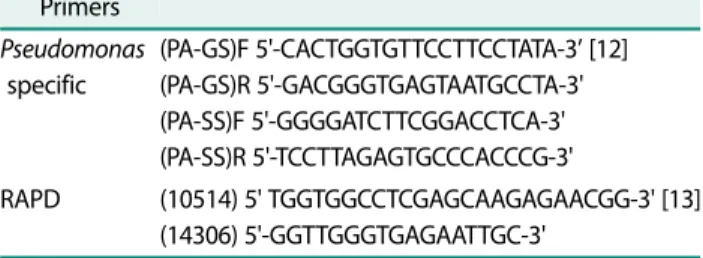
merase chain reaction (PCR) and random amplified polymorphic DNA analysis (RAPD) using pairs of prim- ers shown in Table 1. Using Pseudomonas genus-specific primers PA GS-F and PA GS-R 30 clinical (62.5%) and 18 environmental (37.5%) isolates were identified to be Pseudomonas species. Of these 48 Pseudomonas species, P. aeruginosa-specific primers PA SS-F and PA SS-R confirmed 40 to be Pseudomonas aeruginosa comprising 26 clinical (54.17%) and 14 environmental (29.17%) iso- lates. RAPD analysis of the 40 Pseudomonas aeruginosa isolates produced 8 clusters consisting of 37 different PCR-RAPD profile (Fig. 1). PCR based molecular typing methods have been suggested for epidemiological typing of P. aeruginosa strains, among which RAPD typing has been recommended as an efficient tool in clonal discrimi- nation of this pathogen [14]. Molecular typing by PCR- RAPD analysis of P. aeruginosa isolates from clinical and environmental sources resulted in thirty-seven dif- ferent PCR-RAPD profiles. This showed high level of variations based on the banding patterns among the iso- lates and agrees with the expectation from an organism with a much larger genome [15]. Of the eight clusters generated, cluster 1 comprised sixteen isolates, four of which were clonally related. Other clusters comprised of two to four isolates which were probably not clonally related. This shows that there is a high rate of polymor- phism and hyper-mutation in P. aeruginosa genome.
High level of genetic diversity in P aeruginosa isolates has also been reported as the basis of P. aeruginosa mul- tidrug resistance and high tenacity in environmental adaptability [14]. However, there seems to be no rela- tionship between the genetic profiles and antibiotic sus- ceptibility patterns of the isolates since no correlation was observed between the antibiotic resistance profiles and the DNA subtyping patterns. Similar results have been reported in studies by Smith et al. [6], and Sinem
and Nilufer [16], who observed no relationship between the antibiotic susceptibility profiles and molecular typ- ing patterns of P. aeruginosa.
Antibiotic susceptibility pattern and profile of Pseudo- monas aeruginosa against test antibiotics are indicated in Table 2. Twenty six (65%), were susceptible to levo- floxacin, 27 (62.5%) were susceptible to ciprofloxacin, 36 (90%) were sensitive to gentamicin, 40 (100%) were sen- sitive to imipenem, while 34 (85%) were sensitive to cef- tazidime. Comparison of the sensitivity of environmental and clinical isolates to test antibiotics showed that clini- cal isolates were more sensitive to levofloxacin and cipro- floxacin, while both environmental and clinical isolates were all sensitive to imipenem (Table 2). In the present study P. aeruginosa isolates from environments were less sensitive to ceftazidime, levofloxacin and ciprofloxa- cin than the clinical isolates, while sensitivity to genta- micin was higher in environmental isolates than clinical.
However, the observed differences was not statistically significant (p > 0.05): ciprofloxacin (p = 0.750), gentami- cin (p = 0.658) and ceftazidime (p = 0.403) except levo- Table 1. Genus and species specific Pseudomonas PCR primers
and RAPD primers.
Primers Pseudomonas specific
(PA-GS)F 5'-CACTGGTGTTCCTTCCTATA-3’ [12]
(PA-GS)R 5'-GACGGGTGAGTAATGCCTA-3' (PA-SS)F 5'-GGGGATCTTCGGACCTCA-3' (PA-SS)R 5'-TCCTTAGAGTGCCCACCCG-3'
RAPD (10514) 5' TGGTGGCCTCGAGCAAGAGAACGG-3' [13]
(14306) 5'-GGTTGGGTGAGAATTGC-3'
Fig. 1. Dendrogram constructed by UPGMA showing clus- tering of Pseudomonas aeruginosa based on RAPD. I to VIII stand for the eight clusters that were generated from the den- drogram at the co-efficient of similarity.
436 Oluborode et al.
http://dx.doi.org/10.4014/mbl.1805.05007
floxacin, which had a p-value of 0.031. Imipenem was found to be highly sensitive (100%) against both clinical and environmental isolates. This corroborates the find- ing of Chika et al. [17], and Odumosu et al. [18], who reported P. aeruginosa isolates from environmental, clinical, human, animals and plants not resistant to imi- penem. The potency of this antibiotic could be as a result of its conserved usage for only life threating cases. How- ever there is need for caution in the use of this molecule since resistance in P. aeruginosa has been reported in Brazil [19]. Susceptibility (90%) of P. aeruginosa to gen- tamicin was next to imipenem. This is in line with reports from Lagos [20] and Ethiopia [21] of 91.2% and 91.7% susceptibility of P. aeruginosa to gentamicin respectively. Hence gentamicin is one aminoglycoside which could still be considered a potent antibiotic in the treatment of infections caused by P. aeruginosa [22].
There was 85% susceptibility of P. aeruginosa to ceftazi- dime, a third generation cephalosporin. This concurs with reports of 85.25% and 88.3% susceptibility by Odu- mosun et al. [23] and Olayinka et al. [24]. However there was reduced susceptibility of P. aeruginosa to fluoro- quinoles compared to earlier studies in Nigeria (Odu- mosun et al. [23]; Mohammed et al. [25] and Osundiya et al. [20]). Findings from this study show that imipenem, gentamicin and ceftazidime are still effective antimicro- bials against P. aeruginosa therefore prudent use of these molecules is advocated to forestall development of resistance.
Conflict of Interest
The authors have no financial conflicts of interest to declare.
References
1. World Health Organization. Antimicrobial resistance 2014.
Global Report on Surveillance. WHO press, World Health Organi-
zation, 20 Avenue Appia 1211 Geneva 27, Switzerland. www.who.
int. Accessed Feb. 20, 2018.
2. Olga P, Apostolos V, Alexis G, George V, Athena M. 2016. Antibi- otic resistance profiles of Pseudomonas aeruginosa isolated from various Greek aquatic environments. FEMS Microbiol. Ecol. 92: 1-7.
3. Dantas RCC, Silva RT, Ferreira ML, Goncalves IR, Araujo BF, de Campos PA, et al. 2017. Molecular epidemiology survey of bacte- remia by multidrug resistant Pseudomonas aeruginosa: The rele- vance of intrinsic resistance mechanisms. PLoS One 12: e0176774.
4. Strateva T, Yordanov D. 2009. Pseudomonas aeruginosa a phe- nomenon of bacterial resistance. J. Med. Microbiol. 58: 1133- 1148.
5. Chikwendu CI, Amadi ES, Obi RK. 2010. Prevalence and antimi- crobial resistance in Pseudomonas aeruginosa and Klebsiella pneumoniae isolate from non-clinical urine samples. NY. Sci. J. 3:
194-200.
6. Smith S, Ganiyu O, John R, Fowora M, Akinsinde K, Odeigah P.
2012. Antimicrobial resistance and molecular typing of Pseudo- monas aeruginosa isolated from surgical wounds in Lagos Nigeria.
Acta. Medica. Iranica. 50: 433-438.
7. Eyo A-AO, Ibeneme EO, Thumamo BDP, Asuuo AE. 2015. Antibi- otic resistance profile of clinical and environmental isolates of Pseudomonas aeruginosa in Calabar, Nigeria. IOSR J. Pharm. Biol.
Sci. 10: 9-15.
8. Adesoji AT, Ogunjobi AA, Olatoye IO. 2015. Molecular characteri- zation of selected multidrug resistant Pseudomonas from water distribution systems in South-Western Nigeria. Ann. Clin. Microbiol.
Antimicrob. 14: 39.
9. Igbalajobi OA, Oluyege AO, Oladeji AC, Babalola JA. 2016. Antibi- otic resistance pattern of Pseudomonas aeruginosa isolated from clinical samples in Ekiti State University Teaching Hospital Ado- Ekiti, Ekiti state of Nigeria. Br. Med. Res. J. 12: 1-6.
10. Al-Haik, WM, Al-Mahbash, AA, Al-Mahdi, AY, Mohamed, MME, Al- Haddad, AM. 2016. Genotypic characteristics of clinical and non- clinical isolates of Pseudomonas aeruginosa: Distribution of dif- ferent antibiogram profiles and molecular typing. Jordan J. Biol.
Sci. 9: 185-194.
11. Clinical and Laboratory Standards Institute. Performance Stan- dards for Antimicrobial Susceptibility Testing; Twenty-Third Infor- mational Supplement. 2013. 33: M100-S23.
12. Spilker T, Coenye T, Vandamme P, Lipuma JJ. 2004. PCR-based assay for differentiation of Pseudomonas aeruginosa from other Table 2. Antimicrobial susceptibility pattern of the Pseudomonas aeruginosa isolates.
Antibiotics Clinical sensitive isolates.
N (%) n = 26
Environmental sensitive isolates. N (%) n = 14
Total number of sensitive
isolates. N (%) n = 40 p-values
Levofloxacin 20 (76.92) 06 (42.85) 26 (65.0) 0.031
Ciprofloxacin 18 (69.23) 09 (64.28) 27 (62.5) 0.750
Gentamicin 23 (88.46) 13 (92.85) 36 (90.0) 0.195
Imipenem 26 (100) 14 (100) 40 (100) -
Ceftazidime 23 (88.46) 11 (78.57) 34 (85) 0.403
PCR-RAPD Analysis of Pseudomonas aeruginosa 437
December 2018 | Vol. 46 | No. 4 Pseudomonas species recovered from cystic fibrosis patients. J.
Clin. Microbiol. 42: 2074-2079.
13. Kersulyte D, Struelens MJ, Deplano A, Berg DE. 1995. Comparison of arbitrarily primed PCR and microrestriction (Pulsed Field Gel Electrophoresis) typing of Pseudomonas aeruginosa strains from cystic fibrosis patients. J. Clin. Microbiol. 33: 2216- 2219.
14. Nazik H, Ongen B, Erturan Z, Salcioglu M. 2007. Genotype and antibiotic susceptibility patterns of P. aeruginosa and Stenotro- phomonas maltophila isolated from cystic fibrosis patients. Japan J. Infect. Dis. 60: 82-86.
15. Akanji BO, Ajele JO, Onasanya A. 2011. Genetic fingerprinting of Pseudomonas aeruginosa involved in nosocomial infection as revealed by RAPD-PCR markers. Biotechol. 10: 70-77.
16. Sinem DG, Nilufer A. 2016. Molecular typing of clinical Pseudo- monas aeruginosa strains by using RAPD-PCR. Minerva Biotecno- logica 28: 104-13.
17. Chika EO, Nnek AR, Dorothy ON, Chika E. 2017. Multidrug resis- tant Pseudomonas aeruginosa isolated from hospitals in Onitsha South-Eastern Nigeria. Int. Archives Biomed. Clin. Res. 3: 22-26.
18. Odumosu BT, Ajetunmobi O, Dada-Adegbola H, Odutayo I. 2016.
Antibiotic susceptibility pattern and analysis of plasmid profiles of Pseudomonas aeruginosa from human, animal and plant sources. Springerplus 5: 1381. DOI 10.1186/s40064-016-3073-9.
19. Lucia A, de Freitas P, Barth AL. 2002. Antibiotic resistance and molecular typing of Pseudomonas: Focus on imipenem. Braz. J.
Infect. Dis. 6: 1-7.
20. Osundiya OO, Oladele RO, Oduyebo OO. 2013. Multiple Antibi- otic Resistance (MAR) indices of Pseudomonas and Klebsiella spe- cies isolates in Lagos University Teaching Hospital. Afr. J. Clin. Exp.
Microbiol. 14: 164-168.
21. Gedamu S, Tilahun G, Bitew M, Terefe G. 2014. Drug sensitivity of Pseudomonas aeruginosa from wound infections in Jimma Uni- versity Specialized Hospital, Ethiopia. Online J. Med. Med. Sci. Res.
3: 13-18.
22. Okon K, Agukwe P, Oladosu W, Balogun S, Uba A. 2009. Antibiotic resistance pattern of Pseudomonas aeruginosa isolated from clin- ical specimens in a tertiary hospital in Northeastern Nigeria. Int. J.
Microbiol. 8: 1-6.
23. Odumosu BT, Adeniyi BA, Soge OO, Dada-Adegbola H. 2012.
Multidrug resistant Pseudomonas aeruginosa from South-West Nigeria hospitals. Int. J. Pharm. Sci. Rev. Res. 15: 11-15.
24. Olayinka AT, Olayinka BO, Onile BA. 2009. Antibiotic susceptibility and plasmid pattern of Pseudomonas aeruginosa from the surgi- cal unit of a university teaching hospital in North-Central Nigeria.
Int. J. Med. Med. Sci. 1: 79-83.
25. Mohammed A, Adeshina GO, Ibrahim YK. 2013. Incidence and antibiotic susceptibility pattern of bacterial isolates from wound infections in a Tertiary Hospital in Nigeria. Trop. J. Pharm. Res. 12:
617-621.