Tuberc Respir Dis 2012;72:44-49
CopyrightⒸ2012. The Korean Academy of Tuberculosis and Respiratory Diseases. All rights reserved.
다제내성결핵 균주에서 Reverse Hybridization Assay를 이용한 Fluoro- quinolone, Kanamycin 신속 내성 검사의 유용성
국립마산병원
박진수, 성낙문, 황수희, 전재현, 원영섭, 민진홍, 김천태, 강형석
Evaluation of Reverse Hybridization Assay for Detecting Fluoro- quinolone and Kanamycin Resistance in Multidrug-Resistance Mycobacterium tuberculosis Clinical Isolates
Chinsu Park, M.D., Nackmoon Sung, Ph.D., Soohee Hwang, M.D., Ph.D., Jaehyun Jeon, M.D., Youngsub Won, M.D., Jinhong Min, M.D., Cheon Tae Kim, M.D., Ph.D., Hyungseok Kang, M.D.
Masan National Hospital, Changwon, Korea
Background: Multidrug-resistant tuberculosis (MDR-TB) is an increasing public health problem and poses a serious threat to global TB control. Fluoroquinolone (FQ) and aminoglycoside (AG) are essential anti-TB drugs for MDR-TB treatment. REBA MTB-FQⓇ and REBA MTB-KMⓇ (M&D, Wonju, Korea) were evaluated for rapid detection of FQ and kanamycin (KM) resistance in MDR-TB clinical isolates.
Methods: M. tuberculosis (n=67) were isolated and cultured from the sputum samples of MDR-TB patients for extracting DNA of the bacilli. Mutations in genes, gyrA and rrs, that have been known to be associated with resistance to FQ and KM were analyzed using both REBA MTB-FQⓇ and REBA MTB-KMⓇ, respectively. The isolates were also utilized for a conventional phenotypic drug susceptibility test (DST) as the gold standard of FQ and KM resistance. The molecular and phenotypic DST results were compared.
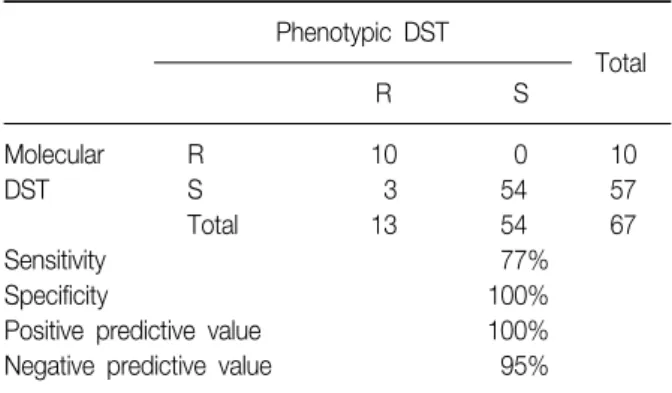
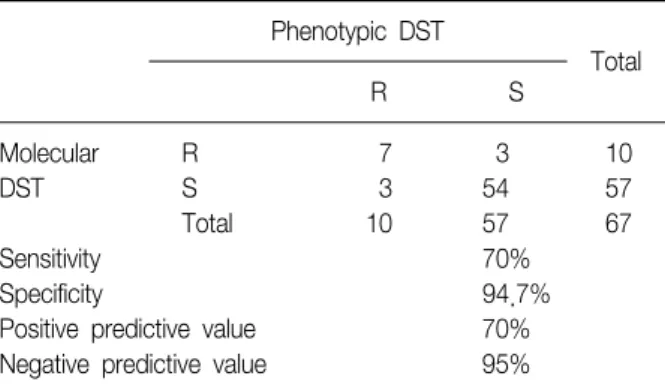
Results: Sensitivity and specificity of REBA MTB-FQⓇ were 77 and 100%, respectively. Positive predictive value and negative predictive value of the assay were 100 and 95%, respectively, for FQ resistance. Sensitivity, specificity, positive predictive value and negative predictive value of REBA MTB-KMⓇ for detecting KM resistance were 66%, 94%, 70%, and 95%, respectively.
Conclusion: REBA MTB-FQⓇ and REBA MTB-KMⓇ evaluated in this study showed excellent specificities as 100 and 94%, respectively. However, sensitivities of the assays were low. It is essential to increase sensitivity of the rapid drug resistance assays for appropriate MDR-TB treatment, suggesting further investigation to detect new or other mutation sites of the associated genes in M. tuberculosis is required.
Key Words: Tuberculosis; Fluoroquinolones; Kanamycin; Drug Resistance, Microbial; Mycobacterium tuberculosis;
Mutation
Address for correspondence: Hyungseok Kang, M.D.
Masan National Hospital, Gapo-dong, Masanhappo-gu, Changwon 631-710, Korea
Phone: 82-55-249-3777, Fax: 82-55-246-1135 E-mail: [email protected]
Received: Oct. 20, 2011 Revised: Nov. 14, 2011 Accepted: Dec. 2, 2011
서 론
다제내성 결핵은 전 세계적으로 심각한 문제가 되고 있 으며, 다제내성 결핵환자의 발생률은 전 세계적으로 증가 하고 있다. 2010년 세계보건기구(World Health Organiza- tion, WHO)의 조사에 의하면 2008년에는 전 세계적으로 440,000명이 다제내성 결핵을 앓고 있는 것으로 보고되었 고1 우리나라의 경우 2004년 1년간 약제감수성 검사가 의
뢰된 11,939 결핵 균주 중 10.5% (n=1,298)가 다제내성 결핵으로 보고되는 등2 국내외적으로 다제내성 결핵은 심 각한 사회적 문제이자 해결하기 어려운 문제라 하겠다.
Bai 등2은 전국 내성 실태조사에서 신환자의 다제내성 결 핵이 1994년 1.6%에서 2004년 2.69%로 의미 있게 증가하 고 있음을 보고하였고, Jeon 등3도 우리나라의 국립병원 에서 2001년 44.3%에서 2005년 57.6%로 증가하였음을 보고하였다.
일반적으로 폐결핵은 임상 증상, 방사선학적 소견, 객 담 또는 기타 검체의 결핵균 도말 및 배양 검사로 진단되 며 항결핵제 감수성 검사(drug susceptibility test, DST)의 결과를 토대로 다제내성 결핵을 진단하고 적절한 항결핵 제를 선택하게 된다. 다제내성결핵의 치료에는 DST 결과 에 따른 감수성 있는 약제의 선택이 중요하며, 약제내성 유무의 판별이 늦어져 적절한 항결핵치료가 지연될 경우 지속적인 내성균 감염원이 됨과 동시에 환자의 예후에도 악영향을 미치게 된다. Flouroquinolone (FQ)계 항생제 와 aminoglycoside (AG)계 항생제는 다제내성 결핵의 치 료에 필수적이며 이러한 약제들에 대한 내성 여부가 예후 를 결정하는 중요한 요소이다4,5. 통상적인 고체배지를 이 용한 약제감수성 검사 시 객담수집에서 감수성 결과가 보 고되기까지 평균 3개월의 기간이 소요된다6,7. 최근 분자 생물학적 기법의 발달로 결핵균의 약제내성에 관여하는 여러 유전자들이 발견되었고, 이를 이용한 빠른 진단법이 기대되고 있는데 FQ의 경우 결핵균의 DNA 복제 및 전사 를 담당하는 DNA gyrase 유전자인
gyrA
의 점 돌연변이와 연관되어 있는 것으로 보고되고 있고8-10, Kanamycin (KM)의 경우 결핵균의 mRNA 복제 및 전사를 담당하는 16S
rRNA 유전자(rrs
)의 점 돌연변이와 관련이 있는 것으 로 보고되고 있다11-14. 이를 근거로gyrA
와rrs
유전자의 변이를 확인하여 FQ계 항생제와 AG계 항생제의 내성을 신속하게 검사할 수 있는 line probe assay와 같은 분자생 물학적 약제감수성 검사(molecular DST)가 임상에서 많 이 시도되고 있다8-14.이에 저자들은 임상 균주를 이용하여 상용화된 REBA MTB-FQⓇ, REBA MTB-KMⓇ (M&D, Wonju, Korea)을 이 용하여
gyrA
와rrs
유전자의 돌연변이를 검사하고 통상적 인 항결핵제 감수성 검사(phenotypic DST) 결과를 기준 으로 이 검사법의 유용성을 평가하였다.대상 및 방법
1. 대상 및 검체
2009년 1월부터 2009년 5월까지 본원에서 치료받은 70 명의 다제내성 결핵환자의 객담에서 분리되어 모아진 67 개의 임상 균주를 이용하였다. 이들 균주는 inositol이 첨 가된 10% skin milk에 −70oC 상태로 보관되어 있었으며 균주를 냉장온도에서 서서히 용해시킨 다음 3% Ogawa 배지에 접종하여 4주간 배양 후 연구에 사용하였다.
2. Lowenstein-Jenson 배지를 이용한 FQ과 KM에 대 한 약제감수성 검사(phenotypic DST)
Ogawa 배지에서 자란 균주를 loop를 이용하여 떼어내 어 Canetii 등15에 의해 기술되었던 절대농도법을 이용하 여 McFarland 0.5 탁도에 맞추어 ofloxacin (OFX), KM이 포함된 Lowenstein-Jensen (L-J) 배지에 접종하였다(OFX 2μg/mL, KM 40μg/mL). 접종된 배지는 8주 동안 배양 하여 매주 판독하였으며, 각 약제가 포함된 배지에서 결핵 균이 자랐을 경우 내성으로 판별하였다.
3. gyrA 와 rrs 유전자 변이 검사(molecular DST)
Ogawa 배지에서 자란 균주를 1 mL 증류수에 부유시키 고, DNA extraction solution 100μL를 넣고 와동(vortex) 시킨 후 이를 10분간 100oC로 중탕한 다음, 13,000 rpm으 로 3분간 원심분리 하였다. 그런 다음, 상층액 3μL를 중 합효소 연쇄반응을 위한 template로 사용하였다. 각각 bi- otin과 tag polymerase가 표지된 REBA MTB-FQⓇ primer mixture (M&D)와 REBA MTB-KMⓇ primer mixture (M&D)를 이용하여 PCR 증폭 후 증폭산물을 reverse blot hybridization kit (M&D)를 사용하여 여러 개의 wild type 과 mutant type의 oligonucleotide와 교잡반응을 시키고 이를 streptavidine-alkaline phosphatase와 반응시켜 이 효소의 발색반응을 이용하여gyrA
와rrs
유전자의 변이유 무를 관찰하였다. REBA MTB-FQⓇ primer mixture (M&D)는gyrA
88, 91, 94번의 돌연변이를 검출하며 REBA MTB-KMⓇ primer mixture (M&D)는rrs
1400, 1401, 1402, 1445, 1484 부위의 변이를 검출할 수 있다 (Figures 1, 2).4. 감수성 검사방법간 결과 비교
Phenotypic DST와 molecular DST의 결과를 확인하고 이를 비교하여 각각의 약제별 민감도와 특이도, 양성 예측
Table 1. Comparative analysis of phenotypic and molec- ular DST of ofloxacin
Phenotypic DST
Total
R S
Molecular R 10 0 10
DST S 3 54 57
Total 13 54 67
Sensitivity 77%
Specificity 100%
Positive predictive value 100%
Negative predictive value 95%
R: resistant; S: susceptible; DST: drug susceptibility test.
Figure 2. Representative patterns of susceptible and re- sistant strains using REBA MTB-KMⓇ. P: positive control (H37Rv); 1: mutation (A1401G); 2: no mutation+mutation (A1401G); 3: no mutation; N: negative control.
Figure 1. Representative patterns of susceptible and re- sistant strains using REBA MTB-FQⓇ. P: positive control (H37Rv); 1: no mutation; 2: no mutation+mutation (D94G); 3: mutation (del WT2); 4: mutation (D94A); N:
negative control.
치와 음성 예측치를 산출하였다. 민감도는 phenotypic DST에서 내성으로 나온 검체수 중에서 molecular DST에 서 내성을 보인 검체의 비로 특이도는 phenotypic DST에 서 감수성으로 나온 검체수 중에서 molecular DST에서
감수성을 보인 검체의 비로 구하였다. 양성 예측치는 mo- lecular DST에서 내성으로 나온 검체수 중에서 pheno- typic DST에서 내성을 보인 검체의 비로 음성 예측치는 molecular DST에서 감수성으로 나온 검체수 중에서 phe- notypic DST에서 감수성을 보인 검체의 비로 구하였다.
결 과
1. OFX의 phenotypic DST와 gyrA 유전자의 변이 확인 을 이용한 molecular DST 결과 비교
다제내성 결핵환자의 객담에서 분리된 67개의 균주에 대해 절대농도법을 이용하여 항결핵제 감수성 검사를 시 행하였으며, 이를
gyrA
에 대한 REBA MTB-FQⓇ 검사결과 와 비교하였다. Phenotypic DST에서 OFX 감수성으로 판 정된 54개의 균주는 REBA MTB-FQⓇ에서도 감수성을 나 타내 특이도는 100%였다(Table 1). Phenotype DST에서 OFX 내성으로 판정된 13개의 균주 중 10개의 균주는 REBA MTB-FQⓇ에서도 내성을 나타내 민감도는 77%였 다. Phenotype과 molecular DST에서 동시에 내성을 보여 주는 10개의 균주 중, 6개의 균주에서 유전자변이가 관찰 되었으며 4개의 균주에서는 wild type의 oligonucletides 에 유전자변이는 존재하였으나 특이 유전자변이는 관찰 할 수 없었다. 유전자변이가 관찰된 6개의 균주에서 모두 균주 당 하나의 유전자변이를 보였고, 모두gyrA
의 94번 째 염기서열의 변이가 관찰되었다(4개의 균주에서 아스파 르트산[aspartic acid, Asp]이 글리신[glycine, Gly]으로 변 이[D94G], 그리고 2개의 균주에서 알라닌[alanine, Ala]으 로 변이[D94A]) (Table 1). OFX 내성을 검출하기 위한 REBA MTB-FQⓇ는 양성 예측율 100% (10/10), 음성 예측Table 2. Comparative analysis of phenotypic and molec- ular DST of kanamycin
Phenotypic DST
Total
R S
Molecular R 7 3 10
DST S 3 54 57
Total 10 57 67
Sensitivity 70%
Specificity 94.7%
Positive predictive value 70%
Negative predictive value 95%
R: resistant; S: susceptible; DST: drug susceptibility test.
율 95% (54/57), 정확도 95.5% (64/67), 정밀도 100%
(10/10)를 보였다(Table 1).
2. KM의 phenotypic DST와 rrs 유전자의 변이 확인을 이용한 molecular DST 결과 비교
항결핵제 감수성 검사와
rrs
유전자변이 검사를 시행했 던 67개의 균주에 대해 검사결과를 분석하였다. Pheno- typic DST상 57개의 균주가 KM 감수성으로 판정되었으 며, 10개의 균주는 KM 내성으로 판정되었다. Phenotypic DST에서 감수성이었던 57개의 균주 중 54개는 REBA MTB-KMⓇ을 이용한 rrs 유전자변이 검사에서 감수성으로 판정되었지만(특이도 94.7%), 3개의 균주에서rrs
유전자 변이가 관찰되었다. 즉, 2개의 균주에서rrs
의 1400 염기 서열에서 deletion이 일어났으며 1개의 균주는 1401 염기 서열에서 Ala이 Gly로 변이가 일어남을 관찰하였다.Phenotypic DST에서 내성으로 판정되었던 10개의 균주 중 3개의 균주에서는
rrs
유전자변이가 관찰되지 않았으 며, 7개의 균주에서rrs
유전자변이가 관찰되었다(민감도 70%). 유전자변이가 관찰된 7개의 균주 중, 5개의 균주에 서 1401 염기서열에서 Ala가 Gly로, 그리고 2개의 균주에 서는 1402 염기서열에서 시스테인(cysteine, Cys)이 Ala으 로 변이되었다. 절대농도법으로 시행한 항결핵제 감수성 검사결과와 비교하여 보았을 때 REBA MTB-FQⓇ을 이용 한 항결핵제 감수성 검사에서 양성 예측율 70% (7/10), 음성 예측율 95% (54/57), 정확도 91% (61/67), 정밀도 70% (7/10)로 나왔다(Table 2).고 찰
Bai 등2, Jeon 등3의 보고에 따르면 국내의 다제내성 결 핵환자의 수가 2000년 이후 꾸준히 증가함을 알 수 있고 다제내성 결핵은 오랜 치료기간과 낮은 완치율, 치료 중 발생하는 부작용과 치료비용의 증가 등의 특징으로 국가 결핵관리체계의 중요한 과제이며 WHO는 약제내성 결핵 의 실태 파악과 치료를 국가결핵관리체계에 포함시킬 것 을 권고하고 있다. 다제내성 결핵환자의 적절한 처방구성 을 위해서는 항결핵제에 대한 정확한 내성 검사가 필수적 으로 요구되나, 기존의 약제 내성 검사는 결과를 얻기까지 평균 3개월이 소요되고 내성 여부에 대한 검사결과의 일 관성 결여 등의 한계점이 있어6,7 분자생물학적인 기법을 통한 신속 검사법이 다양하게 시도되고 있다. 1993년 Telenti 등16에 의해 rifampin 내성과 관련된
rpoB
유전자 의 변이가 처음 기술된 이후, isoniazid 내성과 관련된katG, inhA, inhA
promoter,ahpC, kasA, ndh
유전자, ethambutol 내성과 관련된embB
유전자, pyrazinimide 내성과 관련된pncA
유전자, streptomycin 내성과 관련된rpsL, rrs
유전자 등에 대한 연구가 이루어져 왔다17,18. Fluoroquinolone (FQ)은 광범위 항균력과 탁월한 효과 로 호흡기와 요로감염증 등 여러 감염증에 사용되어 왔으 며 호흡기감염균에 대한 우수한 효과로 폐렴의 1차 항생 제치료로 사용되어 사용빈도가 늘어나게 되었다. FQ은 결핵균의 DNA복제 혹은 RNA전사 과정에서 DNA를 일시 적으로 분리한 후 재연결하는 DNA gyrase에 작용하여 복 제전사를 방해함으로써 항결핵효과를 나타내며 1980년대 OFX이 결핵에 대해 항균효과가 보고된 후 다제내성 결핵 의 치료에도 사용되었다19. 그러나 FQ의 사용이 늘어남에 따라 FQ 내성 결핵 균주의 발생도 보고되었는데20, 결핵 균이 OFX에 내성을 확득하는 주 기전은gyrA
의 quino- lone resistant determining region (QRDR)으로 불리는 유 전자변이로 88, 90, 91, 94번의 아미노산 점 돌연변이가 주로 관찰되며 드물게gyrB
의 변이와 efflux pump를 cod- ing하는lfrA
유전자, pentapeptide proteinMfpA
유전자 등의 변이도 관련이 있다8-10,21. 본 연구에서 시행된 REBA MTB-FQⓇ (M&D)은 QRDR에 존재하는gyrA
의 88, 91, 94번의 돌연변이를 검출하는 방법이다. 본 연구에서는 OFX의 molecular DST는 phenotypic DST를 기준으로 민 감도는 77%, 특이도는 100%로 평가되었으며 phenotypic DST에서 내성으로 나왔으나 molecular DST는 감수성으 로 나온 3개의 검체는gyrA
의 변이가 관찰되지 않았던 것으로 보아 밝혀지지 않은 변이 부위, 다른 기전에 의한 내성 획득 등에 대한 추가연구가 필요할 것으로 생각된다.
Aminoglycoside 제재는 광범위 항생제의 일종으로 결 핵균의 리보솜과 결합하여 단백합성을 저해하는 기전으 로 살균작용을 보인다. 1944년 streptomycin이 소개된 이 후로 항결핵치료에 중요한 역할을 해왔으며 이후 KM, amikacin, capreomycin, viomycin 등 여러 종류의 항생제 가 개발되어 다제내성 결핵의 치료에 사용되어왔다4,5. Streptomycin에 대한 내성획득 기전은 S12 리보솜 단백의
rpsL
유전자변이 혹은 rRNA의rrs
유전자변이를 통해 약 제의 표적이 되는 결핵균의 리보솜을 변형함으로 획득되 는데 KM에 대한 내성도 이와 유사하게 16S rRNA 유전자 (rrs
)의 3' 부분의 A1401G 변이를 통해 주로 이루어지는 것으로 알려져 있고11-14, 또 다른 기전으로 세포벽의 투과 성, 약물 유출 펌프, 약물 격리와 약물 비활성화를 언급한 보고도 있다22. REBA MTB-KMⓇ (M&D)을 이용한 본 연 구의 결과에서는 KM의 molecular DST는 phenotypic DST에 비해 특이도는 94.7%로 비교적 높게 평가되었지 만, 민감도는 70%로 평가되었다. 상대적으로 낮은 민감도 는 연구에 사용된 REBA MTM-KMⓇ이 16S rRNA 유전자 (rrs
)의 1400, 1445, 1484, 1401, 1402 부위의 돌연변이만 을 검출하는 방법이었고, 실험에 포함된 대상 균주들의 표본수가 적었다는 점과 관련있을 것으로 생각된다.현재 상용화된 신속 진단 검사 방법 중 가장 보고가 활 발한 GenotypeⓇ MDRTBDRsl (HAIN Lifescience, German) 의 결과와 비교했을 때 Hillemann 등23이 2009년 보고한 결과에 따르면 63개의 다제내성 결핵 검체와 43개의 1차 항결핵제 감수성 검체에 대해 검사를 시행한 후 FQ에 대 한 민감도와 특이도는 90.2%, 100%였고 AMK에 대한 민 감도와 특이도는 83.3%, 100%로 본 검사보다 우수한 결 과를 보였다.
분자생물학적으로 FQ 내성을 확인 하는 REBA MTB- FQⓇ과 GenotypeⓇ MDRTBDRsl방법은 모두
gyrA
유전 자에서 변이에 의한 내성을 확인하는 방법으로, 같은 표적 유전자를 검출한다. 하지만, 아마도 유전자증폭 시 사용 되는 primer의 차이, PCR 반응조건의 차이, 표적유전자의 변이와 결합하는 oligoneucleotide의 차이, 그리고 연구에 적용된 검체의 수와 질의 차이 등에 의해 두 방법에서 민 감도에 차이가 있음을 추측할 수 있다.본 연구에서는 REBA MTM-FQⓇ, REBA MTM-KMⓇ을 이용하여 다제내성 임상 균주를 이용하여 FQ과 KM에 대 해 phenotypic DST를 기준으로 한 molecular DST의 일치
율(민감도, 특이도)을 살펴보았으나 이미 모여진 임상 균 주를 실험대상으로 하여 국내외 균주들을 대표하는 결론 을 도출하기 어렵고 표본수가 적다는 한계점이 있다. 내 성 결핵균의 발병률이 높은 지역사회에서 FQ, KM의 내성 여부를 신속하게 발견하고 적절한 처방을 구성하기 위해 서는 신속내성 검사법의 민감도와 특이도의 향상이 필수 적이며 이를 위해 보다 많은 수의 임상 균주를 대상으로 유전학적 변이 부위를 추가적으로 찾아내어 포함시켜야 하며 유전자변이 이외의 내성 발현 기전을 고려해야 할 것으로 생각된다.
참 고 문 헌
1. Multidrug and extensively drug-resistant Tb (m/xdr-Tb):
2010 global report on surveillance and response.
Geneva, Switzerland: World Health Organization; 2010.
2. Bai GH, Park YK, Choi YW, Bai JI, Kim HJ, Chang CL, et al. Trend of anti-tuberculosis drug resistance in Korea, 1994-2004. Int J Tuberc Lung Dis 2007;11:571-6.
3. Jeon D, Shin D, Kang H, Sung N, Kweon K, Shin E, et al. Trend of multidrug and extensively drug resistant tuberculosis in a tuberculosis referral hospital, 2001∼
2005. Tuberc Respir Dis 2008;64:187-93.
4. Blumberg HM, Burman WJ, Chaisson RE, Daley CL, Etkind SC, Friedman LN, et al. American Thoracic Society/Centers for Disease Control and Prevention/
Infectious Diseases Society of America: treatment of tuberculosis. Am J Respir Crit Care Med 2003;167:603- 62.
5. Guidelines for the programmatic management of drug- resistant tuberculosis: emergency update 2008. Geneva, Switzerland: World Health Organization; 2008.
6. Joh JS, Lee CH, Lee JE, Park YK, Bai GH, Kim EC, et al. The interval between initiation of anti-tuberculosis treatment in patients with culture-positive pulmonary tuberculosis and receipt of drug-susceptibility test results. J Korean Med Sci 2007;22:26-9.
7. Kim SJ. Drug-susceptibility testing in tuberculosis: me- thods and reliability of results. Eur Respir J 2005;25:
564-9.
8. Takiff HE, Salazar L, Guerrero C, Philipp W, Huang WM, Kreiswirth B, et al. Cloning and nucleotide se- quence of Mycobacterium tuberculosis gyrA and gyrB genes and detection of quinolone resistance mutations.
Antimicrob Agents Chemother 1994;38:773-80.
9. Cheng AF, Yew WW, Chan EW, Chin ML, Hui MM, Chan RC. Multiplex PCR amplimer conformation analy-
sis for rapid detection of gyrA mutations in fluo- roquinolone-resistant Mycobacterium tuberculosis clin- ical isolates. Antimicrob Agents Chemother 2004;48:
596-601.
10. Giannoni F, Iona E, Sementilli F, Brunori L, Pardini M, Migliori GB, et al. Evaluation of a new line probe assay for rapid identification of gyrA mutations in Mycobacte- rium tuberculosis. Antimicrob Agents Chemother 2005;
49:2928-33.
11. Suzuki Y, Katsukawa C, Tamaru A, Abe C, Makino M, Mizuguchi Y, et al. Detection of kanamycin-resistant Mycobacterium tuberculosis by identifying mutations in the 16S rRNA gene. J Clin Microbiol 1998;36:1220-5.
12. Krüüner A, Jureen P, Levina K, Ghebremichael S, Hoffner S. Discordant resistance to kanamycin and amikacin in drug-resistant Mycobacterium tuberculosis.
Antimicrob Agents Chemother 2003;47:2971-3.
13. Maus CE, Plikaytis BB, Shinnick TM. Molecular analysis of cross-resistance to capreomycin, kanamycin, amika- cin, and viomycin in Mycobacterium tuberculosis.
Antimicrob Agents Chemother 2005;49:3192-7.
14. Jugheli L, Bzekalava N, de Rijk P, Fissette K, Portaels F, Rigouts L. High level of cross-resistance between ka- namycin, amikacin, and capreomycin among Mycobac- terium tuberculosis isolates from Georgia and a close relation with mutations in the rrs gene. Antimicrob Agents Chemother 2009;53:5064-8.
15. Canetti G, Fox W, Khomenko A, Mahler HT, Menon NK, Mitchison DA, et al. Advances in techniques of testing mycobacterial drug sensitivity, and the use of sensitivity tests in tuberculosis control programmes.
Bull World Health Organ 1969;41:21-43.
16. Telenti A, Imboden P, Marchesi F, Lowrie D, Cole S, Colston MJ, et al. Detection of rifampicin-resistance mutations in Mycobacterium tuberculosis. Lancet 1993;
341:647-50.
17. Musser JM. Antimicrobial agent resistance in mycobac- teria: molecular genetic insights. Clin Microbiol Rev 1995;8:496-514.
18. Wade MM, Zhang Y. Mechanisms of drug resistance in Mycobacterium tuberculosis. Front Biosci 2004;9:975- 94.
19. Tsukamura M, Nakamura E, Yoshii S, Amano H.
Therapeutic effect of a new antibacterial substance ofloxacin (DL8280) on pulmonary tuberculosis. Am Rev Respir Dis 1985;131:352-6.
20. Sullivan EA, Kreiswirth BN, Palumbo L, Kapur V, Musser JM, Ebrahimzadeh A, et al. Emergence of fluo- roquinolone-resistant tuberculosis in New York City.
Lancet 1995;345:1148-50.
21. Montero C, Mateu G, Rodriguez R, Takiff H. Intrinsic resistance of Mycobacterium smegmatis to fluoroqui- nolones may be influenced by new pentapeptide pro- tein MfpA. Antimicrob Agents Chemother 2001;45:
3387-92.
22. Drlica K, Malik M. Fluoroquinolones: action and resistance. Curr Top Med Chem 2003;3:249-82.
23. Hillemann D, Rüsch-Gerdes S, Richter E. Feasibility of the GenoType MTBDRsl assay for fluoroquinolone, amikacin-capreomycin, and ethambutol resistance test- ing of Mycobacterium tuberculosis strains and clinical specimens. J Clin Microbiol 2009;47:1767-72.